DOI: http://dx.doi.org/10.7316/KHNES.2012.23.4.397
갈락토스-글루코스 혼합당 수소 발효
천효창ㆍ김상현†
대구대학교 대학원, †대구대학교 환경공학과 교수
Hydrogen Fermentation of the Galactose-Glucose Mixture
HYOCHANG CHEON, SANGHYOUN KIM†
Department of Environmental Engineering, Daegu University, Jillyang, Gyeongsan, Gyeongbuk 712-714, South Korea
Abstract >> Galactose, an isomer of glucose with an opposite hydroxyl group at the 4-carbon, is a major fermentable sugar in various promising feedstock for hydrogen production including red algal biomass. In this study, hydrogen production characteristics of galactose-glucose mixture were investigated using batch fermentation experiments with heat-treated digester sludge as inoclua. Galactose showed a hydogen yield compatible with glucose. However, more complicated metabolic steps for galactose utilization caused a slower hydrogen production rate. The existence of glucose aggravated the hydrogen production rate, which would result from the regulation of galactose-utilizing enzymes by glucose. Hydrogen produciton rate at galactose to glucose ratio of 8:2 or 6:4 was 67% of the production rate for galactose and 33% for glucose, which could need approximately 1.5 and 3 times longer hydraulic retention time than galacgtose only condition and glucose only condition, respectively, in continuous fermentation. Hydrogen production rate, Hydrogen yield, and organic acid production at galactose to glucose ratio of 8:2 or 6:4 were 0.14 mL H2/mL/hr, 0.78 mol H2/mol sugar, and 11.89 g COD/L, respectively. Galactose-rich biomass could be usable for hydogen fermenation, however, the fermentation time should be allowed enough.
Key words : Hydrogen fermentation(수소 발효), Sugar mixture(혼합당), Galactose(갈락토스), Glucose(글루코스), Red algal biomass(홍조류 바이오매스)
†Corresponding author : [email protected]
[ 접수일 : 2012.8.1 수정일 : 2012.8.16 게재확정일 : 2012.8.24 ] Copyright ⓒ 2012 KHNES
1. 서 론
기후 변화와 화석연료 시장 불안정에 대한 대응 방안으로서 신・재생에너지의 확보가 전 세계적인 과 제가 되어 있다1,2). 다양한 신・재생에너지 중 수소는 연소 시 이산화탄소 대신 물을 배출하는 환경친화성, 기존 연료(hydrocarbon fuels)보다 2.75배 높은 에너 지 밀도(122kJ/g), 연료전지(fuel cell)를 통해서 직접
전기를 발생시킬 수 있는 우수한 활용성을 가진 유 력한 신에너지이다3-8).
수소를 생산하는 다양한 방법 중, 유기물을 미생 물이 분해하면서 수소를 생산하는 혐기발효는 외부 에너지의 공급을 필요로 하지 않는 지속가능한 수소 생산 방법으로 주목받고 있다9). 혐기발효 수소 생산 에 있어 현재까지는 대부분의 연구가 음식물쓰레기, 식품 폐수 등 유기성 폐자원을 기질로 활용하는 것 에 집중되었다10,11). 이는 가격이 저렴한(혹은 처리비 를 받을 수 있는) 유기성 폐자원을 기질로 사용하여 경제적인 수소 생산과 환경친화적 처리라는 일거양
Fig. 1 Schematic of a PEFC stack (a) and mesh configuration of PEFC (b)
득 효과를 얻을 수 있기 때문이다12,13). 그러나 바이 오수소 생산이 바이오에너지 생산의 한 축을 담당하 기 위해서는 양이 풍부하고, 탄수화물 함량이 높으 며, 지속가능한 방법으로 얻을 수 있는 새로운 종류 의 기질로부터의 수소 생산 기술 개발이 필요하다. 이에 전 세계적으로 해조류 바이오매스에 대한 관 심이 높아지는 추세이며, 국내 해조류 바이오매스의 탄수화물 함량은 약 36~75%로 보고되고 있다14). 또 한, 3면이 바다로 둘러싸여 있으며 난류와 한류가 교 차해 해조류의 종류가 다양하며 자원량도 풍부해 국 내 해조류 바이오매스를 활용한 수소 생산은 매우 적합하다고 판단된다15).
해조류 바이오매스는 일반적으로 갈조류, 홍조류, 녹조류로 나누며 모두 함수율이 높고 종에 따른 탄 수화물 함량의 편차가 심하다14). 최대 탄수화물 함량 은 홍조류가 가장 높다고 알려져 있다16). 홍조류 바 이오매스의 주 탄수화물은 agar(galactan)과 cellulose
이며17,18), 이러한 다당은 전처리를 통해 수소 발효에
적합한 단당으로 전환된다. 특히 galactan은 갈락토 오스(galactose) 기반의 고분자이며 3-linked β-D- galactopyranosyl unit(D-galactose)과 4-linked α-3,6- anhydrogalactopyranosyl unit(3,6-anhydrogalactose, 3,6- AHG)의 교차 결합을 기본 구조로 하며, 미생물에 의 해 쉽게 분해되지 않아 물리화학적 전처리를 필요로
한다19,20). 현재까지 알려진 바로는 홍조류 바이오매
스를 구성하는 발효 가능 단당은 galactose와 glucose 로 약 6:4의 비율로 존재하며, 홍조류 바이오매스의 물리화학적 당화 과정을 통해 생성되는 당화액 내에 도 galactose와 glucose가 9:1~6:4의 함량비로 존재하 는 것으로 보고되고 있다19,20). 일반적으로 발효 시 다양한 단당류가 존재할 경우, 각각의 분해 효율이 다르며, 경우에 따라서는 상호 저해 인자로 작용하는 경우도 있는 것으로 알려져 있다21). 그러나, galactose 와 glucose가 공존할 경우의 수소 발효 특성에 대해 서는 현재까지 보고된 바가 없다.
따라서 본 연구에서는 galactose와 glucose의 함량 비가 수소 생성 효율에 미치는 영향을 고찰하였다.
2. 실험방법
홍조류 바이오매스 전처리시 생성되는 galactose, glucose의 함량비에 따른 수소 발효를 평가하기 위해 회분식 수소 생산 시스템을 구성하고 운전하였다. 반 응조는 400mL 아크릴 재질로 제작하였으며, 유효부 피는 150mL 였다. 발효 기간 동안 온도는 중온(35℃) 으로 유지되었으며, 교반은 마그네틱바를 사용하였 으며 600rpm에서 수행되었다. 반응 중 pH는 5.3 이 상으로 자동 제어되었다. 회분식 수소 생산 시스템을 Fig. 1에 도시하였다.
식종균으로는 G 시 소재 공공 하수처리장 내 소화 조 슬러지를 사용하였다. 소화조 슬러지의 total solids (TS), volatile solids(VS), total suspended solids (TSS), volatile suspended solids(VSS), pH, alkalinity는 각각 26.7g/L, 18.9g/L, 21.3g/L, 16.1g/L, 7.7, 3.340mg CaCO3/L 였다. 소화조 슬러지는 90℃에서 20분간 열 처리된 후 각 반응조에 75mL씩 식종되었다.
기질로 사용된 혼합당은 총 탄수화물 농도 15g/L 에 대하여 galactose와 glucose 함량비를 10:0, 9:1, 8:2, 6:4, 0:10로 변화시키면서 수행하였다. galactose : glucose 함량비 9:1, 8:2, 6:4는 각각 홍조류 바이오매
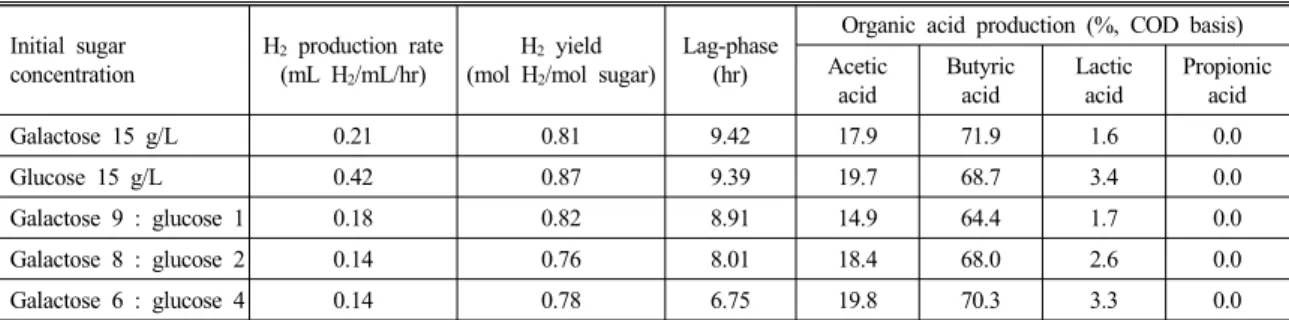
Table 1 Hydrogen and organic acid production at various galactose to glucose ratios
Initial sugar concentration
H2 production rate (mL H2/mL/hr)
H2 yield (mol H2/mol sugar)
Lag-phase (hr)
Organic acid production (%, COD basis) Acetic
acid
Butyric acid
Lactic acid
Propionic acid
Galactose 15 g/L 0.21 0.81 9.42 17.9 71.9 1.6 0.0
Glucose 15 g/L 0.42 0.87 9.39 19.7 68.7 3.4 0.0
Galactose 9 : glucose 1 0.18 0.82 8.91 14.9 64.4 1.7 0.0
Galactose 8 : glucose 2 0.14 0.76 8.01 18.4 68.0 2.6 0.0
Galactose 6 : glucose 4 0.14 0.78 6.75 19.8 70.3 3.3 0.0
스 당화 효율 전처리 효율 67, 76, 100%에 해당한다20). 영양염류는 NH4Cl, KH2PO4, MgCl2・6H2O, CaCl2・ 2H2O, MnCl2・4H2O, FeCl2・4H2O, H3BO3,ZnCl2, CuCl2, NaMoO4・4H2O, NiCl2・6H20, CoCl2・2H2O, Na2SeO3
를 각각 960mg/L, 220mg/L, 98mg/L, 10mg/L, 4.87 mg/L, 68mg/L, 0.05mg/L, 0.05mg/L, 0.03mg/L, 0.01 mg/L, 0.05mg/L, 0.5mg/L, 0.05mg/L로 주입하였다.
가스 발생량은 water displacement method를 이용 하여 측정하였고, 분율은 SGI 310 GC-TCD(SRI instrument)를 이용하여 측정하였다. 칼럼은 0.9m × 3.2mm Molecular Sieve 5A(SRI instrument)를 사용 하였으며 운반기체로를 고순도 질소를 이용하였다. 또한 실험 종료 후 액체 시료를 채취하여 0.45μm PVDF 막과 0.22μm PTFE 막에 순차적으로 거른 후 자외선 검출기(210nm) 고성능 액체 크로마토그래피 (Waters 2487)로 유기산 농도를 측정하였다. 칼럼은 300mm × 7.8mm HPX-87H column(Aminex), 운반 용매는 0.005M 황산용액을 이용하였다. TS, VS, TSS, VSS, pH, alkalinity는 Standard Methods(1998)에 따 라 분석하였다22).
수소 수율과 생산속도는 측정된 누적 수소 생산량 으로부터 Modified Gompertz equation (식 1)으로 해 석되었다.
× exp
exp
× ×
(1) 여기서, H : cumulative hydrogen production (L)P : maximum hydrogen production (L)
Rm : hydrogen producvion rate (L/h) λ : lag-phase time (h)
t : time (h)
e : the base of natural logarithm
3. 결 과
반응 시간에 따른 단일당과 혼합당 조건에서의 수 소 발생량 평균값에서 blank의 수소 발생량 평균값 을 뺀 net cumulative hydrogen production은 Fig. 2에 나타낸 바와 같이 modified gompertz 식을 이용하여 잘 모사되었다. 모든 조건에서 R2값이 0.98 이상으로 신뢰할 수 있는 결과로 판단된다.
Galactose 또는 glucose가 단일하게 존재한 경우의 수소 발효 효율을 비교해보면, galactose의 수소 수 율은 glucose의 93%로 유사한 수준이나, 수소 생산 속도는 50%로 확연한 차이를 보였다(Table 1). Fig. 3 에 나타낸 바와 같이 galactose가 미생물 대사 과정에 활용되기 위하여 glucose 6-phosphate으로 전환되기 위하여 glucose에 비해 더 많은 단계를 거쳐야 하는 것이 이러한 현상을 유발한 것으로 판단된다23).수소 생산이 시작되기까지의 지체 시간은 단당 종류에 따 른 차이가 거의 없는 것으로 나타났다. 이는 열처리 소화 슬러지 내의 미생물 군집이 galactose 분해에 필 요한 galactokinase, galactose-1-phosphate- uridyly- ltransferase, UDP-galactose-4-epimerase, phosphoglu- comutase를 생산하는데 별도의 적응 시간이 필요 없 음을 의미한다.
(a) (b)
(c) (d)
(e)
Fig. 2 Cumulative hydrogen production at various galactose to glucose ratios: (a) galactose 15 g/L, (b) glucose 15 g/L, (c) total carbohydrate 15 g/L (galactose : glucose = 9 : 1), (d) total carbohydrate 15 g/L (galactose : glucose = 8 : 2), (e) total carbohydrate 15 g/L (galactose : glucose = 6 : 4)
Fig. 3 Metabolic pathways of galactose and glucose
한편, galactose와 glucose가 동시에 존재할 경우에 는 galactose가 단일 기질로 존재할 경우와 대비해서 도 수소 생산 속도가 낮은 것으로 나타났다. Galactose:
glucose 비가 8:2 및 6:4인 조건에서, 수소 생산 속도 는 galactose 단일 조건의 67%, glucose 단일 조건의 33%에 해당되었다. 이는 glucose의 존재가 galactose 분해에 필요한 네 가지 효소 중 일부의 발현을 방해 하기 때문에 발생한 현상으로 사료된다24-30). Glucose 가 galactose를 비롯한 타 단당류의 분해를 억제하는 이러한 현상은 Saccharomyces 속 효모균을 이용한 에탄올 발효 등에서 발생하는 것으로 알려져 있으나, 수소 발효에 있어서는 현재까지 규명된 바가 거의 없는 새로운 보고이다.
한편, 유기산 조성은 두 경우 모두 butyric acid의 비중이 가장 높고, lactic acid와 propionic acid의 비 중이 미미하여 수소 발효가 효과적으로 진행되었음 을 확인해 주었다25).
본 연구 결과에 의하면, galactose는 수소 발효에 활용될 수 있으나 glucose에 비해 수소 생산 속도가 다소 느리다. 또한, galactose와 glucose가 혼재할 경 우 수소 생산 속도가 더욱 느려지게 된다. 이는 홍조 류 바이오매스 등 galactose의 함량비가 높은 바이오 매스를 수소 발효에 활용할 경우 기존 glucose 또는 sucrose를 이용한 수소 발효 기초 연구에 비해, 느린 발효 속도를 감안하여 반응조 내 수리학적 체류시간 을 충분하게 제공해야 함을 의미한다. 또한 경우에
따라서는 바이오매스 당화 과정의 다단 구성을 통해 galactose와 glucose를 각각 포함하는 당화액의 생산 과 이의 이단 발효가 효과적을 수도 있을 것으로 사 료된다. 한편, 실제 홍조류 바이오매스 및 당화액에 는 무기 염류가 본 실험에 비해 높게 존재할 수 있다. Sucrose가 기질인 경우 마그네슘, 나트륨, 아연, 철이 수소 생산에 민감하게 영향을 미치는 무기염류이며, 칼슘, 칼륨 등은 상대적으로 큰 영향을 주지 않는 것 으로 알려져 있다31). Galactose가 주요 단당인 경우에 대한 마그네슘, 나트륨, 아연, 철 등의 영향은 추후 실험을 통해 고찰될 예정이다.
4. 결 론
열처리 소화 슬러지를 식종균으로한 회분식 수소 발효에서 galactose와 glucose의 함량비의 영향을 고 찰한 결과 다음과 같은 결론을 도출하였다.
1) Galatose는 glucose와 유사한 수소 수율을 나타내 나, 수소 생산 속도는 절반 수준이다.
2) Galactose와 glucose가 함께 존재할 경우 galactose 단일 조건, glucose 단일 조건에 대비 각각 67%.
33%에 해당되는 낮은 수소 생산 속도를 나타낸다.
3) 홍조류를 비롯한 galactose 함유 바이오매스는 수 소 발효에 적용이 가능하나, glucose에 비해 긴 수 리학적 체류시간이 필요할 것으로 사료된다.
후 기
이 논문은 2010학년도 대구대학교 학술연구비 지 원에 의하여 연구되었음.
참 고 문 헌
1. S. K. Khanal, W. H. Chen, L. Li, and S. Sung,
“Biological hydrogen production : Effects of pH and intermediate products”, International Journal of Hydrogen Energy, Vol. 29, 2004, pp. 1123-1131.
2. S. H. Kim, S. K. Han, and H. S. Shin, “Feasibility
of biohydrogen production by anaerobic co-digestion of food waste sewage sludge”, International Journal of Hydrogen Energy, Vol. 29, 2004, pp. 1607-1616.
3. H. Argun, and F. Kargi, “Bio-hydrogen production by different operational modes of dark and photo- fermentation: An overview”, International Journal of Hydrogen Energy, Vol. 36, 2011, pp. 7443-7459.
4. J. Mathews, and G. Wang, “Methbolic pathway engineering for enhanced biohydrogen production”, International Journal of Hydrogen Energy, Vol. 34, 2009, pp. 7404-7416.
5. C. C. Chen, and C. Y. Lin, “Biohydrogen pro- duction using an up-flow anaerobic sludge blanket reactor”, Advances In Environmental Research, Vol. 7, 2003, pp. 695-699.
6. J. Lay, Y. J. Lee, and T. Noike, “Feasibility of biological hydrogen production from organic fraction of municipal solid waste”, Water Research, Vol. 33, 1999, pp. 2579-2586.
7. D. S. Scott, “Hydrogen-the case for inevitability”, International Journal of Hydrogen Energy, Vol.
29, 2004, pp. 225-227.
8. C. Y. Lee, S. W. Lee, S. J. Hwang, “Effect of Heat Treatment on the Start-up Performance for Anaerobic Hydrogen Fermentation of Food Waste”, Trans. of the Korean Hydrogen and New Energy Society, Vol. 22, No. 6, 2011, pp. 765-771.
9. D. H. Kim, M. K. Lee, S. Y. Lim, and M. S.
Kim, “Dark Fermentative Hydrogen Production using the Wastewater Generated from Food Waste Recycling Facilities”, Trans. of the Korean Hydrogen and New Energy Society, Vol. 22, No. 3, 2011, pp. 326-332.
10. M. Ike, D. Inoue, T. Miyano, T. T. Liu, “Microbial population dynamics during start-up of a full-scale anaerobic digester treating industrial food waste in Kyoto eco-energy project”, Bioresour Technology, Vol. 101, No. 11, 2010, pp. 3952-3957.
11. O. S. Kim, H. N. Son, D. H. Kim, D. J. Jeon, Y. W. Rhee, M. S. Kim, “Biohydrogen Production from Food Waste by Two-Stage (Lactate+Photo)-
Fermentation Process”, Trans. of the Korean Hydrogen and New Energy Society, Vol. 22, No.
3, 2011, pp. 333-339.
12. I. A. Panagiotopoulos, R. R. Bakker, T. Vrije, and E. G. Koukios, “Effect of pretreatment severity on the conversion of barley straw to fermentable substrates and the release of inhibitory com- pounds”, Bioresource Technology, Vol. 102, 2011, pp. 11204-11211.
13. J. I. Park, J. Lee, S. J. Sim, and J. H. Lee,
“Production of hydrogen from marine macro-algae biomass using anaerobic sewage sludge microflora”, Biotechnology and Bioprocess Engineering, Vol.
14, 2009, pp. 307-315.
14. E. Y. Park, S. M. Jeong, Y. J. Kim, and D. H.
Lee, “Review on Hydrolysis of the Macroalgae for Production of Bioethanol”, Journal of Korea Society of Waste Management, Vol. 29, No 4, 2012, pp. 323-333.
15. K. S. Kim, J. H. Kim, M. G. Shin, G. M. Jo, S.
Y. Kim, J. K. Shim, S. B. Kim, Y. J. Kim, M.
H. Lee, S. B. Lee, and H. J. Ryu, “Feasibility Study on the Utilization of Algae for the Bio- Energy Production”, The Ministry of Knowledge Economy, 2007-N-BI17-P-01, 2007, pp. 16-31.
16. A. Jensen, “Present and future needs for algae and algal products”, Hydrobiologia, Vol. 260/261, 1993, pp. 15-23.
17. http://fs.fips.go.kr/index.jsp (assess date: November 28, 2011)
18. Ministry for Food,, Agriculture and Fisheries, Korea, R&D Roadmap (Feasibility Study) for Commercial Culture of Marine Algae and its Use as a Bioenergy Source, No. 11-1541000-000242- 01, 2009.
19. J. H. Park, J. J. Yoon, H. D. Park, Y. J. Kim, D. J. Lim, and S. H. Kim, “Feasibility of biohydrogen production from Gelidium amansii”, International Journal of Hydrogen Energy, Vol.
36, 2011, pp. 13997-14003.
20. J. H. Park, J. Y. Hong, H. C. Jang, S. G. Oh,
S. H. Kim, J. J. Yoon, and Y. J. Kim, “Use of Gelidium amansii as a promising resource for bioethanol: A practical approach for continuous dilute-acid hydrolysis and fermentation”, Bio- resource Technology, Vol. 108, 2012, pp. 83-88.
21. L. F. Bisson, D. M. Coons, A. L. Kruckeberg, and D. A. Lewis, “Yeast Sugal Transporters”, The Journal of Steroid Biochemistry and Molecular Biology, Vol. 28, No. 4, 1993, pp. 259-308.
22. APHA, AWWA, WEF. Standard methods for the examination of Water and Wastewater. 20th ed.
Washington D.C., USA, 1998.
23. S. Ozcan, and M. Johnston, “Function and Regulation of Yeast Hexose Transporters”, Micro- biology and Molecular Biology Reviews, Vol.
63, No. 3, 1999, pp. 554-569.
24. K. Kimata, H. Takahashi, T. Inada, P. Postma, and H. Aiba, “cAMP receptor protein-cAMP plays a crucial role in glucose-lactose diauxie by activating the major glucose transporter gene in Escherichia coli”, Biochemistry, Vol. 94, 1997, pp. 12914-12919.
25. A. Fangkum, and A. Reungsang, “Biohydrogen production from ugarcane bagasse hydrolysate by elephant dung: Effects of initial pH and substrate concentration”, International Journal of Hydrogen Energy, Vol. 36, 2011, pp. 8687-8696.
26. J. D. Keating, J. Robinson, R. J. Bothast, J. N.
Saddler, and S. D. Mansfield, “Characterization of a unique ethanologenic yeast capable of fermenting galactose”, Enzyme Microb. Technol., Vol. 35, 2004, pp. 242-253.
27. R. J. Trumby, “Glucose repression in the yeast Saccharomyces cerevisiae”, Molecular Microbiology, Vol. 6, 1992, pp. 15-21.
28. D. H. Kim, and M. S. Kim, “Thermophilic fermentative hydrogen production from various carbon sources by anaerobic mixed cultures”, International Journal of Hydrogen Energy, Vol.
37, 2012, pp. 2021-2027.
29. L. Jianzheng, R. Nanqi, L. Baikun, Q. Zhi, and H. Junguo, “Anaerobic biohydrogen production from monosaccharides by a mixed microbial community culture”, Bioresour Technol, Vol. 99, 2008, pp. 6528-6537.
30. R. S. Prakasham, P. Brahmaiah, T. Sathish, and R. K. Sambasiva, “Fermentative biohydrogen production by mixed anaerobic consortia: impact of glucose to xylose ratio”, International Journal of Hydrogen Energy, Vol. 34, 2009, pp. 9354- 9361.
31. C. Y. Lin, and C. H. Lay, “A nutrient formulation for fermentative hydrogen production using anaerobic sewage sludge micoflora”, International Journal of Hydrogen Energy, Vol. 30, 2005, pp.
285-292.