257
"J. Korean Soc. Radiol., Vol. 9, No. 4, June 2015"
Measurement of Rn-222 Gas Concentration of Newly Constructed Apartment House in Gwangju Gwangsan-Gu
Hee jun Jang, Sang bock Lee Dept. of Radiology, Nambu University
광주광역시 광산구 소재 신축 아파트 라돈가스 농도 계측
장희준, 이상복 남부대학교 방사선학과
Abstract
Radon is produced after the Uranium-238 and thorium-232 undergone radioactive decay process is a colorless, odorless inert gas is stored in a basement or an enclosed space. Building materials are made by a rock or soil materials. Form of radon gas is introduced into the lungs through the respiratory tract and deposited in the lungs or bronchial Daughter nuclides radon causes lung cancer. In this study, To subject the Constructed Apartment in Gwangju Gwangsan-Gu, the position is closed window and opened window was measured using a measuring instrument for radon. The measured results indicate that the measurement was carried out in concentrations of radon gas measured at Newly Constructed Apartment is low than United states in the radon concentration in air public 4 pCi called radon gas baseline maximum allowable concentrations. The exposure caused by radon concentration of new construction apartment when on the measurement results is expected to be insignificant. However, when radon gas like this is that it accumulates in the body and lungs get damaged due to exposure, such as lung cancer often open the windows to reduce the radon concentration measurements, such as in radiation protection aspects to the ventilation to reduce exposure it is considered necessary.
Key Words : Rn-222 measurement technology, Rn-222 concentration in the air, Radiation Measurement, Radiation Exposure
요 약
라돈은 우라늄-238과 토륨-232가 방사성붕괴 과정을 거친 후 생성되며, 무색, 무취의 불활성 기체로서 지하 또는 밀폐된 공간 에 축적된다. 우라늄-238과 토륨-232는 지각의 암석이나 토양 등에 포함 돼 있다. 건축자재는 암석이나 토양을 재료로하여 만들 어 진다. 가스 형태의 라돈은 호흡기를 통해 폐로 유입되고 라돈의 딸핵종이 폐나 기관지에 침적 되어 폐암을 일으키는 원인이 된 다. 본 연구는 광주광역시 광산구에 위치한 신축 아파트를 대상으로 창문을 닫고 열은 상태에서 라돈 측정기를 이용하여 측정하였 다. 측정 결과로 보아 신축 아파트 실내 평균 라돈농도는 미국 일반인 공기 중 라돈가스 최대허용농도 기준치 4 pCi보다 이하의 값이 나타난다는 것을 볼 수 있다. 측정 결과로 볼 때 신축 아파트의 라돈농도로 인한 피폭은 크지 않을 것으로 예상한다. 그러나 라돈가스가 신체 내에 축적이 되면 폐와 같은 경우는 폐암과 같은 피폭에 의한 피해를 얻을 수 있으므로 방사선 방어적 측면에서 측정 결과와 같이 라돈 농도를 낮추기 위해 창문을 자주 열어 환기를 시켜 피폭을 줄이는 것이 필요하다고 생각 된다. 중심어: Rn-222 측정기술, Rn-222 공기 중 농도, 방사선계측, 방사선피폭
http://dx.doi.org/10.7742/jksr.2015.9.4.257
Corresponding Author: Sangbock Lee E-mail:[email protected] Tel: +82-62-970-0156 Addr. No. 5211, Chomdangwan, NamBu Univ., 23, Cheomdanjungang-ro, Gwangsan-gu, Gwangju
I. INTRODUCTION
Uranium and thorium that naturally exist in rocks and soil decay into radium, and this radium decays and produces Rn-222 gas, which is a radioactive inert gas. Radon is a colorless, tasteless, odorless radioactive gas, and is one of the heaviest gases. According to the survey of a research agency in the United States, the lung cancer death rate due to the accumulation of Ra-222 gas was the second highest.
Currently, the survey of Rn-222 gas is conducted by a number of agencies, but the measurement of the degree of exposure to Rn-222 gas for newly built apartments is insufficient. This study aimed to acquire knowledge and measurement method of Rn-222 gas by measuring the indoor Rn-222 gas concentration of three selected newly built apartments in Gwangsan-gu, Gwangju using a radiation detector, to examine the Rn-222 gas concentration depending on the presence of a gypsum board and the building materials within the house, and to prepare measures for the degree and risk of exposure for the apartment residents .
Ⅱ. DECAY OF Ra AND Rn-222 gas
1. Decay of Ra
Radium (Ra) was discovered in 1898 in pitchblende, which is a uranium ore, by Marie and Pierre Curie, and its atomic number is 88. In the periodic table, it is located at the bottom (seventh period) of the second group (2A) (alkaline earth metal). When introduced into a human body, it could substitute calcium in the bones, and causes a number of health-related problems. In natural condition, radium is produced by the radioactive decay of uranium and thorium. In this regard, all the produced radium isotopes finally decay into stable lead through radon gas.
During this decay process, particles, particles, and rays are emitted. The isotope that accounts for nearly 100% in natural condition is Ra-226 which is produced from U-238 that is the major isotope of
uranium, and the half-life of Ra-226 is 1600 years. The decay of U-238 which is a major isotope is as follows.
As shown in the above decay equation, U-238 becomes Ra-226 via and decays. Through an additional
decay, it becomes Rn-222, which is an inert gas that is to be measured in this study. Then, it emits rays five times and rays four times, and finally becomes Pb-206 which is stable.
2. Rn-222 gas and recommended criteria Radon (Rn-222) is contained in soil, sand, rocks, and minerals among the crust and building materials using the aforementioned materials in trace amounts (7.4~74 Bq/kg), and it is the only colorless, tasteless, odorless gaseous material among the uranium decay series. Radon has a half-life of 3.82 days, is the sixth decay product of uranium, and its atomic number is 86. The daughter nuclides of radon that are produced during decay also emit
, or rays. The daughter nuclides of radon remain in the air as chemically active unadsorbed cation nuclides for a short time (less than 60 seconds after the formation), or are adsorbed and deposited on the surrounding fine dust, vapor, and the surface or floor of a structure. In general, radon gas diffuses due to the temperature and pressure difference between the interior and exterior of a material, or is released to the ground or indoor environment by convection. Therefore, if the ventilation rate of a residential space decreases, radon particles from the ground of a building accumulate in the indoor air, and the concentration increases. When high concentrations of radon and its daughter nuclides are continuously inhaled, basic cells of the lung are exposed to radiation due to the absorption of radiation energy, which increases the risk of lung cancer. In particular, in basements or closed spaces, the possibility of radiation
"J. Korean Soc. Radiol., Vol. 9, No. 4, June 2015"
exposure by radon is high due to the low ventilation rate.
In Korea, the recommended criteria for radon gas in the air is below 148 Bq/㎥ (4 pCi/L) [4]. In the survey of the United Nations Scientific Committee on the Effects of Atomic Radiation (UNSCEAR) [1], it was reported that about 50% of the annual exposure dose from natural radiation (2.4 mSv/y) is due to radon (1.2 mSv/y). The average annual effective dose in Korea is 1.62 mSv/y [5], which is lower than the recommended criteria for radon dose (10 mSv/y) by the International Commission on Radiological Protection (ICRP) [2].
Radon is known to be a secondary material for causing lung cancer, after smoking. A study reported that the fatality is more than 100 times the toxicity of carbon monoxide. The World Health Organization reported that one out of ten lung cancer patients has a lung cancer due to radon gas.
Ⅲ. METHOD AND RESULTS
1. Experiment equipment
The instrument used for the measurement was the Professional Continuous Radon monitor, which has been approved by EPA (Environmental Protection Agency) in the United States [3]. This radon monitor is capable of real-time continuous measurement, and uses a diffused junction photo sensor. As for the measurement principle, radon in the air diffuses into the detecting part of the monitor, and rays emitted from the radon at the internal space of the detecting part are detected by the photo sensor, and this information is stored in a memory.
The photo sensor used in the monitor is a P-N junction detector. When an inverse voltage is applied to a P-N junction diode, a depletion layer with a thickness of 10∼500 μm where almost no current flows is formed.
When a radiation is incident on this depletion layer and electron hole pairs flow, instantaneous current flows, and the instantaneous pulse is measured by collecting this current (electric charge). It is mostly used for the
measurement of α rays. The accuracy is ±5% or ±37 Bq/
㎥, and the error could be reduced by continuous measurement for more than 24 hours.
Fig. 1. Professional Continuous Radon monitor (1027).
2. Experiment site and measurement environment
The sites for the measurement were Apartment A, B, and C located in Gwangsan-gu, Gwangju, and the measurement was made while maintaining the residential environment. Spots with direct sunlight or high humidity were avoided, and samples were collected at spots that satisfy the following conditions: 1.2m from the window of the house, 1.1m above the floor, and 1m from the wall (building material). For each floor of the three selected apartments (1st, 5th, and 10th floors of a maximum of 10-story building), the measurements were made for four times, three hours with the window closed and three hours with the window open, among a total of six hours between 12:00 p.m ~ 06:00 p.m
Fig. 2. Measurement with the window open (ventilation).
Fig. 3. Measurement with the window closed.
3. Result and Discussion
Apartment and floor
First Second Third Fourth Average
(Closed) Average (Open) Closed Open Closed Open Closed Open Closed Open
A 1st floor
3.5 1.2 3.7 1.1 3.4 1.0 3.4 1.1 3.5 1.1
5th floor
2.7 0.9 3.0 1.1 2.7 1.0 2.5 0.8 2.725 0.95
10th floor
2.5 0.6 2.6 0.4 2.6 0.4 2.8 0.4 2.625 0.45
B 1st floor
3.0 1.0 3.1 1.0 3.2 1.1 3.3 1.2 3.15 1.075
5th floor
2.5 0.8 2.6 1.0 2.8 1.1 2.7 0.9 2.65 0.95
10th floor
2.7 0.5 2.4 0.8 2.6 0.6 2.5 0.5 2.55 0.6
C 1st floor
2.8 1.0 2.8 1.2 3.1 0.9 2.8 0.9 2.875 1.0
5th floor
2.7 0.8 2.6 0.8 2.5 1.0 2.7 0.8 2.625 0.85
10th floor
2.5 0.4 2.5 0.6 2.6 0.6 2.5 0.7 2.525 0.575
Table 1. Concentration and average value of radon gas (Unit:
pCi/L)
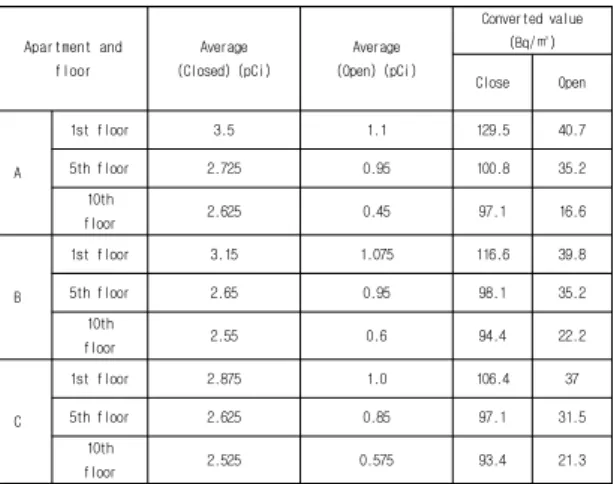
Apartment and floor
Average (Closed) (pCi)
Average (Open) (pCi)
Converted value (Bq/㎥)
Close Open
A
1st floor 3.5 1.1 129.5 40.7
5th floor 2.725 0.95 100.8 35.2
10th
floor 2.625 0.45 97.1 16.6
B
1st floor 3.15 1.075 116.6 39.8
5th floor 2.65 0.95 98.1 35.2
10th
floor 2.55 0.6 94.4 22.2
C
1st floor 2.875 1.0 106.4 37
5th floor 2.625 0.85 97.1 31.5
10th
floor 2.525 0.575 93.4 21.3
Table 2. Average value and converted value of radon gas
Floor Average
(Closed) (pCi)
Average (Open) (pCi)
1st floor 3.175 1.058
5th floor 2.667 0.917
10th floor 2.567 0.542
Table 3. Average value of radon gas for each floor
0 1 2 3 4
1st floor 5th floor 10th floor
Average (Closed) Average (Open)
Fig. 4. Average value of radon gas for each floor (Unit: pCi/L).
The results showed that the measurements when the window was closed were significantly higher than those when the window was open, and that the measurement of the 1st floor was relatively higher than those of the other floors.
Radon concentration in a newly built apartment building is affected by the opening and closing of the window in the measurement site, entrance of residents, presence of ventilation equipment, presence of heater and air conditioner, every behavior that can circulate the air, and diffusion of gas molecules depending on the temperature. The analysis of the values measured by the Professional Continuous Radon monitor in this study indicated that the values were lower than the radon concentration criteria in the indoor air in Korea (148 Bq/
㎥ (4 pCi/L). Also, when the measured values were compared with the risk of lung cancer occurrence for smokers and non-smokers when exposed to radon gas suggested by EPA (Environmental Protection Agency) in the United States, for 14.8 Bq/㎥ which was the measured minimum radon value, 3 out of 1000 smokers have a lung cancer, and non-smokers have almost no lung cancer occurrence. For 70.3 Bq/㎥ which was the measured maximum radon value, 32 out of 1000 smokers have a lung cancer, and 4 non-smokers have a lung cancer [9]. In the case of smokers, the death rate due to lung cancer could decrease if they quit smoking; and in the case of non-smokers, the death rate due to lung cancer could increase if they smoked in the past.
"J. Korean Soc. Radiol., Vol. 9, No. 4, June 2015"
Ⅳ. CONCLUSION
In this study, with the topic of the radon gas concentration measurement for newly built apartments in Gwangsan-gu, Gwangju, radon concentrations to which the residents are exposed were measured using a radon monitor for each apartment, time, and floor when the window was open or closed.
The results of the measurement showed that the radon concentrations within the residence measured at each newly built apartment were lower than the maximum allowable radon gas concentration in the air for the general public in the United States (4 pCi). Therefore, it seems that exposure to radon is not problematic; but if radon gas is accumulated in the lung, damage could occur such as a lung cancer. In terms of precaution, exposure can be reduced through ventilation by frequently opening the window in the residence and through the removal of dust, which indicates that ventilation is the most important. As for the limitation of this study, radon concentration measurements could vary depending on temperature, pressure, air current, season, time, and region, and thus, the survey needs to be performed with specialized personnel and knowledge by relevant institutions. When appropriate measures are taken based on accurate measurement, exposure to radon gas could be reduced, and the residents of newly built apartments could reside in a pleasant environment.
Acknowledgement
This work was supported by National Research Foundation of Korea
Reference
[1] UNSCEAR 2006 REPORT: VOLUME 2
[2] Recommendations of the International Commission on Radiological Protection Publication103(2007)
[3] EPA Assessment of Risk from Radon in Homes(EPA 402-R-03-003)
[4] Notice of the Standard for Radiation Protection: Nuclear Safety and Security Commission 2013-49
[5] Yoon JY, and others. Nationwide Survey of Indoor Radon Level in Korea: Korea Institute of Nuclear Safety (2009)
[6] Comparison data calculated using the Centers for Disease Control and Prevention's 1999-2001 National Center for Injury Prevention and Control Reports
[7] Lee YG, and others. Indoor air quality testing methods. Korea Institute of Construction Technology (2004)
[8] Kim YS, Lee CM, Kim HT, Iida T. A survey of indoor and outdoor radon concentrations by alpha track detector in Korea.
Kor J Env Hlth 2002;28:71-76
[9] The Guardian Origin of The EPA, EPA Historical Publication-1, Spring (1992)
[10] Heejun Jang, Sangbock Lee, “Measurement of Rn-222 Gas Concentration of Newly Constructed Apartment in
Gwangsan-Gu” The Korean Society of Radiology Proceeding of 2014 Autumn Conference 22, November, 2014. pp. 161 ~ 166.