발효 과일식초의 대사체 분석 및 향기 특성
최찬영1, 박은희1, 류수진2, 신우창2, 김명동1*
1강원대학교식품생명공학과
2㈜국순당
Received: July 2, 2018 / Revised: August 21, 2018 / Accepted: August 23, 2018
서 론
식초는우리나라의대표적인발효식품으로
,
식욕과소화 흡수촉진,
항산화활성,
노화방지,
면역기능향상등의생리 활성이보고되었으며,
산미료뿐만아니라건강음료로서최근소비가꾸준히증가하고있다
[1].
국내에서조미료로소비되는식초는주정을원료로사용하는양조식초가주를이 루고있으나
,
건강관련기능성이보고되면서양조식초의수 요가지속적으로증가하고있다.
이외에도과일을이용한음 용식초의개발도증가하고있으며,
고급화,
다양화등으로인 하여향후식초및관련제품시장의규모는더욱증가할것 으로전망된다[2].
식초제조에사용되는대표적인미생물로는
Acetobacter sp., Gluconobacter sp.
등을들수있으며,
에탄올을기질로 사용하여초산을생산한다.
초산발효는초산이외에도알코올
,
에스테르,
유기산및아미노산등의다양한물질을생산하여식초마다고유한향미를나타나게된다
[3, 4].
발효과정중에생성되는주요향기성분으로는식초고유의향기로 알려진
acetic acid, ethyl acetate
등이있으며, phenylethyl alcohol, phenylethyl acetate, isoamyl acetate
등도특유의 풍미를생성하는것으로알려져있다.
식초의품질은원료,
발효및숙성방법에따라달라지며
[5, 6],
최근정밀기기를이용한대사체
(metabolome)
및향기성분분석을통해제품의품질및원산지판별등도가능한것으로보고되었다
[7].
대사체분석은핵자기공명
Nuclear Magnetic Resonance (NMR), Liquid Chromatography-Mass Spectrometer (LC-MS)
및Gas Chromatography-Mass Spectrometer (GC-MS)
등 의다양한분석기기를사용하여시료에존재하는물질을광범위하게 측정하는 것을 의미하며
[8, 9],
최근에는Ultra-
Performance Liquid Chromatography-Quadrupole-Time of Flight Mass Spectrometry (UPLC-Q-TOF/MS)
및Gas Chromatography Time of Flight Mass Spectrometry
(GC-TOF/MS)
등을사용하여극미량으로존재하는물질까지분석할수있는기술이개발된바있다
[10, 11].
Metabolome Analysis and Aroma Characteristics of Fermented Fruit Vinegar Chan-Yeong Choi
1, Eun-Hee Park
1, Su-Jin Ryu
2, Woo-Chang Shin
2, and Myoung-Dong Kim
1*
1
Department of Food Science and Biotechnology, Kangwon National University, Chuncheon 24341, Republic of Korea
2
Kooksoondang Brewery Co. Ltd, Seongnam 13202, Republic of Korea
Vinegar was prepared from the fruits produced in Gangwon province, and major metabolite and aroma components were investigated for acetic acid fermentation. In the case of Meoru-Bokbunja vinegar, the
L- alanine content was greatly changed by acetic acid fermentation. Acetic acid had the highest content (43%) of total aromatic components, and the contents of ester compounds, such as ethyl acetate and isoamyl ace- tate, were significantly increased after fermentation. Omija-Makgeolli vinegar produced linalool and hexa- noic acid by fermentation, and terpenoid compound was prevalent (41.5%).
L-alanine was also increased in Omija-Makgeolli vinegar, similar to that of Meoru-Bokbunja vinegar. Terpene compounds, such as terpinel- 4-ol and α-terpineol in Omija-Makgeolli vinegar, and ethyl acetate in Meoru-Bokbunja vinegar, were identi- fied as major components in each aromatic formulation.
Keywords: Vinegar, metabolome, aroma characteristics, acetic acid, fermentation
*Corresponding author
Tel: +82-33-250-6458, Fax: +82-33-259-5565 E-mail: [email protected]
© 2018, The Korean Society for Microbiology and Biotechnology
향기성분을분석하는방법으로는관능검사법과전자코
,
전자혀 및Gas Chromatography-Olfactometry (GC-O)
등을이용한기기분석방법이있다
[12, 13].
관능검사법은간단하고신속한장점이있으나
,
관능검사에참여하는패널들 의개인적인기호도차이로인해기기분석법에비하여결과 의재현성이상대적으로낮다는단점이있다[14].
최근이러 한단점을보완하기위하여전자코및전자혀등의기기분석법이식품의품질평가에활용되고있으며
[14, 15],
식품내에 존재하는 향기 성분의 농도와 최소감지농도
(Odor Threshold, OT)
의비율을의미하는향기활성가(Odor Activity
Value, OAV)
의정의를통해특정향기성분이해당식품의향미특성에기여하는정도를평가할수있게되었다
[16].
강원도는지형및기후적인영향으로생산되는과실의종 류가국내다른지역에비해다양하지않고생산량도적었 으나산간지역의기후및청정자연환경을이용한특산과
실의재배가점차증가하고있는추세이다
[17].
최근에는지역에서생산되는과일인머루
,
다래,
오미자및복분자등을 이용한와인,
식초등의상품개발이꾸준히이루어지고있으나
[18, 19],
이들의이화학적특성및항산화활성및품질특성에관한연구는상대적으로미흡한실정이다
.
본연구에서는강원도에서생산된과일을사용하여제조 한식초의대사체및향기성분을분석하여고품질식초생 산을위한기초자료를확보하고자하였다
.
재료 및 방법
재료 및 균주
머루는강원도영월군
,
복분자는강원도원주시,
오미자는강 원도횡성군에서2016
년에수확된것을사용하였다.
알코올발 효를위한효모균주는㈜국순당에서제공한Saccharomyces cerevisiae KWN
을사용하였으며[20], YEPD (2% glucose, 1% yeast extract, 2% peptone)
액체 배지에 세포흡광도(OD
600)
기준으로초기농도OD
600= 1
수준으로 접종하여30
℃에서24
시간진탕배양기를사용하여배양하였다.
에탄 올(5%, w/v)
이 함유된GY (2% glucose, 1% yeast extract)
배지를사용하여㈜국순당에서제공한Acetobacter pasteurianus KSD5
균주를30
℃, 150 rpm
조건으로 진탕배양기(JSR,
Japan)
를사용하여18
시간배양한후식초제조를위한종초로사용하였다
[21].
식초 제조
수확된머루를분쇄하여
21
oBrix
의착즙액을제조한후S. cerevisiae KWN
을 초기세포 농도OD
600= 5
수준으로 접종하여, 25
℃에서7
일동안정치배양을통해알코올발효를진행하여에탄올농도
10%(v/v)
의머루주를제조하였다.
머루
·
복분자과실주제작을위하여복분자를분쇄하여얻 은착즙액(10
oBrix)
을머루주와50% (w/v)
비율로혼합하였다
.
오미자착즙액은총산도가약6% (w/v)
수준으로나타나알코올발효가어려울것으로판단되어쌀막걸리
(
㈜국 순당, Korea)
원주를혼합하여사용하였다.
쌀막걸리(10 L)
에오미자착즙액을초산발효중단계적으로추가하였으며,
초산발효개시일에20% (v/v), 10
일후30% (v/v),
발효말기
40% (w/v)
비율로 첨가하였다.
각각의 과실주에A.
pasteurianus KSD5
균주를초기농도OD
600= 5
로접종하 여30
℃항온배양기에서20
일동안정치배양하여초산발 효를진행하였다[22].
시료 전처리 및 유도체화
발효가완료된식초는원심분리
(5,867 ×g, 20
분)
한후상 등액을회수하여초저온냉동고(-70
℃)
에서24
시간동안보관 한후동결건조(
일신바이오베이스, Korea)
하였다.
동결건조물 은70% (w/v)
의에탄올(
덕산과학, Korea)
을사용하여1
시간동 안 추출한 후,
상등액을 회수하여 감압건조기(Eppendorf, Germany)
를사용하여건조하였다. Pyridine (Sigma-Aldrich, USA)
을20 mg/ml
의농도로녹인methoxyamine hydrochloride (Sigma-Aldrich)
를50
μl
첨가하여30
℃에서90
분동안반 응시키고, N-methyl-N-trimethylsilyl trifluoroacetamine (MSTFA, Sigma-Aldrich, USA) 50
μl
를첨가하여37
℃에서30
분간반응한후여과지(polytetrafluoroethylene, 0.45
μm, Sigma-Aldrich)
를사용하여여과하였다.
대사체 분석
GC (7890A, Agilent, USA)
가연결된Pegasus HT-TOF- mass spectrometer (Leco, USA)
에RTX-5sil MS
컬럼(Restek, USA)
을장착하여사용하였다.
컬럼의온도는50
℃ 에서1
분간유지한다음330
℃까지분당20
℃씩증가시킨 후5
분간유지하였다.
이동상으로서헬륨(He)
을1.5 ml/min
의유속으로하였다.
향기 성분 분석
식초에 함유된 휘발성 향기 성분은
Solid Phase
Microextraction-Gas Chromatography/Mass Spectrometry (SPME-GC/MS)
법을이용하여추출하였다[23].
휘발성분포 집을위해시료5 ml
을유리병(Supelco, USA)
에넣어밀봉 한후250
℃에서예열처리된SPME fiber (50/30
μm DVB/
CAR/PDMS, Supelco)
에30
분동안흡착하였다.
흡착된향기 성분은250
℃에서3
분간열탈착한후GC-MS (Agilent)
로분 석하였다.
컬럼은DB-WAX (30 m × 0.32 mm × 0.5
μm,
Agilent, USA)
을 사용하였으며,
이동상으로 헬륨(He)
을1 ml/min
의유속으로사용하였다.
향기활성가 측정
상업적으로판매되는향기성분
18
종을구입하여향기활 성가측정을위한표준물질로사용하였다.
시료의향미특 성에기여하는정도를측정하기위해문헌에보고된각향 기성분의최소감지농도를조사하였으며[24], GC-MS
를이 용하여정량분석하였다[16].
향기활성가는시료에포함된 특정향기성분의농도와최소감지농도의비율로정의하였 다[24, 25].
향기활성가가1
이하인경우특정성분이시료의 향미특성에미치는정도가미미하다고판단하였다[24].
통계처리
모든 측정은
3
회 반복하였으며 통계처리는SPSS Statistics (v. 22, IBM, USA)
를사용하여Duncan
의다중범 위검정법으로유의성을검정하였다[26].
다변량분석을위 하여SIMCA (v.14, Umetrics, Sweden)
를이용하여주성분 분석(Principle Component Analysis, PCA)
과부분최소제곱 판별 분석(Partial Least Square-Discriminant Analysis, PLS-DA)
을수행하였다[27, 28].
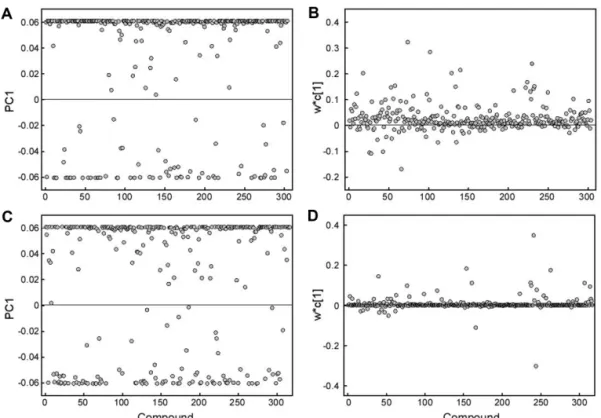
Fig. 1. PCA score plot derived from the GC-TOF/MS (A) and GC-MS (B) of fruit vinegars (light gray circle; Meoru-Bokbunja alcohol, black square; Meoru-Bokbunja vinegar, gray triangle; Omija-Makgeolli alcohol, dark gray inverted triangle; Omija-Makgeolli vinegar).
Fig. 2. PCA loading plot and PLS-DA loading plot from GC-TOF/MS analysis of Meoru-Bokbunja vinegar (A, B) and Omija-
Makgeolli vinegar (C, D).
결과 및 고찰
대사체 분석
강원도에서재배된과일로제조한과일식초의대사체를 분석하였다
.
초산발효전,
머루·
복분자과실주는289
개의 대사체가동정되었으며,
머루·
복분자식초에서는274
개의 대사체가동정되었다.
막걸리가첨가된오미자주에서는303
개,
막걸리가첨가된오미자(
오미자·
막걸리)
를발효한식초 에서는287
개의대사체가동정되어초산발효이후대사체수가다소감소한것으로나타났다
.
주성분분석(PCA)
결과제
1
주성분(PC1)
의기여율은52.6%,
제2
주성분(PC2)
의기여 율은27.9%
로서,
총90.5%
의누적기여율을나타내었다(Fig.
1A).
머루·
복분자과실주와식초는초산발효를통하여대사체의변화가구분되는양상을나타냈으며
,
오미자에막걸 리를첨가하여제조한식초의경우도초산발효에의하여대사체의차이가나타났다
.
머루·
복분자식초가오미자·
막걸 리식초와비교하여초산발효에의한대사체의변화가상 대적으로큰것으로나타났다.
주성분및부분최소제곱판별분석을통하여발효에의한 대사체함량의증감을확인하였다
(Fig. 2).
초산발효가완료 된머루·
복분자식초는총237
종류의대사체의함량이증가된것으로나타났다
(Fig. 2A).
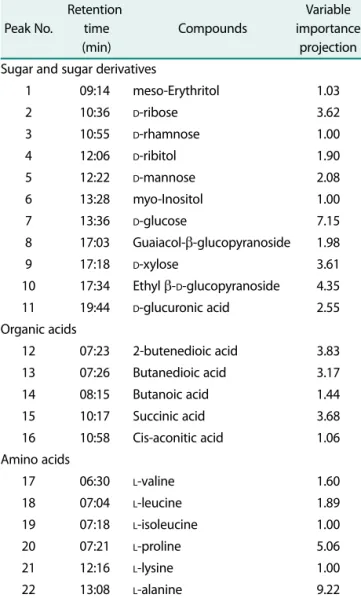
부분최소제곱판별분석을통하여 결정한
VIP (Variable Importance in the Projection)
값이[29] 1.0
이상인당및당유도체류11
종,
유기산류5
종,
아 미노산류6
종등22
개대사체를확인하였다(Table 1).
이들대 사체중L-alanine
의함량변화(VIP = 9.22)
가가장큰것으로 나타났으며,
D-glucose,
L-proline, ethyl-
D-glucopyranoside
순으로나타났다.
약30
종이상의식초에함유된아미노산을분석한연구에서L
-alanine
의함량이식초의종류를구분할수지표물질로제시되지않았으나
[30],
무화과식초에서[5]
는특이적으로높은함량을나타낸바있으며
,
머루·
복분자 식초에서도초산발효전후에유의적인함량의변화를나타 내어머루·
복분자식초의숙성정도를판단할수있는중요 한지표물질중의하나로사료된다.
Table 1. List of discriminative metabolites in Meoru-Bokbunja vinegar.
Peak No.
Retention time (min)
Compounds
Variable importance
projection Sugar and sugar derivatives
1 09:14 meso-Erythritol 1.03
2 10:36
D-ribose 3.62
3 10:55
D-rhamnose 1.00
4 12:06
D-ribitol 1.90
5 12:22
D-mannose 2.08
6 13:28 myo-Inositol 1.00
7 13:36
D-glucose 7.15
8 17:03 Guaiacol- β-glucopyranoside 1.98
9 17:18
D-xylose 3.61
10 17:34 Ethyl β-
D-glucopyranoside 4.35
11 19:44
D-glucuronic acid 2.55
Organic acids
12 07:23 2-butenedioic acid 3.83
13 07:26 Butanedioic acid 3.17
14 08:15 Butanoic acid 1.44
15 10:17 Succinic acid 3.68
16 10:58 Cis-aconitic acid 1.06
Amino acids
17 06:30
L-valine 1.60
18 07:04
L-leucine 1.89
19 07:18
L-isoleucine 1.00
20 07:21
L-proline 5.06
21 12:16
L-lysine 1.00
22 13:08
L-alanine 9.22
Table 2. List of discriminative metabolites in Omija-Makgeolli vinegar.
Peak No.
Retention time (min)
Compounds
Variable importance
projection Sugar and sugar derivatives
1 12:12 Glycoside 1.00
2 13:36
D-glucose 1.28
3 17:03 Guaiacol- β-glucopyranoside 3.24 4 17:34 Ethyl β-
D-glucopyranoside 1.96 Alcohols
5 10:59 4-hydroxyphenyl ethanol 1.96 Organic acids
6 07:23 2-butenedioic acid 5.40
7 07:26 Butanedioic acid 1.35
8 08:15 Butanoic acid 3.09
9 13:21 Pentanedioic acid 1.72
10 14:01 Phosphoric acid 1.00
Amino acids
11 06:12
L-alanine 10.28
12 06:30
L-valine 1.00
13 07:04
L-leucine 1.98
14 07:21
L-proline 8.77
15 09:56
L-glycine 1.64
16 11:34
L-ornithine 2.55
오미자
·
막걸리식초의경우발효후222
개의대사체함량 이증가된것을확인하였으며,
부분최소제곱판별분석시 당및당유도체류4
종,
알코올류1
종,
유기산류5
종,
아미노 산류6
종등총17
종류의대사체함량이증가되는것으로나 타났다(Table 2).
머루·
복분자 식초의경우와유사하게 L- alanine
의함량변화(VIP = 10.28)
가가장큰것으로나타났 으며,
L-proline, butane, 2-butanedioic acid
순으로나타났다.
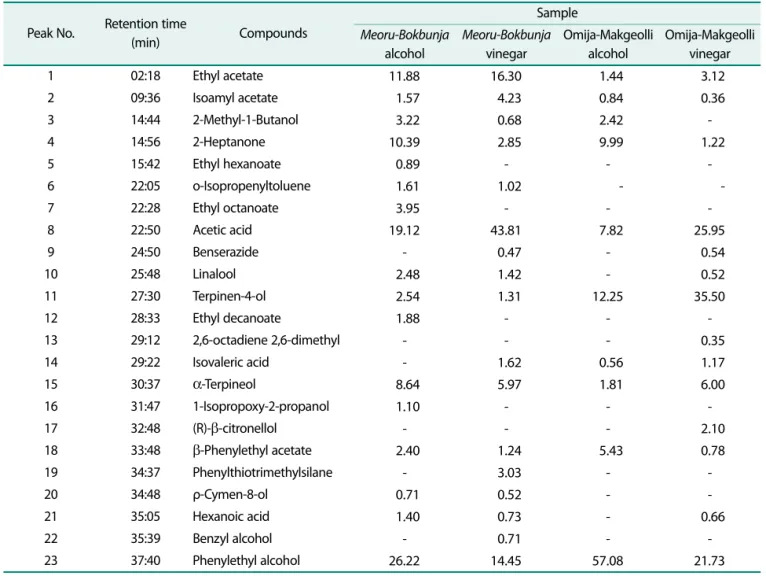
휘발성 성분 분석본연구에서제조한식초의휘발성성분을측정한결과머 루
·
복분자과실주및머루·
복분자식초모두17
종의휘발성 성분이동정되었다(Table 3).
머루·
복분자주는알코올류6
종,
유기산류2
종,
에스테르류6
종,
테르펜류3
종등의휘발성 성분이 확인되었으며,
이 중phenylethyl alcohol, acetic acid, ethyl acetate, 2-heptanone
및α-terpineol
이주요휘 발성 성분으로검출되었다. Linalool, terpinene-4-ol
및α-
terpineol
등의성분은복분자열매에함유된주요휘발성성분으로알려져있다
[31]. Ethyl hexanoate, ethyl octanoate
및ethyl decanoate
등의향기성분들은머루·
복분자주에함 유된것으로나타났으며,
이는알코올발효로인해생성된것으로판단된다
[32].
초산발효가완료된머루·
복분자식초의경우알코올류
4
종,
유기산류3
종,
에스테르류3
종,
테르 펜류3
종등의향기성분이분석되었으며,
초산발효에의해 알코올성휘발성분의함량이감소된것으로나타났다.
초산 은향기성분전체함량중43%
로가장높은함량을나타냈 으며, ethyl acetate, phenylethyl alcohol
순으로나타났으 며,
초산발효후ethyl acetate, isoamyl acetate
등의에스 테르화합물의함량이증가하였다.
Ethyl acetate
는알코올과초산의에스테르화반응에의해생성되는물질로식초특유의향미특성을부여하지만과 도하게존재하게되는경우화학용매
,
페인트류의향을나 타내어식초의품질을저하시키는주요원인으로알려져있Table 3. Volatile compounds in fruit vinegars.
(Unit : peak area, %)
Peak No. Retention time
(min) Compounds
Sample Meoru-Bokbunja
alcohol
Meoru-Bokbunja vinegar
Omija-Makgeolli alcohol
Omija-Makgeolli vinegar
1 02:18 Ethyl acetate 11.88 16.30 1.44 3.12
2 09:36 Isoamyl acetate 1.57 4.23 0.84 0.36
3 14:44 2-Methyl-1-Butanol 3.22 0.68 2.42 -
4 14:56 2-Heptanone 10.39 2.85 9.99 1.22
5 15:42 Ethyl hexanoate 0.89 - - -
6 22:05 ο-Isopropenyltoluene 1.61 1.02 - -
7 22:28 Ethyl octanoate 3.95 - - -
8 22:50 Acetic acid 19.12 43.81 7.82 25.95
9 24:50 Benserazide - 0.47 - 0.54
10 25:48 Linalool 2.48 1.42 - 0.52
11 27:30 Terpinen-4-ol 2.54 1.31 12.25 35.50
12 28:33 Ethyl decanoate 1.88 - - -
13 29:12 2,6-octadiene 2,6-dimethyl - - - 0.35
14 29:22 Isovaleric acid - 1.62 0.56 1.17
15 30:37
α-Terpineol 8.64 5.97 1.81 6.00
16 31:47 1-Isopropoxy-2-propanol 1.10 - - -
17 32:48 (R)- β-citronellol - - - 2.10
18 33:48 β-Phenylethyl acetate 2.40 1.24 5.43 0.78
19 34:37 Phenylthiotrimethylsilane - 3.03 - -
20 34:48 ρ-Cymen-8-ol 0.71 0.52 - -
21 35:05 Hexanoic acid 1.40 0.73 - 0.66
22 35:39 Benzyl alcohol - 0.71 - -
23 37:40 Phenylethyl alcohol 26.22 14.45 57.08 21.73
다
[16].
부패한치즈냄새와같은이취를나타내는물질의하 나인isovaleric acid [33],
머루·
복분자식초와오미자·
막걸 리식초에서검출되었으나전체향기성분의2%
미만으로 상대적으로함량이낮은수준이었다.
오미자
·
막걸리및오미자·
막걸리식초는각각10
종, 14
종 의 휘발성 성분이 동정되었다.
오미자·
막걸리의 경우phenylethyl alcohol
등의알코올류성분이전체향기성분 중59.5%
로가장높은비율을나타내었으며, terpinen-4-ol,
2-heptanone
순으로높은함량을나타났다.
현미식초의경우초산의함량이
75%
내외[34]
로가장높은함량을나타낸것과비교하여머루
·
복분자식초와오미자·
막걸리식초에서 각각43.81%, 25.95%
로낮은초산함량을나타냈다(Table 3).
오미자·
막걸리식초는초산발효에의하여benserazide, linalool, hexanoic acid
등의휘발성성분이생성되었으며,
초 산이외에도terpineol-4-ol,
α-terpineol
등의테르펜류가전체향기성분중
41.5%
의높은비율을차지하였다.
오미자
·
막걸리식초에함유된휘발성분의주성분분석을진행한결과제
1, 2
주성분의기여율은각각44.8, 32.6%
으로나타나총
77.4%
의누적기여율을나타내었다(Fig. 1B).
머루
·
복분자주와머루·
복분자식초는주성분분석을통하여 초산발효에의하여휘발성성분의양상이구분되는것으로 나타났다.
향기활성가 측정
식초의향기특성을부여하는휘발성성분을조사한결과 머루
·
복분자주및머루·
복분자식초에서각각13
종, 11
종의 향기성분이확인되었다(Table 4).
머루·
복분자식초의주요향기성분인초산은
2,970.19 mg/l
로초산발효를통하여약5
배증가한것으로나타났으며, ethyl acetate
는142.26 mg/l
로약2
배증가한것으로나타났다.
문헌에보고된각성분의최소감지농도
[35, 36]
를이용하여향기활성가를측정한결과
acetic acid
와ethyl acetate
는각각14.9, 11.9
로식초 의향기특성에미치는영향이큰것으로판단되었다.
머루
·
복분자주에서과일향을나타내는ethyl hexanoate, Table 4. Changes in aroma-active compounds in Meoru-Bokbunja samples.
Compounds Odor
characteristics
OT
a(mg/l)
Meoru-Bokbunja alcohol Meoru-Bokbunja vinegar Concentration
(mg/l) OAV
bConcentration
(mg/l) OAV
Alcohols
2-Methyl-1-Butanol Winey, onion, fruity 0.045 5.73 127.3 1.95 43.3
Phenylethyl alcohol Honey, spicy, rose 140 0.02 <1 0.01 <1
Benzyl alcohol Floral, rose
ρ-Cymen-8-ol Sweet, Fruity - -
Acids
Acetic acid Pungent, vinegar 200 514.25 2.6 2970.19 14.9
Hexanoic acid Fatty, sour
Isovaleric acid Sweet, cheese 3 - - 0.01 <1
Esters
Ethyl acetate Pineapple, solvent 12 65.66 5.5 142.26 11.9
Ethyl hexanoate Fruity, green apple 0.05 1.58 31.6 - <1
Ethyl octanoate Fruity, winey 0.60 5.59 9.3 - <1
Ethyl decanoate Fruity, grape 0.20 0.16 <1 - <1
Isoamyl acetate Banana 0.30 0.12 <1 0.51 1.7
β-Phenylethyl acetate Flowery, fruity, olive 0.25 0.10 <1 0.09 <1
Ketones
2-Heptanone Cheesy, waxy 0.02 23.46 1171.5 10.32 516
Terpenes
Linalool Fruity, sweet 0.025 1.8 72 1.7 68
Terpinel-4-ol Citrus, spicy 0.25 2.4 9.6 2.1 8.4
α
-Terpineol Floral, sweet 0.25 14.0 56 16.9 67.6
OT : Odor threshold (Concentration/OAV), b) OAV : Odor activity value.
ethyl octanoate
는각각31.6, 9.3
의향기활성가를나타내어 향미특성에영향을크게미칠것으로판단되었다.
반면바 나나향을나타내는2-Methyl-1-butanol [37]
은초산발효에의 하여5.73 mg/l
에서1.95 mg/l
로감소하는것으로나타났다.
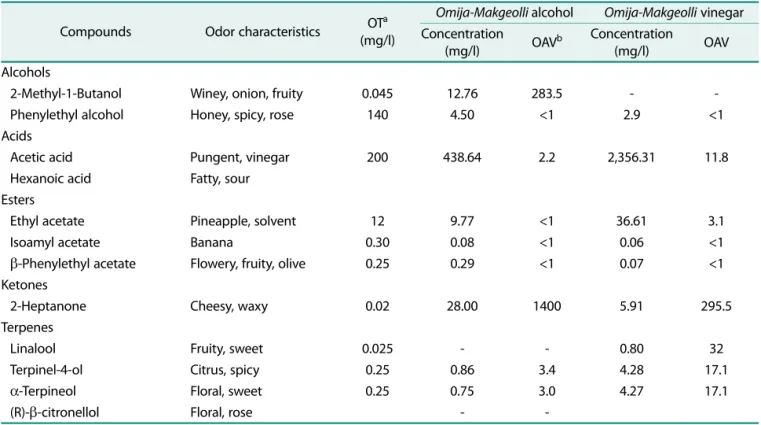
오미자
·
막걸리와오미자·
막걸리식초에서는각각9
종의 향기성분이확인되었으며, 2-metyl-1-butanol
은초산발효과정에서함량이감소하는것으로나타났다
(Table 5).
초산은발효과정을 통하여
438.64 mg/l
에서2,356.31 mg/l
로 약5.3
배증가하였으며, ethyl acetate
는9.77 mg/l
에서36.61 mg/l
로 약3.7
배 증가하였다.
초산의 향기활성가는11.8, ethyl acetate
의향기활성가는3.1
로머루·
복분자식초와비 교하여ethyl acetate
의향기활성가는상대적으로낮았다.
오 미자·
막걸리는초산발효에의하여과일향기,
달콤한향을 나타내는linalool
이생성되었고,
향기활성가가32
를나타내 어오미자·
막걸리식초의향기특성에큰영향을미치는것 으로나타났다.
이외에도감귤향을나타내는terpinel-4-ol,
꽃향기를나타내는α
-terpineol
등테르펜류의향기활성가가17.1
로오미자·
막걸리식초의향미특성에크게관여하는것으로판단되었다
.
Malic acid, lysine, succinic acid, glucose, lactic acid
및1-hexanol
등을이용하여원료에따른식초의차이를판별한 연구 사례가 있으며
[30], acetic acid, ethyl acetate,
isoamyl acetate, isovaleric acid
등은시판과실식초의주요향기 성분으로 보고된 바 있다
[4].
사과식초에서는malic
acid [5],
야콘식초에서는succinic acid [38]
등원료의종류 에따라서제조한식초에서특징적으로높은함량을나타내 는성분들이알려져있다.
본연구를통하여머루·
복분자식 초에서는ethyl acetate,
오미자·
막걸리식초에서는terpinel- 4-ol,
α-terpineol
등테르펜류의성분들이특징적으로나타 나는것을확인하였다.
강원도에서생산된과일을사용하여 제조한식초의대사체및향기성분을분석하여고품질식 초생산을위한기초자료가될것으로사료된다.
요 약
강원도에서생산된과일을사용하여식초를제조하여
,
초 산발효에의하여변화되는주요대사체및향기성분을조 사하였다.
머루·
복분자식초에서는초산발효에의하여L-
alanine
의함량변화가가장크게변화하였으며,
초산은향기성분전체함량중
43%
로가장높은함량을나타냈고,
초 산발효 후ethyl acetate, isoamyl acetate
등의에스테르 화합물의함량이증가하였다.
오미자·
막걸리식초의경우초 산발효에의하여linalool, hexanoic acid
등이생성되었고테르펜류화합물이
41.5%
로대부분을차지하였다.
머루·
복분Table 5. Changes in aroma-active compounds in Omija-Makgeolli samples.
Compounds Odor characteristics OT
a(mg/l)
Omija-Makgeolli alcohol Omija-Makgeolli vinegar Concentration
(mg/l) OAV
bConcentration
(mg/l) OAV
Alcohols
2-Methyl-1-Butanol Winey, onion, fruity 0.045 12.76 283.5 - -
Phenylethyl alcohol Honey, spicy, rose 140 4.50 <1 2.9 <1
Acids
Acetic acid Pungent, vinegar 200 438.64 2.2 2,356.31 11.8
Hexanoic acid Fatty, sour
Esters
Ethyl acetate Pineapple, solvent 12 9.77 <1 36.61 3.1
Isoamyl acetate Banana 0.30 0.08 <1 0.06 <1
β-Phenylethyl acetate Flowery, fruity, olive 0.25 0.29 <1 0.07 <1
Ketones
2-Heptanone Cheesy, waxy 0.02 28.00 1400 5.91 295.5
Terpenes
Linalool Fruity, sweet 0.025 - - 0.80 32
Terpinel-4-ol Citrus, spicy 0.25 0.86 3.4 4.28 17.1
α-Terpineol Floral, sweet 0.25 0.75 3.0 4.27 17.1
(R)- β-citronellol Floral, rose - -
OT : Odor threshold (Concentration/OAV), b) OAV : Odor activity value.
자식초의경우와유사하게L
-alanine
의함량변화가가장큰 것으로나타났다.
머루·
복분자식초에서는ethyl acetate,
오 미자·
막걸리식초에서는감귤향을내는terpinel-4-ol,
꽃향기를내는α
-terpineol
등테르펜류의성분들이각식초의향기특성에큰영향을나타내는것으로확인되었다