/ /
Modeling and RPY Motion Analysis of Bipedal Walking Robots
Byoung-Ho Kim
Biomimetics & Intelligent Robotics Lab., Dept. of Mechatronics Eng., Kyungsung Univ., Busan, 608-736, Korea
,
/ / (roll/pitch/yaw) .
,
. , ,
, ,
. ,
.
: , , ,
Abstract
This paper presents a virtual-legged walking model for bipedal robots and analyzes its fundamental RPY(Roll, Pitch, and Yaw) motion effects by simulation. For the purpose of identifying the motion effects of the bipedal walking, we assign some arbitrary trajectories both at the center of mass and at the center of pressure of the robot based on human walking.
And then we verify the major moments to the roll, pitch, and yaw directions of the robot. As a result, it is shown that those motions are natural in the process of bipedal walking and they are deeply dependent on the step distance, the vertical level of the center of mass, and the acceleration of the robot. The importance of trajectory planning for the footstep location during a bipedal walking is finally addressed in terms of balance.
Key words : Virtual-legged walking model, Bipedal robots, Natural behaviors, Walking balance
1.
(humanoid
robot) [1]-
[4].
1
WABIAN-2 [2] .
(hand/arm coor-
dination) ,
2011 .
: 2010 . , 2010
( ) (NRF-2010-013-2010-
1-D00023).
접수일자 : 2011년 3월 19일 완료일자 : 2011년 5월 11일
(stable walking) . , . ,
(bipedal walking) , (pivot)
, ,
[5]- [7].
1. , WABIAN-2
Fig. 1. A humanoid robot, WABIAN-2
, / / (roll/pitch/yaw)
.
.
2.
/ / (roll/pitch/yaw) 1 2
.
(VL1 VL2)
3
. ,
(pivot) ,
.
,
(force) (moment)
,
.
2.
Fig. 2. A simplified model of bipedal robots
3.
Fig. 3. A virtual-legged walking model of bipedal robots
3 ,
- .
f = A¨pc+ Bpc+ Cpfi+ dg (1)
, f ∈ R6×1, (center
of mass, COM) pc ∈ R3×1
¨pc ∈ R3×1, i
pfi ∈ R3×1 d∈ R6×1
.
f = [fx fy fz τx τy τz]T pc= [xc yc zc]T, ¨pc= [¨xc ¨yc ¨zc]T
pfi = [xfi yfi zfi]T d= [0 0 m 0 0 0]T.
, fx, fy fz x ,
y z
687
. xc, yc zc x , y z , ¨xc, ¨yc, ¨zc x , y
z . xfi, yfi zfi
x , y z i
, m
(total point mass)
, g(= 9.81m/s2) .
(1) (dynamic mapping matrix)
A ∈ R6×3, B ∈ R6×3
C ∈ R6×3 .
A =
⎡
⎢⎢
⎢⎢
⎢⎢
⎣
m 0 0
0 m 0
0 0 m
0 −zcm (yc− yfi)m zcm 0 −(xc− xfi)m
−(yc− yfi)m (xc− xfi)m 0
⎤
⎥⎥
⎥⎥
⎥⎥
⎦ (2)
B =
⎡
⎢⎢
⎢⎢
⎢⎢
⎣
0 0 0
0 0 0
0 0 0
0 mg 0
−mg 0 0
0 0 0
⎤
⎥⎥
⎥⎥
⎥⎥
⎦
(3)
C =
⎡
⎢⎢
⎢⎢
⎢⎢
⎣
0 0 0
0 0 0
0 0 0
0 −mg 0
mg 0 0
0 0 0
⎤
⎥⎥
⎥⎥
⎥⎥
⎦
. (4)
, (1)∼(4) ,
. , (x )
(rolling) y z
, y
(pitching) x z
.
y x
, zc
z (rolling)
(pitching) .
[8] [9]
. ,
z
(yawing) ,
. ,
z . .
.
3.
3.1
(roll), (pitch) (yaw)
.
(a) x
(b) y
(c) z 4.
Fig. 4. Trajectory profiles prescribed at the COM space for a bipedal manipulation
, ,
4(a), (b), (c) . , xc, yc
zc (x ), (y )
(z )
. , 4(b) ,
1 ,
tshift 0.4
. tshift
.
, RS ,
, LS
. 3.2
,
1 3 ,
(roll), (pitch) (yaw) .
1.
Table 1. Assigned position of the supporting foot Step Case xf,support yf,support Remarks
[m] [m]
I 0.000 ±0.089 Start
0 II 0.000 ±0.089 position
III 0.000 ±0.089
I 0.100 0.069 Front/Inside
1 II 0.120 0.089 Center
III 0.140 0.109 Rear/Outside
I 0.180 -0.069 Front/Inside
2 II 0.200 -0.089 Center
III 0.220 -0.109 Rear/Outside
I 0.260 0.069 Front/Inside
3 II 0.280 0.089 Center
III 0.300 0.109 Rear/Outside
1 xf,support yf,support
x y . ,
, (Case I)
x y
(Front) (Inside)
. (Case II)
(Center) , (Case
III) (Rear) (Outside)
. , (Step 0)
y
±0.089m , z
0.94m , 78kg .
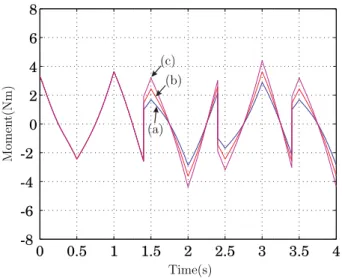
5 (2)
4 3 (A(4, 3)) .
, y
(z ) (rolling mo-
ment) ,
.
5. A(4, 3)
: (a) I, (b) II, (c) III.
Fig. 5. Rolling momentA(4, 3) for the walking task : (a) Case I, (b) Case II, and (c) Case III.
6. A(5, 3)
: (a) I, (b) II, (c) III.
Fig. 6. Pitching momentA(5, 3) for the walking task : (a) Case I, (b) Case II, and (c) Case III.
6 (pitching moment)
A(5, 3) , , x
(z )
689
.
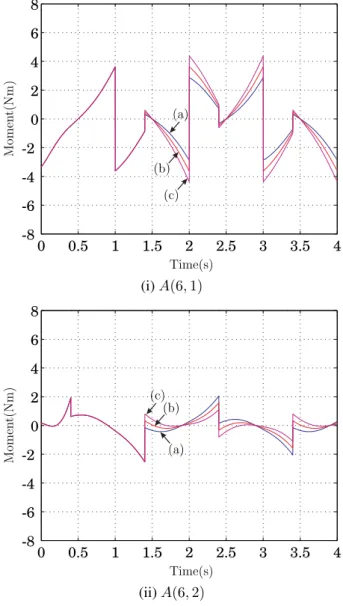
. 7 A(6, 1)
A(6, 2) .
(x ) (y )
, .
(i) A(6, 1)
(ii) A(6, 2) 7.
: (a) I, (b) II, (c) III.
Fig. 7. Yawing moments for the walking task : (a) Case I, (b) Case II, and (c) Case III.
, 5∼7
/ / (roll/pitch/yaw)
. , 7 ,
. ,
.
4.
/ / (roll/pitch/yaw)
. ,
/
.
/ /
, .
. ,
. ,
[10]-
[13] , (falling) [14]
.
[1] Y. Sakagami, R. Watanabe, C. Aoyama, S. Mat- sunaga, N. Higaki, and K, Fujimura, “The intelligent ASIMO: system overview and integration,” Proc. of IEEE/RSJ Int. Conf. on Intelligent Robots and Sys- tems, pp. 2478-2483, 2002.
[2] Y. Ogura, H. Aikawa, K. Shimomura, H. Kondo, A.
Morishima, H.-O. Lim, and A, Takanishi, “Develop- ment of a new humanoid robot, WABIAN-2,” Proc.
of IEEE Int. Conf. on Robotics and Automation, pp.
2478-2483, 2002.
[3] I. W. Park, J.-Y. Kim, J. Lee, and J.-H. Oh, “Me- chanical design of humanoid robot platform KHR-3 (KAIST humanoid robot-3: HUBO),” Proc. of IEEE- RAS Int. Conf. on Humanoid Robots, pp. 321-325, 2005.
[4] I. Mizuuchi, T. Yoshikai, Y. Sodeyama, Y. Nakan- ishi, A. Miyadera, T. Yamamoto, T. Niemela, M.
Hayashi, J. Urata, Y. Namiki, T. Nishino, and M. In- aba, “Development of musculoskeletal humanoid Ko-
taro,” Proc. of IEEE Int. Conf. on Robotics and Au- tomation, pp. 82-87, 2006.
[5] M. Vukobratovic and J. Stepaneko, “On the stabil- ity of anthropomorphic systems,” Mathematical Bio- sciences, Vol. 15, pp. 1-37, 1972
[6] D. G. E. Hobbelen and M. Wisse, “A disturbance re- jection measure for limit cycle walkers: the gait sen- sitivity norm,” IEEE Trans. on Robotics, Vol. 23, Vo, 6, pp. 1213-1224, 2007.
[7] P.-B. Wieber, “Viability and predictive control for safe locomotion,” Proc. of IEEE/RSJ Int. Conf. on In- telligent Robots and Systems, pp. 1103-1108, 2008.
[8] T. Sugihara, Y. Nakamura, and H. Inoue, “Realtime humanoid motion generation through ZMP manip- ulation based on inverted pendulum control,” Proc.
of IEEE Int. Conf. on Robotics and Automation, pp.
1404-1406, 2002.
[9] S. Kajita, F. Kanehiro, K. Kaneko, K. Fujiwara, K.
harada, K. Yokoi, and H. Hirukawa, “Biped walking pattern generation by using preview control of zero- moment point,” Proc. of IEEE Int. Conf. on Robotics and Automation, pp. 1620-1626, 2003.
[10] J. Chestnutt, M. Law, G. Cheung, J. Kuffner, J.
Hodgins, and T. Kanade, “Footstep planning for the Honda ASIMO humanoid,” Proc. of IEEE Int. Conf.
on Robotics and Automation, pp. 631-636, 2005.
[11] A. D. Kuo, “Choosing your steps carefully,” IEEE Robotics & Automation Magazine, pp. 18-29, June 2007.
[12] H. Diedam, D. Dimitrov, P.-B. Wieber, K. Mombaur, and M. Diehl, “Online walking gait generation with adaptive foot positioning through linear model pre- dictive control,” Proc. of IEEE/RSJ Int. Conf. on In- telligent Robots and Systems, pp. 1121-1126, 2008.
[13] D. L. Wight, E. G. Kubica, and D. W. L. Wang,
“Introduction of the foot placement estimator: a dy- namic measure of balance for bipedal robotics,” Jour.
of Computational and Nolinear Dynamics, Vol. 3, Is- sue 1, January 2008.
[14] S.-K Yun, A. Goswami, and Y. Sakagami, “Safe fall:
humanoid robot fall direction change through intel- ligent stepping and inertia shaping,” Proc. of IEEE Int. Conf. on Robotics and Automation, pp. 781-787, 2009.
(Byoung-Ho Kim)
2001 : (
)
1995 ∼ 2001 :
2002 ∼ 2004 : JSPS Post-Doctoral Fellow, Dept. of Robotics, Ritsumeikan Univ.(Japan)
2004 ∼ 2005 : Researcher, Biomimetic Control Research Center, RIKEN, Japan
2005 ∼ :
2006 ∼ :
2010 ∼ 2011 : Visiting Faculty, Robotics Institute, Carnegie- Mellon Univ., USA
: intelligent mobile manipulation, walking algo- rithm, multi-legged & humanoid robots, modeling and control of biomimetic mechanisms, multi-fingered robot/artificial hands and multiple arm control, macro/micro mechanism and intelligent control, neural computation, and sports science.
E-mail : [email protected]
저 자 소 개
68;