• 검색 결과가 없습니다.

Impacts of the Establishments' Safety Behavior, Safety and Health Delivery and Communication on Occupational Safety and Health Policy Satisfaction

N/A
N/A
Protected

Academic year: 2021

Share "Impacts of the Establishments' Safety Behavior, Safety and Health Delivery and Communication on Occupational Safety and Health Policy Satisfaction"

Copied!
8
0
0

로드 중.... (전체 텍스트 보기)

전체 글

(1)

Impacts of the Establishments’ Safety Behavior, Safety and Health Delivery and Communication on Occupational Safety and Health Policy Satisfaction

1)

Seo-Yeon Choi*, Han-Suk Jung*, Joo-Hyun Ham*

Abstract

In this paper, we conducted a study to understand the impacts of safety behavior, safety and health delivery and communication, which should be managed for the establishments’ safety and health control on occupational safety and health policy satisfaction to utilize that as a material for preparing policy support and preventive measures. For this purpose, we conducted a statistic analysis with 2,970 establishments, utilizing the material, “2015 Occupational Safety and Health Company Survey”. As a result, in the manufacturing industry, it turned out in the establishments with more than 300 workers, safety behavior, safety and health delivery and communication of the cooperative firm of the prime contractor were high. In addition, it turned out that safety behaviors had the biggest impact on occupational safety and health policy satisfaction in the manufacturing industry and safety and health delivery and communication had the biggest impact on occupational safety and health policy satisfaction in the construction industry and other industries. As for the relationship between companies, it turned out that safety behaviors had the biggest impact on that between the parent company and a cooperative firm of a prime contractor while safety and health delivery and communication on that between the prime contractor and the subcontractor. Through the results of this study, it is necessary to build up safety and health behavior and safety and health delivery and communication systems for the characteristics of the company, and it is expected that the effect of the safety and health control will increase when policy support is made accordingly.

▸Keyword: Safety behavior, communication, policy, prevention, Company Survey

I. Introduction

최근 국내의 사업장은 안전행동 기반의 안전문화를 중요하게 인식하고, 정착시키기 위하여 많은 노력을 기울이고 있다. 이에 모든 계층의 구성원이 하나가 되어 사업장별 특성을 반영한 고유한 안전문화를 정착시키는 것을 안전관리의 최종 목표로 삼고 있다.

근로자의 건강과 안전 확보를 위하여 실제 사업장에서는 산 업안전보건법 기반의 다양한 활동을 펼치고 근로자의 안전보 건수준 향상을 위해서는 장기간의 노력과 관리가 요구된다.

사업장의 안전보건활동의 영향 요인에 대하여 안전보건동 향조사를 중심으로 분석한 연구에서는 일반적인 안전보건경영 활동, 근로자 건강관리 활동, 화학물질 관리, 보호구 및 유해 위험 기계기구 관리, 정보전달과 의사소통이 관련성이 높다고 하였으며, 계층별 영향도는 사업주의 일반적인 안전보건경영 활동에 대한 영향이 가장 큰 것으로 나타났다. 위험영향요인 은 보호구 및 유해위험기계기구 관리가 높게 나타났으며, 이

∙First Author: Seo-Yeon Choi, Corresponding Author: Joo-Hyun Ham

*Seo-Yeon Choi ([email protected]), Dept. of Health Counseling Welfare, Hanseo University

*Han-Suk Jung ([email protected]), Dept. of Health Counseling Welfare, Hanseo University

*Joo-Hyun Ham ([email protected]), Dept. of Health Counseling Welfare, Hanseo University

∙Received: 2019. 08. 06, Revised: 2019. 08. 27, Accepted: 2019. 08. 27.

∙This paper is based on the data of the Occupational Safety and Health Research Institute 's 2015 Occupational

Safety and Health Trend Survey.

(2)

는 실제 안전보건활동 시 영향요인과 위험 영향 요인에 대한 인식의 차이를 보이는 것으로 파악되었다[1].

중소규모 사업장의 경우 안전보건활동의 자율적 운영과 관리 를 위해서는 위험성평가 기반의 안전 진단 실시와 공정상의 위험 요인을 찾아내고, 관리 방안을 지속적으로 운영하는 것이 요구되 는데 정부에서는 안전보건공단 등의 지원 사업을 통하여 노동자 의 안전 확보와 작업환경 개선에 도움을 주고 있다[2].

조직 내의 안전 환경은 안전 규정, 절차의 준수 및 작업장 내 안전 관련 활동과 관련되어 있으며, 안전성과에 대한 전반 적인 조직 환경의 영향은 안전 환경적 측면에서 접근되고 안 전성과에 의한 안전문화는 안전지식과 동기를 기반으로 활용 된다[3]. 특히, 조직 환경은 작업 환경의 다양한 개인 평가를 포괄하는 다차원 구조로 리더십, 역할 및 의사소통의 안전 분 위기와[4][5], 조직과 사회 요인의 안전 행동에 따라 사업장 의 사고의 원인이 밝혀지기 때문에 작업 설계 및 기계적인 시 스템 외에도 중요하게 인식된다[6].

안전 분위기와 안전행동의 관계는 조직 구성원들의 안전에 대한 동기를 증진시키거나 안전행동의 증가를 가져오게 되며 [7], 사업장의 의사소통을 통하여 조직원 모두가 경영활동을 수행하는 필수요소로 작용하게 된다. 조직 내 안전 관련 정책 과 절차는 산업 현장 근로자의 안전 수칙 준수가 안전 행동으 로 연결되어 안전행동을 유발하기 때문에 올바른 안전보건의 전달과 다양한 의사소통의 기회 마련을 위해서는 산업안전보 건의 정책적인 지원이 필요하다[8].

이에 본 연구에서는 ‘산업안전보건 동향조사’자료를 활용하 여 사업장의 안전보건 활성화와 관리를 위하여 요구되는 안전 행동, 안전보건전달 및 의사소통이 산업안전보건정책 만족도 에 미치는 영향을 파악하고자 하며, 추후 정책적 지원과 예방 대책 자료로 활용하고자 수행되었다.

본 연구 수행을 위하여 다음과 같이 연구문제를 제시한다.

연구문제 1. 연구 대상 사업장의 일반적 특성을 알아본다.

연구문제 2. 안전행동, 안전보건전달 및 의사소통, 산업안 전보건정책 만족도 문항의 평가 및 신뢰도를 알아본다.

연구문제 3. 사업장 특성에 따른 안전행동, 안전보건전달 및 의사소통, 산업안전보건정책 만족도 차이를 알아본다.

연구문제 4. 기업 특성에 따른 안전행동, 안전보건전달 및 의사 소통이 산업안전보건정책 만족도에 미치는 영향을 알아본다.

II. Preliminaries

1. Safety behavior

산업안전보건 분야에서 작업자들의 안전행동 측정은 일반 적으로 행동 체크리스트를 이용하게 되는데 근로자의 행동 관 찰과 기록, 안전행동 관리 지침의 설정된 목표 달성을 위한 정 기적인 피드백 수행, 정해진 안전 목표의 도달 상황 등의 확인

이 필요하다[9]. 일반적으로 근로자의 안전행동은 아차사고와 같이 발생하지 않았으나 발생 가능성이 있는 사고를 포함하 며, 사전에 방지하는 예방적인 관점에서의 접근이 이루어지게 된다. 사업장에서 사고가 발생하거나 발생 할 수 있는 상황에 직면하는 경우에도 사고의 원인과 결과에 대한 처벌 중심 보 다는 사업장 전체가 인지하고 개선하려는 의지가 필요하며, 안전행동의 실천 시에는 보상으로 장려하는 것이 효과적인 것 으로 나타나고 있다[10].

사고의 원인이 되는 근로자의 안전/불안전 행동에 대한 직 접적인 통제는 작업 현장에서 일어나는 상황, 혹은 제시되는 자극이 행동의 결과에 영향을 주기 때문에 행동 관리의 방안 마련이 필요하다. 안전행동은 기존의 작업방법 및 자세 등의 여러 습관적인 요인들에게 영향을 주기 때문에 근로자는 작업 시 불편함, 늦어지는 작업속도와 같이 부정적인 인식이 고착 화 되어 있어 변화에 많은 어려움이 있으며, 일부 생산적인 측 면에서 관리자들에 의해 불안전 행동이 장려되기도 하여 안전 행동에 대한 인식 파악이 사전에 이루어져야 한다[11].

사업장의 불안전한 행동을 막기 위하여 공학적 접근법과 정 책적 접근법이 활용된다. 공학적인 접근법은 사고 위험이 있 는 노후화된 기계를 교체하거나 인간 공학적으로 설계한 기계 도입, 안전장치를 개발 등이 대표적이며, 정책적인 접근법은 안전 규칙을 더 엄격하게 적용하거나 캠페인, 교육과 같은 방 법으로 근로자들의 안전 의식을 변화시키는 것에 초점을 두게 된다[12]. 건설업체와 제조업을 대상으로 안전행동기반 프로 그램을 적용한 연구에서는 근로자들의 관찰된 안전행동, 지각 된 안전행동, 안전 분위기가 프로그램 적용 전에 비하여 적용 후 증가한 것으로 보고된 바 있어[13] 안전행동의 관리가 사 업장의 안전보건의 정착과 활성화에 기여할 것으로 예상된다.

2. Safety and health delivery and communication 의사소통은 조직 내에서 이루어지는 모든 형태의 정보 전달 을 의미하며, 안전 행동으로 연결되는 중요한 요인으로 제시 되고 있다. 의사소통의 전달 과정은 공식적·비공식적 분류하여 고려되며, 사업장에서는 노동조합, 산업안전보건위원회, 노사 협의회 등이 산업안전에 관련된 제도나 공식적인 의사소통기 구로 주요 역할을 담당하고 있다[14].

또한 사업장의 안전과 보건을 담당하는 안전관리자와 보건 관리자는 산업안전보건법에 의하여 선임되는데 산업재해 예방 을 위한 문제점 도출 및 관리, 대책, 관리모델 적용의 업무 이 외에도 정부와 민간재해 예방관리기관 등과도 긴밀한 관계를 유지하여 사업장 근로자의 안전을 확보하는 중심에 있다 [14][15][16].

사업장 구성원들의 공유된 안전에 대한 인식과 사업장의 안

전 목표 달성을 위한 여러 활동들은 실제 작업 시 근로자의 자

발적 참여와 규제 속에서 이루어지게 된다. 사업주와 관리자,

관리자와 관리자, 관리자와 근로자로 연결되는 안전의 전달

체계는 현장의 안전에 관한 다양한 의견 전달이 가능 하도록

(3)

시스템이 구축되어야 하며, 이는 조직의 안전문화 형성에도 많은 영향을 미치게 된다[17][18]. 사업장의 다양한 의견 전 달 체계를 활용할 때에는 전달자의 개인적인 특성과 전문성이 정보전달의 효율에 결정적인 영향을 미칠 수 있고 근로자의 안전에도 직접적인 연관성이 크기 때문에 안전관리자의 역할 을 충분히 고려하는 것이 필요하다[19].

III. Method

1. Research Subject

본 연구는 산업안전보건공단 산업안전보건연구원의 ‘2015 년도 산업안전보건 동향조사’자료를 활용하였다. 산업안전보 건 동향조사는 사업장의 안전보건현황을 다양한 분야에서 심 층적으로 조사 분석·평가하고 향후 산업안전보건 정책지원 및 예방대책을 마련을 위하여 수행된다.

전국표본실태조사 연구로 본 연구에서는 전체 대상 사업장 5,007개소 중 활용된 문항 중 ‘잘 모름’, ‘해당 없음’, ‘응답거 부’ 등을 제외한 2,970개소를 최종 분석 대상으로 선정하였다.

2. Research method

본 연구에서는 업종, 사업장의 상시근로자 수, 기업 간 관계 를 중심으로 안전행동 수준 4문항, 안전보건정보전달 및 의사 소통 8문항, 산업안전보건정책 만족도 7문항을 세부 문항으로 활용하였다.

3. Statistical Method

본 연구에 활용된 ‘2015년도 산업안전보건 동향조사’의 자 료는 SPSS 21.0을 사용하여 분석하였다. 세부적인 분석방법 으로는 연구 대상 사업장의 일반적 특성의 경우 빈도분석을 실시하였고, 안전행동, 안전보건전달 및 의사소통, 산업안전보 건정책 만족도 문항 평가 및 신뢰도는 Cronbach's α를 이용하 였다. 사업장 특성에 따른 안전행동, 안전보건전달 및 의사소 통, 산업안전보건정책 만족도 차이는 일원배치 분산분석을 실 시하였으며, 기업 특성에 따른 안전행동, 안전보건전달 및 의 사소통이 산업안전보건정책 만족도에 미치는 영향을 알아보기 위하여 선형회귀분석을 실시하였다.

IV. Results

1. General characteristics of the target establishments

본 연구에 참여한 사업장의 일반적 특성은 업종의 경우 제

조업의 48.6%, 건설업 27.8%, 기타산업(서비스업 포함) 23.6%로 제조업이 가장 많았으며, 사업장의 상시 근로자 수는 49인 이하 11.5%, 50인 이상 99인 이하 37.7%, 100인 이상 299인 이하 39.0%, 300인 이상 11.8%로 100인 이상 299인 이하의 사업장이 가장 많았다. 기업 간의 관계는 모기업/모기 업 지역 사업장 69.4%, 원청/하청업체 18.2%, 원청 업체의 사내·외 협력업체 12.4%로 나타났다(Table 1).

Division N %

Type of business

Manufacturing 1442 48.6

Construction industry 827 27.8 Other industries 701 23.6

Number of employees

(persons)

49 343 11.5

50인-99인 1120 37.7

11001-299 1158 39.0

300 349 11.8

Relationship between companies

Parent company 2061 69.4

Prime contractor/

subcontractor 542 18.2

Cooperative firm of the

prime contractor 367 12.4

Total 2970 100.0

Table 1. General characteristics of the target establishments

2. Item evaluation and reliability of safety behavior, safety and health delivery and communication, occupational safety and health policy satisfaction 사업장 특성에 따른 안전행동, 안전보건전달 및 의사소통, 산업안전보건정책 만족도에 대한 개별 문항 평가 및 신뢰도는 다음과 같다. 안전행동은 총 4문항으로 ‘귀 사업장의 근로자는 안전한 방법으로 일(작업)을 수행한다’가 4.14±0.69점으로 가 장 높게 나타났으며, ‘귀 사업장의 근로자는 가장 안전한 상태 에서 일(작업)을 한다’가 4.02±0.74점으로 가장 낮게 평가되 었다. 안전보건전달 및 의사소통은 총 8문항으로 ‘근로자의 건 강진단결과를 알려주는 편이다’가 4.46±0.73점으로 가장 높 게 평가되었으며, ‘근로자와 안전보건 상담을 자주 실시한다’

가 3.75±0.83점으로 가장 낮게 평가되었다. 산업안전보건정 책에 대한 만족도는 ‘내용의 적절성’이 3.24±0.78점으로 가장 높게 나타났고, ‘추진과정의 일관성’이 3.15±0.80점으로 가장 낮게 평가되었다.

각 요인별 Cronbach's α를 이용한 신뢰도 분석 결과 안전

행동은 0.925, 안전보건전달 및 의사소통은 0.884, 산업안전

보건정책 만족도 0.952로 문항 간 높은 신뢰도가 확보되었다

(Table 2).

(4)

Factor Question Means±SD Cronbach's α

Safety behavior

Workers in each establishment perform the work (job) with a safe method. 4.14±0.69

0.925 They always use all safety device necessary in doing the work (job). 4.11±0.73

They do the work (job) in accordance with accurate safety procedures. 4.08±0.73 They do the work (job) in the most secure state. 4.02±0.74

Safety and health delivery and communication

The establishment often conducts safety and health counseling with workers. 3.75±0.83

0.884 It sends the examination and decision of the Occupational Safety and Health Committee

to workers 4.14±0.77

It rather informs of workers’ physical checkup result. 4.46±0.73 It rather informs workers of work environment measurement result. 4.17±0.83 It reflects workers’ opinions when it draws up or change the rules of safety and health

control. 4.01±0.83

It actively reflects if workers express opinions or suggest improvements concerning

risk elements in the establishments. 4.31±0.70

When field task leaders/field workers make a proposal concerning safety and health

measures, the safety and health manager rather accept and support that. 4.29±0.68 If the safety and health manager take safety and health measures in the field, the

field task leader/field workers rather cooperate. 4.19±0.73

Occupational safety and health

policy

Convergence of opinions 3.19±0.77

0.952

Appropriateness of content 3.24±0.78

Process transparency 3.22±0.77

Consistency of the promotion process 3.15±0.80

Expectation of effects by the promotion 3.19±0.78

Correction and supplementation of problems 3.16±0.78

Overall satisfaction 3.21±0.75

Table 2. Item evaluation and reliability

Division N Means±SD F

Safety behavior

Manufacturing 1442 4.09±0.61

33.744 ***

Construction industry 827 3.96±0.73

Other industries 701 4.24±0.61

Safety and health delivery and communication

Manufacturing 1442 4.20±0.51

11.975 ***

Construction industry 827 4.09±0.61

Other industries 701 4.18±0.60

Occupational safety and health policy

Manufacturing 1442 3.21±0.64

1.552

Construction industry 827 3.16±0.77

Other industries 701 3.21±0.66

*** p<0.001

Table 3. Differences in safety behavior, safety and health delivery and communication, occupational safety and health policy satisfaction according to the type of business

3. Differences in safety behavior, safety and health delivery and communication, occupational safety and health policy satisfaction according to the type of business

3.1 Difference by type of Business

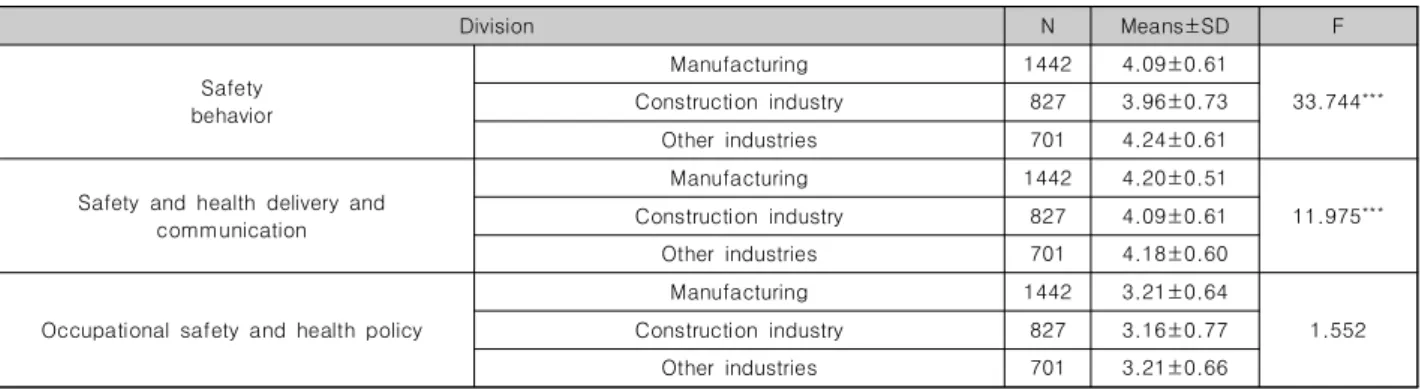
업종에 따른 안전행동, 안전보건전달 및 의사소통, 산업안 전보건정책 만족도 차이는 안전행동의 경우 기타산업이 4.24±0.61점으로 가장 높게 나타났고 건설업이 3.96±0.73점 으로 가장 낮게 평가되었다(p<0.001). 안전보건전달 및 의사 소통은 제조업이 4.20±0.51점으로 가장 높게 나타났고, 건설 업이 4.09±0.61로 가장 낮게 나타났으며(p<0.001), 산업안전 보건정책 만족도는 기타산업 3.21±0.66점, 제조업

3.21±0.64점으로 건설업에 비하여 높게 나타났으나 통계적 차이는 나타나지 않았다(Table 3).

3.2 Difference by Number of employees

상시근로자 수에 따른 안전행동, 안전보건전달 및 의사소

통, 산업안전보건정책 만족도 차이는 안전행동의 경우 300인

이상이 4.13±0.73점으로 가장 높게 나타났으나 상시근로자

수에 따른 통계적인 차이가 없었다. 안전보건전달 및 의사소

통은 300인 이상이 4.25±0.58점으로 가장 높았고 49인 이하

가 4.07±0.63점으로 가장 낮았으며, 상시근로자 수가 많을수

록 높게 나타났다(p<0.001)(Table 4).

(5)

Division N Means±SD F

Safety behavior

Parent company 2061 4.09±0.65

7.469 **

Prime contractor/subcontractor 542 4.01±0.72 Cooperative firm of the prime contractor 367 4.18±0.52

Safety and health delivery and communication

Parent company 2061 4.17±0.56

4.746 **

Prime contractor/subcontractor 542 4.11±0.62 Cooperative firm of the prime contractor 367 4.25±0.50

Occupational safety and health policy

Parent company 2061 3.20±0.70

1.416 Prime contractor/subcontractor 542 3.15±0.67

Cooperative firm of the prime contractor 367 3.22±0.61

** p<0.01, *** p<0.001

Table 5. Differences in safety behavior, safety and health delivery and communication, occupational safety and health policy satisfaction according to the relationship between companies

Division N Means±SD F

Safety behavior

49 343 4.04±0.69

1.386

50인-99인 1120 4.10±0.63

11001-299 1158 4.08±0.63

300 349 4.13±0.73

Safety and health delivery and communication

49 343 4.07±0.63

7.104 ***

50인-99인 1120 4.15±0.55

11001-299 1158 4.19±0.56

300 349 4.25±0.58

Occupational safety and health policy

49 343 3.16±0.73

0.682

50인-99인 1120 3.21±0.65

11001-299 1158 3.19±0.68

300 349 3.20±0.77

*** p<0.001

Table 4. Differences in safety behavior, safety and health delivery and communication, occupational safety and health policy satisfaction according to the number of workers

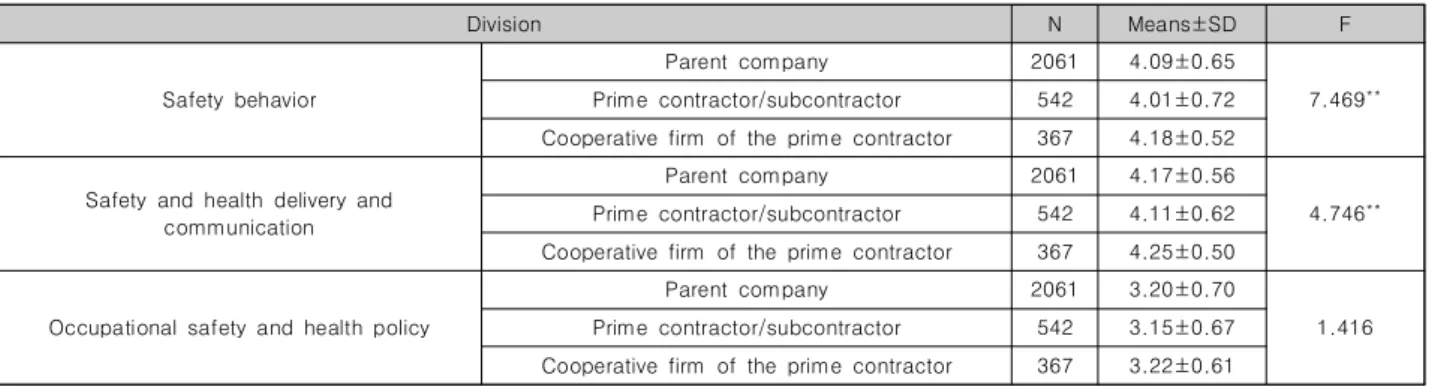
3.3 Difference by relationship between companies 기업 간 관계에 따른 안전행동, 안전보건전달 및 의사소통, 안전·보건문화, 산업안전보건정책 만족도 차이는 안전행동의 경우 원청 업체의 사내외 협력업체가 4.18±0.52점으로 가장 높게 나타났고 원청/하청업체가 4.01±0.72점으로 가장 낮게 나타났다(p<0.01). 안전보건전달 및 의사소통은 원청 업체의 사내외 협력업체가 4.25±0.50점으로 가장 높게 나타났고 원 청/하청업체 4.11±0.62점으로 가장 낮게 나타나 차이를 보였 다(p<0.01)(Table 5).

4. Impact of safety behavior, safety and health delivery and communication on occupational safety and health policy satisfaction according to the characteristics of the company

4.1 Impact of type of Business

업종에 따른 안전행동, 안전보건전달 및 의사소통이 산업안 전보건정책 만족도에 미치는 영향은 제조업의 경우 안전행동, 안전보건전달 및 의사소통에 의하여 산업안전보건정책 만족도 는 7.0% 설명되었고, 안전행동(p<0.001), 안전보건전달 및 의 사소통(p<0.001) 순으로 영향을 미치는 것으로 나타났다. 건

설업의 경우 8.8%가 설명되었고, 안전보건전달 및 의사소통 (p<0.001), 안전행동(p<0.001) 순으로 영향을 미치는 것으로 나타났다. 기타 산업의 경우 6.7%가 설명되었고, 안전보건전 달 및 의사소통(p<0.001), 안전행동(p<0.001) 순으로 영향을 미치는 것으로 나타났다(Table 6).

4.2 Impact of Number of employees

상시 근로자 수에 따른 안전행동, 안전보건전달 및 의사소

통이 산업안전보건정책 만족도에 미치는 영향은 49인 이하의

경우 안전행동, 안전보건전달 및 의사소통에 의하여 산업안전

보건정책 만족도는 7.2%가 설명되었고, 안전보건전달 및 의사

소통(p<0.01)만 영향을 미치는 것으로 나타났다. 50인-99인

의 경우 6.4%가 설명되었고, 안전보건전달 및 의사소통

(p<0.001), 안전행동(p<0.001) 순으로 영향을 미치는 것으로

나타났으며, 100-299인의 경우 8.1%가 설명되었고, 안전행

동(p<0.001), 안전보건전달 및 의사소통(p<0.001) 순으로 영

향을 미치는 것으로 나타났다. 300인 이상은 9.2%가 설명되

었고, 안전행동(p<0.001), 안전보건전달 및 의사소통(p<0.01)

순으로 영향을 미치는 것으로 나타났다(Table 7).

(6)

Relationship

between companies Independent variable B β t R 2

(Adj. R 2 ) F

Parent company

(constant) 1.555   12.759 ***

0.085

(0.084) 95.883 ***

Safety behavior .203 .188 8.039 ***

Safety and health delivery and communication .196 .157 6.735 ***

Prime contractor/

subcontractor

(constant) 2.014   9.697 ***

0.054

(0.051) 15.396 ***

Safety behavior .090 .097 2.103 *

Safety and health delivery and communication .190 .176 3.825 ***

Cooperative firm of the prime contractor

(constant) 1.605   5.220 ***

0.072

(0.067) 14.212 ***

Safety behavior .214 .182 3.329 **

Safety and health delivery and communication .171 .140 2.558 **

Dependent variable: Occupational safety and health policy

* p<0.05, ** p<0.01, *** p<0.001

Table 8. Impact of safety behavior, safety and health delivery and communication on occupational safety and health policy satisfaction according to the relationship between companies

Number of Independent variable B β t R 2

(Adj. R 2 ) Femployees

49

(constant) 1.727   6.366 ***

0.078

(0.072) 14.336 ***

Safety behavior .107 .102 1.670

Safety and health delivery and communication .245 .213 3.497 **

50-99

(constant) 1.803   11.203 ***

0.065

(0.064) 39.092 ***

Safety behavior .146 .142 4.546 ***

Safety and health delivery and communication .196 .167 5.341 ***

100-299

(constant) 1.598   9.911 ***

0.082

(0.081) 51.911 ***

Safety behavior .212 .197 6.309 ***

Safety and health delivery and communication .174 .142 4.547 ***

300

(constant) 1.415   4.567 ***

0.097

(0.092) 18.666 ***

Safety behavior .224 .213 3.717 ***

Safety and health delivery and communication .202 .152 2.648 **

Dependent variable: Occupational safety and health policy

** p<0.01, *** p<0.001

Table 7. Impact of safety behavior, safety and health delivery and communication on occupational safety and health policy satisfaction according to the number of regular workers

Type of business Independent variable B β t R 2

(Adj. R 2 ) F

Manufacturing

(constant) 1.703   11.354 ***

0.071

(0.070) 54.888 ***

Safety behavior .200 .188 6.875 ***

Safety and health delivery and communication .165 .131 4.789 ***

Construction industry

(constant) 1.492   7.999 ***

0.091

(0.088) 40.998 ***

Safety behavior .165 .157 4.272 ***

Safety and health delivery and communication .248 .199 5.432 ***

Other industries

(constant) 1.806   9.252 ***

0.070

(0.067) 26.097 ***

Safety behavior .163 .149 3.509 ***

Safety and health delivery and communication .170 .155 3.643 ***

Dependent variable: Occupational safety and health policy

*** p<0.001

Table 6. Impact of safety behavior, safety and health delivery and communication on occupational safety and health policy satisfaction according to the type of business

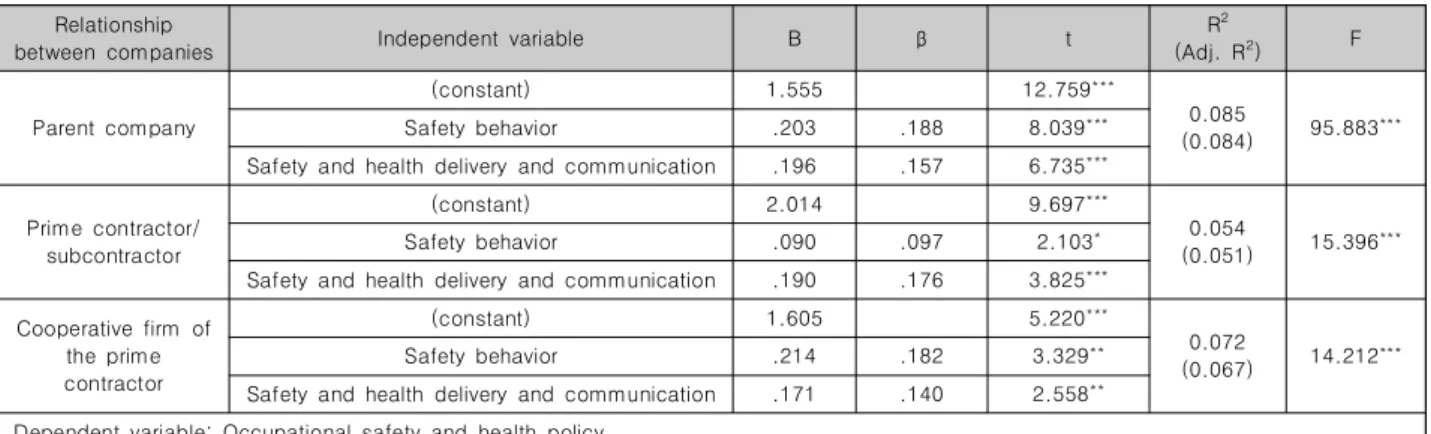
4.3 Impact of relationship between companies 기업 간 관계에 따른 안전행동, 안전보건전달 및 의사소통 이 산업안전보건정책 만족도에 미치는 영향은 모기업의 경우 안전행동, 안전보건전달 및 의사소통에 의하여 산업안전보건

정책 만족도는 8.4%가 설명되었고, 안전행동(p<0.001), 안전

보건전달 및 의사소통(p<0.01) 순으로 영향을 미치는 것으로

나타났다. 원청/하청업체의 경우 5.1%가 설명되었고, 안전보

건전달 및 의사소통(p<0.001), 안전행동(p<0.05) 순으로 영향

(7)

을 미치는 것으로 나타났다. 원청의 협력업체의 경우 6.7%가 설명되었고, 안전행동(p<0.01), 안전보건전달 및 의사소통 (p<0.01) 순으로 영향을 미치는 것으로 나타났다(Table 8).

Ⅴ. Conclusion

본 연구에서는 사업장의 안전보건관리를 위하여 안전행동, 안전보건전달 및 의사소통이 산업안전보건정책 만족도에 미치 는 영향을 파악하고 정책적 지원과 예방 대책 마련 방안 자료 로 활용하고자 수행되었다. 이를 위하여 ‘2015년도 산업안전 보건 동향조사’자료를 활용하여 2,970개 사업장을 대상으로 통계분석을 실시하였다.

그 결과 제조업, 300인 이상 사업장, 원청의 협력업체의 안 전행동, 안전보건전달 및 의사소통이 높게 나타나 업종, 근로 자 수, 기업 간의 관계에 따라 차이를 보였다. 또한 제조업은 안전행동, 건설업과 기타 산업은 안전보건전달 및 의사소통이 산업안전보건정책 만족도에 가장 큰 영향을 미치는 것으로 나 타났다. 근로자 수의 경우 49인 이하의 경우 안전보건전달 및 의사소통만 영향을 미치는 것으로 나타났으며, 50인-99인은 안전보건전달 및 의사소통, 100-299인과 300인 이상은 안전 행동이 가장 큰 영향을 미치는 것으로 나타났다. 기업 간 관계 의 경우 모기업과 원청의 협력업체는 안전행동, 원청/하청업 체는 안전보건전달 및 의사소통이 가장 큰 영향을 미치는 것 으로 나타났다.

이를 통하여 기업의 특성에 맞는 안전행동과 안전보건전달 및 의사소통 시스템을 구성하였을 때 안전보건 관리의 효과가 높아질 것으로 예상되며, 중·소사업장의 경우 안전보건의 자발 적 활동과 체계적인 안전관리 시스템 구축을 위하여 정부와 유관기관의 적극적인 관리와 지원이 필요한 것으로 사료된다.

추후 ‘산업안전보건 동향조사’의 시기별 자료를 수집하여 국내 사업장의 안전보건활동에 관한 변화 및 경향을 파악하고 안전문화 정착을 위한 연구를 제안한다.

REFERENCES

[1] Kyrhee, “The effect of the occupational safety and health activities on perception of the Level of occupational safety and health in Korean manufacturing enterprises”, Korea Social Policy Review, Vol. 18, No. 4, pp.79-111, Dec, 2011.

[2] Jbrim, “Focus on safety and health policy and system improvement activities”, The Hankuk Nochong News, 520, pp. 16-17, Dec. 2015.

[3] A. Neal, M.A. Griffin, & P.M. Hart, “The impact of organizational climate on safety climate and individual behavior”, Safety science, Vol. 34 No. (1-3), pp. 99-109, Feb. 2000.

[4] L.A. James, L.R. James, “Integrating work environment perceptions: Explorations into the measurement of meaning”, Journal of Applied Psychology, Vol. 74, pp.

739-751, Oct. 1989.

[5] L.R. James, M.D. McIntyre, "Perceptions of organizational climate." Individual differences and behavior in organizations, pp. 416-450, 1996.

[6] J. Mullen, J., “Investigating factors that influence individual safety behavior at work”, Journal of safety research, Vol. 35, No. 3, pp. 275-285, June. 2004.

[7] M. A. Griffin, and A. Neal, A., “Perceptions of safety at work: a framework for linking safety climate to safety performance, knowledge, and motivation”, Journal of Occupational Health Psychology, Vol. 5, No. 3, pp.

347-358, July. 2000.

[8] Nkseo, yglee, wbkim, kylee, “Effects of Occupational Safety Communication in Workplace on Safety Consciousness and Action of Employees”, Journal of the Korea Safety Management and Science, Vol. 12, No. 2, pp. 9-16, June. 2010.

[9] A.J. Mento, R.P. Steel, R, and R.J. Karren, “A meta-analytic study of the effects of goal setting on task performance: 1966–1984”, Organizational behavior and human decision processes, Vol. 39 No.1, , pp. 52-83, Feb. 1987.

[10] Wylee, “Influence of job insecurity, organizational commitment, and safety climate on safety behavior and accidents”, In Proceedings of the KSR Conference, Korean Society for Railway, pp. 169-174, May. 2005.

[11] E.S. Geller, and S.W. Clarke, “Safety self-management:

A key behavior-based process for injury prevention”, Professional Safety, Vol. 44, No. 7, pp. 29, Jul. 1999.

[12] D. Zohar, A. Cohen, and N. Azar, “Promoting increased use of ear protectors in noise through information feedback”, Human Factors, Vol. 22, pp. 69-79, Feb.

1980.

[13] Szoah, jhlee, khlee, ksmoon, “The effect of behavior based safety(BBS) program on safety climate and safety behaviors: A field study”, Korean Journal of Industrial and Organizational Psychology, Vol. 25, No.

2, 349-372, Aug. 2012.

[14] Sjjang, “Study on the Qualification on Safety Managers in Manufacturing Industries and Improving the Standards on Assigning”, Myongji University Master dissertation, pp. 2-10. 2010.

[15] Jikim, sychoi, “ A Study on the Comprehension of the

(8)

Industrial Safety Policy Direction by Job Characteristics of Safety Managers”, Korea Safety Management &

Science, Vol. 14, No. 4, pp. 1-12, Dec. 2012.

[16] Cslee, “ A Study on the Relation Between Designation of Safety Manger and Occupation Health and Safety Activities”, Incheon National University Master dissertation, pp. 7-14. 2019.

[17] S.M. Conchie, and I.J. Donald, I. J., “The moderating role of safety-specific trust on the relation between safety-specific leadership and safety citizenship behaviors”, Journal of Occupational Health Psychology, Vol. 14, No. 2, pp. 137-147, Apr. 2009.

[18] K.T. Dirks, and D.L. Ferrin, D. L., “Trust in Leadership:

Meta-analytic findings and Implications for Research and Practice”, Journal of Applied Psychology, Vol. 87, No. 4, pp. 611-628, Aug. 2002.

[19] Kikim, jwpark, msjeong, “Association between Communication for Chemical Hazards Information and Characteristics of Occupational Safety and Health manager”, Journal of Korean Society of Occupational and Environmental Hygiene, Vol. 22, No. 2, pp.

156-163, June. 2012.

Authors

Seo-Yeon Choi received the Ph.D degree in Industrial Engineering and degrees in Social & Preventive Medicine from Inha University at 2008 and 2014.Dr. Choi is currently a professor in the Department of Health Counseling Welfare at Hanseo University.She is interested in Occupational Health, Ergonomics, Safety culture.

Prof. Han-Suk Jung is the chiropractic department head at the HanSeo University.

Currently, he is an advisor for International Board of Chiropractic Examiners and board member of Council on Chiropractic Education Australasia

Joo-Hyun Ham received the master degree

and Ph.D degree in Physiology from

Soonchunhang Medical University at 2005

and 2008. Dr. Ham is currently a professor

of the department of Health Counseling

Welfare at Hanseo University. She is very interested in

industrial safety and musculoskeletal disorders.

수치

Table 1. General characteristics of the target establishments
Table  3.  Differences  in  safety  behavior,  safety  and  health  delivery  and  communication,  occupational  safety  and  health  policy  satisfaction  according  to  the  type  of  business
Table  4.  Differences  in  safety  behavior,  safety  and  health  delivery  and  communication,  occupational  safety  and  health  policy  satisfaction  according  to  the  number  of  workers
Table  6.  Impact  of  safety  behavior,  safety  and  health  delivery  and  communication  on  occupational  safety  and  health  policy  satisfaction  according  to  the  type  of  business

참조

관련 문서

Stavins, Benefit-Cost Analysis in Environmental, Health, and Safety Regulation, American Enterprise Institute, The Annapolis Center, and Resources for the

In the second case, regional maritime safety tribunal will play the role as the 1st instance for the most ordinary marine accidents and central maritime safety tribunal may be

Objective: The purpose of this study is to investigate the relationship between employee satisfaction and patient safety and quality improvement after compulsory certification

And the objective of radiation safety control is to ensure radiation safety by limiting the probability of stochastic effects below the acceptable ALARA

In this thesis, a methodology using the VISSIM simulation model and surrogate safety assessment model (SSAM) was utilized to quantify the impacts of the leading

In conclusion, the result that the walk-using safety educational activities designed for young children had effects on their safety problem solving ability

The Institution of Engineering and Technology, Lifting Operations and Lifting Equipment Regulations 1998(LOLER), Health &amp; Safety Briefing No. 63) The Institution of

Other common applications of lasers are bar code readers, laser printers and laser pointers....