총설
미생물 유래 특이당을 이용한 플라보노이드 당화반응
오태진, 송재경*
Flavonoid Glycosylation Using Microbial-produced Unusual Sugar
Tae-Jin Oh and Jae Kyung Sohng*
접수: 2011년 3월 24일 / 게재승인: 2011년 4월 23일
© 2011 The Korean Society for Biotechnology and Bioengineering
Abstract:1)Glycosylation is a key mechanism in determining diversity of natural products, and influencing their bioactivities.
This approach requires a core set of glycosyltransferase that synthesizes the diverse sugar structures observed in nature.
Recently, the researchers have begun to alter the sugar moiety and glycosylation patterns of natural products both in vivo E. coli system and in vitro for their glycodiversification.
This review highlights new glycosylation tools using microbial- produced deoxysugar and a flexible glycosyltransferase on natural plant-flavonoids to generate novel glycoforms with useful biological activity.
Keywords: Biosynthesis, Carbohydrate, Deoxysugar, Flavonoid, Glycosylation, Glycosyltransferase
1. 서론
자연에서 생산되는 많은 탄수화물들은 중요한 집단으로서 에너지원과 생물학적 골격의 구성성분으로 오랫동안 알려져 왔으며, 최근에는 세포들 사이의 인식, 단백질의 안정성, 효 소의 활성 및 억제 등의 상당히 다양한 생물학적 그리고 생화 학적 반응에 참여하는 것으로 밝혀져 왔다 [1,2]. 실제 인간 의 당단백질 (당지질)은 D-glucose, D-galactose, D-mannose, L-fucose, N-acetyl-D-glucosamine, N-acetylneuraminic acid
선문대학교 제약공학과 생체분자재설계연구소
Institute of Biomolecule Reconstruction (iBR), Department of Pharmaceutical Engineering, SunMoon University, #100, Kalsan-ri, Tangjeong-myeon, Asan-si, Chungnam 336-708, Republic of Korea Tel: +82-41-530-2246, Fax: +82-41-544-2919
e-mail: [email protected]
등을 포함한 하나 이상의 탄수화물 연결로 구성되어 있으며, 식물 유래 사포닌, 플라보노이드, 알칼로이드 등도 골격의 당부분으로 D-glucose, D-galactose, L-fucose, L-rhamnose, D-xylose 등을 포함하고 있다 [3]. 이와 반대로, 미생물 유래 많은 생리활성물질들 (macrolide, anthracycline, polyether, polyene, enedidyne, polypeptide, terpene, aminoglycoside 계 열 등)은 대부분 데옥시당인 aminodeoxysugar, dideoxysugar, nitrosugar, sialic acid 등을 포함하고 있다. 이들 데옥시당은 에너지원으로 사용되는 육탄당과 달리 일반적으로 안정하기 때문에 골격 역할뿐만 아니라, 직접적인 생물학적 활성을 갖 거나 또는 생물학적 활성의 효력 및 기질특이성을 높이는 등 의 다양한 역할을 보여주고 있으며 [4] 또한 현재 여러 항암, 항생, 항바이러스 및 면역강화제로서 사용되고 있다 (Fig. 1).
생물학적 시스템 관점에서 가장 다양한 그룹에 속해 있는 효소인 글라이코실트랜스퍼라제라는 당화효소는 생리활성 물질들의 구조변형에 있어 당을 어글라이콘에 붙임으로써 구조적으로나 기능적으로 그 다양성을 촉매하는 반응을 보여 준다 [5]. 현재까지 단백질 데이터뱅크 안에 15,800 여개의 당화효소가 등록이 되어 있으며, 그들의 아미노산 서열 유사 성을 바탕으로 91개 종류로 분류되어 있다 [6,7]. 당화효소 의 단백질 구조적인 면에서 GT-A와 GT-B로 크게 두 종류 로 나누어지며, linker 부분으로 연결되어진 각각 두 개의 도메인 (N-terminal 도메인과 C-terminal 도메인)으로 구성 되어 활성부위를 포함하고 있다 [8,9]. 대부분의 박테리아 당화효소는 UDP 당과 반응할 수 있는 44 아미노산의 부재 로 진핵생물의 당화효소와 구별이 되며 [10], 이들 박테리아 당화효소는 family I 으로서 생화학적으로 새로운 분자를 생산 할 수 있다고 잘 알려져 있다 [11].
Talose를 포함하는 talosin 및 몇몇 예외를 제외하고 [12]
대부분의 식물 유래 천연물 (플라보노이드, 터페노이드, 스테 로이드 계열 등)들은 이차대사에 존재하는 다양한 특이당인
Fig. 1. Structures of some glycosylated natural compounds.
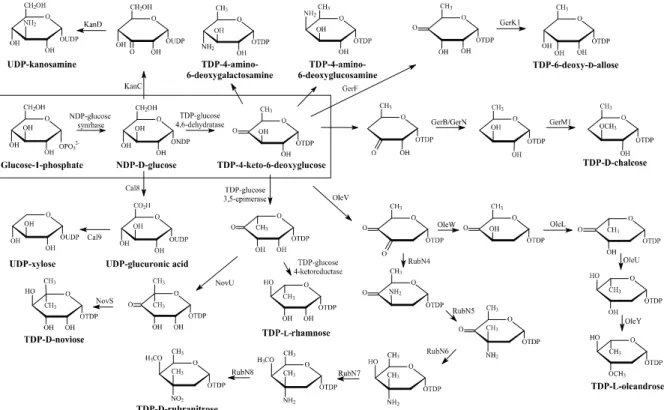
Fig. 2. Biosynthetic pathway of several deoxysugars.
데옥시당을 포함하지 않고 일차대사 관련 당들로 구조를 이루고 있다. 또한 미생물에서 생산되지 않는 이들 식물 유래 천연물들은 대단히 낮은 수용성을 지니고 있기 때문 에 당화반응을 이용한 구조변형 및 약물동력학 성질을 증 가시킬 수 있다. 그 예로 식물에서 분리되는 간보호 항산
화제(hepatoprotective drug)인 flavonolignan silybin은 한 두개의 당화반응에 의해 4-40배의 수용성 증가로 약물의 성질을 변화시킬 수 있는 것으로 보고되었다 [13]. 따라서 본 총설에서는 박테리아에서 알려진 다양한 데옥시당 생합 성유전자와 이들 당화효소를 식물 유래 천연물에 응용하여
(a) (b)
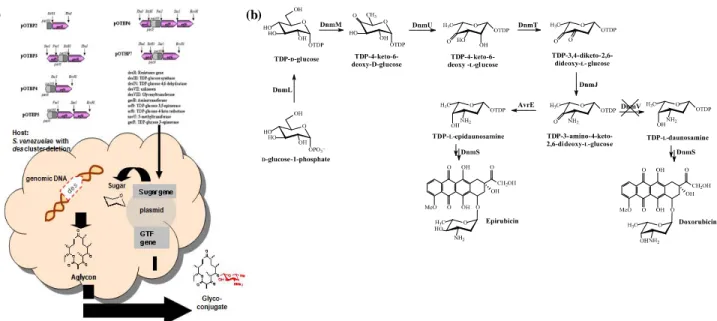
Fig. 3. (a). Formation of glycosylated derivatives by combinatorial biosynthesis using deoxysugar biosynthetic genes. (b) Generation of 4'-epidoxorubicin by combining gene inactivation and overexpression.
새로운 생리활성물질의 생산 및 당화효소 반응을 극대화 시 킬 수 있는 다양한 방법과 결과에 대하여 고찰하고자 한다.
2. 미생물 유래 특이당의 생합성 및 그들의 응용
구조적으로 다양한 데옥시당을 포함하는 미생물 유래 여러 천 연물 관련 생합성 과정이 최근에 유전자 차원에서 밝혀지고 있다 (Fig. 2), 특히 6-데옥시당을 포함하는 2,6-dideoxysugar, 3,6-dideoxysugar, 4,6-dideoxtsuagr, trideoxysugar, aminodeoxysugar 등 현재 200 여 가지 당들의 생합성 과정 이 알려져 있으며, 현재 많은 연구자들이 이들 생합성 과정 을 확인하고 있다 [14], 또한 이들의 생합성과정에 참여하는 유전자 등이 밝혀지면서 in vivo에서 각 당의 구조에 따라 유전자를 재조합하여 새로운 당을 생합성하는 연구가 활발 히 진행 중이다. 특히 데옥시당 생합성 유전자의 유전공학을 이용하여 새로운 당으로 교체된 유도체 개발이 활발히 진행 되고 있으며, 기존에 있는 당 유전자를 제거하고, 합성하고자 하는 당의 생합성 유전자를 조합하여 이종숙주에서 발현하 거나 혹은 어글라이콘을 외부에서 제공하여 당화반응을 시 도하고 있다 [15-19] (Fig. 3(a)). 대표적인 예로 유기화학적 으로 합성이 까다로운 화합물로서 독소루비신의 유도체인 에피루비신을 들 수 있는데, Hutchinson 그룹에서는 합성 수율이 대단히 낮다는 단점을 극복하기 위해 독소루비신 생 산 균주인 Streptomyces peucetius에서 당 생합성 유전자 중에 에피머라제 효소를 제거하고 새로운 유전자를 도입함 으로써 in vivo 상에서 에피루비신의 생산증대를 보여준 바 있다 [20] (Fig. 3(b)).
게다가 in vitro에서 각 유전자들의 발현된 효소를 이용하 여 one-pot reaction에 의한 nucleotide-sugar 뿐만 아니라 신규 생리활성물질 등의 대량 합성 및 생산이 가능하다 [21].
Glucose-1-phosephate와 NMP로부터 ATP의 재활용기술과 NADH의 재활용기술 등을 이용하고 또한 생합성 과정에서 그 기능이 확인된 당 관련 생합성 효소를 이용하여 다양한 nucleotide-sugar를 one-step-reaction에 의해 합성하는 방법 이 잘 알려져 있다 [22-24]. 또한 CMP kinase, acetate kinase, CMP neuAc synthase, NeuAc aldolase, GlcNac-2-epimerase 등 총 5개의 효소를 one step으로 반응시켜 CMP-sialic acid 및 2,3-sialyllactose를 생산한 이후 (Fig. 4(a)), 기존 항생제 인 반코마이신/슈도반코마이신을 기질로 알려진 당화효소 (galactosyltransferase와 sialyltransferase)를 이용하여 얻어진 새로운 활성의 신물질 또한 보고되어 있다 [25] (Fig. 4(b)).
3. 생물학적 유연성을 지닌 당화효소
많은 이차대사물질인 항생제, 항암제, 면역억제제의 구조적 다양성은 그들 어글라이콘의 특별한 부위에 붙어있는 당에 기인하기 때문에 그 생합성에 관여하는 당화효소의 기질유 연성에 대한 연구가 활발히 진행되어 왔다. 이 중 맥크롤 라이드 계열 메티마이신 (S. venezuelae)의 DesVII/DesVIII 와 안쓰라사이클린 계열 엘로라마이신 (S. olivaceus)의 UrdGT2 등에 대한 당화효소의 역할과 기능의 다양성에 대하 여 보고되었다 (Fig. 5) [26-28]. 또한 새로운 당화효소의 확보 차원에서 Bechthold 그룹은 당화효소의 도메인 유사성 부분 에서 hybrid oligonucleotide 프라이머를 이용한 polymerase chain reaction (PCR) 방법을 이용하여 여러 actinomycetes 로부터 22개의 신규 당화효소를 분리하는데 성공하기도 하 였다 [29]. 그리고 최근 Thorson 그룹에서는 당을 부착시켜 주는 기존 당화효소의 전형적인 메카니즘과 달리 당 합성/당 교환/어글라이콘 교환 등 다양한 촉매활성을 지닌 당화효소 (CalG1, GtfD, GtfE) 등의 응용력을 인다인 계열의 캘리캐
(a)
(b)
Fig. 4. (a) One-pot enzymatic production for TDP-4-amino-4,6-dideoxyglucose. (b) Enzymatic incorporations of galactose and sialic acid into pseudo-vancomycin and vancomycin.
Fig. 5. Formation of glycosylated derivatives on methymycin/pikromycin.
아마이신과 글라이코펩타이드 계열의 반코마이신 등에 적용 하여 70 여 개의 신규 유도체 합성을 성공하였다 [30]. 따라 서 이러한 결과 등에서 볼 수 있듯이 생물학적 유연성이 다 양한 당화효소의 확보 및 적용은 기존의 천연물의 구조를 변형시킬 수 있음이 이미 증명되었고 현재 당화효소의 재 그룹핑, 컴퓨터를 이용한 당화효소 단백질의 모델링, 도메인 스와핑 및 공학시스템 등 새로운 신기술을 도입하여 좀 더 가치 있는 당화효소 개발을 시도하고 있다.
4. 당화효소를 이용한 새로운 플라보노이드 생산
국내외 플라보노이드 관련 당화반응에 대한 특허는 대부분 플라보노이드 소스 관련 추출과 제조방법 및 조성물에 대한 생물학적 활성의 기술 부분으로 일부 포도당의 당화반응 에 대한 내용이 알려져 있다. 최근 건국대 안중훈 교수팀은 Bacillus cererus의 당화효소를 이용한 in vitro에서 UDP- glucose를 kaemperol, quercetin 등에 당화시킨 내용을 보고 하였으며 [31], 국외 일본의 경우, Horinouch 교수팀은 식물 유래 플라보노이드 생합성 유전자를 대장균에 도입하여 그 생산 가능성을 입증하였다 [32,33]. 따라서 당화효소를 이용 한 대장균 내에서의 플라보노이드 생산은 가능하리라 여겨 지며, 현재 본 연구팀에서 수행하고 있는 몇 가지 전략적 접 근 방법을 Fig. 6에서 소개하고자 한다. 첫 째, UDP-D-glucose 의 생산을 증가시키기 위한 대장균의 유전자 조작이 수행 되어야 한다. Glucose-1-phosphate의 pool을 늘리기 위해 glucose-6-phosphate isomerase (pgi) 유전자를 제거한 pgi- 돌연변이 대장균 숙주박테리아를 개발한다 [34]. 두 번째, UDP-D-glucose 혹은 TDP-D-glucose의 합성을 위한 유전자 재조합 단계로서, UDP-glucose synthase (galU) 유전자를 pLOI223 (NBRP, NIG, Japan) 벡터에 삽입한 pLOIGalU 제작 (Fig. 6(a)), 그리고 TDP-glucose synthase (TGS) 및 TDP-glucose 4,6-dehydratase (DH) 유전자를 pCDFDuet-1 (Novagen, USA) 벡터에 삽입한 pCDTGSDH를 제작한 이후 에 마지막으로 제작된 벡터를 대장균 숙주박테리아에 각각 삽입한다 (Fig. 6(b) and (c)). 세 번째는 다양한 당 (xylose, rhamnose, allose)을 합성하기 위한 생조합 단계이다. UDP- glucose는 calS7 (UDP-glucose dehydrogenase)에 의해 UDP-glucuronic acid가 합성되며 , calS8 (UDP-glucose decarboxylase)에 의해 UDP-xyloase가 합성될 수 있도록 두 유전자를 발현벡터인 pCDFDuet-1에 재조합하여 pCDS89 를 제작한다 (Fig. 6(a)). 그리고 TDP-glucose는 TDP-4-keto- 6-deoxyglucose가 합성된 다음, TDP-glucose 3,5-epimerase (EP)와 TDP-glucose 4-ketoreductase (KR)에 의해 TDP-L- rhamnose가 합성되는 두 유전자를 pACYCDuet-1 (Novagen, USA) 벡터에 재조합하여 pACEPKR 제작하며 (Fig. 6(b)), 또한 TDP-glucose 3-epimerase (gerF)와 TDP-glucose 4-ketoreductase (gerK)에 의해 TDP-6-deoxy-D-allose가 합성되는 두 유전자를 재조합하여 pAC-GerFK를 제작한 다 (Fig. 6c). 그리고 마지막으로 이들을 대장균 숙주박테리 아에 전이하여 균주시스템을 제작한다 [34-36]. 결과적으로
이렇게 재조합된 유전자들은 대장균 안에서 여러 가지 당화 효소와 함께 발현되어 xylose, gluculonic acid, rhamnose 및 6-deoxyallose가 포함된 플라보노이드 등을 생산하게 된 다. 현재 본 연구팀은 위에서 설명한 여러 당화반응이 가능 한 대장균 플라보노이드 생산시스템을 quercetin, narigenicin, 및 kaempferol 등의 천연물에 적용하여 7-O-glucuronyl narigenicin, 7-O-glucuronyl quercetin, 3-O-glucuronyl quercetin, 7-O-xylosyl nargenicin, 3-O-rhamnosyl-quercetin, 3-O-rhamnosyl-kaemperol 및 3-O-deoxyallosyl-quercetin 등의 새로운 특이당을 포함하는 플라보노이드의 합성을 확인 하였으며, 또한 이러한 시스템을 다른 천연물에 응용 연구 하고 있다 [34-36].
(a)
(b)
(c)
Fig. 6. Strategy to produce xylosyl-flavonoids, glucuronyl-flavonoids (a), rhamnosyl-flavonoids (b), allosyl-flavonoids (c) in E. coli.
5. 결론
자연에 존재하지 않는 특이한 당 구조를 포함하는 플라보
노이드의 합성 시스템은 대장균 feeding을 이용하여 간단 하게 다양한 당을 수식할 수 있는 원천기술이다. 또한 rhamnosyl-플라보노이드 계열 화합물은 항바이러스 및 안구질환 치료 및 예방효과가 있는 것으로 알려져 있으며, 일반적으로 특이당이 합성된 신규 플라보노이드는 항균제, 항곰팡이제, 항산화제 등 다양한 용도로 사용 가능할 것이다.
따라서 이러한 생물전환 기술은 천연물로부터 무작위한 방법 으로 활성물질을 탐색하는 방법보다는 예상되는 약리작용 을 갖는 물질을 디자인하여 창출할 수 있다는 점에서 미래의 신약개발에 주요 기술로 대두가 될 것으로 생각된다. 특히 이미 약효가 입증될 가능성이 높은 신약 개발의 접근 방법으 로서 여러 가지 미생물 유래 항암, 항생제들로부터 우수한 개량의약품 및 개량 신약을 창출할 수 있을 뿐만 아니라, 시간적으로나 연구비용으로 볼 때 매우 경제적인 신약 및 기능성물질 개발의 발전에도 이용될 수 있을 것이다. 식물은 미생물에서 생산되지 않는 다양한 플라보노이드, 터페노이드, 스테로이드 계열 천연물을 생산하며, 이들 식물 유래 천연물 들의 당은 일차대사 과정의 당을 포함하고 있다. 따라서 본 연구의 배경은 미생물 유래 다양한 데옥시당을 식물 유래 천연 물에 도입함으로써 새로운 유용 신규 생리활성물질의 창출 가능성을 증대시킬 수 있으며 또한 새로운 생리활성을 기대 할 수 있을 것으로 사료된다.
감사
이 논문은 2010년도 정부 (교육과학기술부)의 재원으로 한국 연구재단의 기초연구사업 (No. 2010-0015478)과 2011년 도 정부 (농촌 진흥청)의 재원으로 차세대 바이오 그린21사 업의 지원을 받아 수행된 연구임 (SSAC No. PJ 008013).
References
1. Bolen, D. W. (2001) Protein stabilization by naturally occurring osmolytes. Meth. Mol. Biol. 168: 17-36.
2. Pilobello, K. T. and L. K. Mahal (2007) Deciphering the glycocode:
the complexity and analytical challenge of glycomics. Curr.
Opin. Chem. Biol. 11: 300-305.
3. Luzhetskyy, A., C. Méndez, J. A. Salas, and A. Bechthold (2008) Glycosyltransferases, important tools for drug design. Curr.
Top. Med. Chem. 8: 680-709.
4. White-Phillip, J., C. J. Thibodeaux, and H. W. Liu (2009) Enzymatic synthesis of TDP-deoxysugars. Methods Enzymol.
459: 521-544.
5. Bongat, A. F. and A. V. Demchenko (2007) Recent trends in the synthesis of O-glycosides of 2-amino-2-deoxysugars. Carbohydr.
Res. 342: 374-406.
6. Davies, G. J., T. M. Gloster, and B. Henrissat (2005) Recent structural insights into the expanding world of carbohydrate- active enzymes. Curr. Opin. Struct. Biol. 15: 637-645.
7. Cantarel, B. L., P. M. Coutinho, C. Rancurel, T. Bernard, V.
Lombard, and B. Henrissat (2009) The carbohydrate-active enzymes database (CAZy): an expert resource for glycogenomics.
Nucl. Acids Res. 37: D233-D238.
8. Jank, T., T. Giesemann, and K. Aktories (2007) Rho-glucosylating Clostridium difficile toxins A and B: insights into structure and function. Glycobiology 17: 15R-22R.
9. Mittler, M., A. Bechthold, and G. E. Schulz (2007) Structure and action of the C-C bond-forming glycosyltransferase UrdGT2 involved in the biosynthesis of the antibiotic urdamycin. J.
Mol. Biol. 372: 67-76.
10. Lim, E.-K. and D. J. Bowles (2004) A class of plant glycosyltransferases involved in cellular homeostasis. EMBO J. 23: 2915-2922.
11. Méndez, C., A. Luzhetskyy, A. Bechthold, and J. Salas (2008) Deoxysugars in bioactive natural products: development of derivatives by altering the sugar pattern. Curr. Med. Chem. 8:
710-724.
12. Karki, S., H. G. Yoo, S. Y. Kwon, J. W. Suh, and H. J. Kwon (2010) Cloning and in vitro characterization of dTDP-6-deoxy-L-talose biosynthetic genes from Kitasatospora kifunensis featuring the dTDP-6-deoxy-L-lyxo-4-hexulose reductase that synthesizes dTDP-6-deoxy-L-talose. Carbohydr. Res. 345: 1958-1962.
13. Wu, J. W., L. C. Lin, and T. H. Tsai (2009) Drug-drug interactions of silymarin on the perspective of pharmacokinetics. J.
Ethnopharmacol. 121: 185-193.
14. Weymouth-Wilson, A. C. (1997) The role of carbohydrates in biologically active natural products. Nat. Prod. Rep. 14: 99-110.
15. Oh, T. J., S. J. Mo, Y. J. Yoon, and J. K. Sohng (2007) Discovery and molecular engineering of sugar-containing natural product biosynthetic pathway in actinomycetes. J. Microbiol. Biotechnol.
17: 1909-1921.
16. Pageni, B. B., T. J. Oh, K. Liou, Y. J. Yoon, and J. K. Sohng (2008) Genetically engineered biosynthesis of macrolide derivatives including 4-amino-4,6-dideoxy-L-glucose from Streptomyces venezuelae YJ003-OTBP3. J. Microbiol. Biotechnol.
18: 88-94.
17. Pageni, B. B., T. J. Oh, H. C. Lee, and J. K. Sohng (2008) Metabolic engineering of noviose: heterologous expression of novWUS and generation of a new hybrid antibiotic, noviosylated 10-deoxymethynolide/narbonolide, from Streptomyces venezuelae YJ003-OTBP1. Biotechnol. Lett. 30: 1609-1615.
18. Pageni, B. B., T. J. Oh, J. C. Yoo, and J. K. Sohng (2008) Functional characterization of orf6 and orf9 genes involved in the biosynthesis of L-oleandrose from Streptomyces antibioticus Tu99. Biotechnol. Bioproc. Eng. 13: 752-757.
19. Pageni, B. B., T. J. Oh, and J. K. Sohng (2009) Novel desosaminyl derivatives of dihydrochalcomycin from a genetically engineered strain of Streptomyces sp. Biotechnol. Lett. 31: 1759-1768.
20. Madduri, K., J. Kennedy, G. Rivola, A. Inventi-Solari, S. Filippini, G. Zanuso, A. L. Colombo, K. M. Gewain, J. L. Occi, D. J.
MacNeil, and C. R. Hutchinson (1998) Production of the antitumor drug epirubicin (4'-epidoxorubicin) and its precursor by a genetically engineered strain of Streptomyces peucetius.
Nat. Biotechnol. 16: 69-74.
21. Griffith, B. R., J. M. Langenhan, and J. S. Thorson (2005)
‘Sweetening’ natural products via glycorandomization. Curr.
Opin. Biotechnol. 16: 622-630.
22. Oh, J., S. G. Lee, B. G. Kim, J. K. Sohng, K. Liou, and H. C. Lee (2003) One-pot enzymatic production of dTDP-4-keto-6-deoxy- D-glucose from dTMP and glucose-1-phosphate. Biotechnol.
Bioeng. 84: 452-458.
23. Lee, H. C., S. D. Lee, J. K. Sohng, and K. Liou (2004) One-pot enzymatic synthesis of UDP-D-glucose from UMP and glucose- 1-phsphate using an ATP regeneration system. J. Biochem. Mol.
Biol. 37: 503-506.
24. Chung, Y. S., D. H. Kim, W. M. Seo, H. C. Lee, K. Liou, J. K.
Sohng, and T. J. Oh (2007) Enzymatic synthesis of dTDP-4-amino- 4,6-dideoxy-D-glucose using GerB (dTDP-4-keto-6-deoxy-D- glucose aminotransferase). Carbohydr. Res. 342: 1412-1418.
25. Oh, T. J., D. H. Kim, S. Y. Kang, T. Yamaguchi, and J. K. Sohng (2011) Enzymatic synthesis of vancomycin derivatives using galactosyltransferase and sialyltransferase. J. Antbiot. 64: 103-109.
26. Kao, C. L., S. A. Borisova, H. J. Kim, and H. W. Liu (2006) Linear aglycones are the substrates for glycosyltransferase DesVII in methymycin biosynthesis: analysis and implications. J. Am.
Chem. Soc. 128: 5606-5607.
27. Hoffmeister, D., G. Drager, K. Ichinose, J. Rohr, and A. Bechthold (2003) The C-glycosyltransferase UrdGT2 is unselective toward d- and I-configured nucleotide-bound rhodinoses. J. Am. Chem.
Soc. 125: 4678-4679.
28. Salas, J. A. and C. Méndez (2007) Engineering the glycosylation of natural products in actinomycetes. Trends Microbiol. 15: 219-232.
29. Luzhetskyy, A., H. Weiss, A. Charge, E. Welle, A. Linnenbrink, A. Vente, and A. Bechthold (2007) A strategy for cloning glycosyltransferase genes involved in natural product biosynthesis.
Appl. Microbiol. Biotechnol. 75: 1367-1375.
30. Zhang, C., B. R. Griffith, Q. Fu, C. Albermann, X. Fu, I. K. Lee, L. Li, and J. S. Thorson (2006) Exploiting the reversibility of
natural product glycosyltransferase-catalyzed reactions. Science 313: 1291-1294.
31. Ahn, B. C., B. G. Kim, Y. M. Jeon, E. J. Lee, Y. Lim, and J.
H. Ahn (2009) Formation of flavone di-O-glucosides using a glycosyltransferase from Bacillus cereus. J. Microbiol.
Biotechnol. 19: 387-390.
32. Miyahisa, I., N. Funa, Y. Ohnishi, S. Martens, T. Moriguchi, and S. Horinouchi (2006) Combinatorial biosynthesis of flavones and flavonols in Escherichia coli. Appl. Microbiol. Biotechnol.
71: 53-58.
33. Katsuyama, Y., N. Funa, I. Miyahisa, and S. Horinouchi (2007) Synthesis of unnatural flavonoids and stilbenes by exploiting the plant biosynthetic pathway in Escherichia coli. Chem. Biol.
14: 613-621.
34. Simhada, D., N. P. Kurumbang, H. C. Lee, and J. K. Sohng (2010) Exploration of glycosylated flavonoids from metabolically engineered E. coli. Biotech. Bioprocess Eng. 15: 754-760.
35. Simkhada, D., E. Kim, H. C. Lee, and J. K. Sohng (2010) Metabolic engineering of Escherichia coli for the biological synthesis of 7-O-xylosyl naringenin. Mol. Cells 28: 397-401.
36. Simkhada, D., H. C. Lee, and J. K. Sohng (2010) Genetic engineering approach for the production of rhamnosyl and allosyl flavonoids from Escherichia coli. Biotechnol. Bioeng.
107: 154-162.