The Relationship between Sleep Quality and Depressive Mood in University Students Experiencing Financial Difficulties: An Ecological Momentary Assessment Study
Eun Jung Yang Eun-Jung Shim
†Department of Psychology, Pusan National University, Busan, Korea
This study aimed to examine the mediating effects of fatigue, stress, and affect on the relationship between sleep quality and depressive mood in university students experiencing financial difficulties. Participants (35) were university students in a met- ropolitan area of South Korea, recruited from September 2019 to December 2019 and from February 2020 to June 2020.
They completed a pre-ecological momentary assessment online survey assessing sleep quality, fatigue, stress, and quality of life. Subsequently, participants participated in a 14-day ecological momentary assessment of daily depressive mood, sleep quality, fatigue, stress, and positive and negative affect. A multilevel mediation analysis indicated that fatigue completely me- diated the relationship between sleep quality and depressive mood at the within- and between-subject levels, whereas stress and positive affect completely mediated the relationship only at the within-subject level. Negative affect did not mediate the relationship between sleep quality and depressive mood either at the within- or between-subject level. These findings suggest that interventions targeting mediators such as fatigue, stress and affect may alleviate the impact of poor sleep quality on de- pressive mood among university students experiencing financial difficulties.
Keywords: depression, ecological momentary assessment, financial difficulties, sleep quality, university students
Introduction
Depression is prevalent among university students with one-third of students having depression (Ibrahim, Kelly, Adams, & Glaze- brook, 2013). Depression may lead to suicide risk (Dvorak, Lamis,
& Malone, 2013), warranting clinical attention. In particular, de- pression needs to be considered in university students experienc- ing financial difficulties. According to social causation theory, so- cial determinants (e.g., level of economic socioeconomic state etc)
can affect mental health (Conger & Donnellan, 2007). For exam- ple, the experience of material hardship was associated with high- er depression among 2,913 individuals with low-income in the Korean Welfare Panel Data (Kim, Shim, & Lee, 2016).
Sleep problems are considered a symptom of depression, but studies also suggest that sleep problems are a risk factor of depres- sion (Baglioni et al., 2011). Among such problems, poor sleep qual- ity is common in university students and was reported by more than 60% of college students (Lund, Reider, Whiting, & Prichard, 2010). Unlike sleep duration, poor sleep quality significantly pre- dicted decreased physical and mental health in young adults (Muz- ni, Groeger, Dijk, Lazar, 2021). In fact, it was found that students with poor sleep quality were 1.52 times more likely to have depres- sion than those with good sleep quality in a study with 617 college students (Ghrouz et al., 2019). In a study with 445 university stu- dents, the risk of depression was 3.28 times higher in students with
eISSN 2733-4538
†Correspondence to Eun-Jung Shim, Department of Psychology, Pusan National University, Busandaehak-ro 63 beon-gil, Geumjeong-gu, Busan, Korea; E-mail:
Received Mar 11, 2021; Revised May 24, 2021; Accepted Jul 4, 2021
This research was supported by the Ministry of Education of the Republic of Korea and the National Research Foundation of Korea (NRF-2018S1A5A2A01037181).
This article is based on the master’s thesis of the first author from Pusan National University.
poor sleep quality (Çelik, Ceylan, Ünsal, & Çağan, 2019). In addi- tion, students experiencing financial difficulties are more likely to combine schooling with work (Roksa & Velez, 2010) and thus are likely to experience a decrease in sleep quality. For example, work- school conflicts were negatively associated with sleep quality in 74 college students (Y. Park & Sprung, 2015). Similarly, increased work hours were associated with deteriorated sleep quality, which affected an increase in depressive mood in a study with 792 uni- versity students (Peltz, Bodenlos, Kingery, & Rogge, 2020). How- ever, the relationship between sleep quality and depression and mechanisms underlying their association are relatively under-stud- ied in low-income students.
A prior review suggested that depression has a multifaceted eti- ology such as environmental, psychological and biological factors.
Lifestyle factors (i.e., sleep, diet, physical activity) influence biolog- ical processes (e.g., immuno-inflammation, hypothalamic-pitu- itary adrenal axis imbalances, neurotransmitters imbalances etc), leading to depression (Lopresti, Hood & Drummond, 2013). Sleep quality was associated with fatigue (Bouwmans, Bos, Hoenders, Oldehinkel, & De Jonge, 2017; Doerr et al., 2015), stress (Bassett, Lupis, Gianferante, Rohleder, & Wolf, 2015; Yuan, Anya, & Guan- ling, 2018) and affect (Fung, Nguyen, Moineddin, Colantonio, &
Wiseman-Hakes, 2014; Galambos, Dalton, & Maggs, 2009; Simor, Krietsch, Köteles, & McCrae, 2015). In addition, fatigue (Lee & Gi- uliani, 2019), stress (Berk et al., 2013) and affect (Pressman & Co- hen, 2005) influenced biological processes, so they may be factors underlying the relationship between sleep quality and depression.
In fact, in a 5-day ecological momentary assessment (EMA) study with university students, poor sleep quality predicted greater fa- tigue (Doerr et al., 2015). Fatigue, in turn, may cause a negative change in mood (Techera, Hallowell, Stambaugh, & Littlejohn, 2016), which lead to depression (Wong, Zhang, Wing, & Lau, 2017).
To illustrate, fatigue partially mediated the relationship between sleep quality and negative affect (NA) in depressed and healthy in- dividuals (Bouwmans et al., 2017).
Studies have identified that stress is associated with sleep quality and depression. For example, perceived stress partially mediated the relationship between sleep quality and depression among col- lege nursing students (Yuan et al., 2018). Moreover, among univer- sity students and community members, those with poor sleep qual-
ity showed stronger cortisol stress responses (Bassett et al., 2015).
Furthermore, a higher stress level was associated with an increase in depression in a study with 800 university students (Schofield, O'Halloran, McLean, Forrester-Knauss & Paxton, 2016).
Furthermore, a review of the relationship between sleep and emotion suggests that affect plays a mediating role in a pathway through which sleep influences depression (Banglioni Spiegelhal- der, Lombardo, & Riemann, 2010). Sleep quality can lead to seeing things from positive perspective (Galambos et al., 2009). Thus, sleep quality may be associated with positive affect (PA) and negative affect (NA). In fact, good sleep correlated with positive affect (PA) while poor sleep correlated with negative affect (NA) in young adults (Fung et al., 2014). Similarly, deteriorative sleep quality was associated with decreased PA and increased NA (Simor et al., 2015).
Moreover, both PA and NA were related to increased depression (Parrish, Cohen, & Laurenceau, 2011; Raes, Smets, Nelis, & Schoofs, 2012).
Although previous studies suggested potential mediating effects of fatigue, stress and affect in the sleep quality-depression relation- ship, most of them were cross-sectional studies using retrospective reports, which may cause recall bias. An EMA is a method that uses repeated collection of real-time data on individuals’ behaviors and experiences in their environments, minimizing recall bias (Shiff- man, Stone, & Hufford, 2008). It also allows to consider variation in sleep quality, stress, fatigue and affect over time (Bouwmans et al., 2017; Doerr et al., 2015; Simor et al., 2015).
Thus, this study examined the mediating roles of fatigue, stress, PA, and NA on the relationship between sleep quality and depres- sive mood in university students experiencing financial difficul- ties using EMA. In doing so, this study focused on economically disadvantaged university students as low socioeconomic status or income may increase a risk of depression in university students (Farrer, Gulliver, Bennett, Fassnacht, & Griffiths, 2016).
Methods
Participants and procedures
Participants comprised university students in a metropolitan area of South Korea; they were recruited from September 2019 to De- cember 2019 and from February 2020 to June 2020. The inclusion
criteria were as follows: participants were those on (a) national ba- sic livelihood security program (i.e., not enough income to meet their needs such as medical aid, housing, and education benefits), near-poverty groups (i.e., median income of 50 percent or less, but not national basic livelihood security recipients), or within the 1st (KRW 1,384,061 or less, equivalent to USD 1237.50)–3rd income decile (KRW 3,229,475 or less, equivalent to USD 2887.51) in South Korea, and (b) who could use the EMA application. Participants at high suicide risk (Mini-plus ≥10) (Sheehan et al., 1998) were ex- cluded for ethical reasons.
A pre-EMA online survey included questionnaires regarding depression, sleep quality, fatigue, life stress, and quality of life (QOL). EMA was conducted for 14-days and consisted of a once-a- day event-based survey and a twice-a-day time-based survey. The event-based sampling is a data collection method in which pre- defined events are recorded each time they occur (Shiffman et al., 2008). In this study, the event-based survey included items assess- ing previous day’s sleep. Participants received a notification about the event-based survey at 8:30 A.M. If participants did not complete the survey, they received a reminder signal after 2-hour. Regarding the time-based survey, data were collected based on a time sched- ule (Shiffman et al., 2008). The time-based survey included items assessing depressive mood, fatigue, stress, PA, and NA. The time- based survey was prompted at a random time within two time- window: (a) 9:00 A.M.–12:00 P.M. and (b) 5:00 P.M.–8:00 P.M. If they did not answer the questionnaires, a reminder was given via their mobile phone after an hour and half. Participants could re- spond to the time-based survey within 2-hour after the first noti- fication went off.
Participants received a compensation worth KRW 20,000 (equiv- alent to USD 17.94) for their participation. If they completed more than 80% of EMA surveys, they received an additional compensa- tion worth KRW 5,000 (equivalent to USD 4.48). This study was approved by the Pusan National University Institutional Review Board (PNU IRB/2019_92_HR).
Measures
Pre-EMA online survey
Depression was assessed using the Patient Health Questionnaire-9 (PHQ-9; S. J. Park, Choi, Choi, Kim, & Hong, 2010). The PHQ-9
comprises 9-item based on the DSM-Ⅳ criteria for depressive dis- orders; participants rated each item on a 4-point Likert scale (0:
not at all–3: nearly every day). The total score ranged from 0 to 27 and was divided into the following severity categories: minimal (0–4), mild (5–9), moderate (10–14), moderately severe (15–19), and severe (20 or greater; Kroenke, Spitzer, & Williams, 2001). The Cronbach’s α of the PHQ-9 was .81 (S. J. Park et al., 2010).
Sleep quality was assessed using the Korean version of the Pitts- burgh Sleep Quality Index (PSQI-K; Sohn, Kim, Lee, & Cho, 2012).
The PSQI-K comprises 18-item that measure sleep quality, sleep onset latency, sleep duration, sleep efficiency, sleep disturbance, use of sleeping medication, and daytime dysfunction. The score of each question ranged from 0 to 3, and the total score ranged from 0 to 21, with higher scores indicating poorer sleep quality. The Cronbach’s α of the PSQI-K was .84.
Fatigue was assessed using the 11-item Korean version of the Chalder Fatigue Scale (K-CFQ; Ha, Jeong, Hahm, & Shim, 2018).
The CFQ is a two-factor model (physical and mental fatigue; Cella
& Chalder, 2010), whereas the K-CFQ comprises three-factor (phys- ical fatigue, mental fatigue, low energy). Items were rated on a 4-point Likert scale (0: less than usual–3: much more than usual). The to- tal score ranged from 0 to 33, with higher scores indicating a severe level of fatigue. The Cronbach’s α of the K-CFQ was .73–.87 (Ha et al., 2018).
Stress was evaluated with the Revised Life Stress Scale for Col- lege Students (RLSS-CS; Chon, Kim, & Yi, 2000). The RLSS-CS comprises 50-item with eight life stress areas (friends, lover, family, faculty, grade, economy, future, value). Items were rated on a 4-point Likert scale (0: never–3: frequent). The Cronbach’s α of the RLSS-CS was .58-.77.
Quality of life was evaluated with the Korean version of the World Health Organization Quality of Life Scale study assessment instru- ment-BREF (Korean version of WHOQOL-BREF; Min et al., 2002).
The Korean version of the WHOQOL-BREF included 26-item re- garding global QOL and four QOL domains (physical health, psy- chological health, environment, social relationship). The potential scores for all domains ranged from 4 to 20, with higher scores in- dicating better QOL. The Cronbach’s α of the Korean version of WHOQOL-BREF was .58–.77 (Min, Lee, Kim, Suh, & Kim, 2000).
Demographic information included participants’ age, gender,
religion, grade, income decile, part-time job status, and work hours for a week.
EMA
Daily depressive mood, fatigue, and stress were assessed using an item of the visual-analogue scale. The potential score ranged from 0 (not at all) to 10 (severe).
Sleep was evaluated using a translated version of the consensus sleep diary (Carney et al., 2012). The consensus sleep diary com- prises 9-item: (1) What time did you get into bed? (2) What time did you try to go to sleep? (3) How long did it take you to fall asleep? (4) How many times did you wake up, not counting your final awakening? (5) In total, how long did these awakenings last?
(6) What time was your final awakening? (7) What time did you get out of bed for the day? (8) How would you rate the quality of your sleep? (9) Comments. Item 8 (perceived sleep quality) was as- sessed on a 5-point Likert scale (1: very poor–5: very good).
PA and NA were assessed using the Korean version of the Posi- tive Affect and Negative Affect Schedule (K-PANAS; H. S. Park &
Lee, 2016). The K-PANAS comprises two 10-item mood scales that measure PA and NA. Each item was rated on a 5-point Likert scale ranging from 1 (not at all) to 5 (extremely), and the total score for both PA and NA ranged from 10 to 50. The Cronbach’s α of the K- PANAS was .81–.86.
Statistical analyses
A t-test, chi-square test, and Mann-Whitney U test were per- formed to identify group differences in demographic and study variables between students with and without financial difficulties using SPSS 25.0.
EMA data are intensive longitudinal data that are hierarchically nested and generated by repeated measures over time (Bolger &
Laurenceau, 2013). Therefore, multilevel mediation analysis was used to identify the mediating effects of study variables on the sleep quality-depressive mood relationship using HLM 8.0. If indepen- dent, dependent variables, and mediator involved in the mediation model are assessed at level-1(within-subject level), the model is la- beled as 1-1-1 (Preacher, Zyphur, & Zhang, 2010). In this study, sleep quality; depressive mood; and fatigue, stress, PA, NA were measured at level-1. Thus, a 1-1-1 model (Preacher et al., 2010) was
performed (Table 1).
Moreover, depressive mood, fatigue, stress, PA, and NA were measured twice a day, whereas sleep quality was measured once a day. Therefore, we calculated the daily mean levels of depressive mood, fatigue, stress, PA, and NA. In addition, level-1 variables were group-mean centered, and grand-mean centered level-1 vari- ables were used as level-2 (between-subject level) variables to de- compose within- and between-subject effects (Bolger & Laurenceau, 2013). Multiple imputation was used to handle missing data. Fur- ther, the Monte Carlo confidence interval was performed to exam- ine the mediating effects (Preacher et al., 2010) using MASS pack- age in R (Selig & Preacher, 2008).
Results
Participants’ characteristics
A total of 82 students participated in the pre-EMA online survey.
The mean age was 20.72 (SD =1.78). A majority of the participants were female (n=58), sophomores (n=32), had no religion (n=59), and had worked more than one part-time job (n=68). Students with financial difficulties reported significantly longer weekly work hours compared to those without financial difficulties: Mann-Whit- ney U=302.50, p<.01. Students with financial difficulties worked an average of 15.24 (SD = 9.33) hours a week, whereas those with- out financial difficulties did an average of 5.33 (SD =5.22) hours a week.
Mental fatigue, economic stress, and environment QOL signifi- cantly differed between students with and without financial diffi- Table 1. 1-1-1 Multilevel Mediation Model
Steps Level Models
1 1 Yij=β0j+β1j(Xij−X•j)+rij
2 β0j=γ00+γ01(X•j)+u0j
β1j=γ10
2 1 Mij=β0j+β1j(Xij−X1•j)+rij
2 β0j=γ00+γ01(X•j)+u0j
β1j=γ10
3 1 Y_ij=β0j+β1j(Xij-X•j)+β2j(Mij-M•j)+ rij
2 β0j=γ00+γ01(X•j)+γ02(M•j)+u0j
β1j=γ10
β2j=γ20
†. X: sleep quality, M: fatigue/stress/PA/NA, Y: depressive mood.
culties. Students with financial difficulties reported higher levels of psychological fatigue and economic stress compared to those without financial difficulties, psychological fatigue: Mann-Whitney U=175.00, p<.05; economic stress: Mann-Whitney U=124.00, p<.001. Environment QOL was lower in those with financial dif- ficulties than those without, t =-2.26, p<.05. On the other hand, depression, sleep quality, total fatigue, life stress of college students, and QOL did not differ between students with and without finan- cial difficulties.
Participants who did not meet the eligibility criteria regarding income decile (n=18) or had high suicide risk (n=8) were exclud- ed from the EMA. Seventeen students further declined to partici- pate after an explanation regarding the EMA procedure. Excluding four participants who did not complete the EMA, the final sample comprised 35 participants. The mean age was 20.91(SD =1.95).
Most students were female (n=26), sophomores (n=15) and had no religion (n=26). All but one student had part-time jobs, and they worked an average of 14.33 (SD =8.90) hours a week.
EMA completion rate
The students completed 85.51% of sleep diary items and 72.40% of daily depressive mood, fatigue, stress, PA and NA items over 14- days. Twenty-two participants (62.86%) had a compliance rate over 80%.
Sleep quality and depressive mood: mediating effects of fatigue, stress, PA, and NA
Sleep quality and depressive mood
In EMA, intraclass correlation coefficient (ICC) was 0.58 [ICC=
between-subject variation/within-subject variation+between-sub- ject variation)= 290.25/(290.25+208.82)]. This indicated that 58%
of the total variance regarding depressive mood was explained by between-subject variables.
Poor sleep quality the previous night significantly predicted an increase in depressive mood the next day, γ10=-2.89, p<.05.
Sleep quality and depressive mood: the mediating effect of fatigue
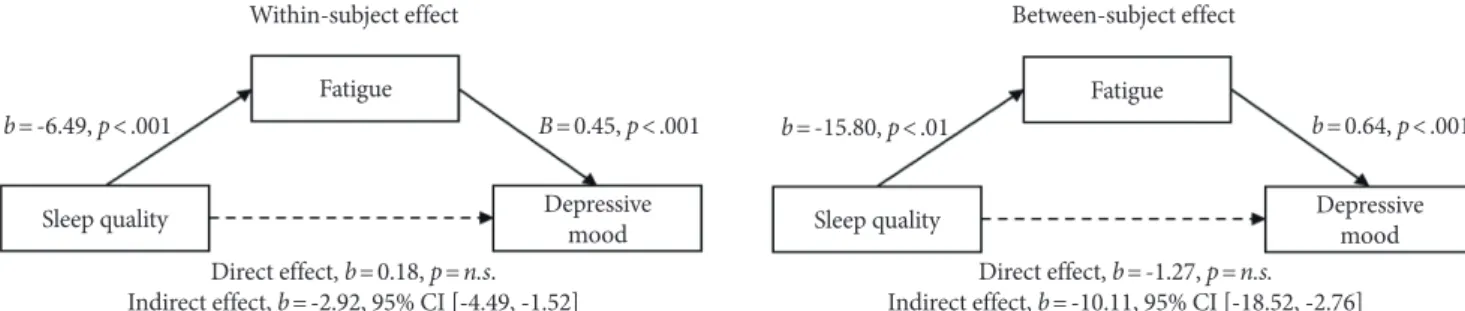
An examination of the mediating effect of fatigue (Figure 1) re- vealed that the 95% confidence interval (CI) did not include 0, 95%
CI [-4.49, -1.52], and that the direct effect of sleep quality on de- pressive mood was not significant at the within-subject level, γ10=0.18, p=.87. This therefore indicates that fatigue completely mediated the relationship between sleep quality and depressive mood at the within-subject level. Specifically, poor sleep quality the previous night predicted greater fatigue the next day, and greater fatigue was significantly related to increased depressive mood the next day.
At the between-subject level, the 95% CI ranged from -18.52 to -2.76 and did not include 0. And the direct effect of sleep quality on depressive mood was not significant, γ01=-1.27, p=.75. This indicates that fatigue completely mediated the relationship be- tween sleep quality and depressive mood also at the between-sub- ject level. On days when people had poorer-than-average sleep quality, they reported higher-than-average fatigue, that led to in- creased depressive mood.
Sleep quality and depressive mood: the mediating effect of stress
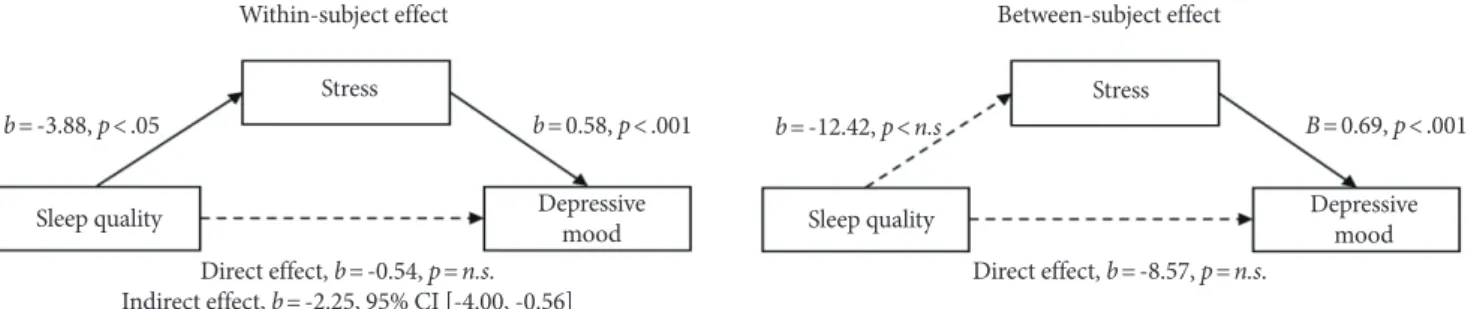
An examination of the mediating effect of stress (Figure 2) revealed that the 95% CI did not include 0, 95% CI [-4.00, -0.56], and that the direct effect of sleep quality on depressive mood was not sig-
Figure 1. Mediating effect of fatigue at the within- (left) and between-subject level (right).
Within-subject effect Fatigue
Sleep quality Depressive Sleep quality
mood Depressive
mood
b=-6.49, p<.001 B=0.45, p<.001 b=-15.80, p<.01 Fatigue b=0.64, p<.001
Between-subject effect
Direct effect, b=0.18, p=n.s.
Indirect effect, b=-2.92, 95% CI [-4.49, -1.52] Direct effect, b=-1.27, p=n.s.
Indirect effect, b=-10.11, 95% CI [-18.52, -2.76]
nificant at the within-subject level, γ10=-0.54, p=.56. This indi- cates that stress completely mediated the sleep quality-depressive mood relationship at the within-subject level. Poor sleep quality at the previous time point predicted higher stress at the next time point, and higher stress was significantly related to increased de- pressive mood at the same time point.
At the between-subject level, sleep quality was not significantly associated with stress; therefore, the mediating effect of stress was not examined.
Sleep quality and depressive mood: the mediating effect of affect
An examination of the mediating effect of PA (Figure 3) revealed that the 95% CI ranged from -1.56 to -0.05 and did not include 0, and the direct effect of sleep quality on depressive mood was insig- nificant at the within-subject level, γ10=-1.85, p=.12. This implies that PA completely mediated the sleep quality-depressive mood relationship at the within-subject level. Poor sleep quality the pre- vious night significantly predicted decreased PA the next day, and decreased PA was associated with increased depressive mood the next day.
The relationship between PA and depressive mood was insig-
nificant at the between-subject level, γ02=-0.17, p=.74; thus, the mediating effect of PA was not examined.
On the other hand, sleep quality did not significantly predict NA at both the within- and between-subject level, within-subject level:
γ10=-0.41, p=.24; between-subject level: γ01=-0.06, p=.97; thus, the mediating effect of NA was not examined.
Discussion
This study examined whether fatigue, stress, PA, and NA mediate the relationship between sleep quality and depressive mood in university students experiencing financial difficulties using EMA.
Results indicated that poor sleep quality at the previous time point significantly predicted increased depressive mood at the next time point. A previous study with university students experiencing fi- nancial strain observed that longer work hours were associated with poor sleep quality, which in turn led to more depressive symptoms (Peltz et al., 2020). Poor sleep could induce biological processes such as immuno-inflammation and hypothalamic-pi- tuitary adrenal imbalances; thus, poor sleep quality might influ- ence increased depression (Lopresti et al., 2013).
With regard to the mediating effect of fatigue on the relationship Figure 2. Mediating effect of stress at the within- (left) and between-subject level (right).
Within-subject effect Stress
Sleep quality Depressive Sleep quality
mood Depressive
mood
b=-3.88, p<.05 b=0.58, p<.001 b=-12.42, p<n.s B=0.69, p<.001
Stress Between-subject effect
Direct effect, b=-0.54, p=n.s.
Indirect effect, b=-2.25, 95% CI [-4.00, -0.56] Direct effect, b=-8.57, p=n.s.
Figure 3. Mediating effect of PA at the within- (left) and between-subject level (right).
Within-subject effect Positive affect
Sleep quality Depressive Sleep quality
mood Depressive
mood
b=0.76, p<.05 b=-0.97, p<.001 b=5.26, p<.01 b=-0.17, p<n.s
Positive affect Between-subject effect
Direct effect, b=-1.85, p=n.s.
Indirect effect, b=-0.69, 95% CI [-1.56, -0.05] Direct effect, b=-10.22, p=n.s.
between sleep quality and depressive mood, fatigue completely mediated the relationship between sleep quality and depressive mood at both the within- and between-subject levels. Individuals with poor sleep quality at the previous time point reported higher fatigue at the next time point, and those with higher fatigue report- ed increased depressive mood. Poorer-than-average sleep quality also mediated the sleep quality-depressive mood relationship.
Combining work with schooling, students experiencing financial difficulties might have sleep problems (Güneş & Arslantaş, 2017;
Mason et al., 2018), and these sleep problems could lead to fatigue.
For example, work-school conflict positively predicted fatigue in college student workers (Y. Park & Sprung, 2015).
Stress also completely mediated the sleep quality-depressive mood relationship at the within-subject level. Poor sleep quality at a previous time point predicted higher stress levels at the next time point, which, in turn, predicted increased depressive mood. This finding was consistent with a previous study of 242 nursing students (Yuan et al., 2018). Emotion regulation could help to understand the mediating effect of stress on the relationship between sleep quality and depressive mood. Poor sleep quality might lead to dys- functional emotion regulation and decreased psychological resourc- es (Baglioni, Spiegelhalder, Lombardo, Riemann, 2010), and mal- adaptive emotion regulation and stress coping could lead to de- pression (Hofmann, Sawyer, Fang, & Asnaani, 2012; Moriya &
Takahashi, 2013).
Regarding the mediating effect of affect, PA completely mediat- ed the sleep quality-depressive mood relationship at the within- subject level, whereas NA did not mediate the relationship either at the within- or between-subject levels. These findings are inconsis- tent with studies that reported that sleep quality was negatively as- sociated with NA (Fung et al., 2014; Simor et al., 2015) and that higher NA predicted increased depressive symptoms (Parrish et al., 2011; Raes et al., 2012). One possible explanation is that sleep quality is more strongly related to PA than to NA. In fact, one study found that sleep quality was a robust predictive variable of PA but not NA (Bower, Bylsma, Morris, & Rottenberg, 2010). A third vari- able, such as PA, might influence the sleep quality-NA relationship.
For example, in a 56-day EMA study with 552 adults, PA signifi- cantly buffered the negative effect of NA on stress (Blaxton, Berge- man, Whitehead, Braun, & Payne, 2017). This suggests that PA
could moderate the sleep quality-NA relationship.
Of note, in the pre-EMA survey, students with financial diffi- culties reported higher mental fatigue, financial stress, and lower environmental QOL. Students with financial difficulties are more likely to combine schooling with work (Roksa & Velez, 2010); thus, they are likely to experience greater fatigue. Also, students experi- encing financial difficulties may experience higher financial stress regarding expenses incurred in their higher education setting. This financial strain could affect perceived stress in university students (Adams, Meyers, & Beidas, 2016). Lastly, as students with financial difficulties may be economically burdened, they are more likely to live in an unsafe physical environment (Braubach & Fairburn, 2010).
These results suggest that interventions targeting fatigue, stress, and PA may alleviate the detrimental effect of poor sleep quality on depressive mood among university students experiencing fi- nancial difficulties. Specifically, fatigue mediated the relationship between sleep quality and depressive mood at both the within- and between-subject levels. These results suggest that cognitive behav- ioral therapy for insomnia (CBT-I) can be an effective intervention.
In fact, CBT-I not only reduced sleep problems (i.e., sleep quality, sleep efficiency, and dysfunctional beliefs about sleep) and depres- sive symptoms (Cunningham & Shapiro, 2018) but also decreased the level of fatigue (Taylor et al., 2014). In addition, fatigue, stress, and PA mediated the sleep quality-depressive mood relationship at the within-subject level while mediating the effects of stress, and PA was not significant at a between-subject level. Between-subject effects are considered to have more generalized (i.e., trait) effects, and within-subject effects are characterized as more situational (i.e., state) (Cano et al., 2014). This implies that timely intervention when individuals experience fatigue, stress or decreased PA may be helpful to reduce depressive mood. An ecological momentary intervention (EMI) can be another feasible option to alleviate daily depressive mood. EMI has the advantage of providing timely in- tervention in a daily environment. Moreover, EMI can be a time- efficient and cost-effective way of intervening (Heron & Smyth, 2010).
This study has several limitations. First, subjective sleep quality was assessed. Despite the established high correlation between subjective and objective estimates of sleep (Grutsch et al., 2011), objective indicators of sleep should be included. Second, this study
assessed in-the-moment sleep quality, fatigue, stress, and depres- sive mood using a single item in order to promote response burden, which may not have provided a comprehensive measurement of variables. Third, the sample size was relatively small, possibly lead- ing to low statistical power, which may have led to the detection of a potentially significant effect.
Despite these limitations, this study examined the mediating role of fatigue, stress, PA, and NA in the sleep quality-depression relationship, by separating within- and between-subject effects, in university students experiencing financial difficulties.
Author contributions statement
Eun-Jung Shim, professor at Pusan National University, and Eun Jung Yang, graduate student at Pusan National University, con- ducted the study and drafted the manuscript. Eun Jung Yang per- formed statistical analyses. All authors approved the final script.
References
Adams, D. R., Meyers, S. A., & Beidas, R. S. (2016). The relation- ship between financial strain, perceived stress, psychological symptoms, and academic and social integration in undergradu- ate students. Journal of American College Health, 64, 362-370.
doi: 10.1080/07448481.2016.1154559
Baglioni, C., Battagliese, G., Feige, B., Spiegelhalder, K., Nissen, C., Voderholzer, U., . . . Riemann, D. (2011). Insomnia as a predictor of depression: a meta-analytic evaluation of longitudinal epide- miological studies. Journal of Affective Disorders, 135, 10-19. doi.
org/10.1016/j.jad.2011.01.011
Baglioni, C., Spiegelhalder, K., Lombardo, C., & Riemann, D. (2010).
Sleep and emotions: A focus on insomnia. Sleep Medicine Reviews, 14, 227-238. doi: 10.1016/j.smrv.2009.10.007
Bassett, S. M., Lupis, S. B., Gianferante, D., Rohleder, N., & Wolf, J.
M. (2015). Sleep quality but not sleep quantity effects on cortisol responses to acute psychosocial stress. Stress, 18, 638-644. doi:
10.3109/10253890.2015.1087503
Berk, M., Williams, L. J., Jacka, F. N., O’Neil, A., Pasco, J. A., Moylan, S., . . . & Maes, M. (2013). So depression is an inflammatory dis- ease, but where does the inflammation come from?. BMC Medi- cine, 11, 1-16. doi.org/10.1186/1741-7015-11-200
Blaxton, J. M., Bergeman, C. S., Whitehead, B. R., Braun, M. E., &
Payne, J. D. (2017). Relationships among nightly sleep quality, daily stress, and daily affect. The Journals of Gerontology: Series B, 72, 363-372. doi: 10.1093/geronb/gbv060
Bolger, N., & Laurenceau, J. P. (2013). Intensive longitudinal meth-
ods: An introduction to diary and experience sampling reserach.
NY, London: The Guilford Express.
Bouwmans, M. E. J., Bos, E. H., Hoenders, H. J. R., Oldehinkel, A.
J., & De Jonge, P. (2017). Sleep quality predicts positive and neg- ative affect but not vice versa. An electronic diary study in de- pressed and healthy individuals. Jouranl of Affective Disordders, 207, 260-267. doi: 10.1016/j.jad.2016.09.046
Bower, B., Bylsma, L. M., Morris, B. H., & Rottenberg, J. (2010). Poor reported sleep quality predicts low positive affect in daily life among healthy and mood-disordered persons. Journal of Sleep Research, 19, 323-332. doi: 10.1111/j.1365-2869.2009.00816.x Braubach, M., & Fairburn, J. (2010). Social inequities in environ-
mental risks associated with housing and residential location—
A review of evidence. European Journal of Public Health, 20, 36- 42. doi: 10.1093/eurpub/ckp221
Cano, M. Á., Lam, C. Y., Chen, M., Adams, C. E., Correa-Fernández, V., Stewart, D. W., . . . Wetter, D. W. (2014). Positive smoking outcome expectancies mediate the association between negative affect and smoking urge among women during a quit attempt.
Experimental and Clinical Psychopharmacology, 22, 332-340. doi:
10.1037/a0036749
Carney, C. E., Buysse, D. J., Ancoli-Israel, S., Edinger, J. D., Krystal, A. D., Lichstein, K. L., & Morin, C. M. (2012). The consensus sleep diary: Standardizing prospective sleep self-monitoring.
Sleep, 35, 287-302. doi: 10.5665/sleep.1642
Cella, M., & Chalder, T. (2010). Measuring fatigue in clinical and community settings. Journal of Psychosomatic Research, 69, 17- 22. doi: 10.1016/j.jpsychores.2009.10.007
Çelik, N., Ceylan, B., Ünsal, A., & Çağan, Ö. (2019). Depression in health college students: Relationship factors and sleep quality.
Psychology, Health & Medicine, 24, 625-630. doi.org/10.1080/135 48506.2018.1546881
Chon, K. K., Kim, K. H., & Yi, J. S. (2000). Devolopment of the re- vised life stress scale for college students. Korean Journal of Health Psychology, 5, 316-335.
Cunningham, J. E. A., & Shapiro, C. M. (2018). Cognitive behav- ioural therapy for Insomnia (CBT-I) to treat depression: A sys- tematic review. Journal of Psychosomatic Research, 106, 1-12. doi.
org/10.1016/j.jpsychores.2017.12.012
Doerr, J. M., Ditzen, B., Strahler, J., Linnemann, A., Ziemek, J., Skolu- da, N., . . . Nater, U. M. (2015). Reciprocal relationship between acute stress and acute fatigue in everyday life in a sample of uni- versity students. Biological Psychology, 110, 42-49. doi: 10.1016/
j.biopsycho.2015.06.009
Dvorak, R. D., Lamis, D. A., & Malone, P. S. (2013). Alcohol use, depressive symptoms, and impulsivity as risk factors for suicide proneness among college students. Jouranl of Affective Disord- ders, 149, 326-334. doi: 10.1016/j.jad.2013.01.046
Farrer, L. M., Gulliver, A., Bennett, K., Fassnacht, D. B., & Griffiths,
K. M. (2016). Demographic and psychosocial predictors of ma- jor depression and generalised anxiety disorder in Australian university students. BMC Psychiatry, 16, 241-249. doi: 10.1186/
s12888-016-0961-z
Fung, C. H. L., Nguyen, M., Moineddin, R., Colantonio, A., &
Wiseman-Hakes, C. (2014). Reliability and validity of the daily cognitive–communication and sleep profile: A new instrument for monitoring sleep, wakefulness and daytime function. Inter- national Journal of Methods in Psychiatric Research, 23, 217-228.
doi: 10.1002/mpr.1422
Galambos, N. L., Dalton, A. L., & Maggs, J. L. (2009). Losing sleep over it: daily variation in sleep quantity and quality in Canadian students' first semester of university. Journal of Research on Ado- lescence, 19, 741-761. doi.org/10.1111/j.1532-7795.2009.00618.x Ghrouz, A. K., Noohu, M. M., Dilshad Manzar, M., Warren Spen-
ce, D., BaHammam, A. S., & Pandi-Perumal, S. R. (2019). Physi- cal activity and sleep quality in relation to mental health among college students. Sleep and Breathing, 23, 627-634. doi: 10.1007/
s11325-019-01780-z
Grutsch, J. F., Wood, P. A., Du-Quiton, J., Reynolds, J. L., Lis, C. G., Levin, R. D., . . . Hrushesky, W. J. M. (2011). Validation of actig- raphy to assess circadian organization and sleep quality in pa- tients with advanced lung cancer. Journal of Circadian Rhythms, 9, 4-15. doi: 10.1186/1740-3391-9-4
Güneş, Z., & Arslantaş, H. (2017). Insomnia in nursing students and related factors: A cross-sectional study. International Journal of Nursing Practice, 23, e12578. doi: 10.1111/ijn.12578
Ha, H., Jeong, D., Hahm, B. J., & Shim, E. J. (2018). Cross-Cultural Validation of the Korean Version of the Chalder Fatigue Scale.
International Journal of Behavioral Medicine, 25, 351-361. doi:
10.1007/s12529-017-9701-0
Heron, K. E., & Smyth, J. M. (2010). Ecological momentary inter- ventions: Incorporating mobile technology into psychosocial and health behaviour treatments. British Journal of Health Psy- chology, 15, 1-39. doi: 10.1348/135910709X466063
Hofmann, S. G., Sawyer, A. T., Fang, A., & Asnaani, A. (2012). Emo- tion dysregultaion model of mood and anxiety disorders. De- pression and Anxiety, 29, 409-416. doi: 10.1002/da.21888 Ibrahim, A. K., Kelly, S. J., Adams, C. E., & Glazebrook, C. (2013).
A systematic review of studies of depression prevalence in uni- versity students. Journal of Psychiatrc Research, 47, 391-400. doi:
10.1016/j.jpsychires.2012.11.015
Kim, J., Shim, J., & Lee, R. (2016). Material hardship and depression among low‐income households in South Korea: differences by household type. International Journal of Social Welfare, 25, 187- 198. doi.org/10.1111/ijsw.12181
Kroenke, K., Spitzer, R. L., & Williams, J. B. W. (2001). The PHQ-9:
Validity of a brief depression severity measure. Journal of Gener- al Internal Medicine, 16, 606-613. doi: 10.1046/j.1525-1497.2001.
016009606.x
Lee, C. H., & Giuliani, F. (2019). The role of inflammation in de- pression and fatigue. Frontiers in Immunology, 10, 1-12.
Lopresti, A. L., Hood, S. D., & Drummond, P. D. (2013). A review of lifestyle factors that contribute to important pathways associ- ated with major depression: Diet, sleep and exercise. Journal of Affective Disorders, 148, 12-27. doi.org/10.1016/j.jad.2013.01.014 Lund, H. G., Reider, B. D., Whiting, A. B., & Prichard, J. R. (2010).
Sleep patterns and predictors of disturbed sleep in a large popu- lation of college students. Journal of Adolescent Health, 46, 124- 132. doi.org/10.1016/j.jadohealth.2009.06.016
Mason, H. R., Winseman, J., Marcellon, R., Huamantl, M., Ruiz, C.,
& Ayala, E. E. (2018). First-generation medical student wellness in the United States. Journal of Best Practices in Health Profes- sions Diversity, 11, 96-106.
Min, S. K., Kim, K. I., Lee, C. I., Jung, Y. C., Suh, S. Y., & Kim, D. K.
(2002). Development of the Korean versions of WHO Quality of Life scale and WHOQOL-BREF. Quality of Life Research, 11, 593- 600. doi: 10.1023/A:1016351406336
Min, S. K., Lee, C. I., Kim, K. l., Suh, S. Y., & Kim, D. K. (2000). De- velopment of Korean versionof WHO quality of life scale abbre- viated version (WHOQOL-BREF). Journal of Korean Neuropsy- chiatrc Association, 39, 571-579.
Moriya, J., & Takahashi, Y. (2013). Depression and interpersonal stress: The mediating role of emotion regulation. Motivation and Emotion, 37, 600-608. doi: 10.1007/s11031-012-9323-4
Muzni, K., Groeger, J. A., Dijk, D. J., & Lazar, A. S. (2021). Self‐re- ported sleep quality is more closely associated with mental and physical health than chronotype and sleep duration in young adults: A multi‐instrument analysis. Journal of Sleep Research, 30, e1-15. doi.org/10.1111/jsr.13152
Park, H. S., & Lee, J. M. (2016). A validation study of Korean version of PANAS-revised. Korean Journal of Psychology: General, 35, 617-641. doi: 10.22257/kjp.2016.12.35.4.617
Park, S. J., Choi, H. R., Choi, J. H., Kim, K. W., & Hong, J. P. (2010).
Reliability and validity of the Korean vesion of the patient health questionnaire-9 (PHQ-9). Anxiety and Mood, 6, 119-124.
Park, Y., & Sprung, J. M. (2015). Weekly work–school conflict, sleep quality, and fatigue: Recovery self-efficacy as a cross-level mod- erator. Journal of Organizational Behavior, 36, 112-127. doi: 10.
1002/job.1953
Parrish, B. P., Cohen, L. H., & Laurenceau, J. P. (2011). Prospective relationship between negative affective reactivity to daily stress and depressive symptoms. Journal of Social Clinical Psychology, 30, 270-296. doi: 10.1521/jscp.2011.30.3.270
Peltz, J. S., Bodenlos, J. S., Kingery, J. N., & Rogge, R. D. (2020). The role of financial strain in college students’ work hours, sleep, and mental health. Journal of American College Health, 1-8. doi: 10.
1080/07448481.2019.1705306
Preacher, K. J., Zyphur, M. J., & Zhang, Z. (2010). A general multi- level SEM framework for assessing multilevel mediation. Psycho- logical Methods, 15, 209-233. doi: 10.1037/a0020141
Pressman, S. D., & Cohen, S. (2005). Does positive affect influence health?. Psychological Bulletin, 131, 925-971. doi: 10.1037/0033- 2909.131.6.925
Raes, F., Smets, J., Nelis, S., & Schoofs, H. (2012). Dampening of positive affect prospectively predicts depressive symptoms in non-clinical samples. Cognition and Emotion, 26, 75-82. doi: 10.
1080/02699931.2011.555474
Roksa, J., & Velez, M. (2010). When studying schooling is not enough:
Incorporating employment in models of educational transitions.
Research in Social Stratification and Mobility, 28, 5-21. doi: 10.
1016/j.rssm.2009.03.001
Schofield, M. J., O'Halloran, P., McLean, S. A., Forrester-Knauss, C.,
& Paxton, S. J. (2016). Depressive symptoms among Australian university students: Who is at risk? Australian Psycholgist, 51, 135-144. doi: 10.1111/ap.12129
Selig, J. P., & Preacher, K. J. (2008). Monte Carlo method for assess- ing mediation: An interactive tool for creasting confidence inter- vals for indirect effect. Retrieved from http://quantpsy.org/
Sheehan, D. V., Lecrubier, Y., Sheehan, K. H., Amorim, P., Janavs, J., Weiller, E., . . . Dunbar, G. C. (1998). The mini-international neuropsychiatric interview (M.I.N.I): The development and val- idation of a structured diagnostic psychiatric interview for DSM- IV and ICD-10. Journal of Clinical Psychiatry, 59, 22-33.
Shiffman, S., Stone, A. A., & Hufford, M. R. (2008). Ecological mo- mentary assessment. Annual Review of Clinical Psychology, 4, 1-32.
doi: 10.1146/annurev.clinpsy.3.022806.091415
Simor, P., Krietsch, K. N., Köteles, F., & McCrae, C. S. (2015). Day- to-day variation of subjective sleep quality and emotional states among healthy university students—A 1-week prospective study.
International Journal of Behavioral Medicine, 22, 625-634. doi:
10.1007/s12529-015-9464-4
Sohn, S. I., Kim, D. H., Lee, M. Y., & Cho, Y. W. (2012). The reli- ability and validity of the Korean version of the Pittsburgh Sleep Quality Index. Sleep and Breathing, 16, 803-812. doi: 10.1007/
s11325-011-0579-9
Taylor, D. J., Zimmerman, M. R., Gardner, C. E., Williams, J. M., Grieser, E. A., Tatum, J. I., . . . Ruggero, C. (2014). A pilot ran- domized controlled trial of the effects of cognitive-behavioral therapy for insomnia on sleep and daytime functioning in col- lege students. Behavior Therapy, 45, 376-389. doi.org/10.1016/
j.beth.2013.12.010
Techera, U., Hallowell, M., Stambaugh, N., & Littlejohn, R. (2016).
Causes and consequences of occupational fatigue: Meta-analysis and systems model. Journal of Occupational and Environmental Medicine, 58, 961-973. doi: 10.1097/JOM.0000000000000837 Wong, M. L., Zhang, J., Wing, Y. K., & Lau, E. Y. Y. (2017). Sleep-
related daytime consequences mediated the neuroticism–de- pression link. Sleep and Biological Rhythms, 15, 21-30. doi: 10.
1007/s41105-016-0074-6
Yuan, Z., Anya, P., & Guanling, C. (2018). Perceived stress medi- ates the associations between sleep quality and symptoms of anxiety and depression among college nursing students. Interna- tional Journal of Nursing Education Scholarship, 15, 1-10. doi:
10.1515/ijnes-2017-0020