Article
DOI: 10.4217/OPR.2010.32.3.321 Ocean and Polar Research
Temporal Variation of Phytoplankton Community Related to Water Column Structure in the Korea Strait
Yong-Woo Lee
1, Hyun Je Park
2, Eun Jung Choy
3, Yunsook Kim
2, and Chang-Keun Kang
2*1
Department of Oceanography
Pusan National University, Busan 609-735, Korea
2
Ocean Science and Technology Institute
Pohang University of Science and Technology, Pohang 790-784, Korea
3
Korea Polar Research Institute, KORDI Incheon 406-840, Korea
Abstract : Photosynthetic pigments, nutrients, and hydrographic variables were examined in order to elucidate the spatio-temporal variation of water column structure and its effect on phytoplankton community structure in the western channel of the Korea Strait in fall 2006 and spring 2007. High phytoplankton biomass in the spring was associated with high salinity, implying that nutrients were not supplied by coastal waters or the Yangtze-River Diluted water (YRDW) with low salinity. Expansion of the Korea Strait Bottom Cold Water (KSBCW) and a cold eddy observed during the spring season might enhance the nutrient supply from the subsurface layer to the euphotic zone. Chemotaxonomic examination showed that diatoms accounted for 60-70% of total biomass, followed by dinoflagellates. Nutrient supply by physical phenomena such as the expansion of the KSBCW and the occurrence of a cold eddy appears to be the controlling factors of phytoplankton community composition in the Korea Strait. Further study is needed to elucidate the mechanisms by which the KSBCW is expanded, and its role in phytoplankton dynamics.
Key words : phytoplankton, nutrients, Korea Strait, Korea Strait Bottom Cold Water, eddy
1. Introduction
Phytoplankton community structure in the ocean may have an effect on biological productivity, food web structure in pelagic and benthic ecosystems, and carbon export to the deep ocean (Azam et al. 1983; Karl 1999;
Karl et al. 2001). Phytoplankton community composition and biomass are controlled by various physical and chemical factors including nutrient and light conditions, seawater acidification, and hydrographic features such as water column structure, eddies, and upwelling (Schofield et al. 1993; Ruardij et al. 1997; Moline 1998; Lee et al.
2009).
The Korea Strait is located between the Korean
peninsula and the Japanese islands. It is similar to a sill separating the East China Sea (ECS) and the East/Japan Sea (EJS). The Tsushima Warm Current (TWC), a branch of the Kuroshio Warm Current (KWC), is the principal surface current flowing northeastward from the ECS into the EJS through the Korea Strait. It plays an important role in transporting nutrients and various materials, originating from Yangtze-River discharge, to the southern region of the EJS and the Korea Strait (Yanagi 2002;
Onitsuka et al. 2007; Morimoto et al. 2009).
The Korea Strait is a dynamic environment because of topography, river discharge (e.g. Yangtze River), and current transport. Having the largest flux of freshwater and various materials into the ECS, annual discharge from the Yangtze River was reported to be approximately 9.25×10
11m
3yr
−1(Tian et al. 1993). Freshwater discharge
*Corresponding author. E-mail : [email protected]
control by the recent construction of the Three Gorges Dam on the Yangtze River (Jiao et al. 2007) was suggested to influence physical and chemical environments as well as biological response in the ECS, Korea Strait, and potentially EJS (Liu et al. 2003; Gong et al. 2006;
Onitsuka et al. 2007; Jiao et al. 2007). Yang et al. (2000) suggested that initiation of the harmful algal bloom occurring along the southern coast of Korea during summer season is related to the intrusion of the Yangtze- River Diluted water (YRDW) containing high nutrients.
Volume transport of the TWC through the Korea Strait exhibits a seasonal variation, typically high in the summer and low in the winter (Lyu et al. 2002; Takikawa et al.
2005). Counterclockwise eddies, affecting phytoplankton biomass in the euphotic zone, have been observed frequently in the eastern channel of the Korea Strait (Morimoto et al. 2009).
It is important to understand the relationship between phytoplankton community structure and the hydrological and chemical variables in a complex system like the Korea Strait (Onitsuka et al. 2009). However, few studies have been conducted to understand temporal variation of phytoplankton community structure and biomass, and the relationship to short- and long-term variability in water mass properties in the Korea Strait.
To understand the biological change (phytoplankton community structure) related to temporal variation of physical and chemical environments in the Korea Strait, this study investigated 1) the spatial and temporal variation of water mass properties, including nutrient
dynamics, and 2) the response of phytoplankton biomass and community structure to water mass variations in a northwest-southeast transect across the Korea Strait using HPLC pigment analysis and CHEMTAX analysis of pigment signatures, which have been used as powerful tools for studying phytoplankton community (Mackey et al. 1996; Hassen et al. 2008).
2. Materials and methods
Study area and seawater sampling
The Korea Strait is divided by Tsushima Island into eastern and western channels. This study was mainly conducted in the western channel of the Korea Strait.
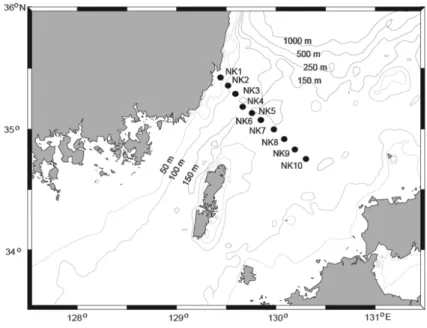
Hydrographic observation and seawater sampling were conducted on 9 October, 26 October, and 13 November in 2006 as well as 28 May in 2007 along a transect located in the western channel of Tsushima Island (St. NK1-NK6 in Fig. 1). In May 2007, the cruise was extended to the eastern channel of the Korea Strait (St. NK1-NK10).
Hydrographic properties (temperature and salinity) were measured with a CTD profiler (Seabird Electronics 911).
Nutrient and photosynthetic pigment analyses Water samples for nutrient and pigment analyses were taken at depth intervals of 10 m in the upper layer above 150 m at each station in the transect, with the exception of some stations. To determine nutrient concentration, approximately 500 ml of each seawater sample was filtered through GF/F filters (25 mm in diameter) and
Fig. 1. Sampling locations in the Korea Strait.
stored in a freezer at −20
oC. Concentrations of NO
3−, NO
2−, PO
43−, and Si(OH)
4were analyzed with an Auto-Analyzer (Futura plus II, Alliance Co.). NO
xis defined as the sum of NO
3−and NO
2−, DIP as PO
43−, and DSi as Si(OH)
4.
To analyze photosynthetic pigments, seawater samples (~2 l) were filtered immediately after sampling using GF/
F filters (47 mm in diameter) onboard the ship. Each filter was wrapped in aluminum foil and stored in a freezer ( −20
oC). Upon arrival at the land-based laboratory, the samples were stored at −80
oC in a deep freezer until analysis. The samples were extracted with 100% acetone (5 ml) for 24 hrs in the dark ( −20
oC) after sonication for 5 minutes to enhance cell disruption. The extracted solution was centrifuged at 2500 rpm for 10 min to remove particulate materials. Supernatant (1 ml) was well-mixed with 300 µl of deionized water. Then 100 µl of this mixture was analyzed by reverse-phase high-performance liquid chromatograph (Shimadzu Co. system) equipped with a Rexchrom-S5-100-ODS column (Regis, USA, 250×4.6 mm, particle size: 5 µm), following a modified method described by Wright et al. (1991). Canthaxanthin was used as an internal standard. Standard pigments were quantified by a spectrophotometer using a published extinction coefficient (Jeffrey 1997). Pure standard pigments, obtained from Sigma Chemical and DHI, were used to identify pigment peaks and calibrate pigment concentrations based on the peak areas.
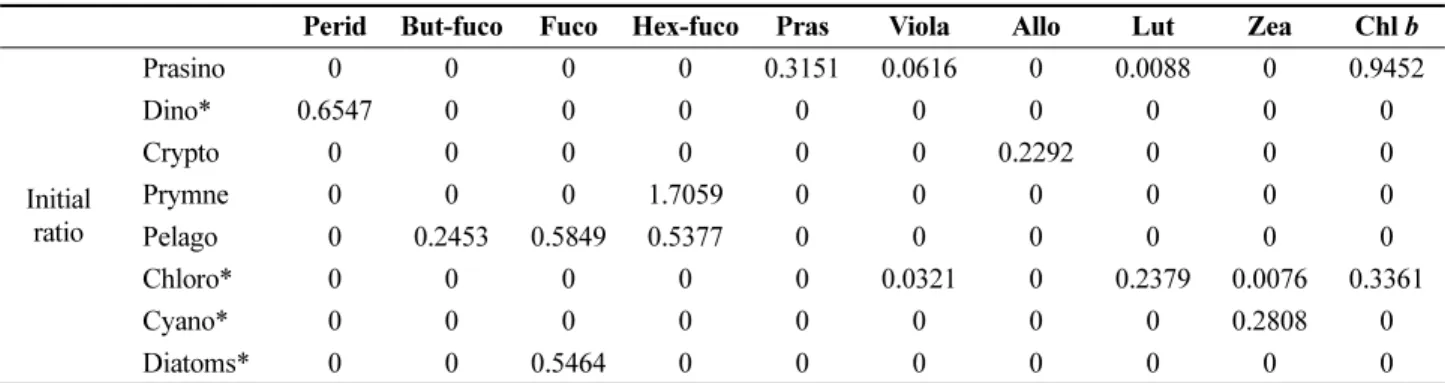
On the basis of measured pigment signatures, phytoplankton community composition was determined using the CHEMTAX program (Mackey et al. 1996). In this study, the diagnostic biomarker pigments are chlorophyll a, fucoxanthin, 19'-hexanoyloxy-fucoxanthin, 19'-butanoyloxy- fucoxanthin, peridinin, chlorophyll b, prasinoxanthin, lutein, violaxanthin, alloxanthin, and zeaxanthin. Modified from the values in Mackey et al. (1996), class-specific pigment
ratios were used as the input pigment ratios of the CHEMTAX program (Table 1). The initial ratios of marker pigments to chlorophyll a for chlorophytes, dinoflagellates, diatoms, and cyanobacteria were obtained from phytoplankton species isolated from offshore seawaters of the Korean peninsula by the Korea Marine Microalgae Culture Center (KMMCC).
3. Results and discussion
Distributions of temperature, salinity, and nutrients Various factors, such as light intensity, stability of the water column, temperature, and nutrient concentrations, may influence biomass and community composition of phytoplankton (Reid et al. 1990; Lee et al. 2009). During the study periods, seawater temperature and salinity ranged from 5 to 25
οC and from 32 to 35, respectively.
Temperature in May 2007 (5-20
οC) was lower than in October and November 2006 (8-25
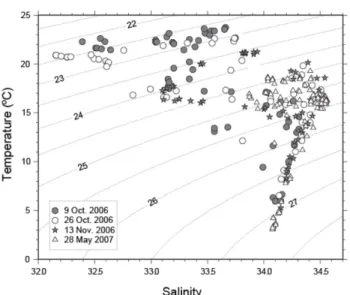
οC), while salinity in May 2007 (33-34.5) was higher than in fall 2006 (32.2- 34.5) (Fig. 2). Temperature and salinity in surface waters increased gradually from on the shelf to off the shelf, reflecting the increasing influence of KWC with high temperature and salinity (Fig. 3).
Expansion and contraction of the bottom cold water mass (<10
οC) in the Korea Strait varied seasonally (Fig.
3). In May 2007, the Korea Strait Bottom Cold Water (KSBCW) (<10
οC) expanded to off the shelf (St. NK6) and reached up to 20 m in depth below the surface mixed layer on the shelf (St. NK1). Presence of the KSBCW in the bottom layer of the Korea Strait and its seasonal variability has been reported (Lim and Chang 1969; Cho and Kim 1998). Lim and Chang (1969) suggested that the KSBCW originates from the western region of the EJS (the southeastern coast of the Korean peninsula) and
Table 1. Initial pigment ratios used for the CHEMTAX program. *Pigment ratios from our cultures
Perid But-fuco Fuco Hex-fuco Pras Viola Allo Lut Zea Chl b
Initial ratio
Prasino 0 0 0 0 0.3151 0.0616 0 0.0088 0 0.9452
Dino* 0.6547 0 0 0 0 0 0 0 0 0
Crypto 0 0 0 0 0 0 0.2292 0 0 0
Prymne 0 0 0 1.7059 0 0 0 0 0 0
Pelago 0 0.2453 0.5849 0.5377 0 0 0 0 0 0
Chloro* 0 0 0 0 0 0.0321 0 0.2379 0.0076 0.3361
Cyano* 0 0 0 0 0 0 0 0 0.2808 0
Diatoms* 0 0 0.5464 0 0 0 0 0 0 0
1
Abbreviations: Prasino, Prasinophytes; Dino, Dinoflagellates; Crypto, Cryptophytes; Prymne, Prymnesiophytes; Pelago, Pelagophytes; Chloro,
Chlorophytes; Cyano, Cyanobacteria; Perid, Peridinin; But-fuco, 19'-butanoyloxy-fucoxanthin; Fuco, Fucoxanthin; Hex-fuco, 19'-hexanoyloxy-
fucoxanthin; Pras, Prasinoxanthin; Viola, Violaxanthin; Allo, Alloxanthin; Lut, Lutein; Zea, Zeaxanthin; and, Chl b, Chlorophyll b.
expands broadly in the summer compared to the winter season (Kim et al. 2006). The expansion and upwelling of the KSBCW on the shelf in May 2007 appears to have enhanced nutrient supply to the surface layer and, consequently, enhanced phytoplankton growth.
Surface mixed layer gradually increased offshore with increasing water depth. The surface mixed layer was 40- 60 m thick and much shallower in November 2006 and May 2007 than in October 2006 (Fig. 3). Mixed layer depth is one of the main factors controlling the supply of nutrients from the subsurface layer to the euphotic zone, triggering phytoplankton growth. Chen and Chen (2006) reported that phytoplankton biomass was higher in the winter when surface mixed layer was shallow than in the
summer. A shallow surface mixed layer formed on the shelf in May 2007, especially, because of a strong KSBCW.
A more expanded region was examined to include the off shelf region (St. NK7-NK10) in May 2007. A cold eddy associated with the shallow surface mixed layer near Tsushima island station was observed in May 2007.
Counterclockwise eddies in the Korea Strait have been observed frequently (Takikawa et al. 2005; Morimoto et al. 2009). This island-induced eddy has a significant impact on the nutrient supply from the subsurface layer to the euphotic zone, enhancing primary production (Morimoto et al. 2009; Onitsuka et al. 2009).
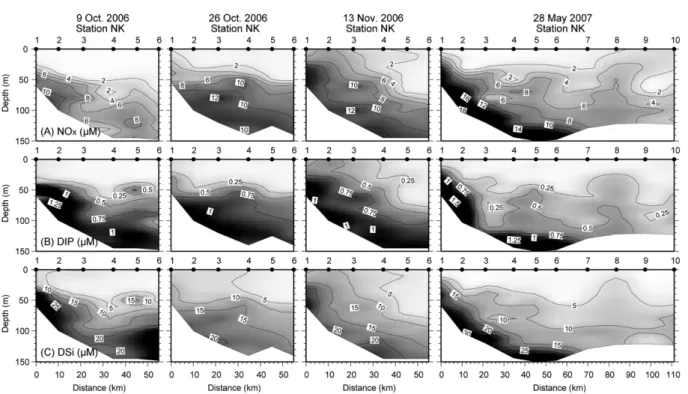
The concentration of dissolved inorganic nitrogen (NO
x: NO
3−+NO
2−) in the surface seawater (0-20 m) was mostly less than 2 µM (Fig. 4). In the euphotic zone (<40 m depth: approximately 1% of the surface light penetration), concentrations of dissolved inorganic phosphate (DIP) and silicate (DSi) were in the range of 0.0-1.50 and 0.19- 36.9 µM, respectively. The nutrient (NO
x, DIP, and DSi) concentrations in the euphotic zone were higher in late fall (13 November 2006), when water column stratification was weakened, than in October 2006. In May 2007, although water column stratification was weakened, nutrient concentrations in the euphotic zone were low.
Nutrient concentrations are mainly controlled by river discharge, water column stratification, and atmospheric deposition. Many studies have reported that excess nutrients in the Korea Strait are supplied by the YRDW (Onitsuka et al. 2007; Morimoto et al. 2009). High precipitation in summer influences salinity and chemical characteristics in the Korea Strait. Salinity in fall 2006 Fig. 2. T-S diagrams of the water column of the NK
transect in the Korea Strait.
Fig. 3. Contour plots of temperature and salinity along the NK transect in the Korea Strait.
was low compared to May 2007 (Fig. 2). The Yangtze- River discharge (approximately 9.25×10
11m
3yr
−1) supplies a large amount of fresh water and various materials into the ECS and the Korea Strait (Tian et al. 1993). Surface water runoff, including the discharge of the Nakdong River from the southern coastal region of the Korean peninsula, is another main source of inorganic nutrients in the western channel of the Korea Strait (Lee et al. 1984).
However, a narrow range of salinity was observed in November 2006 (33-34.5) compared to October 2006 (32- 34.5). In November 2006, by destruction of stratified water column, high nutrient concentrations seem to be related to nutrient supply from the subsurface layer to the euphotic zone. On the other hand, lower nutrient concentrations in the euphotic zone associated with a shallow surface mixed layer in May 2007 seem to be caused by nutrient consumption by phytoplankton.
Distribution of phytoplankton community structure The dynamic change of water mass properties in the Korea Strait is expected to affect primary producer biomass.
As an index of phytoplankton abundance, chlorophyll a concentrations, integrated in the euphotic zone (<40 m depth) of the NK transect in the Korea Strait, ranged from 6 to 110 mg m
−2(Fig. 5). Average integrated chlorophyll a concentration from NK1 to NK6 in May 2007 (34.1±5.5
mg m
−2) was higher than in October 2006 (15.4±10.6 mg m
−2) by approximately two-fold (Table 2; Fig. 5).
Chlorophyll a concentration decreased with increasing offshore bottom water depth in May 2007. The high phytoplankton biomass seems to be related to the expansion of the KSBCW to the euphotic zone on the shelf in May 2007. Although wind-driven coastal upwelling has a different nutrient supply mechanism into the euphotic Fig. 4. Contour plots of dissolved inorganic nutrients (A) NO
x(NO
3−+NO
2−), (B) DIP, and (C) DSi along the NK
transect in the Korea Strait.
Fig. 5. Distributions of chlorophyll a average inventory
(0-40 m) along the NK transect in the Korea
Strait.
zone with the KSBCW, it has frequently occurred in the southeastern part of Korea in summer (Lee and Na, 1985;
Kim and Lee, 2004; Yoo and Park, 2009). Yoo and Park (2009) suggested that high primary production in the region is associated with nutrient supply from the subsurface region to the euphotic zone due to coastal upwelling.
Upwelling, induced by a cold eddy, was observed at NK8 in May 2007. Chlorophyll a concentration (46 mg m
−2) integrated at this station was approximately two-fold
higher than at adjacent stations. By supplying nutrients from the subsurface layer to the euphotic zone, this island- induced eddy has significant impacts on the distribution and productivity of phytoplankton and zooplankton (Morimoto et al. 2009; Onitsuka et al. 2009). The high phytoplankton biomass in the Korea Strait in May 2007 seems be related to the expansion of the KSBCW and the eddy event on the shelf and off the shelf, respectively.
The most abundant diagnostic pigments in the Korea Strait were fucoxanthin and peridinin, indices of diatoms Table 2. Marker pigment concentrations (ng m
-2) integrated in the upper 40 m of each sampling station in the transect
of the Korea Strait
Station Perid But-fuco Fuco Hex-fuco Pras Viola Allo Lut Zea Chl b Chl a 9 Oct. 2006
NK1 506 27 6095 339 1033 108 418 188 1496 14739 16226
NK2 173 219 3025 130 1022 76 213 53 2322 9384 12244
NK3 267 582 5637 111 1561 16 245 11 592 9040 8854
NK4 127 703 13386 118 2295 161 460 35 413 9528 16391
NK5 173 515 4950 236 2968 75 346 18 1230 13927 45697
NK6 168 1088 2719 803 1973 37 256 4 950 10404 11681
26 Oct. 2006
NK1 0 61 2700 436 171 58 187 72 508 30514 8336
NK2 299 36 4827 583 361 45 276 35 843 27054 11184
NK3 219 0 2021 225 147 65 478 530 133 21472 8228
NK4 39 259 1361 209 615 2 119 3 411 19742 6295
NK5 499 1048 5952 4758 0 133 453 48 1043 28023 18636
NK6 284 1231 10687 57 3623 8 632 36 528 21499 21235
13 Nov. 2006
NK1 1085 8331 8223 1284 2163 137 636 191 535 18441 26558
NK2 368 204 8265 340 1852 100 422 106 399 11047 18255
NK3 845 354 13184 4502 950 554 2135 3892 267 36075 109535
NK4 715 1238 5191 927 5160 67 535 121 980 14534 22089
NK5 463 713 28715 61 1739 0 1074 2755 161 4823 28410
NK6 391 546 18531 12 1397 0 712 162 104 3316 18905
28 May 2007
NK1 7160 472 26481 1087 735 1242 243 62 141 18551 37809
NK2 3702 481 17357 1435 0 610 140 69 17 13833 36584
NK3 11863 768 9698 1404 0 453 8 50 372 9007 32844
NK4 13779 590 8894 1241 0 0 93 236 0 6201 30199
NK5 12148 359 7232 866 0 71 62 318 39 6262 25906
NK6 19271 1340 14997 650 973 491 177 253 170 10496 41063
NK7 6353 920 11735 3045 0 229 121 286 112 7057 26555
NK8 11338 1160 26272 3354 0 65 214 251 27 19567 46402
NK9 2784 331 7901 966 13 0 11 373 0 4174 19586
NK10 2265 450 7098 1393 0 9 97 238 0 4719 18960
1