Print ISSN: 2288-4637 / Online ISSN 2288-4645 doi:10.13106/jafeb.2021.vol8.no2.0643
The Contribution of Non-conventional Microfinancing on Economic, Social and Household Empowerment of Women Borrowers in Malaysia*
Tasnuba HAQUE
1, Chamhuri SIWAR
2, Rospidah GHAZALI
3, Jamaliah SAID
4, Abul Bashar BHUIYAN
5Received: November 05, 2020 Revised: December 30, 2020 Accepted: January 08, 2021
Abstract
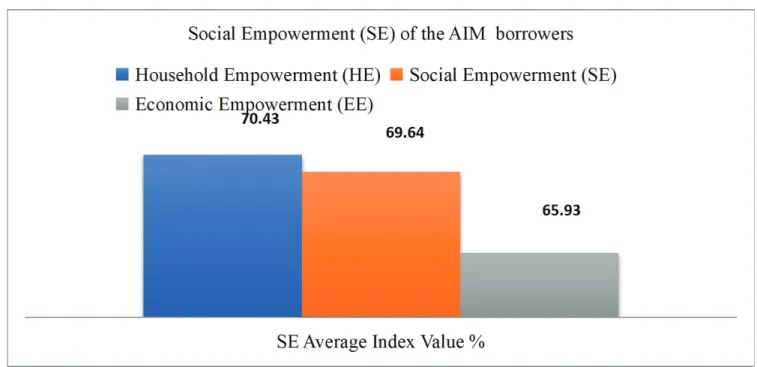
This study investigated the effect of the Amanah Ikhtiar Malaysia (AIM) microfinancing on the economic, social, and household empowerment of women borrowers in Malaysia. The study used a quantitative approach based on primary data. For this study, the participants comprised 384 AIM borrowers from Terengganu, Kelantan, and Pahang in the east coast region of Malaysia. Purposive stratified random sampling was used as well as the Krejcie and Morgan method to count the number of samples. Descriptive statistics and the Women Empowerment Index (WEI) were used in the analysis. The study findings reveal that AIM microfinancing affects the economic, social, and household empowerment of women borrowers in Malaysia. However, in comparing the three categories, women enjoyed more freedom in social and household decision-making than in economic decision-making. The present study recommends policies for the successful and effective operation of microfinance programs by providing the necessary guidelines for the control of AIM loan for women borrowers; increasing income-generating activities, sufficient access of credit, and proper education for the borrowers; and giving economic freedom of choice with necessary skill training policymaking options for the government and NGOs with the aim to improve the total household income and empowerment of the microcredit borrowers in Malaysia.
Keywords: Amanah Ikhtiar Malaysia (AIM), Microfinance, Women Empowerment, Malaysia JEL Classification Code: G02, G20, G21, G24
1. Introduction
Microcredit programs have been launched as one of the prime strategies in the overall movement to ensure women empowerment and to elevate them out of poverty. Many countries have established microcredit programs to reduce poverty by providing a small amount of credit to the poor for them to generate self-employment through income-earning activities (Haque, Siwar, Ghazali, & Bhuiyan, 2018a;
Mago, 2014; Mia, 2016). The idea began when Bangladeshi economist Dr. Mohammad Yunus introduced microcredit programs to end poverty in rural areas as an action project in the Jobra Village in the district of Chittagong, Bangladesh.
One of the major problems facing the poor and the lower- income group is access to credit. Their lack of assets for collateral and financial records, and limited credit history make obtaining credit from formal financial institutions almost impossible. The poor are tied to low productivity and usual self-employed economic activities because of the lack of capital. Thus, providing the poor with credit generally helps them solve poverty. Lack of capital and savings make it very difficult and, sometimes, impossible to obtain basic
*Acknowledgements:
The study acknowledged for financial support of FRGS project entitled “Formulation of Microfinance Institutions Sustainability Index (MISI) in Malaysia” (Ref: FRGS/1/2018/SS01/UNISEL/02/2)
1
First Author. Ph.D. Research Fellow, Institute for Environment and Development, Universiti Kebangsaan Malaysia, Malaysia.
Email: [email protected]
2
Professor Emeritus, Senior Research Fellow, Institute for Environment and Development (LESTARI), Universiti Kebangsaan Malaysia (UKM), Malaysia. Email: [email protected]
3
Research Fellow, Institute for Environment and Development, Universiti Kebangsaan Malaysia, Malaysia. Email: [email protected]
4
Professor, Director, The Accounting Research Institute, Universiti Teknologi MARA, Malaysia. Email: [email protected]
5
Corresponding Author. Associate Professor, Faculty of Business and Accountancy (FBA), University Selangor (Unisel), Malaysia [Postal Address: Jalan Timur Tambahan, 45600 Batang Berjuntai, Selangor, Malaysia] Email: [email protected]
© Copyright: The Author(s)
This is an Open Access article distributed under the terms of the Creative Commons Attribution Non-Commercial License (https://creativecommons.org/licenses/by-nc/4.0/) which permits unrestricted non-commercial use, distribution, and reproduction in any medium, provided the original work is properly cited.