연구노트
케이지 사육에서 방사사육으로 전환한 산란노계의 가슴살과 대퇴부살에 포함된 지방산 함량의 비교 조사
김창만․최정훈1)․최인학2)*
㈜농업법인 유심, 1)한양대학교 화학과, 2)중부대학교 애완동물자원학과 (2012년 3월 12일 접수; 2012년 4월 2일 수정; 2012년 5월 16일 채택)
Changes in Fatty Acid Profile of Breast and Thigh Muscle of Old Laying Hens as Transferred from Cage to Backyard Raising System
Chang-Man Kim, Jung-Hoon Choi1), In-Hag Choi2)*
Yushim Farming Guild Corporation, Youngju 750-917, Korea
1)
Department of Chemistry, Hanyang University, Seoul 133-791, Korea
2)
Department of Companion Animal & Animal Resources Sciences, Joongbu University, Kumsan 312-702, Korea
(Manuscript received 12 March, 2012; revised 2 April, 2012; accepted 16 May, 2012)Abstract
The objective of this study was undertaken to investigate changes in fatty acid profile of breast and thigh muscle of old laying hens as transferred from cage to backyard raising system and to provide basic information on using old laying hens to producers for environmental managements. Overall, percentages of unsaturated fatty acid obtained from breast and thigh muscle with cage and backyard raising system are the most abundant, followed by saturated fatty acid. For breast muscle, there were no differences (P>0.05) between cage rearing system and backyard raising system in saturated fatty acid (SFA) and mono unsaturated fatty acid (MUFA). Poly unsaturated fatty acid (PUFA) and PUFA:SFA ratios were significantly higher in backyard raising systems in comparison with cage rearing systems (P<0.05). No differences (P>0.05) were detected between both rearing systems for MUFA, PUFA, and PUFA:SFA ratios with thigh muscles. SFA in thigh muscle was significantly (P<0.05) higher in cage rearing systems compared with backyard raising systems.
In conclusion, using breast and thigh muscle meats from old laying hens as functional foods or investigating impact assessment on the improvement of farm management system may serve as a good management practice to encourage producers.
Key Words : Cage rearing system, Backyard raising system, Fatty acid profile, Breast muscle, Thigh muscle
1)
*Corresponding author : In Hag Choi, Department of Companion Animal & Animal Resources Sciences, Joongbu University, Kumsan 312-702, Korea
Phone: +82-19-527-7422 E-mail: [email protected]
1. 서 론
최근 국민 소득향상과 서구화된 식습관의 변화로 육류의 소비가 꾸준히 증가되고 있다. 더불어 육류 소 비의 증가에 기인한 질병의 증가로 인하여 기능성 식 품에 관한 관심 또한 매우 높다. 그러한 맥락에서 닭고
기는 다른 육류에 비하여 가격이 저렴하며, 영양학적 측면에서도 불포화 지방 함유량이 높고 포화지방산 및 콜레스테롤이 함량은 낮은 고단백질 기능식품으로 알려져 있다(Nanari 등, 2004; Jaturasitha 등, 2008;
Jeon 등, 2010).
현재 닭고기는 짧은 사육기간과 대량 생산이 가능 한 육계가 가장 많이 소비되고 있으며, 대부분의 양계 농가는 높은 수익성으로 인해 평사(floor pen rearing system) 형태인 육계사육을 선호하고 있다(Ahn과 Park, 2002). 이와는 반대로 토종 닭은 육계사육과는 달리 소규모로 사육되고 있으며, 사육기간이 비교적 길다는 단점을 가지고 있다(Sang 등, 2006; Lee 등, 2011). 그런데 우리나라 토종 닭의 사육형태는 방사 (backyard raising system) 및 평사(floor pen rearing system)사육을 원칙으로 하고 있다. Jeon 등(2010)의 연구에 따르면, 토종 닭의 영양적 특성은 지방함량이 적을 뿐만 아니라 육질이 단단하고 담백한 맛을 가지 고 있다고 하였다. 또한 풍미의 우수성 때문에 시중가 격보다 비싸게 판매되고 있다. 그런데 산란계의 경우 는 닭고기의 의미보다는 일정한 산란율을 유지하는 것이 최종목표로 케이지(cage rearing system)사육을 중요시하고 있다. 이러한 산란계의 축산경영에서 일 정한 산란율이 떨어질 경우, 산란계는 노계의 형태로 시중에 유통하게 된다. 결국 산란노계의 도태 필요성 은 사료 소비효율과 밀접하게 관련되기 때문에 노계 의 가격이 일정하게 유지 또는 상승하게 되면 도태시 키는 것이 유리하다.
이러한 사육 방식에 따라 가금생산성과 생리학·영 양학적 반응에 미치는 영향에 대해 많은 연구들이 진 행되고 있지만 이에 대한 논란의 여지가 많다. 그러나 산란노계의 경우, 영향학적 특성을 다룬 연구나 논문 등의 사례는 거의 보고되지 않았다. 따라서 본 연구에 서는 산란계의 케이지 사육방식에서 방사사육으로 사 육방식을 전환할 경우에 가슴살과 대퇴부살의 지방산 함량 변화를 조사하였다. 그리고 그 연구결과로써 양 계생산자들에게 산란노계의 활용가치에 대한 환경경 영적인 기초자료를 제공하는 데 있다.
2. 재료 및 방법
2.1. 실험 동물 및 설계
본 시험은 68주령 Hy-line Brown 갈색계 200수를 공시하여, 총 16주 동안 사양실험을 실시하였다. 모든 사양프로그램은 흥생양계(경북 의성)에서 제공되는 프로그램에 준하여 실시되었다. 케이지사육은 흥생양 계에서 8주 동안 실시된 후 이중 100수의 산란노계를 선발하고 방사사육 시설로 옮겨 8주 동안 실시되었다.
케이지 사육의 경우, 계사시설은 창문이 없는 무창계 사로서 사료, 물 및 점등은 사양기간 동안 컴퓨터 자동 조절 시스템으로 조절되게 하였다. 이와는 달리 방사 사육은 기본 울타리 시설에 일정한 공간을 주고 사료 와 물은 자유 급식시켰다.
2.2. 샘플채취 및 계육의 지방산 분석
케이지 사육과 방사사육을 통해 선발된 각각 5마리 산란노계는 전통적인 방법으로 목 부위의 경동맥을 방 혈시켜 도계하였다. 먼저 도계하기 전 털을 제거 후 가 슴살 및 다리육을 채취하여 다음 분석시까지 냉장 보 관(4℃)하였다. 계육의 지방산 분석은 Folch 등(1957) 의 방법에 준하여 chloroform과 methanol을 2:1의 비 율로 적용하여 가슴살과 대퇴부살로부터 지질을 추출 하였다. 추출된 지질 80 mg과 tricosanoic acid methyl esters(0.4 mg/mL of hexane, internal standard) 0.4 mg 을 뚜껑이 있는 글래스 튜브에 넣은 후 30℃에서 질소가스로 용매와 추출물질을 증발시켰다. 그리고 0.5 N NaOH (in methanol) 1 mL를 넣고 7분 동안 90℃
에서 열을 가하였다. 이를 실온에서 5분 이상 식인 후, 유리지방산은 90℃에서 10분 동안 4% H2SO4 용액 1 mL로 메틸화시켰다. 다시 30분 동안 실온에서 식힌 후, Hexane 2 mL와 증류수 4 mL을 시료 샘플에 넣고 섞은 다음 상층부위 1 mL을 채취하여 분석시까지 -2 0℃에서 저장하였다. GC(GA-17A, Shimadzu, Tokyo, Japan) 분석조건은 column의 초기 온도 180℃에서 시 작하여 1.5℃/min의 속도로 230℃까지 온도를 2분간 유지하였다. Injector와 detector의 온도는 각각 240℃
와 260℃였으며, 냉장된 시료 샘플의 상층액 0.5μL를 취하여 GC에 주입하였다. 계측된 지방산은 상대적 retention time을 비교 분석하고 함량은 백분율로 환산
Fatty acids (%) Cage Rearing System
Backyard
Raising System Significance1
Myristic acid (C14:0) 2.29±1.50 0.23±0.01 NS2
Pentadecanoic acid (C15:0) 0.45±0.34 0.04±0.01 NS
Palmitic acid (C16:0) 21.27±0.64 20.10±0.25 NS
Palmitoleic acid (C16:1) 2.41±0.45 0.50±0.01 NS
Heptadecanoic acid (C17:0) 0.23±0.02 0.18±0.01 NS
Heptadecenoic acid (C17:1n‐7) 0.44±0.16 1.02±0.03 NS
Stearic acid (C18:0) 10.16±1.22 12.97±0.10 NS
Oleic acid (C18:1n‐9) 32.26±4.10 21.64±0.41 *
Linoleic acid (C18:2n‐6) 22.42±0.40 20.83±0.18 NS
Alpha‐linolenic acid (C18:3n‐3) 0.76±0.02 0.37±0.03 *
Gamma‐linolenic acid (C18:3n‐6) 0.16±0.01 0.09±0.01 *
Eicosedienoic acid (C20:2n‐6) 0.09±0.09 0.41±0.02 NS
Eicosatrienoic acid (C20:3n‐6) 0.18±0.01 0.40±0.01 *
Arachidonic acid (C20:4n‐6) 4.97±0.22 17.50±0.13 *
Docosatetraenoic acid (C22:4n‐6) 0.96±0.36 1.53±0.06 NS
Docosapentaenoic acid (C22:5n‐3, DPA) 0.23±0.07 1.29±0.01 *
Docosahexaenoic acid (C22:6n‐3, DHA) 0.74±0.36 0.88±0.01 NS
Saturated fatty acid (SFA) 34.40±3.71 33.53±0.37 NS
Mono unsaturated fatty acid (MUFA) 35.11±4.40 23.16±0.43 NS
Poly unsaturated fatty acid (PUFA) 30.49±0.70 43.31±0.06 *
PUFA:SFA 0.89±0.08 1.29±0.01 *
1T‐test
2NS: not significant.
*P < 0.05.
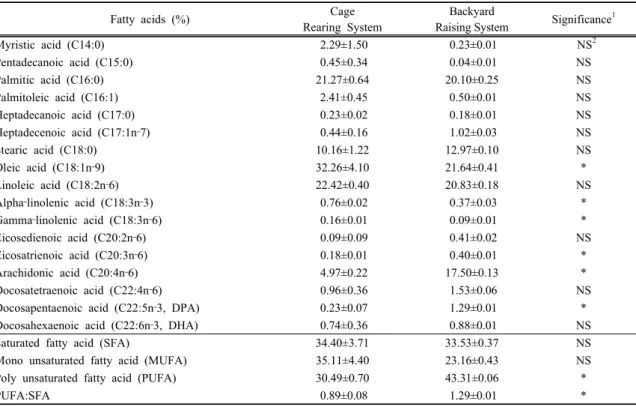
Table 1. Fatty acid composition in breast muscles of old laying hens as transferred from cage rearing system to backyard raising system
하였다.
2.3. 통계처리
본 연구에서 얻어진 자료의 통계분석은 t-test에 의 하여 평균치를 비교하였으며, 통계적 유의성은 5% 수 준에서 검정하였다.
3. 결과 및 고찰
3.1. 산란노계 가슴살의 지방산 함량 변화
산란노계의 케이지사육에서 방사사육 시스템으로 전환 시 가슴살의 지방산함량 변화를 Table 1에 나타내 었다. Oleic acid, alpha-linolenic acid, gamma- linolenic acid, eicosatrienoic acid, arachidonic acid, docosapen- taenoic acid(DPA), poly unsaturated fatty acid (PUFA) 및 PUFA/SFA 비율은 사육방식에 있어
통계적 유의성이 인정되었다(P<0.05). 그러나, myristic acid, pentadecanoic acid, palmitic acid, palmitoleic acid, heptadecanoic acid, heptadecenoic acid, stearic acid, linoleic acid, eicosedienoic acid, docosatetraenoic acid, docosahexaenoic acid, saturated fatty acid(SFA) 그리고 mono unsaturated fatty acid(MUFA)함량에 대한 두 사육방식간에는 통계적 유의적 차이는 나타 나지 않았다(P>0.05). 본 연구결과의 산란노계의 전체 적인 지방산 변화는 사육방식을 케이지사육에서 방사 사육으로 바꿈에 따라 포화지방산함량보다 불포화지 방산 함량이 높아진다는 이전 연구와 같다는 것을 보 여준다(Nanari 등, 2004; Grashorn과 Serini, 2006;
Husak 등, 2008). 포화지방산(saturated fatty acid)에 서는 두 사육방식 모두 palmitic acid와 stearic acid 함 량이 높게 나타났다. 분석된 가슴살의 MUFA의 변화
Fatty acids (%) Cage Rearing System
Backyard
Raising System Significance1
Myristic acid (C14:0) 0.82±0.07 0.40±0.02 *
Pentadecanoic acid (C15:0) 0.09±0.01 0.07±0.01 NS2
Palmitic acid (C16:0) 26.64±0.85 18.94±0.42 *
Palmitoleic acid (C16:1) 1.61±0.05 1.29±0.06 NS
Heptadecanoic acid (C17:0) 0.21±0.01 0.20±0.01 NS
Heptadecenoic acid (C17:1n‐7) 0.84±0.05 0.00±0.00 *
Stearic acid (C18:0) 11.86±0.27 11.65±0.10 NS
Oleic acid (C18:1n‐9) 27.28±2.95 27.03±0.66 NS
Linoleic acid (C18:2n‐6) 17.00±0.79 29.84±0.41 *
Alpha‐linolenic acid (C18:3n‐3) 0.62±0.09 0.67±0.07 NS
Gamma‐linolenic acid (C18:3n‐6) 0.12±0.06 0.00±0.00 NS
Eicosedienoic acid (C20:2n‐6) 0.13±0.04 0.37±0.03 *
Eicosatrienoic acid (C20:3n‐6) 0.03±0.03 0.36±0.04 NS
Arachidonic acid (C20:4n‐6) 9.09±3.29 7.53±0.06 NS
Docosatetraenoic acid (C22:4n‐6) 1.68±0.01 0.87±0.03 *
Docosapentaenoic acid (C22:5n‐3, DPA) 0.42±0.05 0.31±0.03 NS
Docosahexaenoic acid (C22:6n‐3, DHA) 1.10±0.23 0.48±0.04 NS
Saturated fatty acid (SFA) 39.62±1.16 31.25±0.30 *
Mono unsaturated fatty acid (MUFA) 29.73±3.04 28.32±0.60 NS
Poly unsaturated fatty acid (PUFA) 30.66±4.21 40.43±0.31 NS
PUFA:SFA 0.78±0.13 1.29±0.01 NS
1T‐test
2NS: not significant
*P < 0.05.
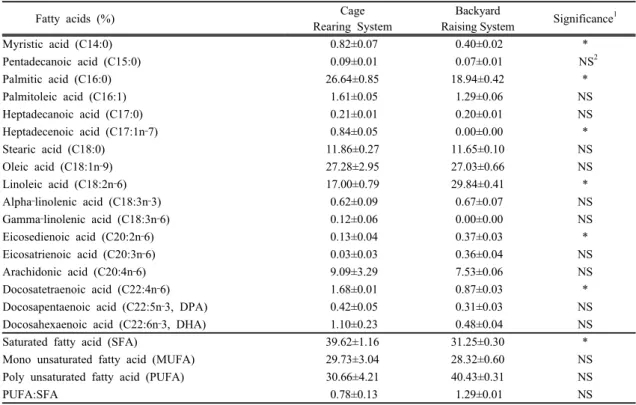
Table 2. Fatty acid composition in thigh muscles of old laying hens as transferred from cage rearing system to backyard raising system
는 케이지사육이 방사사육보다 높았지만, PUFA의 변 화는 케이지사육보다 방사사육 방식에서 훨씬 높게 나 타났다. 일반적으로 omega-3 그룹은 alpha-linolenic acid, stearidonic acid, eicosatrienoic acid(ETA), eicsosatetraenoic acid, eicosapentaenoic acid(EPA), docosapentaenoic acid(DPA), docosahex aenoic acid (DHA) 및 tetracosahexaenoic acid을 포함하는 것으 로(Slanker's Grass-Fed Meats), 고기에 축적되는 포화 지방산과는 달리 외부자극에 대한 면역시스템을 유지 하기 위한 필수영양소로서 이용된다. 또한 PUFA 대 SFA 비율은 케이지사육보다 방사사육 방식에서 높게 나타났다. 이러한 차이는 케이지사육과 방사사육 방 식에서 적용된 환경적인 요인과 영양학적인 특성차이 모두에 기인한 것으로 판단된다. 그러나 Jahan 등 (2004)에 따르면, 육계(broiler)를 비 유기농 사육방식
과 유기농 사육방식으로 비교했을 때, 유기농 사육방 식에서 성장한 육계의 가슴살에서 omega 3(n-3) 함량 은 낮았지만, PUFA, omega 6(n-6) 함량과 그리고 n-6 대 n-3 비율이 높다고 하였다. 이것은 유기농 방식이 지만 육계인 경우로 사육환경보다는 사육 사료에 기 인한 것으로 판단된다. 또한 Martino 등(2008)은 사육 사료와 고기의 PUFA 함량사이에 유의미한 상관관계 가 있다고 보고하였다.
3.2. 산란노계 대퇴부살의 지방산 함량 변화
Table 2는 산란노계의 케이지 사육에서 방사사육 으로 사육방식의 전환 시 대퇴부살의 지방산 함량 변 화를 나타내고 있다. 사육방식의 차이는 전체적인 지 방산함량 가운데 대퇴부살의 pentadecanoic acid, palmitoleic acid, heptadecanoic acid, stearic acid, oleic acid, alpha-linolenic acid, gamma-linolenic acid,
eicosatrienoic acid, arachidonic acid, docosapentaenoic acid(DPA), docosahexaenoic acid(DHA), MUFA, PUFA 및 PUFA/SFA 비율에 아무런 영향을 주지 않 았다(P> 0.05). 하지만, myristic acid, palmitic acid, heptadecenoic acid, linoleic acid, eicosedienoic acid, docosatetraenoic acid 그리고 SFA 지방산 함량은 두 사육방식 모두에서 통계적 유의성을 보였다(P< 0.05).
두 사육방식에서 포화지방산(saturated fatty acid)의 경우는 palmitic acid와 stearic acid 함량이 대부분을 차지하는 것으로 나타났다. 대퇴부살의 축적된 MUFA 지방산의 변화는 케이지사육에서 약간 높았지 만, PUFA 변화에서는 방사사육이 훨씬 높게 나타났 다. Table 2에서 제시하듯, 사육방식에 따른 산란노계 의 대퇴부살의 PUFA 함량 변화와 PUFA/SFA 비율은 케이지사육보다 방사사육에서 높게 나타났다. 이상의 결과로서 케이지사육에서 방사사육으로 바꿈에 따라 불포화지방산의 두드러진 변화 차이는 정확하게 설명 할순 없지만, 환경적 요인과 사료에 함유된 불포화지 방산의 전이 또는 조직에 축적되는 비율이 다르기 때 문인 것으로 판단된다. 그 예로 Hargis와 Elswyk (1993)와 Ozpinar 등(2003)의 연구에서는 불포화지방 산을 함유한 지방공급 사료를 일정수준 공급할 경우, 가금의 위 속에는 DHA를 분해하는 미생물이 적기 때 문에 각 조직에 따라 축적된다고 설명하고 있다.
4. 결 론
본 연구는 산란노계의 케이지사육에서 방사사육으 로 사육방식의 전환 시 가슴살과 대퇴부살의 지방산 함량 변화를 조사하였으며, 환경경영 관점에서 가금 생산자들에게 산란노계의 활용가치에 대한 기본정보 를 제공하는 데 있다.
전체적으로 사육방식의 변화에 따른 산란노계의 지방산 변화는 포화지방산보다 불포화지방산 함량이 높았다. 산란노계 가슴살에서의 지방산함량 변화는 MUFA의 경우 케이지사육이 방사사육보다 높았으며, PUFA 함량은 케이지사육보다 방사사육 방식에서 높 게 나타났다. 대퇴부살의 축적된 MUFA 함량은 케이 지 사육에서 약간 높았지만, PUFA 함량은 방사사육 방식이 훨씬 높게 나타났다. 가슴살과 대퇴부살의
PUFA/SFA 비율은 방사사육 방식에서 높게 나타났 다. 가슴살과 대퇴부살의 불포화지방산 변화의 이러 한 차이는 두 사육방식 즉 서로 다른 환경적 요인에 따 라 사료에 함유된 불포화지방산의 전이 또는 조직의 영양소 축적 비율이 다르기 때문인 것으로 사료된다.
결론적으로 본 연구결과는 기능성 식품으로서 산란 노계의 가슴살과 대퇴부살의 활용가치를 분명하게 제 고할 필요가 있음을 반증하는 것이다. 또한 이러한 결과 는 환경경영 측면에서 사육방식의 효율성 제고와 산란 노계의 활용가치에 대한 실제적인 정보를 축산경영자 들에게 제공할 수 있으며, 이에 대한 관련 영향평가를 하는데 중요한 자료로써 활용될 수 있음을 의미한다.
참 고 문 헌
Ahn, D. H., Park, S. Y., 2002, Studies on components related to taste such as free amino acids and nucleotides in Korean native chicken meat, J Korean Soc Food Sci. Nutr, 31, 547-552.
Folch, J., Lee, M., Sloane-Stanley, G. H., 1957, A simple method for the isolation and purification of lipids from animal tissues, J Biol Chem, 226, 497-509.
Grashorn, M. A., Serini, C., 2006, Quality of chicken meat from conventional and organic production, XII. European Poultry Conference, Verona, Italy.
Hargis, P. S., Van Elswyk, M. E., 1993, Manipulating the fatty acid composition of poultry meat and eggs for the health conscious consumer, World's Poultry Sci J, 49, 251-264.
Husak, R., Sebranek, J. G., Bregendahl, K. A., 2008, A survey of commercially available broilers marketed as organic, free range and conventional broilers for cooked meat yields, meat composition and relative value, Poult Sci, 87, 2367-2376.
Jahan, K., Paterson, A., Spickett, C. M., 2004, Fatty acid composition, antioxidant and lipid oxidation in chicken breast from different production regimes, Int J Food Sci Tech, 39, 443-453.
Jaturasitha, S., Srikanchai, T., Kreuzer, M., Wicke, M., 2008, Difference in carcass and meat characteristics between chicken indigenous to northern Thailand (black boned and Thai native) and imported
extensive breeds (Bresse and Rhode Island Red), Poultry Sci, 87, 160-169.
Jeon, H. J., Choe, J. H., Jung, Y., Kruk, Z. A., Lim, D.
G., Jo, C., 2010, Comparison of the chemical composition, textural characteristics, and sensory properties of North and South Korean native chickens and commercial broilers, Korean J Food Sci Ani Resour, 30, 171-178.
Lee, K. H., J, Y. H., Jung, S., Lee, J. H., H, K. N., Jo, C.
R., 2011, Physiochemical characteristics of the meat from Korean native chicken and broiler reared and slaughtered as the same conditions, Korean J. Poult.
Sci, 38, 225-230.
Martino, G., Ponzielli, V., Grotta, L., 2008, Healthier fat content through organic production, World Poult, 24, 33-34.
Nanari, M. C., Hewavitharana, A. K., Beca, C., de Jong, S., 2004, Effect of dietary tocopherols and tocotrienols on the antioxidant status and lipid stability of chicken, Meat Sci, 68, 155-162.
Ozpinar, H., Kahraman, R., Abas, I., Kutay, H. C., Eseceli, H., Grashorn, M. A., 2003, Effect of dietary fat source on n-3 fatty acid enrichment of broiler meat, Poult Sci, 67, 57-64.
Sang, B. D., Kong, H. S., Kim, H. K., Choi, C. H., Kim, S. D., Cho, Y. M., Sang, B. C., Lee, J. H., Jeon, G.
J., Lee, H. K., 2006, Estimation of genetic parameters for economic traits in Korean, Asian-Aust J Anim Sci, 19, 319-323.
Slanker's Grass-Fed Meats, Fatty Acid Analysis, http://texasgrassfedbeef.com/id73.htm.