CRDS Study of Tropospheric Ozone Production Kinetics : Isoprene Oxidation by Hydroxyl Radical
Ji-Ho Park †
Department of Environmental Health, Korean National Open University, Seoul 110-791, Korea
(Received November 4, 2009/Revised November 20, 2009/Accepted December 5, 2009)
ABSTRACT
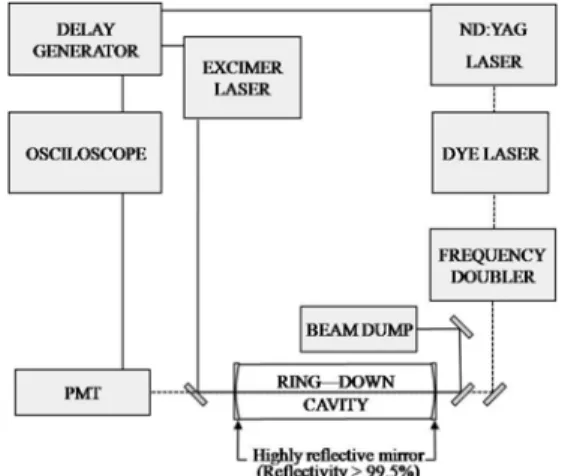
The tropospheric ozone production mechanism for the gas phase additive oxidation reaction of hydroxyl radical (OH) with isoprene (2-methyl-1,3-butadiene) has been studied using cavity ring-down spectroscopy (CRDS) at total pressure of 50 Torr and 298 K. The applicability of CRDS was confirmed by monitoring the shorter (~4%) ring- down time in the presence of hydroxyl radical than the ring-down time without the photolysis of hydrogen peroxide.
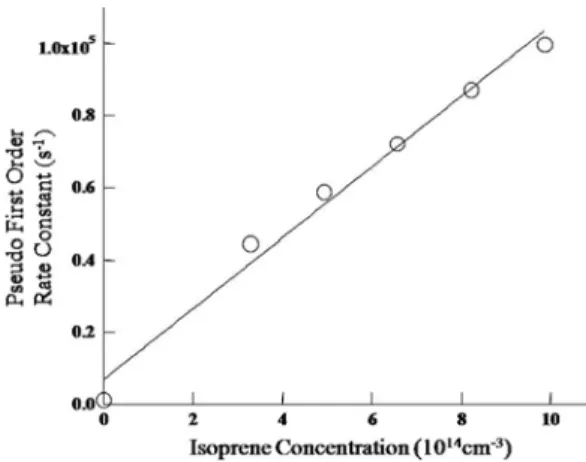
The reaction rate constant, (9.8±0.1)×10
−11molecule
−1cm
3s
−1, for the addition of OH to isoprene is in good agreement with previous studies. In the presence of O
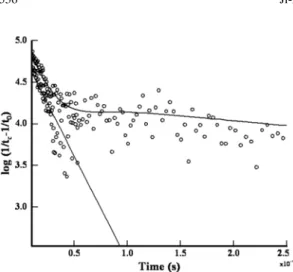
2and NO, hydroxyl radical cycling has been monitored and the simulation using the recommended elementary reaction rate constants as the basis to OH cycling curve gives reasonable fit to the data.
Keywords: cavity ring-down spectroscopy, ozone, isoprene, oxidation, rate constant
I. Introduction
Among the issues in regional air quality, the tropospheric ozone production through the photo- chemical oxidation of unsaturated hydrocarbons has been drawing attention of many atmospheric scientists. Isoprene (2-methyl-1,3-butadiene, C 5 H 8 ) is the most abundant non-methane biogenic organic compound emitted by vegetation into the atmosphere (~450 Tg/yr) and its oxidation serves as a major source of tropospheric ozone. 1,2) During the day time, isoprene reacts predominantly with the hydroxyl radical (OH) which has tropospheric lifetime of a few seconds or less and the concentration of OH in the sunlit troposphere is near 10 6 molecules·cm −3 . 3)
In the metropolitan city, the atmosphere is polluted by automobile exhaust gases including nitrogen oxides (NO x ) 4) and isoprene is oxidized by OH in the presence of moderate concentration of NO as well as O 2 . The OH regeneration during
isoprene oxidation in the presence of NO and O 2 is abbreviately shown in Fig. 1. The first intermediate radical product, hydroxy alkyl radical (HOC 5 H 8 ), reacts with O 2 to produce the hydroxy peroxy radical (HOC 5 H 8 O 2 ). The reaction between hydroxy peroxy radicals and NO yields alkoxy radical (HOC 5 H 8 O) and nitrogen dioxide. The decomposition of alkoxy radicals, followed by the HO 2 + NO reaction regenerates OH radical. It is worth noting that each cycle of the isoprene oxidation produces two molecules of ozone from the reaction between O 2 and O followed by photolysis of nitrogen dioxide.
†