Print ISSN: 2288-4637 / Online ISSN 2288-4645 doi:10.13106/jafeb.2021.vol8.no8.0067
The Effect of RGEC and EPS on Stock Prices:
Evidence from Commercial Banks in Indonesia
Mu’minatus SHOLICHAH
1, M. JIHADI
2, Bambang WIDAGDO
3, Novita MARDIANI
4, Dewi NURJANNAH
5, Yoosita AULIA
6Received: April 10, 2021 Revised: June 26, 2021 Accepted: July 04, 2021
Abstract
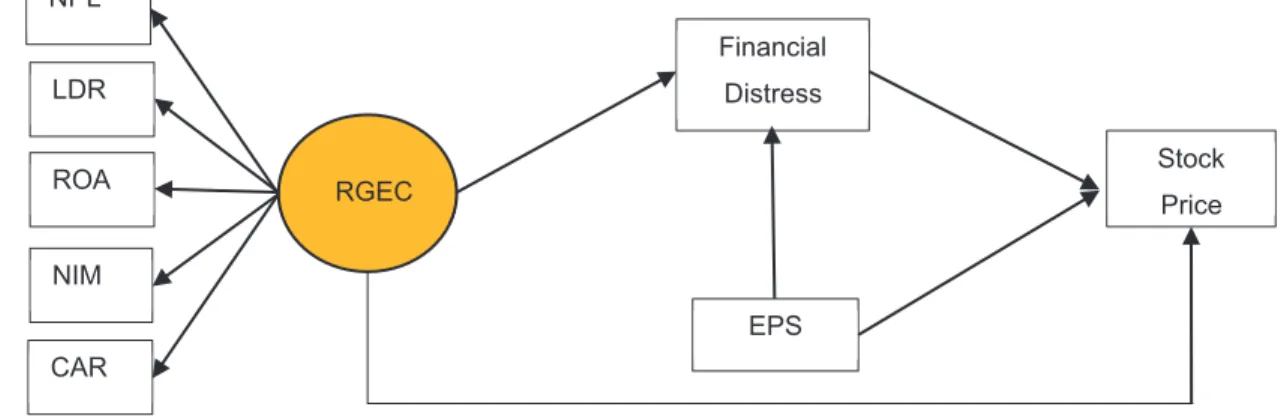
This study aims to examine and analyze the effect of Risk Profile, Good Corporate Governance (GCG), Earnings, Capital (RGEC), and Earnings per Share (EPS) on stock prices with financial distress as an intervening variable. The sampling technique used purposive sampling based on certain criteria and data used was secondary data, that is, annual reports of commercial banks in Indonesia for the period of 2012–2018 with a sample of 23 banks from a total population of 81 banks. This type of research is explanative with a quantitative descriptive approach to describe or explain quantitative data. The data obtained was analyzed using SEM (Structural Equation Model) with the AMOS Program. The results showed that RGEC, EPS, and financial distress affect stock prices. This is based on testing the direct effect as indicated by a p-value that is smaller than 0.05. Based on the mediation test, the results show that financial distress cannot mediate the effect of RGEC and EPS on stock prices as indicated by a p-value greater than 0.05. The implication of this research is very important for investors to analyze stock price changes based on RGEC, EPS, and financial distress to gain profits. In addition, there are various warning signs indicating that a company is experiencing financial distress or it is heading towards such a state.
Being aware of these signs can help prevent failure.
Keywords: Commercial Banks, Earning Per Share, Financial Distress, RGEC, Stock Prices JEL Classification Code: G21, G32, G33
1. Introduction
The other way to grow your fortune is to invest your assets so that they increase in value over time. Whether you invest in stocks, bonds, mutual funds, options, futures, precious metals, real estate, small business, or a combination of all of the above, the objective is to generate cash. This can come in the form of increased value to the investment, dividend income, or the sale of a business, or some other liquidity event. Hundreds of banks trade on the major stock exchanges, and they come in various sizes, geographic locations, and focuses. The International Finance Corporation (IFC) estimated that investor interest in stocks and bonds had reached 21 trillion US $ in 2019 as a result of the global market investment. Irama (2018) explained that company performance is indicated by stock prices that move in the same direction as the company’s performance.
More than anything, investors want to see a return on their investment. Investors are in the business of putting money
1
First Author. Associate Professor, Faculty of Economics and Business, University of Muhammadiyah Gresik, Gresik, Indonesia.
Email: [email protected]
2
Corresponding Author. Faculty of Economics and Business, University of Muhammadiyah Malang, Malang, Indonesia [Postal Address: l. Bendungan Sutami No.188, Sumbersari, Kec.
Lowokwaru, Kota Malang, Jawa Timur 65145, Indonesia]
Email: [email protected]
3
Professor, Faculty of Economics and Business, University of Muhammadiyah Malang, Malang, Indonesia.
Email: [email protected]
4
Faculty of Economics and Business, University of Muhammadiyah Malang, Malang, Indonesia. Email: [email protected]
5
Lecturer, Faculty of Economics and Business, University of Muhammadiyah Malang, Malang, Indonesia.
Email: [email protected]
6