After the discovery of the Bi-Sr-Ca-Cu-O (BSCCO) high Tc superconductor, studies on the application of this system has attracted a huge attention. BSCCO superconductor is classified into three phases according to the number of Cu-O 2 planes n, and the critical temperature (Tc) varies depending on the phases such as Bi-2201 (n = 1, Tc ~ 20 K), Bi-2212 (n = 2, Tc ~ 85 K), and Bi-2223 (n = 3, Tc ~ 110 K) [1, 2]. Fabrication of an isolated phase of Bi- 2223 is found to be difficult due to the fact that the Bi-2212 phase grows prior to the Bi-2223 phase during synthesis [3], therefore, Bi-2212 phase necessarily occupies a certain volume fraction in the fabrication of Bi-2223 phase. For the application of the BSCCO system, not only the critical current density but also Tc must be considered. The Bi- 2212 phase has a higher critical current density than the Bi- 2223 phase due to fewer weak links, but has a much lower Tc , which is close to the liquid nitrogen temperature [4].
Since low critical current density and low Tc have significant limitations in application of superconductors, various methods have been tried to improve the both characteristics.
Partial substitutions or additions of certain elements at different cationic sites have been conducted to enhance the
Superconducting properties of the Bi-2223 system. In particular, it is known that substitution of Pb in the Bi sites or addition of Pb in the BSCCO composition can effectively increase the volume fraction of the Bi-2223 phase [5]. As another approach, in order to improve the critical current density of (Bi, Pb)-2223, additions of impurity materials have been tried to introduce artificial pinning centers [6]. Especially, ferromagnetic Fe 3 O 4
doping in (Bi, Pb)-2223 system has been tried to improve the critical current density, however, the values of Tc are reported to decrease abruptly as the Fe 3 O 4 content increases [7].
In this research, we investigate the mechanism of Tc
decrease in Fe 3 O 4 -added Bi 1.6 Pb 0.4 Sr 2 Ca 2 Cu 3 O 10+𝜹 ((Bi, Pb)-2223) polycrystalline samples by using extended X- ray absorption fine structure (EAXFS) spectroscopy.
Variation in Tc of cuprates is reported to relate to the change in the local structure of the CuO 2 plane. EAXFS is known to be a powerful tool to identify the distribution of atomic displacements. Especially, EXAFS data measured at the Cu K-edge provide useful information on both the local structure of the CuO 2 plane and the structural phase variation in Fe 3 O 4 -added (Bi, Pb)-2223 system. In addition, the coordination number and distribution of oxygen atoms around copper are determined by using of the Cu-O pair distribution function (PDF) [8].
Phase transition of (Bi, Pb)-2223 superconductor induced by Fe3O4
addition
Y. J. Koa, J. Y. Oha, C. Y. Songa, D. S. Yangb, D. H. Tranc, and B. Kanga,*
a Department of Physics, Chungbuk National University, Cheongju, 28644, Korea
b Department of Physics Education, Chungbuk National University, Cheongju, 28644, Korea
c Faculty of Physics, VNU University of Science, Hanoi, Vietnam
(Received 10 October 2019; revised or reviewed 18 November 2019; accepted 19 November 2019)
Abstract
We investigated the effect of Fe 3 O 4 addition on the critical temperature of (Bi, Pb)-2223 polycrystalline samples.
Bi 1.6 Pb 0.4 Sr 2 Ca 2 Cu 3 O 10+δ + x wt. % Fe 3 O 4 (x = 0.0, 0.2, 0.4, 0.6, and 0.8) samples were prepared by using a solid-state reaction method. The analysis of X-ray diffraction data indicates that as Fe 3 O 4 is added, dominant phase of the sample changes from Bi- 2223 to Bi-2212 with an increasing Bi-2201 phase. The transition temperature of the samples drastically decreased with the Fe 3 O 4
addition. The resistance data of samples with x = 0.2 and 0.4 showed a double transition indicating a coexistence of Bi-2223 and Bi-2212 phase while the samples with x = 0.6 and 0.8 showed a single transition with a semiconducting behavior. This phase transition may originate from changes in local structure of the Bi-2223 system by Fe 3 O 4 addition. Analysis of the pair distribution function of the Cu-O pair in the CuO 2 plane calculated from extended X-ray absorption fine structure data revealed that the oxygen coordination of copper ion changes from CuO 4 planar type (x = 0.0 - 0.4) to CuO 5 pyramidal type (x = 0.6, 0.8). The correlated Debye-Waller factor, providing information on the atomic disorder within the CuO 2 plane, shows an inverse relation to the coordination number. These results indicate that addition of Fe 3 O 4 changes the oxygen distribution around Cu in the CuO 2 plane, causing a phase transition from Bi-2223 to more stable Bi-2212/Bi-2201 phases.
Keywords: (Bi,Pb)-2223, Fe 3 O 4 , critical temperature, EXAFS, coordination number, FWHM
Samples with starting composition of Bi 1.6 Pb 0.4 Sr 2 Ca 2 Cu 3 O 10+𝜹 (Bi, Pb)-2223 were prepared using the solid-state reaction method. The Pb content was chosen to be 0.4 as this is the optimized value for the highest Tc . Bi 2 O 3 , PbO, SrCO 3 , CaCO 3 and CuO powders of high purity (99.99%) were mixed in appropriate amounts and ground before being calcined in four steps of 670 ℃ / 48 hours + 750 ℃ / 48 hours + 800 ℃ / 48 hours + 820 ℃ / 48 hours. After adding 0.0, 0.2, 0.4, 0.6, and 0.8 wt. % of Fe 3 O 4 as magnetic material, several times of milling and intermittent grindings were performed to ensure homogeneity of the sample. The powders were then pressed and sintered in air at 850 ℃ for 160 hours [9]. The Bi 1.6 Pb 0.4 Sr 2 Ca 2 Cu 3 O 10+𝜹 + x wt. % Fe 3 O 4 superconductors fabricated for this study were named as Pure, F02, F04, F06, and F08 according to the Fe 3 O 4 content.
The powder X-ray diffraction (XRD) (D8 Disconver with GADDS) and energy dispersive X-ray spectroscopy (EDX) (FlatQuard) were used to determine the resultant phase and the compositional distribution, respectively. To determine the critical temperature of samples, the resistance measurements as a function of temperature were carried out by using a four-probe technique in a closed loop helium system [10]. In order to observe the local structure around Cu atoms, the Cu-K (8980.0 eV) X-ray absorption spectra were collected in the Pohang Accelerator Laboratory (PAL) 8C nanoprobe beam line at room temperature.
The collected Cu K-edge XAFS spectra were normalized to the atomic energy absorption by using the EXAFS method [11], and collected EXAFS data were analyzed by the ATHENA code of the IFEFFIT software program [12]. For an analysis of the oxygen distribution in the Cu-O 2 layer, the atomic PDF is calculated on the 1 st Cu- O shell by using a regularization method [13].
3. RESULTS AND DISCUSSION
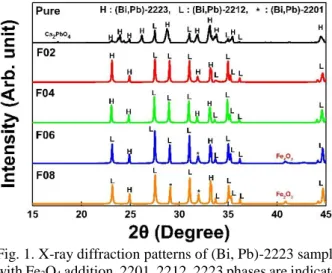
Figure 1 shows the powder X-ray diffraction (XRD) patterns of the samples Pure, F02, F04, F06, and F08. The peaks belong to 2223, 2212, and 2201 phases are marked as H, L, and*, respectively, and impurities such as Ca 2 PbO 4
and Fe 2 O 3 are separately indicated. Ca 2 PbO 4 impurity is found only in the pure sample, and it disappears in all the samples in which Fe 3 O 4 is added. In addition, as Fe 3 O 4 is added to (Bi, Pb)-2223, a number of peaks of 2223 phase disappear, and a new peak of Fe 2 O 3 starts to appear in samples of F06 and F08. The volume fraction of Fe 2 O 3 in F06 is 0.7 % respect to the total volume, and the relative volume fraction of Fe 2 O 3 in F08 increases to 1.0 %.
As can be seen in Fig. 1, the addition of Fe 3 O 4 seems to promote a phase transition from 2223 to 2212 and 2201 phases and to induce a peak shift. All three phases are found to coexist in the samples with Fe 3 O 4 except Pure sample. The volume fractions of the superconducting phase are calculated from the diffraction intensities of 2201, 2212, and 2223 by using the equation (1) and listed in Table I. The 2223 volume fraction for the pure sample is
Fig. 1. X-ray diffraction patterns of (Bi, Pb)-2223 samples with Fe 3 O 4 addition. 2201, 2212, 2223 phases are indicated as *, L, and H, respectively.
TABLE I
S UPERCONDUCTING VOLUME FRACTION OF (Bi, Pb)-2223 WITH Fe 3 O 4 ADDITION .
67.2% and the other phase is 2212. As Fe 3 O 4 is added, the 2223 volume fraction drastically decreases and 2212 becomes a major phase with increasing 2201 phase.
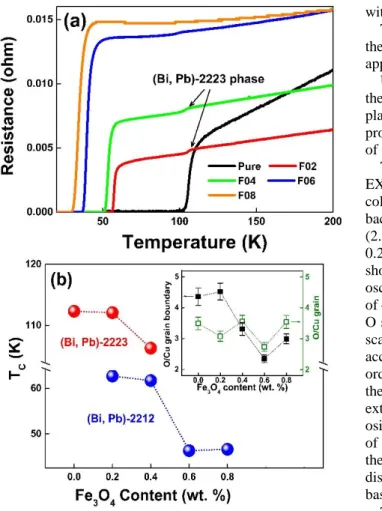
𝟐𝟐𝟐𝟑 (𝒑𝒆𝒂𝒌)+ ∑ 𝑰 𝟐𝟐𝟏𝟐 (𝒑𝒆𝒂𝒌)+∑ 𝑰 𝟐𝟐𝟎𝟏 (𝒑𝒆𝒂𝒌) × 𝟏𝟎𝟎 Figure 2 shows electrical resistance as a function of temperature of all of the samples. Pure, F02, and F04 exhibit a metallic behavior in the normal state, whereas F06 and F08 exhibit a semiconducting behavior in the normal state. Similar results of semiconducting resistance due to the Fe substitution for Cu in Bi-2212 system had also reported [14]. It could infer the possibility of partial substitution of Fe for Cu. The value of T c,onset of pure is 112.3 K, showing the highest critical temperature. A close inspection on the resistances of F02 and F04 reveals double transitions, a weak transition around 106 K, but a dominant transition at 62.7 K and 61.7 K, respectively, which may indicate a coexistence of 2223 and 2212 phases. As the Fe 3 O 4 content further increases , the transition becomes a single and the values of T c,onset reduce to near 46 K for F06 and F08. In addition, a systematic increase in the transition width ΔT c as well as a systematic decrease in the residual resistance ratio (RRR) with increasing the Fe 3 O 4 content indicate an increase of impurity phase.
Sample Volume Fraction (%)
2201 2212 2223
Pure 0.0 32.8 67.2
F02 4.3 68.0 27.6
F04 5.0 70.0 27.6
F06 11.5 74.5 14.0
F08 19.4 64.1 16.4
(3)
F ig. 2. (a) Resistance of (Bi, Pb)-2223 samples as a function of temperature with Fe 3 O 4 addition (b) Critical temperature as a function of Fe 3 O 4 content. Phase transition from 2223 to 2212 and 2201 is obvious as the Fe 3 O 4 content increases. Inset: atomic % of oxygen relative to copper at grain boundaries and inside grains of (Bi, Pb)- 2223.
TABLE II
T HE CRITICAL TEMPERATURE OF (Bi, Pb)-2223 WITH Fe 3 O 4 ADDITION .
In order to check variation in the elemental composition of (Bi, Pb)-2223, EDX analysis is performed. The inset of Fig. 2(b) shows the relative atomic ratio of oxygen to copper both inside grains and at the grain boundaries. The oxygen ratio inside grains is fluctuating around 3.2 irrespective of the Fe 3 O 4 content. However, the ratio of oxygen to copper at grain boundaries decreases abruptly with increasing Fe 3 O 4 content. For example, it starts from near 4.2 in Pure and approaches to about 3 for sample F08.
The abrupt decrease of the relative ratio of oxygen to copper by increasing Fe 3 O 4 content seems to be correlated
with the phase transition from Bi-2223 to Bi-2212.
Therefore, information on the distribution of oxygen in the Cu-O 2 plane may provide an explanation on the appearances of lower T c phases (Bi-2212 or Bi-2201) [15].
Using EXAFS measurements, it is possible to identify the oxygen distribution around Cu atoms in the Cu-O 2
plane, and an advanced PDF method is capable of providing an accurate information of isolated contribution of Cu-O pairs.
To examine the oxygen distribution in the Cu-O 2 plane, EXAFS data obtained at the Cu K-edge are analyzed. The collected EXAFS signal is weighted by k3 without the background spectrum. The transform window is set to k = (2.8 – 11.6) Å -1 , and the Hanning window is given as dk = 0.2 Å -1 . A typical Fourier transforemd EXAFS spectra is shown in the inset of Fig. 3. Fourier transformed EXAFS oscillations represent that the 1 st shell locates at a distance of ~1.5 Å , which corresponds to the contribution of the Cu- O scatterings. However, due to the possibility of multiple scatering effect from other shells, it cannot provide an accurate information in CuO 2 plane by fitting process. In order to evaluate an isolated contribution of Cu-O pairs in the Cu-O 2 plane, sigle contribution of Cu-O pairs was extractd from the EXAFS signals. The indentical shapes of osillations in Fig. 3 showed the well-extracted contribution of Cu-O pairs without any informational distortion from the other scatterings. Through this data, the atomic pair distribution funtion (PDF) of Cu-O pairs is calculated based on the EXAFS regularization method [16].
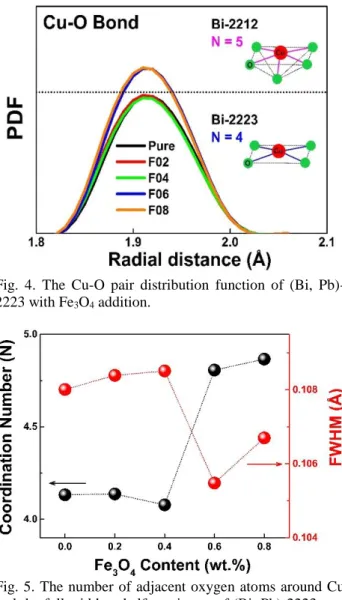
Typical PDFs of Cu-O pairs of (Bi, Pb)-2223 samples with Fe 3 O 4 addition are shown in Fig. 4. The line shapes of PDF for all of the samples are well separated into two groups; (i) Pure, F02, F04 and (ii) F06, F08. Especially, PDF for each group shows that integrated areas are different, where the area of the Gaussians corresponds to the oxygen coordination number adjacent to the photo absorbing Cu atoms [17]. An increase of the area of the distribution seems to have a correlation with Fe 3 O 4 content.
Thus, to identify the oxygen coordination number, the Gaussian amplitude fitting to PDF is performed.
Fig. 3. Filtered Cu-O EXAFS signal in the range of R = (1.02 to 1.96 Å ). Inset: the Fourier transforms of Cu-K edge EXAFS spectra of all the samples .
Sample Critical Temperature T c (K)
T c onset T c zero ΔT c RRR
Pure 112.3 102.4 9.9 2.00
F02 62.7 55.8 6.9 1.55
F04 61.7 50.8 10.9 1.38
F06 46.3 36.0 10.3 1.27
F08 46.6 29.6 17.0 1.18
(4)
Fig. 4. The Cu-O pair distribution function of (Bi, Pb)- 2223 with Fe 3 O 4 addition.
Fig. 5. The number of adjacent oxygen atoms around Cu and the full width at half maximum of (Bi, Pb)-2223 as a function of Fe 3 O 4 content.
Figure 5 shows the expected coordination numbers of oxygen for the average crystallograpic structure, obtained from the PDF fitting, as a function of Fe 3 O 4 content. The abrupt increase of the coordination number from ~ 4.1 for Pure to ~ 4.9 for F06 and F08 can be clearly observed.
Since the coordination numbers are associated with the distibution of oxygen in the CuO 2 plane, this result indicates that the oxygen coordination of copper ion changes from the CuO 4 planar type to the CuO 5 pyramidal type. It seems that partial vanish of CuO 4 square planes in the Bi-2223 phase induces average structural transformation to the CuO 5 pyramids of Bi-2212 and/or Bi- 2201. In other words, vanish of stacked CuO 4 plane due to Fe 3 O 4 addition alters the superconducting phase from Bi- 2223 to Bi-2212, which is in good agreement with the analysis of X-ray diffraction data.
The full width of half maximum (FWHM) of PDF curves, which corresponds to the correlated Debye-Waller factors providing information on the atomic disorder within the CuO 2 plane, are also calculated and displayed in Fig. 5. The values of FWHM are found to have an inverse relation with the coordination number, infering that the system becomes more stable with Fe 3 O 4 addition. It is generally known that among this family, the Bi-2212 phase
has larger structural stability than the Bi-2223 phase [18].
As a result, it can be concluded that a unstable structure of the (Bi, Pb)-2223 system relaxes to another stable structure by the phase transition from Bi-2223 to Bi-2212 as the Fe 3 O 4 content increases beyond x = 0.6.
4. CONCLUSION
In this study, the origin of Tc drop in the Fe 3 O 4 -added Bi 1.6 Pb 0.4 Sr 2 Ca 2 Cu 3 O 10+𝜹 ((Bi, Pb)-2223) system is investigated. (Bi, Pb)-2223+ x wt. % Fe 3 O 4 (x = 0.0, 0.2, 0.4, 0.6, and 0.8) polycrystalline samples was fabricated by a solid-state reaction method. The analysis of X-ray diffraction data indicates that as Fe 3 O 4 is added, a dominant phase of the sample changes from Bi-2223 to Bi-2212 with an increasing volume fraction of the Bi-2201 phase. The values of Tc of the samples drastically decrease with the Fe 3 O 4 addition. The R-T curves of the samples with x = 0.2 and 0.4 show double transitions indicating a coexistence of Bi-2223 and Bi-2212/Bi-2201 phases. On the other hand, the samples with x = 0.6 and 0.8 show a single transition with a semiconducting behavior.
This phase transition may be originated from changes in local structure of the CuO 2 plane in the (Bi, Pb)-2223 system by adding ferromagnetic Fe 3 O 4 . EXAFS measurements were carried out at the Cu K-edge to identify the effect of Fe 3 O 4 of addition on the local structure.
Analysis of PDF of the Cu-O pair in the CuO 2 plane calculated from EXAFS reveals that the oxygen coordination of copper ion changes from the CuO 4 planar type (x = 0.0 - 0.4) to the CuO 5 pyramidal type (x = 0.6, 0.8). The atomic disorder within the CuO 2 plane is found to decrease as the Fe 3 O 4 content increases. These results indicate that addition of Fe 3 O 4 changes the oxygen distribution around Cu in the CuO 2 plane, causing a phase transition from Bi-2223 with high Tc to more stable Bi- 2212/Bi-2201 phases with low Tc .
ACKNOWLEDGMENTS
This work was supported by the National Research Foundation of Korea (NRF) grant funded by the Korean government (MSIT) (NRF-2018R1A2B6004784). This work was partially supported by the research fund of Chungbuk National University in year of 2018.
REFERENCES
[1] I. H. Gul, M. A. Rehman, M. Ali, and A. Maqsood, “Effect of vanadium and barium on the Bi-based (2223) superconductors,”
Physica C, vol. 432, pp. 71-80, 2005.
[2] M. Tange, T. Amano, S. Nishizaki, and R. Yoshizaki,
“Superconducting properties of Bi-2212 whiskers,” Physica C, vol.
392-396, pp. 428-431, 2003.
[3] A. Gama, E. Chavira, and R. Escudero, “Superconductivity above 100 K by Pr substitution in the two-copper-layer Bi-Pb-Sr-Ca-Cu-O system,” Phys. Rev. B, vol. 42, pp. 2161-2165, 1990.
[4] H. Salamati and P. Kameli, “The effect of Bi-2212 phase on the weak
link behavior of Bi-2223 superconductors,” Physica C, vol. 403, pp
60-66, 2004.
(5)
[5] N. Knauf, J. Harnischmacher, R. Miiller, R. Borowski, B. Roden, and D. Wohlleben, “Preparation and characterisation of single-phase Bi- Pb-Sr-Ca-Cu-O high temperature superconductors,” Physica C, vol.
173, pp. 414-424, 1991.
[6] D. H. Galvan, A. Durán, F. F. Castillón, E. Adem, R. Escudero, D.
Ferrer, A. Torres, and M. José-Yacamán, “Enhancement of the Current Density J C for Bi 2 Sr 2 CaCu 2 O 8 by Means of Carbon and NbSe2 Nanotubes,” J. Super. Nov. Magn., vol. 21, pp. 271-277, 2008.
[7] N. Ghazanfari, A. Kılıç,, Ş. Özcan, H. Sözeri, H. Ö zkan, and A.
Gencer, “Preparation of Nano-Scale Magnetite Fe 3 O 4 and its Effects on the Bulk Bi-2223 Superconductors,” AIP Conf. Proc., vol. 929, pp.
414-424, 2007.
[8] D. S. Yang and G. Buker, “Improved R-space resolution of EXAFS spectra using combined regularization methods and nonlinear least- squares fitting,” Phys. Rev. B, vol. 54, pp. 3169-3172, 1996.
[9] J. Y. OH, A. T. Pham, D. H. Tran, D. S. Yang, and B. Kang, “Effect of K Substitution on Local Structure of Bi 1.6 Pb 0.4 Sr 2-x K x Ca 2 Cu 3 O 10+𝜹
System Probed by Extended X-Ray Absorption Fine Structure,” J.
Electronic Mater., vol. 48, pp. 4920-4924, 2019.
[10]C. Y. Song and B. Kang, “Development and Evaluation of a Measurement System with a Closed-Cycle Refrigerator for Characterizing the Resistance of a Superconductor,” New Physics:
Sae Mulli, vol. 68, pp. 737-741, 2018.
[11]Abhijeet Gaur, B. D. Shrivastava, and H. L. Nigam, “X-ray Absorption Fine Structure (XAFS) Spectroscopy,” Proc. Indian Natn.
Sci. Acad., Part B, pp. 921-966, 2013.
[12] J. Y. Oh, Tien M. Le, A. T. Pham, D. H. Tran, D. S. Yang, and B.
Kang, “Role of interlayer coupling in alkaline-substituted (Bi, Pb)- 2223 superconductors,” J. Alloy. Compd., vol. 804, pp. 348-352, 2019.
[13]D. S. Yang, “Separation of Different Atomic Shell in EXAFS spectrum Using the Regularization Method,” J. Phys. Conf. Ser., vol.
712, pp. 1-4, 2016.
[14] V. N. Narozhnyi and V. N. Kochetkov, “Influence of rare-earth ionic radius on the properties of Ni- and Fe-substituted RBa 2 (Cu 1-x M x ) 3 O 7- y systems (R = Y,Nd,Eu,Gd,Ho,Tm; M = Ni,Fe)”, Phys. Rev. B, vol.
53, pp. 5856-5862, 1996.
[15]Md. Atikur Rahman, Md. Zahidur Rahaman, and Md. Nurush Samsuddoha, “A Review on Cuprate Based Superconducting Materials Including Characteristics and Applications,” Am. J. Phys.
Appl., vol. 3, pp. 39-56, 2015.
[16] D. S. Yang, I. Kim, B. Jiang, S. G. Min, and S. C. Yu, “EXAFS Study for a Magnetic Shape Memory Alloy Ni-Mn-Ga,” J. Kor. Phys.
Society, vol. 50, pp. 1062-1067, 2007.
[17]J. Timoshenko, Z. Duan, G. Henkelman, R. M. Crooks, and A. I.
Frenkel, “Solving the Structure and Dynamics of Metal Nanoparticles by Combining X-Ray Absorption Fine Structure Spectroscopy and Atomistic Structure Simulations,” Annu. Rev. Anal.
Chem., vol. 12, pp. 501-522, 2019.
[18]Berdan Özkurt, “Effects of Ni Substitution in Bi-2212
Superconductors,” J. Super. Nov. Magn., vol. 25, pp. 1775-1779,