Korean Circulation Journal
Introduction
The presence of ventricular arrhythmias in dilated cardiomyopathy patients with severely depressed left ventricular ejection fractions (LVEFs) is strongly associated with sudden cardiac arrest.
1)Cardiac resynchronization therapy (CRT) may be indicated if the patients have wide QRS complexes and their left ventricular (LV) systolic dysfunction cannot be improved by appropriate medical therapy.
2)Previous reports have indicated that the antiarrhythmic effect of CRT can be observed from 1 to 12 months after the initiation
of biventricular pacing and is proportional to the improvement in LV systolic function.
3)4)We implanted a CRT defibrillator in a dilated cardiomyopathy patient who presented with congestive heart failure and a large ventricular arrhythmia burden which had not improved following guideline-directed optimal medial therapy (OMT) for four weeks. Ventricular arrhythmias, including monomorphic and polymorphic ventricular tachycardia (VT), had disappeared almost completely three days after the initiation of biventricular pacing. This case demonstrates a rapid and potent antiarrhythmic effect of CRT.
Case
A 67-year-old man was admitted for dyspnea of New York Heart Association Functional Classification III and generalized edema.
The patient had been diagnosed with dilated cardiomyopathy five years earlier, and had recently been taking oral digoxin 0.25 mg/day, furosemide 40 mg/day, and spironolactone 25 mg/day.
He had a blood pressure of 93/74 mmHg, heart rate of 80 beats per minute, respiratory rate of 26 breaths per minute, and an axillary temperature of 36.6°C. The patient reported no alcohol or substance abuse or addiction. The initial surface electrocardiogram
Print ISSN 1738-5520 • On-line ISSN 1738-5555
Rapid and Potent Antiarrhythmic Effect of Cardiac Resynchronization Therapy in a Patient with Advanced Dilated Cardiomyopathy and
a Large Ventricular Arrhythmia Burden
Dong Sub Jeon, MD, and Jong Sung Park, MD
Division of Cardiology, Department of Internal Medicine, Dong-A University College of Medicine, Busan, Korea
We report a case demonstrating a rapid and potent antiarrhythmic effect of biventricular pacing. A 67-year-old male patient with dilated cardiomyopathy was admitted for heart failure. The initial surface electrocardiogram revealed a left bundle branch block with a QRS complex duration of 200 ms. Echocardiographic examination revealed a left ventricular ejection fraction of 16%, a left ventricular end- diastolic dimension of 91 mm, and marked interventricular dyssynchrony. Continuous rhythm monitoring revealed frequently-recurring non-sustained monomorphic ventricular tachycardia (VT). Polymorphic VT, which persisted for 27 seconds, occurred on the third day after admission, and the R on T phenomenon recurred every two to three days thereafter. Optimal medical therapy for four weeks failed to suppress the recurrence of ventricular arrhythmias or ameliorate heart failure. Cardiac resynchronization therapy was initiated for an anticipated antiarrhythmic effect of biventricular pacing. Three days after the initiation of biventricular pacing, the ventricular arrhythmias disappeared almost completely. (Korean Circ J 2017;47(4):523-527)
KEY WORDS: Cardiac resynchronization therapy; Cardiomyopathy, dilated.
Received: October 9, 2016
Revision Received: November 25, 2016 Accepted: January 9, 2017
Correspondence: Jong Sung Park, MD, Department of Cardiology, Divi sion of Internal Medicine, Dong-A University College of Medicine, 32 Daesingongwon-ro, Seo-gu, Busan 49202, Korea
Tel: 82-51-240-5040, Fax: 82-51-242-5852, E-mail: [email protected]
• The authors have no financial conflicts of interest.
This is an Open Access article distributed under the terms of the Creative Commons Attribution Non-Commercial License (http://creativecommons.
org/licenses/by-nc/3.0) which permits unrestricted non-commercial use,
distribution, and reproduction in any medium, provided the original work
is properly cited.
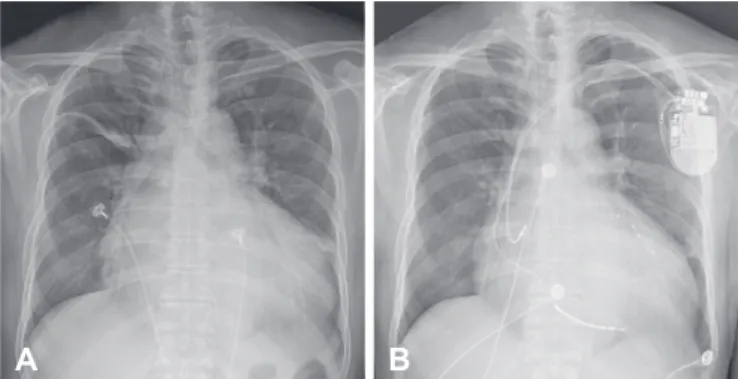
revealed the sinus rhythm and a left bundle branch block with a QRS complex duration of 200 ms and a prolonged corrected QT interval of 550 ms (Fig. 1A). A chest X-ray revealed severe cardiomegaly (Fig. 2A). The serum digoxin level was 0.82 ng/mL (reference range: 0.8-2.0 ng/mL). The cardiac troponin-I level was 0.04 ng/mL (reference range: 0-0.04 ng/mL) and the brain natriuretic peptide level was 2351 pg/mL (reference range: 0-60 pg/mL). The serum K+
concentration was 4.0 mmol/L (reference range: 3.5-5.5 mmol/L).
Echocardiographic examinations demonstrated globally hypokinetic LV wall motion with an LVEF of 16% and LV end-diastolic dimension (LVEDD) of 91 mm. Doppler studies revealed severe functional mitral valve regurgitation and marked interventricular dyssynchrony.
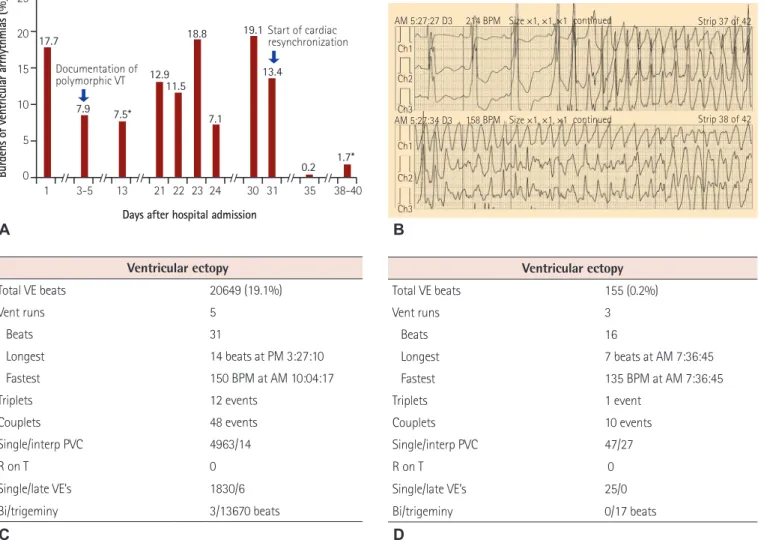
The LVEF measured by a magnetic resonance imaging study was 12%, and delayed gadolinium enhancements were noted along the mid-to-basal septal segments. Initial 24-hour ambulatory electrocardiographic monitoring revealed multiple episodes of non- sustained monomorphic VT, which persisted for 3-5 seconds and recurred more than 100 times. The burden of ventricular arrhythmic events was 17.8% of the total daily beats (Fig. 3A). The patient was
considered to be at high risk of sudden arrhythmic death.
Because the patient had not been taking a beta blocker and an angiotensin converting enzyme or angiotensin II receptor blocker within 3 months of admission, oral bisoprolol 2.5 mg/day and perindopril 4 mg/day were added to the medication list to meet the requirements of guideline-directed OMT. Furosemide was titrated up to 80 mg/day and administered intravenously to control dyspnea and generalized edema. However, on the fifth day after admission, polymorphic VT, which was sustained for 27 seconds and accompanied by a loss of consciousness, occurred early in the morning (Fig. 3B). Although the sustained polymorphic VT terminated spontaneously, the R on T phenomenon recurred every two to three days thereafter. Class III antiarrhythmic agents such as amiodarone or sotalol were not administered due to the potential risk of prolongation of the corrected QT interval, which can cause the recurrence of fatal polymorphic VT. Although low- dose dobutamine was additionally administered intravenously at an infusion rate of 2.5 μg/min for 10 days to suppress the occurrence of ventricular arrhythmias by rapidly improving LV systolic function, the dobutamine therapy did not effectively control either the ventricular arrhythmias or heart failure. Despite guideline-directed OMT for 4 weeks, non-sustained monomorphic VT recurred dozens of times per day, and the burden of ventricular arrhythmic events at this stage was still approximately 19% (Fig. 3C). Follow-up echocardiography did not reveal significant improvement of the LVEF or reduction of the LVEDD. The patient was still considered to be at high risk of sudden arrhythmic death.
When the clinical response to the OMT for four weeks was considered, it was anticipated that medical therapy alone would fail to prevent the deterioration of heart failure and the occurrence of sudden arrhythmic death. Because we were not sure that we could eradicate or reduce the burden of ventricular arrhythmias Fig. 2. Radiographic findings. (A) Initial chest X-ray displays cardiomegaly with a cardiac-thoracic ratio of 0.7 and minor fissural effusion. (B) Follow- up chest X-ray acquired 3 days after the initiation of cardiac resynchronization therapy displays a slight decrease in the cardiac- thoracic ratio compared to the initial image.
A B
Fig. 1. Electrocardiographic findings before and after initiation of cardiac resynchronization therapy. (A) Initial electrocardiogram exhibits the sinus rhythm and notched broad QRS complexes with left bundle branch block configuration. The QRS complex duration was 200 ms, and the corrected QT interval calculated by Bazett’s formula was 550 ms. (B) Follow-up electrocardiogram acquired during biventricular pacing exhibits shortening of the QRS complex duration from 200 to 160 ms and of the corrected QT interval from 550 to 500 ms. aVR: augmented voltage right arm, aVL:
augmented voltage left arm, aVF: augmented voltage left foot.
A
B
enough to prevent sudden arrhythmic death by radiofrequency catheter ablation without procedure-related complications, we did not perform radiofrequency ablation. Although the Korean Health Insurance Review and Assessment Service guidelines recommend OMT for at least three months before the initiation of CRT, we decided to perform early CRT, with the expectation that biventricular pacing might induce rapid electrical and mechanical remodeling of the LV and suppress the recurrence of ventricular arrhythmias.
A CRT defibrillator device with a unique MultiPoint™ pacing
function (Quartet™ LV lead, Durata™ right ventricular lead, Tendril MRI™ right atrial lead, Quadra Assura MP™ generator, St. Jude Medical, St. Paul, MN, USA) was implanted without complications.
The electrocardiograms acquired immediately after the initiation of biventricular pacing revealed marked shortening of the QRS complex duration (from 200 to 160 ms) and of the corrected QT interval (from 550 to 500 ms) (Fig. 1B). Disappearance of the characteristic electrocardiographic findings of left bundle branch block was noted, together with a significant reduction in the ventricular arrhythmia burden from the day after the initiation
Burdens of ventricular arrhythmias (%)
25 20 15 10 5 0
1 3-5 13 21 22 23 24 30 31 35 38-40 Days after hospital admission
17.7
7.9 7.5*
1.7*
12.9 18.8
7.1 19.1
Documentation of 13.4 polymorphic VT
Start of cardiac resynchronization 11.5
0.2
Selected strips 27 D3 214 BPM
AM 5:27:27 D3 Size ×1, ×1, ×1 continued Strip 37 of 42 Ch1
Ch2 Ch3
Ch3 Ch2 Ch1
AM 5:27:34 D3 158 BPM Size ×1, ×1, ×1 continued Strip 38 of 42