A new type of clear orthodontic retainer incorporating multi-layer hybrid materials
Clear thermoplastic retainers have been widely used in daily orthodontics;
however, they have inherent limitations associated with thermoplastic polymer materials such as dimensional instability, low strength, and poor wear resistance.
To solve these problems, we developed a new type of clear orthodontic retainer that incorporates multi-layer hybrid materials. It consists of three layers; an outer polyethylenterephthalate glycol modified (PETG) hard-type polymer, a middle thermoplastic polyurethane (TPU) soft-type polymer, and an inner reinforced resin core. The resin core improves wear resistance and mechanical strength, which prevent unwanted distortion of the bucco-palatal wall of the retainer. The TPU layer absorbs impact and the PETG layer has good formability, optical qualities, fatigue resistance, and dimensional stability, which contributes to increased support from the mandibular dentition, and helps maintain the archform. This new type of vacuum-formed retainer showed improved mechanical strength and rate of water absorption.
[Korean J Orthod 2015;45(5):268-272]
Key words: Polyethylenterephthalate glycol modified; Retention; Thermoplastic;
Thermoplastic polyurethane Hyo-Won Ahn
Kyung A Kim Seong-Hun Kim
Department of Orthodontics, School of Dentistry, Kyung Hee University, Seoul, Korea
Received May 14, 2015; Accepted June 10, 2015.
Corresponding author: Seong-Hun Kim.
Professor, Department of Orthodontics, School of Dentistry, Kyung Hee University, 26 Kyungheedae-ro, Dongdaemun-gu, Seoul 130-701, Korea.
Tel +82-2-958-9390 e-mail [email protected]
*This research was supported by Basic Science Research Program through the National Research Foundation of Korea (NRF) funded by the Ministry of Science, ICT & Future Planning (NRF-2014R1A1A1038263).
© 2015 The Korean Association of Orthodontists.
The authors report no commercial, proprietary, or financial interest in the products or companies described in this article.
This is an Open Access article distributed under the terms of the Creative Commons Attribution Non-Commercial License (http://creativecommons.org/licenses/by-nc/4.0) which permits unrestricted non-commercial use, distribution, and reproduction in any medium, provided the original work is properly cited.
pISSN 2234-7518 • eISSN 2005-372X
http://dx.doi.org/10.4041/kjod.2015.45.5.268
INTRODUCTION
The vacuum-formed retainer (VFR) is one of the most common types of orthodontic retainers, and is pre- ferred by patients because of its excellent esthetic cha- racteristics, simplicity of use, superior formability, main- tenance of good oral hygiene, and lesser discomfort compared to the Hawley retainers.
1-3However, from a clinical perspective, VFRs have major limitations related to their material properties. Thermoplastic retainers show poor wear resistance and durability along the in cisal and occlusal surfaces with subsequent cracking after only a few months of use.
4-6To overcome these disadvantages, we designed a new VFR composed of multi-layer hybrid materials and performed mechanical tests to determine its physical characteristics.
APPLIANCE DESIGN
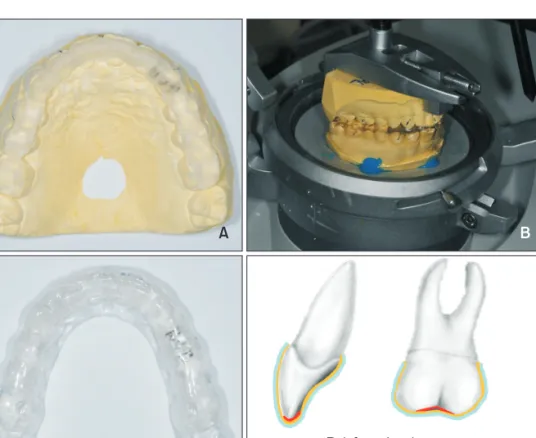
The new type of multi-layer VFR was fabricated as follows. The innermost layer consisted of a reinforced resin core that covered the incisal and lingual sides of the anterior teeth and occlusal surfaces (central fossa area) of the posterior teeth. The thickness of the resin core did not exceed 1 mm in the first molar area. The middle layer was made up of thermoplastic polyurethane (TPU) soft-type thermoplastic material, and the outer layer, which was made up of hard-type thermoplastic
material (polyethylenterephthalate glycol modified, PETG), covered all the buccal, occlusal and palatal surface of upper arches (Figure 1). The resin core showed good mechanical retention with thermoplastic polymers, and delamination did not occur between layers. The total thickness of the appliance was less than 3 mm.
Three-point occlusal contact with mandibular dentition was accomplished during the thermoforming procedure;
therefore, minimal final adjustment of occlusion at the chair side was required.
MECHANICAL TESTS
Tensile test
Ten rectangular specimens (length = 40 mm, width = 5 mm) were prepared for each group according to the number of layers; single- (1.0 mm, Track A; Forestadent, Pforzheim, Germany) and double-layer (2.0 mm, Track B;
Forestadent) products available on the market were tested along with the newly designed three-layer retainer. The tensile test was performed using a universal mechanical testing instrument Instron 3367 (Instron Co., Norwood, MA, USA) with a load cell of 3 kN. Maximum tensile load with a loading rate of 1.5 mm/min was measured at room temperature. The data from mechanical test were analyzed using Bluehill® Lite version 2.0 software (Instron Co.). Comparisons between the specimens were performed by one-way analysis of variance (ANOVA)
Reinforced resin core
A B
C D
Soft thermoplastic layer Hard thermoplastic layer
Figure 1. The fabrication pro cess of multi-layer vacu- um-formed retainers (VFRs).
A, Inner reinforced resin core.
B, Connection with ther-
moplastic dual layers. Three-
point occlusal contact is
ac hieved during the vacuum
for ming procedure. C, Final
pro duct. D, Schematic dia-
gram of multi-layer VFRs.
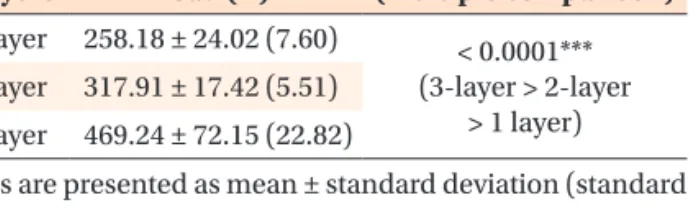
and Schéffe’s test. The maximum tensile load increased with the increasing number of layers, and the three-layer specimen group yielded a significantly greater mean value (469 N) compared to the other groups (single-layer, 258 N; double-layer, 318 N; p < 0.001, Table 1).
Water absorption test
Five circular specimens (diameter 5 cm) were prepared for each group according to the number of layers. The specimens were stored in a desiccator until they reached a constant weight (M1), and then immersed in distilled water at 37.8
oC. After the beginning of immersion, the weight (M2) of each specimen was measured at 1, 3, 6, 12, 24, 48, 72, 168, and 336 hours. The water absorption rate was calculated as (M2–M1) × 100/M1 (wt%).
7Com parisons of water absorption rates at 336 h between groups were evaluated using the Kruskal- Wallis test. Figure 2 shows the changes in water absorption rates for up to 2 weeks. Water absorption of all specimen groups increased with time, and the double-layer specimen group showed the highest water absorption at all time points. The single-layer specimen group had the lowest water absorption value, with a rate of 0.77 wt% after 336 hours. The three-layer specimen group showed water absorption rates similar to that of the single-layer specimen group up to 24 hours, and gradually increased. The water absorption rates after 336 hours was significantly different between groups (p
< 0.001).
DISCUSSION
Various types of polymers have been used for VFRs, and they have different wear resistance and durability characteristics according to their molecular structure.
Generally, polymers used in orthodontic fields are divided into amorphous polymers, including polycarbonate, PETG, and polyurethane (Invisalign; Align Technology, Inc., San Jose, CA, USA), and partly crystalline polymers, including polypropylene, polyethylene, and ethylene
vinyl acetate.
7The mechanical properties of these thermoplastic polymers during real-world usage are not same as those provided by the manufacturers, because they are affected by environmental factor during intraoral use; the changes in surface characteristics are accelerated after intraoral exposure. Therefore, to ensure maintenance of the final treatment outcome through the retention periods, a critical understanding of the mechanical properties of the different thermoplastic materials is essential.
Our newly designed multi-layer retainer consists of three layers; an outer PETG hard thermoplastic layer, middle TPU soft thermoplastic layer, and an inner rein- forced resin core. The resin core shows good wear re- sistance, mechanical strength and dissipates the occlusal force, which prevents unwanted distortion of the bucco- palatal lateral wall during fitting and use. TPU is a duc- tile elastomer, which aids in improving elasticity,
8,9and absorbs impact while providing good wear sensation.
The outer layer, PETG has good formability, optical qualities, fatigue resistance, and dimensional stability,
10which contributes to increased support from the mandi- bular dentition, and helps maintain the archform.
The primary mechanism of surface changes after intraoral exposure is hydrolytic degradation.
11,12The po- lymer material absorbs water, which induces polymer swelling and dimensional change, and eventually, its backbone chain is irreversibly degraded by hydrolysis.
11Therefore, the ideal thermoplastic materials for VFRs should have low water absorption properties. Generally, as the number of layers in the VFR increases, the water absorption rate is expected to increase. However, in our study, the water absorption rate of three-layer VFRs was lesser than that of the double-layer VFRs at all time points, and at 24 hours, it was similar to that of single-
Waterabsorption(wt%)
0 1.4
1.2
1.0
0.8
0.6
0.4
0.2
0 24 48 72 96120 144 168 192 216 240 264 288 312 336 360 1 layer 2 layer 3 layer
Time (hour)