INTRODUCTION
Chronic lower back pain (CLBP) is prevalent worldwide in all
age groups, and is associated with significant morbidity and high health care costs.1,2 CLBP treatments are multimodal, in- cluding medication, injection, physical therapy, exercise, back school, and sometimes surgery.3 Since surgical intervention is a last resort for CLBP, therapeutic treatment is acute and also requires patient adherence. Single or cocktail medical treat- ments with or without narcotics are conservative, widely ac- cepted treatment practices. Nonsteroidal anti-inflammatory drugs (NSAIDs) are more often prescribed than muscle relax- ants, antidepressants, antiepileptics, or narcotics.4
NSAIDs have many side effects, including adverse gastroin- testinal effects, cardiovascular risk, and patient adherence.5,6 Cyclooxygenase-2 (COX-2) inhibitors are associated with fewer NSAID-related side effects. First-line COX-2 inhibitors are rec-
Efficacy and Safety of Different Aceclofenac
Treatments for Chronic Lower Back Pain: Prospective, Randomized, Single Center, Open-Label Clinical Trials
Jae-Ho Yang1, Kyung-Soo Suk1, Byung-Ho Lee2, Woo-Chul Jung1, Young-Mi Kang1, Ji-Hye Kim1, Hak-Sun Kim1, Hwan-Mo Lee1, and Seong-Hwan Moon1
1Department of Orthopedic Surgery, Yonsei University College of Medicine, Seoul;
2Department of Orthopedic Surgery, Catholic-Kwandong University College of Medicine, International St. Mary’s Hospital, Incheon, Korea.
Purpose: Nonsteroidal anti-inflammatory drugs are a mainstay for medical treatment of chronic lower back pain (CLBP). In- creased dose intervals for medication have been associated with increased patient adherence to prescriptions. The purpose of this clinical trial was to compare the efficacy and safety of a once daily dose of aceclofenac controlled release (CR) and a twice daily dose of aceclofenac for CLBP management.
Materials and Methods: A prospective, randomized, single center, open-label clinical trial was performed to compare the efficacy and safety of aceclofenac CR (200 mg once daily) to aceclofenac dose (100 mg twice daily). Fifty patients in each group were en- rolled for the study. The primary end point was Visual Analogue Scale (VAS) change at baseline to that at 2 weeks after medication and safety profiles. Also, change in quality of life measured by EuroQoL 5D (EQ-5D) and Oswestry Disability Index (ODI) func- tional score for the lumbar spine were also assessed.
Results: Within groups at pre- and post-treatment, there were significant VAS reductions for aceclofenac CR and aceclofenac (p=
0.028). EQ-5D increased significantly in both groups (p=0.037). ODI scores decreased significantly in both groups (p=0.012). However, there were no significant differences between aceclofenac CR and aceclofenac at pre- and post-treatment. Patients with aceclofe- nac CR showed significant increases in heartburn and indigestion and adverse gastrointestinal effects, compared to aceclofenac.
Conclusion: In patients with CLBP, aceclofenac CR and aceclofenac demonstrated significant symptomatic pain relief, improve- ment in quality of life and functional scores. Aceclofenac CR slightly increased gastrointestinal adverse effects, such as heartburn and indigestion.
Key Words: Chronic lower back pain, NSAIDs, aceclofenac
pISSN: 0513-5796 · eISSN: 1976-2437
Received: May 3, 2016 Revised: January 10, 2017 Accepted: February 1, 2017
Corresponding author: Dr. Seong-Hwan Moon, Department of Orthopedic Sur- gery, Yonsei University College of Medicine, 50-1 Yonsei-ro, Seodaemun-gu, Seoul 03722, Korea.
Tel: 82-2-2228-2188, Fax: 82-2-363-1139, E-mail: [email protected]
•The authors have no financial conflicts of interest.
© Copyright: Yonsei University College of Medicine 2017
This is an Open Access article distributed under the terms of the Creative Com- mons Attribution Non-Commercial License (http://creativecommons.org/licenses/
by-nc/4.0) which permits unrestricted non-commercial use, distribution, and repro- duction in any medium, provided the original work is properly cited.
Yonsei Med J 2017 May;58(3):637-643 https://doi.org/10.3349/ymj.2017.58.3.637
ommended for elderly patients presenting with osteoarthritis and gastrointestinal risk factors. Conventional NSAIDs can be prescribed to relatively young patients (<60 years) with mus- culoskeletal pain, in whom cardiovascular and gastrointesti- nal risk is relatively lower than patients >60 years.
Aceclofenac is a NSAID phenylacetic acid derivative {2-[(2, 6-dichlorophenyl)amino]-phenylacetoxyacetic acid} widely and safely prescribed for musculoskeletal pain associated with rheumatic, degenerative, and traumatic injury etiologies.7-9 Furthermore, aceclofenac is effective for managing acute to CLBP, and has a wide safety profile.10 Aceclofenac and diclofe- nac are classified as acetic acid NASIDs, and are not associat- ed with adverse cardiovascular events. NSAIDs that have been associated with adverse cardiovascular events include ibupro- fen, celecoxib, and rofecoxib.11
Dose interval is a crucial factor to assuring adherence to medical therapy. Increased dose interval has been associated with increased patient adherence to NSAID and osteoporotic medication.12 Controlled release (CR) maintained therapeutic serum levels for longer periods of time, with less gastrointesti- nal insult and increased patient adherence.13
Accordingly, the purpose of this clinical trial was to compare the efficacy and safety of a once daily dose of aceclofenac CR and a twice daily dose of aceclofenac for CLBP management.
MATERIALS AND METHODS
Study design
A prospective, randomized, single center, open-label clinical trial was performed from February 2011 to December 2012 at an out-patient orthopedic clinic. The clinical trial protocol was approved by the Institutional Review Board of Yonsei Univer- sity College of Medicine, Seoul, Korea (CR NO. 4-2010-0433).
All subjects voluntarily submitted informed consent after thor- ough trial protocol explanation. The trial protocol was devel- oped to compare the efficacy and safety of a once daily dose of aceclofenac CR (200 mg once daily) to a conventional twice daily aceclofenac dose (100 mg twice daily) (Fig. 1). Change in Visual Analogue Scale (VAS) (range 0–100; higher scores indi- cate greater pain)14 from baseline to 2 weeks after each medi- cation was assessed. Safety profiles, change in quality of life as measured by EuroQoL 5D (EQ-5D),15,16 and Oswestry Disability Index (ODI)17,18 functional score for lumbar spine were also assessed. Data were analyzed with an intention-to-treat design.
The sample size calculation was based on differences in VAS score between the groups as obtained from a previous study.13 We calculated that a minimum of 45 patients would be needed in each treatment arm (allowing 20% dropouts) to detect a dif- ference of at least 0.6 between groups with a two-sided type I error of 0.05 and 80% power.
Subject selection criteria Inclusion criteria
Subjects of both genders aged 20 to 75 years reporting CLBP for at least 3 months or more, with pain intensity as measured by the VAS >40 mm, were enrolled. CLBP pain parameters in- cluded lower back pain >3 months, VAS >40 mm, CLBP with or without leg pain, daily pain attacks, and persistent pain.
Plain lumbar radiographs were used to make diagnoses. De- tailed procedures and hazard/benefit were carefully explained to all subjects.
Exclusion criteria
Subjects were excluded if they presented with acute fracture, malignancy, neurologic deficit, severe leg pain mandating sur- gery (lumbar disc herniation and spinal stenosis), fibromyalgia, compensation case, recent injection procedure, spinal surgery, history of allergy to aceclofenac, narcotic abuse, and alcohol abuse.
Outcome measures Visual Analogue Scale
VAS mean level of back pain was assessed (0–100 mm pain scale: 0=none and 100=unbearable).
EQ-5D
EQ-5D consisted of five dimensions: mobility, self-care, usual activities, pain/discomfort, and anxiety/depression. Each di- mension had three levels of severity: 1) no problems, 2) some problems, and 3) extreme problems. EQ-5D was calculated thusly: each level of all dimensions with 1 as perfect, and 0 as worst quality of life. Current general health status was also as- sessed using the EQ-5D VAS (0–100, 100=best health status).
Oswestry Disability Index
The ODI is a 10-item self-report questionnaire measuring
“back-specific function” with six response levels. Each item was scored from 0 to 5, higher scores being worse, which were transformed into a 0 to 100 scale. The 10 items included pain intensity, personal care, lifting, walking, sitting, standing, sleep- ing, sex life, social life, and traveling.
Table 1. Patient Demographic Data
Aceclofenac CR Aceclofenac p value
Number of patients (n) 50 50
Gender (male:female) 12:38 12:38 1.000*
Age 57.6±11.3 56.9±11 0.799†
Height (cm) 160.2±8.1 159.6±7.7 0.695†
Weight (kg) 62.3±8.7 61.6±8.7 0.978†
Duration of back pain 50.0±55.1 91.6±119.0 0.184† CR, controlled release.
*Chi-square test, †Unpaired t-test.
Gastrointenstinal assessment
A separate questionnaire was utilized to assess post-treatment gastrointestinal symptoms. The following six items were in- cluded: indigestion, heartburn, nausea, vomiting, abdominal pain, and diarrahea graded as 1, 2, or 3 (minimal to severe symp- toms limiting daily activities).
Statistical analysis
Values of VAS and EQ-5D VAS are expressed as mean with standard deviation, and values of EQ-5D and ODI are ex- pressed as median with an inter-quartile range (IQR). To com-
pare pain reduction in VAS and change in EQ-5D VAS after treatment, paired t-test was utilized. Quality of life improve- ment as EQ-5D and ODI were analyzed by using non-para- metric statistics, such as Mann-Whitney U test, to compare changes in EQ-5D and ODI pre-and post-treatment in each group and Wilcoxon’s rank sum test to compare changes in EQ-5D and ODI between aceclofenac CR and aceclofenac groups. To compare gastrointestinal symptoms and adverse ef- fects between groups, Fisher’s exact test was used. Significance level was set as p<0.05.
RESULTS
Of 106 subjects screened with the criteria described above, 100 Table 2. Change of Pain in VAS, EQ-5D, EQ-5D VAS, and ODI
100-mm VAS score Aceclofenac CR (n=50)
In group Aceclofenac (n=50)
In group Between group
Mean±SD Mean±SD
Pre treat 58.2±14.0 64.0±13.1 p=0.075†
Post treat 35.7±17.1 p=0.028* 45.5±20.8 p=0.013* p=0.109†
Alteration 22.6±15.8 18.6±17.7 p=0.145†
EQ-5D VAS Aceclofenac CR (n=20)
In group Aceclofenac (n=20)
In group Between group
Mean±SD Mean±SD
Pre treat 60.0±15.1 62.7±14.1† p=0.245†
Post treat 65.0±22.5 p=0.071* 68.5±13*† p=0.082* p=0.125†
Alteration 5.0±14.7 5.8±16.7 p=0.249†
EQ-5D Aceclofenac CR (n=50)
In group Aceclofenac (n=50)
In group Between group
Median (IQR) Median (IQR)
Pre treat 0.5 (0.3–0.7) 0.5 (0.3–0.7) p=0.423§
Post treat 0.7 (0.5–0.9) p=0.037‡ 0.6 (0.4–0.8) p=0.042‡ p=0.359§
Alteration 0.2 (0.1–0.4) 0.1 (-0.1–0.3) p=0.438§
ODI Aceclofenac CR (n=50)
In group Aceclofenac (n=50)
In group Between group
Median (IQR) Median (IQR)
Pre treat 34.6 (21.8–47.4) 37.1±13.3 (23.8–50.4) p=0.097§
Post treat 23.8 (11.1–36.5) p=0.012‡ 27.3±12.7 (14.6–40.0) p=0.026‡ p=0.165§
Alteration 10.6 (-1.0–22.2) 10.4±12.9 (-2.5–23.3) p=0.581§
CR, controlled release; VAS, Visual Analogue Scale; EQ-5D, EuroQoL 5D; EQ-5D VAS, EuroQoL 5D Visual Analogue Scale; ODI, Oswestry Disability Index.
Values of VAS and EQ-5D VAS are expressed as mean with standard deviation (SD). Values of EQ-5D and ODI are expressed as median with an inter-quartile range (IQR) in parenthesis. p<0.05: statistically significant.
*Paired t-test: to compare VAS, EQ5D VAS of pre- and post-treatment in each group, †Unpaired t-test: to compare VAS, EQ5D VAS between aceclofenac CR and aceclofenac groups, ‡Mann-Whitney U test: to compare EQ-5D, ODI change of pre-and post-treatment in each group, §Wilcoxon signed rank test: to compare EQ-5D, ODI change between aceclofenac CR and aceclofenac groups.
Fig. 1. Screening, randomization, and follow-up of clinical trial. CR, con- trolled release.
Discontinuation (n=3, 6%) Withdrew consent
Aceclofenac CR (n=50)
Randomization (n=100) Screening (n=106)
Completed study (n=47, 94%)
Aceclofenac (n=50)
Completed study (n=50, 100%)
Table 3. Gastrointenstinal Symptom Assessment Gastrointestinal
symptom
Aceclofenac CR (n=47)
Aceclofenac
(n=50) p value
Indigestion, n (%) 4 (8.5) 1 (2.0) 0.195
Heartburn, n (%) 10 (21.3) 3 (6.0) 0.037
Nausea, n (%) 2 (4.3) 1 (2.0) 0.610
Vomit, n (%) 1 (2.1) 0 (0.0) 0.485
Abdominal pain, n (%) 2 (4.3) 0 (0.0) 0.232
Diarrahea, n (%) 1 (2.1) 0 (0.0) 0.485
CR, controlled release.
subjects were assigned to either aceclofenac CR (200 mg once daily) or conventional aceclofenac (100 mg twice daily) groups.
There were 50 subjects in each group. During the study, only three subjects from the aceclofenac CR group dropped out of
the study; all 50 aceclofenac subjects completed the study.
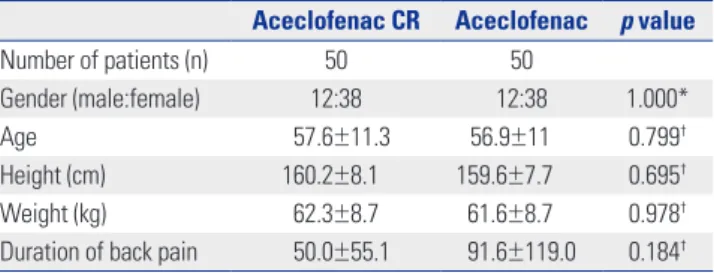
Before treatment, there were no differences between groups in demographic characteristics, duration of lower back pain, VAS, EQ-5D, or ODI (Table 1 and 2).
Table 4. Adverse Events
System organ class
Preferred term
p value Aceclofenac CR (n=50) Aceclofenac (n=50)
Adverse events Adverse events
Gastrointestinal disorders, n (%) 10 (21.2) 7 (14.0) 0.595
Dyspepsia 10 (21.2) 4 (8.0)
Nausea 2 (4.2) 1 (2.0)
Constipation 2 (4.2) 0 (0.0)
Abdominal pain 2 (4.2) 0 (0.0)
Abdominal distension 0 (0.0) 2 (4.0)
Vomiting 1 (2.1) 0 (0.0)
Diarrhea 1 (2.1) 0 (0.0)
Skin and subcutaneous tissue disorders, n (%) 5 (10.6) 5 (10.0) >0.999
Swelling face 3 (6.4) 3 (6.0)
Pruritus 1 (2.1) 1 (2.0)
Skin disorder 1 (2.1) 0 (0.0)
Acne 0 (0.0) 1 (2.0)
General disorders and administration site conditions, n (%) 9 (19.2) 1 (2.0) 0.016
Generalized edema 5 (10.6) 0 (0.0)
Swelling 1 (2.1) 1 (2.0)
Edema peripheral 1 (2.1) 0 (0.0)
Edema 1 (2.1) 0 (0.0)
Face edema 1 (2.1) 0 (0.0)
Nervous system disorders, n (%) 3 (6.4) 4 (8.0) >0.999
Somnolence 2 (4.3) 1 (2.0)
Paresthesia 0 (0.0) 2 (4.0)
Dizziness 0 (0.0) 1 (2.0)
Headache 1 (2.1) 0 (0.0)
Investigations, n (%) 0 (0.0) 4 (8.0) 0.117
Aspartate aminotransferase increased 0 (0.0) 2 (4.0)
Gamma-glutamyltransferase increased 0 (0.0) 2 (4.0)
Alanine aminotransferase increased 0 (0.0) 1 (2.0)
Infections and infestations, n (%) 1 (2.1) 1 (2.0) >0.999
Nasopharyngitis 0 (0.0) 1 (2.0)
Oral herpes 1 (2.1) 0 (0.0)
Musculoskeletal and connective tissue disorders, n (%) 2 (4.3) 0 (0.0) 0.495
Pain in extremity 1 (2.1) 0 (0.0)
Musculoskeletal pain 1 (2.1) 0 (0.0)
Vascular disorders, n (%) 1 (2.1) 0 (0.0) >0.999
Flushing 1 (2.1) 0 (0.0)
Renal and urinary disorders, n (%) 1 (2.1) 0 (0.0) >0.999
Pollakiuria 1 (2.1) 0 (0.0)
Eye disorders, n (%) 0 (0.0) 1 (2.0) >0.999
Abnormal sensation in eye 0 (0.0) 1 (2.0)
Cardiac disorders, n (%) 1 (2.1) 0 (0.0) >0.999
Palpitations 1 (2.1) 0 (0.0)
CR, controlled release.
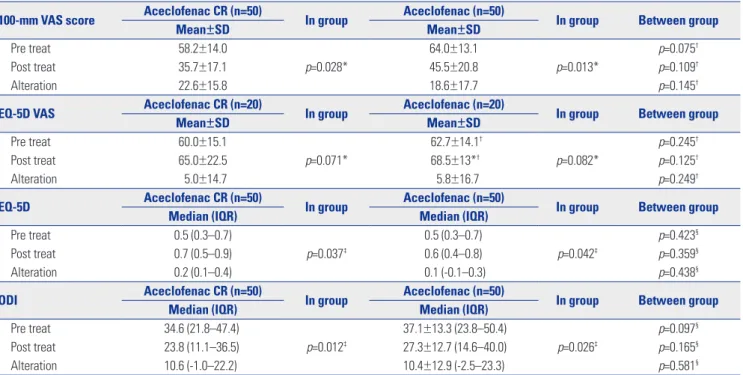
VAS (0–100 mm) pain intensity was significantly reduced in both groups: aceclofenac CR, before 58.2±14.0, after 35.7±17.1, p<0.05; aceclofenac, before 64.0±13.1, after 45.5±20.8, p<0.05.
There was no significant difference in pain intensity between groups pre- and post-treatment (Table 2, Fig. 2A).
Quality of life as measured by calculated EQ-5D increased significantly in aceclofenac CR [before 0.5 (0.3–0.7), after 0.7 (0.5–0.9), p<0.05] and aceclofenac groups [before 0.5 (0.3–0.7), after 0.6 (0.4–0.8), p<0.05]. By contrast, there were no signfi- cant differences in EQ-5D general health status between ace- clofenac CR and aceclofenac groups pre- and post-treatment.
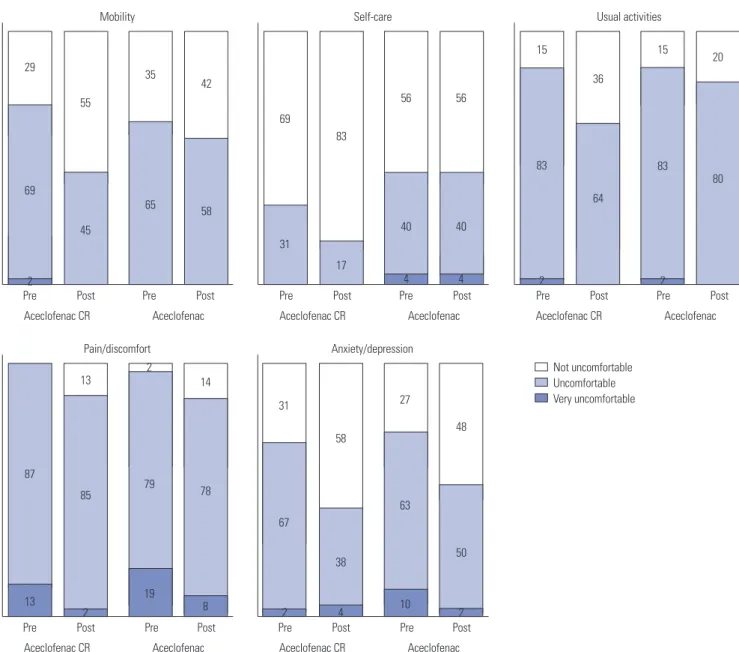
All EQ-5D dimensions (mobility, self-care, usual activities, pain/discomfort, and anxiety/depression), except self-care in the aceclopenac group, showed level increases (Table 2, Figs.
2B and 3).
ODI spinal functional score decreased significantly in both aceclofenac CR [before 34.6 (21.8–47.4), after 23.8 (11.1–36.5), p<0.05] and aceclofenac groups [before 37.1±13.3 (23.8–50.4), after 27.3±12.7 (14.6–40.0), p<0.05]. In contrast, there was no signficant difference between groups for other ODI items pre- and post-treatment (Table 2, Fig. 2C).
Gastrointenstional assessment revealed the aceclofenac CR group presented with more complaints than the aceclofenac group for all items: indigestion (4 vs. 1), heartburn (10 vs. 3) (p<0.05), nausea (2 vs. 1), vomiting (1 vs. 0), abdominal pain (2 vs. 0), and diarrahea (1 vs. 0). Among items of gastrointenstion- al assessment, only heartburn showed significant increase in aceclofenac CR group (p<0.05). However, the aceclofenac CR group presented only five complaints at the most severe symp- tom level, while the remaining 15 were at minimal and tolera- ble levels (Table 3).
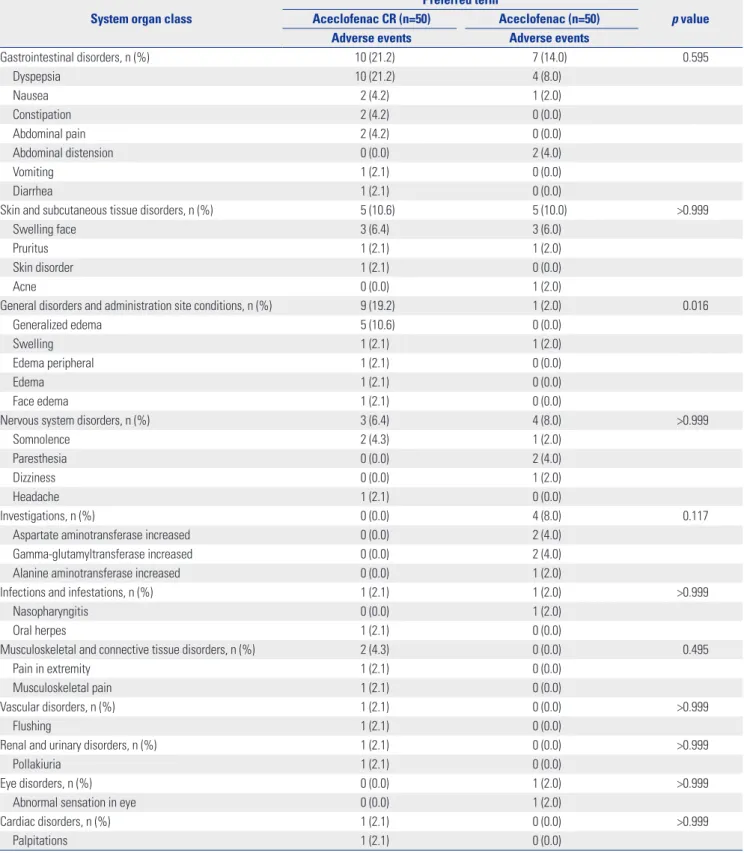
Adverse effects post aceclofenac CR and aceclofenac treat- ment are presented in Table 4. In mutiple categories (gastro- intestinal, skin and subcutaneous, general physical, nervous system, serologic, infectious, musculoskeletal, vascular, renal,
ocular, and cardiac) there were no significant differences in adverse effects between groups, except edema and swelling in general disorders and administration site conditions (p<0.05).
DISCUSSION
Both aceclofenac CR and aceclofenac were associated with significant pain reduction, increase in quality of life, improve- ment in spinal function, and tolerable minor adverse effects.
For all measures only EQ-5D VAS showed no significant change pre- to post-treatment.
There was significant VAS reduction for aceclofenac CR (22.6) and aceclofenac (18.6), which was significant within groups pre- and post-treatment; however, there was no signif- icant difference between groups pre- and post-treatment. Fur- thermore, increase in quality of life as calculated by EQ-5D was also significant within both groups. Alpha was set at 0.05, but p=0.10 for EQ-5D increase for both groups. Also, both groups showed significant improvement in ODI spinal functional score. There was no significant difference between groups in all ODI categories. A questionnaire specifically assessing gastro- intestinal symptoms showed increased overall gastrointestinal complaints in both groups: aceclofenac CR (19 complaints) and aceclofenac (5 complaints). However, rate of heartburn was statistically significantly higher in the aceclofenac CR group. This protocol did not provide any gastrointestinal medi- cations to protect stomach and duodenum mucosa, hence a single daily dose of aceclofenac CR (200 mg) might result in greater acidic insult to gastric mucosa than the lower twice daily dose (100 mg). There were no serious gastrointestinal ef- fects seen in either group during the study interval. Among gas- trointestinal complaints (20 incidences) on a questionnare spe- cilized for gastrointestinal symptoms in the aceclopenac CR group, only five complaints were severe in intensity, while the Fig. 2. (A) Change in Visual Analogue Scale (VAS) presented as mean±standard deviation. (B) Change in calculated EuroQoL 5D (EQ-5D) presented as median and interquartile range (IQR). (C) Change in Oswestry Disability Index (ODI), presented as median and IQR. Comparison between aceclofenac controlled release (CR; 200 mg once daily) and conventional aceclofenac (100 mg twice daily) showed there was significant reduction of pain and ODI score, and increase in EQ-5D for each group at 2 weeks, however, there was no difference between groups pre- and post-treatment for VAS, ODI, and EQ-5D. *p<0.05, †Non-significant.
120 100 80 60 40 20 0
1.5
1.0
0.5
0.0
-0.5
100
80
60
40
20
Pre treat Pre treat 0 Pre treat
Aceclofenac CR Aceclofenac CR Aceclofenac CR
* *
* * *
*
†
†
†
†
†
†
Aceclofenac Aceclofenac Aceclofenac
Pre treat Pre treat Pre treat
Post treat Post treat Post treat Post treat Post treat Post treat
VAS (mm) EQ-5D ODI
A B C
remaning 15 complaints were minial intensity. Even though pa- tients were enrolled in randomized fashion, duration of CLBP is different between aceclofenac CR and aceclofenac. Since CLBP is defined as lower back pain for more than 3 months, several outliers, such as CLBP more than years, seem to provide differences between groups. However, the duration of CLBP between group was statistically insignificant and chronicity of lower back pain seemed to have little effect on aceclofenac in- tervention, as shown in the results of uniform improvement in pain scale and quality of life measurements.
In conclusion, this prospective, randomized, single center, open-level aceclofenac CR and aceclofenac clinical trial in sub- jects with CLBP showed both dose regimens resulted in effec- tive symptomatic pain relief, improvement in quality of life and functional scores, and tolerable adverse gastrointestinal effects.
REFERENCES
1. Witt CM, Pach D, Reinhold T, Wruck K, Brinkhaus B, Mank S, et al.
Treatment of the adverse effects from acupuncture and their eco- nomic impact: a prospective study in 73,406 patients with low back or neck pain. Eur J Pain 2011;15:193-7.
2. Andrade NS, Flynn JP, Bartanusz V. Twenty-year perspective of ran- domized controlled trials for surgery of chronic nonspecific low back pain: citation bias and tangential knowledge. Spine J 2013;13:
1698-704.
3. Chaparro LE, Furlan AD, Deshpande A, Mailis-Gagnon A, Atlas S, Turk DC. Opioids compared with placebo or other treatments for chronic low back pain: an update of the Cochrane Review. Spine (Phila Pa 1976) 2014;39:556-63.
4. Cawston H, Davie A, Paget MA, Skljarevski V, Happich M. Efficacy of duloxetine versus alternative oral therapies: an indirect com- parison of randomised clinical trials in chronic low back pain. Eur
Pre Pre Pre Pre Pre Pre
Pre Pre
Aceclofenac CR
Aceclofenac CR Aceclofenac CR
Aceclofenac CR Aceclofenac CR
Not uncomfortable Uncomfortable Very uncomfortable Aceclofenac
Aceclofenac Aceclofenac
Aceclofenac Aceclofenac
Mobility
Pain/discomfort Anxiety/depression
Self-care Usual activities
Pre Pre
Post Post Post Post Post Post
Post Post Post Post
29
55
45
65
35 42
58
31 69
83
17
40
4 56
40
4 56
15
36
15 20
83 80
2 64
83
2 69
2
87
13
79 2
14
31
67 78
19 8 85
2 2 4
38 58
27
63
10 2
50 48
13
Fig. 3. Change in each dimension (mobility, self-care, usual activity, pain/discomfort, anxiety/depression) for EuroQoL 5D pre- to post-treatment with ace- clofenac CR (200 mg once daily) and conventional aceclofenac (100 mg twice daily) over the 2 week trial. With the exception of self-care in the aceclofe- nac group, all dimensions showed improvement post-treatment. CR, controlled release.
Spine J 2013;22:1996-2009.
5. Schattenkirchner M, Milachowski KA. A double-blind, multicen- tre, randomised clinical trial comparing the efficacy and tolerabil- ity of aceclofenac with diclofenac resinate in patients with acute low back pain. Clin Rheumatol 2003;22:127-35.
6. Li J, Mansmann UR. Modeling of non-steroidal anti-inflammato- ry drug effect within signaling pathways and miRNA-regulation pathways. PLoS One 2013;8:e72477.
7. Day RO, Graham GG. Non-steroidal anti-inflammatory drugs (NSAIDs). BMJ 2013;346:f3195.
8. Bae SK, Kim SH, Lee HW, Seong SJ, Shin SY, Lee SH, et al. Phar- macokinetics of a new once-daily controlled-release formulation of aceclofenac in Korean healthy subjects compared with imme- diate-release aceclofenac and the effect of food: a randomized, open-label, three-period, crossover, single-centre study. Clin Drug Investig 2012;32:111-9.
9. Legrand E. Aceclofenac in the management of inflammatory pain. Expert Opin Pharmacother 2004;5:1347-57.
10. Pareek A, Chandurkar N, Chandanwale AS, Ambade R, Gupta A, Bartakke G. Aceclofenac-tizanidine in the treatment of acute low back pain: a double-blind, double-dummy, randomized, multicen- tric, comparative study against aceclofenac alone. Eur Spine J 2009;
18:1836-42.
11. Trelle S, Reichenbach S, Wandel S, Hildebrand P, Tschannen B, Villiger PM, et al. Cardiovascular safety of non-steroidal anti-in-
flammatory drugs: network meta-analysis. BMJ 2011;342:c7086.
12. Vestergaard P, Hermann P, Jensen JE, Eiken P, Mosekilde L. Effects of paracetamol, non-steroidal anti-inflammatory drugs, acetyl- salicylic acid, and opioids on bone mineral density and risk of frac- ture: results of the Danish Osteoporosis Prevention Study (DOPS).
Osteoporos Int 2012;23:1255-65.
13. Pareek A, Chandurkar N, Gupta A, Sirsikar A, Dalal B, Jesalpura B, et al. Efficacy and safety of aceclofenac-cr and aceclofenac in the treatment of knee osteoarthritis: a 6-week, comparative, random- ized, multicentric, double-blind study. J Pain 2011;12:546-53.
14. Ogon M, Krismer M, Söllner W, Kantner-Rumplmair W, Lampe A.
Chronic low back pain measurement with Visual Analogue Scales in different settings. Pain 1996;64:425-8.
15. Johnsen LG, Hellum C, Nygaard OP, Storheim K, Brox JI, Rossvoll, et al. Comparison of the SF6D, the EQ5D, and the Oswestry Dis- ability Index in patients with chronic low back pain and degener- ative disc disease. BMC Musculoskelet Disord 2013;14:148.
16. Whynes DK, McCahon RA, Ravenscroft A, Hodgkinson V, Evley R, Hardman JG. Responsiveness of the EQ-5D health-related quality- of-life instrument in assessing low back pain. Value Health 2013;
16:124-32.
17. Fairbank JC, Couper J, Davies JB, O’Brien JP. The Oswestry low back pain disability questionnaire. Physiotherapy 1980;66:271-3.
18. Fairbank JC, Pynsent PB. The Oswestry Disability Index. Spine (Phila Pa 1976) 2000;25:2940-52.