투고일: 2013. 12. 6 심사의뢰일: 2013. 12. 6 게재확정일: 2013. 12. 12. 29 주요어: 중환자 간호, 간호연구, 연구동향
* 본 논문은 2013년도 한국중환자간호학회 학술연구비 지원을 받아 수행된 연구임 Address reprint requests to : Lee, Yun-Mi
Department of Nursing, Inje University College of Medicine, 633-162 Gaegeumdong, Busanjin-gu, Busan, Korea Tel: 82-51-890-6933, Fax: 82-51-896-9840, E-mail: [email protected]
I. 서 론
1. 연구의 필요성
중환자간호는 건강상태가 위급하거나 불안한 환자를 돌 보는 분야로서 다른 어느 간호 분야보다 과학적 지식과 수
준 높은 기술이 뒷받침되어야 하는 전문분야라고 할 수 있 다. 따라서 국외의 경우, 중환자간호와 관련된 최신 지식 과 의견 및 연구결과를 교류할 수 있는 학술지를 쉽게 접 할 수 있다. 세계 중환자간호사회에서는 2001년도부터 Connect: the World of Critical Care Nursing이라는 학술지를 발행하고 있으며(Connect: the world of criti
중환자간호학회지 2008∼2013년 게재 논문 분석
손연정1·강지연2·송효정3·박영례4·이윤미5·박진희6·김민주7
1순천향대학교 간호학과 교수, 2동아대학교 간호학과 부교수, 3제주대학교 간호대학 교수, 4군산대학교 간호학과 부교수
5인제대학교 간호학과 부교수, 6아주대학교 간호대학 부교수, 7동아대학교 간호학과 조교수
Analysis of Research Studies Published in Journal of Korean Critical Care Nursing : 2008-2013
Son, Youn-Jung
1ㆍKang, Jiyeon
2ㆍSong, Hyo-Jeong
3ㆍPark, Young-Rye
4ㆍLee, Yun-Mi
5ㆍPark, Jin-Hee
6ㆍKim, Minju
21Professor, Department of Nursing, Soonchunhyang University
2Associate Professor, Department of Nursing, Dong-A University, 3Professor, College of Nursing, Jeju National University
4Associate Professor, Department of Nursing, Kunsan National University, 5Associate Professor, Department of Nursing, Inje Univesity
6Associate Professor, College of Nursing, Ajou University, 7Assistant Professor, Department of Nursing, Dong-A university
Purpose: The purpose of this study was to identify the trends in studies published in Journal of Korean Critical Care Nursing (JKCCN) from 2008 to 2013. Methods: A total of 65 studies published between 2008 to 2013 were reviewed using criteria developed by researchers. Results: Approximately 36% of studies were conducted with patients. Intensive care unit (ICU) was the most popular site as the study setting. Among 59 research papers, 42.4% were approved by institutional review board (IRB). Quantitative studies were 78.6%, while qualitative studies were 4.6%. The research designs for the quantitative studies were survey (52.3%), quasi-experimental (16.9%), and so on. There was no randomized controlled trial. The most frequently used methods to provide nursing intervention was education. In addition, “nurse“ and “ICU“
were most commonly used keyword. Conclusion: Considering the low rate of IRB approval, more stringent application of research ethics is necessary to improve the quality of JKCCN. In addition, more randomized controlled trials should be encouraged to support evidence-based practice in critical care.
Keywords: Critical Care, Nursing Research, Research Trends, Analysis
78 79
78 79
cal care nursing, 2013), 미국중환자간호협회에서는 이 미 1980년대부터 총 3종의 학술지( American Journal of Critical Care, Critical Care Nurse, AACN Advanced Critical Care)를 정기적으로 발행하고 있다(AACN pub lications, 2013). 한편 영국의 중환자간호협회는 Nurs ing in Critical Care라는 학술지를 2003년도부터 현재까 지 발행하고 있다(BACCN journal, 2013).
학술지를 통한 국내의 중환자간호 연구 교류는 국외에 비해 늦게 시작되었다. 한국 중환자간호학회는 공식 학회 지인 중환자간호학회지를 2008년 창간호를 시작으로 가 장 최근호인 2013년 6월의 5권 1호까지 연 2회 정기적으 로 발행하고 있다. 중환자간호학회지가 비록 역사는 짧지 만 이미 CINAHL (Cumulative Index to Nursing and Allied Health Literature)의 학술데이타베이스에 등재되 었고, KoreaMED에는 회원학회로 가입되었으며, 국내에 서 유일하게 급·만성 중환자 및 그 가족과 관련된 간호연 구를 공유할 수 있는 학술지로서 중환자 간호와 관련된 최 신 경향과 지식을 활성화하는데 기여하고 있다.
중환자간호와 관련된 연구는 양적, 질적인 측면에서 성 장하고 있다. Scholes (2010)는 1995년부터 2009년까지 Nursing in Critical Care라는 학술지에 실린 168편의 중 환자간호 관련 연구논문을 분석한 결과, 조사연구뿐 아니 라 질적연구, 실험연구, 방법론적 연구 및 체계적 분석까 지 연구방법적 측면에서 1995년 이전에 비해 매우 다양해 졌음을 보고하였다. 연구 주제 역시 중환자간호 업무를 비 롯하여 환자의 경험과 보호자의 요구, 생애말기간호 및 의 사결정, 간호중재 및 도구개발, 다학제간 협력까지 그 범 위가 확대되었다. 세계 중환자간호사외 회장인 Kleinpell (2013, August)은 중환자간호의 발전은 근거중심실무를 통해 이루어질 수 있으며 근거는 중환자실의 조직문화, 다 학제간 협력, 개방면회, 건강한 간호업무환경, 중환자실 환자의 이동성 증진, 소음, 생애말기 완화간호 등과 관련 된 연구들을 통해 축적될 수 있다고 하였다.
근거중심 간호실무의 발전을 위해서는 다양한 주제에 관한 연구를 통해 광범위한 근거를 수집하는 것도 중요 하지만 근거를 도출해낸 과정, 즉 연구방법에 대한 검토 를 통해 알 수 있는 근거의 강도와 수준도 매우 중요하다 (Armola et al., 2009). 또한 인간을 대상으로 하는 연구 에서 윤리적인 원칙과 절차에 관한 기준이 점점 엄격하게
적용되고 있는 상황(Rani & Sharma, 2012)에서 중환자 간호연구의 대상자에 대한 기본권 보장과 연구 윤리 준수 에 관한 부분 역시 심각하게 간주되어야 할 것이다.
따라서 본 연구에서는 창간한지 약 5년이 경과된 중환자 간호학회지에 게재된 연구논문들의 주제, 대상, 방법, 윤 리적 고려, 연구주제어 등을 분석함으로써 국내 중환자 간 호연구의 경향과 문제점을 짚어보고 앞으로의 발전 방향 을 모색하고자 한다.
2. 연구목적
1) 중환자간호학회지 게재논문의 전반적 특성을 파악한다.
2) 중환자간호학회지 게재논문의 연구설계 유형을 분석한다.
3) 중환자간호학회지 게재논문의 자료분석 방법을 분석 한다.
4) 중환자간호학회지에 게재된 실험연구 논문의 전반적 특성을 파악한다.
5) 중환자간호학회지 게재논문의 인간, 건강, 간호, 환 경 영역별 주제어를 분석한다.
II. 연구방법
1. 연구 설계
본 연구는 최근 5년간 중환자 간호학회지에 게재된 논문 을 연구목적에 따라 분류하고 분석한 조사연구이다.
2. 분석 대상
한국중환자간호학회는 중환자 간호 분야의 학문적 발
전, 학술 교류, 실무적 발전을 위한 이론 및 기술개발을 위
한 연구를 게재하고 있으며, 연 2회 발간되고 있다. 본 연
구에서의 분석대상은 2008년 9월부터 2013년 6월(1권 1
호-6권 1호)까지 중환자간호학회지에 게재된 총 논문 65
편이다.
3. 연구도구
본 연구에서는 총 65편의 연구논문을 연구방법과 주제 어 영역으로 크게 나누어 분석하였다. 연구방법은 연구대 상자, 연구수집장소, 연구설계유형, 자료분석방법, 간호 중재, 윤리적인 고려여부 등으로 나누어 분석하였다. 또한 연구주제어는 MeSH에 근거한 주요어를 간호학의 네 가 지 메타파라다임인 인간, 건강, 간호, 환경의 4가지 영역 에 따라 주요어의 수, 주제, 분류의 항목으로 나누어 분석 하였다.
4. 자료수집 및 분석
논문분석에 앞서 연구자들의 논의를 거쳐 연구도구가 되 는 분석틀을 결정하였다. 결정된 조사 형식에 따라 해당년 도의 논문을 각 호별로 분류하여 자료를 수집하였으며, 내 용의 일관성을 유지하기 위해 각 분석 항목마다 동일한 연 구자가 전체 논문 65편을 분석하였다. 수집된 자료는 Ex- cel program을 이용하여 해당 변수별로 빈도와 백분율로 분석하였다.
III. 연구결과
1. 게재 논문의 전반적 특성
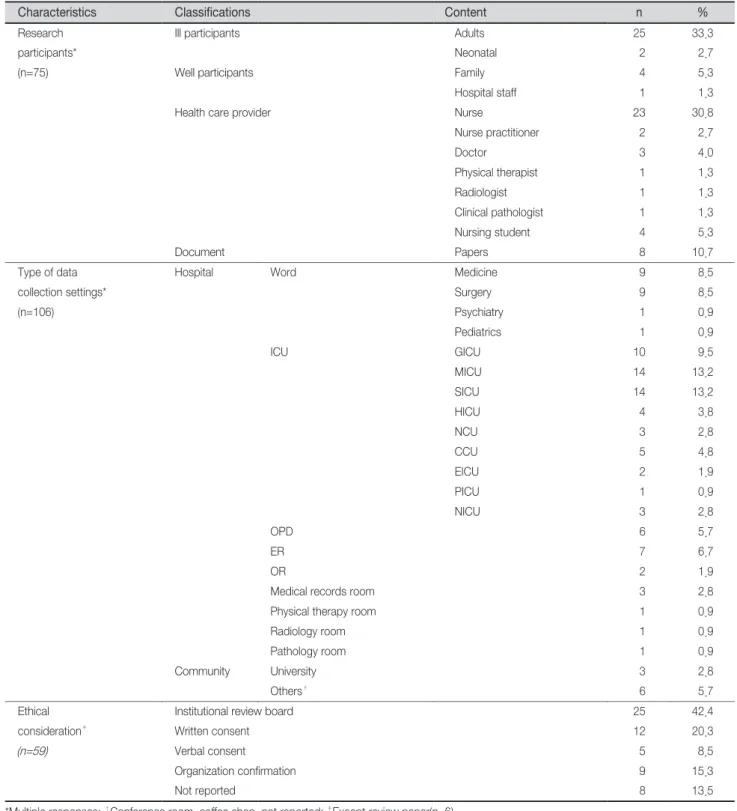
연구대상자, 자료수집 장소, 윤리적 고려 측면에 대한 분석결과는 Table 1과 같다. 연구 대상자는 간호사, 환 자, 가족 등의 경우와 같이 다양한 연구참여자가 포함되었 는데, 연구대상자 중 가장 많은 부분을 차지하는 군인 환 자를 대상으로 한 논문은 전체 게재논문의 36%(성인 환 자 33.3%, 신생아 환자 2.7%)를 차지하였으며 건강한 군 에는 가족 5.3%, 의료인 중에서는 간호사 33.5%(간호사 30.8%, 전문간호사 2.7%)가 가장 많은 것으로 나타났다.
연구수집 장소를 병원과 지역사회로 분류한 후 병원은 병동, 중환자실, 외래, 응급실, 수술실, 의무기록실, 물리 치료실, 방사선실, 병리과로 나누었으며 지역사회는 대학 교와 기타 장소(회의실, 커피숍, 장소 언급 없는 논문포함) 로 나누어 분석하였다. 연구수집 장소가 병원인 경우, 중
환자실이 52.8%로 가장 많았으며, 내﹡외과중환자실이 각 각 13.2%로 동일하였으며, 일반 중환자실 9.5%, 심장내과 중환자실 4.8%, 흉부외과 중환자실 3.8%, 신경외과중환 자실·신생아중환자실 각각 2.8% 등으로 나타났다. 중환자 실을 제외한 일반병동, 외래, 응급실, 의무기록실 등의 병 원 장소는 38.7%, 지역사회는 8.5% 순이었다.
문헌고찰 논문을 제외한 59편을 대상으로 윤리적 고려 내용을 분석한 결과 연구윤리심의 위원회(Institutional review board, IRB)의 승인을 받은 경우가 42.4%로 가장 많았으며, 서면동의 20.3%, 기관동의 15.3%, 언급하지 않 은 경우 13.5%, 구두동의 8.5% 순으로 나타났다.
2. 연구설계 유형
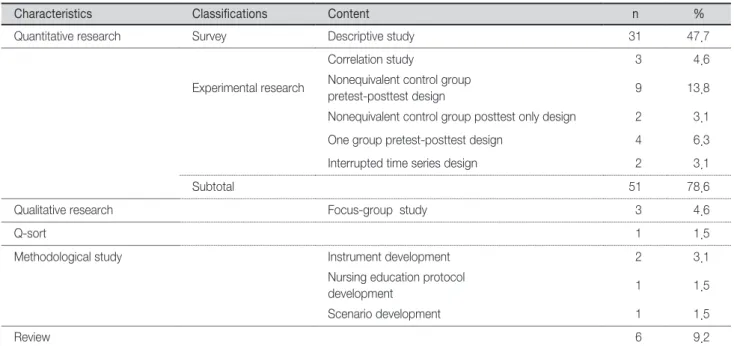
연구설계 유형을 분석한 결과 양적연구가 51편(78.5%) 으로 대부분을 차지하였으며, 질적연구 3편(4.6%), Q방 법론 1편(1.5%), 방법론적 연구 4편(6.1%), 문헌고찰 6편 (9.2%)인 것으로 나타났다(Table 2). 양적연구 중에는 조 사연구가 34편(52.3%)으로 가장 많았으며 실험연구가 17 편(26.3%)으로 순수실험연구는 없었으며, 유사실험연구 11편(16.9%), 원시실험연구 6편(9.4%)으로 나타났다.유사 실험연구 중에서는 비동등성 대조군 사전사후 설계연구 9 편(13.8%), 비동등성 대조군 사후 설계연구 2편(3.1%)이 었으며 원시실험연구 중에서는 단일군 사전사후연구 4편 (6.3%), 단일군 중단적 시계열연구 2편(3.1%)으로 나타났 다. 질적연구는 3편 모두 포커스그룹 연구였으며, 방법론 적 연구 4편(6.1%)은 도구개발 2편(3.1%), 프로토콜 개발 과 시나리오 개발 각각 1편(1.5%)으로 나타났다. 문헌고찰 6편(9.2%)은 사전의사 결정제도에 있어 전문간호사의 역 할 및 근거중심의 중환자간호에 대한 문헌고찰이 수행되 었다.
3. 자료분석 방법
자료분석 방법을 기술통계와 추론통계로 구분한 결과는 Table 3과 같다. 기술통계 혹은 추론통계를 사용한 논문 은 총 57편으로 이 중 52편이 SPSS (Statistical package for the social sciences)를 이용하여 통계분석을 하였다.
기술통계는 전체 분석대상 논문의 82.5%에서 사용되
80 81
Table 1. Overall Analysis of Published Papers (N=65)
Characteristics Classifications Content n %
Research Ill participants Adults 25 33.3
participants* Neonatal 2 2.7
(n=75) Well participants Family 4 5.3
Hospital staff 1 1.3
Health care provider Nurse 23 30.8
Nurse practitioner 2 2.7
Doctor 3 4.0
Physical therapist 1 1.3
Radiologist 1 1.3
Clinical pathologist 1 1.3
Nursing student 4 5.3
Document Papers 8 10.7
Type of data Hospital Word Medicine 9 8.5
collection settings* Surgery 9 8.5
(n=106) Psychiatry 1 0.9
Pediatrics 1 0.9
ICU GICU 10 9.5
MICU 14 13.2
SICU 14 13.2
HICU 4 3.8
NCU 3 2.8
CCU 5 4.8
EICU 2 1.9
PICU 1 0.9
NICU 3 2.8
OPD 6 5.7
ER 7 6.7
OR 2 1.9
Medical records room 3 2.8
Physical therapy room 1 0.9
Radiology room 1 0.9
Pathology room 1 0.9
Community University 3 2.8
Others† 6 5.7
Ethical Institutional review board 25 42.4
consideration‡ Written consent 12 20.3
(n=59) Verbal consent 5 8.5
Organization confirmation 9 15.3
Not reported 8 13.5
*Multiple responses; †Conference room, coffee shop, not reported; ‡Except review paper(n=6)
GICU=general intensive care unit; MICU=medical intensive care unit; SICU=surgical intensive care unit; HICU=heart surgery intensive care unit NCU=neurosurgery care unit; CCU=coronary care unit; EICU=emergency intensive care unit; PICU=pediatric intensive care unit;
NICU=neonatal intensive care unit; OPD=outpatient department; ER=emergency room; OR=operating room
었고, 추론통계는 66.7%로 나타났다. 추론통계를 모수통 계와 비모수통계로 구분한 결과 모수통계가 66.7%로 상 대적으로 많이 사용되었다. 모수통계에서 가장 많이 사용 한 분석법은 t-test (59.6%), Pearson correlation coef ficient (38.6 %), one-way ANOVA (35.1%), Multiple linear regression (14.0%) 순이었다. 비모수통계에서 는 Chi-square test (33.3%)가 가장 많았으며 다음으로 Fisher’s exact test가 8.8% 로 많았다. 사후분석방법으로 는 Scheffé' test가 12.3%로 가장 많이 이용되었다.
4. 실험연구의 전반적 특성
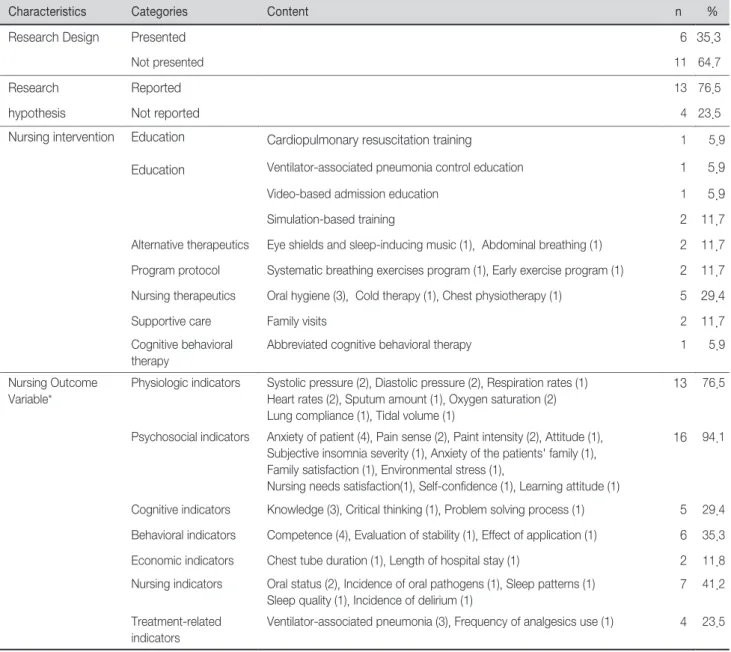
실험연구 17편을 대상으로 이론적 기틀 및 연구가설 유 무, 간호중재방법, 종속변수를 분석한 결과, 이론적 기틀 이 없는 경우가 64.7%, 연구가설이 있는 경우가 76.5%
로 나타났다. 17편 중 가장 많이 활용된 중재는 구강간 호 17.6%였으며, 다음으로 웹기반교육의 시뮬레이션교육 11.7%, 지지적 간호로서 가족면회가 11.7%를 차지하였다.
그 외 교육, 동영상 기반 간호, 보완대체요법, 프로토콜 개 발, 냉요법, 흉부물리요법, 인지행동요법이 각각 5.9%로 나타났다. 종속변수로는 사회심리적 지표가 17편 중 16편 으로 가장 많이 측정되었으며, 그 중에서도 환자 불안이 Table 2. Classification of Research Design (N=65)
Characteristics Classifications Content n %
Quantitative research Survey Descriptive study 31 47.7
Correlation study 3 4.6
Experimental research Nonequivalent control group
pretest-posttest design 9 13.8
Nonequivalent control group posttest only design 2 3.1
One group pretest-posttest design 4 6.3
Interrupted time series design 2 3.1
Subtotal 51 78.6
Qualitative research Focus-group study 3 4.6
Q-sort 1 1.5
Methodological study Instrument development 2 3.1
Nursing education protocol
development 1 1.5
Scenario development 1 1.5
Review 6 9.2
Table 3. Data Analysis Methods (N=57)
Statistical methods* n %
Descriptive statistics 47 82.5
Inferential statistics Parametric statistics
t-test 34 59.6
One-way ANOVA† 20 35.1
ANCOVA‡ 3 5.3
Pearson's correlation coefficient 22 38.6 Multiple linear regression 8 14.0 Non parametric statistics
Chi-square test 19 33.3
Mann-Whitney U test 4 7.0
Wilcoxon signed rank test 1 1.8
Friedman test 1 1.8
Spearman's rank correlation 2 3.5 Kendall tau rank correlation 1 1.8
Kruskal-Wallis test 3 5.3
Fisher's exact test 5 8.8
Kolmogorov-Smirnov test 1 1.8
Bonferroni correlation 2 3.5
Scheffé'test 7 12.3
Tukey test 2 3.5
Duncan test 2 3.5
*Multiple responses; †Analysis of variance; ‡Analysis of covariance
82 83 23.5%를 차지하였다. 다음으로 생리적 지표 13편, 행동적 지표 6편 순으로 나타났다(Table 4).
5. 간호학 메타파라다임에 따른 주제어 분류
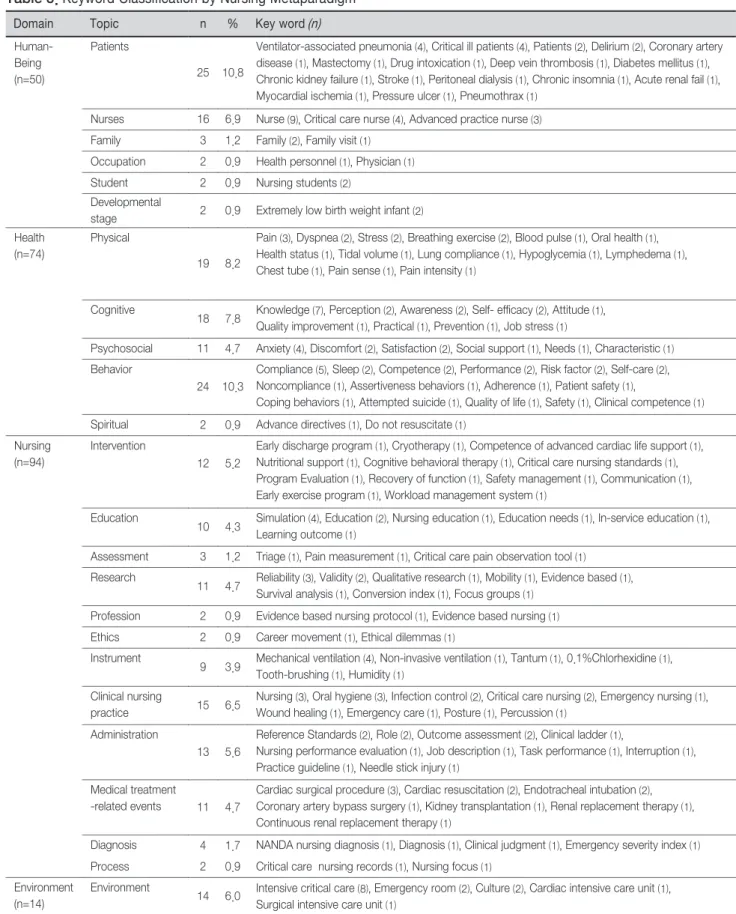
최근 5년간 중환자간호학회지에 게재된 논문의 주제어 232개를 간호학의 주요 메타파라다임인 인간, 건강, 간호, 환경의 영역으로 구분한 결과는 Table 5와 같다. 간호영역 에서 포함된 주요어가 94개로 가장 많았고, 다음은 건강,
인간, 환경의 순이었다. 환경 영역에 속하는 주요어는 14 개에 불과하였다.
인간 영역에서는 대상자에 대한 주요어가 환자인 경 우가 25개(10.8%)로 가장 많았고, 그 다음은 간호사 16 개(6.9%), 가족, 학생, 발달단계 순이었다. 환자 중에서 는 중환자와 인공호흡기 관련 폐렴환자가 각각 4개로 가 장 많았다. 건강 영역의 주요어로는 행동적 건강이 24개 (10.3%)로 가장 많았으며, 다음은 신체적, 인지적, 심리사 회적, 영적 건강이 순이었다. 행동적 건강 중에서는 이행
Table 4. Characteristics of Experimental Research (N=17)
Characteristics Categories Content n %
Research Design Presented 6 35.3
Not presented 11 64.7
Research Reported 13 76.5
hypothesis Not reported 4 23.5
Nursing intervention Education
Education
Cardiopulmonary resuscitation training 1 5.9
Ventilator-associated pneumonia control education 1 5.9
Video-based admission education 1 5.9
Simulation-based training 2 11.7
Alternative therapeutics Eye shields and sleep-inducing music (1), Abdominal breathing (1) 2 11.7 Program protocol Systematic breathing exercises program (1), Early exercise program (1) 2 11.7 Nursing therapeutics Oral hygiene (3), Cold therapy (1), Chest physiotherapy (1) 5 29.4
Supportive care Family visits 2 11.7
Cognitive behavioral therapy
Abbreviated cognitive behavioral therapy 1 5.9
Nursing Outcome Variable*
Physiologic indicators Systolic pressure (2), Diastolic pressure (2), Respiration rates (1) Heart rates (2), Sputum amount (1), Oxygen saturation (2) Lung compliance (1), Tidal volume (1)
13 76.5
Psychosocial indicators Anxiety of patient (4), Pain sense (2), Paint intensity (2), Attitude (1), Subjective insomnia severity (1), Anxiety of the patients' family (1), Family satisfaction (1), Environmental stress (1),
Nursing needs satisfaction(1), Self-confidence (1), Learning attitude (1)
16 94.1
Cognitive indicators Knowledge (3), Critical thinking (1), Problem solving process (1) 5 29.4 Behavioral indicators Competence (4), Evaluation of stability (1), Effect of application (1) 6 35.3 Economic indicators Chest tube duration (1), Length of hospital stay (1) 2 11.8 Nursing indicators Oral status (2), Incidence of oral pathogens (1), Sleep patterns (1)
Sleep quality (1), Incidence of delirium (1)
7 41.2
Treatment-related indicators
Ventilator-associated pneumonia (3), Frequency of analgesics use (1) 4 23.5
* Multiple responses
Table 5. Keyword Classification by Nursing Metaparadigm
Domain Topic n % Key word (n)
Human- Being (n=50)
Patients
25 10.8
Ventilator-associated pneumonia ⑷, Critical ill patients ⑷, Patients ⑵, Delirium ⑵, Coronary artery disease ⑴, Mastectomy ⑴, Drug intoxication ⑴, Deep vein thrombosis ⑴, Diabetes mellitus ⑴, Chronic kidney failure ⑴, Stroke ⑴, Peritoneal dialysis ⑴, Chronic insomnia ⑴, Acute renal fail ⑴, Myocardial ischemia ⑴, Pressure ulcer ⑴, Pneumothrax ⑴
Nurses 16 6.9 Nurse ⑼, Critical care nurse ⑷, Advanced practice nurse ⑶ Family 3 1.2 Family ⑵, Family visit ⑴
Occupation 2 0.9 Health personnel ⑴, Physician ⑴
Student 2 0.9 Nursing students ⑵
Developmental
stage 2 0.9 Extremely low birth weight infant ⑵ Health
(n=74)
Physical
19 8.2
Pain ⑶, Dyspnea ⑵, Stress ⑵, Breathing exercise ⑵, Blood pulse ⑴, Oral health ⑴, Health status ⑴, Tidal volume ⑴, Lung compliance ⑴, Hypoglycemia ⑴, Lymphedema ⑴, Chest tube ⑴, Pain sense ⑴, Pain intensity ⑴
Cognitive
18 7.8 Knowledge ⑺, Perception ⑵, Awareness ⑵, Self- efficacy ⑵, Attitude ⑴, Quality improvement ⑴, Practical ⑴, Prevention ⑴, Job stress ⑴
Psychosocial 11 4.7 Anxiety ⑷, Discomfort ⑵, Satisfaction ⑵, Social support ⑴, Needs ⑴, Characteristic ⑴ Behavior
24 10.3
Compliance ⑸, Sleep ⑵, Competence ⑵, Performance ⑵, Risk factor ⑵, Self-care ⑵, Noncompliance ⑴, Assertiveness behaviors ⑴, Adherence ⑴, Patient safety ⑴,
Coping behaviors ⑴, Attempted suicide ⑴, Quality of life ⑴, Safety ⑴, Clinical competence ⑴ Spiritual 2 0.9 Advance directives ⑴, Do not resuscitate ⑴
Nursing (n=94)
Intervention
12 5.2
Early discharge program ⑴, Cryotherapy ⑴, Competence of advanced cardiac life support ⑴, Nutritional support ⑴, Cognitive behavioral therapy ⑴, Critical care nursing standards ⑴, Program Evaluation ⑴, Recovery of function ⑴, Safety management ⑴, Communication ⑴, Early exercise program ⑴, Workload management system ⑴
Education
10 4.3 Simulation ⑷, Education ⑵, Nursing education ⑴, Education needs ⑴, In-service education ⑴, Learning outcome ⑴
Assessment 3 1.2 Triage ⑴, Pain measurement ⑴, Critical care pain observation tool ⑴ Research
11 4.7 Reliability ⑶, Validity ⑵, Qualitative research ⑴, Mobility ⑴, Evidence based ⑴, Survival analysis ⑴, Conversion index ⑴, Focus groups ⑴
Profession 2 0.9 Evidence based nursing protocol ⑴, Evidence based nursing ⑴ Ethics 2 0.9 Career movement ⑴, Ethical dilemmas ⑴
Instrument
9 3.9 Mechanical ventilation ⑷, Non-invasive ventilation ⑴, Tantum ⑴, 0.1%Chlorhexidine ⑴, Tooth-brushing ⑴, Humidity ⑴
Clinical nursing
practice 15 6.5 Nursing ⑶, Oral hygiene ⑶, Infection control ⑵, Critical care nursing ⑵, Emergency nursing ⑴, Wound healing ⑴, Emergency care ⑴, Posture ⑴, Percussion ⑴
Administration
13 5.6
Reference Standards ⑵, Role ⑵, Outcome assessment ⑵, Clinical ladder ⑴,
Nursing performance evaluation ⑴, Job description ⑴, Task performance ⑴, Interruption ⑴, Practice guideline ⑴, Needle stick injury ⑴
Medical treatment
-related events 11 4.7
Cardiac surgical procedure ⑶, Cardiac resuscitation ⑵, Endotracheal intubation ⑵, Coronary artery bypass surgery ⑴, Kidney transplantation ⑴, Renal replacement therapy ⑴, Continuous renal replacement therapy ⑴
Diagnosis 4 1.7 NANDA nursing diagnosis ⑴, Diagnosis ⑴, Clinical judgment ⑴, Emergency severity index ⑴ Process 2 0.9 Critical care nursing records ⑴, Nursing focus ⑴
Environment (n=14)
Environment
14 6.0 Intensive critical care ⑻, Emergency room ⑵, Culture ⑵, Cardiac intensive care unit ⑴, Surgical intensive care unit ⑴