Achievements of Characterized Education for Healthcare Data Science Initiative
HwaGyoo Park*
Content
Abstract 1. Introduction 2. Background 2.1 HDS Trend 2.2 HDSI Project: CK-1 3. HDSI Curriculum
4. HDSI Evaluation 4.1. Overview
4.2. Survey-based analysis 4.3 Result indicators-based analysis 5. Discussion and Conclusion Korean Abstract
ABSTRACT
ㄴ
Healthcare and data science are often linked through finances as the industry attempts to reduce its expenses with the help of large amounts of data. Data science and medicine are rapidly developing, and it is important that they advance together.
Data science is a driving force in transition of healthcare systems from treatment-oriented to preventive care in healthcare 3.0 era. It enables customized precision-based medicine that current healthcare systems cannot facilitate, and discovers more cost-effective treatment. Currently, healthcare big data is in the reality of medical institution, public health, medical academia, pharmaceutical sector as well as insurance agency. With this motivation, the medical college of Soonchunhyang university has performed a 'healthcare data science initiative(HDSI)' since 2014. Most of domestic HDSI programs focus on short-term contents such as mentoring and sharing cases for data science. Therefore, it is difficult to provide education tailored to the level of skills and job competency required at the practical site. Soonchunhyang HDSI implemented specialized strategies for improving resilience and response to changes in the IT education of current healthcare with the emphasis on the need for systematic activation of the practical HDSI. The HDSI has been performed as a part of on industry-academic link program in CK-1. Through quantitative and qualitative analysis, this paper discussed the HDSI process, performance, achievement, and implications.
Keywords: healthcare; data mining; data science initiative; data scientist; characterized education
접수일(2019년 5월 27일), 수정일(2019년 9월 16일), 게재확정일(2019년 9월 26일)
* First Author, Professor, College of Medical Science, Soonchunhyang University. [email protected]
1. Introduction
Healthcare industry is generating a amount of data every day. Electronic medical records, billing, clinical systems, data from wearables, and various pieces of research continue to generate big volumes of information. It presents a valuable opportunity for healthcare providers to ensure better patient care powered by possible insights from previous patient history data. The healthcare data science(HDS) is making it happen(Gang, 2019).
With the help of HDS analytics, healthcare data scientists are gradually revolutionizing the healthcare industry. From improving care delivery to achieving operational experience, they’re working to optimize every aspect of healthcare operation by unlocking the potential of healthcare data(Gang, 2017). HDS is a driving force in transitional healthcare systems from treatment care to proactive and preventive care. Healthcare data science(HDS) demand is increasing rapidly, but research on data science curriculum is very insufficient(Gang, 2017).
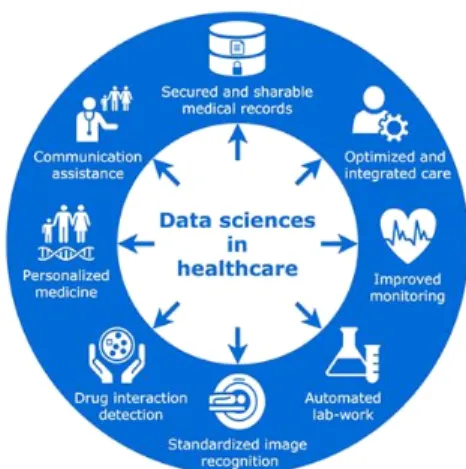
The HDS lets patients make more informed decisions when care providers are able to make evidence-based recommendations. In preventive healthcare system, health risks are detected early on and enhance the controling over their health at every stage of lifespan. As shown in <Fig.
1-1>(Vinh et al., 2018), HDS enables more cost-effective discovery, helping us do the right thing at the right time in the field of; 1. optimized and integrated care, 2. improved monitoring patients, 3. automated lab-work, 4. standardized image recognition in PACS, 5. drug interaction
detection, 5. personalized medicine, and 5.
communication assistance utilizing secured and sharable EMR(HIRA, 2018; Kang H. et al., 2018).
For instance, rather than have someone trying and failing ten different drugs at great expense to a patient side, the science can help us choose the right one on the first try. HDS is capable of improving patient outcomes and conditions efficiently and can also lowers the total costs and time. Recent Stanford research has begun to explore the possibilities of monitoring cardiomyopathy patients at home and monitoring children in the ER and ICU. This leads to proactive, consumer-based cares(HIRA, 2019b).
In addition to the ability to store, analyze and utilize big data in health care, healthcare data scientists also need the following skills:(a) engineering skills to design and analyze health care systems;(b) the knowledge and skills of programming that can be significantly summarized for users to benefit from and prepare for use for their purposes;(c) the knowledge and skills to deal with the extracted data statistically, and thus to summarize what appears to be complex; and(d) health care and behavioral analysis(Kang et al., 2018b).
2. Background
Medicine and healthcare is a revolutionary and promising industry for implementing the HDS solutions. HDS is needed to move the medical science to a whole new level, from computerizing medical records to drug discovery and genetic disease exploration(Gang, 2017; Vinh et al., 2018).
Industry 4.0 wave is bringing about a new era of healthcare data science based on big data analytics(Gang, 2019). In this section, HDS trend and HDSI Project(CK-1) are described.
2.1 HDS Trend
A new era of healthcare data science is coming based on big data analytics(HIRA, 2019a). The analytics covers electronic medical records, patient disease registration information, patient health monitoring device data, genomic information, insurance claims data and clinical data(Kim & Lee, 2018). The National Cancer Institute of the U.S.
National Institutes of Health is promoting a medical big data service that shares cancer-related imaging data, preparing a disease treatment system through gene data sharing for various disease studies, and predicting and managing diseases under major care.
It has 1,700 genetic information in the Amazon cloud and has been deployed available(HIRA, 2018).
The UK Department of Health publishes Personalized Health and Care 2020 and provides HDS-based healthcare big data through the independent establishment of the Health & Social Care Information Center(HSCIC), an organization that strengthens control over citizens and patients' welfare and medical information(Gang et al., 2017).
In Singapore, the People Association(PA) shares various activities of more than 1,800 community committee centers with one another to implement a customized welfare society and provides the age, culture, age, race and income of residents to provide personalized services(Gang et al., 2017;
HIRA, 2019b). Japan has already announced the 'next-generation healthcare-based law' under the
supervision of the Ministry of Health, Labor and Welfare on how to create and utilize a virtuous business model based on HDS. It emphasize on solving health care issues in its future investment strategy(SDS, 2019).
In Korea, through the healthcare big data open system, the Korea HIRA provides public data such as examination status and medical benefits to 27 types of care information, 14 types of medication statistics such as nursing homes and pharmacy prescriptions, 11 types of statistics on medical use of age-based recipients and major diseases, and eight other OECD statistics such as health status indicators and healthcare resources. The National Health Insurance Corporation has a number of data related to health insurance, such as eligibility and insurance data, long-term care data, and health examination data collected through health insurance and medical examination.
2.2 HDSI Project: CK-1
University for Creative Korea(CK) is a project that invests a total of 1.2 trillion won over five years by providing 23.1 billion won to local universities(CK-I) and 54.6 billion won to universities(CK-II) in order to encourage them to improve their educational organizations, considering the needs and characteristics of the belonging community(CK, 2018).
Fig. 1-1 Data Sciences in Healthcare
A total of 989 groups applied for the public offering at 160 out of 195 four-year universities nationwide, and the Education Ministry finalized the final selection project group, including Soonchunhyang University, after the first-phase and second-phase presentation evaluations and review by the Fairness Verification Committee. A total of 265 business groups from 80 local universities(CK-I) and 77 business groups from 28 universities in the Seoul metropolitan area(CK-II) were finally selected.
In addition to the Act on the Promotion of Local Universities, the synergy effect of the virtuous circle of local universities and communities and the foundation for the development of regional equality were established(Education Ministry, 2017; CK, 2018).
In this study, the author focused on 'service science' program, HDISI, of Soonchunhyang University's Creative Korea-1 project(SCH CK-1). In definition, the past epidemic prevention era is defined as the healthcare 1.0 and the disease treatment centered age is defined as the healthcare 2.0. The 3.0 era of healthcare defines the need for personal-tailored health life extension and reduction
of medical expenses, including personalized prevention, treatment, rehabilitation and daily management.
This has led to a significant increase in HDS staffing needs for pharmaceutical, medical devices and medical services industry business models and the structured and unstructured health care data analysis derived from them(SCH, 2016; SCH, 2017).
The healthcare sector that can analyze this precise data is a key component of evidence-based medicine.
The paradigm shift with precision medicine will be designed, analyzed and optimized across individual health, living and environment(SCH, 2017).
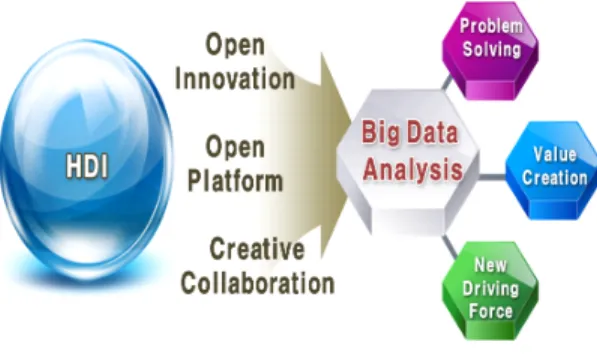
Fig. 1-2 HDSI Vision and Objectives
In accordance with accelerating the convergence of knowledge and technology in the fourth revolution wave, the SCH CK-1 group defines its educational vision and goals as shown in <Fig. 1-2>
and develops its capabilities in consilience expertise
as three strategic goals to achieve the vision; a.
Field Inside Education, b. Consilience Track Education, c. Resilience Reinforcement Education.
The HDSI characterization was specialized in training HDS analytic workforce for an environment that provides personalized health management and customized health care. Currently, most medical institutions use electronic medical records in patient care, a prescription communication system for various examinations and drug prescription information, and a medical imaging system for computerized tomography and magnetic resonance imaging. In addition, various structural and unstructured, multi-digital data are being generated through customer relations management system, healthcare resources management system, and knowledge management system(Kang et al., 2018b).
Healthcare data scientist demand is rapidly increasing. Therefore, we defined the following classified areas for education of HDSI(Kang et al., 2018a; HIRA, 2018).
1. Medical information support: ability to analyze medical big data for individual disease symptoms and support
2. Medical management support: ability to achieve quality improvement of medical services based on medical information, such as comparing nursing facilities, evaluating hospitals, operating information of other organizations, and prescribing by local administrative agencies
3. Medical industry support: ability to provide information on prescription drug inventory status, medical device supply status, etc. by the analysis of data application information in the medical industry
The domestic HDS industry needs these capabilities with a steep rise till 2025, requiring
more than 10,000 high-quality workers(HIRA, 2019a;
HIRA, 2019b).
Fig. 1-3 HDS requirements(SCH, 2016)
As shown in <Fig. 1-3>, the health care industry is approaching a fourth wave of health care based on the cyber-physics system, where the volume and qualitative expansion of data and the IT paradigm are converging.
Fig. 1-4 Information flow model of HDS
This, like the previous three industrial revolutions, has a strong influence in the health care industry and is expected to have a significant meaning of transformation(HIRA, 2019a; Vinh et al., 2018).
To implement the practices of HDSI in the real world healthcare, a systematic seamless approach
has been developed and adopted by the SCH medical science college considering students' medical education strategies and goals(HIRA, 2019a).
The benefits using HDS in hospitals can be depicted as a system dynamic model. A hospital case of information flow modeling of HDS is depicted as a diagram, as shown in <Fig. 1-4>. The purpose of this specification analysis is to sharpen specific missions and their HDSI relationships on the basis of arrows sign(CK, 2018).
3. HDSI Curriculum
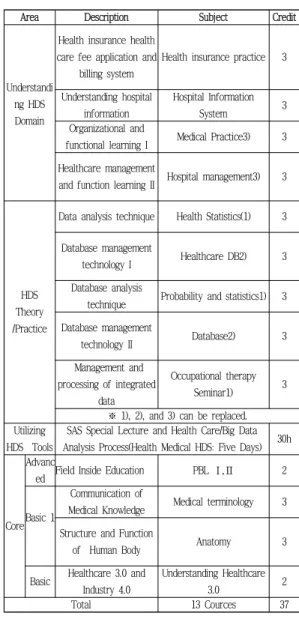
For this purpose, this specialized curriculum consists of four areas, as shown in table 2-1. The curriculum required for employment was developed to take the relevant subjects through the basic, core, and cross-disciplinary courses required for specialized skills, and those who have completed the course will receive advanced courses required for HDS. These convergence tracks were designed to ensure students' practical skills in their respective tasks by actively operating comparative courses, as well as cross-disciplinary courses. It is designed based on the national competency standards(NCS).
In addition to regular subjects, there are two courses for non-regular students: "Problem-Based Learning" and "SAS Special Lecture and Health and Medical Big Data Analysis Process." First, the PBL class focuses on the practical education and HDS professional competence in the studio by adopting practical education method. This is a process of training solution application by problem to acquire HDS practical expertise for two school years a
year. In this case, external experts are used to support both practical and external business environment. Second, the definition, data collection, analysis, use cases, and practice of health care big data and data science were carried out using SAS and SPSS analysis tools by utilizing the 'SAS Special Lecture and Health Care Big Data Analysis Process' vacation period.
Tab. 2-1. Composition of the Curriculum
Area Description Subject Credit
Understandi ng HDS Domain
Health insurance health care fee application and
billing system
Health insurance practice 3
Understanding hospital information
Hospital Information
System 3
Organizational and
functional learning I Medical Practice3) 3 Healthcare management
and function learning II Hospital management3) 3
HDS Theory /Practice
Data analysis technique Health Statistics(1) 3
Database management
technology I Healthcare DB2) 3 Database analysis
technique Probability and statistics1) 3 Database management
technology II Database2) 3
Management and processing of integrated
data
Occupational therapy
Seminar1) 3
※ 1), 2), and 3) can be replaced.
Utilizing HDS Tools
SAS Special Lecture and Health Care/Big Data Analysis Process(Health Medical HDS: Five Days) 30h
Core Advanc
ed Field Inside Education PBL Ⅰ,Ⅱ 2
Basic 1
Communication of
Medical Knowledge Medical terminology 3 Structure and Function
of Human Body Anatomy 3
Basic Healthcare 3.0 and Industry 4.0
Understanding Healthcare
3.0 2
Total 13 Cources 37
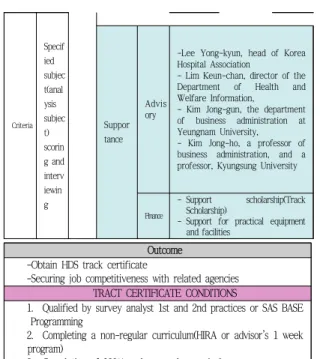
The operation of the criteria for completion and evaluation system for each convergence track defines the minimum requirements for students to verify their competences and awards certificates under the president's name after assessing their competencies through rigorous screening.
Input, Process & Outcome(IPO) schematic specifying these HDS curriculum requirements is shown in <Fig. 2-1>(SCH, 2016).
Fig. 2-1 IPO Process in HDSI
4. HDSI Evaluation
This performance analysis utilizes the CK-1 project plan and annual report of Soonchunhyang University. The background, necessity and direction of specialization of the project were analyzed and the contents of each annual report were analyzed and the contents of specialized education and educational performance were aggregated.
To measure the satisfaction of the students participating in this program, the student survey period was conducted between January 11, 2019 and January 23, 2018.
4.1. Overview
The performance analysis of this characterization program is divided into survey-based student
Part Curriculum
College Year 2, 3, 4
Basic subject
⇨
Open subject in another department
Subjects designat ed in each dept.
( S e e Curricul
u m
Details)
Medical practice(medical IT engineering dept.:(Terms and mutual incompatibilities are not included.)
⇩ ⇩
No.
1 0 stude n t s p e r school year
PBL-I
Studio practice
PBL-II
D a t a anal ysi s technolog i c a l learning/d evelopme nt
D a t a analysi s techniq
u e
learnin g/appli cation
⇧ ⇧
Non Credit Course 1. Completed non-regular
curriculum(HIRA)
2. Academic advisor's 1 week program)(a total of 30 hours)
Criteria Specif ied subjec t(anal ysis subjec t) scorin g and interv iewin g
Suppor tance
Advis ory
-Lee Yong-kyun, head of Korea Hospital Association
- Lim Keun-chan, director of the Department of Health and Welfare Information,
- Kim Jong-gun, the department of business administration at Yeungnam University, - Kim Jong-ho, a professor of business administration, and a professor, Kyungsung University
Finance
- Support scholarship(Track Scholarship)
- Support for practical equipment and facilities
Outcome -Obtain HDS track certificate
-Securing job competitiveness with related agencies TRACT CERTIFICATE CONDITIONS
1. Qualified by survey analyst 1st and 2nd practices or SAS BASE Programming
2. Completing a non-regular curriculum(HIRA or advisor's 1 week program)
3. Completion of 100% or less regular curriculum Input
Credit: 34 Core1 28credits
(refer to curriculum) Core2 4credits(HDS PBL I, II) Non
Credit: 30h
Completed 1 week program for HIRA (30 hours)
Process
satisfaction indicators and outcome indicators. As shown in table 4-1, the structure of the survey-based student satisfaction education consisted of general information of the participating students, program satisfaction, business satisfaction, improvement points, and other divisions of the requirements, and the result indicators evaluated the results of the HDS-specific program with HDS employment rate, student qualification acquisition rate, and number of education personnel indicators(AHRQ, 2019; Gang, 2017).
4.2. Survey-based analysis
As an analysis on the education satisfaction level of the CK-1 characterization program, this survey was conducted to prepare basic data on performance status breakdown by specifically surveying and analyzing the satisfaction status 'before and after participation' of 56 students of HDSI program. The survey was conducted through an online survey for eight days. Data analysis of the results of the survey was conducted using the SPSS 23 Windows.
Tab. 4-1. Survey Structure
As shown in table 4-2, the survey was comprised of 26 questions in four categories, and the satisfaction level was given as a measure of five points; highly satisfied, satisfied, normal, dissatisfied, and highly dissatisfied. The last two questions of 'improvement and requirements' were presented in open-ended format.
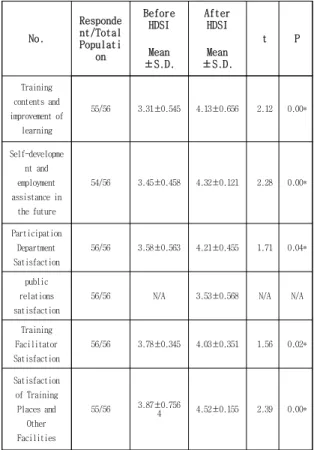
Tab. 4-2. Main Response Analysis
The table represents main response analysis from
Area Que stio ns
Descriptions Etc
1.general information 4
․Gender
grade, department, entrance year 5 point scale
2.Program 6
․Training contents and improvement of learning, Self-development and employment assistance in the future, participation department satisfaction, Public Relations Satisfaction, Trainee Satisfaction, Training Place and Other Facilities Satisfaction
3.HDSI 14
․Convergence Track, Competition(English Situation Drama, Field Practical Competition, etc.) Exposition and Job Conference, Understanding of Healthcare 3.0, Academic Subjects, Field Visits, Invite Specialists to Specialize Specialized
Training, Global Major Experience, Change Response Camp, Tutoring, Collaborative Learning, Global Competency Strengthening Program, Training and Training for Practical People and Graduates 4.Other 2 ․Improvements, requirements
No.
Responde nt/Total Populati
on
Before HDSI Mean
±S.D.
After HDSI Mean
±S.D.
t P
Training contents and improvement of
learning
55/56 3.31±0.545 4.13±0.656 2.12 0.00*
Self-developme nt and employment assistance in
the future
54/56 3.45±0.458 4.32±0.121 2.28 0.00*
Participation Department Satisfaction
56/56 3.58±0.563 4.21±0.455 1.71 0.04*
public relations satisfaction
56/56 N/A 3.53±0.568 N/A N/A
Training Facilitator Satisfaction
56/56 3.78±0.345 4.03±0.351 1.56 0.02*
Satisfaction of Training Places and Other Facilities
55/56 3.87±0.756
4 4.52±0.155 2.39 0.00*
questionnaire survey on a paired t-test. It shows the change in satisfaction 'before and after' program participation. The results of p=0.000 to 0.004 in all of the questions, except 'promotional desirability', and show a statistically significant improvement in p<0.05 level. The HDSI program has significantly contributed to the training content and learning enhancement, future self-development and employment assistance, participation degree satisfaction, training facilitator satisfaction, training venue and other facilities satisfaction.
In detail, 88.4%(before participating: 59.6%) responded more than 'satisfied' while 1.2%(before participating: 8.5%) responded less than 'unsatisfactory'. Only 86.4%(before participation:
67.3%) of future self-development and employment assistance items and 0.6%(before participation: 5.5%) were dissatisfied. 70.6%(before participation: 58.1%) responded more than satisfied, and 1.2%(before participation: 5.3%) responded less than unsatisfactory. 80.6%(before participation: 67.3%) responded more than satisfied; 0.6%(before participation: 3.6%) responded less than unsatisfactory; and lastly, 75.3%(before participation:
59.2%) answered more than 'satisfied'; and 1.8%(before participation: 3.1%). In sum, there has been a significant increase in education and learning advancement and satisfaction with self-development and employment assistance.
4.3 Result indicators-based analysis
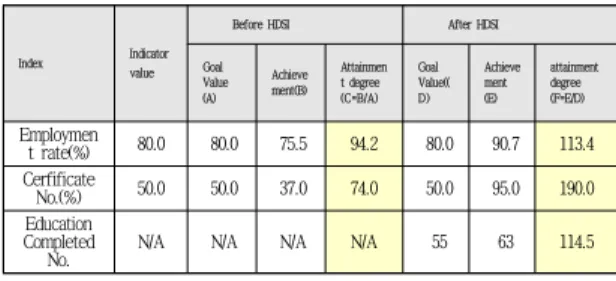
Table 3-1 shows the 'result indicator-based performance' of the employment rate, student certification acquisition rate, and number of persons in education into HDS characterization field. The
relevant areas for employment rate were health care data analysis areas, consulting and administration areas, and student certificates were counted to 'social survey analysts', 'big data analysts', and 'SAS base programmers'. The number of educational employees was the total number of students who completed the specialization program by the end of the HDSI project. In the table, the reference value is expressed as '%' for the degree of achievement, during joining HDSI. The method of calculation for 'C' and 'F' is expressed as a percentage of the achievement compared with the target value.
The employment rate of certificates was raised from 94.2 % to 113.4 %, and the acquisition rate of student certificates was raised from 74.0 % to 190.0
%. In addition, the 30-hour practical training course for SAS special lecture and healthcare big data analysis is completed by 63 students. It is surpassing the target of 55 into 114.5%.
Tab. 4-3. HDSI Results Indicators Summary
5. Discussion and Conclusion
Many healthcare organizations have already started to leverage HDS based on big data in an effort to improve overall healthcare. There is a massive amount of scattered healthcare data from
Index Indicator
value
Before HDSI After HDSI
Goal Value (A)
Achieve ment(B)
Attainmen t degree (C=B/A)
Goal Value((
D) Achieve ment (E)
attainment degree (F=E/D) Employmen
t rate(%) 80.0 80.0 75.5 94.2 80.0 90.7 113.4 Cerfificate
No.(%) 50.0 50.0 37.0 74.0 50.0 95.0 190.0
Education Completed
No. N/A N/A N/A N/A 55 63 114.5
various sources like websites, wearables, social media and Google maps. This data holds the key to understanding the overall healthcare in a specific geography. HDSI enables participating students to analyze it to prepare heatmaps pertaining to parameters like population, health ailments, medical results of people in the geography etc.(Gang, 2019).
In addision healthcare costs only appear to be rising with time and this proves to be an impacting factor in delivering a superior patient experience.
However, with analytics and HDS tools, this can be addressed as well. Trained students in HDSI can look into billing data and information from clinical systems pertaining to categories of charges and variables. This allows them to drill down to the trends in room usage and required resources available to cater to patient needs; thus, helping identify potential areas of operational gaps and revenue losses.
Healthcare providers can also leverage data science to optimize their supply chain and review equipment maintenance schedules to prevent unexpected breakdowns. This can help them understand how to keep the costs low. Using HDSI analytics, it’s also possible to monitor patient recovery and planning discharge protocols accordingly so as to minimize readmissions(Gang, 2017; Gang, 2019).
As mentioned above, we looked at the background, necessity, performance and satisfaction of the HDSI program, which was conducted by the 'CK-1' Project in Suncheonhyang university.
Through HDSI, students can apply HDS learning techniques to process extensive clinical and laboratory reports to conduct a quicker and more precise diagnosis assistance. HDSI may allow them
to detect early signs of an issue and enable the doctors to provide preventive care and better treatment to the patients in the future. Additionally, HDS data can also be used by medical researchers to diagnose chronic diseases at early stages and identify treatment options that have proven success records.
Needless to say, this amount of data would be impossible to interpret without SCH HDSI. As the developments in HDSI continue, we can look forward to a better healthcare model in the days to come. A systematic longitude study is needed in the future as to what causes the HDSI performance, and what causes achievement of academic and employment rates, beyond simple correlation analysis.
Reference
[1] AHRQ(2019), National Healthcare Quality and Disparities report:introduction and methods AHRQ website, [Online] Available: https://statesnapshots.
ahrq.gov/snaps10/Methods.jsp?menuId=67&state=N DCommittee 5-6 Dec. DELSA/HEA 21.
[2] CK(2018) CK Business Introduction: Vision and Strategy-CK Statistics.[Online] Available:http://
www.ckgc.co.kr/sub.php?menukey=7
[3] Education Ministry(2017). 'University Specialization Project' [Online] to Increase University Competitiveness Available: https://www.moe.go.kr/
boardCnts/list.do?boardID=294&m=0503&s=moe [4] Gang E. J. et al.(2019). Understanding healthcare 3.0.
Hongneung Publishing House.Front. Public Health, 03 April 2018 | https://doi.org/10.3389/fpubh.
2018.00099
[5] Gang J. et al.(2017). Experience and Implications of University Characterization Excellence and Business:
A Case of the Department of Health Administration and Management at Soonchunhyang University.
Journal of the Korean Health Association. 19, 19-27.
[6] HIRA (2018). Health Insurance Review and Assessment Service:Statistics Indicators for 2018 Medical Expenses.
[7] HIRA(2019a). Health Care Big Data-(Medical Data).[Online] Available: https://opendata.hira.or.kr /home.do
[8] HIRA(2019b). Medical Big Data Open System Medical Resources(HRs/Facilities) Status, [Online]
Available:https://opendata.hira.or.kr/home.do [9] Kang H. et al.(2018a). Korea Medical Quality Report.
Sejong: The Korea Institute for Health and Social Affairs.
[10] Kang H. et al.(2018b). 2017 Korea Medical Quality Report: Evaluation of Innovative Performance of the Korean Medical System(II). Sejong: The Korea Institute for Health and Social Affairs.
[11] Kim H. & Lee H.(2018). Real-world evidence versus randomized controlled trial: Clinical research based on electronic medical records. JKMS 2018 Aug 34, 20-33.
[12] SCH(2016). Suncheon Hyang University-Report on the Interim(Performance) Evaluation of Local University Specialization Projects: Business Group Sector - University Self-governance Type Non-Privacy.
[13] SCH(2017).Suncheon Hyang University-2017 Specialized Excellence and Annual Report, Health Administration Management Department, Medical Science University, Suncheonhyang University.
[14] SDS(2019).System dynamics reviews [Online]
Available: https://www.systemdynamics.org /system
-dynamics-review
[15] Vinh. P., Ivan L. et al.(2018). Revolution in Health Care: How Will Data Science Impact Doctor–Patient Relationships?, Front. Public Health, 03 April 2018, [Online] Available: https://doi.org/10.3389/fpubh.
2018.00099
Park, Hwa Gyoo([email protected])
Hwa Gyoo Park received his PhD study and degree from the Korea Advanced Institute of Science and Technology(KAIST) and Oklahoma State University(OSU), in 1993 and 1999 respectively. He was a Researcher at the Korea Institute of Science and Technology, Seoul, from 1993 to 2004. Since 2005, he has been a Professor at the Soonchonhyang University, Asan, Republic of Korea. He is interested in diversity management and information system in healthcare.
대학 특성화 사업 성과에 관한 연구-보건의료 데이터 사이언티스트 프로그램을 중심으로
박 화 규*
요약
ㄴ
본 소고는 ‘대학 특성화 사업’의 헬스케어분야에 선정된 순천향대학교의 CK-1 사업단의 보건의료 데이 터 사이언티스트 특성화 프로그램인 HDSI 성과에 관한 연구이다. 현 대학들의 HDSI 데이터 전문인력 양성 활성화를 위한 지원정책은 미진하나 해외 경우 전문인력 양성교육 및 과정 개발등 에 특성화하여 운영하는 경우가 많다. 또한 대부분의 HDSI 국내 인력양성 프로그램은 기업과의 멘토링·사례 공유 등 단기적 콘텐츠 위주로 협업이 이루어지고 있으나, 기업에서 요구하는 기술수준과 직무능력에 맞춘 교육을 제공하기 어려운 실정이다.
본 CK-1 사업단에서는 현재 대학의 HDSI 보건의료의 IT 교육이 급변하는 환경과 현실 간 괴리가 있음을 판단하고, 실무중심의 특성화 산학연계프로그램이 체계적으로 활성화될 필요가 있음을 강조하여 1) 실무형 Field Inside 교육 2) 융합형 트랙교육, 3) 회복탄력성 및 변화대응력 강화 교육의 3가지 특화전략을 갖고 추 진되었다.
이는 한국연구재단에서 우수사업단으로 선정되었고, 종합평가에서 A등급을 받아 매우 유의미한 연구 성과 로 인정받았다. 더불어, 본 특성화프로그램에 참여 학생들은 설문분석과 결과지표 분석을 통해, 만족도 유의 미하게 상향되었음을 알 수 있었다. 이러한 HDSI 정량적 및 정성적 분석을 통해 특성화 사업의 과정, 결과와 성과를 비특성화 사업 참여 대학 및 일반에 알림으로서 CK-1 정책이 대학 경쟁력 강화에 얼마만큼 기여하고 있는지를 제시하고자 한다.
표제어: 보건의료, 데이터 사이언티스트, 데이터 마이닝, 특성화 교육, 성과
* 순천향대학교 의료과학대 보건행정경영학과 교수, [email protected]