INTRODUCTION
Since tourism industry in South Korea has ex- pended and developed, the hotel industry became more competitive than before. Based on these si- tuation, high quality hotels such as five star hotels make an effort to derive customers and success their business (Kim & Kim 2005; Min, Min & Joo 2008).
Customers who are usually prefer the green attri- butes in hotels have more focused on various factors related to green initiatives (Kang et al 2012). Environ- mental concerns related to green marketing in hotel have spread around the globe especially pertaining
to the exhaustion of natural resources and energy, global warming and weather change, destruction of ecosystem (ecocide), etc. Green life promotes a good quality of life as it not only saves resources and en- ergy and protect environment in everyday life but al- so pursue eco-friendly life (Kang el al 2012; Millar et al 2012; Mostafa 2009). Many U.S. corporate have re- cently developed and applied renewable energy by purchasing RECs as the U.S. government pledged that it will reduce 80 percent of greenhouse gas emissions by 2050. Furthermore, Japan launched
“Fukuda Vision” in 2008 and Great Britain passed Climate Change Act 2008 as an effort to decrease Culinary Science and Hospitality Research (October 2015)
Vol. 21, No. 5, pp. 72-87
A Study on Diffusion of Green Commitment in Hotel Employees : Focused on The Mediator Effects of Environmental
Attitude of Line Supervisor and Peer Group
Geon-Whee Kim1, Ji-Hye Jung2, Ji-Soo Han3 and Heon-Su Ha4
1Dept. of Hotel Management, Sangji Youngseo College, Korea
2Dept. of Hotel & Restaurant Management, Dongwon College, Korea
3Dept. of Food Industry Management, HanKook Tourism College, Korea
4¶Dept. of Foodservice Management, GyeongJu University, Korea
ABSTRACT: The purpose of this study is to investigate how environmental attitudes of top managers of hotel business affect on environmental commitment of hotel employees and identify of the mediator ef- fects of line supervisor and peer group during implementing green management process using Sobel z test. Data analysis is conducted by SPSS 18.0. The findings and implications can be summarized as follows.
First, environmental attitudes of top managers has significantly positive effect on environmental attitude of line supervisors and peer group. Second, environmental attitude of line supervisors and peer group, in turns, has significantly positive effect on value or normative commitment on green management of hotel employments. Third, there is positive mediating effect of environmental attitude of line supervisors and peer group between environmental attitudes of top managers and value or normative commitment of hotel employees. Hence we can conclude that implementing of green management intention of top managers to hotel employs in work place needs strong support of line supervisors and peer group.
Keywords: environmental attitudes, value commitment, normative attitude, line supervisor, peer group
¶ Corresponding Author: Heon-Su Ha, Dept. of Foodservice Management, GyeongJu University, Korea, 188 Taejong-ro, GyeongJu Gyeongbuk, South Korea, Tel. +82-54-770-5311, Fax. +82-54-770-5311, E-mail : [email protected]
carbon emissions.
The Korean government announced “A Frame- work Act on Low Carbon green Growth” as a re- sponse to solving many socio-economic and environ- mental challenges posed by the traditional growth paradigm – heavily dependent on the consumption of energy and natural resources. Green growth is na- tion’s new vision that nurtures new growth boosters, and makes the best use of green technology and clean energy, and creates jobs with harmonious de- velopment between the economy and the environ- ment. Thus green technology innovate the economic and industrial structure of the nation as well as its citizens’ modes of life into low carbon and pro environmental.
Green growth provides nation a new survival stra- tegy as for green management provides business a new survival strategy. Thus green management is a combination between the social value, prosperity and coexistence of mankind, and innovative strategy that presents a ground-breaking approach. Despite the huge initial spending, green management deli- vers incentive mechanisms for business in various perspectives simply from energy saving to enhanced reputation, brand and market value, tax benefits, etc (Graci & Dodds 2008; Han, Hus & Sheu 2010).
Although green management is a recent trend leading various industries, it is difficult for hotels to adapt green management. As hotel benefits in return of intangible service provided to customers and it is rather costly in customer’s perspective. Thus decision making process for customer often depends on ima- ge of the hotel. The green label may harm the illus- tration of luxuriousness and comfort given to hotel.
Also adopting green management into hotel in- dustry costs immense expense requiring a new em- ployment, facility expansion and information ga- thering. The top management needs to establish a long term vision for the successful green manage- ment and become adaptable for pro-environment management.
The hotel industry is aware of this new trend and has set policies in this respect; however, the precise research for these initiatives has rarely been done.
There are few studies on green management of the hotel industry, such as Hyun Jaecheon and Lee Byunghak’s “The Research on Image of Environmen-
tal Hotel,” Park Ohsung and Jeongin Eunkyung’s “The Correlation between Consumer’s Purchase and Green Marketing of Hotel Industry,” Nam Jimin’s “The Strategy of Environmental Hotels in Adapting Green Policy,” and Son Hyeran’s “The Correlation of Green Management of the Hotel and its Performance;”
however, no specific studies have been conducted in relation to the hotel employees.
This study emphasizes the role of top manage- ment in order to enhance reputation and gain po- sitive outcome. Implementing green management intention from top managers to hotel employees needs a strong support of line supervisors and peer group. In other words, environmental attitude of line supervisor and peer group has significant mediator effect between environmental attitude of top ma- nagement and green commitment of hotel emplo- yees. The study has conducted survey on hotel em- ployees from 5 five-star hotels and concluded that environmental attitude of top management effects line supervisor and peer group.
LITERATURE REVIEW
The Green Management of Hotel
Many companies initiated green marketing with energy saving policy in order to reduce manufactur- ing cost. Steady growth in Corporate Social Responsi- bility facilitated business to implement society’s envi- ronmental awareness, such as recycle and waste reduction. In long run, it will enhance reputation and market value in needs of customer value. Over the decade, the environmental management system has recently been more recognized in hotel industry.
Hotels face environmental concerns just as other in- dustry, including energy saving issues, waste con- sumption and disposables problems because it pro- vides service to customers day and night. Hotel in- dustry has been considered no smoking industry to reduce emission of environmental containment (Ka- sim 2004). The following is for new recognition that reflects society’s strong aspiration for hotel’s green management. Consequently Korea Environmental Industry & Technology Institute required eco label on hotel service among other tourism industry Hotels first need to develop a checklist and evaluate envi- ronmental management system in accordance with
global standards. More specifically, it may be divided into seven categories such as energy saving–the im- plementation of energy savings measure and renew- able energy sources, maintenance of the facilities, water conservation policy–monitoring water con- sumption, reusing waste water, and implementation of water savings measure, the reduction of chemical usage and industrial waste–instruction on usage of toxic substance, and control, preservation, and re- placement of toxic substance, rooms management–
no smoking policy and caring air quality whilst re- modeling, green purchase–purchase of durable prod- ucts, and lastly, green management –the promotion of green management and action plan, constant il- lustration of pro-environmental information.
Hotel’s environmental management system sh- ould promote guidelines, such as reuse, recycle, re- duce, redesign, re-imagine, and rebuild. For instance,
‘The Marriott International,’ an award winning hotel in 2005 2006 and 2007 from the US Energy star, suc- cessfully reduced greenhouse gas emission 2% per room (70,000 ton overall) and save $ 6,000,000 per year. It also practices green card policy and water ef- ficient laundry system sets 450,000 fluorescent light, LED lamp, and optical fiber light. Further, ‘The Victo- ria Best Western Premier’ promotes following envi- ronmental policy including low carbon emission, so- lar energy (7,000kw/h) to 25% of the room, using wood pellet which helps saving 50,000L of oil and re- ducing CO2 emission. As shown in number of the prominent cases, implementation of the environ- mental management is not only costly but also re- quiring voluntary awareness of its members, long term cost-saving, earns reputation of the brand. Thus many hotels in Korea started to induce environ- mental management system.
Prominent case in Korea practices following action plan– greenhouse gas certification, energy reduction, water preservation, waste control, environmental program, green building, green standard, environ- mental policy, and green product (Kim Geon-Whee 2013). Gran Hyatt releases its action plan and share information through operation of the Hyatt Earth and SeSe@GHSL (Save energy Save earth@Grand Hyatt Seoul). Part of energy reduction practice- For example, it reuses domestic sewage through ‘recy- cling heat of condensed water’ and saves 7,500,000
won per year, save 60,000,000 won per year, save 15,000,000 won by replacing facility and trap of wa- ter storage, eco-friendly material for reconstruction of the room, providing ‘aromatherapy associates’
body products, a famous eco-friendly British beauty brand. Further, ‘Jeju Sila’ is certified with ISO14001 in 1997 – storing and reusing 1500 tons of rainwater as cleaning and gardening purpose.
Environmental Attitude of Top Management Top management is a governing body, consists of a group of individuals that are elected to establish corporate management related policies and to make decisions on major company issues. It has the ulti- mate decision-making authority and is empowered to set the company’s policy, objectives, and overall direction, adopt bylaws, hiring and firing of employ- ees, etc. Leading an innovative organizational culture is a key component in ensuring company’s prosper- ity and such directionality is depended upon top management (Jung Heesoo, Jo Yoonhyung 2001).
Minzberg(1973) emphasizes decision making as the most important role of Chief Executive Offier (CEO)’s role among other aspects. Thus role of top manage- ment is critical in order to promote green manage- ment as the long term policy.
As a decision making body, top management shall amend the objective of the management, deliver im- plementation of the green management, decide en- ter into the green management business. Industry re- quires framework for corporate sustainability in order for top management to run sustainable green man- agement (Kim Geon-Whee 2013). In “A Guide to Corporate Sustainable Management,” Ministry of En- vironment suggests that CEO’s strategic motive on green management factors into sustainable growth of hotel industry. Green management cannot remain as hotel management in long run without overall recognition about the environment and systematic arrangement.
Environmental Attitude of Line Supervisor and Peer Group
Social support from the various relations, espe- cially reference group -the peer and friends-, greatly affect individual perception and behavior pattern.
Thus many researchers have provided theories and
models explaining how relationships among peer group affect individual behavior. A. H. Maslow (1943)’s hierarchy of needs emphasized love and be- longingness needs. He explained social phenomena on how environment and relationship influence in- dividuals.
The support from the supervisor and organization is rather important in reducing employee’s physical and psychological stress due to their administrative position. Support from peer group relives occupa- tional stress via cooperation and psychological sup- port (Lee Sukwang & Choi Woosung 2005). Social support includes all possible resources provided to individuals such as assist, concern, encouragement, etc (Lee Kieun 2008). Findings from the previous ca- ses prove that social support, such as peer and su- pervisor, influences organizational commitment, in- tention to leave one’s work, occupational stress, and occupational burnout.
Line supervisor shares and supports employees in order to carry out environmental program. They also convey top management’s environmental philoso- phy to the bottom line. As an observer, he or she oversees green management and evaluate perfor- mance of the related business circle. As a leader, line supervisor evaluates and guides employee. The re- cent trend requires diverse approaches on job per- formance, such as multi source assessment, on green management rather than traditional evaluation.
The social capital strengthens relationship that bond one to peer group who are similar to each other. One can safely assume that the social capital is an important factor predicting organizational gr- owth (James 2000). Compatibility with peer indirectly illustrates job performance of individual, group, and organization. Individual job performance and acti- vities cannot be fulfilled without cooperation and co- ordination with peer group. Further environmental practice requires individual and organizational coo- peration. Thus, environmental attitude and aware- ness of peer group influences formation and con- solidation of employee’s green commitment.
Green Commitment of Hotel Employee
Environmental attitude of hotel employee de- pends upon their value commitment. Commitment is often associated with job oriented notion in so-
ciology. The sociologists used it in order to analyze organizational behavior. It was a descriptive concept to provide examination of individual and organiza- tional characteristics. Starting from 1960s, organi- zation commitment was employed to analyze corre- lation between individual and organization (Becker 1960).
Organizational commitment has been studied from two different theoretical perspectives–the ex- change relationship and psychological approach. The exchange relationship perceives organizational com- mitment as interaction between individual contri- bution and inducement of the organization and its members. The member tends to feel stronger com- mitment to stay in the organization seeing various rewards as positive factor. In psychological approach, employees identify themselves with the organization and endeavor their service to the organization (Por- ter et al 1974).
Meyer and Allen(1991) indicated that there are three mind sets, affective commitment, continuance commitment and normative commitment which can characterize an employee’s commitment to the or- ganization. Affective commitment is defined as the employee’s emotional attachment to the organi- zation. Normative commitment is employee’s sense of obligation to stay in Organization. Continuance Commitment is the gains versus losses of working in an organization. Etzioni(1975) developed a typology of involvement based on the factors that motivate people to join—moral involvement (organizational aim and intrinsic motivation, based on positive ori- entation), alienative involvement (designates an ne- gative orientation with exploitative relations), and calculative involvement (based on notion of the effi- cient exchange, reward and compensation).
Angle & Perry(1981) categorized commitment into two group–commitment to stay and value commit- ment. Commitment to stay is related to member’s in- tention to stay in organization, such as consolidation of motive and action. Value commitment Katz and Kahn(1975)’s voluntary and psychological behavior pattern. In overall, it is similar to Etzioni(1975)’s moral involvement.
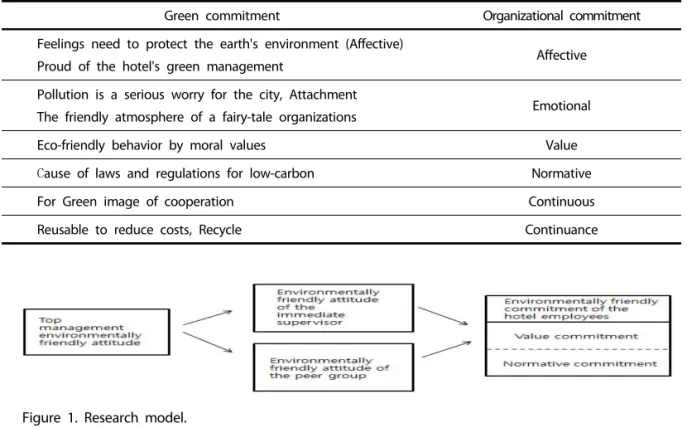
This study used a term commitment because envi- ronmental is rather value oriented concept. The green commitment can be categorized into 5 differ-
ent groups in line with organizational commitment.
Affective commitment means sense of ‘affection in preserving environment and dignity in hotel’s green management’. Emotional commitment can be de- scribed as ‘an attachment and concern toward pol- luted city,’ value commitment as ‘environmental practice derived by one’s virtue,’ normative commit- ment as ‘pro-environmental image of one’s business,’
and continuance commitment as ‘recycle and reuse for cost reduction’ Table 1.
This study indicates green commitment of hotel employee as normative commitment and value com- mitment as variables of this study. Normative com- mitment is defined by member’s intrinsic obligation to his or her organizational purpose, value and co- mmitment. Value commitment is based upon affec- tion and loyalty and is rather affective and volun- tary.
Objective and Hypothesis
Study Model and Establishing Hypothesis Figure 1 is a sample model provided for purpose of this study.
Andersson and Bateman(2000). Jiang & Bansal
(2003) states that implementation of the system, de- ification of environmental issues, documentation of procedures, and correction of the default depend upon voluntary participation of employees. Inten- tion of top management cannot be fulfilled without affecting attitude of individual employees and su- pervisor. Thus top management generally insists pro-environmental behavior of employees to serve its purpose.
In bureaucratic society, it is difficult to convey vi- sion of top management to associate level. Unlike top management, line supervisor has a distinct role in pursuing certain goa, endowed with limited au- thority. Line supervisor may have difficulties im- plementing day to day business without under- standing strategic intention of top management.
Thus having green culture within organization is also an important aspect. Thus, the following relations are hypothesized.
Hypothesis 1: Environmental attitude of top management affects environmental attitude of line supervisor.
Hypothesis 2: Environmental attitude of top
Green commitment Organizational commitment
Feelings need to protect the earth's environment (Affective)
Proud of the hotel's green management Affective
Pollution is a serious worry for the city, Attachment
The friendly atmosphere of a fairy-tale organizations Emotional
Eco-friendly behavior by moral values Value
Cause of laws and regulations for low-carbon Normative
For Green image of cooperation Continuous
Reusable to reduce costs, Recycle Continuance
Table 1. Eco-friendly mission and organizational commitment
Figure 1. Research model.
management affects environmental attitude of peer group.
Stinglhamber & Vandenberghe(2003) states that employees have tendency to identify policy and sup- port of supervisor with organization’s policy and support. Environmental attitude of line supervisor di- rectly affects attitude and interest of employees.
Further, the social exchange is formed between em- ployee and line supervisor. Further, environmental attitude of line supervisor directly affects green com- mitment of employee because employees have ten- dency to regard commitment to line supervisor as the commitment to the organization.
Organ & Ryan(1995) states that individual job per- formance and activity can only be achieved through cooperation of associates. Boiral & Paille(2012) sug- gest that both individual practices and pro-envi- ronmental behavior of peer group determine and strengthen one’s Green Commitment. Thus, the fol- lowing relations are hypothesized.
Hypothesis 3: Environmental attitude of line su- pervisor and peer group has positive effect on green commitment of hotel employee.
Hypothesis 3-1: Environmental attitude of line supervisor has positive effect on green co- mmitment of hotel employee.
Hypothesis 3-2: Environmental attitude of peer group has positive effect on green commitment of hotel employee.
Hypothesis 4: Environmental attitude of line su- pervisor and peer group has positive effect on normative commitment of hotel em- ployee.
Hypothesis 4-1: Environmental attitude of line supervisor has positive effect on normative commitment of hotel employee.
Hypothesis 4-2: Environmental attitude of peer group has positive effect on norma- tive commitment of hotel employee.
Pro-environmental behavior of top management may be related to pro-environmental behavior of su- pervisor and peer group, and vice versa; however, the mediator effects combining these to phenomena
may not be significant. Thus, identifying whether en- vironmental attitude of line supervisor and peer group has significant mediator effect between envi- ronmental attitude of top management and value commitment of hotel employee is a critical step.
Thus following relations are hypothesized.
Hypothesis 5: Environmental attitude of line su- pervisor and peer group has mediator effect between environmental attitude of top ma- nagement and value commitment of hotel employee.
Hypothesis 5-1: Environmental attitude of line supervisor has mediator effect between en- vironmental attitude of top management and value commitment of hotel employee.
Hypothesis 5-2: Environmental attitude of peer group has mediator effect between environmental attitude of top manage- ment and value commitment of hotel em- ployee.
Hypothesis 6: Environmental attitude of line su- pervisor and peer group has mediator effect between environmental attitude of top ma- nagement and normative commitment of hotel employee.
Hypothesis 6-1: Environmental attitude of line supervisor has mediator effect between en- vironmental attitude of top management and normative commitment of hotel em- ployee.
Hypothesis 6-2: Environmental attitude of peer group has mediator effect between environmental attitude of top manage- ment and normative commitment of hotel employee.
METHOD
Sample and Data Collection
This study approaches previous studies on pro- environmental management and environmental atti- tude of hotel employees in order to provide theore- tical background. Based on figure 1, survey, pilot test was conducted for 30 hotel employers. I revised sam- ple survey based on preliminary result to this re-
search. The sample is restricted to hotel employees from 5 five-star hotels in Seoul because only five-star hotel practices pro environmental policy. The study ran for 45 days, from 1 April 2013 to 15 May 2013, and the survey was self-response questionnaire un- der supervision of manager at each hotel.
SURVEY
Environmental Attitude of Top Management This study defined environmental attitude of top management as ‘an action with a clear understand- ing and values on environment, environmental poli- cy as a new opportunity to induce green commit- ment and support environment.’ The survey has total of 8 questionnaires on environmental attitude of top management, mostly based on Branzei et al (2004) and revised to be adequate for this study. 5 point Likert scale is used to determine the level of environ- mental attitude of top management. Reverse ques- tion is reverse coded. ‘Not applicable’=1, with nearly no environmental practice found on top manage- ment level and ‘Strongly agree’=5, with a clear un- derstanding and active environmental practice seen from top management.
Environmental Attitude of Line Supervisor Hotel employers often associate themselves with organizational policy and provision and thus, envi- ronmental attitude of line supervisor directly affects related workers. The survey on environmental atti- tude of line supervisor was modified from Organ and Ryan (1995) and Boiral and Paillle(2012) with 8 que- stionnaires. One question was reverse coded for the One question was reverse coded for the reliability(in- tegrity) of the response others with 5 point Likert scale from 1 being ‘not applicable’ to 5 being ‘st- rongly agree’.
Environmental Attitude of Peer Group
The survey on environmental attitude of peer group was based on Organ & Ryan (1995) and Boiral
& Paillle(2012) with 7 questionnaires. . One question was reverse coded for the integrity of the response others with 5 point Likert scale, from 1 as ‘not appli- cable’ to 5 as ‘strongly agree.’
Green Commitment
With value commitment, members feel value and dignity through environmental practice, accept the organizational aim and whilst endeavoring for orga- nizational growth. Normative commitment is defined by one’s obligation to stay in organization. Thus va- lues commitment is closely related to affective and voluntary and normative commitment is more com- pulsory and functional. Based on definition of Angle
& Perry(1983) and Meyer & Allen (1991), 10 ques- tionnaires with Likert scale are coded from ‘not appli- cable’=1 to ‘strongly agree’=5 on environmental prac- tice.
Data Analysis
Frequency analysis has been done with Applying SPSS18. Factor consistency analysis has been done for reliability and validity of tool. Regression analysis has been done for the verification of hypothesis.
Environmental attitude of top management affects environmental attitude of line supervisor or peer group. Although, environmental attitude of line su- pervisor or peer group affects environmental attitude of hotel employers, mediation effect between two variables may not be significant. Thus applying Sobel z is essential to verify significant mediation effect be- tween environmental attitude of top management and environmental sense of duty of hotel employers.
PROOF ANALYSIS
Demographic Feature of Sample
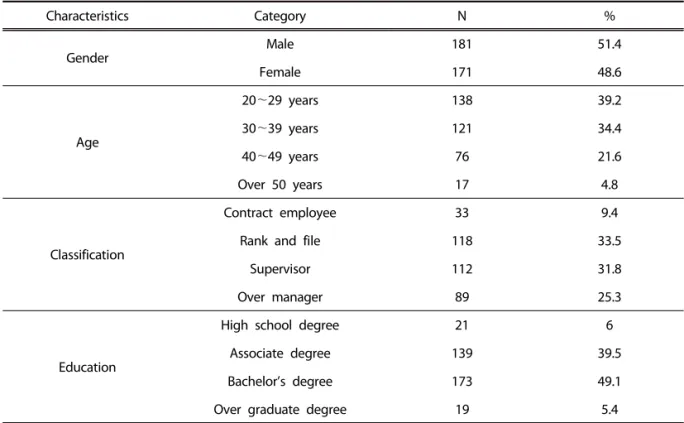
360 employees from five-star hotels located in Seoul participated in this survey. In total, 359 valid surveys were returned and 353 surveys were in this study, excluding incomplete. Table 2 shows demog- raphy of the sample of this study (98.05% response rate). Unmarked questionnaire is considered missing value and excluded from the relevant analysis, by gender-51 % of male and 48% of female, by age- 39.20% of 20s, 34.4% of 30s, 21.6% of 40s, 4.8% of 50s, by education —6% of high school graduate, 39.5
% of community college graduate, 49% of college graduate, 5.4% of above college graduate, and by job title-9.4% of contracted worker, 33.5% of asso- ciate level, 31.8% of manager, 25.3% of a section or
above.
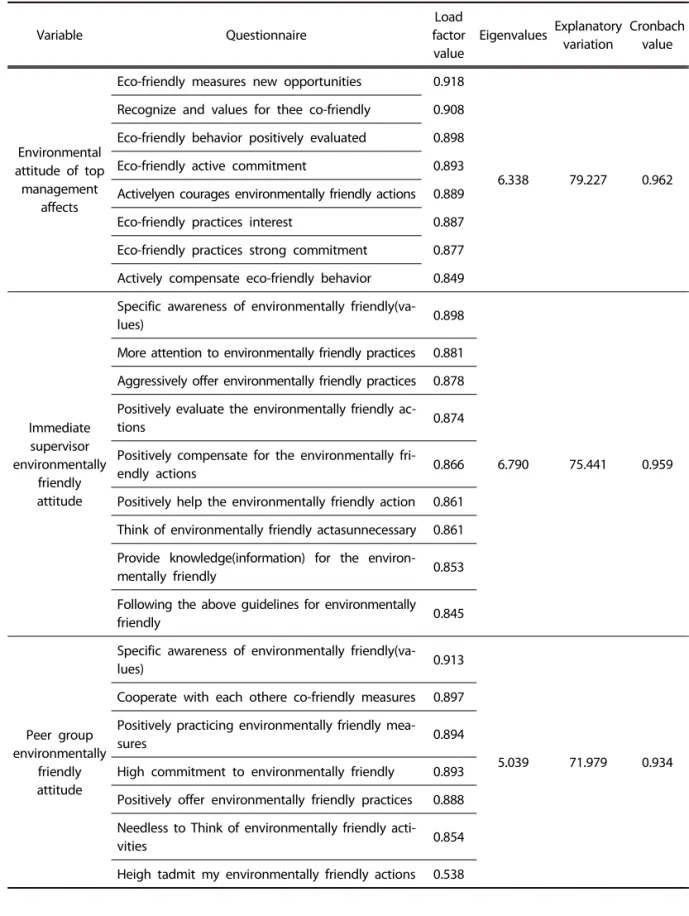
Reliability and Validity Analysis on Instrument This study applied exploratory data analysis and Cronbach a to analyze reliability and validity of the following two variables, environmental attitude of top management and environmental attitude of line supervisor and peer group. The study ran factor ana- lysis on environmental attitude of top management (dependent variable) and environmental attitude of line supervisor and peer group (parameter) as a sin- gle scale factor. Inappropriate questionnaire was re- moved in accordance with factors loadings 0.5/0.4 standard. Table 2 and Table 3 illustrates the result of final factor analysis and Cronbach a. Factor loadings of the environmental attitude of top management (dependent variable) and environmental attitude of line supervisor and peer group (parameter) exceeds 0.8, Eigen value is 6.338, 6.790, 5.039, exceeding 1.0.
The result of variance explained is 79.227% 75.441%, 71.979%, exceeding 50%. Reliability and validity of instrument is applicable Table 3. Also Cronbach a of this study exceeds 0.9 (0.962, 0.959, 0.934) and thus instrument measurement of internal consistency is
valid.
On the other hand, Table 3 findings show that all factor loadings exceed 0.5 on hotel employee (DV)’s green commitment, Eigen value exceeds 2.034, and normative commitment is 2.159 (< 1.0). Cumulative variance is 52.411%, confirming reliability and vali- dity of the instrument Table 3. Instrument on hotel employees’ green commitment is internally consis- tent as normative commitment of Cronbach a (0.637) and value commitment of Cronbach a (0.806) all ex- ceed 0.6.
On the other hand, Table 3 findings show that all factor loadings exceed 0.5 on hotel employee (DV)’s green commitment, Eigen value exceeds 2.034, and normative commitment is 2.159 (< 1.0). Cumulative variance is 52.411%, confirming reliability and vali- dity of the instrument Table 3. Instrument on hotel employees’ green commitment is internally con- sistent as normative
Evaluation of Hypothesis
Hypothesis 1. Environmental attitude of top ma- nagement positively affects section leader/
head/manager’s environmental attitude.
Characteristics Category N %
Gender
Male 181 51.4
Female 171 48.6
Age
20~29 years 138 39.2
30~39 years 121 34.4
40~49 years 76 21.6
Over 50 years 17 4.8
Classification
Contract employee 33 9.4
Rank and file 118 33.5
Supervisor 112 31.8
Over manager 89 25.3
Education
High school degree 21 6
Associate degree 139 39.5
Bachelor’s degree 173 49.1
Over graduate degree 19 5.4
Table 2. The general characteristics of the sample
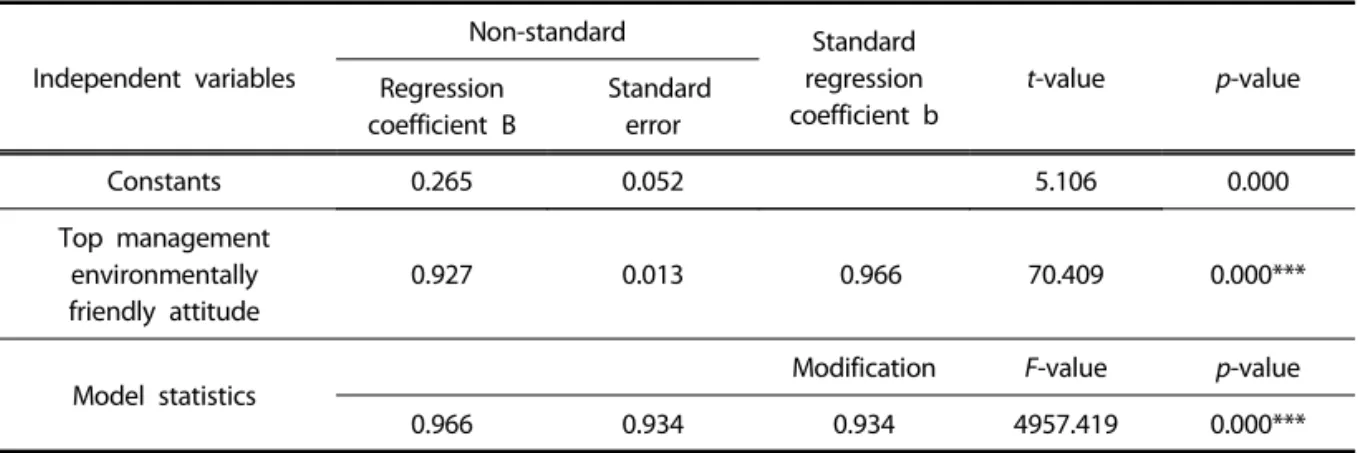
Table 4 findings demonstrated the result of re- gression analysis on environmental attitude of top
management and line supervisor. This result, B=
0.927, t=70.409(p<0.001), proves that environmental
Variable Questionnaire
Load factor value
Eigenvalues Explanatory variation
Cronbach value
Environmental attitude of top
management affects
Eco-friendly measures new opportunities 0.918
6.338 79.227 0.962
Recognize and values for thee co-friendly 0.908 Eco-friendly behavior positively evaluated 0.898 Eco-friendly active commitment 0.893 Activelyen courages environmentally friendly actions 0.889 Eco-friendly practices interest 0.887 Eco-friendly practices strong commitment 0.877 Actively compensate eco-friendly behavior 0.849
Immediate supervisor environmentally
friendly attitude
Specific awareness of environmentally friendly(va-
lues) 0.898
6.790 75.441 0.959
More attention to environmentally friendly practices 0.881 Aggressively offer environmentally friendly practices 0.878 Positively evaluate the environmentally friendly ac-
tions 0.874
Positively compensate for the environmentally fri-
endly actions 0.866
Positively help the environmentally friendly action 0.861 Think of environmentally friendly actasunnecessary 0.861 Provide knowledge(information) for the environ-
mentally friendly 0.853
Following the above guidelines for environmentally
friendly 0.845
Peer group environmentally
friendly attitude
Specific awareness of environmentally friendly(va-
lues) 0.913
5.039 71.979 0.934
Cooperate with each othere co-friendly measures 0.897 Positively practicing environmentally friendly mea-
sures 0.894
High commitment to environmentally friendly 0.893 Positively offer environmentally friendly practices 0.888 Needless to Think of environmentally friendly acti-
vities 0.854
Heigh tadmit my environmentally friendly actions 0.538
Table 3. Validity of the reliability of the independent variables and parameters measuring tools
attitude of line supervisor is significant and positive.
In other words, environmental attitude of line super- visor significantly rises as environmental attitude of top management increases. The results provided support for Hypothesis 1. Coefficient of determi- nation (R2), measuring model validation equals 0.934, explains section leader’s environmental attitude, ve- rifying significance of the model (F=4,597.419 (p<
.001). Thus the model is significant.
Hypothesis 2. Environmental attitude of top ma- nagement positively affects environmental atti- tude of peer group.
As Table 5 illustrated B=0.886, t=57.363 (p< .001),
environmental attitude of top management has sig- nificant effect on environmental attitude of peer group. Thus environmental attitude of peer group significantly increases when environmental attitude of top management increases. The results provided support for Hypothesis 2. The statistical model illus- trates coefficient of determination (R2) as 0.904, envi- ronmental attitude of peer group explains 90.4% of the entire fluctuation. The model is significant re- sulted in F=3290.471(p<.001).
Hypothesis 3. Environmental attitude of line su- pervisor and peer group positively influences hotel employer’s value green commitment.
Hypothesis 3.1 Environmental attitude of line su- Independent variables
Non-standard Standard
regression coefficient b
t-value p-value Regression
coefficient B
Standard error
Constants 0.265 0.052 5.106 0.000
Top management environmentally friendly attitude
0.927 0.013 0.966 70.409 0.000***
Model statistics
Modification F-value p-value
0.966 0.934 0.934 4957.419 0.000***
Table 5. Impact on the attitude of top management department manager eco friendly attitude
Variable Questionnaire Load factor
value Eigenvalues
Cumulative explanatory fluctuations
Cronbach value
Value- commitment
Positive impact on other staff 0.674
2.034 25.422 0.637
The company proud of eco-friendly
activities 0.668
The same awareness hotel between me 0.644 Top instructions positive thinking 0.627 Eco-friendly policy actively accept 0.565
Normatively commitment
Environmental Initiatives duty 0.881
2.159 52.411 0.806
Supervisor indication executive influ-
ence 0.846
Eco accepted by peers influence 0.800
Table 4. Reliability and validity of the dependent variable measuring tools
pervisor positively influences hotel employer’s value green commitment.
Hypothesis 3.2 Environmental attitude of peer group positively influences hotel employer’s environmental value green commitment.
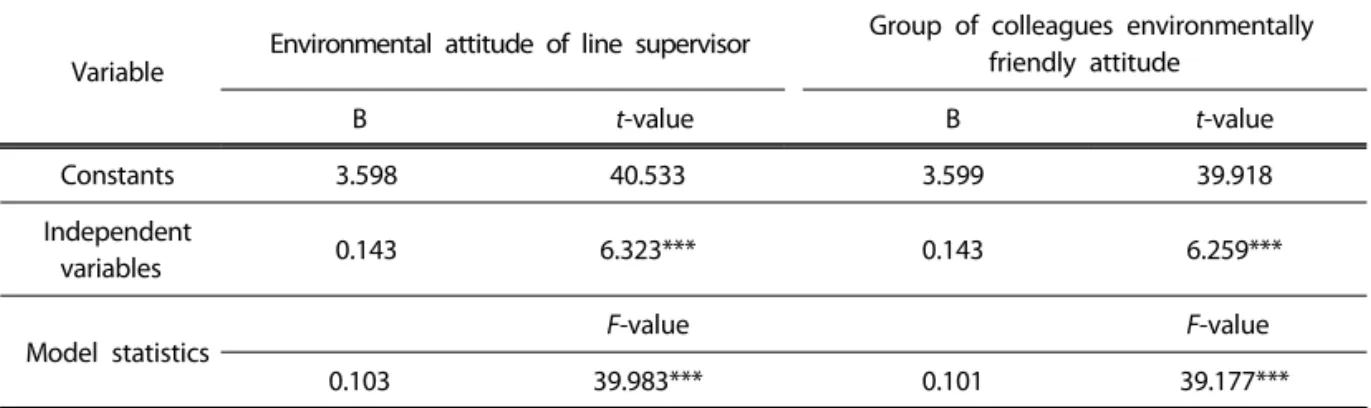
Table 6 shows the result of regression analysis on what factors into line supervisor’s value commitment about environment. In correlation coefficient, line su- pervisor’s environmental attitude and peer group’s environmental attitude are highly correlated. The study analyzed VIF(variance inflation factor) first to avoid multi-collinearity. As a result, multi-collinearity occurs as VIF exceeds 19.0 and confirms impossibility to run multiple regression. Independent variables have been put in regression model to support for hy- pothesis 3.
As a result, environmental attitude of line super- visor B=0.143, t=6.323(p<.001), environmental atti-
tude of peer group which significantly positive influ- ence on hotel employer’s value attitude. Value com- mitment significantly rises as environmental attitude of line supervisor and peer group rises. Thus the re- sults provided support for hypothesis 3.1 and 3.2.
Coefficient of determination for environmental atti- tude of line supervisor is 0.103, F=39.983(p<.001) and environmental attitude of peer group is 0.101, F=39.177(p<0.001).
Hypothesis 4. Environmental attitude of line su- pervisor and peer group positively influences hotel employee’s normative green commit- ment.
Hypothesis 4.1 Environmental attitude of line su- pervisor positively influences hotel employer’s normative green commitment.
Hypothesis 4.2 Environmental attitude of peer group positively influences hotel employer’s Independent variables
Non-standard Standard
regression coefficient b
t-value p-value Regression
coefficient B Standard error
Constants 0.445 0.061 7.306 0.000
Top management environmentally friendly
attitude
0.886 0.015 0.951 57.363 0.000***
Model statistics
Modification F-value p-value
0.951 0.904 0.904 3,290.471 0.000***
* p<.05, ** p<.01, *** p<.001.
Table 6. Top management influence on eco-friendly attitude, the attitude of colleagues
Variable Environmental attitude of line supervisor Group of colleagues environmentally friendly attitude
B t-value B t-value
Constants 3.598 40.533 3.599 39.918
Independent
variables 0.143 6.323*** 0.143 6.259***
Model statistics
F-value F-value
0.103 39.983*** 0.101 39.177***
* p<.05, ** p<.01, *** p<.001.
Table 7. Factors affecting the value of environmentally friendly attitude
environmental normative green commitment.
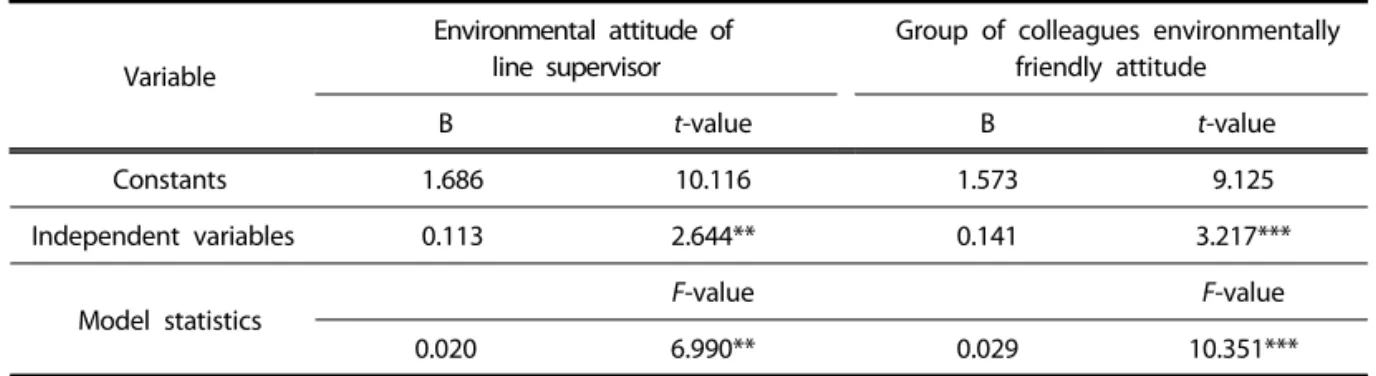
Hotel Employee’s normative commitment on envi- ronment is analyzed with a regression analysis as Independent variable Table 8. This result suggested that environmental attitude of line supervisor [B=
0.113, t=2.644(p<.01)] and peer group [B=0.141, t=3.217(p<.001)] has significant and positive effects on hotel employee’s normative commitment. Thus if environmental attitude of line supervisor or peer group rises hotel employee’s normative commitment rises significantly. Thus the results provided support for hypothesis 4.1 and 4.2. The statistical model showed that coefficient of definition on lines upervi- sor as 0.020, F=6.990(p<.01) and on peer group as 0.029, F=10.351(p<.001)
Hypothesis 5. Environmental attitude of line su- pervisor and peer group has mediator effect between environmental attitude of top mana-
gement and value commitment of hotel em- ployee.
Hypothesis 5.1 Environmental attitude of line su- pervisor has mediator effect between environ- mental attitude of top management and va- lue commitment of hotel employee.
Hypothesis 5.2 Environmental attitude of line su- pervisor has mediator effect between environ- mental attitude of top management and va- lue commitment of hotel employee.
Table 10 showed the result of Sobel z, supporting hypothesis 5. Sobel’s approximated Z statistics is de- fined as following.
Further, Z follows standardized normal distribu- tion/Gaussian distribution N(0,1). As a result, signifi- cant mediation effect exists between environmental attitude of top management [Z=6.194 (p< .001)] and hotel employee’s value commitment [Z=6.183(p<
Variable
Environmental attitude of line supervisor
Group of colleagues environmentally friendly attitude
B t-value B t-value
Constants 1.686 10.116 1.573 9.125
Independent variables 0.113 2.644** 0.141 3.217***
Model statistics
F-value F-value
0.020 6.990** 0.029 10.351***
* p<.05, ** p<.01, *** p<.001.
Table 8. Factors affecting the eco-friendly attitude norms
Parameter
Top management environmentally friendly attitude
→ Parameter a
Parameter
→ Value attitude b a*b Sobel z value p value
B s.e. B s.e.
Immediate supervisor environmentally friendly attitude
0.927 0.013 0.113 0.043 0.105 2.626***
Fellow eco-friendly
attitude 0.886 0.015 0.143 0.023 0.127 6.183***
* p<.05, ** p<.01, *** p<.001.
Table 9. Direct superior eco-friendly attitude toward the value of a sense of duty, the mediating effect of peer environment-friendly attitude
.001)]. Thus the results provided support for hypoth- esis 5.1 and 5.2.
Hypothesis 6. Environmental attitude of line su- pervisor and peer group has mediator effect between environmental attitude of top ma- nagement and normative commitment of hotel employee.
Hypothesis 6.1 Environmental attitude of line su- pervisor has mediator effect between environ- mental attitude of top management and nor- mative commitment of hotel employee.
Hypothesis 6.2 Environmental attitude of peer group has mediator effect between environ- mental attitude of top management and nor- mative commitment of hotel employee.
Table 9 illustrated mediation effect between envi- ronmental attitude of top management and hotel employee’s normative environmental attitude. This finding suggests that both environmental attitude of line supervisor [z=2.626(p<.001)] and peer group [z=3.200(p<.001)] has significant mediator effect be- tween environmental attitude of top management and normative commitment of hotel employee. Thus the results provided support for hypothesis 6.1 and 6.2.
RESULT
Current study performed to identify how environ- mental attitudes of luxury hotels business influence
on environmental commitments as perceived by 360 hotel employees from 5 five-star hotels. In addition, this study has conducted to find mediator effects of line supervisor and peer group during implementing green management process. All hypothesizes have developed to find the relationships among the effect of top manager’s environmental attitude on line su- pervisor, peer group, effect of line supervisor, and peer group’s environmental attitude on employee’s normative as well as value commitment. Detailed re- sults and implications are followed.
First, if environmental attitude of top manager is active, it has more positive effect on normative and value commitment of hotel employee. Although green management is the recent trend leading vari- ous industries, green management may seem to harm profit-based policy. Thus it is nearly impossible for supervisor and associates to apply green manage- ment without a strong determination of top ma- nager.
Second, environmental attitude of line supervisors and peer group has positive effect on value or nor- mative commitment hotel employees. It is not plau- sible for supervisor and associates to apply green management without support from peer group and supervisor. It could even get worse if employee is not aware of environmental practices because ‘environ- mental’ is value oriented notion rather than profit based term. Thus hotel needs regular evaluation on attitude and awareness of supervisor and employee in order to practice green management in day to day business. A mediator effect of line supervisor and Parameter
Top management environmentally friendly attitude
→ Parameter a
Parameter
→ Value attitude b a*b Sobel z value p value
B s.e. B s.e.
Immediate supervisor environmentally friendly attitude
0.927 0.013 0.143 0.023 0.133 6.194***
Fellow eco-friendly
attitude 0.886 0.015 0.143 0.023 0.127 6.183***
* p<.05, ** p<.01, *** p<.001.
Table 10. Direct superior eco-friendly attitude toward the norms mission, mediating effect of peer environ- ment-friendly attitude
peer group becomes very significant whilst analyzing the influence of environmental attitude of top ma- nagement on normative and value commitment ho- tel employee.
The results imply that luxury hotels such as five star hotels in South Korea should significantly consi- der environmental attitudes along with green proc- ess to satisfy hotel employees. To improve the atti- tudes of employees, typical education program of green commitment has to provide. Well-educated the supervisor or peer group of hotels will positive influence on normative commitment and green com- mitment, and these positive effect can effect on their customers as well.
Hotels gain benefit from providing intangible service to customers. Although green management is the recent trend leading various industries and represents important social value, green label may harm image of the hotel. Top management needs to establish a long term vision to successfully adopt green management into hotel industry. Further- more, implementing green management intention from top managers to hotel employees needs a strong support of line supervisors and peer group.
Hotel first requires a regular evaluation on employ- ees’ environmental attitude in order to enhance a new label into hotel. It also needs to investigate a way to promote a clear image as green hotel to customers.
Limitation and Further Research
The study has conducted survey on hotel employ- ees from 5 five-star hotels and concluded that envi- ronmental attitude of top management effects line supervisor and peer group. Thus the conclusion of this study cannot provide generalization on other hotel management. The study may cause over-esti- mation because respondent may provide more posi- tive answers than their usual environmental attitude because the term ‘environmental’ is a rather value oriented notion.
For further research, expanding a range of sample collection is necessary in order to obtain more appli- cable and generalized results. It may sort by location, level of green management, and by size to inves- tigate whether differences exist depending on such factors. Research on whether image of the brand af-
fects revisits of customers and problems whilst pub- licly promotion in order to initiate green manage- ment of hotels.
REFERENCES
Graci S, Dodds R (2008). Why go green? The business case for environmental commitment in the cana- dian hotel industry. An International Journal of Tourism and Hospitality Research 19(2):251-270.
Han HS, Hsu L, Sheu C (2010). Application of the theory of planned behavior to green hotel choice: Testing the effect of environmental fri- endly activities. Tourism Management 31(3):325- 334.
Kang KH, Stein L, Heo CY, Lee S (2012). Consumers' willingness to pay for green initiatives of the ho- tel industry. International Journal of Hospitality Management 31(2):564-572.
Kim GW (2013). The Determinants of green commit- ment. Doctoral Thesis, Gacheon University.
Kim HB, Kim WG (2005). The relationship between brand equity and firms’ performance in luxury hotels and chain restaurants. Tourism Manage- ment 26(4):549-560.
Nam Jimin (2010). The strategy of environmental ho- tels in adapting green policy, Korea Environmen- tal Industry. Technology Institute, Global Green Growth Policy No. 25.
Committee on Green Growth (2009). Green Growth and Five-Year Plan.
Park OS, Jung EK (2005). The correlation between consumer’s purchase and green marketing of ho- tel industry. Tourism Research 5(3):62-65.
Lee BH (2013). An effect of green management of hotel on brand image and consumer’s decision.
Doctoral Thesis, Kyunghee University.
Lee BY (2009). The spread of low carbon green growth and green management. Korea Environ- mental Industry & Technology Institute, No. 4.
Lee SK, Choi WS (2005). Adjustable effect of social support on relations between hotel employee’s individuality and career identity. Tourism Mana- gement Research Organization 25:251-263.
Lee JI et al (2009). Changing Life and Environment with Green Life – Introduction of Summer Time and its Socio-Economic Impact. Samsung Econo-
mic Research Institute.
Lee JH et al (2008). The Advent of Green Growth(CEO Information No. 675). Samsung Economic Re- search Institute.
Son HR (2012). The effect of hotel’s green manage- ment on employee’s job performance. Doctoral Thesis, Gyemyung University.
Jung HS, Jo YH (2001). Strategic leadership and cor- porate development. Research on Strategic Ma- nagement 4(2):53-76 Korean Society of Strategic Management.
Jung BM (2011). Research on correlation among ho- tel’s leadership, organizational culture, commit- ment, intention to leave. Doctoral Thesis, Dong- myung University.
Ministry of Environment (2005). A Guide to Corporate Sustainable Management –Focus on Environ- mental Aspect-.
Millar M, Mayer KJ, Baloglu S (2012). Importance of green hotel attributes to business and leisure travelers. Journal of Hospitality Marketing & Ma- nagement 21(4):395-413.
Min H, Min HS, Joo SJ (2008). A data envelopment analysis-based balanced scorecard for measuring the comparative efficiency of Korean luxury hotels. International Journal of Quality & Reliability Management 25(4):349-365.
Mostafa MM (2009). Shades of green: A psycho- graphics segmentation of the green consumer in Kuwait using self-organizing maps. Expert Sys- tems with Applications 36(8):11030-11038.
Hwang SA (2010). The structural relations and eff- ects of hotel leadership on management strate- gy, structural change, and achievement. Doctor- ate Thesis, Kyughee University.
Allen NJ, Meyer JP (1990), The measurement and an- tecedents of affective, continuance and norma- tive commitment to the organization. Journal of Occupational Psychology 63(1):1-18.
Angle HL, Perry JL (1981). An empirical assessment of organizational commitment and organiza- tional effectiveness. Administrative Science Quar- terly 26(1):1-14.
Argyris C, Schon DA (1978). Organizational Learning:
A Theory of Action Perspective. Reading, MA:
Reading, Mass: Addison-Wesley.
Baron RM, Kenny DA (1986). The moderator-mediator
variable distinction in social psychological resear- ch, conceptual, strategic, and statistical conside- ration. Journal of Personality and Social Psychol- ogy 51:1173-1182.
Barnard CI (1938). The Functions of the Executive.
Cambridge, MA, Harvard University Press.
Becker HS (1960). Notes on the concept of commit- ment. The American Journal of Sociology 66(1):
32-40.
Dodgson M (1993). Organizational learning: A review of some literatures. Organization Studies 14(3):
375-394.
Etzioni A (1975). A Comparative Analysis of Complex Organization. New York: The Free Press.
Friedman, Thomas L.(2008). Hot, Flat, and Crowed:
Why We Need a Green Revolution and How It Can, Review America, Douglas & Mclntyre Ltd.
Farrar.
ISO (1996) ISO 14004: Environmental Management Systems - General Guidelines on Principles, Sys- tems and Supporting Techniques, Geneva.
Kasim A (2004). Socio-environmental responsible ho- tel business: Do tourists to penang island, Malay- sia Care?, Journal of Hospitality & Leisure Market- ing 11(4):5-28.
Lave J, Wenger EC (1991). Situated Learning: Legiti- mate Peripheral Participation. NY: Cambridge University Press.
Meyer JP, Allen NJ (1991). Development of organiza- tional commitment during the first year of em- ployment: A longitudinal analysis. Journal of Management 17:717-733.
Mintzberg Henry (1973). The Nature of Managerial Work. New York: Harper Collins.
Peattie K (1995). Environmental Marketing Manage- ment. London: Pitman Publishing, 25-30.
Porter LW, Steers RM, Mowday RT, Boulian PV (1974).
Organizational commitment, job satisfaction, and turnover among psychiatric technicians. Journal of Applied Psychology 59(5):603-609.
Saint-Onge H, Wallace D (2003). Leveraging Commu- nities of Practice for Strategic Advantage. NY.
Butterworth Heinemann.
Received: 18 August, 2015 Revised: 24 September, 2015
Accepted: 15 October, 2015
호텔 종사자의 친환경 사명감에 영향을 미치는 요인 - 직속상사와 동료의 친환경태도의 매개효과를 중심으로 -
김건휘1) 정지혜2) 한지수3) 하헌수4)
1)상지영서대 호텔경영학과, 2)동원대학 호텔경영학과,
3)한국관광대 외식산업과, 4)¶경주대학교 외식조리학부
국문초록
본 연구의 목적은 호텔의 최고경영자의 친환경적인 태도가 호텔 직원들과 직속상사와 동료그룹들에게 Sobel z 테스트를 사용하여 녹색경영 프로세스를 구현하는 동안 어떻게 영향을 미치는지에 대한 조사이다.
첫째, 최고경영자의 환경적인 태도는 직속상사와 동료그룹의 환경적인 태도에 상당히 긍정적인 효과가 있다. 둘째,
직속상사와 동료그룹의 환경적인 태도, 호텔고용의 녹색 경영은 가치적 사명감 또는 규범적 사명감에 상당한 긍정적 인 효과를 가지고 있다. 셋째, 직속상사와 동료그룹의 환경적인 태도와 최고경영자의 친환경적인 태도 그리고 호텔
직원의 가치적 사명감과 규범적 사명감 사이에는 긍정적인 매개 효과가 있다. 따라서 호텔의 최고 경영자의 녹색
경영의지의 구현에서 직속상사와 동료그룹의 강력한 지원이 업무현장에서의 호텔 고용을 위하여 필요하다는 결론을 내릴 수 있다.
주제어: 친환경태도, 가치적 사명, 규범적 사명감, 직속상사, 동료그룹