약침을 이용한 수화조절법으로 호전된 갱년기 상열감 및 발한과다 환자 치험 3례
세명대학교 부속 제천한방병원 침구의학과 조나영, 노정두
ABSTRACT
Three Cases of Menopausal Hot Flush and Sweating Treated by Ascending Kidney Water and Descending Heart Fire (AKDH) Pharmacopuncture
Treatment
Na-Young Jo, Jeong-Du Roh
Dept. of Acupuncture & Moxibustion Medicine, Je-Cheon Hospital of Traditional Korean Medicine, Se-Myung University
Objectives: The purpose of this study is to evaluate the clinical effects of ascending kidney water and descending heart fire pharmacopuncture treatment for hot flush and sweating.
Methods: Ascending kidney water and descending heart fire pharmacopuncture is achieved by injecting pharmacopuncture on a specific acupoint to change from the state of water-fire disharmony to harmonious state. Hwangryunhaedok-tang (黃連解毒湯) pharmacopuncture is injected on both side Gyeonjeong (GB 21 ), Pungji (GB 20 ). Total 0.4 cc was injected by 0.1 cc each point. BUM (Bear’s gall bladder, ox bezoar and musk) pharmacopuncture is injected on both side Jeonjung (CV 17 ), Jungwan (CV 12 ), Gihae (CV 6 ). Total 0.15 cc was injected by 0.05 cc each point.
Treatment was done daily. The method of evaluation are Hot Flush Score (HFS), VAS and sweating areas.
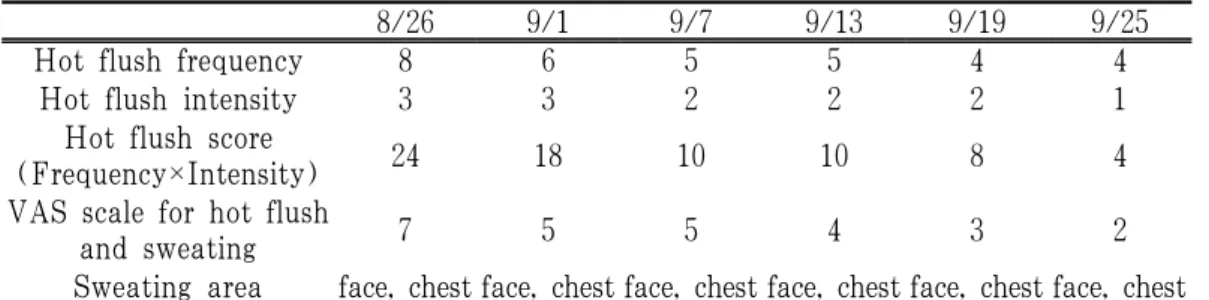
Results: In case 1, after treatment hot flush score was reduced from 24 to 4 points. VAS scale was reduced from 7 to 2. It took about two weeks for the symptoms to decrease by half. Associated symptoms almost did not stay at discharge.
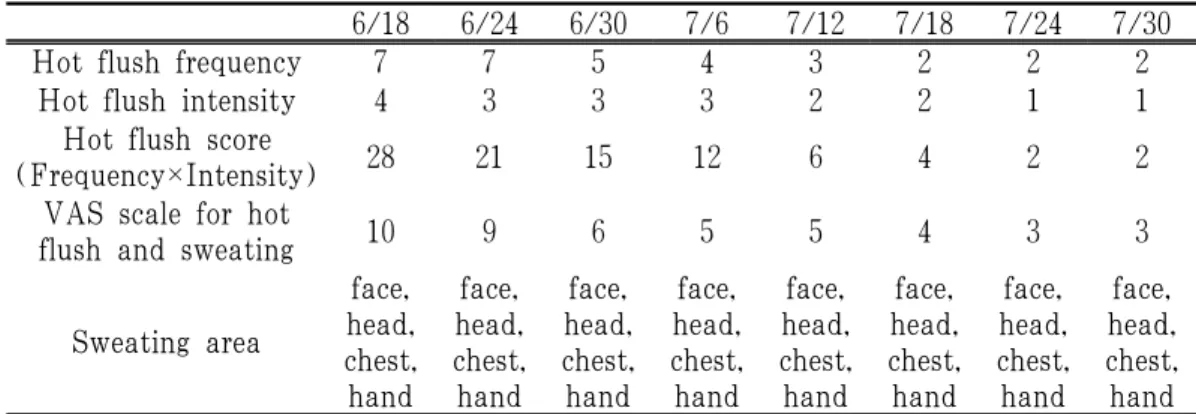
In case 2, after treatment hot flush score was reduced from 28 to 2 points.
VAS scale was reduced from 10 to 3. And emotional symptoms were reduced about 70%.
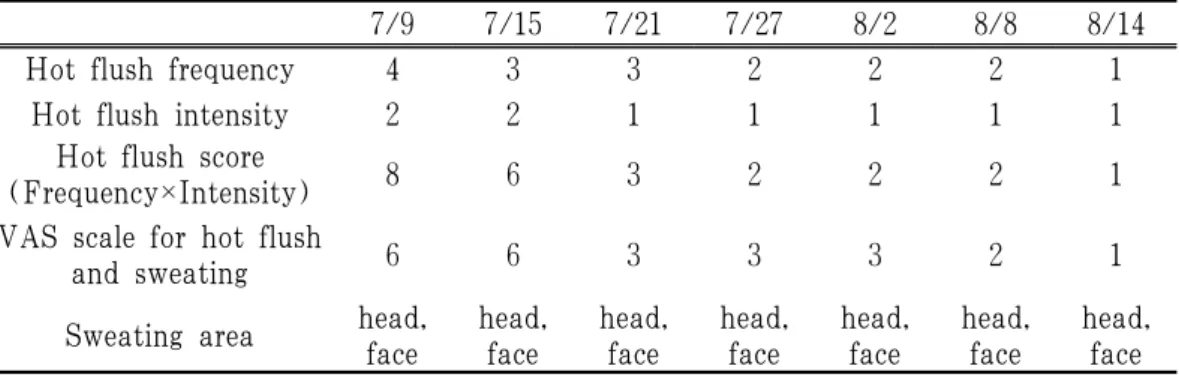
In case 3, after treatment hot flush score was reduced from 8 to 1 points. VAS scale was reduced from 6 to 1. And headache and chest discomfort symptoms have disappeared.
Conclusions: Ascending kidney water and descending heart fire pharmacopuncture treatment is effective for improve ascending kidney water and descending heart fire energy. Therefore, it will be used to alleviate hot flush and sweating.
Key Words: Ascending kidney water and descending heart fire pharmacopuncture treatment, Menopause symptoms, Hot flush, Sweating, VAS
16)
Corresponding author(Jeong-Du Roh) : Dept. of Acupuncture & Moxibustion Medicine, Je-cheon Hospital of Traditional Korean Medicine, Se-Myung University Semyung-ro 65, Sinwoul-dong, Je-cheon city,
Chung-buk, 390-711, Republic of Korea
Tel : +82-43-649-1816 Fax : +82-43-645-1382 E-mail : [email protected]
Ⅰ. Introduction
The heat cycle based on the function of Heart and the fluid metabolism cycle based on the function of Kidney are the two most important factors in the biological activity in Korean medicine. The former called ‘Simhwa (心火)' the latter called
‘Sinsu (腎水)' in Korean medicine. In a healthy state, two factors act in harmony.
They help each other to maintain a healthy body. When the destruction occurs in this harmony, the action of Simhwa or Sinsu is biased and this imbalance causes the disease. When Simhwa is stronger, heart palpitations, troubled dreamy sleep, insomnia occur. When Sinsu is weak, symptoms such as frequent urination, knee pain, back pain, genital diseases and decreased libido 1) appear.
Ancient Korean doctors were aware of the flow of energy inside human body in the same perspective as a natural phenomenon. The part of ancient medical textbook 「Somun Yinyangeungsangdaeron (素問陰陽應相大論)」 includes following information: The energy of the earth are clouds that give the rain (fluid) to the earth. The earth energy and the sky energy will affect each other. And it rises coming down, downs coming up.
Earth energy wants to rise, the sky energy wants to go down. The ancient doctors thought that it was the energy flow direction 2) .
Korean medicine was developed based
on a system of yin and yang (陰陽).
The addition of Yin-Yang and the five elements are the basis of the Korean medicine. The five elements include fire, wood, water, metal and earth. The five elements correspond to each internal organ. Heart corresponds to fire, and kidneys correspond to water. The function of Heart is called Simhwa (心火). The function of Kidneys is called Sinsu. The energy of body moves up and down.
Simhwa (心火) and Sinsu (腎水) are the axis of up-and-down motion of energy.
Their interaction is a very important mechanism in health. If a problem occurs in up-and-down motion of the energy, the human body is in a state of disease 3) . Menopause symptom is a good example.
For helping the harmony of Simhwa and Sinsu, we used Ascending Kidney water and Descending Heart fire (AKDH) pharmacopuncture treatment.
Menopausal symptoms is shown before and after the menopause. The symptoms may appear when menopause is in progress.
Women's ovaries produce periodical estrogen and progesterone during childbearing years.
When function of the ovaries decreases, the menopausal symptoms appear. The most obvious symptom is the hot flush in the face. Symptoms including sweat, heart palpitations, headache appear 4) .
Hot flush is a subjective symptom that
patients complain about. It is associated
with the function of the Heart in Korean
medicine 5,6) . Often occurs in menopausal
women 7) .
The decrease in estrogen provokes the increase of progesterone and follicle stimulating hormone. This is the cause of hot flush. In western medicine menopausal patients go on treatment with Hormone Replacement Therapy (HRT) 8) . But there is a controversy about the side effects of the hormone therapy. According to previous research, the single use of estrogen or the combination with progesterone increases the possibility of coronary disease.
The side effects were noticeable in long-term studies 4) . In Bae’s study 9) , The majority of patients discontinued hormone therapy.
because of the fear about cancer. The side effects should be the points to be considered as important as the effect of the treatment. So the importance of treatment without side effects have been highlighted.
In western medicine, researchers developed drug complex that reduces the side effects.
This is based on Korean herbal medicine 10) . Korean medicine uses treatment methods including moxibustion, acupuncture, pharmacopuncture, herbal medicine and cupping to relieve menopausal symptoms.
There are various studies about the Korean medicine treatment on menopausal syndrome.
The effect of treatment was demonstrated by the studies. Shihogayonggolmoryo-tang 11) , Danchisoyo-san 12) , Insamyangyeongt-ang 13) and Gamiguibi-tang 14) have been used in the case report. Another report shows that a short period of hospitalization improved menopausal symptoms 15) . Other report use to pharmacopuncture treatment.
This is a report about Hwangryunheadok-tang Herbal-Acupuncture on hot flushes 16) , not about AKDH pharmacopuncture treatment.
This report showed the effect objectively using evaluated tools such as a hot flush score and Visual Analogue Scale (VAS).
This point is the significance of the report.
Ⅱ. Subjects and Methods
1. Subjects
Study was done in patients admitted to the hospital of traditional Korean medicine, Semyung university. The subjects were three people and all are women.
They are in the late 40s and undergoing menopause. The main complaints are hot flush and sweat.
2. Methods
1) pharmacopuncture treatment
AKDH pharmacopuncture is achieved by injecting pharmacopuncture on a specific acupoint to change from the state of Water-Fire disharmony to harmonious state.
Hwangryunheadoktang pharmacopuncture
is injected on both side Gyeonjeong
(GB 21 ), Pungji (GB 20 ). Total 0.4 cc was
injected by 0.1 cc each point. Coptidis
Rhizoma, Scutellariae Radix, Phellodendri
Cortex and Gardeniae Fructus are the
raw material of the Hwangryunheadoktang
pharmacopuncture. Bear’s gall bladder, ox
bezoar and musk (BUM) pharmacopuncture
is injected on Jeonjung (CV 17 ), Jungwan
(CV 12 ), Gihae (CV 6 ). Total 0.15 cc was
injected by 0.05 cc each point. Each pharmacopuncture were prepared in accordance with the prescribed method.
Treatment was done daily. This treatment was based on the Pharmacopuncturology 17) .
2) Assessment Methods of Effect The evaluation is performed using the objective method. The research items are Hot Flush Score (HFS), VAS and sweating area.
(1) Hot Flush Score (HFS)
Score comes multiplying the frequency and intensity of hot flush. Intensity is divided into four steps. One point is the lower intensity, four is stronger. Jeffet al.
recommend in his study that researchers use the HFS for more objective data 18) .
(2) Visual Analogue Scale (VAS) Discomfort due to hot flush and sweat was evaluated by the participants using VAS scale.
(3) Sweating area
Occurrence area of the symptoms were recorded.
Ⅲ. Case
<Case 1>
1. Name : Hwang○○
2. Sex/Age : F/48
3. Chief complain and current medical history
She complained of pain in the plantar.
Plantar and back pain made it her difficult to walk. During hospitalization, she complained of hot flush and sweat symptoms. In addition, also showed symptoms of palpitations. Menopause was 47 years old, a year ago. Then symptoms appear repeatedly. She taken the hormone drug for six months after menopause.
She visited the another local Korean medical clinic for relief of symptoms.
But symptoms repeated the deterioration and improvement. The symptoms occur suddenly, spontaneous regression and lasts 5-6 minutes. Sweat comes mainly from the face and chest. Sometimes she feel burning sensation at hands and feet.
4. Past medical history
She was diagnosed with arthritis in both knees in 2014 and reflux esophagitis in 2013. She has been taking the pill about reflux esophagitis when needed.
She is not taking the drugs regularly.
5. Hospitalization period : 2014. 8. 25
~2014. 9. 29
6. Family’s medical history : none 7. Treatment other than pharmacopuncture
She has been taking the acupuncture
both side Seunggeun (BL 56 ), Seungsan
(BL 57 ), Wijung (BL 40 ), and physical
therapy. Hwalrak-tang and Dokhwalsokdan
-tang has been supplied for plantar and
back pain relief.
8/26 9/1 9/7 9/13 9/19 9/25
Hot flush frequency 8 6 5 5 4 4
Hot flush intensity 3 3 2 2 2 1
Hot flush score
(Frequency×Intensity) 24 18 10 10 8 4
VAS scale for hot flush
and sweating 7 5 5 4 3 2
Sweating area face, chest face, chest face, chest face, chest face, chest face, chest Table 1. The Change of Symptoms about Case 1
Fig. 1. The change of hot flush score about case 1.
Fig. 2. The change of VAS scale about case 1.
<Case 2>
1. Name : Jin○○
2. Sex/Age : F/48
3. Chief complain and current medical history
She complained of severe back pain.
Back pain made it her difficult to sleep or rest. During hospitalization, she complained
of hot flush and sweat symptoms. In addition, also showed symptoms of palpitations, powerlessness, sudden anger and depression. From a year ago the menstrual cycle is irregular. Menstrual period is 4-8 weeks, emissions blood volume is also decreased. The symptoms occur suddenly and lasting more than 30 minutes. She did not eat the hormone drug. Sweat comes mainly from the face, head, chest and hand.
4. Past medical history
She was diagnosed with stenosis in lumbar 3-5 in 2013 and cyst of the uterus in 2010. She receives regular checkups every six months. She is not taking the drugs regularly.
5. Hospitalization period : 2014. 6. 17~
2014. 7. 31
6. Family’s medical history : none 7. Treatment other than pharmacopuncture
She has been taking the acupuncture both side Seunggeun (BL 56 ), Seungsan (BL 57 ), Wijung (BL 40 ), and physical therapy.
Hwalrak-tang and Dokhwalsokdan-tang
has been supplied for plantar and back
pain relief.
6/18 6/24 6/30 7/6 7/12 7/18 7/24 7/30
Hot flush frequency 7 7 5 4 3 2 2 2
Hot flush intensity 4 3 3 3 2 2 1 1
Hot flush score
(Frequency×Intensity) 28 21 15 12 6 4 2 2
VAS scale for hot
flush and sweating 10 9 6 5 5 4 3 3
Sweating area
face, head, chest,
hand
face, head, chest,
hand
face, head, chest,
hand
face, head, chest,
hand
face, head, chest,
hand
face, head, chest,
hand
face, head, chest,
hand
face, head, chest,
hand Table 2. The Change of Symptoms about Case 2
Fig. 3. The change of hot flush score about case 2.
Fig. 4. The change of VAS scale about case 2.
<Case 3>
1. Name : Shin○○
2. Sex/Age : F/46
3. Chief complain and current medical history
She complained of back and neck pain. Back and neck pain made it her
difficult to walk. During hospitalization, she complained of hot flush and sweat symptoms. In addition, She also showed headache, chest discomfort and insomnia.
Her last menstrual period (LMP) was the six months ago. Menstruation did not occur in hospitalization period. She had not eaten the hormone drug. Sweat came mainly from the head and face.
4. Past medical history
She was diagnosed with uterine fibroids in 2008 and cyst of the uterus in 2013.
She receives regular checkups every year.
She is taking the drugs for osteoporosis regularly.
5. Hospitalization period : 2014. 7. 8~
2014. 8. 14
6. Family’s medical history : none 7. Treatment other than pharmacopuncture
She has been taking the acupuncture
both side Seunggeun (BL 56 ), Seungsan
(BL 57 ), Wijung (BL 40 ), and physical
therapy. Hwalrak-tang and Dokhwalsokdan
-tang has been supplied for plantar and
back pain relief.
7/9 7/15 7/21 7/27 8/2 8/8 8/14
Hot flush frequency 4 3 3 2 2 2 1
Hot flush intensity 2 2 1 1 1 1 1
Hot flush score
(Frequency×Intensity) 8 6 3 2 2 2 1
VAS scale for hot flush
and sweating 6 6 3 3 3 2 1
Sweating area head, face
head, face
head, face
head, face
head, face
head, face
head, face Table 3. The Change of Symptoms about Case 3
Fig. 5. The change of hot flush score about case 3.
Fig. 6. The change of VAS scale about case 3.
Ⅳ. Discussion
Menopause brings hormonal changes.
Decreased sex hormone leads to a physical and mental changes. The most obvious symptom is hot flashes and sweating. The cause of these symptoms
is decreased estrogen. Palpitations, anxiety, headaches, and depression, etc. may be accompanied. The symptoms appeared in half of postmenopausal women and 25% of them have severe enough to interfere with life. They need a proper treatment 4) .
This case report is an attempt to improve by AKDH pharmacopuncture treatment for low back pain patients who complain of menopausal symptoms.
The significance of this study is that the menopausal symptoms are reduced through the AKDH pharmacopuncture treatment.
Rating Scale was used by three. Items are Hot Flush Score (HFS), VAS and sweating area. Kuppermans’s Index use as evaluation standard in most studies.
Menopause specific quality of life
questionnaire (MENQOL) and Menopause
Rating Scale (MRS) are also used in the
complementary form 12) . But core symptoms
of this cases are hot flush and sweat,
we chose the tools to focus on it. In
Park’s study 15) utilized for this evaluation
tool for measure the symptoms change.
Score comes multiplying the frequency and intensity of hot flush. So, the change of symptoms are accurately measurement.
VAS is a tool that indicates the condition visually. It has the advantage that can represent the subjective feel to the objective indicators.
The cause of menopausal symptoms in Korean medicine is very versatile.
The cause is the lack of the necessary energy or incongruity of energy flow.
Differ symptoms appear depending on the differ cause and treatment also selected by differ cause.
In case 1, She went through the menopause a year. Past treatment were not effectiveness. After AKDH pharmacopuncture treatment, symptoms were steadily reduced.
It took about two weeks for the symptoms to decrease by half. Associated symptoms almost did not stay at discharge.
In case 2, She is menopause transition patients has an irregular menstrual cycle.
The most severe symptoms of the cases.
The patient complained of psychological symptoms such as depression, anger or helplessness. After AKDH pharmacopuncture treatment, emotional symptoms were reduced about 70%.
In case 3, symptoms of patients was mild. After AKDH pharmacopuncture treatment headache and chest discomport symptoms disappeared.
Cases of patients were complaining of hot flashes and shedding sweat. The symptoms resulting from the incongruity
of the heart and the kidney energy from a Korean medical point of view.
AKDH pharmacopuncture treatment is improve this incongruity. Therefore, it will be used to alleviate menopausal symptoms.
But this study is only just confirmed three cases. The study confirmed the feasibility of AKDH pharmacopuncture treatment. The more systematic research is needed. Follow-up is also needed. If this study use the Kupperman's Index, MENQOL, or MRS would determine the broader results. Nevertheless, this study is significant in that it confirm the effect of the AKDH pharmacopuncture treatment by objective indicators.
V. Conclusions
1. Frequency and intensity of hot flush was decreased significantly all cases after AKDH pharmacopuncture treatment.
2. Various symptoms due to menopause was also decreased after AKDH pharmacopuncture treatment.
3. VAS scale was decreased significantly all cases after AKDH pharmacopuncture treatment.
4. AKDH pharmacopuncture treatment was effective for improve energy incongruity, Therefore, it will be used to alleviate menopausal symptoms.
5. There was no change in the sweating
area.
□ Received : April 24, 2015
□ Revised : April 27, 2015
□ Accepted : May 08, 2015
국문초록