2021 The Korean Society of Veterinary Science.
This is an open-access article distributed under the terms of the Creative Commons Attribution Non-Commercial license (http://creativecommons.
org/licenses/by-nc/4.0/), which permits unrestrict- ed non-commercial use, distribution, and repro- duction in any medium, provided the original work is properly cited.
Introduction
Food poisoning incidents caused by various foods have been a common occur- rence since the past [1-4]. In particular, livestock products are most likely to be contaminated with bacteria during production, slaughter, processing, distribution, and sales due to various factors such as the presence of moisture and nutrients conducive for bacterial growth [5,6]. In Korea, the hazard analysis and critical control points (HACCP) system is implemented for all livestock industries such as feed factories, animal farms, slaughterhouses, processing plants, meat packaging plants, milk collection centers, distribution centers, and meat and milk retail stores for ensuring the hygiene and safety of livestock products [7-9]. After the imple- mentation of the HACCP system for the domestic livestock industry, the hygiene and safety of livestock products has greatly improved [10,11]. However, there is still room for improvement, and consumers have demanded that the system be further strengthened and optimized to enhance food safety.
Until now, studies on HACCP in the livestock sector were mainly limited to the effectiveness of HACCP implementation [12,13]. There are very few studies on HACCP evaluation items and inspection methods in the livestock products sector [14,15]. In order to increase the effectiveness of the HACCP system, it is consid- ered necessary to examine the evaluation items and conduct a detailed study on the methods of inspection. The meat shop represents a stage in which slaughtered and processed livestock products are finally sold to consumers, and has a very im-
system in the hazard analysis and critical control points prerequisite program for meat shops in Korea
Seung-Hee Baek1, Insik Nam1,2,*
1 Research Centre for Environment Friendly and Quality Livestock Production Technology, Hankyong National University, Anseong 17579, Korea
2 School of Animal Life Convergence Science, Hankyong National University, Anseong 17579, Korea
pISSN 2466-1384 · eISSN 2466-1392 Korean J Vet Res 2021;61(3):e20 https://doi.org/10.14405/kjvr.2021.61.e20
*Corresponding author:
Insik Nam
School of Animal Life Convergence Science, Hankyong National University, 327 Jungang- ro, Anseong 17579, Korea
Tel: +82-31-670-5126 Fax: +82-31-670-5129 E-mail: [email protected] ORCID:
https://orcid.org/0000-0002-3785-315X Conflict of interest:
The authors declare no conflict of interest.
Received: May 20, 2021 Revised: June 25, 2021 Accepted: June 30, 2021
Original Article
This study is to develop a new scoring system for rating Hazard analysis and critical control points prerequisite evaluation items for meat shops to provide a more objec- tive and accurate evaluation of food safety compliance. The importance of each item was measured by looking at the hazard severity level and the rate of non-compliance associated with it. It was found that the new scoring system is more stringent and gives a clearer picture of compliance with the most critical safety standards, and therefore is expected to have a positive effect on the hygiene and safety of livestock products.
Keywords: hazard analysis and critical control points; Butcher’s shop; livestock; food safety; assessment
portant part in hygiene and safety management. The HACCP evaluation items for meat shops consist of the prerequisite pro- gram and HACCP management [16]. Among them, the evalua- tion items in the HACCP management field were composed based on Codex [17], and the prerequisite program was estab- lished based on the Livestock Products Sanitation Management Act [18]. The evaluation items of the HACCP prerequisite pro- gram for meat shops include total 51 items (facilities manage- ment, 23; sanitation management, 7; storage and transportation management, 12; inspection management, 8; recall manage- ment, 1) [16]. All these 51 items are scored using a 3-point scale, with the highest score being 2 points, medium score being 1 point, and lowest score being 0 point. This current evaluation and scoring system is not sufficiently effective in terms of en- suring food safety as all evaluation items are assumed to have the same level of importance despite their varying impact on food safety. For example, compliance with standards for “re- stroom, changing room management” and “raw meat and fin- ished product inspection” will both earn 2 points, even though the latter has a much greater effect on consumer health safety.
As a result, the final total score does not clearly reflect whether a store has fulfilled the most critical food safety requirements.
This shortcoming of the current evaluation system may com- promise the hygiene and safety management of livestock prod- ucts. For this reason, the HACCP evaluation items in the gener- al food sector in Korea and Good Agricultural Practices (GAP) evaluation items in the United States use scoring methods in which different scores are given according to the level of impor- tance of each evaluation item [16,19].
The purpose of this study was to assess the importance of each prerequisite evaluation item and give a differential score for each item in order to increase the accuracy and effectiveness of the HACCP evaluation system for meat shops in assessing compliance with food safety standards.
Materials and Methods
Method for improving the scoring of evaluation items The importance (i.e., the safety relevance) of each evalua- tion item was analyzed based on the analysis of: (1) the sever- ity of hazards caused by each item, and (2) the non-compli- ance ratio associated with each item over the past 3 years. The analyzed results were applied to the evaluation items of the prerequisite program, and the practical effectiveness was veri- fied through comparative analysis with the current evaluation score system.
Analysis of non-compliance ratio
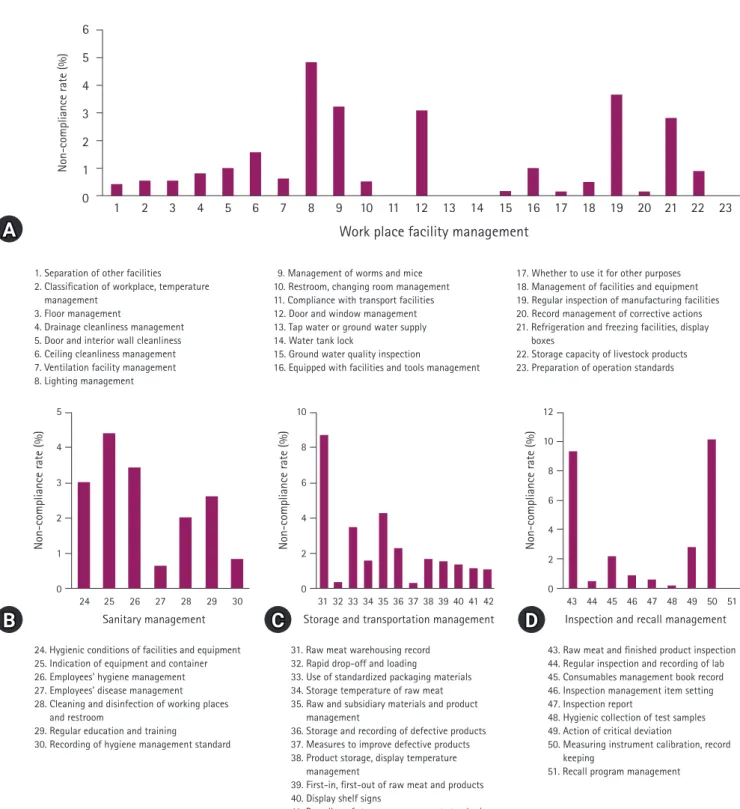
The rate of non-compliance with the prerequisite evaluation items in a total 1,400 meat shops over the past 3 years was an- alyzed (Fig. 1). The results were used for portfolio map analy- sis.
Analysis of severity level of hazards
The HACCP prerequisite evaluation items for meat shops were classified into 3 categories (high, middle, and low) based on their hazard severity levels. The hazard severity level was de- termined based on the effects of the evaluation item on human health safety and the quickness with which the damage can be corrected. Evaluation items with a high (3 points) level of haz- ard directly affect meat quality and health safety and corrective action for the safety incident takes a long time. Middle-scored (2 point) items are indirectly related to meat quality and health safety and corrective action takes a long time. Low (1 point) in- dicates items whose effects on meat quality and health safety are indirect and the effects can be corrected immediately.
Portfolio map analysis
The importance level of each evaluation item was determined by analyzing the portfolio map. The portfolio map has the ad- vantage of facilitating analysis by visually representing each val- ue. In this study, the differentiated score for each evaluation item was presented through the portfolio analysis using the re- sults of analysis of the hazard severity level and the rate of non-compliance with the prerequisite evaluation items. The av- erage value of the rate of non-compliance and the hazard sever- ity level was set as a cut-off value, and the area corresponding to the higher value was judged as highly important, scoring 3 points. Next, 2 points were given to the areas where either the rate of non-compliance or the hazard severity level was lower than the average value. One point was given to the areas where both the rate of non-compliance and the hazard severity level were lower than the average value.
Field implementation and comparative analysis
The new scoring system developed through this study was compared with the scoring system currently being used. This comparison was done to verify whether the new scoring system is more accurate and effective in assessing safety compliance.
The new scoring system was analyzed for differences with the currently used evaluation score system through evaluation of HACCP prerequisites for meat shops.
1 6 5 4 3 2 1
0 2 3 4 5 6 7 8 9 10
Work place facility management
11 12 13 14 15 16 17 18 19 20 21 22 23
Non-compliance rate (%) Non-compliance rate (%) Non-compliance rate (%) Non-compliance rate (%)
Sanitary management Storage and transportation management Inspection and recall management
24 25 26 27 28 29 30 313233 34 3536373839404142 43 44 45 46 47 48 49 50 51
5 4 3 2 1 0
10 8 6 4 2 0
12 10 8 6 4 2 0
A
B C D
Fig. 1. Analysis of non-compliance rates for each hazard analysis and critical control points prerequisite evaluation item for meat shops over the last 3 years. (A) Work place of facility management. (B) Sanitary management. (C) Storage and transportation management. (D) Inspection and recall management.
1. Separation of other facilities
2. Classification of workplace, temperature management
3. Floor management
4. Drainage cleanliness management 5. Door and interior wall cleanliness 6. Ceiling cleanliness management 7. Ventilation facility management 8. Lighting management
24. Hygienic conditions of facilities and equipment 25. Indication of equipment and container 26. Employees’ hygiene management 27. Employees’ disease management 28. Cleaning and disinfection of working places
and restroom
29. Regular education and training
30. Recording of hygiene management standard
31. Raw meat warehousing record 32. Rapid drop-off and loading
33. Use of standardized packaging materials 34. Storage temperature of raw meat 35. Raw and subsidiary materials and product
management
36. Storage and recording of defective products 37. Measures to improve defective products 38. Product storage, display temperature
management
39. First-in, first-out of raw meat and products 40. Display shelf signs
41. Recoding of storage management standard 42. Hygiene management of vehicles, tools, etc.
43. Raw meat and finished product inspection 44. Regular inspection and recording of lab 45. Consumables management book record 46. Inspection management item setting 47. Inspection report
48. Hygienic collection of test samples 49. Action of critical deviation
50. Measuring instrument calibration, record keeping
51. Recall program management 9. Management of worms and mice
10. Restroom, changing room management 11. Compliance with transport facilities 12. Door and window management 13. Tap water or ground water supply 14. Water tank lock
15. Ground water quality inspection
16. Equipped with facilities and tools management
17. Whether to use it for other purposes 18. Management of facilities and equipment 19. Regular inspection of manufacturing facilities 20. Record management of corrective actions 21. Refrigeration and freezing facilities, display
boxes
22. Storage capacity of livestock products 23. Preparation of operation standards
Results
Analysis of the non-compliance ration in meat shop Fig. 1 shows the analysis result of the non-compliance rate for the HACCP prerequisite program for a total of 1,400 meat shops. In the workplace facility management, a total 6 items (no.
2, classification of workplace, temperature management; no. 8, lighting management; no. 9, management of worms and mice;
no. 12, door and window management; no. 19, regular inspec- tion of manufacturing facilities; no. 21, refrigeration and freez- ing facilities, display boxes) with a non-compliance rate of 2.0%
or more were identified. On the other hand, there were 3 evalu- ation items that had never met with non-compliance. For most other evaluation items, the non-compliance rate was around 1.0%. Most of the evaluation items related to sanitary manage- ment showed a high non-compliance rate. Of the total 7 evalua- tion items, 5 items showed a non-compliance rate of over 2.0%, and 2 items showed a rate of less than 1.0%. In the domain of storage and transportation management, the highest non-com- pliance rate (over 8.0%) was found in raw meat warehousing re- cords. In addition, the non-compliance rate above 2.0% was seen in no. 33 (use of standardized packaging materials), no. 35 (raw and subsidiary materials and product management), and no. 36 (storage and recording of defective products). In the field of inspection and recall management, no. 43 (raw meat and fin- ished product inspection), no. 45 (consumables management book record), no. 49 (action of critical deviation), and no. 50 (measuring instrument calibration, record keeping) showed high non-compliance.
Analysis of hazard severity level of each HACCP prerequisite evaluation item
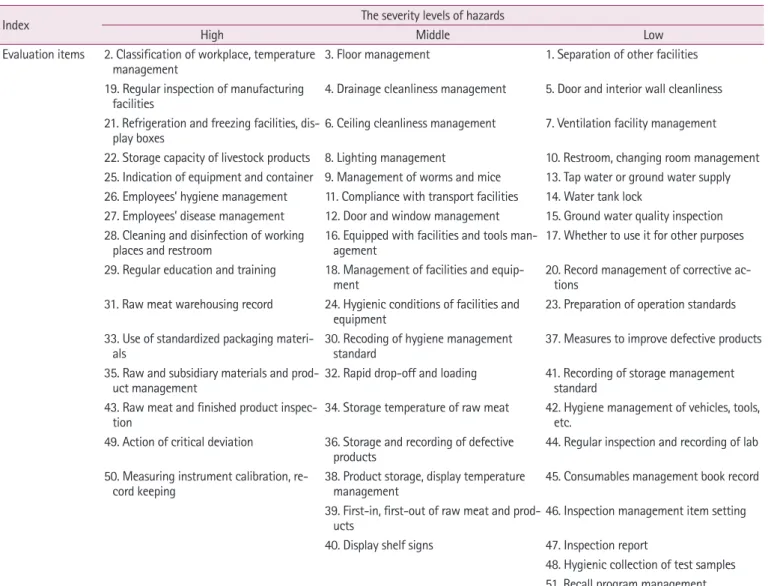
Table 1 shows the analysis results by dividing the hazard se- verity levels into 3 categories (high, middle, low) for each evalu- ation item of the HACCP prerequisites for meat shops. The hazard severity level for each evaluation item was established through consultation with Korea Agency of HACCP Accredita- tion and Services (KAHAS). There were a total 15 items (no. 2, 19, 21, 22, 25, 26, 27, 28, 29, 31, 33, 35, 43, 49, 50) in the evalua- tion items for which the hazard severity level was high. A total 17 evaluation items (no. 3, 4, 6, 8, 9, 11, 12, 16, 18, 24, 30, 32, 34, 36, 38, 39, 40) had middle hazard severity levels. The remaining 19 evaluation items (no. 1, 5, 7, 10, 13, 14, 15, 17, 20, 23, 37, 41, 42, 44, 45, 46, 47, 48, 51) showed low hazard severity levels.
Analysis of the importance level of each evaluation item In this study, the importance level was classified using the
portfolio map method through the analysis of the rate of non-compliance (statistical method) and hazard severity level (subjective method) of each evaluation item (Fig. 2). As per the portfolio map analysis, the evaluation items that belong to the B area with both high non-compliance rate and high hazard se- verity level were no. 2, 8, 9, 12, 19, 21, 24, 25, 26, 28, 29, 31, 33, 35, 36, 43, 49, and 50. The number of evaluation items in the D area, with high hazard severity level and low non-compliance rate was 1 (no. 45). The evaluation items corresponding to the A area, with high non-compliance rate and low hazard severity level were no. 3, 4, 6, 11, 16, 18, 22, 27, 30, 32, 34, 38, and 39.
And both low non-compliance ration and low hazard severity level (C area) was no. 1, 5, 7, 10, 13, 14, 15, 17, 41, 42, 44, and 46.
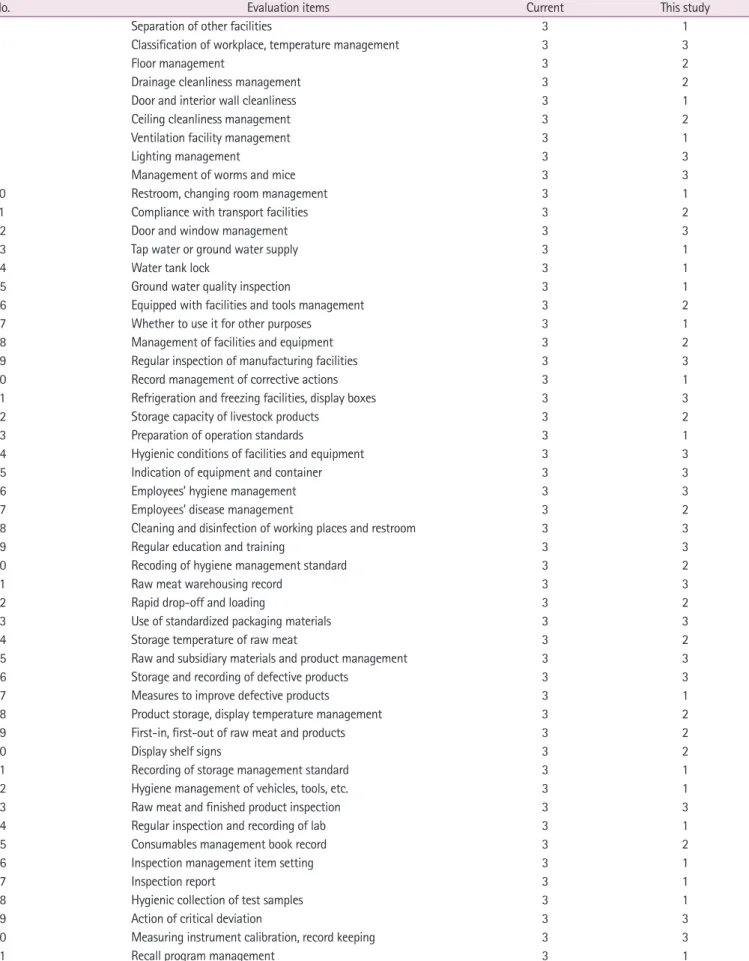
Comparative analysis with the current scoring system Based on the results of the portfolio map analysis, 2 points were given for the evaluation items in the areas A and D, 3 points for items in the B area, and 1 point for items in the C area. Table 2 compares the scoring system for each evaluation item used currently in meat shops and the scoring system de- veloped through this study. In the current scoring system for meat shops 3 points are given regardless of the importance level of each evaluation item. However, in the system developed through this study, evaluation items are given 3 points, 2 points, or 1 point according to their importance level. The score system composition according to the level of importance consisted of 15 evaluation items (29.4%) corresponding to 3 points, 17 eval- uation items (33.3%) for 2 points, and 19 evaluation items (37.3%) with 1 point.
Evaluation of the meat shops using the newly developed score system
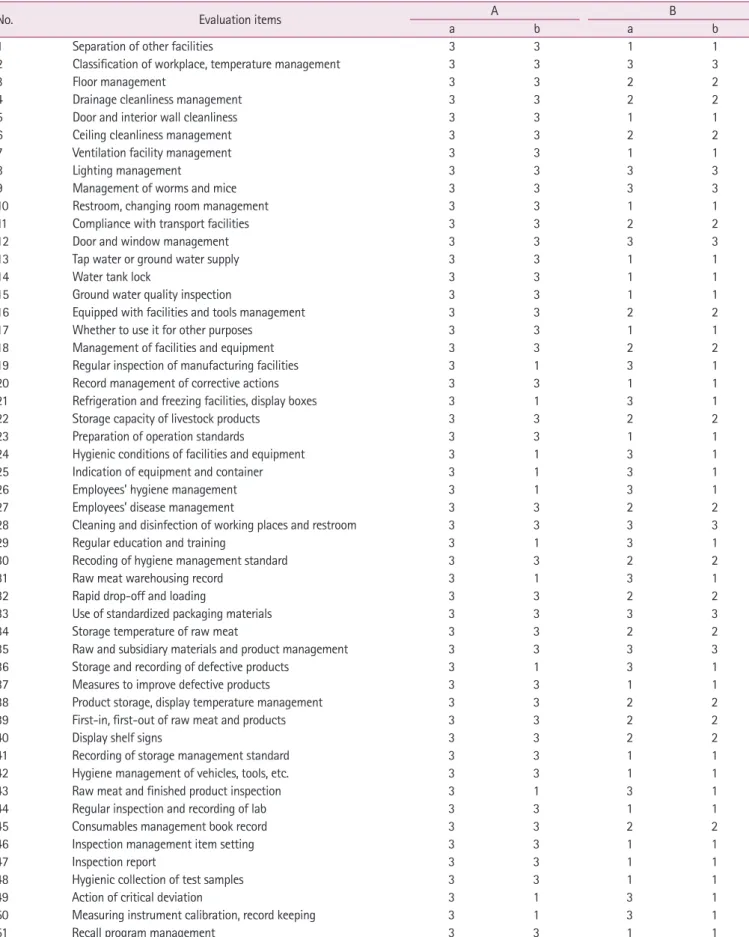
In order to compare the current scoring system with the new scoring system developed in this study, the evaluation was con- ducted by selecting meat shop X with excellent facilities and poor prerequisite operation, and a meat shop Y with poor facili- ties and excellent prerequisite operation (Table 3). The evalua- tion found that a total of 11 non-compliances occurred, includ- ing evaluation item no. 19 (regular inspection of manufacturing facilities), no. 21 (refrigeration and freezing facilities, display box), no. 24 (hygienic conditions of facilities and equipment), no. 25 (indication of equipment and container), no. 26 (employ- ees’ hygiene management), no. 29 (regular education and train- ing), no. 31 (raw meat warehousing record), no. 36 (storage and recording of defective products), no. 43 (raw meat and finished product inspection), no. 49 (action of critical deviation), and
Table 1. Analysis of hazard severity levels of each hazard analysis and critical control points evaluation item in meat shops
Index The severity levels of hazards
High Middle Low
Evaluation items 2. Classification of workplace, temperature
management 3. Floor management 1. Separation of other facilities
19. Regular inspection of manufacturing
facilities 4. Drainage cleanliness management 5. Door and interior wall cleanliness 21. Refrigeration and freezing facilities, dis-
play boxes 6. Ceiling cleanliness management 7. Ventilation facility management 22. Storage capacity of livestock products 8. Lighting management 10. Restroom, changing room management 25. Indication of equipment and container 9. Management of worms and mice 13. Tap water or ground water supply 26. Employees’ hygiene management 11. Compliance with transport facilities 14. Water tank lock
27. Employees’ disease management 12. Door and window management 15. Ground water quality inspection 28. Cleaning and disinfection of working
places and restroom 16. Equipped with facilities and tools man-
agement 17. Whether to use it for other purposes
29. Regular education and training 18. Management of facilities and equip-
ment 20. Record management of corrective ac-
tions 31. Raw meat warehousing record 24. Hygienic conditions of facilities and
equipment 23. Preparation of operation standards
33. Use of standardized packaging materi-
als 30. Recoding of hygiene management
standard 37. Measures to improve defective products
35. Raw and subsidiary materials and prod-
uct management 32. Rapid drop-off and loading 41. Recording of storage management standard
43. Raw meat and finished product inspec-
tion 34. Storage temperature of raw meat 42. Hygiene management of vehicles, tools, etc.
49. Action of critical deviation 36. Storage and recording of defective
products 44. Regular inspection and recording of lab 50. Measuring instrument calibration, re-
cord keeping 38. Product storage, display temperature
management 45. Consumables management book record
39. First-in, first-out of raw meat and prod-
ucts 46. Inspection management item setting
40. Display shelf signs 47. Inspection report
48. Hygienic collection of test samples 51. Recall program management High, point 3; middle, point 2; low, point 1.
Non-compliance rate (%)
0 2.0 4.0 6.0 8.0 10.0 12.0
Severity levels of hazards (score)
3.0
2.5
2.0
1.5
1.0 Fig. 2. Classification and scoring of importance levels
using the method of portfolio analysis.
Table 2. Comparison of the current scoring system and the new scoring system developed in this study
No. Evaluation items Current This study
1 Separation of other facilities 3 1
2 Classification of workplace, temperature management 3 3
3 Floor management 3 2
4 Drainage cleanliness management 3 2
5 Door and interior wall cleanliness 3 1
6 Ceiling cleanliness management 3 2
7 Ventilation facility management 3 1
8 Lighting management 3 3
9 Management of worms and mice 3 3
10 Restroom, changing room management 3 1
11 Compliance with transport facilities 3 2
12 Door and window management 3 3
13 Tap water or ground water supply 3 1
14 Water tank lock 3 1
15 Ground water quality inspection 3 1
16 Equipped with facilities and tools management 3 2
17 Whether to use it for other purposes 3 1
18 Management of facilities and equipment 3 2
19 Regular inspection of manufacturing facilities 3 3
20 Record management of corrective actions 3 1
21 Refrigeration and freezing facilities, display boxes 3 3
22 Storage capacity of livestock products 3 2
23 Preparation of operation standards 3 1
24 Hygienic conditions of facilities and equipment 3 3
25 Indication of equipment and container 3 3
26 Employees’ hygiene management 3 3
27 Employees’ disease management 3 2
28 Cleaning and disinfection of working places and restroom 3 3
29 Regular education and training 3 3
30 Recoding of hygiene management standard 3 2
31 Raw meat warehousing record 3 3
32 Rapid drop-off and loading 3 2
33 Use of standardized packaging materials 3 3
34 Storage temperature of raw meat 3 2
35 Raw and subsidiary materials and product management 3 3
36 Storage and recording of defective products 3 3
37 Measures to improve defective products 3 1
38 Product storage, display temperature management 3 2
39 First-in, first-out of raw meat and products 3 2
40 Display shelf signs 3 2
41 Recording of storage management standard 3 1
42 Hygiene management of vehicles, tools, etc. 3 1
43 Raw meat and finished product inspection 3 3
44 Regular inspection and recording of lab 3 1
45 Consumables management book record 3 2
46 Inspection management item setting 3 1
47 Inspection report 3 1
48 Hygienic collection of test samples 3 1
49 Action of critical deviation 3 3
50 Measuring instrument calibration, record keeping 3 3
51 Recall program management 3 1
Table 3. Differences in the evaluation of the meat shop Y based on the current scoring system and the new scoring system developed in this study
No. Evaluation items A B
a b a b
1 Separation of other facilities 3 3 1 1
2 Classification of workplace, temperature management 3 3 3 3
3 Floor management 3 3 2 2
4 Drainage cleanliness management 3 3 2 2
5 Door and interior wall cleanliness 3 3 1 1
6 Ceiling cleanliness management 3 3 2 2
7 Ventilation facility management 3 3 1 1
8 Lighting management 3 3 3 3
9 Management of worms and mice 3 3 3 3
10 Restroom, changing room management 3 3 1 1
11 Compliance with transport facilities 3 3 2 2
12 Door and window management 3 3 3 3
13 Tap water or ground water supply 3 3 1 1
14 Water tank lock 3 3 1 1
15 Ground water quality inspection 3 3 1 1
16 Equipped with facilities and tools management 3 3 2 2
17 Whether to use it for other purposes 3 3 1 1
18 Management of facilities and equipment 3 3 2 2
19 Regular inspection of manufacturing facilities 3 1 3 1
20 Record management of corrective actions 3 3 1 1
21 Refrigeration and freezing facilities, display boxes 3 1 3 1
22 Storage capacity of livestock products 3 3 2 2
23 Preparation of operation standards 3 3 1 1
24 Hygienic conditions of facilities and equipment 3 1 3 1
25 Indication of equipment and container 3 1 3 1
26 Employees’ hygiene management 3 1 3 1
27 Employees’ disease management 3 3 2 2
28 Cleaning and disinfection of working places and restroom 3 3 3 3
29 Regular education and training 3 1 3 1
30 Recoding of hygiene management standard 3 3 2 2
31 Raw meat warehousing record 3 1 3 1
32 Rapid drop-off and loading 3 3 2 2
33 Use of standardized packaging materials 3 3 3 3
34 Storage temperature of raw meat 3 3 2 2
35 Raw and subsidiary materials and product management 3 3 3 3
36 Storage and recording of defective products 3 1 3 1
37 Measures to improve defective products 3 3 1 1
38 Product storage, display temperature management 3 3 2 2
39 First-in, first-out of raw meat and products 3 3 2 2
40 Display shelf signs 3 3 2 2
41 Recording of storage management standard 3 3 1 1
42 Hygiene management of vehicles, tools, etc. 3 3 1 1
43 Raw meat and finished product inspection 3 1 3 1
44 Regular inspection and recording of lab 3 3 1 1
45 Consumables management book record 3 3 2 2
46 Inspection management item setting 3 3 1 1
47 Inspection report 3 3 1 1
48 Hygienic collection of test samples 3 3 1 1
49 Action of critical deviation 3 1 3 1
50 Measuring instrument calibration, record keeping 3 1 3 1
51 Recall program management 3 3 1 1
A, current scoring system; B, newly developed scoring system; a, maximum score; b, the number of scores obtained as a result of evaluation.
no. 50 (measuring instrument calibration, record keeping).
These evaluation items are classified as evaluation items that can directly hazard consumer’s safety if management is neglect- ed. Thus, when the same meat shop was evaluated using the current and new scoring systems, the current system gave the store a quality rating of “suitable” with 85.6% (131 points), but the new scoring system gave the rating of “non-compliance”
with 78.4% (80 points). This shows that the new scoring system is more accurate and stringent, which can improve food safety management.
Discussion
The most advanced food hygiene and safety management program is the HACCP system. For this reason, many devel- oped countries implement the HACCP system in all food sec- tors [20-23]. The effects of implementation of the HACCP sys- tem are appearing in various fields, such as improving the hy- giene and safety of food, systemic management, and increasing consumer satisfaction [10,24,25]. The HACCP system of meat shops is divided into the prerequisite program and HACCP management field. Among them, the HACCP management field was established based on Codex [17], and the prerequisite program was developed based on the Livestock Products Sani- tation Management Act [18]. Accordingly, the HACCP evalua- tion items for meat shops were developed in accordance with the legal standards (prerequisite evaluation items) and Codex (HACCP evaluation items). The meat shop is the final stage of the meat production chain where consumers come to purchase meat. Therefore, a lot of attention is needed on the hygiene and safety of meat. However, the effectiveness of HACCP imple- mentation is compromised because all evaluation items of the HACCP prerequisite program for meat shops are evaluated on a 3-point scale despite the differences in their safety relevance [16]. In fact, the HACCP evaluation items for most livestock products do not consider the level of importance of each item in terms of their effect on human safety. In order to resolve this problem, the US GAP [19] or the Korean food HACCP system [16] is operated by assigning different levels of importance ac- cording to the evaluation items. The scoring system that con- siders the level of importance of each evaluation item is consid- ered to be effective in enhancing the safety of food as it has a positive effect on the evaluation results. The purpose of this study was re-establishing the score according to the level of im- portance of the HACCP prerequisite evaluation items for meat shops. As a result of implementing the results of this study in a meat shop quality inspection, it was verified that effective hy-
giene and safety management is possible. In addition, if there are no detailed criteria for evaluation items, the evaluation re- sults are determined according to the subjective opinion and bias of the inspector, so additional studies on establishing de- tailed criteria for each evaluation item are required to increase objectivity.
ORCID
Seung-Hee Baek, https://orcid.org/0000-0003-0737-7268 Insik Nam, https://orcid.org/0000-0002-3785-315X
References
1. Kangethe EK, Sirma AJ, Murithi G, Mburugu-Mosoti CK, Ouko EO, Korhonen HJ, Nduhiu GJ, Mungatu JK, Joutsjoki V, Lindfors E, Ramo S. Occurrence of mycotoxins in food, feed, and milk in two counties from different agro-ecological zones and with historical outbreak of aflatoxins and fumonisins poi- sonings in Kenya. Food Qual Saf 2017;1:161–170.
2. Wakabayashi Y, Umeda K, Yonogi S, Nakamura H, Yamamo- to K, Kumeda Y, Kawatsu K. Staphylococcal food poisoning caused by Staphylococcus argenteus harboring staphylococcal enterotoxin genes. Int J Food Microbiol 2018;265:23–29.
3. Filipello V, Bonometti E, Campagnani M, Bertoletti I, Roma- no A, Zuccon F, Campanella C, Losio MN, Finazzi G. Investi- gation and follow-up of a staphylococcal food poisoning out- break linked to the consumption of traditional hand-crafted alm cheese. Pathogens 2020;9:1064.
4. Li X, Sapp AC, Singh N, Matthias L, Bailey C, DeMENT J, Havelaar AH. Detecting foodborne disease outbreaks in Flor- ida through consumer complaints. J Food Prot 2020;83:1877–
1888.
5. Tegegne HA, Phyo HWW. Food safety knowledge, attitude and practices of meat handler in abattoir and retail meat shops of Jigjiga Town, Ethiopia. J Prev Med Hyg 2017;58:E320–
E327.
6. Nielsen B, Colle MJ, Ünlü G. Meat safety and quality: a bio- logical approach. Int J Food Sci Technol 2021;56:39–51.
7. Nam IS. The implementation and effects of HACCP system on broiler farms in Korea. J Anim Plant Sci 2017;27:2063–
2068.
8. Kim S, Choi K, Myung D, Chung H, Kim S, Choe N. A study on the needs to improve Korea abattoir’s critical control point of HACCP system. Korean J Vet Res 2020;60:105–108.
9. Baek SH, Nam I. Evaluation of the effects of seasonal raw ma- terials and processing stages in feed mills implementing the
HACCP system on mycotoxin content in feed. Korean J Vet Res 2021;61:e7.
10. Kim JH, Hur SJ, Yim DG. Monitoring of microbial contami- nants of beef, pork, and chicken in HACCP implemented meat processing plants of Korea. Korean J Food Sci Anim Re- sour 2018;38:282–290.
11. Cho SH, Baek SH, Ahn JH, Nam IS. A study on microbial management level of manufacturing environment, raw meat and products in HACCP implemented meat market. Korean J Org Agric 2019;27:193–204.
12. Lee SM, Yoo HS, Honsg CH. Analysis of biological hazards and control points in layer houses. Korean J Vet Res 2004;44:
593–605.
13. Kang IB, Song KY, Kim DH, Kim HS, Yim JH, Kim YJ, Lee JY, Chon JW, Kim H, Om A, Koo R, Kim SH, Seo KH. Analysis and Improvement of HACCP program for small and medi- um-sized dairy plants of Korea. J Food Hyg Saf 2017;32:14–
19.
14. Hong CH, Lee JH. Weak points of HACCP prerequisite pro- gram operation at slaughterhouses in Korea. J Prev Vet Med 2012;36:55–59.
15. Hong CH. Simplification of HACCP prerequisite require- ments in meat packaging plants. J Prev Vet Med 2016;40:39–
45.
16. Ministry of Food and Drug Safety. Food and livestock prod- ucts Safety Management Certification Standard (HACCP).
Notification number 2020-15. Ministry of Food and Drug Safety, Cheongju, 2020.
17. Joint FAO/WHO Codex Alimentarius Commission. Codex Alimentarius: Food Hygiene Basic Texts. 2nd ed. Food and Agriculture Organization of the United Nations, Rome, 2001.
18. Ministry of Agriculture, Food and Rural Affairs (MAFRA).
Livestock Products Sanitary Control Act. MAFRA, Sejong, 2020.
19. United States Department of Agriculture (USDA). USDA Good Agricultural Practices Good Handling Practices Audit Verification Checklist. USDA, Washington, DC, 2014.
20. Ropkins K, Beck AJ. Evaluation of worldwide approaches to the use of HACCP to control food safety. Trends Food Sci Technol 2000;11:10–21.
21. Ismail RM, Latiff FAA, Mustafar M. Malaysia food safety con- cern-bringing HACCP to the community. J Soc Sci Res 2018;
Spec No 6:202–207.
22. Yang Y, Wei L, Pei J. Application of meta-analysis technique to assess effectiveness of HACCP-based FSM systems in Chinese SLDBs. Food Control 2019;96:291–298.
23. Dzwolak W. Assessment of HACCP plans in standardized food safety management systems–the case of small-sized Pol- ish food businesses. Food Control 2019;106:106716.
24. Imami D, Zhllima E, Skreli E. Analyzing consumer awareness and perceptions about food safety in the context of a Europe- an transition country applying segmentation approach. J Econ Agribus 2020;13:14–28.
25. Mandal S, Singh AK, Singh B, Singh K, Singh S, Pandey VK.
Study on safety and quality aspects in restaurants based on HACCP in Allahabad city. Eur J Biotechnol Biosci 2021;9:6–9.