1. Introduction
1.1. Objectives
Recently, a lot of local government office buildings constructed with curtain walls has been rapidly increasing. The report of the building energy efficiency rating analysis performed by the Korea Institute of Construction Technology showed that the energy consumptions of Y, Seong-nam, and Cheon-an city halls were 791.3, 603.3, and 422.2 kWh/㎡yr, which were off-grade (less than fifth grade), off-grade, and fourth grade. The building energy efficiency rating system is designed to analyze the energy efficiency of newly constructed apartment houses or commercial buildings, and to determine their grade according to the yearly energy consumption per unit area (kWh/㎡yr)[1].
A glass curtain wall can give people a good feeling with its openness and spectacular appearance, but it has some thermal weakness in preventing radiant heat and cold air from entering through the window due to its sensitivity to instantaneous climate change from the outside. Looking at the case of the same floor in a building during daylight hours in winter, the south-facing room requires cooling due to the hot indoor air even in winter, whereas the north-facing room needs to be heated due to the chilly indoor
pISSN 2288-968X, eISSN 2288-9698
air. As identified in this case, the building made with glass curtain walls eventually consumes more heating and cooling energy.
Especially during the summer months when the electric energy supply and demand situation is poor, the energy problem of public buildings constructed with glass curtain walls is considered a very sensitive issue. To solve this, optimum building envelope design is indispensable. But at design stage, it is very difficult to predict precise energy performance because there are many variables affecting energy performance such as envelope composition, window wall ratio, building direction, louvers, blinds, zoning, and etc. So, a detailed building energy simulation can be a good solution for predicting energy performance at design stage.
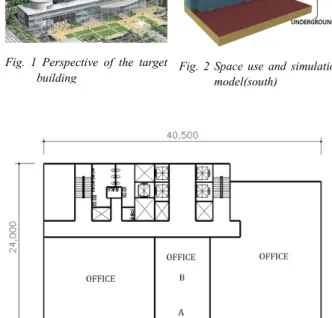
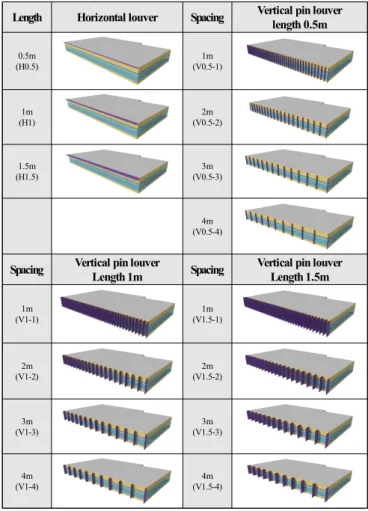
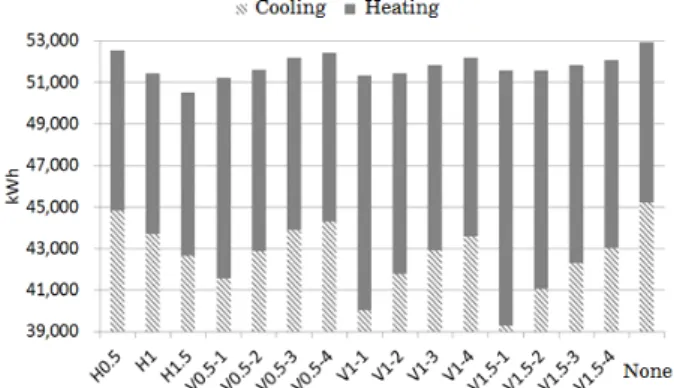
In this regard, This study tried to show accuracy of detailed building energy simulation tool through comparing actual measured and simulated data. And also, using simulation tool, to reduce energy consumption of curtain wall building, this study suggests the most energy efficient shading type for a city hall building.
1.2. Research Process
For the objective of this study, Y city hall was selected as the primary target. this study collected and analyzed the energy consumption data of local government office buildings. The collected actual energy consumption data were compared to
KIEAE Journal
Korea Institute of Ecological Architecture and Environment 78
1)