Print ISSN: 2288-4637 / Online ISSN 2288-4645 doi:10.13106/jafeb.2021.vol8.no4.0971
Effects of Information Quality of Online Travel Agencies on Trust and Continuous Usage Intention: An Application of the SOR Model
Seul Ki LEE
1, So Ra MIN
2Received: August 20, 2020 Revised: March 07, 2021 Accepted: March 15, 2021
Abstract
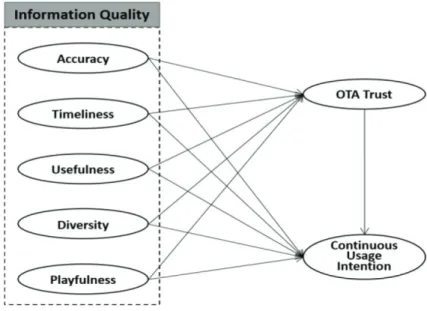
The purpose of this study was to investigate the relationship between information quality, Online Travel Agency (OTA) trust, and continuous usage intention provided by OTA through the application of the SOR(Stimulus-Organism-Response) model. To achieve the purpose of the study, 234 responses were used for analysis, and the hypotheses were tested through the SPSS v.21 program and AMOS v.21 programs.
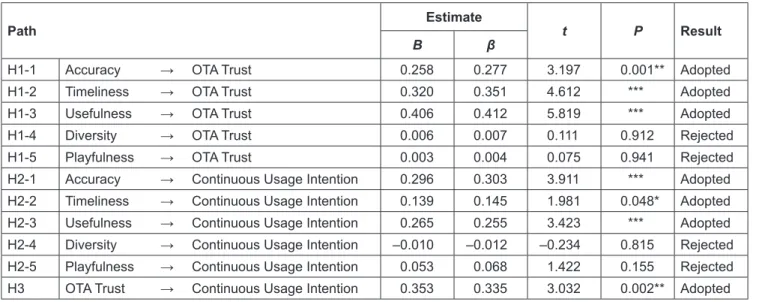
The research results can be classified into the following three categories. First, it was determined that accuracy, timeliness, and usefulness among the factors for information quality had a significant positive effect on OTA trust and continuous usage intention. Second, it was determined that OTA trust was found to have a significant positive effect on continuous usage intention. Third, it was determined that OTA trust had an indirect effect on the relationship between accuracy, timeliness, usefulness, and continuous usage intention among the factors for information quality. This study looked at the lower dimension of information quality, which was insufficient in the field of OTA. This study can be used as basic data to, in practice, build a user-centered informational provision environment by identifying the factors that promote the continuous usage intention of consumers, which is linked to the revenue of online travel agencies.
Keywords: Online Travel Agency, Information Quality, Trust, Continuous Usage Intention JEL Classification Code: L15, L83, L86, M15
common, the Internet can be used anytime, anywhere. It has therefore become possible to easily search for information related to tourism and to establish a plan (Xiang et al., 2015). As a result, online search engines have become very powerful means of accessing tourism products (Xiang et al., 2008). As a result, the use of online travel agencies (OTA) has increased, and traditional travel agencies that have only secured offline channels have also created online platforms (Min & Lee, 2020).
The term “online travel agency” refers to a company that provides travel information, accommodation, transportation services, food and beverage services, and local activity products through an online platform based on an information system (Skalska, 2017). Typical examples include Agoda, Expedia, Hotels.com, Booking.com, and Trip.com. Online travel agencies have the advantage of providing information on tourism products with characteristics of experience goods in various forms that are difficult to evaluate before experiencing them directly (Tan & Wu, 2016; Yu & Sun, 2019). In such a situation, information quality has been suggested as a factor that positively affects consumer attitude, such as the perception of value or satisfaction with online travel agencies (Pham & Nguyen, 2019; Kaushik et al., 2017).
1
First Author. Lecturer, Faculty of Business Administration, Sangmyung University, Seoul, Korea. Email: [email protected]
2
Corresponding Author. Assistant Professor, Department of Airline Service, Osan University, Korea [Postal Address: 45, Cheonghak-ro, Osan-si, Gyeonggi-do, 18119, Korea] Email: [email protected]
© Copyright: The Author(s)
This is an Open Access article distributed under the terms of the Creative Commons Attribution Non-Commercial License (https://creativecommons.org/licenses/by-nc/4.0/) which permits unrestricted non-commercial use, distribution, and reproduction in any medium, provided the original work is properly cited.