한국환경과학회지 제20권(제4호), 551~554, 2011 DOI: 10.5322/JES.2011.20.4.551 Journal of the Environmental Sciences
Note
DNA Analysis of mtDNA COI Gene in the Sharp-toothed Eel (Muraenesox cinereus Forskal) from Yeosu, Jinhae, Jeju, Goseoung, Jangheung and Haenam Populations in Korea Using
PCR-aided RFLP
Taeg-Yun Oh, Sun-Beom Jeong1), Eun-Seob Cho2)*
Division of Fisheries Resources Research, NFRDI, Busan 619-705, Korea
1)Division of Marine Technology, Chonnam National University, Yeosu 550-749, Korea
2)Southwest Fisheries Research Institute, NFRDI, Yeosu 556-823, Korea
(Manuscript received 20 November, 2010; revised 7 February, 2011; accepted 21 February, 2011)
Abstract
The production of the sharp-toothed eel by commercial catch off waters of Korea is annually declined after 1978. This study was carried out to obtain the stock management of the sharp-toothed eel using the PCR-aided RFLP method. The mtDNA COI gene was amplified using species-specific primers and PCR product was observed to 700 bp. Amplified DNA fragments were treated with six kinds of restriction enzymes (BaeHI, EcoRI, PstI, Ksp22, HinfI and HaeIII). The treatment of HaeIII showed a distinct PCR product between Yeosu/Jinhae/Jeju/Goseoung and Jangheung/Haenam populations that were observed from 300 to 400 bp in reference to 100 bp molecular marker. However, DNA fragment within populations had an identical pattern. The phylogenetic homology is 82% between two populations inferred from RFLP PCR product pattern using NTsysPC ver. 2.1. The use of HaeIII plays an important role in discriminating populations. It is thought that adults after over-wintering in the southern part of Jeju migrate to the Yeosu, Jinhae and Goseoung regions to spawn instead of to southwestern waters. Individuals within populations showed a relatively active genetic mixing and migration regardless of geography. However, the genetic ancestor of Jangheung and Haenam populations is appeared to be more adjacent to China or Japan than Jeju.
Key Words : Sharp-toothed eel, Population, MtDNA, HaeIII, RFLP
1)
1. Introduction
The sharp-toothed eel (Murenesox cinereus Forskal) was one of the most commercially important fish resources in Korea and had a wide distribution from the East China to the South China Seas(Chyung,
*Corresponding author : Eun-Seob Cho, Southwest Fisheries Research Institute, NFRDI, Yeosu 556-823, Korea
Phone: +82-61-690-8959 E-mail: [email protected]
1977). This species has existed in the southwest of Jeju during the period of winter and migrated to the South and West Seas in the beginning of spring (NFRDA, 1988). After 1978, the production of the sharp-toothed eel had an extreme annual decline (Zhang et al., 1998). To solve this problem, some researchers have studied the stock management based on ecological characteristics and fisheries management implications(Kang et al., 1998; Kim et al., 1998; Park et al., 1998; Zhang et al., 1998). However, genetic
552 Taeg-Yun Oh, Sun-Beom Jeong, Eun-Seob Cho
characterization studies of sharp-toothed eel have been limited to the relationships between strains and geographic areas. Understanding of the genetic diversity and population structure is vital for the success of stock management. Consequently, our objectives were as follows: (1) to detect the possible existence of the genetic subdivision: and (2) to investigate the extent of the mtDNA divergence within micro- and between macro-geographic regions.
2. Materials and methods
2.1. Sampling collection
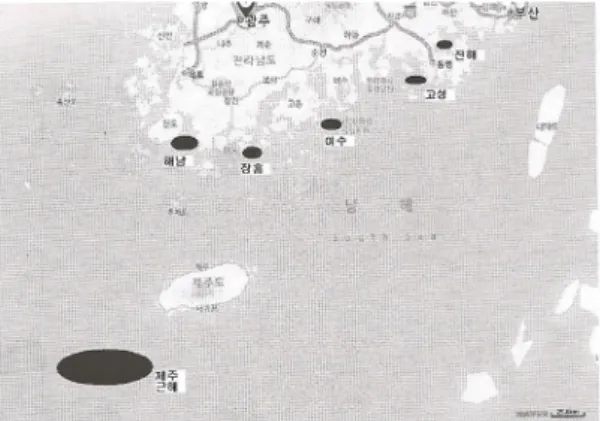
The sharp-toothed eels were obtained from 6 localities in Korea during the period of September to October in 2009 (Fig. 1). We used a total of 28 individuals. The specimen in Jeju was collected by commercial cat off Jeju waters, while the other samples were provided by a Danish seine fishery.
Samples were frozen at -70°C until required.
Fig. 1. Map showing the sampling stations of the sharp-toothed eel.
2.2. Molecular works
Total genomic DNA was extracted from 0.5g of their mussel by the method of Asahida (Asahida et al., 1996). The extracted genomic DNA was frozen at -20℃ until required. Potential forward and reverse primers were selected manually and by using an on-line Primer program (http://www-genome.wi.mit.edu/
cig/primer) from aligned mitochondrial cytochrome oxidase (CO) I gene region sequences of sardine (Sardina pilchardus). The primer sequences are as follows:
forward primer (5’-cgaagcttgatatgaaaaaccatcgttg-3’) and reverse primer (5’-gcccctcagaatgatatttgtcctca-3’).
PCR reactions were carried out under the following conditions in 25 μl reaction volumes: 20 pmol of each primer; 0.5 mM dNTPs; 1.25 unit Taq DNA polymerase (FastStar Taq DNA polymerase, Roche);
10 × PCR reaction buffer (Roche); 10-50 ng total genomic DNA. The thermocycling profile included an initial denaturation step of 95°C for 5 min, followed by 35 cycles of 1 min at 95°C, primer annealing for 1 min at 50°C and extension for 1 min at 72°C. The final extension step was increased to 5 min. The PCR was carried out by MyCycler Thermocycle (Bio-Rad). To obtain successful DNA amplification, electrophoresis was carried out 50 min using 1 × TBE buffer in 1.5% agarose gel. The PCR products were digested with six restriction enzymes, BamHI, HaeIII, EcoRI, PstI, Ksp22, HinfI, according to the manufacturer’s instructions. The resulting fragments were separated on 1.5% agarose gels for 50 min at 50 V, and stained with ethidium bromide, and imaged under UV light with an Image Analysis System (Sygene Co.). The DNA fragment sizes were in reference to a 100 bp DNA ladder run in the same gel. Phylogenetic tree was generated using NTsysPC ver. 2.1.
3. Results
PCR amplification of the mtDNA COI gene region from all populations of sharp-toothed eel resulted in a single product of approximately 700 bp (Fig. 2). The restriction patterns of all sharp-toothed eel populations from Yeosu, Jinhae, Jeju, Goseoung, Jangheung and Haenam using BaeHI, EcoRI, PstI, Ksp22 and HinfI restriction enzymes were identical and were not clearly different from those of all other populations
DNA Analysis of mtDNA COI Gene in the Sharp-toothed Eel (Muraenesox cinereus Forskal) from Yeosu, Jinhae, Jeju, Goseoung, Jangheung and Haenam Populations in Korea Using PCR-aided RFLP 553
Fig. 2. Amplified PCR product of sharp-toothed eel using species-specific primers for mtDNA COI gene of sharp-toothed eel. M, size marker (100 bp).
(data not shown). A unique 600 bp DNA band treated with these restriction enzymes was shown in the samples from Yeosu, Jinhae, Jeju, Goseoung, Jangheung and Haenam (data not shown). However, DNA fragment patterns were different using the restriction enzyme HaeIII (Fig. 3). DNA banding patterns of Yeosu, Jinhae, Jeju and Goseoung populations were equivalent and distinguishable from those of Jangheung and Haenam populations. Two populations between Yeosu/Jinhae/Jeju/Goseoung and Jangheung/Haenam had a different site recognized by HaeIII restriction enzyme. However, identical banding patterns for each individual of all samples were observed under even treated with six restriction enzymes used in this study. Repeated amplification under the same PCR conditions resulted in stable
Fig. 3. Restriction fragment patterns of PCR products obtained from COI gene in mitochondria of sharp-toothed eel using HaeIII restriction enzyme. Arrow asteroid indicate a species-specific DNA product shown in Jangheung and Haenam populations. M, size marker (100 bp).
Fig. 4. Phylogenetic relationship of sharp‐toothed eel popula- tions based on restriction fragment patterns using BamHI, HaeIII, EcoRI, PstI, Ksp22 and HinfI restriction enzyme. The tree was inferred from a distance matrix based on Euclidean method.
banding patterns. The phylogenetic tree inferred from the PCR-RFLP pattern was different in that the relationship between Yeosu/Jinhae/Jeju and Jangheung/
Haenam populations showed 0.82 of similarity distance (Fig. 4).
4. Discussion
We previously carried out the analysis of mtDNA in anchovy (Engraulis japonicus Temminck &
Schlegel) from Korean waters, but it was found that considerable migration and gene flow in Korean anchovy populations caused the formation of genetically homogenous structure(Cho and Kim, 2006; Kim et al., 2004; Oh et al., 2009). Likewise, the sharp-toothed eel populations, except for the Jangheung and Haenam populations, have a monophyletic genetic relationship and active genetic mixing that are caused by the high level of genetic migration and gene flow between populations. The sharp-toothed eel populations from Yeosu, Jinhae, Jeju and Goseoung were formed of individuals randomly dispersed within the population over geographic areas. The phylogeography of the sharp-toothed eel is similar to previous results from
554 Taeg-Yun Oh, Sun-Beom Jeong, Eun-Seob Cho
the anchovy. Migration caused by geographic barriers and hydrographic restriction is often limited.
Furthermore, different food organisms and heterogeneous environments between populations cause a distinct population. It is assumed that the Yeou, Jinhae, Jeju and Goseoung populations have a unique co-ancestor, whereas the Jangheung and Haenam populations have a different ancestor. On the basis of genetic structure, the ancestor of Yeosu, Jinhae and Goseoung populations is possibly considered as Jeju population.
However, the genetic ancestor of Jangheung and Haenam populations appears to be of Chinese or Japanese populations.
Acknowledgments
This work was funded by a grant from the National Fisheries Research and Development Institute (RP- 2010-FR-058).
References
Asahida, T., Kobayashi, T., Saitoh, K., Nakayama, I., 1996, Tissue preservation and total DNA extraction from fish stored at ambient temperature using buffers containing high concentration of urea, Fish.
Sci., 62, 727-730.
Cho, E. S., Kim, J. I., 2006, Mitochondrial DNA polymorphism of the Japanese anchovy (Engraulis japnicus Temminck & Schlegel) collected from the Korean offshore and inshore waters, J. Life Sci., 16, 812-827.
Chyung, M. K., 1977, The Fishes of Korea, Iijisa, Seoul, 727.
Kang, Y. J., Jeon, B. S., Zhang, C. I., 1998, A study on the stock management of the sharp-toothed eel, Muraenesox cinereus (Forskal) in Korean waters III. Maturation and spawning, J. Kor. Soc. Fish.
Res., 1, 18-24.
Kim, J. Y., Cho, E. S., Kim, W. J., 2004, Population genetic structure of Japanese anchovy (Engraulis japonicus) in Korean waters based on mitochondrial 12S ribosomal gene sequences, J. Life Sci., 14, 938-950.
Kim, M. J., Kang, Y. J., Park, C. S., 1998, A study on the stock management of the sharp-toothed eel, Muraenesox cinereus (Forskal) in Korean waters II.
Age and growth, J. Kor. Soc. Fish. Res., 1, 11-17.
NFRDA, 1988, Assessment of Fisheries Resources in Korean waters, 254.
Oh, T. Y., Kim, J. I., Seo, Y. I., Cho, E. S., 2009, The population genetic structure of the Japanese anchovy (Engraulis japonicus Temminck &
Schlegel) in the West, South and East Seas of Korea based on microsatellite DNA analysis, J.
Life Sci., 19, 174-178.
Park, C. S., Lee, D. W., Kang, Y. J., Kim, Y. S., Zhang, C. I., 1998, A study on the stock management of the sharp-toothed eel, Muraenesox cinereus (Forskal) in Korean waters I. districution patterns, J. Kor. Soc. Fish. Res., 1, 1-10.
Zhang, C. I., Park, C. S., Sohn, M. H., 1998, A study on the stock management of the sharp-toothed eel, Muraenesox cinereus (Forskal) in Korean waters IV. Population ecological characteristics and biomass, J. Kor. Soc. Fish. Res., 1, 25-35.