A Proposal of Hazard/Risk Assessment Criteria and an Asbestos Management Method for Asbestos-containing Building Materials
Whame Park† and Yoonshin Kim
Institute of Environmental and Industrial Medicine, Hanyang University, Seoul, Korea
ABSTRACT
Objectives: The AHERA method by the US EPA, ASTM E2356-04, and HSG264 by the UK HSE, all of which are hazard/risk assessment methods for asbestos-containing building materials, were reviewed and compared based on 231 homogeneous areas. In addition, the current Act on Asbestos Safety Management (enforcement:
April 29, 2012) was reviewed and analyzed. This trial provided fundamental data for improving the current asbestos hazard/risk assessment method.
Methods: For the hazard/risk assessment of 77 asbestos-containing public buildings including schools, 231 homogeneous areas were selected, each of which was assessed using AHERA, ASTM E2356-04, and HSG264.
Results: The matching rate of the hazard/risk assessment stood at 20.4 percent between AHERA and ASTM, at 71.4 percent between AHERA and HSG264 and at 17.8 percent between ASTM and HSG264. The AHERA method includes a seven-category rating scale. There were three categories, two of which have three sub- categories. ASTM provides two decision-making charts consisting of ten rating scales for current condition estimation and for potential for disturbance estimation. In addition, the HSG264 method has a total of 20 scores with four items, and then provides four grades. This HSG264 method cannot clearly separate current condition and potential for disturbance.
Conclusions: In the Korean Act on Asbestos Safety Management, the hazard/risk assessment method for asbestos-containing building materials should consider balance between current condition estimation and the potential for disturbance estimation.
Keywords: Asbestos-containing building, Hazard assessment, AHERA, ASTM, HSG
I. Introduction
Asbestos is a set of six naturally occurring silicate minerals including magnesium and iron. Asbestos became increasingly popular among manufacturers, and has been used in more than 3,000 different products, including material for flooring, roofing, brake lines, and building insulation for boilers and pipes as well as cement pipe, due to its sound absorption, average tensile strength, and resistance to fire, heat, and sound.
Although asbestos is useful and economical in terms of industrial usage, its life-threatening effects as one of the human carcinogens have led many
countries to adopt a policy of prohibition or restriction of its use. As reports announced that asbestos may have a strong connection with lung cancer,8) and mesothelioma, the lethal diseases caused by asbestos include lung cancer, mesothelioma and asbestosis.11)
The Investigation on the actual conditions of asbestos use in primary school building materials revealed that 88.3 percent of school buildings are built using asbestos materials.1,14) Research on the actual conditions of asbestos use in public buildings found that out of 424 public buildings including city halls/borough offices/public community centers, 335 (79 percent) were reported to have asbestos materials.4) In addition, 153 out of 313 public use
†
Corresponding author: Institute of Environmental and Industrial Medicine, Hanyang University, Seoul 133-791, Korea, Tel: +82-2-2220-4910, Fax: +82-2-2299-3915, E-mail: [email protected]
Received: 22 December 2011, Revised: 16 January 2012, Accepted: 13 February 2012
facilities nationwide have asbestos materials according to research on the actual conditions of asbestos use in asbestos-containing public use facilities3,5) and 50.3 percent of workplaces are found to have asbestos according to a study.6)
In the U.S., if the condition of asbestos-containing material used in a building is maintained to be good, it is recommended to keep the condition in that manner, while if the condition of asbestos-containing material used in a building is severely deteriorated, it is recommended to remove, close or overlay the material.12)
The priority for appropriate management of the asbestos-containing building materials should be determined after the hazard/risk assessment of the materials is performed. The maintenance and manage- ment strategy for asbestos-containing buildings can then be established, accordingly.13)
For this reason, a new system of hazard/risk assessment criteria that is appropriate for the actual circumstances in Korea should be prepared for the asbestos-containing building materials.
In this study, the hazard/risk assessment methods of AHERA of the US EPA, ASTM E2356-04, and HSG264 of UK HSE were reviewed, and a comparative analysis of the assessment methods was conducted by applying them to asbestos-containing buildings in Korea. Based on the review and analysis result, the hazard/risk assessment criteria for asbestos- containing buildings stipulated in the Korean Asbestos Regulations were also reviewed to provide fundamental data that can provide a direction for improvement of Korean hazard/risk assessment criteria for asbestos-containing buildings.
II. Materials and Methods
1. Research scope
231 homogeneous areas were selected from asbestos-containing buildings and investigated for hazard/risk assessment. The buildings consisted of 57 public buildings, 20 school buildings, and 77 general buildings. In terms of the year in which the buildings were built, 26% were built before the 1980s, 31% between 1981 and 1990, and 43% after 1991.
2. Research method
The hazard/risk assessment was conducted by
inspecting the current condition and potential for disturbance withtesting method for visual assessment.
To minimize the error rate, a single team of researchers who had received asbestos research training designated by the Minister of Labor investigated the areas, and the standardization of area research was secured. The asbestos-containing building materialsincluded ceiling materials 80%, walls boards 31%, gaskets 5.4%, and caulking and others 0.8%.
In this study, to assess hazard/risk of asbestos- containing buildings, the AHERA method of the US EPA (hereinafter referred to as AHERA), the ASTM E2356-04 method (hereinafter referred to as ASTM) and the HSG264 of the UK HSE (hereinafter referred to as HSG264) were used.
1) Hazard assessment for asbestos maintenance using AHERA
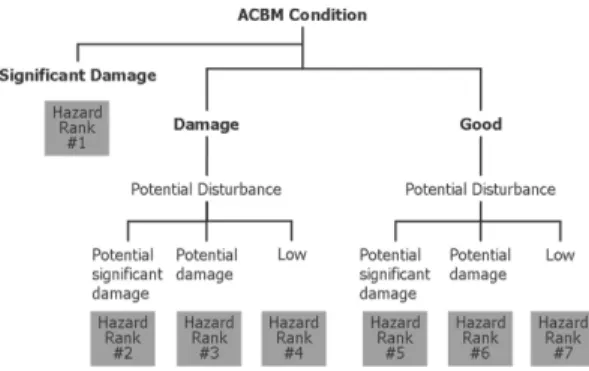
The most widely used assessment method, AHERA divides materials into seven different categories depending on the severity of the hazardous event.
Here, for the hazard assessment of asbestos-containing material (bulk), the consideration factors include current condition and vibration identified by visual inspection, potential contact by the human body, and possibility of releasing asbestos into the air.
The current condition can fall into three categories:
very severe (high), severe (moderate), and not severe (low); and the potential for disturbance can also fall into three general categories, as shown in Fig. 1 below.9)
2) Hazard assessment for asbestos maintenance using ASTM
ASTM method were derived from the current
Fig. 1. Hazard/Risk assessment using AHERA.
conditions indicated in Table 1, and assessment according to the estimation protocol for potential for disturbance.7) The result of assessment illustrates a decision-making process that places a heavy emphasis on maintenance and repair, whereas illustrates a decision-making process when a heavy emphasis is placed on dismantlement and removal.
3) Hazard assessment for asbestos maintenance using HSG264
The consideration factors of HSG264 used in the UK for hazard assessment for asbestos-containing materials are also based on AHERA.10) However, the rating scale of HSG264 is more detailed than that of AHERA. A different gravity is given according to the type of asbestos depending on the hazard level, which is noticeably different from AHERA.
Using Table 2 below, the point that can be given to an item ranges from 2 points to 12 points.
III. Results
1. Simple estimation of the rating scales of AHERA, ASTM and HSG264
To implement a more detailed comparative analysis of the hazard/risk assessment methods, the rating scale of each method should be analyzed. AHERA has a seven category scale; ASTM also has its own scale but provides a decision-making chart on which the assessment results are marked in terms of current condition and potential for disturbance; and HSG264 has a rating scale by which an item is given from 2
points up to 12 points in four different areas,and falls into one of four different categoriesbased on the points added and then is utilized.
For this reason, it is inevitable that each assessment method should be simplified in order to conduct a comparative analysis of methods that have different rating scales. In this study, a simplified rating scale is used, falling into three categories: Good, Damaged or Significantly Damaged (Table 3).
Fig. 2 shows the comparative results based on this method. From the results, it is found that of 231 homogeneous areas, 133 areas, 24 areas and 172 areas were classified as Good when evaluated by AHERA, ASTM and HSG264, respectively; 83 areas, 107 areas and 52 areas as Damaged, respectively;
and 15 areas, 100 areas and 7 areas as Significantly Damaged, respectively. Despite the homogeneous
Table 1. Current condition/Potential for disturbance protocol for asbestos management program by ASTM
Current condition Potential for disturbance
Qualitative Ranking
Numerical Rating
Qualitative Ranking
Numerical
Rating Physical disturbance Environmental disturbance
Good 8,9,10 Low 1,2,3
accessibilty activities vibration air/dust corrosive water damage Fair 4,5,6,7 Medium 4,5,6,7
Poor 1,2,3 High 8,9,10
Table 2. Risk assessment standard grade of HSG264 recommended asbestos-containing materials Score Range Assessment Criteria
≥10 7-9 5-6
≤4
Highly likely to release asbestos into the air Likely to release asbestos into the air Unlikely to release asbestos into the air Highly unlikely to release asbestos into the air
Table 3. Simple estimation table for different graded hazard/risk assessment estimation
Category AHERA ASTM HSG264
Good 7 Depending on
the decision- making chart
*≤4
Damaged 4,5,6 5-9
Significantly Damaged 1,2,3 ≥10
*The overlapping part between the maintenance/repair- emphasized chart and the dismantlement/removal-emphasized chart falls into the damaged condition.
Fig. 2. The comparison of hazard/risk assessment results.
areas, the results of an assessment using ASTM show more danger, while those derived with HSG264 show relatively less danger.
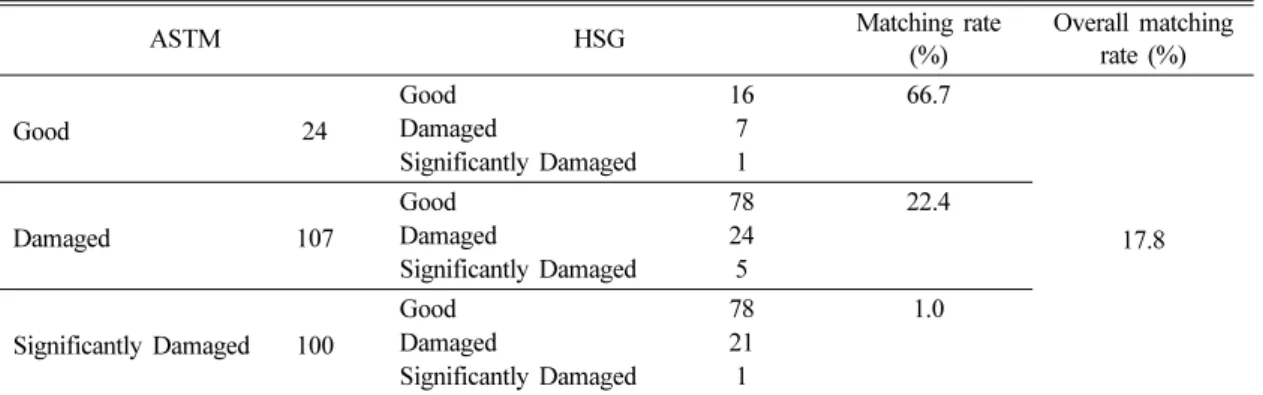
To take a closer look at the assessment methods, the following is a comparison between two of the three methods. Table 4 is a comparison between AHERA and ASTM. As shown in Table 6, the matching rate between the two methods stood at
only 20.4 percent, which is rather low. In particular, many homogeneous areas assessed as Good by AHERA fell either into the Damaged Categoryor into the Significantly Damaged Category when evaluated using ASTM. Moreover, there were only 3 percent of the homogeneous areas commonly evaluated as Good by both of the methods. In terms of Damaged and Significantly Damaged Categories
Table 4. The comparison between AHERA and ASTM
AHERA ASTM Matching rate
(%)
Overall matching rate (%)
Good 133
Good 4 3.0
20.4 Damaged 61
Significantly Damaged 68
Damaged 83
Good 18
Damaged 38 45.8
Significantly Damaged 27 Significantly Damaged 15
Good 3 Damaged 8
Significantly Damaged 5 33.3
Table 5. The comparison between AHERA and HSG264
AHERA HSG Matching rate
(%)
Overall matching rate (%)
Good 133
Good 128 96.2
71.4 Damaged 5
Significantly Damaged 0
Damaged 83
Good 43
Damaged 35 42.2
Significantly Damaged 5 Significantly Damaged 15
Good 1 Damaged 12
Significantly Damaged 2 13.3
Table 6. The comparison between ASTM and HSG264
ASTM HSG Matching rate
(%)
Overall matching rate (%)
Good 24
Good 16 66.7
17.8 Damaged 7
Significantly Damaged 1
Damaged 107
Good 78 22.4
Damaged 24 Significantly Damaged 5 Significantly Damaged 100
Good 78 1.0
Damaged 21
Significantly Damaged 1
There were 45.78 percent and 33.3 percent of common areas, respectively, when evaluated using both of the methods.
Table 5 shows the comparative results between AHERA and HSG264. 96.2 percent of the homogenous areas were commonly evaluated to be Good by both of the methods. In terms of Damaged and Significantly Damaged Categories, there were 42.2 percent and 13.3 percent common areas between the analytical results, respectively, when evaluated using both of the two methods. The overall matching rate between the two methods stood at 71.4 percent, showing that there is relatively much in common between the two methods.
Table 6 reveals the comparative results between ASTM and HSG264. 66.7 percent of the homogeneous areas were commonly evaluatedasGoodby both of the methods. In terms of Damaged and Significantly Damaged Categories, there were 22.4 percent and 1.0 percent common areas between the analytical results, respectively, when evaluated using both of the two methods. The overall matching rate between the two methods stood at 17.8 percent.
IV. Discussion
1. Hazard/Risk Assessment Items Recommended in AHERA, ASTM and HSG264
The methods utilized in assessing hazard/risk of asbestos-containing materials can be largely divided into two: visual inspection, which evaluates a damaged part with naked eyes, and potential for disturbance inspection, which evaluates any potential for disturbance than the current condition identified.
In the rating system of AHERA, there are three category rating scales and three sub-scales not only for current condition but also for potential for disturbance. If an area is evaluated to be high in any of the potential for disturbance estimation items, such as potential contact, vibration and air erosion, the area will be evaluated as highly likely to be damaged.
The hazard/risk assessment in ASTM is similar to that in AHERA. However, the rating scale of ASTM is more detailed in terms of current condition and potential for disturbance. The ten category rating scale is used rather than the three category rating scale used in AHERA. The more detailed the rating category is, the less error might arise. Therefore, a more detailed rating scale is considered as a device
that can minimize the error arising from individual variation. Estimation is conducted in each step, and more consideration factors are presented than those of AHERA. potential contact, vibration, air erosion are considered in AHERA, while accessibility, vibration, and amount of activities in addition to airflow, dust in the air, water leak and air erosion are added to evaluate in ASTM.
HSG264 employs the four category rating scale.
The rating system gives a point to each specific item of a building material, such as product type, severity of damage, surface treatment, and type of asbestos, and divides the assessed material into one of four categories based on the points added. Although HSG264 does not assess the current condition and potential for disturbance separately, the surface treatment among the consideration factors can be considered to be similar to the estimation items for potential for disturbance in AHERA and ASTM.
In a nutshell, of the hazard/risk assessment methods for asbestos-containing buildings, when evaluated by ASTM, which holds more assessment items for potential for disturbance than any other method, the number of areas that need to be dismantled or removed was shown to be highest, followed by AHERA and HSG264 in that order.
In other words, when evaluated by HSG264, a homogenous area may turn out to be the least dangerous.
It is, however, hasty to conclude that one of these three different hazard/risk assessment methods is most appropriate or suitable for Korea’s unique circumstances. Even though it may be the case, in terms of potential for disturbance, the hazard level can be overestimated by AHERA or ASTM if one of the consideration factors is evaluated to be high.
For this reason, the analytical results by ASTM show more areas that need to be dismantled or removed than those by AHERA, because of its detailed estimation items for potential for disturbance.
The only conclusion that can be made in this study is that hazard/risk assessment using ASTM will identify the target as relatively more dangerous, and that by HGS264 will identify it as relatively safer.
2. Proposal for a Korean standard hazard/risk assessment method for asbestos-containing buildings Based on the review of the hazard/risk assessment methods for asbestos-containing building materials
currently used in advanced countries, this study aims to perform a hazard/risk assessment for domestic asbestos-containing building materials.
The hazard assessment criteria and method for asbestos-containing building materials stipulated in Asterisk 3 of the Korean Act of Asbestos Safety Management (expected to be enforced in April, 2012) announced as of October, 2011 under the Asbestos Safety Control Act notified in April, 2011, were reviewed.
According to the Korean Act of Asbestos Safety Management, there are four categories to assess asbestos-containing building materials: physical property, potential for disturbance by vibration, airflow and water leak, potential for disturbance by maintenance and repair, and potential of exposure to the human body.2)
The rating scale for these items consists of a total of 30 points. The first assessment part of physical property is current condition, for which 12 points are assigned. In the remaining part of evaluation, 6 points are assigned to potential for disturbance by vibration, airflow and water leak, disturbance by maintenance, and potential of exposure, respectively, amounting to a total of 18 points.
The method proposed is composed of 60 percent of items stipulated in the hazard assessment criteria and method of the Korean Act of Asbestos Safety Management. Currently, the Korean Act on Asbestos Safety Management is mostly focused on potential of exposure. The items that can assess the severity of current exposure are relatively lacking.
Therefore, the hazard assessment method for asbestos-containing building materials in the Korean Act of Asbestos Safety Management (Enforcement) needs to strike a balance between the estimation of current condition, potential for disturbance and potential of exposure for the building materials.
Moreover, it is believed that there is a growing need for a balanced estimation tool with which asbestos inspectors can easily assess materials.
V. Conclusions
In this study of the assessment methods of current condition and potential for disturbance for asbestos- containing building materials, AHERA of the US EPA, ASTM E2356-04 and HSG264 of the UK HSE were reviewed to perform a comparative analysis of
asbestos-containing building materials used for domestic building structures. By comparing the assessment methods with the content stipulated as the hazard/risk assessment method in Asbestos Safety Management, the study aims to provide fundamental data for future improvement of the hazard/risk assessment method for asbestos-containing building materials.
In the comparative analysis, the matching rate of hazard/risk assessment stood at 20.4 percent between AHERA and ASTM, at 71.4 percent between AHERA and HSG264, and at 17.8 between ASTM and HSG264. The matching rate between AHERA and HSG264 was shown to be highest. 96.2 percent of the areas evaluated as Good by AHERA were also evaluated as Good by HSG264.
The potential of exposure based on the current condition and potential for disturbance is considered to be significant in the assessment methods for asbestos-containing building materials used so far.
AHREA has a seven-category rating system, consisting of three categories, two (current condition and potential for disturbance) of which have three sub- categories. ASTM divides current condition and potential for disturbance into a ten rating scale and uses the decision-making chart for an inspector to determine whether to maintain/repair it or dismantle/
remove it. In HSG264, a material is given a point for four respective items, and a set of the points is added and rated at one of four categories. The current condition and potential for disturbance are enumerated rather than clearly distinguished, and an overall emphasis is put on current condition, not on potential for disturbance.
The hazard/risk assessment method for asbestos- containing building materials stipulated in Asbestos Safety Management seems to be based on HSG264.
However, through an analysis of estimation items of the method, it is revealed that there are many estimation items, and that a relatively high emphasis is put on potential for disturbance.
From the analytical results, it is indicated that the hazard/risk assessment methods for asbestos-containing buildings currently used should be reflected in the assessment method for domestic asbestos-containing buildings to the greatest extent possible, but it is also believed that the assessment for the current condition and potential for disturbance should be balanced.
Acknowledgments
This research was supported by Basic Science Research Program through the National Research Foundation of Korea (NRF) funded by the Ministry of Education, Science and Technology (Grant No.
2011-0015038).