한국환경보건학회지 , 제 46 권 제 6 호 (2020) J Environ Health Sci. 2020; 46(6): 655-666
655
pISSN: 1738-4087 eISSN: 2233-8616 https://doi.org/10.5668/JEHS.2020.46.6.655
폐금속광산 지역 주민들의 요 중 비소종별 농도와 관련요인 평가
울 지* · 서정욱** · 김병권* · 임현주** · 장준영*** · 이철우*** · 조성식**** · 손현진* · 홍영습*
,**
†*동아대학교 의과대학 예방의학교실, **동아대학교 중금속노출 환경보건센터,
***국립환경과학원 환경건강연구부, ****동아대학교 의과대학 직업환경의학교실
Urinary Arsenic Species Concentrations and Related Factors among Residents Living near Abandoned Metal Mines
Ulziikhishig Surenbaatar*, Jeong-Wook Seo**, Byoung-Gwon Kim*, Hyoun-Ju Lim**, Jun-Young Chang***, Chul-Woo Lee***, Seong-Sik Cho****,
Hyun-Jin Son*, and Young-Seoub Hong*
,**
†*Department of Preventive Medicine, College of Medicine, Dong-A University
**Heavy Metal Exposure Environmental Health Center, Dong-A University
***Department of Environmental Health Research, National Institute of Environmental Research
****Department of Occupational and Environmental Medicine, College of Medicine, Dong-A University
ABSTRACT
Objectives: The purpose of this study was to evaluate urinary arsenic concentrations by arsenic species and to identify related factors among local residents near abandoned metal mines in Korea.
Methods: Among the subjects of the Health Survey of Residents Near Abandoned Metal Mines for 2013-2017, 664 people were enrolled in this study. Urinary arsenic species analysis was performed using ICP/MS.
Result: The geometric means (95% Confidence Interval) by urinary arsenic species were 0.15 (0.13-0.17) µg/
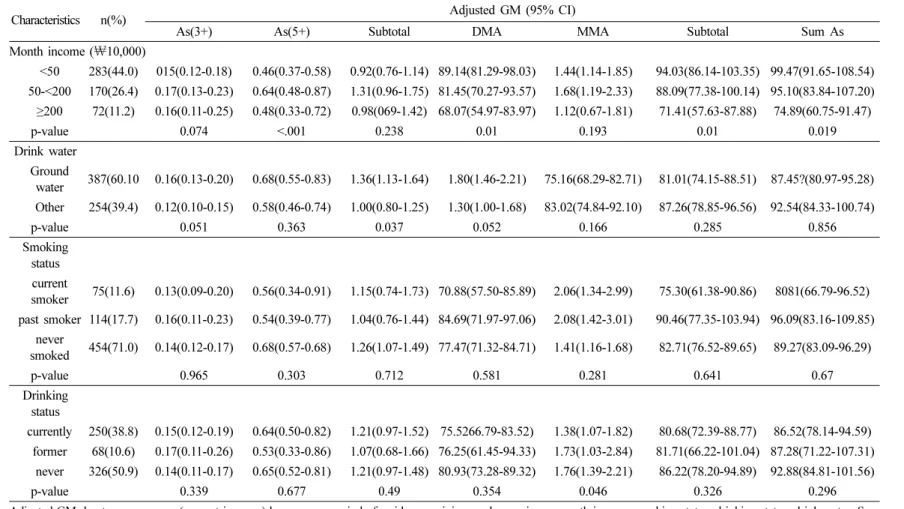
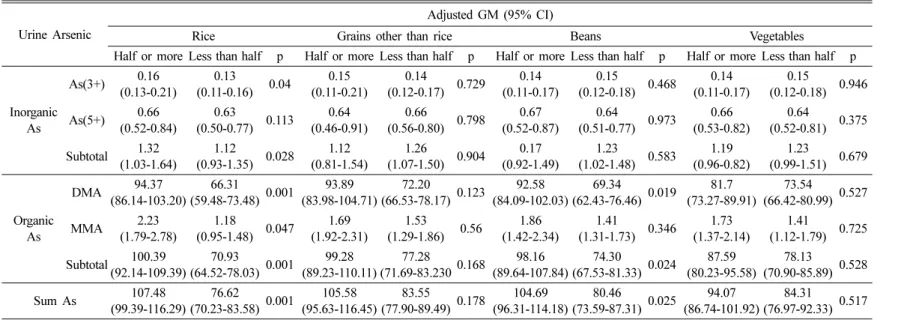
L for AsIII, 0.64 (0.55-0.75) µg/L for AsV, and 1.21 (1.05-1.40) µg/L for inorganic arsenic. The geometric means of urinary MMA and DMA were 1.58 (1.35-1.86) µg/L and 77.93 (72.61-83.63) µg/L, respectively, and that of organic arsenic was 83.15 (77.80-88.88) µg/L. The concentration of inorganic arsenic in the group using groundwater as drinking water was 1.36 (1.13-1.64) µg/L, which was statistically significantly higher than the 1.00 (0.80-1.25) µg/L in the other drinking water groups. Regarding rice consumption, the concentration of inorganic arsenic in urine in the group whose consumption was more than half rice produced in the residential area was 1.32 μg/L, which was statistically significantly higher than that of the 1.12 μg/L for the group whose consumption was less than half.
Conclusion: In the analysis of the factors affecting the urinary inorganic arsenic concentration of the residents of the abandoned metal mine area, the use of groundwater as drinking water and consumption of rice produced in the residential area were considered related factors.
Key words: Arsenic exposure, arsenic species, abandoned metal mine, related factors
†
Corresponding author: Department of Preventive Medicine, College of Medicine, Dong-A University, 32, Daesingongwon- ro, Seo-gu, Busan, Republic of Korea, Tel: +82-51-240-2888, Fax: +82-51-253-5729, Email: [email protected] Received: 28 October 2020, Revised: 11 November 2020, Accepted: 12 November 2020
원 저 Original articles