| Abstract |
Purpose: The purpose of this study was to investigate the effects of forward-and-backward shift trunk exercise using a proprioceptive neuromuscular facilitation (PNF) diagonal pattern in a closed kinematic chain exercise on the upper limb function and activity of daily living (ADL) in a stroke patient.
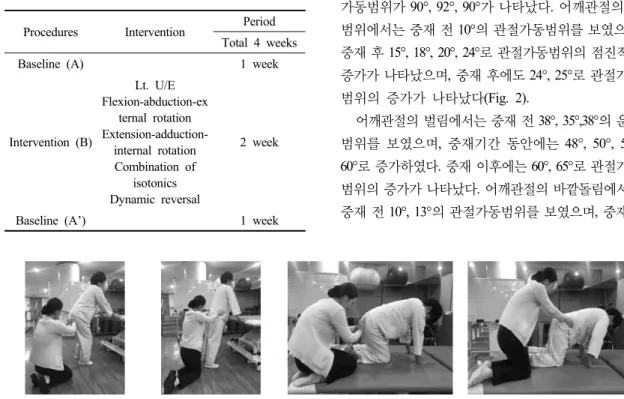
Methods: One subject participated in this study. The study used a reversal A-B-A’ design, where A and A’ were the baseline period (no intervention), and B was the intervention period. The intervention was a forward-and-backward trunk shift exercise, using a PNF diagonal pattern on both a stand-on-hand position and a quadruped position of closed kinematic chain exercises, for 20 min per day for 2 weeks. The range of motion (ROM) of the shoulder joint was measured and a Fugl-Meyer assessment of upper extremity (FMA-UE) and a functional independence measure (FIM) were performed to measure upper limb function and activity of daily living (ADL).
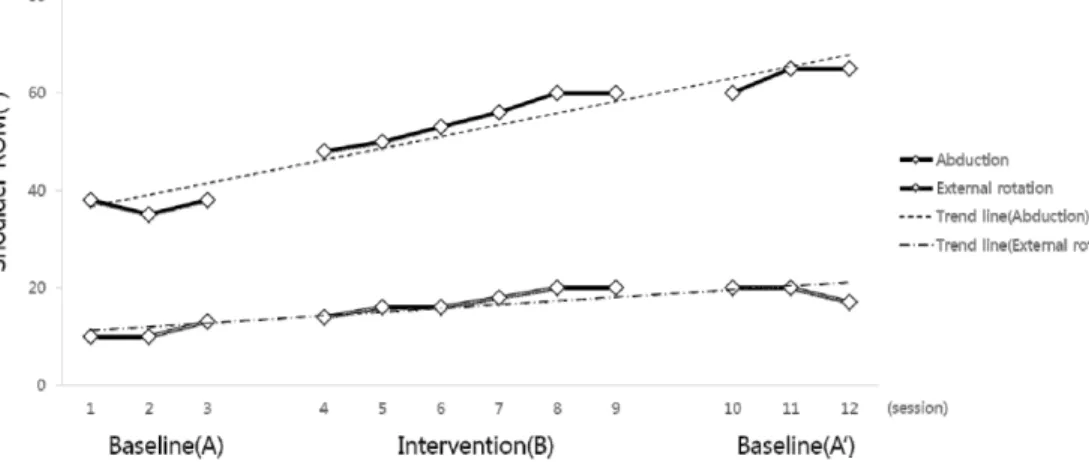
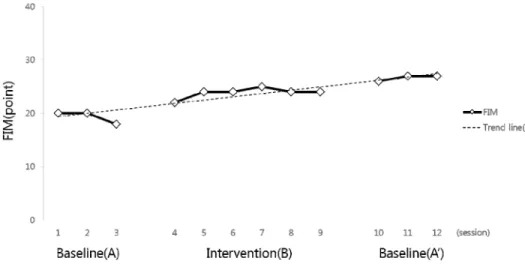
Results: ROMs of shoulder joint (flexion, extension, abduction, and external rotation) increased in the intervention phase. The FMA-UE score increased (from 28 to 36) in the intervention phase. The FIM score increased (from 20 to 25) in the intervention phase. These increases were maintained after intervention (Baseline Ⅱ).
Conclusion: These results suggest that forward-and-backward shift trunk exercises using a PNF diagonal pattern in a closed
†Corresponding Author : Sang-Hyun Moon ([email protected])
Case study Open Access
닫힌사슬에서의 PNF 대각선 패턴을 이용한 몸통 전⋅후방 이동운동이 뇌졸중환자의 상지 기능 및 일상생활에 미치는 영향
-단일 사례 연구-
박시은⋅문상현
1†2)세명재활의학병원 물리치료실,
1바른움직임연구소
Effect of Forward-and-Backward Shift Trunk Exercise Using Proprioceptive Neuromuscular Facilitation Diagonal Pattern in Closed Kinematic Chain Exercises on
Upper Limb Function and ADL in Stroke Patient
-A Single-Subject Design- Si-Eun Park⋅Sang-Hyun Moon
1†Department of Physical Therapy, Semyeong Rehabilitati1ation Medicine Hospital
1