한여름 기온이
‘
후지’
/M.9 사과나무의 과실 일소증상 발생에 미치는 영향송양익1*·박무용1·양상진2·사공동훈1
1국립원예특작과학원사과시험장, 2농촌진흥청농촌지원국원예특작과
(2009년 9월 22일접수; 2009년 11월 27일수정; 2009년 11월 27일수락)
Influence of Air Temperature during Midsummer on Fruit Sunburn Occurrence in
‘Fuji
’/M.9 Apple Tree
Yang-Yik Song1*, Moo-Yong Park1, Sang-Jin Yang2 and Dong-Hoon Sagong1
1Apple Experiment Station, National Institute of Horticulture & Herbal Science, Rural Development Administration, Gunwi 716-812, Korea
2Horticulture & Herbal Crop Division, Extension Service Bureau, Rural Development Administration, Suwon, 441-707, Korea
(Received September 22, 2009; Revised November 27, 2009; Accepted November 27, 2009)
ABSTRACT
This study was carried out to investigate the effects of air temperature during midsummer on sunburn occurrence that had some problems recently on
‘Fuji
’/M.9 planting system in Korea. There was a positive relationship between sunburn incidence and accumulated days with high air temperature over 31
oC, or accumulated total quantum per day.
‘Fuji
’/M.9 apple trees with relatively open canopies, compared to
‘Fuji
’/M.26, were more susceptible to sunburn injury because the fruit was more exposed to sunlight. In
‘Fuji
’/M.9 apple trees, those that were poor in vigor or with short bourse shoot length were more susceptible to sunburn injury. Sunburn incidence was affected by neither regions nor row orientations. Sunburn was observed most often on the fruits on the south and west sides of the trees. The reason was due to high skin temperature of the fruits reaching 40~45
oC under full sunlight.
Key words
:
Malus domesticaBorkh., Fruit skin temperature, High temperature, Rootstock, Row orientation
I. 서 론
일소증상(sunburn)은 과실이강한 태양광에 노출될
경우과실의표면온도가높아지면서과실표면이노란 색 혹은갈색으로 변하는생리증상으로, 해에 따라서
는 피해가 30%를넘어 경제적손실이크다(Schrader
et al., 2003; Piskolczi et al., 2004; Schupp et al.,
2004). 일반적으로일소증상이발생하는주요인은강한
태양광에 인한 높은 과실의표면온도에 의한 것으로
(Corelli Grappadelli, 2003), Schrader et al.(2008)은 일소증상을크게 3가지로나누었다. 첫째는일소괴사
(sunburn necrosis)로서 태양광의유무에 상관없이과
실의 온도가 52oC에 도달하면과실의표피층이 괴사
하면서 나타난다고하였다. 둘째는 일소갈변(sunburn
browning)으로서과실의양광면이노랗게혹은갈색으
로 변하는 증상으로 일소괴사보다 낮은 온도(46~
49oC)에서발생하지만태양광이없으면발생하지않는 다고하였다. 마지막셋째는 광산화일소(photooxidative
* Corresponding Author : Yang-Yik Song ([email protected])
sunburn)로서 음지에있던과실이전정 및유인에의 해 갑작스럽게 광에 노출되면 나타나는데낮은 온도
(31oC 이하)에서도발생할수있다고하였다.
이러한일소증상발생에영향을미치는기온및광 조건은재배지역의위도, 지대, 기후에따라 다르지만 나무의용적, 재식밀도, 수형체계등에의해서도달라 질 수 있다(Palmer et al., 2003). 일소증상이 특히 문제시되는 ‘후지’ 품종에있어 Schupp et al.(2002)는 왜성대목을이용할경우나무의크기가작아일소증상 발생이많아질수있으며, 세력이강한대목을이용할 경우상대적으로많은잎의차광효과에의해일소증상 이 감소하긴 하지만과실 착색이잘 되지않는 단점 이있다고하였다.
국내사과원은 1970년대이전까지교목성실생대목
을이용한거목소식재배를하다가그이후부터 1990
년대 중·후반까지준왜성대목인 M.26과 MM.106이 많이이용되었다. 1990년대후반에들어와서는유럽에
서널리 보급되고있는 M.9 왜성대목을이용한밀식
재배에관한연구가대구경북지역을중심으로사과시 험장과대학에서본격적으로시작되었다(Yoon, 2004).
그러나 1990년대중·후반까지만해도크게문제시되
지않았던일소증상 발생은 M.9를이용한밀식재배
체계로전환된과원면적이증가되면서(2006년: 5천ha,
18%; 농림수산식품부자료참조) 큰문제로대두되고
있으며, 최근에널리논의되고있는지구온난화에의 한기온상승도일소증상발생률의증가에밀접한관계 가 있을 것으로 추정된다(Blanke, 2008; Iamsub et al., 2008; Smit et al., 2008).
본시험은 ‘후지’/M.9을대상으로일소증상의발생요
인들을구명하고자 3년(2001~2003년) 동안실시하였다.
II. 재료 및 방법
2.1. 수체생육과일소증상발생관계
‘후지’ 사과나무의수체생육과일소증상발생관계를 구명하기 위하여 2년(2001, 2002년)동안 경북군위군 소보면 소재 사과시험장에서 세장방추형으로 정지한 사과원에서실험을수행하였다.
일소증상발생률에따른수체생육상태의비교조사 는 2001년에 ‘후지’/M.9 4년생(3.2×1.2m로 재식) 사
과나무를 대상으로 8월경에 일소증상 발생률이 전체
과실의 15~20%인나무와일소증상 발생률이 5% 미
만인나무를각각 5주선정하여나무당착과수, 과대 지길이, 총 엽수, 평균엽면적을 비교하였다. 과대지
길이는 수확 후 주당 20~30개를 측정하였다. 나무당
총엽수는과실수확후측정하되, 14cm2이하의작은
과총엽은엽수에포함시키지않았다. 총엽면적은정단 신초중간부위의성엽을나무당 10개씩채취하여휴 대용엽면적측정기(LI-3000A, LI-COR, USA)로측정 한평균엽면적(cm2)을총엽수에곱하여 m2로산출하 였다. 과실당엽수는주당착과수를총엽수로나누어 산출하였다.
과대지 길이별 일소증상 발생률 조사는 2001년에
3.5×1.5m로 재식된 4년생 ‘후지’/M.9 10나무를 선정
한 뒤 6월말에 수관외부(주간에서 50~80cm 떨어진
위치)의 과대지가 5cm미만, 5~10cm, 10~15cm,
15~20cm, 20cm이상인 과실을 나무 당 각각 5개씩
선정하여이들과실의 8월말일소증상발생률을조사 하였다.
대목에따른일소증상발생조사는우리나라에서대
표적으로 이용되고 있는 M.9과 M.26을 대상으로,
2002년에 6년차 ‘후지’/M.9(재식거리: 3.2×1.2m, 260
주/10a)과 ‘후지’/M.26(재식거리: 4.0×2.0m, 125주/ 10a)의일소증상발생률및수관용적, 신초길이를조사
하였다. 시험구 배치는 ‘후지’/M.9과 ‘후지’/M.26이 재식되어있는각포장에서임의로 5나무를선정하여 나무당일소증상발생률및수관용적, 정단신초길이 를조사하였다. 나무당착과량은 M.9 시험구는 80개 내외, M.26 시험구는 80~100개였다.
일소증상발생률은일소증상이많이나타나는 8월말 에 나무전체 과실에 대한일소증상 발생 과실의비 율로서, 과실의일소증상 발생여부는 과피에노란색 혹은 갈색으로 변한 부분이 조금이라도있는 과실로 하였다(Schrader et al., 2003; 2008). 수관용적은 12
월경에 수고, 수폭을조사한 후 1/3πr2h(r=수폭의 반 지름, h=수고-첫측지위치)으로 계산하여 m2로나타 내었다(Robinson et al., 1991). 수고는지면에서부터가 장높이있는신초의끝까지의길이로하였고, 수폭은 열간과주간을각각조사한후평균값으로하였다. 정단 신초길이는정단신초 10개/주이상을조사하였다.
2.2. 지역및기온에따른일소증상발생
‘후지’/M.9 사과나무의시기별일소증상발생및최
고기온을 조사하였다. 시기별 일소증상 발생 조사는
사과시험장에 3.2×1.2m로 재식된 4년생 세장방추형
사과나무 10주의 수관외부(주간에서 80~100cm 떨어
진위치)에착과된과실중과대지가 5cm 미만인과
실을 나무 당 5개씩 선정하여 2001년 7월 31일부터
8월 15일까지착과된상태로과실의일소증상발생량
을매일조사하였다. 최고기온조사는나무사이지표 면 1.3m 높이에 자료집록기(EKO, SOLAC V, Japan)
를 설치하여 1시간 간격으로 측정된평균기온 중 가 장높았던기온을최고기온으로나타내었다.
지역에따른일소증상발생조사는경북사과주산지
4개지역(의성, 안동, 청송, 영주)의일반농가와군위
소재 사과시험장의 시험 포장에 3.2~3.5×1.2~1.5m로 재식된 4~6년생세장방추형 ‘후지’/M.9 사과나무를대
상으로 3년(2001~2003년)동안실시하였다. 각지역별 포장의 열 방향은 북쪽을 기준으로 한 360o에 대한
지역별 포장의 열 각도를 구한 뒤, 이들 포장의 열 각도에 대한 연장선이 동서방향에 가까우면 동서-열 각도, 남북방향에가까우면남북-열각도로나타내었다.
이러한기준으로열방향을표현하면의성의경우동 서-120o 이었으며, 안동은 남북-155o, 청송은 동서- 115o, 영주는남북-40o, 군위는 동서-75o 이었다. 조사
대상나무는수령에따라착과량이 60~80과인나무를
임의로 5주를 선정하여나무당 8월말의일소증상발 생률을 조사하였다. 기타 관수 및 재배관리(전정 및 병해충관리)는각지역의관행재배에따랐다.
지역별기온조사는일소증상발생과연관성이높은 최고기온이 31oC 이상(Piskolczi et al., 2004)이었던 날의 누적일수를 조사하였는데, 군위의 경우 노지에 설치되어 있던 자동 기상관측기(AWS, Campbell, USA)를 이용하여 3년(2001~2003년)동안 조사하였으 며, 의성, 안동, 영주는기상청의표준관측기온자료를
활용하였다. 하루평균누적총광량조사는군위지역 만조사하였다. 조사기간은과실직경이 15mm 이상인 유과기(5월 15일)에서 일소증상이많이 나타나는 8월 말(8월 31일)까지로하였다.
착과방향에따른일소증상발생조사는지역별일 소증상 발생률을 조사한 4개 지역(의성, 안동, 청송,
영주)의 포장에서 2001년 지역별 일소증상 발생률을
조사한동일나무들을대상으로 2001년에만조사하였
다. 일소증상 발생률은 주간을 중심으로 동, 서, 남,
북방향으로착과된과실중일소증상발생과실수를 조사하여 8월말경의나무 당 전체 일소증상발생 과 실수에대한각방향의일소증상발생률로나타내었다.
착과위치에따른 과실온도변화 조사는 2001년 8
월 27일에열방향이동서-75o인사과시험장포장에서 오전 9시부터 오후 7시까지 매 1시간마다 과실표면,
엽, 기온의평균온도를측정하였다. 과실 표면온도측
정은 지상에서 80~130cm 높이에서 주간을중심으로
동서남북 4방향의 과실 하나씩을 선정하여 Copper-
Constantan 열전대를태양광에노출된 양광면에부착
하여 측정하였으며, 추가로남쪽과서쪽에착과된과 실은과실표면이수관내부로향한과실의음광면에부 착하여 측정하였다. 이외 나무 사이에 자료집록기
(EKO, SOLAC V, Japan)를 설치하여 남쪽 방향의
엽온과평균기온을측정하였다.
III. 결 과
3.1. 수체생육과일소증상발생관계
일소증상 발생 정도(다: 발생률 15~20%, 소: 발생 률 5%미만)에 따른 나무별 수체생장 및엽 특성 비 교에있어서는일소증상발생률이높았던나무들의평 균 과대지 길이 및 과실 당 엽수, 평균 엽면적, 총 엽면적이일소증상발생률이낮았던나무들보다적은 수준이었다. 특히, 과대지길이는 일소증상 발생률이
높았던나무들이 8.0cm로발생률이 낮았던나무들의
18.2cm보다 10cm나 짧았다. 주당 착과수와 나무 당
총엽수는시험구간차이가없었으나과실당엽수는 일소증상발생률이높았던나무가낮았던나무보다 8
개정도적었다. 평균엽면적및총엽면적은일소증상 Table 1. Shoot growth and leaf character in different incidence of sunburn disorder on 'Fuji'/M.9 apple trees in 2001
Range of sunburn (Percentage of sunburn per tree)
No. Fruit per
tree Avg. bourse shoot
(cm) No. leaf
per tree No. leaf per fruit Avg. leaf area (cm2) Total leaf area (m2)
15.0~20% 74 az 08.0 b 2,415 a 33.5 b 20.2 b 4.89 b
Under 5.0% 63 a 18.2 a 2,574 a 41.0 a 25.1 a 6.46 a
zMeans followed by the same letter are not significantly different using T-test, P=0.05.
발생이 많았던나무가각각 20.2cm2, 4.89m2으로 일 소증상발생이낮았던시험구의 25.1cm2, 6.46m2보다
각각 20%, 25%정도적었다(Table 1).
과대지길이에따른일소증상발생률에서는과대지 길이가길수록일소증상발생률이감소되었는데, 과대
지길이가 20cm 이상일경우 일소증상발생률은 7%
에불과하였으나과대지길이가 5cm 미만일경우에는
43%로약 6배정도발생이증가하는것으로나타났다
(Fig. 1).
대목에 따른 일소증상 발생 조사에 있어 M.26의
일소증상발생률은 9.5%이었으나 M.9에서는 18.7%로 M.26보다 약 2배정도 발생률이 높았다. 수관용적은
M.26이 4.53m3으로 M.9의 2.61m3대비 74%정도 컸
으며, 정단신초 역시 M.26이 M.9보다 약 5cm정도 더길었다(Table 2).
3.2. 지역및기온에따른일소증상발생
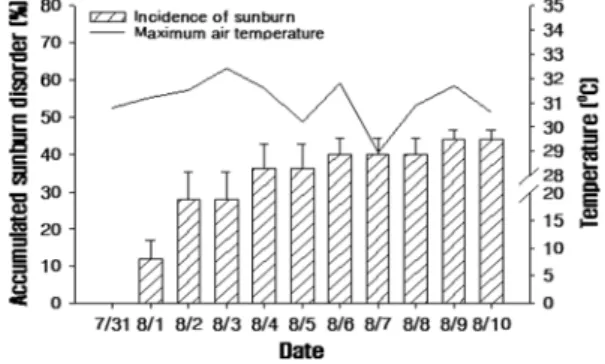
2001년 7월 31일에서 8월 10일까지의 시기별누적
일소증상발생과최고기온비교조사에서는 7월 31일 까지 조사대상의과실에서일소증상이나타나지않았
으나 최고기온이 31oC를넘었던 8월 1일부터일소증
상이 나타나기 시작하였다. 이후 최고기온이 31oC를 넘었던 8월 4일까지는일소증상발생률이증가하였으
나 최고기온이 31oC 이하였던 8월 5일과 8월 7~8일 에는잠시발생이멈추었고이후다시 31oC를넘었던
8월 9일에일소증상발생이증가하였다(Fig. 2).
지역에따른 일소증상 발생률은 3개년(2001~2003)
모두차이가없었으나조사년도에따라일소증상발생
률은 달랐는데, 2001, 2002년의 경우 모든 시험구의
일소증상 발생률이 17.3~23.2%로 비슷하였던반면에
2003년도는절반수준인 9.2~11.2%였다(Table 3).
2001년열방향이다른 4개지역(의성, 안동, 청송,
영주)의포장에서 착과방향에따른일소증상 발생양
상을살펴보면(Fig. 3), 4개포장에서쪽과남쪽을향
해착과된과실들의평균일소증상발생비율은각각
51.7%, 34.1%로 동쪽 11.7%, 북쪽 5.8%보다 현저하 Fig. 1. Influence of different bourse length on incidence of
sunburn disorder in ‘Fuji’/M.9 apple trees in 2001. Vertical bars indicate standard errors.
Table 2. Influence of different rootstock on canopy volume, terminal shoot length, and incidence of sunburn disorder in
‘Fuji’ apple trees in 2001 Rootstock Incidence of
sunburn (%)
Canopy volume
(m3)
Terminal shoot length
(cm)
M.9 18.7 az 2.61 b 20.1 b
M.26 09.5 b 4.53 a 24.9 a
zMeans followed by the same letter are not significantly different using T-test, P=0.05.
Fig. 2. Seasonal changes in accumulated incidence of sunburn disorder on fruit with bourse shoot that was about 5 cm length and maximum air temperature from July 31th to August 10th, 2001 in ‘Fuji’/M.9 apple orchard. Reference fruits were not harvested in reference period on incidence of sunburn. Vertical bars indicate standard errors.
Table 3. Influence of regional difference on incidence of sunburn disorder in slender spindle ‘Fuji’/M.9 apple trees for 3 years
Region (Row orientationy)
Incidence of sunburn Calender year
2001 2002 2003
Uiseong (EW-120o) 18.1 az 19.7 a 09.2 a Andong (NS-155o) 20.3 a 20.2 a 10.3 a Cheongsong (EW-115o) 23.2 a 20.5 a 11.2 a Yeongju (NS-40o) 17.3 a 18.3 a 09.4 a Gunwi (EW-75o) 18.2 a 19.7 a 10.1 a
zMeans followed by the same letter are not significantly different using Duncan's multiple range test, P=0.05.
게높았다. 특히, 열방향이동서방향에가까운동서- 120o인의성 포장과동서-115o인청송 포장에서는수 관내동쪽에착과된과실들에서일소증상이나타나지 않았으며, 열방향이 남북방향에가까운 남북-335o인 안동포장과남북-40o인영주포장에서는북쪽에착과
된과실들에서일소증상이나타나지않았다.
지역별일소증상발생과상관성이높았던최고기온
31oC를 기준온도로 넘었던 날(Fig. 2)의 누적일수와 일소증상발생률간의상관관계에있어서는누적일수 가높아질수록일소증상발생이증가하는경향을나타 내었다. 누적일수가 28~50일이었던 2001년의일소증 상 발생률은 17.3~20.3% 이었으며, 누적일수가 14~24
일이었던 2002년은일소증상발생률이 18.3~20.2%로
2001년과비슷하였다. 그러나누적일수가 6~11일이었
던 2003년의 일소증상 발생률은 2001, 2002년의 절
반수준인 9.2~10.3% 이었다(Fig. 4). 군위지역의연도
별 하루 평균 누적 총광량은 2001, 2002년의 경우
9.13~9.29MJ/m2로 차이가 없었으나 2003년은 2001, 2002년의 82~84% 수준인 7.68MJ/m2로낮았다(Fig. 5).
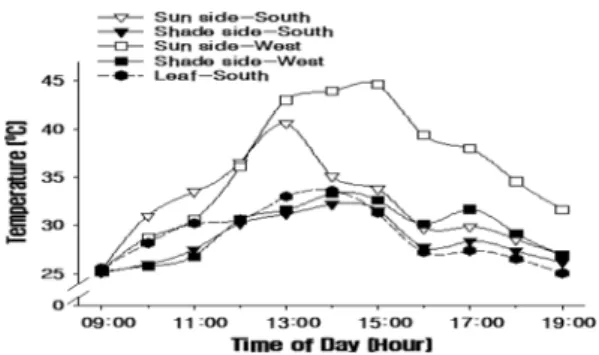
2001년 열 방향이 동서방향에 가까운 동서-75o인 군위소재 사과시험장포장에서 착과 방향(동, 서, 남,
북)에따른과실의양광면온도는오전 9시전까지는 평균기온과차이가없었으나오전 10시를넘어서는북
쪽을제외한모든양광면과실의온도가평균기온보다 높아졌다. 양광면과실온도가최고가된시점은착과
방향에 따라 달랐는데, 남쪽의 과실은 오후 1시에
40.6oC, 서쪽 과실은 오후 3시에 44.6oC 이었다. 동
쪽 과실은오전 11시에 33.6oC까지 올라갔으나이후
지속적으로떨어졌으며, 북쪽 과실은기온이가장높 았던오후 3시의 32.0oC와차이가없었다. 각방향의 과실표면온도와기온의차이에있어서는북쪽과동쪽 의 경우 각각 최대 5.8oC, 8.1oC의 차이가 나타났던
반면에 남쪽과 서쪽은 최대 차이가 각각 15.1oC,
19.1oC로북쪽과동쪽 대비 차이가약 10oC 더컸다
(Fig. 6). 남쪽과 서쪽에 착과된 과실 음광면과 남쪽
부위엽의평균온도는양광면에비해완만히증가되는 경향을보였다. 엽과과실음광면의온도가최고가된 시각은오후 2시로 엽은 33.6oC 이었으며, 남쪽과서 쪽의 과실은 각각 32.2oC, 33.3oC로 엽과 큰 차이가
없었다. 그반면, 남쪽과서쪽에착과된 과실의양광 면과 음광면의 과실 간온도 차이는남쪽의경우 오 Fig. 3. Influence of different sides of canopy and row orientation
on incidence of sunburn in slender spindle ‘Fuji’/M.9 apple trees in 2001. Row orientation was SE-120° in Uiseong, NW- 335° in Andong, SE-115° in Cheongsong, and NE-40° in Yeongju.
Fig. 4. Relationship between incidence of sunburn disorder and accumulated days (with maximum temperature of >31oC between 15 May and 31 August) in ‘Fuji’/M.9 apple orchards in Uiseong, Gunwi, Andong, and Yeongju for 3 years.
Fig. 5. Accumulated total quantum per day (between 15 May and 31 August) in ‘Fuji’/M.9 apple orchards in Gunwi for 3 years. Vertical bars indicate standard errors.
후 1시경에 9.4oC 차이가 났으며, 서쪽의 경우 오후
3시경에 12.0oC로큰폭의차이를나타냈다(Fig. 7).
IV. 고 찰
사과의 생산성은 수광률(light interception)과 정의 상관관계가성립되기에오늘날밀식사과원재배자들 은 수관 내 수광률 및 광 분포(light distribution)를 극대화하여 생산성증가 및과실품질 향상에 초점을 맞추고있다(Corelli-Grappadelli and Lakso, 2007).
본실험에서는왜화도의차이에따라 M.26 대목보
다 M.9 대목의수관용적이상대적으로 적었으며, 이
에 따라 일소증상 발생률도 높았다(Table 2). 수관용
적은 수고, 수형, 재식밀도 및대목에 의해 결정되는
데(Robinson, 2003), 왜성대목을 이용할 경우 작은
수관용적으로인해과실의직사광노출이높아져일소
증상 발생이 많아진다는 보고(Paulin, 1989; Schupp
et al., 2002; Wnsche et al., 2004)와유사하였다.
본시험에서 일소증상 발생률 정도에따른 나무별
수체생장및엽특성을비교한결과(Table 1), 일소증
상 발생이많았던나무들의 과대지길이 및과실 당 엽수가일소증상이적었던나무보다작았다. 또한과 대지길이에따른일소증상발생률에있어과대지길 이가길수록일소증상발생률이낮아지는경향이나타
나(Fig. 1), 과대지 길이가 길수록 엽의 차광효과가
높아져일소증상이감소되는것으로추정되었다(Fisher, 2000; Wnsche et al., 2001).
일반적으로열방향(row orientation)이남북쪽인과 원의 수광률및 광분포는열 방향이동서쪽인 과원 보다 높으며(Barden and Neilsen, 2003), 일소증상은 대부분나무의남쪽혹은남서방향에착과된과실에서 많이발생한다(Piskolczi et al., 2004). 본실험에서는
3개년 모두열방향에따른 일소증상발생차이는없
는것으로나타났으나(Table 3), 수관 내착과 방향에 따른일소증상발생은열방향에관계없이모두남쪽 과서쪽을향해착과된과실에서높은것으로나타났 다(Fig. 3).
8월의최고기온이 31oC를넘었을때누적일소증상
발생률이증가하였는데(Fig. 2). 이러한결과는 7~9월
기온이 28~32oC 이상이되면일소증상이발생된다는
보고(Piskolczi et al., 2004)와 일별 최고기온이
35oC를넘으면 과실 온도가일소갈변 증상이 발생될
수 있는 45oC에도달한다는 보고(Gindaba and Wand,
2005)와비슷한결과라고생각된다.
4지역의 3개년간의 일소증상 발생률(Table 3)과최
고기온이 31oC를넘었던날들의 누적일수간에는유 의한 상관관계가있었는데(Fig. 4), 2001년도는 2002
년도에비해 누적일수가 2배에달했으나일소증상발 생률은 비슷하였다. Schrader et al.(2003; 2008)는
과실온도에영향을미치는요인이많아단순히최고기 온만을가지고일소증상발생을예측할수없다고하 였다. 본실험에서 군위지역의 2001년과 2002년도 5
월 15일에서 8월 31일까지의 하루평균 누적 총광량 은 각각 9.29MJ/m2,9.13MJ/m2로 차이가 없었기 때
문에 일소증상 발생률에 차이가 나타나지 않았으며, 2003년의일소증상발생률이 2001년과 2002년에비해
낮았던것은누적일수와누적총광량모두낮아서발 생된것으로추정되었다(Fig. 5).
Fig. 6. Fruit surface temperature in different location in the tree canopy and air temperature on warm sunny day (27 Aug. 2001). Temperature was averaged hourly and surface temperatures were measured on the skin of the most exposed surface.
Fig. 7. Sun side and shade side of fruit surface temperature in the different location in the tree canopy and leaf temperature on warm sunny day (27 Aug. 2001). Temperature was averaged hourly and, surface temperatures were measured on the skin of the most exposed surface and shaded surface.
과실온도와기온의 상관관계에있어(Fig. 6, 7), 본 실험에서의일중평균기온은 15시에 가장높았으나,
남, 서쪽에착과된과실의양광면온도는 13시에이미
40oC를 넘었다(Parchomchuk and Meheriuk, 1996).
평균기온이 약 32oC로 가장 높았던 15시경 서쪽에
착과된 과실의 양광면온도는 44.6oC로 과실 온도가
약 12oC정도 높았다. 동일시각의양광면과평균기온 의 최대 차이는 15.1~19.1oC 이었으며(Schrader et
al., 2008), 양광면과음광면의 차이는 양광면이음광
면보다 3.4~6.5oC 정도높았다(Piskolczi et al., 2004;
Saudreau et al., 2008; Seo et al., 2008)는 보고에
근접한결과였다.
앞선 결과및보고를토대로할경우 ‘후지’/M.9에
서문제시되는일소증상발생은최고기온이 31oC 이 상인 누적일수가많을때 증가하는것으로나타났다.
또한본연구에서는조사지역별일사량에대한자료 를모두제시하지못하였으나군위의경우하루누적 총광량이 높았던해의일소증상 발생이많았다. 일반 적으로 대기가청명한날에 일사 강도는기온 및 과 실 온도 상승과 밀접한관계가 있으므로 일소증상의
원인이되는 40~45oC의과실온도는결국강한일사
의영향으로추정할수있다. 따라서향후 ‘후지’/M.9
의착과량조절, 유인, 전정을통해나무의적정수체 생장및광투과율을구명한다면일소증상발생을재 배적 기술만으로도상당히 경감시킬 수 있을 것으로 생각되었다.
적 요
본실험은 ‘후지’/M.9 재배체계에있어최근문제시
되는 일소증상 발생에미치는 한여름의 기온 요인을 구명하기 위하여실시되었다. 일소증상은최고기온이
31oC이상인누적일수및하루누적총광량이많을수록
발생이증가하였다. 상대적으로개방된수관을형성한
‘후지’/M.9은 ‘후지’/M.26보다 과실이 광에 노출되기
쉬워 일소증상 피해가 더컸다. ‘후지’/M.9 사과나무
중에서는과대지길이가짧은나무에서일소증상피해 가 더 컸다. 일소증상 발생은 재배지역 및 재식 열
방향에영향을받지않았고, 주로남쪽과서쪽에착과 된과실에서일소증상발생이많았다. 그이유는과실
이직사광선에노출되어과실온도가 40~45oC를넘었 기때문으로판단되었다.
REFERENCES
Barden, J.A. and G.H. Neilsen. 2003: Selecting the orchard site, site preparation and orchard planning and establis- hment. Apples; botany, production and uses, D.C Ferree and I.J. Warrington (Eds.), CABI Publishing, Cambridge, MA, USA, 237-265.
Barritt, B.H., 2000: The hytec (Hybrid tree cone) orchard system for apples. Acta Horticulturae513, 303-309.
Blanke, M.M., 2008: Perspectives of fruit research and apple orchard management in Germany in a changing climate. Acta Horticulturae772, 441-446.
Contreras, C., J.P. Zoffoli, J.A. Alcalde, and M. Ayala, 2008: Evolution of sunburn damage on ‘Granny Smith’ apples during storage. Cienciae Investigacion Agraria 35, 113-122.
Corelli Grappadelli, L. and A.A. Lakso, 2007: Is maximizing orchard light interception always the best choice?. Acta Horticulturae732, 507-518.
Corelli Grappadelli, L., 2003: Light relations. Apples; botany, production and uses, D.C Ferree and I.J. Warrington (Eds.), CABI Publishing, Cambridge, MA, USA, 195-216.
Fischer, G., 2000: Ecophysiological aspects of fruit growing in tropical highlands. Acta Horticulturae531, 91-98.
Gindaba, J. and S.J.E. Wand, 2005: Comparative effects of evaporative cooling, kaolin particl film, and shade net on sunburn and fruit quality in apples. HortScience40(3), 592-596.
Iamsub, K., Y. Sekozawa, S. Sugaya, H. Gemma, and Y.
Kamuro, 2008: Improvement of fruit quality by S-ABA and the fertilizer formulated K, P, Mg, Bo, Mn containing S- ABA as pre-harvest application on peaches and apples.
Acta Horticulturae804, 219-224.
Palmer, J.W., J.P. Priv, and D.S. Tustin, 2003: Temperature.
Apples; botany, production and uses, D.C. Ferree and I.J. Warrington (Eds.), CABI Publishing, Cambridge, MA, USA, 217-236.
Parchomchuk, P. and M. Meheriuk, 1996: Orchard cooling with pulsed overtree irrigation to prevent solar injury and improve fruit quality of ‘Jonagold’ apples. Hort Science31(5), 802-804.
Paulin, R., 1989: An apple production system for Western Australia. Acta Horticulturae 240, 109-114.
Piskolczi, M., C. Varga, and J. Racsko, 2004: Areview of the meteorological causes of sunburn injury on the surface of apple fruit (Malus domestica BORKH). Journal of Fruit and Ornamental Plant Research12, 245-252.
Robinson, T.L., 2000: V-shaped apple planting systems.
Acta Horticulturae513, 337-347.
Robinson, T.L. 2003: Apple-orchard planting systems. Apples;
botany, production and uses, D.C Ferree and I.J.
Warrington (Eds.), CABI Publishing, Cambridge, MA, USA, 345-407.
Robinson, T.L., A.N. Lakso, and S. G. Carpenter. 1991: Canopy
development, yield, and fruit quality of ‘Empire’ and
‘Delicious’ apple trees grown in four orchard production systems for ten years. Journal of the American Society for Horticultural Science116(2), 179-187.
Saudreau, M., A. Marquier, B. Adam, P. Monney, and H.
Sinoquet, 2008: On the relationship between tree archi- tecture, microclimate, and fruit temperature within a tree crown. Acta Horticulturae803, 217-224.
Schrader, L., J. Sun, J. Zhang, D. Felicetti, and J. Tian, 2008:
Heat and light-induced apple skin disorders: Causes and prevention. Acta Horticulturae772, 51-58.
Schrader, L., J. Zhang, and J. Sun, 2003: Environmental stresses that cause sunburn of apple. Acta Horticulturae 618, 397-405.
Schupp, J., E. Fallahi, and I.J. Chun, 2002: Effect of particle film on fruit sunburn, maturity and quality of
‘Fuji’ and ‘Honeyscrisp’ apples. Hort Technology 12, 87-90.
Schupp, J., E. Fallahi, and I.J. Chun, 2004: Effect of particle film on fruit sunburn, maturity and quality of
‘Fuji’ and ‘Honeyscrisp’ apples. Acta Horticulturae636, 551-556.
Seo, J.H., J. Sun, L. Schrader, and J. Tian, 2008: Use of chlorophyll fluorescence to assess heat stress in apple fruit. Acta Horticulturae772, 279-282.
Smit, A., W.J. Steyn, and S.J.E. Wand, 2008: Effects of shade netting on gas exchange of Blushed apple cultivars. Acta Horticulturae772, 73-80.
Wnsche, J.N., D.H. Greer, J.W. Palmer, A. Lang, and T.
McGhie, 2001: Sunburn-The cost of a high light envi- ronment. Acta Horticulturae557, 349-356.
Wnsche, J.N., J. Bowen, I. Ferguson, A. Woolf, and T.
McGhie, 2004: Sunburn on apples-Causes and control mechanisms. Acta Horticulturae636, 631-636.
Yoon, T.M. 2004: Development of high density apple growing in Europe and Korea. Proceedings of the symposium on recent high density apple growing techniques and prospects, National Horticultural Research Institute, 79-97.
http://www.mifaff.go.kr/(2009. 9. 8)