몽골에서의 문화개입과 알코올 중독증의 관계에 관한 연구
1)바타르 볼로마*, 노윤채**, 김종욱***
A Study on the Relationship between Cultural Intervention and Alcoholism in Mongolia
Baatar Bolormaa*, Yun-Chae Noh**, Jong-Wook Kim ***
요 약
알코올과 알코올 중독증을 문화적 면에서 연구하는 문헌이 있다. 하지만 사회 내부제도가 변화되면서 음주문화 를 변화시킨 정부의 문화개입이 발생하였음에도 불구하고 음주행위나 알코올 중독증의 영향에 관한 연구는 거의 없 다고 볼 수 있다. 이 문제는 본 연구의 주목적이다. 연구목적을 달성하기 위하여 연구사례로 몽골을 선정하였으며 몽골의 전통 음주문화 혹은 음주예절의 측정을 위해 몽골의 역사적 근원을 연구해서 1인당음주량, 알코올중독 관련 70년간의 인지도조사, 통계 등 다양한 연구자료에 의해 분석을 하였다. 각종 연구자료 분석 시 몽골의 청년 음주문 화가 그들의 조상들이 엄숙하게 따르던 전통음주문화와 맥락부터 많이 변화된 것을 관찰할 수 있었다. 연구결과에 의하면 현대화 관련 음주문화 변화와 음주(소비)간에는 상관성이 있는 것으로 나타났다.
▸Keywords : 문화적 개입, 음주 문화, 내부 제도, 알코올과 알코올 중독
Abstract
There is literature addressing to cultural aspects of alcohol and alcoholism. However, scholars have paid little attention to study what will happen to alcohol consumption behavior and alcoholism if there is a national government cultural intervention, so that the alcohol drinking culture would change in association with the change of internal institution in a society. This work attempted to study this research question.
For this purpose, I selected Mongolia as a research case and examined survey data, statistical data, and data from research-based resources, referring to the last 70 years profile of Mongolian alcohol per capital consumption and alcoholism as well as studying Mongolian historical sources for measuring Mongolian traditional alcohol drinking customs. The data I gathered and observed during this research proved that
∙제1저자 : 바타르 볼로마, 교신저자 : 김종욱
∙투고일 : 2014. 12. 19, 심사일 : 2014. 12. 26, 게재확정일 : 2015. 1. 12.
* 몽고 과학기술대학 교수(Mongolian University of Science and Technology)
** 광주광역시 통합정신건강센터 상담원(Integrated Mental Health Centre of Gwangju Metropolitan City)
*** 나주 청소년 상담센터(Naju Adolescent Consulting Centre)
there is a huge difference between the current drinking culture among younger generation and Mongolian traditional cultural context that was respected and strictly followed by their ancestors. Findings suggest that there has been a parallel increase between the change of alcohol drinking culture and alcohol consumption in connection with the modernization.
▸Keywords : cultural intervention, drinking culture, internal institutions, alcohol and alcoholism
I. Introduction
In this research, I also made observations on survey and statistical data that covering 1950-2014 in attempt to analyze whether there has been rapid increase in alcoholism's spread among mass or the amount of patients who suffer from alcoholism. I gathered and made observations on two types of data. Firstly, I worked on data that describe the production amounts of alcoholic beverages from 1950-2014. The data confirm that the production of spirit and alcoholic beverages have often increased at a rapid pace steadily since 1950. Most especially both production and import of alcoholic beverages and spirit have increased explosively since 1990s.
These data mean that there has been rapid increase in the demand for alcoholic beverages and spirit in the last two decades. Secondly, I analyzed data, referring to the amount of patients who suffer from alcoholism and the amount of people who drink to excess. This type of data also confirms that there has been steady and radical increase in alcoholism in 1950-2014.
Finally, I compared the above two sets of data in order to measure the effect of cultural change and modernization on drinking culture of Mongols and as a result, alcoholism emerged as a serious social problem that occurred in 1950-1989 and in 1990-2014. Discussion part of this paper focuses on
analyzing whether there is causality relationship between the internal institutional change under the influence of modernization and the change of drinking customs among Mongols and finally as a result, the emergence of alcoholism as a social problem.
Ⅱ. Mongolian Traditional Alcohol Drinking Culture
Internal institutions play a crucial role in determining national values, culture, customs, and way of living. Modernization, internationalization and globalization have had strong effects on the change of traditional internal institution. For example, in the last century there have been strong changes in the internal institution of many countries around the world. Most especially, modernization brought huge changes in countries where strong state existed. One good example is Mongolia.
The Mongolian history of last century is very rich for the stories of revolutions, independence, modernization, and freedom. Those great changes affected the traditional internal institutions of Mongols a lot including national value, way of living, individual philosophy, culture, and etc. This study assumes that the Mongolian internal institutions’ change affected the alcohol drinking culture of Mongols through two revolutions’ waves:
the 1921 People's Revolution and 1990 Democratic
Revolution. Therefore, the purpose of this study aims to examine whether there is a causal effect between the internal institutions’ change and alcohol drinking culture. For this purpose, I faced a challenge to determine the traditional alcohol drinking culture that used to exist among Mongols before the 1921 People's Revolution for independence and modernization that brought effective political, economical, cultural and educational mobilizations that affected Mongolia's traditional internal institutions.
Alcohol Drinking Culture in Mongolian Traditional Internal Institution
According to Mongolian historical sources, the consistency of Mongolian traditional alcohol drinking culture dates back to 12th century when Khabul Khan[22] ruled Mongolia. During the reign of Khabul Khaan, there was an alcohol drinking custom that 40 year old person should taste alcohol a little; 50 year old person should drink alcohol in moderation, and 60 year old person should drink for happiness.[6]
L. Erdenebayar (2001) said that spending time for happiness and entertainment together during a festival, celebration day, feast and other special events was more important than drinking alcohol.
Generally Mongolians didn’t prefer to encourage their guests to drink to excess. Instead, according to the traditional custom for alcohol drinking, it was more important for Mongolians to organize feasts and festivals for entertainment and happiness with plenty of food.
Mongolian famous scholar B. Rinchin (1970) wrote that drinking alcoholic beverages create good feeling, but custom is the most important.[13] He strongly crticized the alcohol drinking patterns of people in the 1970s in his article published in newspaper. The Khudulmur. According to his article, Mongolia is a great nation with a tremendous custom to consume alcoholic beverages, but some modern young people ignore the alcohol drinking
custom and drink to excess and become intoxicated when old people see them. The traditional custom strongly prohibits young people to drink alcohol to excess. This fact shows that drinking alcohol to excess and becoming intoxicated is not the Mongolian custom.
uring the Mongolian Lunar New Year, it is strongly prohibited to drink alcohol until they become intoxicated. Mongolians think that they will be intoxicated for a whole year if they become intoxicated during the Mongolian Lunar New Year’s celebration. During other celebration and special days including a wedding, hair feast, festival, housewarming party, relatives’ visit and etc, Mongolians used to drink a little alcohol as a custom.
According to Mongolian traditional alcohol drinking custom, it is strictly prohibited for people to treat young people with alcoholic beverages.
There was a strong traditional custom among Mongols to offer and drink alcoholic beverage when a guest arrives at home. Only a wife had the right to offer an old person or a guest alcohol, but the old person or guest didn’t raise a toast and empty the glass or cup of alcoholic beverage (Erdenebayar, 2001). Mongolians dislike people who empty a glass.
L. Erdenebayar (2001) explained that full glass or cup of alcohol doesn’t mean serving guest with too much alcohol, so that the guest becomes intoxicated.
It means that a guest should be provided with an opportunity to drink alcohol slowly, so that the guest has a good talk, nice time, and fun with a host family. According to the traditional drinking custom, during a feast, host family must offer guests alcoholic beverages only after they treat guests with meals and tea, but the guests should drink little alcoholic beverages.
During traditional feasts and festivals, there are
moderators. In Mongolian traditional customs, the
moderators shouldn’t focus on creating environment
to become intoxicated. They should provide
participants with the opportunities to enjoy festivals or feasts and have full fun. The moderators have the right to end the festival or feast with good words explaining that the host family or host side wants to continue the feast or festival, but we need to follow our ancestors’ tradition to end it for our tomorrow’s work. This way of ending a feast or a festival prevents becoming intoxicated.
If old people see a person drinking to excess or becoming intoxicated or a young person drinking alcohol during a feast, they say to the person becoming intoxicated or the young person drinking alcohol to go out and see a horse. The word means that the person must stop to drink alcohol (Erdenbayar, 2001).
Traditional External Institutions[5] against Drinking to Excess
L. Erdenebayar (2009) wrote that Mongolians used to respect alcoholic beverages, but they passed laws prohibiting drinking alcohol to excess and used to have strong regulations to realize them. There used to be strong regulations determining the doses to drink alcoholic beverages.[7]
The most ancient legal regulation against drinking alcohol to excess refers to Yehe Zasag (Yassa). Yasa is a code of honor, dignity, and excellence created by Chingis Khan. Chingis Khan was very aware of harmful consequences of becoming intoxication and had very clear statement about those harmful effects on human’s violent behavior and all sorts of accidents and mistakes. The Chingis Khan’s statement about the use and consequences of alcoholic beverages are clearly described in the Paul Rachnevsky’s biography.
ü “The commoners (qarachu) drank away their horses, their herds and became beggars. One of Chingis' bilik (sayings) stated that alcoholic drink intoxicated the good and the bad to the same extent, without respect for position and character; it numbed the senses and the limbs;
hands lost their ability to grasp properly, limbs their ability to move, the mind the ability to think sensibly. Chingis, a student of human nature, was, however, realistic in formulating his command for moderation: 'If there is no means to prevent drunkenness, a man may become drunk thrice a month; if he oversteps this limit he makes himself guilty of a punishable offence. If he is drunk only twice a month, that is better - if only once, that is more praiseworthy. What could be better than that he should not drink at all?
But where shall we find a man who never drinks? If, however, such a man is found, he deserves every respect.'"[12]
The dose of drinking alcoholic beverages is prescribed in the Yehe Zasag Code (Yasa) as it is written below.
ü “If unable to abstain from drinking, a man may get drunk three times a month; if he does it more than three times he is culpable; if he gets drunk twice a month it is better; if once a month, this is still more laudable; and if one does not drink at all what can be better? But where can I find such a man? If such a man were found he would be worthy of the highest esteem. (Riasanovsky considers this fragment to belong to the Maxims of CHINGIS KHAN, maxim 20)”[12]
The second major law before the 1921 People’s Revolution that had provisions about the use of alcoholic beverages was Khalkh Juram. It was enacted in 1709. Most especially there was a strong provision prohibiting the use of alcoholic beverages among monks. For example:
ü In the 298th article of Chapter 12, it is prescribed that if a bhikkhu monk drinks alcohol, he will be fined with three horses; if an ordained monk drinks alcohol, he will be fined with two horses, and if a novice monk drinks alcohol, he will be fined with one horse.
ü In the 229th article, it is written that if a man
on official trip drinks alcohol, he will be fined with one horse and the one horse will be given to a witness.
ü In 300th article, if a person hides above mentioned accidents of drinking alcohol, the person will be fined with one horse. In the 301st article, if a person offers above mentioned people, the person will be fined with one horse.[3]
Ⅲ. Modernization and Cultural Change among Younger Generation:
New Alcohol Drinking Culture and Alcoholism
Although Mongolia wasn't successful enough in developing democracy, maintaining freedom, and developing national economics during the socialist period from 1921 to 1990, it achieved great success in modernization and education at those years.
Mongolia succeeded in eliminating illiteracy during the socialist period. Due to the significant achievement, today 98% of population is literate.
[20] This is very high literacy rate. Before the 1921 People's Revolution, Mongol had very low literacy rate, rated around 10%. In those years, modern science, secondary education, higher education, and public health systems were introduced to Mongolia and developed at an enormously rapid pace.
Although Mongolia made great achievements in modernization and above mentioned areas during the socialist period, some negative cultural effects also occurred. In this study, I assume that the modernization caused the serious weakness of Mongolian traditional internal institutes; the weakness affected the change of alcohol drinking custom of Mongols dramatically, and as a result, the change has led to the rapid increase of alcoholism in Mongolia. This section focuses mainly on examining
whether there is a parallel increase in the production of alcoholic beverages and alcoholism in Mongolia in connection with the modernization and cultural change.
New culture and new way of living began to spread among younger generation that had been educated in Eastern Europe, mostly in the Soviet Union with the strong Eastern European cultural influence and full of the Soviet Union or Marxist-Leninist propaganda. Due to the achievement in the development of Soviet Union style education, the powerful influence of Mongolian traditional internal institutions began to weaken and some of them began to disappear among young people.
European style banquets and parties began to become popular everywhere in Mongolia. For instance, the celebration of New Year had been more popular rather than the Lunar New Year and already become an official holiday by the 1950s.
Since nomads became processing industry workers, members of agriculture and animal husbandry collectives (negdels), university students, government staff, medical staff, academic staff, and etc, they began to have various banquets and parties including colleague party, organization banquet, graduation ceremony, anniversary ceremonies, award banquets, and so on. Even making a toast had been already common in Mongolia. Therefore, I gathered and observed the data that refer to the production of alcoholic beverages and the statistical data of alcoholism from 1950 to 1990 and from 1990 to present in an attempt to examine whether there are production and alcoholism data that supports the main assumption of this research.
For the above purpose, I observed and analyzed
the data on the level of consumption “The Recorded
Alcohol per Capita (15+) Consumption (in litres of
pure alcohol) from 1960 t0 1989. The data is
available in the database of World Health
organization. Global Health Observatory Data
Repository has the data set. The data that describe
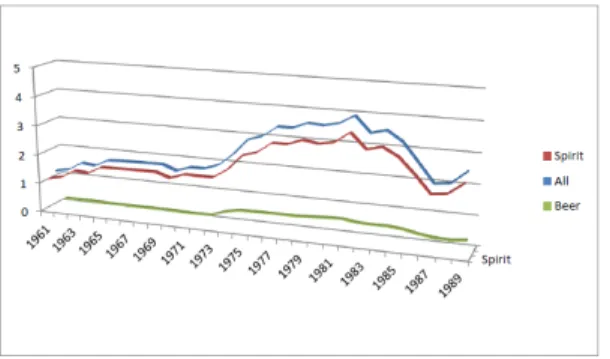
the Mongolian alcohol per capita consumption from 1961 to 1989 is available there. And also it contains data of Mongolian alcohol consumption per capita from 1990 to present. At first, I focused on the first data set from 1960 to 1989 in an attempt to examine whether there a parallel increase between modernization and alcohol consumption during the socialist period (1921-1990). The data is shown below.
Figure 1. Mongolia: Recorded Alcohol per Capita (15+) Consumption, 1961-1989
Source: Global Health Observatory Data Repository, World Health Organization, 2014.
The data shown above describe that the alcohol consumption among Mongolians increased steadily and rapidly since 1961 to the early of the 1980s.
This fact indicates that consumption rise matches the modernization and cultural change's period that occurred actively from 1961 to 1980.
The steady increase in the alcohol per capita consumption also means that there had been high demands of alcohols in those years. In other words, we could conclude that Mongols had already adopted Soviet style new drinking culture that had motivated and created the steady and rapid increase of alcohol demand or consumption in the domestic market.
According to the data set, it seems that spirit and beer replaced Mongolian traditional soft milk liquor and they became major alcohols on the tables of modern style feasts such banquets, a graduation party, a colleague party, a birthday party, new year party, and so on.
This also shows that the change of Mongolian internal institutions (cultural change) that occurred in 1961-1980 affected the type of alcoholic beverages Mongolians consumed and alcohol drinking culture of Mongolian younger generation. Mongolian younger generation was used to drinking vodka that is distilled from spirit. Moreover, the data from the World Health Organization shows that Mongolians began to consume beer during those years. However, in comparison with the spirit, the beer per capita consumption was very low during the socialist period.
In addition to the data of alcohol per capita consumption, I gathered and observed the data describing the profile of alcoholism from the beginning of the 1960s to the early of the 1980s. I gathered most of the data from L. Erdenebayar's research based sources, because he is the most outstanding Mongolian scholar who has conducted many useful theoretical research projects and reliable surveys on alcoholism since the socialist period until present. Since his research-based works and surveys are the most reliable ones in Mongolia, I apply the data from his research based sources in this section to measure whether the new alcohol drinking culture among Mongolian younger generation caused the increase of alcoholism in Mongolia.
First, in the early of the 1940s, Soviet Union's doctor I. S. Anisimov began to treat few patients that suffered from narcotics and alcoholism.
This shows that alcoholism was not so serious social problem at that time. However, the data from one of the research-based sources tell us that alcoholism had already emerged as a serious social problem that came into the attention of socialist Mongolian government by the early of the 1970s (L.
Erdenebayar, 2009). For instance, for the goal to
boost campaign against alcoholism, the People's
Great Khural of the People's Republic of Mongolia
passed 111th and 120th decrees in March and April,
1974 consequently. In the framework of government
effective policy against alcoholism, the Narcology Center cabinet was founded at the Mental Health Dispensary and narcology department with 25 beds was opened at the Mental Health Hospital in Shar Khad in 1975-1976 (l. Erdenebayar, 2009).
On May 21, 1985, the People's Great Khural passed 126th decree to send some acute patients to corrective labor treatment centers. The corrective labor treatment divisions were established in some corrective labor colonies in Yeruu, Burenkhaan, and Bayanzurekh and each colony had a corrective treatment division with 50 beds (L. Erdenebayar, 2009). These data mentioned above describe that alcoholism emerged as a serious social problem in the same period when new drinking culture developed and new types of alcohols became popular among Mongolian younger generation. These facts also show that there is a causal effect between alcohol drinking culture and alcoholism.
The alcoholism surveys conducted in 1987-1997 match the statement I made in the above paragraph.
According to the results of those surveys, the amount of people in pre-alcoholism condition who often abuse alcohols increased in regions with intensive rate of alcoholism expansion. By 1987, the amount of alcohol abusers was relatively high. There were 14.9-18.7 among 1000 people in urban areas and 11.0-14.2 were among 1000 people in rural areas. The amount increased to 80.5-103.3 in urban areas and 23.5-26.6 in rural areas. L. Erdenebayar (2009) concluded that we could explain the increasing trend of alcohol abusers with socioeconomic, cultural, and ethnic factors. He explained that the rapid rise of alcohol abusers could be the result of urbanization. According to the survey conducted in 1997, 51.2% of total adults drink alcohol to excess and 8% of them were women.
The amount was 543 among 1000 people. The rate of alcoholism increased three times in Mongolia in 1994-2009 (L. Erdenebayar, 2009).
The sample survey that was made in 1997 show that 23-25 liter alcoholic beverage referred to per
person (L. Erdenebayar, 2009). However, world average level is less than 8 liter for per person.
There were 235 factories or companies that produced 5.9 million liter spirit, 16.8 million liter vodka and 7.3 million beers. These data indicate that there is a huge expansion in the alcohol per capita consumption.
I observed the data of alcohol per capita consumption in 1990-2010 to examine the Mongolian trend of alcohol consumption after 1990 Democratic Revolution. The data is also obtained from the database of the World Health organization. The data includes data from 1990 to 2010.
Figure 2. Levels of Consumption: Recorded Alcohol Per Capita Consumption,
from 1990 to 2010
Source: Global Health Observatory Data Repository, World Health Organization, 2014.
The data described above show that there was decrease in the alcohol per capita consumption in the 1990s. We shouldn't understand the decrease as a result of the change of Mongolian alcohol drinking culture that occurred after the democratic revolution. If there is a change in alcohol drinking culture, the decrease should have continued steadily, but the alcohol per capita consumption began to increase at a rapid pace again since 2004.
We can explain the decrease in association with the economic crisis that occurred exactly after the socialist regime collapsed in Mongolia. At that time, Mongolia faced many serious economic problems:
basic food shortage; unemployment rise, national
industry bankruptcy, and inflation. There was
nothing in shops except for salt. Mongolian government introduced food rationing system to overcome the food shortage. A family was allowed to buy one bottle of vodka per month during the food rationing system. Moreover, at that time illegal spirit trade and production expanded a lot at that time. Consequently, although alcohol per capita consumption decreased during those years, the amount of alcohol abusers increased and their amount reached 51.2% of total adults and as a result, alcoholism increased three times since two decades later after the 1990 Democratic Revolution.
In 2000-2003, Mongolian economy also declined again, because Mongolian agriculture and animal husbandry had huge loss in association with natural disasters and bad weather. Since there had been alcohol drinking culture supporting alcohol abuse and alcoholism, alcohol per capita consumption began to increase again rapidly when Mongolian economy began to recover since 2004.
Ⅳ. Discussion
In this research, I focused on the causal relationship between cultural context and alcohol abuse and also between cultural context and alcoholism.
To address the causality relationship, I proposed a relatively new research goal to examine what will happen to alcohol consumption behavior and alcoholism if there is a government cultural intervention, so that the alcohol drinking culture would change in association with the change of internal institute in a society.
In the first step of this research, I focused on measuring the feature of traditional alcohol consuming culture among Mongolians. The data I gathered and observed during this research proved that there is a huge difference between the current drinking culture among younger generation and Mongolian traditional cultural context that was respected by their ancestors.
Younger generation follow more Soviet style drinking culture rather than their ancestors' cultural tradition when they consume alcoholic beverages. For example, Mongolian ancestors never celebrated their birthday every year, but younger generation do so. Traditionally, there had been strong customs and internal institutions prohibiting or preventing to drink to excess. There had been strong age limits for consuming alcoholic beverages and the age limitation used to determine the dose of drinking alcohols among Mongols. Today, Mongolians don't follow the age limitation tradition in consuming alcoholic beverages. The data that were gathered and observed during this research show that younger generation has given up using their ancestors' strong customs determining alcohol drinking behavior of Mongols. This influenced me to pay attention to what caused the weakness at the best or disappearance at the worst of Mongolian traditional cultural context on alcohol consumption.
I made a prediction that government cultural mobilization for modernization caused the change of cultural context. To examine my prediction, I worked on historical sources that contain data on socialist Mongolian government’s intervention policies and operations for modernizing its society.
This research result shows that the most effective and successful modernization in education, culture, and way of living occurred in 1950-1970.
During the research, I found that on one hand,
government effective role can manage to modernize
nation even that had 100 year backwardness, but on
the other hand, if there is a biased modernization
policy, it could destroy some advantages of
traditional culture. The good example is a Mongolian
case. During the socialist Mongolian period, the
education for younger generation was full with
Marxist-Leninist ideology and aimed to undermine
national ideology and traditional customs. Due to
the effective biased educational campaign,
Mongolian younger generation began to ignore their
traditional customs and preferred to learn and follow
modern European culture. Consequently, Mongolian society that was dominated by younger generation lost its immunity to prevent the expansion of alcohol abuse and alcoholism as well as maintaining the smart alcohol consumption under the advantages of traditional internal institutions on alcohol.
I also found that new Soviet style culture created a comfortable social context increasing opportunities to consume alcohols more often and introducing new strong types of alcoholic beverages. As European party culture had been very influential over younger generation, the number of events or special days that create environments to consume alcoholic beverages increased a lot. For example, European style banquets, graduation ceremony, and other celebration events became very popular among Mongolian population during the socialist period.
In sum, all the evidences I revealed during this research suggest that alcoholism has emerged as a new serious social problem in Mongolia since the socialist Mongolian period, especially since the late 1970s. We could find the reason from the radical changes of Mongolian internal institute that started in the early 1950s. This research found that the change of cultural context leads to the change of drinking behavior of a society if there is a government effective educational and cultural mobilization with full of political ideology and ambition to change the behavior of social members (citizens).
Ⅴ. Conclusion
This research aimed to examine the causal effect between the change of alcohol cultural context and the expansion of alcohol abuse or alcoholism. During this research, I found evidences suggesting that the Mongolian government mobilization for modernization affected the change of whole Mongolian internal institutions and the change of alcohol drinking culture was the result of structural effect of the changes that occurred in the Mongolian
traditional internal institutions.
In this research, I used international and domestic statistical survey data on alcohol per capita consumption, and data obtained from research-based sources and historical sources. I didn’t use any data that were produced through qualitative approach. Therefore, future research on this issue needs to use data that are produced from qualitative research.
This research focused only on Mongolian case in examining its theoretical predictions or hypotheses suggesting that the change of alcohol drinking cultural context determines or affects alcohol consumption behavior, level of alcohol abuse and the rate of alcoholism. Thus, for the further generalization, comparative studies on this research issue are required.
REFERENCES
[1] Au.M.A, Judith G.. and Steward I. Donaldson.
2000. “Social Influences as Explanations for Substance Use Differences among Asian-Americans and European-American Adolescents . ” Journal of Psychoactive Drugs 32 (January-March):15-23
[2] Dietler, Michael. 2006. “Alcohol Anthropological/ Archaeological Perspectives.”
The Annual Review of Anthropology 35:
229-249.
[3] Enkhbaatar. 2010. “Халх журам хуул ь [Khalkh Juram Law].” January 26.
http://halhjuram.blog.gogo.mn/read/entry7602 9 (June 27, 2014).
[4] Felson, Richard B., Juka Savolainen, Thorroddur Bjarnason, Amy L. Anderson, and I Tusty Zohra. 2011. "The Cultural Context of Adolescent Drinking and Violence in 30 European Countries." American Society of Criminology 49 (3):699-728.
[5] Kasper, Wolfgang and Manfred E. Streit. 2001.
Institutional Economics: Social Order and Public
Policy. Cheltenham, UK & Northampton, MA, US: Edward Elgar.
[6] Luvsandorj, Erdenebayar,. 2001. Мансуур ал судлалын үндэс [Basic Narcotics].
Ulaanbaatar: T&U.
[7] Luvsandorj, Erdenebayar. 2009. Архинд д ондох өвчин [Alcoholism]. Ulaanbaatar.
Soyombo Printing.
[8] Mandelbaum, Daved G. 1965. “Alcohol and Culture.” Current Anthropology 6 (3): 281-293.
[9] Neumark, Yehuda D., Giora Rahav, Meir Teichman, and Deborah Hasin. 2001. “Alcohol Drinking Patterns among Jewish and Arab Men and Women in Israel.” Journal of Studies on Alcohol (July): 443-447.
[10] Nolen-Hoeksema, Susan. 2004. “Gender Differences in Risk Factors and Consequences for Alcohol Use Problems.” Clinical Psychological Review 24: 981-1010.
[11] Newman, Ian. 2002. “Cultural Aspects of Drink and Alcohol Controls in China.” The Globe (Global Alcohol Policy Alliance) (1): 18-21.
[12] Oestmoen, Per Inge. 2003. “The Yasa of Chingis Khan: A Code of Honor, Dignity, and Excellence.”
February 27. http://www.coldsiberia.org/
webdoc9.htm(June 28, 2014)
[13] Rinchen, B. “Сахад сайхан ч ёс эр хэм [Alcoholic Beverage Makes Good Feeling, but Custom is More Important],” Khudulmur, 1970.
[14] Room, Robin, and Sandra L. Bullock. 2002.
“Can Alcohol Expectancies and Attributions Explain Western Europe’s North-south Gradient in Alcohol’s Role in Violence?” Contemporary Drug Problems 69:619–48.
[15] Room, Robin. 1988. “Cross-cultural Research in Alcohol Studies: Research Traditions and Analytical Issues.” In Cultural Influences and Drinking , eds. Tom Harford and Lee Towle.
Washington, D.C.:USGPO, 9-40.
[16] Room, Robin. 2001. Intoxication and Bad Behaviour: Understanding Cultural Differences
in the Link. Social Science and Medicine 53:189–98.
[17] Room, Robin. 2007. Understanding Cultural Differences in young people’s drinking. In Youth Drinking Cultures: European Experiences , eds.
Margaretha J¨arvinen and Robin Room.
Burlington, VT: Ashgate.
[18] Russel-Bennett, Rebecah and Andrew Golledge.
2009. “An Investigation of Cross-Cultural Differences in Bindge-Drinking Perceptions and Behaviours.” In Proceedings of Autsralia and New Zealand Marketing Academy Conference, November- 2
ndSeptember.
[19] Tse, Eliza C. 2011. “A Comparative Analyses of Alcohol Consumption Pattern among Global University Students.” Presented at the International CHRIE Conference-Refereed Track. Paper 10.
[20] World Bank. 2010. Literacy Rate, Adult Total http://data. worldbank. org/ indicator/SE. AD T. LITR.ZS
[21] World Health Organization. 2014. Global Health Observatory Data Repository.
[22] Khabul khan (1120-1148 / 1150) is the first
khan of all Mongols' confederation and great
grand-father to Chinggis Khaan (also see
Encyclopaedia Britannica, p://www.britannica
.com/EBchecked/topic/316014/Khabul-Khan).
저 자 소 개
Baatar Bolormaa
2014: Completion of Ph.D. Course in Social Welfare, Graduate School, Chosun University.
Present: Lecturer, Mongolian University of Science and Technology Area of Interest: Social Welfare
Policy, School Social Work, Theory of Addiction
e-mail: bumbaalai8888mn@yahoo. com
Noh Yun-Chae
2013: Completion of Doctoral Course in Social Welfare, Graduate School, Chosun University.
Present: Integrated Mental Health Centre in Gwangju Metropolitan city Area of Interest: Mental health,
Youth welfare, Social work practice.
e-mail: [email protected]
Kim Jong-Wook
2014: Completion of Doctoral Course in Social Welfare, Graduate School, Chosun University.
Present: Naju Adolescent Counseling Center Area of Interest: Social Welfare
Policy, Community Psychiatry Health, Policy Evaluation of Psychiatry Health
e-mail: [email protected]