• 검색 결과가 없습니다.

Exercise Adherence Model of Middle-Aged based on Theory of Self-determination

N/A
N/A
Protected

Academic year: 2021

Share "Exercise Adherence Model of Middle-Aged based on Theory of Self-determination"

Copied!
7
0
0

로드 중.... (전체 텍스트 보기)

전체 글

(1)

Exercise Adherence Model of Middle-Aged based on Theory of Self-determination

1)

Miok Lee*

Abstract

The purpose of this study was to construct and validate a middle - aged exercise adherence model.

The model was designed based on self - determination theory. Participants were 215 middle-aged men and women aged 40-60 who had been exercising for more than six months. Data was collected from four big cities of Seoul, Busan, Gwangju and Daejeon in Korea, using a questionnaire consisting of basic psychological needs, intrinsic motivation, social support, and exercise adherence. Data were analyzed with SPSS 19.0 and AMOS 20.0. Social support and exercise adherence of the questionnaire were partially revised and verified by confirmatory factor analysis. The results of the study were as follows.

The model's fit indices: GFI = .938, AGFI) = .915, NFI = .912, CFI = .941, and RMSEA = 0.041. The model satisfied the model fit of the structural model equation. This study model based on self - determination theory was confirmed that basic psychological needs, intrinsic motivation, and social support were important factors for the middle - aged's exercise adherence. Basic psychological need and intrinsic motivation had a direct influence on the adherence of exercise, and social support indirectly influenced the exercise adherence through intrinsic motivation. Both basic psychological needs and social support directly affected internal motivation. The most influential factor in the middle - aged's exercise adherence was intrinsic motivation. In conclusion, it was found that intrinsic motivation such as interest and fun is important for the middle - aged to continue the exercise. Also, the basic psychological needs were important for middle aged's exercise adherence. The results of this study will provide basic data for restoring or maintaining health by continuing exercise. Strategies that enhance intrinsic motivation are needed when a chronic ill person needs to continue long-term exercising.

▸Keyword: Exercise, Middle-aged, Motivation, Need, Self-determination theory

I. Introduction

Middle-aged exercise is essential for health. Even if you know that exercise is healthy, it is not easy to participate in exercise. It is also difficult to continue for a long period even if one begin exercising.

In middle age, aging begins and health problems are likely to occur. In addition, the support of the elderly parents and the independence of their adult children can lead to mental

health problems such as depression due to economic burden and empty nest. Middle-aged women experience menopause.

Menopause is not only a loss of youth, but also a chance to find a new self. They are also at risk for cardiovascular disease or osteoporosis due to a rapid decline in female hormones. Health care is more important to adapt to the various physical and mental changes of middle age.

∙First Author: Miok Lee, Corresponding Author: Miok Lee

*Miok Lee ([email protected]), Dept. of Nursing, Kyungdong University

∙Received: 2018. 09. 06, Revised: 2018. 09. 20, Accepted: 2018. 09. 20.

∙This paper is part of a doctoral dissertation.

(2)

For middle-aged health, regular health checkups, nutrition, and exercise are important. Among these, exercise has been recommended as an essential factor for middle-aged health.

Regular exercise in middle age was known to be beneficial to mental health as well as physical health.

In the middle ages, a steady physical exercise is essential for health because the metabolism slows down and weight gain and insulin requirement increase, which can lead to various diseases such as diabetes, arteriosclerosis, hypertension and myocardial infarction[1]. There was a significant difference in the middle-aged body image depending on the exercise, and the body image and the depression showed a negative correlation[2]. Middle-aged women suffer from menopause, which can lead to osteoporosis due to a decrease in estrogen. There was a statistically significant difference in the exercise-related prevention of osteoporosis education among women aged 35-45 compared to the control group[3]. Cardiovascular disease prevention education in postmenopausal women includes exercises on cardiovascular disease prevention knowledge and health behavior practice items[4]. However, according to a study of the relationship between aging and physical activity in the urban middle-aged in 2015, 62.6% of the participants did not perform physical activities[5]. The fact that middle-aged exercise participation rate was not even half showed that there was a gap between knowledge and practice.

Therefore, the factors connecting the gap between knowing and doing should be identified.

Barriers to participation in physical activity and exercise among middle-aged and elderly individuals were lazy, lack of motive, time, exercise facility, friends[6]. Therefore, it is necessary to pay attention to the factors that sustain the exercise in the middle age which keeps the exercise despite the obstacles of these various exercises.

Therefore middle - aged's exercise needed to be support not only the internal factors but also the exercise environment such as facilities or colleagues.

According to Self-determination theory(SDT), individual’s basic psychological needs and intrinsic motivation are important to keep to do specific behavior[7]. Autonomy support was effective in changing health behaviors such as smoking cessation[8]. In SDT, when basic psychological need was satisfied, motivation for specific behavior was emerged.

Especially when individual enjoy the excise, he or she is likely to motivate to do it. Joy or fun in exercise made one pursue do that exercise. Middle-aged women who exercise over 6 month said they adhered experience because the

exercise be felt as a wonderful, pure joy[8]. They wanted be pleasured by keeping engage exercise[9]. Because joy or fun is a inborn need in SDT. Pursuing fun can result in exercise adherence. And that regular exercise resulted in health outcome such as weight loss, confidence, self-respect, etc[9]. Until now, exercise intervention in nursing had been planned for chronic patients who had to long-term exercise.

Nurse in the research usually focused on health outcome rather than the process to achieve health[10]. It was a kind of extrinsic motivation in SDT. As extrinsic motivation increases, intrinsic motivation decreases, so it was easier to stop exercise if someone emphasized that one have to exercise[7]. After nurse’s exercise program was over, even though one should keep one’s own exercise. But few studies of nursing had been interested in this point. According to the theory of self-determination, the innate need and motivation of the human being is important to maintain certain behaviors such as exercise. People with chronic illnesses can recover and maintain their health through voluntary long-term exercise. However, even if they know that exercise is beneficial to health, it is difficult to practice or keep it.

Therefore, this study tried to construct and validate an exercise adherence model based on self - determination theory. Because self - determination theory has focused on human basic needs and innate motives. Therefore, this study sought to find a link to connect the high perception rate that exercise is important and the low exercise participation rate.

The results of this study will provide a basis for constructing a theory related to the continuation of health behavior by introducing self - determination theory into nursing science.

In addition, it will provide basic data on the development of exercise interventions for nursing clients who need long-term initiative exercise.

II. Methods

1. Participants and Ethics

This study was conducted through approval of

Institutional Review Board of S University in Seoul

(Approval number; 2013-8). Participants were 215 men

and women aged 40 to 60 who exercised for more than 6

months. Data were surveyed by Researcher and research

assistant from the sports facilities such as swimming pool,

table tennis courts, fitness club in 4 big city of Seoul,

Busan, Gwangju and Deajeon in Korea. The survey tool

(3)

Characteristics Categories n(%) Mean(SD)

Gender Male

Female

120(55.8) 95(44.2)

Age(yr)

40-44 45-49 50-54 55-60

63(29.3) 53(24.7) 56(26.0) 43(20.0)

48.7(6.0)

Marital state Married

Not married

206(95.8) 9(4.2)

Education

Middle school High school College

6(2.8) 86(40.0) 123(57.2) Perceived

economic status

Low Moderate High

17(7.9) 172(80.0) 26(12.1)

Religion Yes

No

112(52.1) 103(47.9)

Occupation Yes

No

168(78.1) 47(21.9) Table 1. Characteristics of Participants( N =215)

Construct Variables Mean (SD) Mini-Maxi Skewness Kurtosis

Need

Autonomy 4.17(0.76) 2.17-5.00 -0.602 -0.711

Competence 3.47(0.79) 1.67-5.00 0.121 -0.393

Relatedness 3.99(0.77) 1.67-5.00 -0.473 -0.527

Social support

Emotion 3.62(1.06) 1.00-5.00 -0.712 0.097

Information 3.43(1.03) 1.00-5.00 -0.462 -0.186

Tangible 3.45(0.87) 1.00-5.00 -0.354 -0.095

Motivation

Ability 3.56(0.82) 1.00-5.00 -0.072 -0.422

Interest 4.09(0.75) 2.00-5.00 -0.472 -0.763

Effort 3.83(0.69) 2.25-5.00 0.084 -0.792

Adherence

Frequency

(per week) 4.39(0.58) 2.44-5.00 -0.360 -0.707

Duration

(months) 3.60(1.17) 3.00-5.00 -0.081 -1.482

Habit

(5 Likert scale) 3.71(0.96) 3.33-5.00 -0.591 -0.061

Table 2. Descriptive statistics of variables ( N =215)

was a questionnaires consisted of basic psychological needs, intrinsic motivation, social support and exercise adherence. After completing the questionnaire, the participant received a small gift.

2. Scales and Data Analysis

This study was conducted through approval of Institutional Review Board of S University in Seoul (Approval number;

2013-8). The data were collected by questionnaire consisting of basic psychological need[11], social support[12], intrinsic motivation[13] and exercise adherence[14]. Social support was revised by adding one item. Exercise adherence was revised by choosing exercise habit from exercise adherence scale[14], by adding exercise frequency and exercise period.

Two modified tools were confirmed by confirmatory factor analysis of AMOS. Data was analyzed by SPSS 19.0 and AMOS 20.0. The characteristics of participants and research

variables were analyzed by descriptive statistics, Pearson's correlation. The Fit of model was verified by χ²(CMIN), Normed χ²(CMIN/d.f.), GFI, AGF, NFI and RMSEA.

3. Conceptual Framework

Based on the self – determination theory, several research

and literature were reviewed. As a result of reviewing

literature, we found that intrinsic motivation appears when

basic psychological needs are satisfied. Intrinsic motivation

was a predisposing factor to adhere certain behaviors. Social

support was treated as a important factor in the previous

literatures on exercise of middle-aged. Therefore, social

support was included as a factor influencing intrinsic

motivation. This study provided the theoretical basis for the

basic psychological needs and social support as exogenous

variables, intrinsic motivation as a mediating variable and

exercise adherence as final endogenous variable.

(4)

χ² p d.f. Normed χ² GFI AGFI RMSEA CFI NFI

77.664 .001 28 2.773 .938 .915 .041 .941 .912

GFI: Goodness of fit index, AGFI: Adjusted goodness of fit index, RMSEA: Root mean square error of approximation, CFI : Comparative fit index, NFI: Normal fit index

Table 4. Fit of the Model

Path Direct Effect Indirect Effect Total Effect

Basic Psychological

Need → Intrinsic Motivation .606** - .606

Social Support → Intrinsic Motivation .340** - .340

Basic Psychological

Need → Exercise Adherence .128** .331** .459

Social Support → Exercise Adherence .001 .185** .186

Intrinsic Motivation → Exercise Adherence .546** - .546

** p<.01

Table 3. Effect of Variables in the Model Fig. 1. Conceptual framework

III. Results

1. Characteristics of Participants

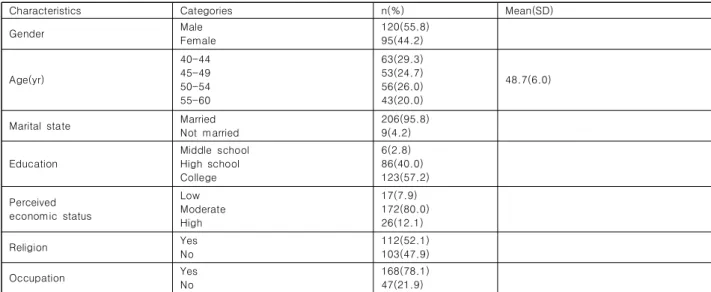
The general characteristics of participants are described in table 1. There were 120 males (55.8%) and 95 females (44.2%). The average age of participants was 48.7years. 206 (95.8%)of participants were married, 123 (57.2%) were college graduate. 112 (52.1%)of participants had religion and 168(78.1%) were had occupation.

2. Descriptive statistics of the measured variables The sub-factors constituting the constructs were as follows. The frequency of exercise was 4.39, autonomy 4.17, and interest 4,09 among the variables using the 5 - point Likert scale.

3. Effects of Variables in the Model

Causal effects between measured variables were analyzed by covariance structure analysis. In this model,

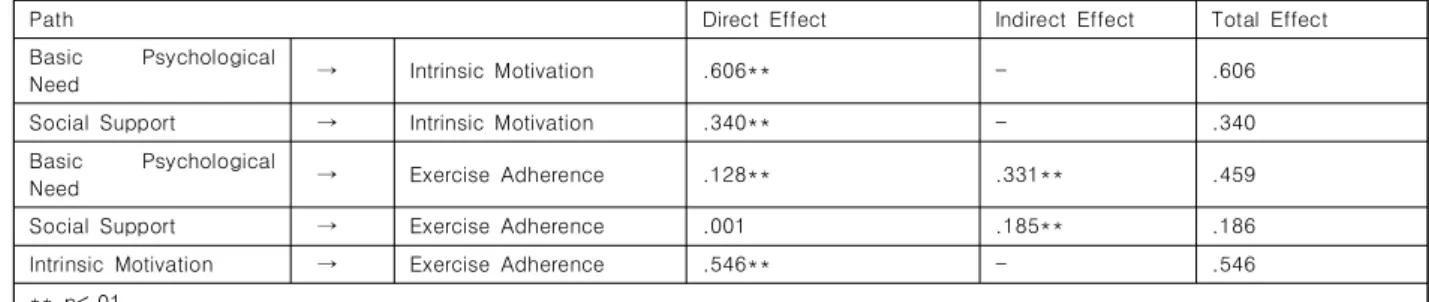
the basic psychological need directly influenced to intrinsic motivation .606, total effect was .606. Social support directly influenced to intrinsic motivation .340 and total effect was .340. The basic psychological need affected exercise adherence directly .128, indirectly .331, and total effect was .459. Intrinsic motivation direct effect to exercise adherence was .546, and total effect was .546. Social support's indirect effect to exercise adherence was .185 and total effect was .186. In this way, the basic psychological desire did directly effect on the intrinsic motivation, and the intrinsic motivation effected directly to exercise adherence. The strongest influence directly on the exercise adherence of middle-aged was intrinsic motivation.

4. Fit of the Model

Table 4 shows the fitness indices of this study model.

The chi-square is 77.664, the GFI is .938, the AGFI is .915, the NFI is .912, the CFI is .941, the mean square error .The square root (RMSEA) was .041. Therefore, this study model satisfied the fit standard of the structural model equation.

IV. Discussion

This model of exercise adherence in middle-aged

based on self-determination theory met the standard of

structural equation model. The basic psychological needs

and social supports directly influenced intrinsic

(5)

motivation. Basic psychological needs and intrinsic motivation directly affected the exercise adherence, which was similar context as the positive emotions of leisure participants had related their behavioral commitment[15]. In middle-aged, rather than a professional athlete, ordinary people’s adherence to sport was supported by fun and pleasure [16, 17]. The enjoyment or pleasure experienced by ordinary people during exercise can be regarded as internal motivation. In this study, middle-aged intrinsic motivation directly affected the duration of exercise. Middle-aged were ordinary people, not exercise experts. Middle-age intrinsic motivation influenced the adherence of exercise.

Thus, the relationship between intrinsic motivation and exercise adherence supported previous studies. Intrinsic motivation meaned fun or pleasure in exercise. This is distinguished from the way in which cancer patients were monitored and encouraged by nurse for continuing exercise in the home[10]. This is because cancer patients should continue to exercise after termination of nursing intervention. Nurse should make them experience intrinsic motivation. It means if one enjoyed exercise, one do one’s best to get joy, doing this repeat, one do adhere to exercise and can get final health outcome. In this study, exercise-related social support indirectly affected the duration of exercise through internal motivation. This was somewhat different from the results of the study that exercise behaviors in urban middle - aged women should include social support, such as an athletic environment and an exercise partner[18].

However, in the middle age, social support was a influencing factor to the exercise adherence by increasing intrinsic motivation. In middle-aged women, the pleasure of exercise was the power to sustain exercise while changing type or time of exercise[9]. In this study, we confirmed that both the internal experience and the environmental factors were important factors of exercise adherence in middle aged men and women. The fact that non-professional exercisers were engaged in exercise pursues fun and pleasure as a intrinsic motivation rather than reward or punishment as a external motivation[9, 17-18]. Until now, nursing studies related to physical activity had little interest in exercise adherence. Social support was an important factor as the previous study[19].

The middle age, which overestimates physical activity, maintained good health status compared to those who did

not[20]. Since middle-aged exercise is essential for health, this study revealed a pathway for the middle-aged to continue the exercise.

This study model that combined social support and self - determination factors met the model fit criteria. If the patient's psychological needs and intrinsic motivation are applied to nursing in a long-term exercise plan based on self-determination theory, health will be achieved more efficiently.

V. Conclusion

This study has provided theoretical basis for achieving health by constructing and verifying a model in which middle-aged people continue their exercise. Based on the theory of self - determination, this study synthesized the psychological needs and intrinsic motivation and the social support that is important in nursing. In self-determination theory, intrinsic motivation, such as interest, is important in sustaining certain behaviors. Also, the emphasis is on the basic psychological desire for achievement, autonomy, and relationship. These self-deterministic factors were introduced into nursing and the model was constructed by identifying the continuation pathways of exercise. This study implies that the introduction of self - determination theory into nursing has provided a basis for applying it to nursing subjects who are essential for long - term exercise.

Especially when it comes to health, it does not mean that

you have to continue exercising. The basic psychological

desire and intrinsic motivation were shown to have

influenced the continuity of certain behaviors such as

exercise. The results of this study can be applied to

nursing research or clinical setting considering the basic

psychological needs and intrinsic motivation of nursing

clients. The results will provide a evidence for nursing

intervention and further research. It will also help

planning program by nurse for chronic patients who need

to do long-term exercise by themselves. In order to

generalize the research results, data were collected from

four major cities in Korea, but they were limited in the

generalization of research results because they were

convenient extraction.

(6)

REFERENCES

[1] K. S. Kim et al., Medical-Surgical Nursing, Soonoonsa, Paju, pp.21-23, 2017.

[2] J. S. Kim and S. Kang. KS., A study on body image, sexual quality of life, depression, and quality of life in middle-aged adults. Asian Nursing Research, Vol. 9, No.

2, pp. 96-103, 2015.

[3] Aslı Kalkım, Safak Da ghan, Theory-based Osteoporosis Prevention Education and Counseling Program for Women: A Randomized Controlled Trial, Asian Nursing Research Vol. 11, No. 2, pp. 119-127, 2017.

[4] S. K. Choi and I. S. Kim, Effects of a cardiocerevascular disease prevention education program for postmenopausal middle-aged women, Journal of Korean Academy of Nursing , Vol. 45, No.1, pp. 25-34, 2015.

[5] S. H. Cho, et al., Relationship between expectations regarding aging and physical activity among middle aged adults in urban areas: based on the Pender's health promotion model. Journal of Korean Academy of Nursing , Vol. 45, No.1, pp. 14-24, 2015.

[6] M. Justine, N. A. Azizan, V. Hassan, Z. Salleh, Barriers to participation in physical activity and exercise among middle-aged and elderly individuals, Singapore medical journal Vol.54 No.10, pp. 581-586, October, 2013. 

[7] Deci, E. L., & Ryan, R. M. Intrinsic Motivation and Self-Determination Theory in Human Behavior. New York, NY: Plenum Press, 1985.

[8] Y. S. Ha and Y. H. Choi, Effectiveness of the Self-determination Theory based a Motivational Interviewing YOU-TURN Program for Smoking Cessation among Adolescents, Journal of Korean Academy of Nursing , Vol. 45, No.3, pp.347-456, 2015.

[9] M. O. Lee and Y. S. Hah, Exercise adherence in middle aged women with the qualitative theme analysis method.

Nursing Perspectives, Vol. 8, No. l. pp. 156-166. 2011.

[10] J. H., Choi, H. S, Kang, Effects of a home-based exercise program for patients with stomach cancer receiving oral chemotheraphy after surgery. Journal of Korean Academic Nurse , Vol. 42, Nol. 1. pp. 95-104, 2012.

[11] Y. G. Jung, The Relationships between Basic Psychological Need Satisfaction, Sport Participation Motivation and Persistence Intention among Participants in Leisure Sport. Journal of Sport and Leisure Studies, Vol. 34, No. 2, pp. 1591-1604. 2008.

[12] J. A. Choi, Construction of leisure physical activity model of middle-aged women in urban area. Korean Society of Adult Nursing, Vol. 20, pp. 626-640, 2008.

[13] J. Yoo and J. H. Huh, The effects of achievement goal orientation and motivational climate on intrinsic

motivation and performance in Physical Education(PE) Settings. Korean Society of Sport Psychology , Vol. 12, No. 1, pp. 109-123, 2001.

[14] S. H. Choi, (The)Development of a Korean exercise adherence scale. Doctoral dissertation, Seoul National University, Seoul, Korea, 2005.

[15] Y. G. Jung, Validity verification of sport commitment behavior scale. Korean Journal of Sports Psychology , Vol. 15, No. 1, pp. 1- 21, 2004.

[16] C. M. Frederick and R. M. Ryan, Differences in motivation for sport and exercise and their relations with participation and mental health. Journal of Sport Behavior , 16(1993), 124-146.

[17] J. A. Murcia, C. M. Galindo and P. M. Pardo, Motivations and reasons for exercising in water: Gender and age differences in a sample of Spanish exercisers.

International Journal of Aquatic Research and Education , Vol. 2, pp. 237-246. 2008.

[18] S. H. Seo, Determinants of Exercise Adherence in Rural Area. A doctoral dissertation. Department of physical Education. Graduate School. University of Incheon, Incheon, Korea, 2012.

[19] M. A. Choe et al., A study on exercise behavior, exercise environment and social support of middle-aged women, Journal of Korean Academy of Nursing , Vol. 38, No.1, pp. 101-110, 2008.

[20] J. G. Godino et al., Awareness of physical activity in

healthy middle-aged adults: a cross-sectional study of

associations with sociodemographic, biological,

behavioural, and psychological factors, BMC Public

Health . Vol 14, pp. 421, 2014. Published online 2014

May 2. doi: 10.1186/1471-2458-14-421https://www

.ncbi.nlm.nih.gov/pmc/articles/PMC4012086/

(7)

Miok Lee received the B.S. and Ph.D.

degrees in Nursiing from Seoul National University, Korea, in 1986, and 2013 respectively. Dr. Lee joined the faculty of the Department of Nursing at Woosuk University, Jeollabuk Do, Korea, in 2008.

She is currently a Professor in the Department of Nursing, Kyungdong University. She is interested in psychiatric nursing, medical-surgical nursing and maternity nursing.

Authors

수치

Table  2.  Descriptive  statistics  of  variables  ( N =215)
Table  3.  Effect  of  Variables  in  the  Model Fig.  1.  Conceptual  framework

참조

관련 문서

Key Words : Self-regulated learning, Autonomy support, Self-determination motivation, Interpersonal competence, Achievement goal orientation.. *This study was performed

As a result of the empirical analysis, it was found that among the major psychological needs related to self-determination, the variables other than

Development and Construct Validation of the Basic Psychological Needs Scale for Korean Adolescents: Based on the Self-Determination Theory.. The Social Value

This study is based on advanced research to determine whether Self-determination motivation theory such as the autonomy, competence, relatedness has

This study analyzed whether smartphone addiction management apps have features to support adolescent users' basic needs, that is, autonomy, competence,

An application of the theory of planned behavior. Relationships among health beliefs, self- efficacy and exercise adherence. The development of self-efficacy

suggest ways to use healthy social network services, and empirically verify how behavioral approaches, in other words self-determination theory, that deals with human

This study examined which types of use motivations affect the intention of knowledge exchange in public libraries when using public libraries based on the self-determination