재한중국유학생의 문화적응환경에서의 건강증진행위와 건강관련 삶의 질
Health Promotion Behavior and Health-related Quality of Life by Acculturation Levels among Chinese University Students in Korea
김선정*, 최경온**
대구보건대 간호학과*, 연세대학교 경영연구소**
Sun Jung Kim([email protected])*, Kyongon Choi([email protected])**
요약
본 연구는 재한 중국 유학생의 문화적응 상황 하에서 건강증진행위와 건강관련 삶의 질의 관계를 파악해 보고자 하였다. 서울 및 수도권 소재 10개 대학의 학부 및 대학원 석/박사 과정에 속해있는 총 395명의 중국 인 유학생들이 문화적응도 및 건강증진행위와, 건강관련 삶의 질 SF-12 도구를 이용한 자가보고식 설문조 사에 참여해주었다. 그 결과 문화적응도가 낮은 유학생들은 건강증진행위가 신체적 삶의 질 점수에 크게 영향을 미치고 있는 것으로 나타났으며, 문화적응도가 높은 경우 건강증진행위가 정신적 삶의 질에 큰 영향 을 주는 것으로 나타났다. 이는 문화적응도가 건강증진행위와 삶의 질의 관계에서 통제요인으로 작용할 수 있다는 결과이다. 그러므로 재한 중국유학생들의 건강증진행위와 삶의 질을 개선할 수 있는 중재 프로그램 을 개발할 경우 문화적응도를 함께 고려하면 프로그램의 효과를 극대화시킬 수 있는 방법을 찾는데 도움이 될 것으로 사료된다.
■ 중심어 :∣문화적응∣건강증진행위∣삶의 질∣유학생∣
Abstract
This study was to identify the relationship between health promoting behaviors and health related quality of life at acculturation environment of Chinese international students in Korea.
From November 2010 to December 2011, 395 Chinese international students in undergraduate, masters or doctorate courses from 10 universities and graduate schools in Seoul and vicinity participated in self-report survey of the acculturation level, the health promoting behaviors and SF-12, the health related quality of life. The data of 395 students were classified to 3 groups based on the acculturation level. The low level group showed the health promoting behaviors strongly influence the physical component score of quality of life. As the acculturation level increased, the health promoting behaviors closely affected to the mental health-related quality of life. The results indicated that the acculturation level may be control variable to define the relationship between the health promoting behaviors and the health-related quality of life.
■ keyword :∣Acculturation∣Health Promoting Behaviors∣Quality of Life∣International Student∣
접수일자 : 2017년 04월 25일 수정일자 : 2017년 06월 26일
심사완료일 : 2017년 07월 13일
교신저자 : 김선정, e-mail : [email protected]
I. Introduction
1. The Need for Research
Health is one of the most precious happiness that human can enjoy and one of the basic constitutional rights. In the past, the health was focused on the treatment or the cure from illness but recently it has been changed into maintaining and promoting good health. As a result, the improvement of quality of life has become the goal of health[1].
health promoting is a process to enhance the health and to strengthen control. It also refers to change of lifestyle in order to improve the quality of life beyond disease control. health promoting behaviors is an individual behavior to change lifestyle for the optimal maintenance of health and a technical behavior that pursues physiological and psychological well-being and prolongs life while improving quality of life. As such, health promoting behaviors is considered a key for elevating quality of life for humans and is also considered the most important predictor for the life’s satisfaction[2].
At the World Health Organization(WHO), the quality of life is defined as “the perception by individuals of their position in life, in the context of the culture and value systems in which they live and in relation to their goals, expectations, standards and concerns”[3]. The perspective is focused on putting the quality of life in the cultural, societal and environmental backgrounds.
When two groups with different cultural backgrounds come into contact over a long period of time, either members of one group or both may experience cultural changes in their culture. This is referred to the acculturation. Moving to a foreign country causes an individual to - during the process of departing from the social position the individual has established up until now and in the course of adapting to an
environment with a different lifestyle - experience the inducement of various types of stress and thereby threatening the physical and the mental state of health of an individual[4]. Under these circumstances, international students as a part of the migrant population can be faced to a lot of stress not from only school works but also changes in the living environment, differences in values and cultural heterogeneity, language barrier, lack of emotional support, difficulties in forming interpersonal relationships, etc., and the physical and the mental state of health is under threat. In addition, international students become independent from their parents and family members and are responsible for managing one’s own health. Various health problems could occur during this time. While the students may not recognize the importance of health, perhaps due to curiosity to the new things or to peer pressure, they may commit behaviors that are damaging to their own health[5].
The international students can be subjected to - due to the perceived discrimination, the confusion of one’s own identity, a sense of loss of support systems and due to other reasons - mental health issues such as depression, loneliness, etc., which can lead to physical health problems[6]. On top of this, since the international students are usually under the plan to stay a relatively short period of time until completing their degrees and to return to their own countries afterwards, they have a sense of psychological pressure of having to achieve their goals within a fixed, relatively short time frame. Meanwhile, the social support systems necessary for properly leading these students in their efforts to adapt to Korean culture don’t exist at the present. Moreover, a lot of these students are in their late adolescent stage, during which one’s self-centeredness is the predominant force and exacerbate the difficulties of adapting to a different culture[7]. In particular, graduate school
students undergoing master’s or Ph.D. degree programs, while they have high self-esteem, have high academic and acculturation stress levels due to a low sense of academic achievement in relation to the academic ability required for the attainment of degrees and the problems of language barriers. There are numerous cases of the factors turning into mental health problems as well.
The previous studies are mostly comprised of the acculturation stress and the accompanying mental health of Chinese students studying in Korea such as the relationships between the acculturation stress and mental health of Chinese expatriates living in Korea[8] and the social support and acculturation stress of Chinese international students in Seoul[6].
While Kim’s 2016 study of a prediction model of health promoting behaviors of Chinese international students in Korea[9] covered the acculturation and the health promoting behaviors, only few studies dealt with the issues and the health-related quality of life of the international students in Korea are not explored yet. This exploratory study focused on the Chinese international students in Korea account for the most number of the foreign students currently studying in Korea. Especially the Chinese international students who are undergoing formal master’s and Ph.D. degree programs and are part of the group with the highest level of education are selected due to the nature of highest academic requirement to achieve the academic degrees. In particular, centered around “the level of the acculturation” a topic not addressed in previous studies, we attempted to understand, by separating the group into smaller groups, the relationship between the health promoting behaviors and the health-related quality of life - by sub-groups.
2. Study Objectives
The objectives of this study are as follows:
z To understand the general characteristics of Chinese international students in Korea who enrolled in formal degree programs of undergraduate, master’s and Ph.D. programs.
To understand the degrees of the acculturation, the health promoting behaviors and the quality of life(physical health elements and mental health elements) as related to the health of Chinese international students in Korea.
z To examine to see if there are differences, in accordance with the general characteristics, in the degrees of the acculturation, the health promoting behaviors and the quality of life as related to the health of Chinese international students.
z To examine to see if there are differences, in accordance with the acculturation level, in the degrees of practicing of health promoting behaviors and quality of life of Chinese international students in Korea.
z To examine how, in accordance with the levels of acculturation, the relationship between the health promoting behaviors and the quality of life of Chinese international students in Korea would differ.
II. Study Method
1. Research Design
The goal of the study is to understand the relationship, under the conditions of the acculturation, between the health promoting behaviors and health-related quality of life through self-reporting questionnaires.
2. Participants
The subjects of this study are international students in Korea come from China(excluding
students from China who are of Korean ethnicity and ancestry) and enrolled in formal academic degree programs of bachelor’s, master’s or Ph.D. programs at undergraduate and graduate schools in Korea and having lived in Korea for more than 6 months. In consideration for the ease of access, this study was carried out by using a non-probabilistic sampling method of random sampling method and snowball sampling method.
3. Measurement
The research instrument is a self-reported survey questionnaire. It is translated and revised from the research instrument with that have been proven its validity and reliability by previous studies. After 2 pretests and screening total 78 items: 16 general demographic questions; 37 health promoting behaviors;
13 acculturation level, and 12 SF-12 health survey.
The following steps were taken to increase the validity of the instruments which had to be translated.
Step 1: Based on the literature review, the researcher selected the instruments with the proven validity and reliability. Three nursing faculties and a communication faculty reviewed the content validity of the questionnaire. Step 2: The questionnaire was translated from Korean to Chinese by a professional native Chinese translator. Step 3: A Chinese doctorate student who has stayed in Korea for more than 7 years and is fluent in Korean language back-translated the Chinese questionnaire into Korean. The researcher and 2 nursing faculty members compared the original Korean questionnaire and the back-translated questionnaire for the meaning of the questions. Step 4: To confirm whether the participants can clear in understanding of the Chinese questionnaire, the pretest was conducted with 5 Chinese graduate students who have stayed in Korea more than 3 years. Based on the pretest results, some
of the questions were modified to clarify the meaning.
Step 5: Two pilot tests were conducted with 2 groups of 10 Chinese international students to finalize the questionnaire. Step 6: The final items for the study were chosen based on the content analysis and reliability test of the instruments.
The research instrument to measure the level of the acculturation was 13 of 20 questions of the Suinn-Lew Asian Self-Identity Acculturation scale developed by Suinn, Khoo and Ahuna[10] in a 5-point Likert scale, ranging from 1(strongly disagree) to 5(strongly agree). Higher score indicates higher level of the acculturation. At the time of development, Cronbach’s
α
was .79 and in our study Cronbach’sα
was seen to be .83. The health promoting Lifestyle profile(HPLP) developed by Walker, Hill-Polerecky and Pender[11] was used to measure the degree of practice of the health promoting behaviors. Of the total of 47 questions from the original instrument, 37 questions that were determined to be appropriate after a preliminary investigation were used. Each of the questions was in a 4-point Likert scale, ranging from 1(never) to 4(always). High scores indicate better health promoting behaviors. At the time of development, Cronbach’sα
was .92 and in our study it was seen to be .85. In order to measure the health-related quality of life, the SF-12(Short Form of SF-36), whose reliability and validity were verified in the study by Ware, Kosinski and Keller[12] was used. It is a questionnaire comprised of 12 questions that are separated into 2 areas of physical health(PCS:Physical Component Score) and mental health(MCS:
Mental Component Score). An approval for the use of the tools was attained from Quality Metric Incorporated, and the collected materials were converted into scores via the Quality Metric Health Outcomes Scoring Software 4.0. The scoring was calculated by selecting a 0-100 point calculation
method and higher score means a better of the health-related quality of life. The reliability Cronbach’s
α
for the original tool was .86 and in our study it was measured to be .79.4. Data Collection
The data were collected from November 2010 to December 2011. To collect the data, we introduced ourselves to and solicited cooperation directly from the representatives of the student associations of Chinese international students in 10 universities in the metropolitan areas of Seoul. For data collection, self-reporting questionnaires written in both the Korean and Chinese languages were used, and, first, the researcher of this study and the student association representatives, who assisted the study, of the Chinese international students in Korea at each of the universities explained to the participants, who are of Chinese nationality, the purpose of this study and the guarantee for confidentiality and obtained written consents for participation in the study, and afterwards the participants completed the questionnaire in a form of self-reporting in accordance with instructions to fill out the questionnaire. The total time taken in answering the questionnaire was approximately 60 minutes. All of these process steps were carried only after receiving deliberations from the Institutional Review Board(IRB) of the research institution for the protection of the study participants(Yonsei University Medical Center; approval number: 2010-1023). Total of 420 questionnaires were handed out and the 401 questionnaires were collected, and of these 6 were excluded for their seemingly insincere responses, whereby making the total of 395 questionnaires to be processed.
5. Data Analysis
The collected data was statistically processed using
the IBM SPSS Statistics Ver. 20 for Windows.
Descriptive statistics and frequency analysis for the participants and the research variables were conducted and, in order to understand the effects of the demographic variables on the research variables, t-tests and ANOVA were conducted for the nominal demographic variables(gender, degree program, health insurance coverage status, etc.) and Pearson correlation analysis was conducted for continuous demographic variables(age and the length of stay).
By comparing the frequencies of each of the levels based on the level of the acculturation of the participants, the participants were divided into 3 groups based on notable differences: low-level group, mid-level group and high-level group[Fig. 1]. By groups, the presence of statistical significance in the differences between the health promoting behaviors and the health-related quality of life(physical and mental) were determined and the relationships among the variables were verified through Pearson correlation analysis.
III. Results of Study
1. Characteristics of Participants
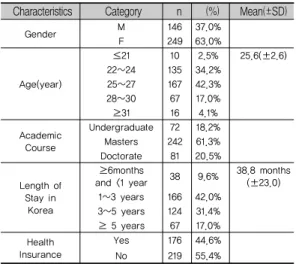
The demographic characteristics of the participants of this study are as follows[Table 1]. There were a total of 395 study participants with males accounting for 37.0% with 146 and females 63.0% with 249. The ages of participants were from 20 to 34 years with an average age of 25.6(±2.6) years. 81 participants(20.5%) are in graduate school Ph.D.
programs, 242 participants(61.3%) are in graduate school master’s programs and 72 participants(18.2%) are in undergraduate bachelor’s programs. The lengths of stay in Korea up until the time of the questionnaire were on average 38.78 months(±23.03).
Among the participants, a majority of 298 participants(75.3%) had no religion and 98 participants(24.7%) had religion. 176 participants (44.6%) were enrolled in health insurance and 219 participants(55.4%) had no health insurance coverage.
n=395
Characteristics Category n (%) Mean(±SD)
Gender M 146 37.0%
F 249 63.0%
Age(year)
≤21 10 2.5% 25.6(±2.6)
22~24 135 34.2%
25~27 167 42.3%
28~30 67 17.0%
≥31 16 4.1%
Academic Course
Undergraduate 72 18.2%
Masters 242 61.3%
Doctorate 81 20.5%
Length of Stay in
Korea
≥6months
and <1 year 38 9.6% 38.8 months (±23.0) 1~3 years 166 42.0%
3~5 years 124 31.4%
≥ 5 years 67 17.0%
Health Insurance
Yes 176 44.6%
No 219 55.4%
Table 1. General Characteristics
2. Descriptive Statistics of the Variables and the Relationship between the Variables and Demographic Characteristics
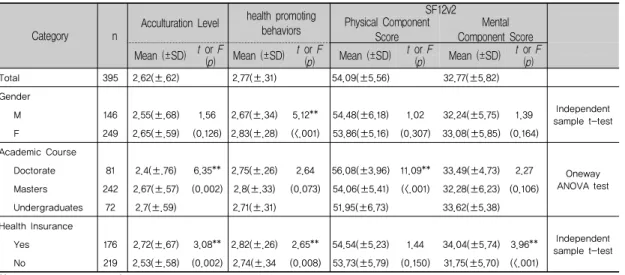
The Acculturation level was 2.62(±.62) points out of 5.0 total points, and the health promoting behaviors were 2.77(±.31) points out of 4.0 total points. Of the health-related quality of life, the Physical Component Score representing the physical health was on average 54.09(±5.56) points out of 100 total points, and the Mental Component Score representing the mental health was on average 32.77(±5.82) points out of 100 total points. Regarding to the effects of demographic characteristics on the research variables, first, gender showed significant difference in health promoting behaviors(t=5.13, p<.001), and females showed higher health promoting behaviors than males[Table 2].
Statistically significant differences between school degree programs were observed at the acculturation level(F=6.35, p=.002) and the PCS(F=11.09, p<.001).
The Ph.D. students showed the lowest acculturation level and the undergraduate students showed the lowest PCS.
The higher the age, the lower the acculturation level(R2=.19, p<.001) and the higher the PCS(R2=.181,
p<.001). And the longer the length of stay, the higher
the MCS(R2=.17, p=.001)[Table 3].The health insurance enrollment status showed differences in the variables of the acculturation level (t=3.08, p=.002), health promoting behaviors (t=2.65,
p=.008) and MCS(t=3.96, p<.001). The participants
with the health insurance showed statistically higher acculturation level, health promoting behaviors and MCS than the participants with no coverage.3. Correlation and Regression Analysis of health promoting behaviors and Quality of Life in Accordance with the acculturation level
The Pearson Correlation analysis among the research variables showed the higher the acculturation level, the higher the health promoting behaviors(R2=.19,
p<.001), and the higher the health promoting
behaviors, the higher the MCS(R2=.11, p=.036)[Table 3].The regression analysis shows the PCS is influenced by the age and the MCS is done by the health promoting behaviors but both coefficients of determination are still less than 5%.
To explore the relationship among the research variables, the total participants were divided into 3 groups by the acculturation level. Based on the Hierarchical Cluster Analysis Method by the acculturation level, we divided the participants to three groups - low-level acculturation group (47 participants, 11.9%), mid-level group (309 participants, 78.2%) and
Category n Acculturation Level health promoting behaviors
SF12v2 Physical Component
Score
Mental Component Score Mean (±SD) t or F Mean (±SD) t or F Mean (±SD) t or F Mean (±SD) t or F
(p) (p) (p) (p)
Total 395 2.62(±.62) 2.77(±.31) 54.09(±5.56) 32.77(±5.82)
Gender
Independent sample t-test M 146 2.55(±.68) 1.56 2.67(±.34) 5.12** 54.48(±6.18) 1.02 32.24(±5.75) 1.39
F 249 2.65(±.59) (0.126) 2.83(±.28) (<.001) 53.86(±5.16) (0.307) 33.08(±5.85) (0.164) Academic Course
Oneway ANOVA test Doctorate 81 2.4(±.76) 6.35** 2.75(±.26) 2.64 56.08(±3.96) 11.09** 33.49(±4.73) 2.27
Masters 242 2.67(±.57) (0.002) 2.8(±.33) (0.073) 54.06(±5.41) (<.001) 32.28(±6.23) (0.106)
Undergraduates 72 2.7(±.59) 2.71(±.31) 51.95(±6.73) 33.62(±5.38)
Health Insurance
Independent sample t-test Yes 176 2.72(±.67) 3.08** 2.82(±.26) 2.65** 54.54(±5.23) 1.44 34.04(±5.74) 3.96**
No 219 2.53(±.58) (0.002) 2.74(±.34 (0.008) 53.73(±5.79) (0.150) 31.75(±5.70) (<.001)
** 99% Confidence Level, * 95% Confidence Level (two tails) SF12v2: Short Form Survey version 2
Table 2. The Differences of the Research Variables by Demographic Variables
Fig. 1. Acculturation level subgroups.
high-level group (39 participants, 9.9%). [Fig. 1]
illustrates the acculturation level by the rank. It clearly shows inflection points among the subgroups.
To confirm the differences among the main research variables of each of the groups, a one-way
ANOVA test was conducted. As a result, the differences among the groups were statistically verified to be present in the variables of the acculturation level(F=370.32, p<.001), the health promoting behaviors(F=4.91, p=.008), the PCS(F=4.54,
Variable Acculturation Level
Health Promoting
Behavior
Physical Component Score
Mental Component Score
(p) (p) (p) (p)
Age -.19** (<.001) .04 (.450) .18** (<.001) .07 (.165)
Length of Stay .02 (.652) .06 (.228) .05 (.348) .17** (.001)
Acculturation Level .19** (<.001) .01 (.889) .11* (.036)
health promoting behaviors .09 (.071) .21** (<.001)
Physical Component Score -.07 (.146)
** 99% Confidence Level, *95% Confidence Level (two tails)
Table 3. Pearson Correlation Coefficients of the Research Variables
Acculturation Level Subgroups
Variable Low Middle High Total F(p) Post-Hoc
An 47 309 39 395
Mean Comparison
Acculturation Level 1.53 2.65 3.68 2.62 370.32 (<.001) a<b, b<c
health promoting behaviors 2.64 2.79 2.77 2.77 4.91 (.008) a<b,c
SF12v2 PCS 55.35 53.65 55.99 54.09 4.54 (.011) b<a,c
SF12v2 MCS 32.52 32.53 34.96 32.77 3.09 (.047) a,b<c
Age 27.15 25.36 25.28 25.57 11.03 (<.001) a>b,c
Gender Male 29 102 15 146 14.46
(χ
2) (.001)
Female 18 207 24 249
Correlation with health promoting behaviors
SF12v2 PCS .54** .09 - .16 .09
(p) (<.001) (.138) (.346) (.071)
SF12v2 MCS .18 .21** .54** .21**
(p) (.227) (<.001) (<.001) (<.001)
** 99% Confidence Level, * 95% Confidence Level (two tails) A: Post hoc method: Tukey
Post hoc subgroup a: Acculturation low level group, b: Acculturation middle level group, c: Acculutration high level group PCS: Physical Component Score / MCS: Mental Component Score
SF12v2: Short Form Survey version 2
Table 4. The Relationship between health promoting behaviors and Quality of Life by Acculturation Level p=.011) and the MCS(F=3.09, p=.047) and in all the
research variables.
The average of the health promoting behaviors of the mid-level group, which was the largest group among the 3 groups in accordance with the acculturation level, was 2.79(±.32), the PCS was 53.65(±3.81) and the MCS was 32.53(±6.05). In this interval, the health promoting behaviors showed less than 5% but still statistically significant positive influence to MCS. But, there is no relationship between the health promoting behaviors and the PCS.
The average of the health promoting behaviors of the low-level acculturation group was 2.64(±.29), PCS was 55.35(±3.90) and MCS was 32.53(±5.59). The
regression models for the PCS in the low-level acculturation group showed the health promoting behaviors is a strong predictor of the PCS. The coefficient of the determination(R2) is 29.4%.
Combining the health promoting behaviors and the age, the R2 goes up to 46.1%. In other words, in the group with low level of the acculturation among the Chinese international students, as the health promoting behaviors increased, their physical health-related quality of life would increase as well.
However, there was no notable relationship between the health promoting behaviors (or the age) and the mental health-related quality of life.
The average of the health promoting behaviors of
Group Variables Standardized
β S.E. t (p) R
2F (p)
Total
AAge 0.181 0.107 3.644 (<0.001) 0.033 13.280 (<0.001)
Gender
BMale Age 0.222 0.182 2.736 (0.007) 0.049 7.484 (0.007)
Female
Step 1 Acculturation Level 0.146 0.553 2.327 (0.021) 0.021 5.416 (0.021)
Step 2 Acculturation Level 0.162 0.550 2.579 (0.01) 0.044 5.670 (0.004)
Age 0.151 0.134 2.412 (0.017)
Acculturation Level Subgroup
cLow
Step 1 health promoting behaviors 0.542 1.686 4.324 (<0.001) 0.294 18.697 (<0.001) Step 2 health promoting behaviors 0.445 1.530 3.918 (<0.001) 0.461 18.820 (<0.001)
Age 0.420 0.173 3.698 (0.001)
Middle Age 0.180 0.134 3.202 (0.002) 0.032 10.254 (0.002)
High None
A, B : Independent variables - health promoting behaviors, Acculturation level, Age C: Independent variables - health promoting behaviors, Age
Table 5. Multiple regression coefficients of Physical Component Score by Acculturation level subgroups
Group Variables Standardized
β S.E. t (p) R
2F (p)
Total
Ahealth promoting behaviors 0.211 0.922 4.286 (<0.001) 0.045 18.368 (<0.001) Gender
BMale None
Female
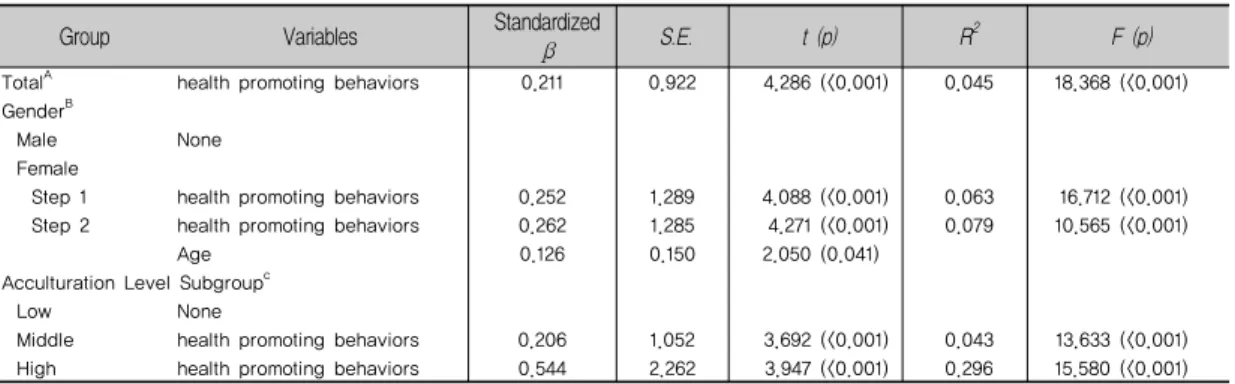
Step 1 health promoting behaviors 0.252 1.289 4.088 (<0.001) 0.063 16.712 (<0.001) Step 2 health promoting behaviors 0.262 1.285 4.271 (<0.001) 0.079 10.565 (<0.001)
Age 0.126 0.150 2.050 (0.041)
Acculturation Level Subgroup
cLow None
Middle health promoting behaviors 0.206 1.052 3.692 (<0.001) 0.043 13.633 (<0.001) High health promoting behaviors 0.544 2.262 3.947 (<0.001) 0.296 15.580 (<0.001) A, B : Independent variables - health promoting behaviors, Acculturation level, Age
C: Independent variables - health promoting behaviors, Age
Table 6. Multiple regression coefficients of Mental Component Score by Acculturation level subgroups
the high-level acculturation group was 2.77(±.21),PCS was 55.99(±3.81) and MCS was 34.96(±3.38). In the subgroup, the health promoting behaviors is proved the strong predictor of the MCS. The R2 of the regression model is 29.6% which means about 30% of the MCS can be explained by the health promoting behaviors. An independent sample t-test for the research variables between the high-level acculturation group and the mid-level group showed significant differences on the PCS(t=2.42, p=.016) and the MCS(t=3.79, p<.001). In other words, the high-level group showed higher values in both the
PCS and the MCS as compared to the mid-level group.
Other than the acculturation level subgroups, the multiple regression analysis found few variables to influence to the quality of life. While the regression model for the PCS was statistically significant,
F=13.28, p<0.001, the age was the only predictor with
the weak R2(=0.033, p<0.001). The role of gender also showed minimal influence, still less than 5% of the coefficient of the determination. We got the similar results from the regression model for the MCS. Still statistically significant, F=18.368, p<0.001, the R2 was only 0.045.IV. Discussion
To understand the acculturation, the health promoting behaviors and the quality of life of the Chinese international students in Korea and to examine the relationship between the health promoting behaviors and the quality of life by the acculturation level, this study was conducted to provide the preliminary base to develop nursing interventions for the health promoting behaviors and the quality of life of Chinese international students in the future.
In this study, the acculturation level of Chinese international students was 2.62 out of the 5 total points, and it was seen that the higher the age, the lower the acculturation level. It was a lower figure than the 3.77 average score measured by Jung and Lee[13] of the married immigrant women in Korea but it is consistent with the results of the study by Ra and Kang[6] on the acculturation stress of immigrant workers in Korea. It was suggested that the acculturation stress that occurs during the process of adapting to the new culture for immigrants is lower than that for international students in Korea.
And the results from the 2010 study of women who immigrated for the marriage conducted by Lee and Kim[14], which stated that social networks are an influential factor for their psychological adaptation, can be considered as reference. Compare to the women who immigrated for marriage, the international students tend to have relatively high acculturation stress due to the fact that they lack systematic support networks, and this is deemed to be exerting an influence on the acculturation level.
In examining the health promoting behaviors in accordance with the general characteristics of the study participants, in overall, the females showed a higher health promoting behaviors (2.83) than males
(2.67). This was consistent with the results of the study on persons living abroad conducted by Park &
Choi[5], however, this showed an opposite result as compared to of the study conducted by Hur, Yeom and Jung[15]. Regarding the health promoting behaviors by the status of health insurance enrollment, the students who were enrolled in health insurance showed a higher health promoting behaviors than the students not enrolled in health insurance. This was consistent with the results of the study on Chinese international students conducted by Kim[16].
In our study, regarding the health-related quality of life, when converted into a 100-point scale, the physical health condition score was 54.09 points and the mental health condition score was 32.77 points.
The health-related quality of life was measured with the SF-12 v2, which converted the 2009 data on the general public of the U.S. so that the average was made to be 50 and standard deviation was 10. As such, the results can be viewed as that, whereas the physical health condition of the participants of our study was higher than the general public of the U.S., the mental health condition of the participants of our study was lower than that of the general public of the U.S. The results of a study[17] on the quality of life of Chinese nationals residing in Hong Kong using the same instruments found that the physical health condition was 52.3 and the mental health condition was 49.1; whereas, in the study by Lam, Lam, Fong and Hung[18], the physical health condition was measured to be 50.0 and the mental health condition was measured to be 49.9. The physical health of the participants of this study showed higher physical health as compared to typical Chinese; however, the mental condition of the participants was seen to be lower. This is consistent with the results of a previous study by Ferrer & Alonso[19] which stated
that, although the level of physical health gradually decreases with increasing age, the mental health increases, and in addition, it is consistent with the results of study by Gooding[20] which found that the younger generation tends to be typically unstable and vulnerable and that causes a number of problems whereby resulting in low health levels in the areas of psychological and social health. In addition, the results of a study by Mi-young Lee[21], which stated that stress management is an influential factor for the quality of life of college students, may be cited as reference. In other words, acculturation stress experienced by students studying abroad is deemed to influence the quality of life of Chinese international students. Other than these, as well, among the general characteristics of the participants of this study, the PCS showed significant differences in the school degree program and age; and the gender, length of stay and the status of enrolment in health insurance were seen to be significant in the PCS.
This is consistent with a previous study[22] that reported that gender showed significant differences in the quality of life of college students. In addition, the higher the acculturation level the higher the health promoting behaviors in the relationship between health promoting behaviors and quality of life; and, the higher the health promoting behaviors, the higher the MCS.
Regarding the health promoting behaviors, the low-level acculturation group showed the lowest and the mid-level group and the high-level group showed about the same. Regarding PCS, although the mid-level acculturation group was far behind the low-level acculturation group, it recovered again as it moved into the high-level group. Concerning MCS, in contrast to the low-level acculturation group and the mid-level group showing a similar pattern, as it moved into the high-level group it increased in a
statistically significant manner.
Accordingly, although in the low-level group the health promoting behaviors and the physical health-related quality of life showed a positive correlation, the health promoting behaviors in mid-level group started to show a statistically significant positive correlation with the mental health-related quality of life, rather than with the physical health-related quality of life, and reported a stronger positive correlation in the high-level group.
Comparing the previous studies on the health promoting behaviors and acculturation, the results of our study were consistent with the study of marriage immigrants and the study[13] that studied Japanese marriage immigrants, and also with other studies.
These results are similar to the results of the previous study conducted by Marmot & Syme[19], which reported that the acculturation level affects health promoting behaviors and influences the reduction of disease occurrence rate. Even though there haven’t been any studies conducted in Korea that reported that disease occurrence rates were increasing among Chinese international students in Korea - when considering the study results of Marmot and Syme [19] and the Department of Health and Human Services[23] which reported that the acculturation level maintains the health and lowers the disease occurrence rates of participants who need to adapt to different cultural environments - the foregoing would suggest that, in order to improve the health of the Chinese international students in Korea, before anything else, various measures would need to be prepared for aiding their acculturation. In addition, it was possible to ascertain that the result of our study were consistent with the existing previous study[24] on the health promoting behaviors and quality of life of college students which reported that health promoting behaviors exert influence as factors
of quality of life.
The result of our study showed that, in accordance with the acculturation level of Chinese international students, the relationship between health promoting behaviors and quality of life changes. In the low-level acculturation group, the regression model of the PCS showed the health promoting behaviors was the main predictor of the physical health-related quality of life but irrelevant with the mental health-related quality of life. In contrast, the regression model of the high-level acculturation group showed the health promoting behaviors was the main predictor of the mental health-related quality of life.
Therefore, in regard to the development of health promoting program for improving the quality of life of the Chinese international students in Korea, by giving more considerations to the acculturation of the subject international students, it would be possible to develop more effective nursing intervention approaches that can bring about positive results for the improvement of quality of life.
V. Conclusion and Recommendations
By understanding how the health promoting behaviors and health-related quality of life differ under the circumstance of acculturation of Chinese international students in Korea and by analyzing whether the relationship between health promoting behaviors and quality of life varies, this study was attempted to provide the basic materials needed for the nursing interventions for raising health promoting behaviors and health-related quality of life.
In conclusion, in the mid-level acculturation group, whereas the health promoting behaviors showed no notable relationship with the improvement of physical health-related quality of life, for the improvement of
mental health-related quality of life, the group showed a statistically significant relationship. In contrast, in the low-level acculturation group, even though the health promoting behaviors directly related with the improvement of physical health-related quality of life, it showed no statistically significant relationship with the mental health-related quality of life. In the overall view, the health promoting behaviors strongly influences the physical health-related quality of life at the initial acculturation stage. As the acculturation level increases, the influence of the health promoting behaviors on the physical health-related quality of life diminishes and begins to affect the mental health-related quality of life.
By dividing the Chinese international students in Korea who participated in the study into 3 groups in accordance with the acculturation level and analyzing them, this study suggests that the relationship between the health promoting behaviors and the health-related quality of life can be analyzed in a more sophisticated manner. By including various variables from a more, multi-faceted levels, based on this study, and by attaining a more in-depth understanding of the relationship between the health promoting behaviors and the detailed factors of the health-related quality of life, conducting studies that can develop more effective health promoting programs for the improvement of health-related quality of life, under the environment of acculturation, is therefore suggested. It is deemed that studies like this can - in the current realities of Korea, which is transitioning from a mono-cultural society gradually into a multi-cultural environment - make contributions in facilitating a lively pursuit of studies in the field of nursing for actively responding to the circumstances of adaptation to diverse cultures.
참 고 문 헌
[1] S. J. Kim and E. O. Ahn, “College women’s health concept and health behavior,” Journal of Korean Academy of Nursing, Vol.27, No.2, pp.264-274, 1997.
[2] K. S. Han, J. H. Kim, K. M. Lee, and J. S. Park,
“Correlation between Quality of Life and health promoting behaviors among hospital staff nurses,” Journal of Korean Academy of Psychiatric and Mental Health Nursing, Vol.13, No.4, pp.430-437, 2004.
[3] World Health Organization, “WHOQOL study protocol,” Geneva: World Health Organization, 1993.
[4] J. B. Mckinlay, “Some issues associated with migration, health status and the use of health services,” Journal of chronic diseases, Vol.28, pp.579-592, 1975.
[5] S. J. Park and S. H. Choi, “Factors influencing health promoting behaviors of Korean students in China,” The Korean journal of fundamentals of nursing, Vol.13, No.2, pp.269-274, 2006.
[6] D. S. Ra and S. H. Kang, “A study on the cultural adjustment competence by their Acculturative Stress-mediating and moderating effects of social support,” Korean journal of youth studies, Vol.17, No.7, pp.21-46, 2010.
[7] I. S. Lim, The actual conditions of early
overseas Korean students in China and identifying protective factor for the psychosocial adjustment,
Unpublished Master’s thesis, Sookmyung Women’s University, Seoul, 2008.[8] R. P. Oh, Relationship between cultural
adaptation and mental health of Chinese students in Korea, Unpublished, Master’s thesis,
Chungbuk National University, Cheongju, 2008.[9] S. J. Kim and I. Y. Yoo, “Health promoting behaviors of Chinese International Students in
Korea Including Acculturation Factors: A Structural Equation Model,” Asian Nursing Research, Vol.10, No.1, pp.25-31, 2016.
[10] R. M. Suinn, G. Khoo, and C. Ahuna, “The Suinn-Lew Asian self-identity Acculturation scale: Cross-cultural information,” Journal of Multicultural Counseling and Development, Vol.23, No.3, pp.139-148, 1995.
[11] K. R. Sechrist, S. N. Walker, and N. J. Pender,
“Development and psychometric evaluation of the exercise benefits/barriers scale,” Research in nursing & health, Vol.10, No.6, pp.357-365, 1987.
[12] J. E. Ware, M. Kosinski, and S. D. Keller, “A 12-Item Short-Form health survey: construction of scales and preliminary tests of reliability and validity,” Medical Care, Vol.34, No.3, pp.220-223, 1996.
[13] N. O. Jung and M. H. Lee, “A prediction model of health promoting behaviors in women who immigrate for marriage,” Journal of Korean Academy of Nursing, Vol.40, No.5, pp.695-704, 2010.
[14] C. J. Lee and S. G. Kim, “Social networks and psychological adjustment of female foreign immigrants in Korea,” Korean Journal of Family Welfare, Vol.12, No.15, pp.73-91, 2010.
[15] E. H. Hur, S. K. Yeom, and Y. K. Jung, “A study on the relations between a health promoting daily life style and Self-Efficiency in university students,” The Journal of the Korean Society of School Health, Vol.11 No.2, pp.203-216, 1998.
[16] S. R. Kim, D. H. Kim, and J. H. Kim, “A comparison of Health-Promoting Behavior of Han-Chinese to Korean-Chinese university students in Korea,” The Journal of Korean Society for School Health Education, Vol.24, No.1, pp.89-98, 2011.
[17] L. K. Lam and Y. Y. Tse, “Is the standard
SF-12 health survey valid and equivalent for a Chinese population?,” Quality of life Research, Vol.14, No.2, pp.539-547, 2005.
[18] T. P. Lam, L. K. Lam, and Y. T. Fong, and W.
Huang, “Is the SF-12 version 2 health survey a valid and equivalent substitute for the SF-36 version 2 health survey for the Chinese?,”
Journal of evaluation in clinical practice, Vol.17, No.6, pp.1-9, 2011.
[19] M. Ferrer and J. Alonso, “The use of the Short Form(SF)-36 questionnaire for older adults,”
Age Aging, Vol.27 No.6, pp.755-756, 1998.
[20] M. G. Marmot and S. L. Syme, “Acculturation and coronary heart disease in Japanese-Americans.
American journal of epidemiology,” Vol.104, No.3, pp.225-247, 1976.
[21] J. Gooding, “Blue collar blues on the assembly line,” Fortune, pp.69-71, 1970(7).
[22] Y. M. Lee, “Quality of life and its related factors among university students,” Journal of Korean Society for Mental Education and Promotion, Vol.24, No.2, pp.77-91, 2007.
[23] N. E. Kim, “The relationships among stress, resilience and Quality of Life in college students,” Journal of Adolescent Welfare, Vol.14, No.4, pp.1-19, 2011.
[24] US Department of Health and Human Service, Public Health Service, Health People 2000:
National health promoting and Disease Prevention Objective, DHHS Pub no(PHS)
91-50212, Washington, DC: US Government Printing Office, 1990.[25] M. K. Cho, The Relation of university students'
participation of life sports, health promoting behaviors, health control behavior, and quality of life, Ph.D. dissertation, The Graduate School
of Sejong University, Seoul, 2007.저 자 소 개
김 선 정(Sun Jung Kim)
정회원
▪1999년 2월 : University of the Newcastle, Australia(Nursing)
▪2006년 2월 : 연세대학교 간호대 학(간호학 석사)
▪2011년 2월 : 연세대학교 간호대 학(간호학 박사)
▪2013년 ∼ 현재 : 대구보건대학교 간호대학 조교수 <관심분야> : 문화적응, 건강증진, 삶의 질, 의료기기 마케팅, 글로벌임상시험, 친고령제품사용성평가지표 개발
최 경 온(Kyongon Choi)
정회원
▪1989년 3월 : 연세대학교 경영학 과(경영학사)
▪2001년 6월 : Harvard Business School(MBA)
▪2012년 2월 : 연세대학교 경영대 학(경영학박사)
▪2009년 3월 ∼ 현재 : 연세대학교 경영연구소
▪2016년 6월 ∼ 현재 : ㈜토탈아이앤디 대표 <관심분야> : 휴먼브랜드, 헬스마케팅, 사용성평가,
소셜미디어커뮤니케이션