학 술 논 문
215
호흡보조의료기기의 사용목적 및 대상에 따른 규격적용 방안 및 성능에 관한 연구
박준현
1· 호예지
1· 이덕희
1· 최재순
1,2*
1서울아산병원 아산생명과학연구원 의공학연구소, 2울산대학교 의과대학
A Study for Application of Standard and Performance Test According to Purpose and Subject of Respiratory Medical Device
Junhyun Park
1, YeJi Ho
1, Duck Hee Lee
1and Jaesoon Choi
1,2*
1
Medical Engineering R&D Center, Asan Institute for Life Sciences, Asan Medical Center
2
College of Medicine, University of Ulsan
(Manuscript received 17 July 2019 ; revised 29 August 2019 ; accepted 16 September 2019)
Abstract: The respiratory medical device is a medical device that delivers optimal oxygen or a certain amount of humidification to a patient by delivering artificial respiration to a patient through a machine when the patient has lost the ability to breathe spontaneously. These include respirators for use in chronic obstructive pulmonary disease and anesthesia or emergency situations, and positive airway pressure devices for treating sleep apnea, and as the population of COPD (chronic obstructive pulmonary disease) and elderly people worldwide surge, the market for the respiratory medical devices it is getting bigger. As the demand for both airway pressure devices, there is a problem that the ventilator standard is applied because the reference standard has not been established. Therefore, the bound- aries between the items are blurred due to the purpose, intended use, and method of use overlapping similar items in a respiratory medical device. In addition, for both airway pressure devices, there is a problem that the ventilator standard is applied because the reference standard has not been established. Therefore, in this study, we propose clear classification criteria for the respiratory medical devices according to the purpose, intended use, and method of use and provide safety and performance evaluation guidelines for those items to help quality control of the medical devices. And to contribute to the rapid regulating and improvement of public health. This study investigated the safety and performance test methods through the principles of the respiratory medical device, national and inter- national standards, domestic and international licensing status, and related literature surveys. The results of this study are derived from the safety and performance test items in the individual ventilator(ISO 80601-2-72), the Inter- national Standard for positive airway pressure device (ISO 80601-2-70), The safety and performance of humidifiers (ISO 80601-2-74) and the safety evaluation items related to home healthcare environment (IEC 60601-1-11), In addi- tion, after reviewing the guidelines drawn up through expert consultation bodies including manufacturers and import- ers, certified test inspection institutions, academia, etc., the final guidelines were established through revision and supplementation. Therefore, in this study, we propose guidelines for evaluating the safety and performance of the respiratory medical device in accordance with growing technology development.
Key words: Medical device, Respiratory medical device, Ventilator, positive airway pressure device
I. 서 론
호흡보조의료기기란, 인체가 자발적으로 호흡을 할 수 있는 기능을 상실하게 되었을 때 기계를 통하여 인공적으로 호흡을 환자에게 전달하여 최적의 산소나 일정한 가습량을 공급하는 의료기기를 의미한다[1,2]. 전 세계적으로 만성폐쇄성폐질환 Corresponding Author : Jaesoon Choi
88, Olympic-ro 43-gil, Songpa-gu, Seoul, Republic of Korea Tel : +82-2-3010-2092
E-mail : [email protected]
본 연구는 2019년도 식품의약품안전처의 연구개발비(17172심평연
334) 로 수행되었으며 이에 감사드립니다.
216
환자와 노인인구가 급증함에 따라 호흡보조의료기기의 시장 이 촉발되고 있으며[3], 대표적으로 인공호흡기와 양압지속 유지기, 네뷸라이저 등이 있다. 그 중 인공호흡기(Ventilator) 는 자발적 호흡이 불가능하거나 불충분한 환자에게 기계적 으로 공기가 환자의 폐 안으로 들어가고 나올 수 있도록 도 움을 주는 인공 환기장치로 침습적 인공호흡기(입이나 코를 통한 기관 내 튜브 또는 기관절개튜브를 이용)와 비 침습적 인공호흡기(마스크 또는 비강 캐뉼라와 같은 외부인터페이 스를 통해 호흡을 지원)로 분류할 수 있다[4]. 양압지속유지 기는 자발적인 호흡이 가능한 사람에게 사용되고 수면 시 기도가 유지되도록 양압을 발생시켜 주는 기기이며, 수면무호흡 환자 및 신생아 중 폐가 발달하지 않아 집중치료실(NICU)에 있거나 기관지염 및 폐렴이 있는 영유아에게 주로 사용되고 있다[5]. 식약처에 따르면 인공호흡기와 양압지속유지기는 사용목적이 다른 기기임에도 불구하고, 호흡보조의료기기 내 유사품목과 중첩된 사용목적을 표방함으로서 품목 간 경계가 모호한 경우가 있고, 보험수가 및 일부기능추가 등의 이유로 양 압지속유지기임에도 불구하고 다른 품목명(예. 인공호흡기) 로 허가받는 사례가 발생하고 있다. 또한 양압지속유지기의 기준규격이 제정되기 전이므로 인공호흡기 규격을 적용하여 안전성 및 성능을 검증한다는 제한점이 있다. 따라서 호흡 보조의료기기 중 가장 경계가 모호한 개인용 인공호흡기와 양압지속유지기를 조사·분석하여 사용목적 및 대상에 따라 명확한 품목분류 기준과 해당 품목에 대한 안전성 및 성능 평가 항목을 제시하고자 한다.
II. 연구 방법
1. 호흡보조의료기기의 국내·외 품목 분류 및 제조·수입업체 현황, 허가 현황 조사
식품의약품안전처 고시 제 2017-6호 “의료기기 품목 및 품목별 등급에 관한 규정”을 통해 호흡보조의료기기의 품목 분류 현황을 분석하였고, 최근 제조 및 수입업체의 신고, 허 가 및 인증 형황을 조사하였다. 또한 미국, 유럽, 중국, 일 본의 규제현황을 조사하여 호흡보조의료기기의 국내·외 등 급 및 품목분류 현황을 비교분석하였다.
2. 호흡보조의료기기의 국내·외 안전성 및 성능평가 관련 기 준규격 조사
호흡보조의료기기의 안전성 및 성능평가에 적용 가능한 평가 항목을 도출하기 위하여 개인용 인공호흡기 및 양압지 속유지기에 대한 식품의약품안처고시 공통기준규격, 국제표 준화기구(International Organization for Standardization, ISO), 미국재료시범학회(American Society for Testing and Materials, ASTM), 국제전기기술위원회(International
Electrotechnical Commission, IEC) 등의 국내·외 규제기 관의 가이던스 및 국제규격 등을 조사·분석하였다.
3. 호흡보조의료기기의 분류기준
식약처에 따르면 인공호흡기와 양압지속유지기 같은 호흡 보조의료기기는 다양한 성능을 구비하고 있어 호흡보조의료 기기 내 유사품목과 중첩된 사용목적을 표방함으로서 품목 간 경계가 모호해지는 사례가 발생되고 있다. 또한 양압지 속유지기의 경우, 기준규격이 제정되기 전이므로 인공호흡 기 규격을 적용되는 문제점이 있고, 최근 보험수가, 일부기 능추가 등의 이유로 양압지속유지기임에도 불구하고 다른 품목명(예. 인공호흡기)으로 허가받는 경우가 파악되어지고 있으므로 사용목적 및 대상에 따라 품목분류 기준을 제시할 필요성이 있다. 따라서 국내·외 규격을 분석하여 명확한 품 목분류 기준을 제시하고자 하였다.
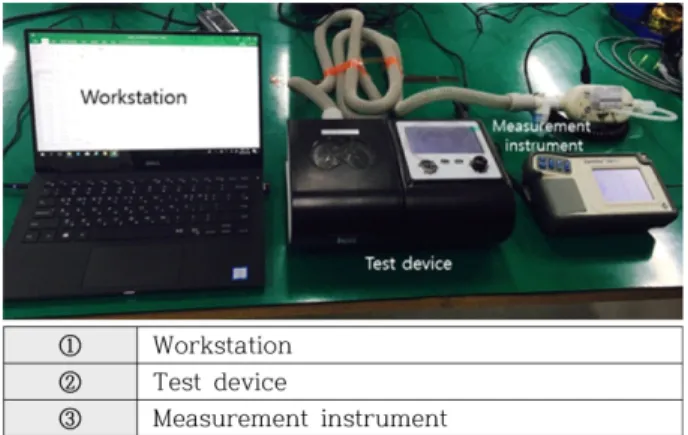
그림 1. 호흡보조의료기기 실험환경 Set-up
Fig. 1. Set-up the test environment of Respiratory medical device
그림 2. 가습생산량 측정을 위한 실험 Set-up Fig. 2. Humidification measurement Set-up
217 4. 호흡보조의료기기의 안전성 및 성능평가 항목 및 시험
국내·외 자료를 조사·분석한 결과를 바탕으로 호흡보조의 료기기에 적용가능한 안전성 및 성능평가항목을 선정하였고 타당성을 확인하기 위해 전문가 자문회의를 개최하여 관련 전문가들의 의견을 반영하였다.
또한 개인용 인공호흡기는 개별규격에 따라 제정된 국내 기준규격을 바탕으로 시험평가를 받고 있으나, 양압지속유 지기의 경우 국내 기준규격이 없는 상태이므로 제시한 안전 성 및 성능평가 항목 중 파손, 고장위험이 있는 일부 항목 을 제외한 나머지 항목에 대하여 유속계(PF-300, MT Medical, Germany) 와 무작위로 세 업체의 양압지속유지 기 시험의료기기를 선정하여 시험 환경을 구축하여 시험을 실시하였다.
III. 연구 결과
1. 호흡보조의료기기의 국내·외 품목 분류 현황
1.1 국내 분류체계 현황
호흡보조의료기기는「의료기기 품목 및 품목별 등급에 관한 규정」 에 의해 A07000 호흡 보조기(Respiratory apparatus)로 분류되어 있으며 표 1과 같이 사용대상, 장소 및 용도에 따라 각각 3등급으로 분류되어 있고, 의료기기 제품정보방에서 확 인할 수 있는 2012년부터 2017년 9월까지의 국내 허가현 황은 범용인공호흡기 14건, 개인용인공호흡기 21건, 양압지 속유지기 43건 등으로 파악된다.
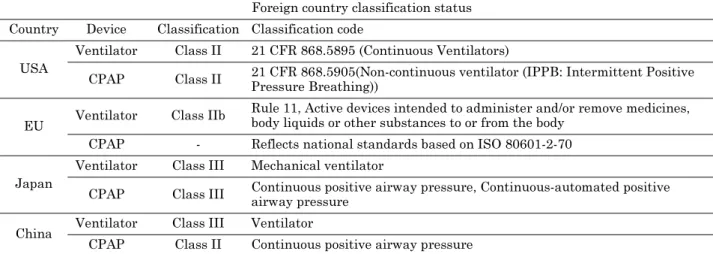
표 1. 국외 분류체계 현황
Table 1. Foreign country classification status
Foreign country classification status Country Device Classification Classification code
USA
Ventilator Class II 21 CFR 868.5895 (Continuous Ventilators)
CPAP Class II 21 CFR 868.5905(Non-continuous ventilator (IPPB: Intermittent Positive Pressure Breathing))
EU Ventilator Class IIb Rule 11, Active devices intended to administer and/or remove medicines, body liquids or other substances to or from the body
CPAP - Reflects national standards based on ISO 80601-2-70
Japan
Ventilator Class III Mechanical ventilator
CPAP Class III Continuous positive airway pressure, Continuous-automated positive airway pressure
China Ventilator Class III Ventilator
CPAP Class II Continuous positive airway pressure
표 2. 호흡보조의료기기의 시험항목 도출을 위한 참고규격
Table 2. Reference standards for derivation of test for respiratory medical device Referenced international standards
ISO 80601-2-12:2011, Medical electrical equipment - Part 2-12: Particular requirements for basic safety and essential performance of critical care ventilators
ISO 80601-2-70:2015, Medical electrical equipment - Part 2-70: Particular requirements for basic safety and essential performance of sleep apnoea breathing therapy equipment
ISO 80601-2-72:2015, Medical electrical equipment - Part 2-72: Particular requirements for basic safety and essential performance of home healthcare environment ventilators for ventilator-dependent patients
ISO 10651-6:2004, Lung ventilators for medical use - Particular requirements for basic safety and essential performance - Part 6: Home-care ventilatory support devices
ISO 80601-2-74:2017, Medical electrical equipment - Part 2-74: Particular requirements for basic safety and essential performance of respiratory humidifying equipment
IEC 60601-1-11:2012, Medical electrical equipment - Part 1-11: General requirements for basic safety and essential performance - Collateral standard: Requirements for medical electrical equipment and medical electrical systems used in the home healthcare environment
YY 0600.1-2007, Lung ventilators for medical use. Particular requirements for basic safety and essential performance.
Part 1: Home-care ventilatory support devices
YY 0600.2-2007, Lung ventilators for medical use. Particular requirements for basic safety and essential performance.
Part 2: Home care ventilators for ventilator-dependent patients
218
1.2 국외 분류체계 현황
미국 FDA, 유럽 CE, 일본 PMDA 및 중국 CFDA의 호 흡보조의료기기 분류체계는 표 1과 같다.
2. 호흡보조의료기기 관련 국내·외 기준규격
호흡보조의료기기의 안전성 및 성능평가 항목을 도출하기 위하여 인공호흡기(중환자용, 개인용 등), 양압지속유지기 및
표 3. 호흡보조의료기기의 품목분류기준
Table 3. Classification criteria for respiratory medical devices
Ventilator CPAP
Intended use Support and control breathing opening Upper airway Target
Patients unable to spontaneously breathe (eg central sleep apnea, severe chronic obstructive pulmonary disease, lung cancer, etc.)
Patients capable of spontaneous breathing (ex.
Patients with obstructive sleep apnea, Lou Gehrig's disease, etc.)
use Invasive (ex. Tracheal intubation), Non-invasive
(ex. Mask) Non-invasive (ex. Mask, nasal cannula)
표 4. 인공호흡기 안전성 및 성능평가 항목
Table 4. Safety and Performance evaluation list of Ventilator
Safety and Performance evaluation list Reference
Safety
Pressurized gas input Overpressure
ISO 80601-2-72 compatibility
Protect against mechanical hazards Unwanted side shift Excessive temperatures and other
HAZARDS
Temperature of applied part Leakage
Power supply interruption Accuracy of controls and instruments Gas Level Monitoring Equipment
Dangerous output
Incorrect output
Patient Connection Port Pressure Accidental Adjustment
Hazardous situation and Defective
Conditions Gas supply failure
Ventilator breathing system Leakage in the ventilator breathing system Spontaneous breathing on power loss
Performance
General requirements Gas Flow Rate and Leakage Standard Protect against mechanical hazards Sound
Protection against the accuracy and dangerous output of controls and instruments
Accuracy of Control and Instrument
Breathing type Gas Volume Control Breathing Type Pressure-controlled breathing type
Hazardous output
Protection device to limit Maximum pressure
Oxygen monitor
Exhalation gas level or low gas level alarm condition
End tidal carbon dioxide
High pressure alarm condition and protection device
Occlusion alarm Partial occlusion alarm Low breath alarm
Positive pressure continuous alarm High leakage
219 호흡보조의료기기에 적용되는 가습기에 대한 국제 규격과
참고 가능한 규격을 조사하였다(표 2).
3. 호흡보조의료기기의 품목분류기준
호흡보조의료기기의 기능이 중첩되어 모호한 품목을 분류 하기 위해 관련 자료를 분석하여 사용목적, 대상 및 사용방 법에 따른 분류기준을 제시하였다(표 3). 개인용 인공호흡기의 사용목적은 호흡을 지원 또는 제어하는 것이다. 자발호흡이 불가능한 환자를 대상으로 하며, 기관삽관을 통한 침습적 사 용과 마스크를 사용한 비침습적 사용법이 있다. 양압지속유 지기의 경우 상기도 개방을 사용목적으로 하며 자발호흡이 가능한 환자에게 사용한다. 또한 마스크나 비강 캐뉼라 등을 통하여 사용하게 된다.
4. 호흡보조의료기기의 안전성 및 성능평가 항목
개인용 인공호흡기의 개별규격「ISO 80601-2-72」와 양 압지속유지기의 개별규격 「ISO 80601-2-70」을 분석하여 각 규격에서 제시하는 품목별 안전성 및 성능항목을 도출하 였고, 각 기기의 특성에 따라 일부 성능항목을 추가하였다.
또한 두 품목 모두 의료시설 외의 환경에서 사용 가능한 기 기임을 고려하여 홈 헬스케어 환경 의료기기에 대한 규격인
「IEC 60601-1-11」을 참고하였으며 가습기의 경우 두 품 목에 공통적으로 적용되는 항목이므로 개별규격 「ISO 80601-2-74 」를 바탕으로 공통항목으로 제시하였다.
5. 양압지속유지기의 안전성 및 성능평가 시험
해당품목의 평가 항목 중 환자연결포트의 압력, 설정압력에 대한 유속 및 가습생산량에 대하여 시험을 실시하였다.
5.1 환자연결포트의 압력
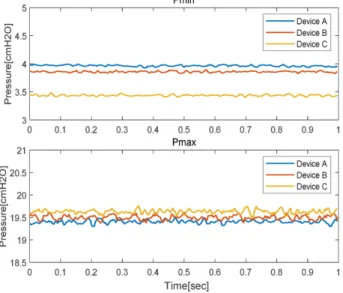
기 허가/판매된 기기 A, B, C를 무작위로 선정하여 CPAP (Continuous positive airway pressure) 모드 시 환자연 결포트 압력의 최소/최대치를 측정하였다(그림 3). 표 6과
표 5. 양압지속유지기 안전성 및 성능평가 항목
Table 5. Safety and Performance evaluation list of CPAP
Safety and Performance evaluation list Reference
Safety
Excessive temperatures and other HAZARDS
Temperature of applied part
ISO 80601-2-70 Leakage
Power supply interruption
Accuracy of controls and instruments
Stability of patient connection port static pressure accuracy – long term accuracy
Stability of patient connection port dynamic pressure accuracy – short term accuracy
Dangerous output Pressure of patient connection port Carbon dioxide rebreathing
Performance
General requirements Characteristics of gas flow rate and pressure Protect against mechanical hazards Sound
Protection against the accuracy and dangerous output of controls and instruments
Protection device to limit Maximum pressure Maximum flow rate
Humidification Production
그림 3. 환자연결포트의 압력 (Device A, B, C)
Fig. 3. Pressure of patient connection port (Device A, B, C) 표 6. 환자연결포트의 압력
Table 6. Pressure of patient connection port
Test device Setting value Measuring value Device A 4.0 cmH2O 4.004 cmH2O
20.0 cmH2O 20.186 cmH2O Device B 4.0 cmH2O 3.871 cmH2O
20.0 cmH2O 19.492 cmH2O Device C 4.0 cmH2O 4.014 cmH2O
20.0 cmH2O 20.186 cmH2O
220
같이 설정값에 대한 시험기기의 각 단일 측정압력은 오차가 1% 를 넘지 않는 것을 확인할 수 있다.
5.2 최대 유속
기기 A, B, C의 CPAP 모드에서의 환자연결포트 압력 최 대/최소에 대한 유속을 측정하고,「ISO 80601-2-70」에 제 시된 표를 따라 설정압력 범위 당 평균유속에 대한 성능표를 작성하였다(그림 4, 표 7). 실제 시험 평가 시 도출된 유속 성능표(표 7)와 제조사가 제시한 값을 비교하여 시료의 성 능을 평가할 수 있다.
5.3 가습생산량
기 허가/판매된 CPAP(Continuous positive airway pressure)
B, C 를 대상으로 설정압력 10.0 cmH
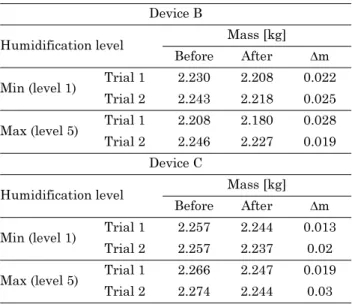
2O 에서 가습레벨에 따 른 가습생산량에 대해 질량측정법을 이용하여 시험하였다. 실 험결과는 표 8과 같으며 이 값은 제조사가 제시한 성능표와 비교하여 확인한다.
IV. 결 론
본 연구는 호흡보조의료기기 중 가장 경계가 모호한 개인 용(home-use) 인공호흡기와 양압지속유지기에 대하여 국내
· 외 규격, 규제기관의 가이드라인 등의 자료를 조사·분석하 여 사용목적, 대상 및 사용방법에 따른 품목분류 기준을 제 시하고 각 품목에 대한 안전성 및 성능평가항목을 도출하였
그림 4. 최대유속(Device A, B, C)Fig. 4. Maximum flow rate (Device A, B, C) 표 7. 최대유속(Device A, B, C)
Table 7. Maximum flow rate(Device A, B, C)
Device A
Test pressure Pmin Pmin + 25%
(Pmax - Pmin)
Pmin + 50%
(Pmax - Pmin)
Pmin + 75%
(Pmax - Pmin) Pmax
Airway pressure (cmH2O) 3,965 7,825 11,685 15,545 19,405
Airway pressure flow average (L/min) 9.103 12.123 15.142 18.161 21.180
Device B
Test pressure Pmin Pmin + 25%
(Pmax - Pmin)
Pmin + 50%
(Pmax - Pmin)
Pmin + 75%
(Pmax - Pmin) Pmax
Airway pressure (cmH2O) 3,858 7,768 11,678 15,588 19,498
Airway pressure flow average (L/min) 8.968 12.037 15.106 18.176 21.245
Device C
Test pressure Pmin Pmin + 25%
(Pmax - Pmin)
Pmin + 50%
(Pmax - Pmin)
Pmin + 75%
(Pmax - Pmin) Pmax
Airway pressure (cmH2O) 3,437 7,485 11,534 15,582 19,630
Airway pressure flow average (L/min) 8.440 11.660 14.880 18.100 21.319
표 8. 가습생산량 (Device B, C)
Table 8. Humidification measurement (Device B, C) Device B
Humidification level Mass [kg]
Before After Δm
Min (level 1) Trial 1 2.230 2.208 0.022 Trial 2 2.243 2.218 0.025 Max (level 5) Trial 1 2.208 2.180 0.028 Trial 2 2.246 2.227 0.019
Device C
Humidification level Mass [kg]
Before After Δm
Min (level 1) Trial 1 2.257 2.244 0.013
Trial 2 2.257 2.237 0.02
Max (level 5) Trial 1 2.266 2.247 0.019
Trial 2 2.274 2.244 0.03
221 다. 특히 국내기준규격이 없는 양압지속유지기는 일부 평가
항목을 선정하여 시험을 실시하였으며 모든 항목의 결과는 오차범위 이내 및 개별규격 내 요구사항에 적합한 것을 확 인하였다.
본 연구결과에 따라 개인용 인공호흡기와 양압지속유지기의 혼용을 방지할 수 있고, 실제 시험평가 시 개별규격 및 제 조사에서 제시한 허용범위와 비교하여 양압지속유지기의 안 전성 및 성능에 대한 검증을 실시하여 제조사 및 허가·시험 평가자가 정확한 업무를 수행할 수 있을 것이라 예상된다.
References
[1] Milliner BH, Bentley S, DuCanto J. A pilot study of impro- vised CPAP (iCPAP) via face mask for the treatment of adult respiratory distress in low-resource settings. International Journal of Emergency Medicine. 2019;12(7).
[2] Shneerson JM. Techniques in mechanical ventilation : prin- ciples and practice. Thorax. 1996;51(7):756-61.
[3] https://www.who.int/en/news-room/fact-sheets/detail/chronic- obstructive-pulmonary-disease-(copd). Accessed on 26 Jan 2019.
[4] Kacmarek RM. The Mechanical Ventilator. Past, Present, and Future. Respiratory Care. 2011;56(8):1170-80.
[5] Venessa L. Pinto, Sandeep Sharma. Continuous Positive Air- way Pressure (CPAP). StatPearls. 2019.
[6] ISO 80601-2-12:2011. Medical electrical equipment – Part
2-12: Particular requirements for basic safety and essential performance of critical care ventilators.
[7] ISO 80601-2-70:2015. Medical electrical equipment – Part 2-70: Particular requirements for basic safety and essential performance of sleep apnoea breathing therapy equipment.
[8] ISO 80601-2-72:2015. Medical electrical equipment – Part 2-72: Particular requirements for basic safety and essential performance of home healthcare environment ventilators for ventilator-dependent patients.
[9] ISO 10651-6:2004. Lung ventilators for medical use – Particular requirements for basic safety and essential performance – Part 6: Home-care ventilatory support devices.
[10] ISO 80601-2-74:2017. Medical electrical equipment – Part 2-74: Particular requirements for basic safety and essential performance of respiratory humidifying equipment.
[11] IEC 60601-1-11:2012. Medical electrical equipment – Part 1-11: General requirements for basic safety and essential per- formance - Collateral standard: Requirements for medical electrical equipment and medical electrical systems used in the home healthcare environment.
[12] YY 0600.1-2007. Lung ventilators for medical use. Particu- lar requirements for basic safety and essential performance.
Part 1: Home-care ventilatory support devices.
[13] YY 0600.2-2007. Lung ventilators for medical use. Particular requirements for basic safety and essential performance. Part 2:
Home care ventilators for ventilator-dependent patients.
[14] Standard 30. Ventilator.
[15] Standard 30. General purpose Ventilator.