• 검색 결과가 없습니다.

Possible new LNK mutations in myeloproliferative neoplasms

N/A
N/A
Protected

Academic year: 2021

Share "Possible new LNK mutations in myeloproliferative neoplasms"

Copied!
3
0
0

로드 중.... (전체 텍스트 보기)

전체 글

(1)

Possible new LNK mutations in myeloproliferative neoplasms

Jung-Sook Ha and Dong-Seok Jeon

Recently, lymphocyte adaptor protein ( LNK or SH2B3) has been reported as a new genetic abnormality in BCR-ABL negative myelopro- liferative neoplasms (MPN). We performed LNK sequence analysis in 42 chronic phase MPN patients (14 polycythemia vera, 15 essential thrombocythemia, 9 primary myelofibrosis, and 4 myeloproliferative neoplasm, unclassified) and detected total three types of genetic muta- tions (7.1%) including p.Q423X, p.R551W and p.I568T. These mutations were accompanied by a JAK2 V617F mutation. The p.Q423X is a non- sence mutation located on exon 7 encoding the Src homology 2 domain. The p.R551W and p.I568T are missense mutations located on exon 8 encoding the C-terminal region. Our study suggests that LNK mutations occur in low frequency in human MPN, and can occur in several regions of the LNK gene not only on a pleckstrin homology domain which have been regarded as a ‘hot spot’.

Recently, the mutation of lymphocyte adaptor protein (LNK or SH2B3) was detected in MPN. LNK is a negative regulator of thrombopoietin (TPO)- MPL and erythropoietin (EPO)-EPO receptor-mediated JAK2 activation [10,11]. LNK belongs to a family of adaptor proteins possessing several domains: a proline-rich N-terminal dimerization domain, a pleckstrin homol- ogy (PH) domain, a Src homology 2 (SH2) domain, and a conserved C-ter- minal tyrosine residue [12]. Via its SH2 domain, LNK binds to JAK2 and inhibits its downstream signal transduction. LNK is also capable of regulating the aberrant signaling of MPL-W515L and JAK2 V617F in vitro [13,14].

LNK-deficient mice show a phenotype consistent with MPN, involving an expanded hematopoietic stem cell compartment, megakaryocytic hyperpla- sia, splenomegaly, leukocytosis, and thrombocytosis [15]. In human MPN, three studies about LNK mutations have been reported, in which 12 of 102 patients were shown to harbor 14 different LNK mutations [16–18].

In this study, we performed LNK mutation analysis in 42 chronic-phase MPN patients to study additional mutations in human MPN. We also per- formed JAK2 and MPL W515L/K mutation analyses to identify the relation- ship with the LNK mutation.

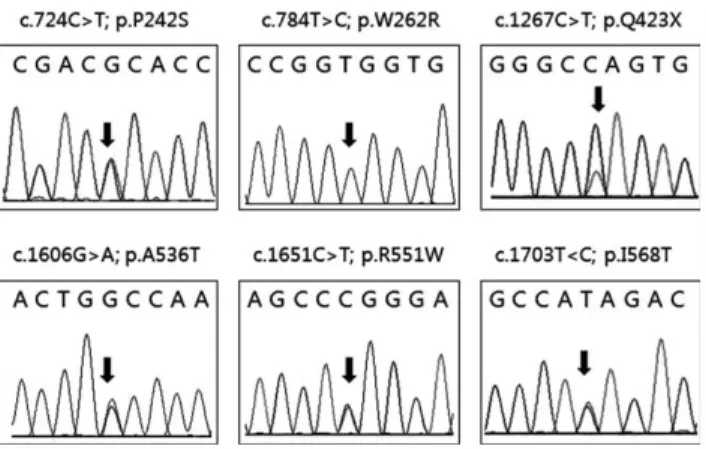
The patients comprised 27 males and 15 females with average ages of 63 and 64 years, respectively. All patients were on initial diagnosis with chronic phase, and the subtypes were 14 PV, 15 ET, 9 PMF, and 4 MPN, unclassi- fied (MPN-U) (See Supporting Information I). Six genetic variations were detected including p.P242S, p.W262R, p.Q423X, p.A536T, p.R551W, and p.I568T (Fig. 1). The p.P242S (c.724C >T) were detected in six patients and was an already known polymorphism (rs78894077) listed in the National Center for Biotechnology Information Single Nucleotide Polymorphism (SNP) Database (dbSNP; http://ncbi.nlm.nih.gov/projects/SNP/). The p.W262R (c.784T>C) was detected in all 42 patients as a homozygote, was also known polymorphism (rs3184504). The p.A536T (c.1606G>A) variation was detected in a PV patient. Although it was not listed in the dbSNP, we regarded it as one of polymorphisms, because it was detected in one of 50 normal controls. In contrast, the other three variations, p.Q423X (c.1267C>T), p.R551W (c.1651C>T), and p.I568T (c.1703T>C), which were detected in each ET, PMF, and PV patient, were not found in 50 con- trol samples. Moreover, those had not been reported in previous literatures or listed in the dbSNP, either. The p.Q423X is located on exon 7 of LNK gene and results in a premature stop codon in the SH2 domain. The p.R551W and p.I568T are missense variations located on exon 8, which enc- odes the C-terminal region of the LNK protein. Because we could not per- form germline study with the paired normal cell in each patient, we could not definitely rule out the possibility that these variations were not true somatic mutations, especially for p.R551W and p.I568T. However, when we regarded these three variations as new mutations based on the study using 50 normal controls, the prevalence of LNK mutation in our study could be estimated as 7.1% in chronic-phase MPN. The evaluation of the subtype- specific prevalence of LNK mutation was not performed due to small num- bers of cases harboring the mutations. Previous estimates of LNK mutation prevalence have ranged from 6.1 to 25% [16–18]. Oh et al. reported two types of LNK mutations in 33 (6.1%) JAK2 V617F-negative MPN patients

[17], and Lasho et al. identified two mutations (25.0%) in eight JAK2 V617F- negative patients with unexplained erythrocytosis [19]. Pardanani et al.

studied a relatively large cohort of 61 patients with blast-phase MPN, and postulated that LNK mutations are more prevalent in the blast-phase (13.1%) than in the chronic phase (4.9%).

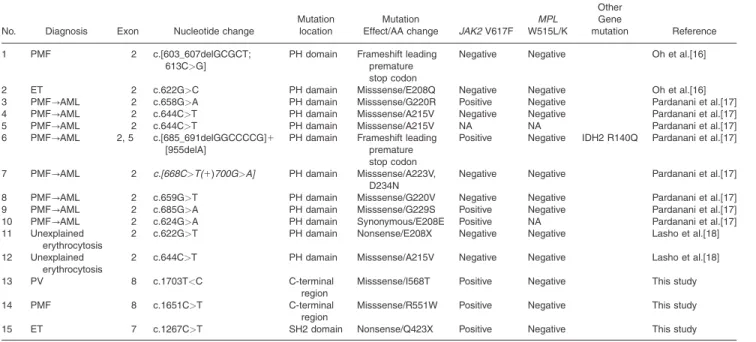
The previously reported mutations were variable and differed across patients, except for one mutation (c.644C >T) that was detected in three cases (Table I). Interestingly, most of the mutations were located on the PH domain, which have led investigators to regard the PH domain as a mutational ‘‘hot spot’’ [18]. The PH domain of LNK is involved in the coloc- alization of LNK to the plasma membrane. These mutations are expected to disrupt the PH domain and consequently mislocalize LNK in the cyto- plasm abrogating its function to JAK2. However, the mutations we detected were on the SH2 domain or C-terminus. The SH2 domain of LNK is known to bind JAK2 and do a critical role in negative regulation of the down- stream signal transduction. So, we expected the p.Q423X mutation might result in the disruption of LNK function and have a role in MPN pathogen- esis. If we perform the expression study for the production of truncated protein or no protein synthesis by this mutation, it would be more helpful to understand its effect to LNK function. Regarding the p.R551W and p.I568T in C-terminal region, actually we cannot expect the functional con- sequences because those are not located in the main domain. When we performed the conservation study, we could find these location were well- conserved interspecies, so we just guessed these amino acid changes might have effect on the LNK structure or its function (See Supporting Information II). According to previous investigations using transgenic mice, the mutational effect of LNK could be different according to the mutation type. The SH2-mutated type showed most severe disruption of LNK func- tion compared to the mutated form in PH domain or C-terminal tyrosine residue [10,19]. If large number of cases with LNK mutations would be col- lected in the future, the phenotypic difference according to mutation type could be evaluated.

The JAK2 V617F (exon 14) was detected in 26 of 42 patients (61.9%), but the exon 12 mutation was not detected in this study. All of three patients with LNK mutation also harbored JAK2 V617F mutation. The MPL W515L was identified in two ET patients, and neither of them harbored LNK or JAK2 V617F mutations. The frequent cooccurrence of LNK mutation and JAK2 V617F was also observed in previous study, which reported LNK mutations were found at similar frequencies between JAK2 V617F-negative and positive patients [17]. Now we do not know whether the LNK mutation and JAK2 V617F occur in the same clone or not, and the effect of those

Figure 1. Nucleotide variations found in our study. Arrows in each DNA sequence trace are indicating the substituted position. Three variations are new mutations composed of two missense mutations (p.R551W and p.I568T) and one nonsense mutation (p.Q423X). The others (p.P242S, p.W262R and p.A536T) are known SNPs.

letters

866 American Journal of Hematology

(2)

cooccurrence on MPN pathogenesis or phenotype. We expected more severe phenotype will result in cases with two mutations than those with only one mutation, based on a previous study that reported the augmented ability of oncogenic JAK2 to expand myeloid progenitors in LNK-deficient mice [20].

Although only a few studies, including ours, have been published regard- ing LNK mutations in human MPN, the collective data does favor some sug- gestions. The prevalence of LNK mutations is not high in human MPN, especially among patients with chronic-phase MPN (<10% mutated). Sec- ond, LNK mutations can target several regions of the LNK gene, not only in the PH domain. Whether mutations in different domains contribute differently to phenotypic expression needs to be addressed in larger studies. Finally, the LNK mutation could be accompanied by JAK2 V617F. We cannot be sure if LNK mutations and consequent functional disruption are solely responsible or only provide a supportive role for MPN pathogenesis by other genetic changes like JAK2 V617F. Larger-scale studies of LNK mutation in human MPN are warranted.

Methods

Sample collection. This study was approved by the Dongsan Medical Center’s Institutional Review Board. Total 42 DNA samples that had been extracted and stored from peripheral blood or bone marrow of MPN patients between 2007 and 2010 were used. All samples were obtained on initial diagnosis and chronic phase of MPN. For control study, total 50 DNA samples from healthy controls were acquired.

Mutation analysis. The primers for LNK (exon 2-8) and JAK2 (exon 12 and 14) were designed using Primer3 (http://frodo.wi.mit.edu/primer3/), and the sequencing was conducted using a BigDye Terminator v3.1 Cycle Sequenc- ing kit (Applied Biosystems, Foster City, CA) on an ABI 3730XL DNA ana- lyzer (Applied Biosystems) (See Supporting Information III). The detection of MPL W515L or W515K mutation was performed using a Real-QTM MPL W515L/K screening kit (BioSewoom, Seoul, Korea) according to the manu- facturer’s instructions.

Acknowledgments

The authors thank KS Park, Ph.D. and WA Bae, Ph.D. for good assistance with sample collection, DNA extraction, and sequencing analysis.

Department of Laboratory Medicine, Keimyung University School of Medicine, 194 Jung-gu Dongsan-dong, Daegu 700-712, South Korea Grant sponsor: Bisa Research Grant of Keimyung University

*Correspondence to: Dr. Jung-Sook Ha, Department of Laboratory Medicine, Keimyung University School of Medicine, 194 Jung-gu Dongsan-dong, Daegu 700-712, South Korea E-mail: [email protected] Additional Supporting Information may be found in the online version of this article.

Conflict of interest: Nothing to report.

Published online 14 June 2011 in Wiley Online Library (wileyonlinelibrary.com).

DOI: 10.1002/ajh.22107

References

1. Tefferi A, Vardiman JW. Classification and diagnosis of myeloproliferative neo- plasms: The 2008 World Health Organization criteria and point-of-care diag- nostic algorithms. Leukemia 2008;22:14–22.

2. Baxter EJ, Scott LM, Campbell PJ, et al. Acquired mutation of the tyrosine kinase JAK2 in human myeloproliferative disorders. Lancet 2005;365:1054–1061.

3. Pikman Y, Lee BH, Mercher T, et al. MPLW515L is a novel somatic activating mutation in myelofibrosis with myeloid metaplasia. PLoS Med 2006;

3:e270.

4. Tefferi A. Novel mutations and their functional and clinical relevance in myelo- proliferative neoplasms: JAK2, MPL, TET2, ASXL1, CBL, IDH and IKZF1.

Leukemia 2010;24:1128–1138.

5. Oh ST, Gotlib J. JAK2 V617F and beyond: Role of genetics and aberrant sig- naling in the pathogenesis of myeloproliferative neoplasms. Expert Rev Hem- atol 2010;3:323–337.

6. Antonioli E, Guglielmelli P, Pancrazzi A, et al. Clinical implications of the JAK2 V617F mutation in essential thrombocythemia. Leukemia 2005;19:

1847–1849.

7. Lippert E, Boissinot M, Kralovics R, et al. The JAK2-V617F mutation is fre- quently present at diagnosis in patients with essential thrombocythemia and polycythemia vera. Blood 2006;108:1865–1867.

8. Scott LM, Tong W, Levine RL, et al. JAK2 exon 12 mutations in polycythemia vera and idiopathic erythrocytosis. N Engl J Med 2007;356:459–

468.

9. Pardanani AD, Levine RL, Lasho T, et al. MPL515 mutations in myeloprolifer- ative and other myeloid disorders: A study of 1182 patients. Blood 2006;108:

3472–3476.

10. Tong W, Lodish HF. Lnk inhibits Tpo-mpl signaling and Tpo-mediated mega- karyocytopoiesis. J Exp Med 2004;200:569–580.

11. Tong W, Zhang J, Lodish HF. Lnk inhibits erythropoiesis and Epo-dependent JAK2 activation and downstream signaling pathways. Blood 2005;105:4604–

4612.

12. Rudd CE. Lnk adaptor: novel negative regulator of B cell lymphopoiesis. Sci STKE. 2001;2001:pe1.

13. Gery S, Gueller S, Chumakova K, et al. Adaptor protein Lnk negatively regu- lates the mutant MPL, MPLW515L associated with myeloproliferative disor- ders. Blood 2007;110:3360–3364.

14. Gery S, Cao Q, Gueller S, et al. Lnk inhibits myeloproliferative disorder-asso- ciated JAK2 mutant, JAK2V617F. J Leukoc Biol 2009;85:957–965.

TABLE I. LNK mutations reported in previous literatures including our cases

No. Diagnosis Exon Nucleotide change

Mutation location

Mutation

Effect/AA change JAK2 V617F MPL W515L/K

Other Gene

mutation Reference

1 PMF 2 c.[603_607delGCGCT;

613C >G]

PH domain Frameshift leading premature stop codon

Negative Negative Oh et al.[16]

2 ET 2 c.622G >C PH damain Misssense/E208Q Negative Negative Oh et al.[16]

3 PMF ?AML 2 c.658G >A PH damain Misssense/G220R Positive Negative Pardanani et al.[17]

4 PMF ?AML 2 c.644C >T PH damain Misssense/A215V Negative Negative Pardanani et al.[17]

5 PMF ?AML 2 c.644C >T PH damain Misssense/A215V NA NA Pardanani et al.[17]

6 PMF ?AML 2, 5 c.[685_691delGGCCCCG]1 [955delA]

PH damain Frameshift leading premature stop codon

Positive Negative IDH2 R140Q Pardanani et al.[17]

7 PMF ?AML 2 c.[668C >T(1)700G>A] PH damain Misssense/A223V, D234N

Negative Negative Pardanani et al.[17]

8 PMF ?AML 2 c.659G >T PH damain Misssense/G220V Negative Negative Pardanani et al.[17]

9 PMF ?AML 2 c.685G >A PH damain Misssense/G229S Positive Negative Pardanani et al.[17]

10 PMF ?AML 2 c.624G >A PH damain Synonymous/E208E Positive NA Pardanani et al.[17]

11 Unexplained erythrocytosis

2 c.622G>T PH damain Nonsense/E208X Negative Negative Lasho et al.[18]

12 Unexplained erythrocytosis

2 c.644C>T PH damain Misssense/A215V Negative Negative Lasho et al.[18]

13 PV 8 c.1703T<C C-terminal

region

Misssense/I568T Positive Negative This study

14 PMF 8 c.1651C>T C-terminal

region

Misssense/R551W Positive Negative This study

15 ET 7 c.1267C >T SH2 domain Nonsense/Q423X Positive Negative This study

Abbreviations: AA, amino acid; AML, acute myeloblastic leukemia; ET, essential thrombocythemia; MPN, myeloproliferative neoplasm; NA, not available; PH domain, pleckstrin homology domain; SH2 domain, Src homology 2 domain; PMF, primary myelofibrosis; PV, polycythemia vera.

letters

American Journal of Hematology 867

(3)

15. Velazquez L, Cheng AM, Fleming HE, et al. Cytokine signaling and hematopoietic homeostasis are disrupted in Lnk-deficient mice. J Exp Med 2002;195:1599–1611.

16. Oh ST, Simonds EF, Jones C, et al. Novel mutations in the inhibitory adaptor protein LNK drive JAK-STAT signaling in patients with myeloproliferative neo- plasms. Blood 2010;116:988–992.

17. Pardanani A, Lasho T, Finke C, et al. LNK mutation studies in blast-phase myeloproliferative neoplasms, and in chronic-phase disease with TET2, IDH, JAK2 or MPL mutations. Leukemia 2010;24:1713–1718.

18. Lasho TL, Pardanani A, Tefferi A. LNK mutations in JAK2 mutation-negative erythrocytosis. N Engl J Med 2010;363:1189–1190.

19. Baran-Marszak F, Magdoud H, Desterke C, et al. Expression level and differential JAK2-V617F-binding of the adaptor protein Lnk regulates JAK2-mediated signals in myeloproliferative neoplasms. Blood 2010;116:

5961–5971.

20. Bersenev A, Wu C, Balcerek J, et al. Lnk constrains myeloproliferative dis- eases in mice. J Clin Invest 2010;120:2058–2069.

Concomitant lupus anticoagulant and monoclonal IgMk antibody in a patient with bleeding tendency:

a case report and literature review

Marie-Alexandra Alyanakian, 1,2 Hikaru Okada, 1,2 Christilla Bachelot-Loza, 1,3 Peggy Tournoux, 4 Bruno Varet, 1,5 and Dominique Lasne 1,3,4

Antiphospholipid antibodies (aPL) are a heterogeneous population of autoantibodies including lupus anticoagulant (LAC), anticardiolipin antibodies and antib

2

-glycoprotein I antibodies. aPL may be associated with systemic lupus erythematosus, other autoimmune disorders, connective tissue disorders, malignancies, drug use and/or infections.

They are usually associated with thrombotic complications (throm- boembolism, spontaneous abortion, livedo reticularis). Bleeding is generally not a feature of aPL, but uncommonly, bleeding can occur if significant thrombocytopenia or prothrombin deficiency develop.

An aPL-monoclonal gammopathy association has been described, particularly in patients suffering from lymphoid proliferations, includ- ing Waldenstro ¨ m’s macroglobulinemia and lymphoma. Here we report a strong association between LAC and hemostasis abnormalities with monoclonal immunoglobulin Mk in a 71-year-old woman who experi- enced excessive bleeding after dental extraction. Our findings suggest that the monoclonal component induced spontaneous platelet aggre- gation. Unlike previous reports, Waldenstro ¨ m’s macroglobulinemia or lymphoma was not found in this patient.

The patient was referred by her general practitioner to our Hematology Department because of abnormal bleeding after dental extraction, not requir- ing transfusion. Several years ago, the patient had undergone surgery, e.g.

complete hysterectomy, cholecystectomy, and sclerotherapy for varicose veins, without complications. She had no personal history of abnormal bleed- ing or family history of coagulation disorders. No clinical abnormality was found. She was not taking any drug known to increase the hemorrhage risk.

Complete blood count was normal (erythrocytes 4.25 3 10

12

/L, leuko- cytes: 3.9 3 10

9

/L, platelets: 156 3 10

9

/L). Her bleeding time was prolonged (11.5 min, normal range <8 min), as was the closure time measured with the Platelet Function Analyzer (PFA100) with the cartridge containing epi- nephrine (170 sec, normal range <160 sec), but normal with the ADP car- tridge. Repeated coagulation tests showed normal prothrombin time, throm- bin time, and fibrinogen level but a markedly prolonged activated partial pro- thrombin time (aPTT ratio 2.4, normal range <1.2). Mixing aPTT test of the patient’s plasma with normal plasma did not correct the abnormal aPTT and the Rosner index was positive (50, normal range <15). The presence of a lupus anticoagulant (LAC), according to International Society on Thrombosis

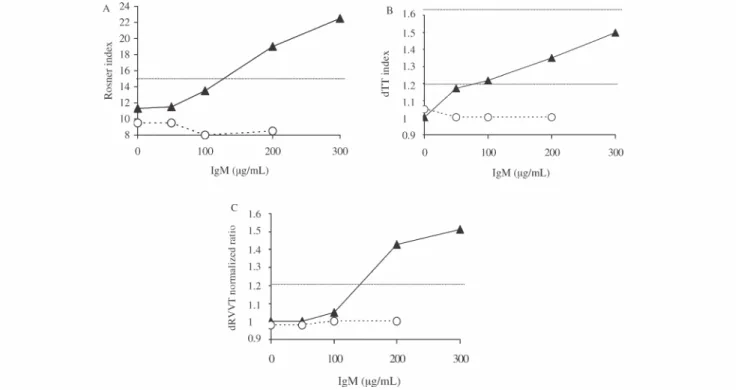
Figure 1. The lupus anticoagulant activity of the patient’s IgMk. Effect of increasing concentrations of the patient’s ( ~) or control (*) monoclonal IgMk in normal plasma on the aPTT (A), dTT (B) and dRVVT (C). Index were calculated as follow: Rosner: (mixing aPTT test - normal plasma aPTT)/patient aPTT, dTT: mixing dTT test/normal plasma dTT, dRVVT normalized ratio: patient plasma LA1 Screening Reagent/mean normal LA1 Screening reagent) x (mean normal LA2 Confirmation Reagent/patient plasma LA2 Confirmation reagent). LAC is positive when its value is above the horizontal dotted line.

letters

868 American Journal of Hematology

수치

Figure 1. Nucleotide variations found in our study. Arrows in each DNA sequence trace are indicating the substituted position
TABLE I. LNK mutations reported in previous literatures including our cases
Figure 1. The lupus anticoagulant activity of the patient’s IgMk. Effect of increasing concentrations of the patient’s ( ~) or control (*) monoclonal IgMk in normal plasma on the aPTT (A), dTT (B) and dRVVT (C)

참조

관련 문서

Note that the boundary with the smallest misorientation is made up of a row of dislocations, whereas the high-angle boundaries have a disordered structure in

barriers for nucleation are high, the highest nucleation rates will be produced by grain-corner nucleation. 3) At very high driving forces it may be possible for the (C 1 /C 0

8.4.1 Two-phase equilibrium between the liquid and a solid solution (iii) Extension of tie line cannot intersect the vertex of triangle6. Exception : solubility

(a) Low-Angle and High-Angle Boundaries (b) Special High-Angle Grain Boundaries (c) Equilibrium in

The problem of atom migration can be solved by considering the thermodynamic condition for equilibrium; namely that the chemical potential of an atom must be the same

Different composition between parent and product (Ex. The growth of the B-rich phase into the A-rich α-phase) Growth of the new phase will require long-range diffusion

The stain field associated with a dislocation can in certain cases provide a favorable interaction with the strain field of the martensite nucleus, such that one of the

Model performances in the stations of Nam river monitoring data 42 Table 15... List