• 검색 결과가 없습니다.

Dielectric Properties of BaTiO<sub>3</sub> Substituted with Donor Dopants of Nb<sup>5+</sup> and Ta<sup>5+</sup>

N/A
N/A
Protected

Academic year: 2021

Share "Dielectric Properties of BaTiO<sub>3</sub> Substituted with Donor Dopants of Nb<sup>5+</sup> and Ta<sup>5+</sup>"

Copied!
6
0
0

로드 중.... (전체 텍스트 보기)

전체 글

(1)

<연구논문>

한국표면공학회지

J. Korean Inst. Surf. Eng

ISSN 1225-8024(Print) Vol.54, No.4, 2021.

ISSN 2288-8403(Online)

1. Introduction

Ferroelectrics such as BaTiO

3

as well as Pb(Zr,Ti)O

3

, which were the first transducers, continue to be used in various applications such as pyroelectric sensors, piezoelectric actuators, electro-optical devices and thermistors. The discovery of ferroelectricity of BaTiO

3

oxide ceramics, which is not related to hydrogen bonding, is significant in terms of physical and material science. In BaTiO

3

, in the ferroelectric

state below the Curie temperature (T

C

~120 ℃), spontaneous polarization occurs due to the non-centrosymmetric displacement of Ti

4+

and O

2-

ions with respect to Ba

2+

ions P4mm [1].

Pure BaTiO

3

exhibits excellent insulator properties with a large energy gap (~3.05 eV at room temperature) that becomes a semiconductor when displaced by a small amount of donor ions.

However, since Nb

5+

and Ta

5+

ions have different valences from Ba

2+

or Ti

4+

ions, replacing them with Nb

5+

and Ta

5+

ions will cause charge imbalance and charge compensation, which may change the ferroelectric properties of BaTiO

3

into designing characteristics. The

Dielectric Properties of BaTiO 3 Substituted with Donor Dopants of Nb 5+ and Ta 5+

Yeon Jung Kim*

College of Engineering, Dankook University, Yongin 16890, Korea

Abstract

The temperature and frequency dependence of the dielectric constant of the BaTiO

3

substituted with two types of donor dopants, Nb

5+

and Ta

5+

, respectively, were compared and analyzed.

Dielectric specimens of four specific compositions, Ba

0.95

Nb

0.05

TiO

3

, Ba

0.90

Nb

0.10

TiO

3

, Ba

0.95

Ta

0.05

TiO

3

, and Ba

0.90

Ta

0.10

TiO

3

were prepared by calcining at 1100 °C and sintering at 1300 °C to have a perovskite structure to measure capacitance. XRD and SEM analysis were used to observe the structure, with particular focus on the integration into the Nb

5+

and Ta

5+

substituted BaTiO

3

crystal lattice. X-ray diffraction peaks in the (200) and (002) planes were observed between 45.10

o

and 45.45

o

of the BaTiO

3

solid solution substituted with different fractions of Nb

5+

and Ta

5+

. The dielectric properties were analyzed and the relationship between the properties and structure of the substituted BaTiO

3

was established. The fine particles and high density of the substituted BaTiO

3

were maintained like pure BaTiO

3

, and in particular, a shift toward the low temperature side of the phase transition temperature range was clearly found, unlike pure BaTiO

3

. In addition, the phase transition at a temperature higher than the Curie temperature relatively satisfies the modified Curie-Weiss law.

Keywords : BaTiO

3

, Dielectric properties, Modified Curie-Weiss law

*Corresponding Author: : Yeon Jung Kim College of Engineering, Dankook University Tel: +82-31-8005-3764 ; Fax: +82-31-8021-7211 E-mail: [email protected]

https://doi.org/10.5695/JKISE.2021.54.4.178
(Received 05 August, 2021 ; revised 18 August, 2021 ; accepted 19 August, 2021)

(2)

powder treatment and sintering conditions of BaTiO

3

have a significant impact on the substitution/doping mechanism, defect creation, obtained crystal structure and finally the overall physical properties of BaTiO

3

[2].

This study aims to develop an environmentally friendly lead-free ceramic device suitable for modern IT and future ultra-precision industries, and to investigate the effect on the microstructure and dielectric properties of BaTiO

3

substituted with pentavalent Nb

5+

and Ta

5+

ions.

2. Experiment Procedure

A reagent grade oxide powder of BaCO

3

, TiO

2

, Nb

2

O

5

, and Ta

2

O

5

having a purity of 99.5% or more was used as a starting material, and Nb

2

O

5

and Ta

2

O

5

were substituted at a concentration ranging from 0.5 to 1.0 mole%

to synthesize a measurement specimen. The completion of the reaction and the structure of the material were observed by XRD and SEM.

Green pellets were sintered in an alumina

crucible at 1250~1350 °C for 4 hours to make high-density ceramics. The XRD pattern confirmed that the perovskite phase was grown without any evidence of impurities. As a result of observing the fracture surface of the sintered pellets by SEM, it was found that they had grown into high-density and dense grains. The temperature and frequency dependence of the dielectric constant and loss of the specimens polarized with DC 15 kV/cm were measured from 0.1 to 1000 kHz at a heating rate of 4

°C/min using an LCR meter, an environmental chamber, a control device and its interface.

3. Results and discussion

The sintered density of Nb

5+

and Ta

5+

doped BaTiO

3

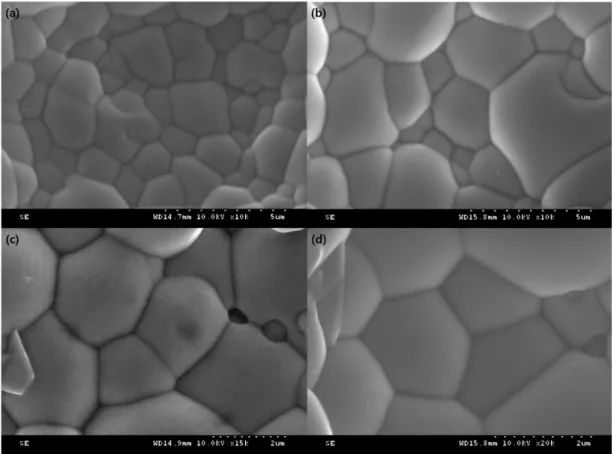
(sintered at 1300 °C for 4 hours) was observed to be about 86~89 % of the theoretical density. The fractured surface of the sintered body observed by SEM for the four compositions under various sintering temperature conditions is shown in Figure 1(a~d). Samples sintered at

Fig. 1. SEM images of Nb

5+

and Ta

5+

substituted BaTiO

3

. (a) Ba

0.95

Nb

0.05

TiO

3

, (b) Ba

0.90

Nb

0.10

TiO

3

, (c)

Ba

0.95

Ta

0.05

TiO

3

, and (d) Ba

0.90

Ta

0.10

TiO

3

.

(3)

about 1300 °C showed a large particle size of 1.5~3.0 μm. In the case of Ba

0.95

Nb

0.05

TiO

3

and Ba

0.90

Nb

0.10

TiO

3

substituting Nb

5+

, the grain size was 1.5~2.5 μm, and the grain size of Ba

0.95

Ta

0.05

TiO

3

, and Ba

0.90

Ta

0.10

TiO

3

substituting Ta

5+

was enlarged to about 2.0~3.0 μm.

Substitution of isovalent impurities in BaTiO

3

has a small effect on the electrical conductivity, but off-valent impurities have a large effect on the ferroelectric behavior and conductivity. As shown in Figure 1(a~d), the substitution of low concentrations of Nb

5+

and Ta

5+

in BaTiO

3

moderately enhances the grain growth to improve several physical properties. The main role of the two donor cations Nb

5+

and Ta

5+

is the effect of grain boundary mobility because charge compensation has a significant effect.

When Nb

5+

and Ta

5+

replace Ba

2+

and Ti

4+

, the difference in radius and valence of Nb

5+

, Ta

5+

, Ba

2+

, and Ti

4+

leads to a change in the vacancy concentration of the crystal to compensate for the charge imbalance. In this experiment, it is analyzed that Nb

5+

and Ta

5+

ions exist in high concentrations at or near the grain boundary to suppress abnormal grain growth during sintering and promote the formation of fine grains and high-density BaTiO

3

. As shown in

Figure 1, Ba

0.95

Nb

0.05

TiO

3

substituted with 0.5 mole% Nb

5+

had a smaller particle size than the other three compositions, Ba

0.90

Nb

0.10

TiO

3

, Ba

0.95

Ta

0.05

TiO

3

, and Ba

0.90

Ta

0.10

TiO

3

solid solutions, but relatively uniform grain growth was observed.

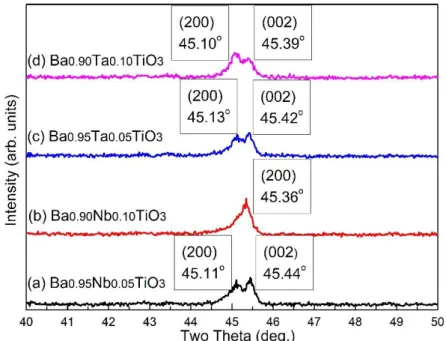
Figure 2 shows the XRD diffraction peaks in the (200) and (002) planes of BaTiO

3

systems between 40 and 50 degrees of substitution with different ratios of Nb

2

O

5

and Ta

2

O

5

. The XRD pattern shows the tetragonal perovskite structures for the Nb

5+

and Ta

5+

doped BaTiO

3

systems. In general, it is known that BaTiO

3

crystals have a tetragonal phase and a cubic phase. Ba

0.95

Nb

0.05

TiO

3

, Ba

0.95

Ta

0.05

TiO

3

, and Ba

0.90

Ta

0.10

TiO

3

have the strongest diffraction in the XRD pattern between 45.10 and 45.45 degrees, and the formation of two BaTiO

3

phases can be observed. Therefore, tetragonal and cubic phases can be identified by analyzing the (002)-tetragonal, (200)-tetragonal and (200)-cubic peaks in the measured 2θ range.

However, as shown in Figure 2, Ba

0.95

Nb

0.05

TiO

3

, Ba

0.95

Ta

0.05

TiO

3

, and Ba

0.90

Ta

0.10

TiO

3

clearly showed splitting of (200) and (002) in XRD, whereas Ba

0.90

Nb

0.10

TiO

3

exhibited a single cubic phase of (200) phases. In other words,

Fig. 2. XRD patterns of (200) and (002) plane of Nb

5+

and Ta

5+

substituted BaTiO

3

.

(4)

it is analyzed that the (002) and (200) peak splits in Figure 2(a, c, d) indicate a tetragonal phase, and the single (200) peak in Figure 2(b) means a cubic phase [3].

Figure 3 shows the change in reciprocal dielectric constant of Nb

5+

and Ta

5+

substituted BaTiO

3

sintered at 1300 °C with temperature from room temperature to 350 °C. In addition, Nb

5+

and Ta

5+

ions in BaTiO

3

displace Ba

2+

and Ti

4+

to form a solid solution, but without changing the structural shape of the original BaTiO

3

, slightly distort the crystal lattice, shifting the Curie peak to a lower temperature and improving the dielectric properties of the ceramic material. Since ions with higher valences are replaced by ions with smaller valence states, the introduction of dopants has an effect on changing the charge balance in the crystal lattice of BaTiO

3

. Since the amount of substitution in this experiment is small, it is not uniformly distributed in the specimen, so it is presumed that it will have a small influence on ferroelectric parameters such as dielectric constant, dielectric loss, pyroelectric coefficient and piezoelectric coefficient. This means that the dopant will act actively depending on the atomic radius, valence, electronegativity, and concentration of the dopant. These dielectric properties are very similar to the data results according to the

dielectric constant and loss of temperature dependence and the amount of dopant of the specimens added with Mn

4+

and Nb

5+

to BaTiO

3

analyzed by several researchers [4, 5].

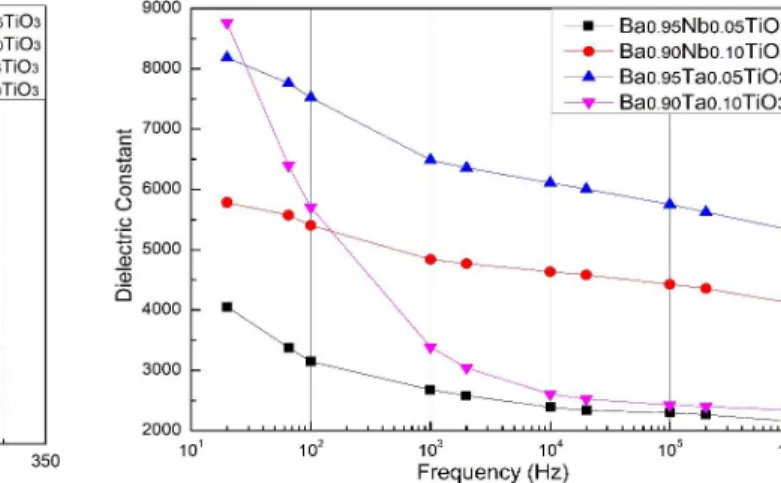
Figure 4 shows the frequency dependence of the dielectric constant for Nb

5+

and Ta

5+

substituted BaTiO

3

at room temperature. The type of dopant and the observed microstructure directly affect the dielectric properties of the doped BaTiO

3

. The highest dielectric constant at room temperature and the largest change in dielectric constant as a function of frequency was observed for BaTiO

3

doped with 0.5 mole%

Ta

5+

. All the investigated specimens showed a large dielectric constant initially at a low frequency, and maintained a constant trend when the frequency was higher than 10

3

Hz.

In general, an abrupt phase transition from ferroelectric to paraelectric phase was observed at the dielectric constant versus temperature response and Curie temperature for both the Nb

5+

and Ta

5+

substituted BaTiO

3

. The overall dielectric behavior in Nb

5+

doped BaTiO

3

is analyzed to be dominated by two different microstructural regions: a chemically heterogeneous system and a significant amount of paraelectric phase already present at temperatures below the Curie temperature.

Figure 5 shows the change in ln[(1/K)-(1/K

m

) versus l n[T-T

m

] for Nb

5+

and Ta

5+

substituted BaTiO

3

.

Fig. 3. Temperature dependence of reciprocal dielectric

constant of Nb

5+

and Ta

5+

substituted BaTiO

3

. Fig. 4. Frequency dependence of dielectric constant of

Nb

5+

and Ta

5+

substituted BaTiO

3

.

(5)

Since BaTiO

3

substituted with an acceptor or donor dopant is difficult to grow into a uniformly distributed crystal, the effect on the Curie temperature, an intrinsic dielectric parameter, is small. The microscopic diffusion characteristics of BaTiO

3

according to dopant substitution can be qualitatively analyzed according to the Curie-Weiss law {1/K=1/K

m

+[(T-T

m

)

γ

/(2K

m

δ

2

)]}, where K is the dielectric constant, K

m

is the maximum dielectric constant, T is the temperature, T

m

is the maximum temperature of the dielectric constant, C is the Curie constant, γ is the critical exponent, and δ is the diffusion parameter [6-8].

As shown in Figure 5, when Nb

5+

and Ta

5+

are substituted for pure BaTiO

3

, it can be calculated that the degree of diffusion parameter is slightly changed, though not a large change. The diffusivity of the dopant substituted BaTiO

3

is significantly different from that of the typical complex perovskite PbABO

3

type, but as a macroscopic approach, it can be analyzed by applying the diffuse phase transition mechanism. That is, the diffusivity of BaTiO

3

substituted with a dopant can be predicted by calculating the critical exponent. As the Nb

5+

and Ta

5+

content increased, the critical exponent of the specimens decreased. Many researchers have reported that this diffusion

phenomenon is explained by the change in local composition according to different microregions, and that the phase transition temperature is slightly different for each microregion [9, 10]. It is analyzed that this result is due to various changes in the grain size in the crystal due to Nb

5+

and Ta

5+

substitution.

4. Conclusions

The temperature and frequency dependence of the dielectric constant of the BaTiO

3

substituted with two types of donor dopants,

Nb

5+

and Ta

5+

, respectively, were compared and

analyzed. X-ray diffraction peaks in the (200)

and (002) planes were observed between 45.10

and 45.45 degrees of the BaTiO

3

substituted with

different fractions of Nb

5+

and Ta

5+

. In addition,

the phase transition at a temperature higher

than the Curie temperature relatively satisfies

the modified Curie-Weiss law. These results are

analyzed to indicate that the introduction of

dopants such as Nb

5+

and Ta

5+

did not cause

significant changes in the local structures

around the Ba

2+

and Ti

4+

atoms. The Curie

temperature of all the measured specimens was

lower than the Curie temperature of pure

Fig. 5. Plot of ln[(1/K)-(1/K

m

)] versus ln(T-T

m

) for Nb

5+

and Ta

5+

substituted BaTiO

3

.

(6)

BaTiO

3

. A marked decrease in dielectric constant was observed at frequencies up to 10

3

Hz in all specimens.

References

[1] H.F.Kay, P.Vousden, Symmetry changes in barium titanate at low temperatures and their relation to its ferroelectric properties, Phil. Mag., 40 (1949) 1019-1040.

[2] A.J.Moulson, J. M. Herbert, Electroceramics, second Ed, Wiley Press, New York (2003).

[3] Y.J.Kim, J.W.Hyun, H.S.Kim, J.H.Lee, M.Y.Yun, S.J.Noh, Y.H.Ahn, Microstructural characterization and dielectric properties of barium titanate solid solutions with donor dopants, Bull. Korean Chem. Soc., 30(6) (2009) 1267-1273.

[4] D. Phuyal, S. Mukherjee, S. Jana, F. Denoel, M. Venkata Kamalakar, S. M. Butorin, A.Kalaboukhov, H. Rensmo, O. Karis, Ferroelectric properties of BaTiO

3

thin films co-doped with Mn and Nb, AIP Advances, 9 (2019) 095207, doi:

10.1063/1.5118869.

[5] V.Paunovic, V.Mitic, M.Djordjevic, Z.Prijic, Niobium doping effect on BaTiO

3

structure and dielectric properties, Ceramics International, 46(6) (2020) 8154-8164.

[6] Y.J.Kim, Characterization and Physical Properties of Ba

0.9

Sb

0.1

TiO

3

Solid Solution, Appl.Sci.Converg.Technol., 28(4) (2019) 126-129.

[7] A.Jain, N.Makhuri, R.Saroha, M.Pastor, A.K.Jha, A.K.Panwar, Microstructural and dielectric investigations of vanadium substituted barium titanate ceramics, Adv.Mater.Lett., 7(7) (2016) 567-572.

[8] M.S.Alkathy, AGayam, K.C.James Raju, Effects of nickel and lithium co-substituted barium titanate ceramics on structural and dielectric properties, J.Mater Sci:Mater Electron., 28 (2017) 1684-1694.

[9] V.Paunovic, V.Mitic, M.Marjanovic, L.Kocic, Dielectric properties of La/Mn co-doped barium titanate ceramics, Electronics and Energetics, 29(2) (2016) 285-296.

[10] M.A.Mohiddon, K.L.Yadav, Effect of 90°

domain on ferroelectric properties of alkali

modified SBN, J.Phys.D: Appl.Phys., 41

(2008) 225406-225413.

수치

Fig.  1.  SEM  images  of  Nb 5+ and  Ta 5+ substituted  BaTiO 3 .  (a)  Ba 0.95 Nb 0.05 TiO 3 ,  (b)  Ba 0.90 Nb 0.10 TiO 3 ,  (c)  Ba 0.95 Ta 0.05 TiO 3 ,  and  (d)  Ba 0.90 Ta 0.10 TiO 3 .
Fig.  2.  XRD  patterns  of  (200)  and  (002)  plane  of  Nb 5+ and  Ta 5+ substituted  BaTiO 3 .
Fig.  3.  Temperature  dependence  of  reciprocal  dielectric

참조

관련 문서