1. 서론
1.1 연구의 배경 및 목적
건설프로젝트는 다양한 주체들이 참여하고 수행주체들 은 각자의 성공을 위해 노력한다. 그 중에서도 발주자는 건 설프로젝트의 많은 부분에 영향을 끼치며 프로젝트 성공 에 있어 핵심주체이다. 그런데 발주자는 건설프로젝트 수 행에서 다양한 입장을 가지고 있다. 국내의 경우는 발주 자(Project Owner)라는 하나의 용어로 통칭하여 사용하 는 것이 일반적인데 반해 영국의 정부건설공사 조달지침 (Government Construction Procurement Guidance)을 보 면, 발주자라 불리는 주체를 기능과 책임에 따라 투자의사결 정자(Investment Decision Maker), 프로젝트 오너(Project Owner), 프로젝트 스폰서(Project Sponsor), 그리고 프로젝 트 관리자(Project Manager)로 구분한다.
건설프로젝트가 진행되는 시점에서 투자의사결정자로서
의 발주자는 사업초기에 프로젝트의 성공여부를 궁금해 한 다. 프로젝트 오너로서의 발주자는 사업적인 만족도에 관심 이 있고 프로젝트 스폰서로서의 발주자는 공기연장, 공사비 의 증액, 그리고 공사품질과 같은 정량적인 성과를 확인하고 싶어 한다. 본 연구에서 대상으로 하는 프로젝트 관리자로서 의 발주자는 프로젝트를 수행에 따라 발생 가능한 문제를 해 결할 수 있는 해결책(solution)을 필요로 하고 이에 대한 지속 적인 개발과 향상을 통해 최적의 프로젝트를 수행을 원한다 (Ashley et al., 1987).
모든 건설프로젝트의 성공을 위해서는 개략적인 계획단계 에서부터 구체적인 실행단계에 이르기까지 합리적인 의사결 정을 필요로 한다. 합리적인 의사결정에 의한 건설프로젝트 의 수행을 위해서는 현시점에 대한 올바른 평가가 필요하며 평가된 결과를 과학적인 방법으로 가공하여 이를 활용하여야 한다.
본 연구의 목적은 발주자의 다양한 입장에 따라 프로젝트에 서 요구하는 사항이 다른 점을 고려하여 프로젝트관리자로서 실무적으로 활용이 가능한 사업수행평가모델의 프레임워크 를 개발하는 것이다. 발주자가 프로젝트를 성공적으로 수행할 수 있도록 평가도구를 제시하고 평가 결과에 따라 프로젝트를 효과적으로 관리할 수 있는 최적의 솔루션(solution)을 선택할
프로젝트 관리자로서의 발주자 사업수행평가 프레임워크 개발
김종훈1·이현수2·박문서2·박상혁*·이인범1
1한미글로벌(주)·2서울대학교 건축학과
Developing an Owner’s Project Evaluation Framework for Construction Management
Kim, Jonghoon
1, Lee, Hyun-Soo
2, Park, Moonseo
2, Park, Sanghyuk
*, Lee, Inbeom
11HanmiGlobal Co., Ltd
2Department of Architecture and Architectural Engineering, Seoul National University
Abstract :
Owner’s participation on a construciton project can alter the success of a construction project. In general, success of a construction project is measured by project schedule and cost decrease without considering the role an owner has in a project. As a result, this research developed a framework for the project evaluation form and after extracting a total of 9 project critical success factors (CSF) and 27 sub-CSF. AHP method was utilized to evaluate the importance factor of each CSFs. Setting a goal for each CSFs at the beginning of a project and comparing the values at the completion of the project utilizing the project evalaution form will allow a systematic evaluation and management of a project. Solution Map was introduced and Solution Tool was suggested in order to utlize the evaluation results effectively. In the future studies, various project cases needs to be supplemented for further verification and a solution based on the evaluation result needs to be developed that can be applied to construction projects.
Keywords :
AHP, CSF, PDRI, Project Evaluation Form
* Corresponding author: Park, Sanghyuk, Construction Strategic Research Institute, HanmiGlobal Co., Ltd., Seoul 135-973, Korea E-mail: [email protected]
Received June 3, 2016: revised July 28, 2016 accepted August 28, 2016
수 있는 맵(map)을 제안함으로써 건설 프로젝트 성공을 위한 합리적인 의사결정 가이드라인을 제시하고자 한다.
1.2 연구의 범위 및 방법
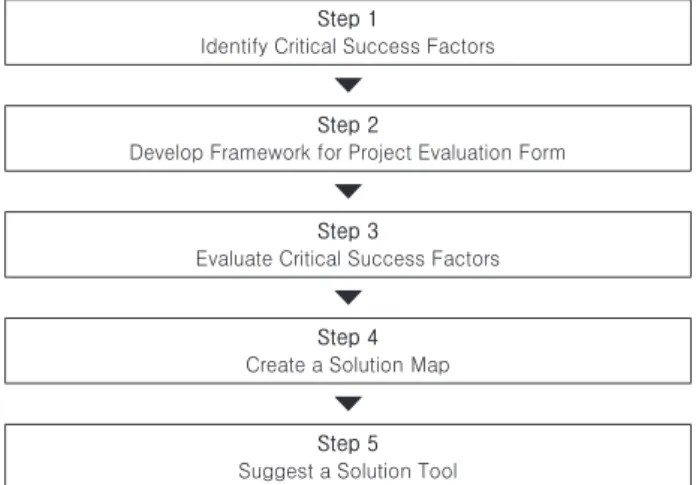
건설프로젝트의 사업수행평가를 위해서는 먼저 프로젝트 의 성공을 명확히 정의한 뒤에 그에 따른 필수적으로 적용되 는 핵심성공요인을 도출할 필요가 있다. 도출된 핵심성공요 인을 평가하기 위한 도구인 사업수행평가서를 개발하고 평 가결과에 따라 중점관리가 필요한 핵심성공요인이 결정된 다. 결정된 핵심성공요인을 관리하기 위한 도구인 솔루션 맵 (Map)과 툴(Tool)은 프로젝트관리자로서 발주자가 이를 활용 하여 수행하는 프로젝트를 효과적으로 관리할 수 있도록 지 원한다. Fig. 1은 건설프로젝트를 효과적으로 관리하기 위한 사업수행평가 및 솔루션 맵의 프레임워크를 개발하는 연구프 로세스이다.
Step 1
Identify Critical Success Factors
▼ Step 2
Develop Framework for Project Evaluation Form
▼ Step 3
Evaluate Critical Success Factors
▼ Step 4
Create a Solution Map▼ Step 5
Suggest a Solution ToolFig. 1. Research process in developing a solution tool for construction projects
2. 프로젝트 성공에 대한 고찰
건설프로젝트에서 성공은 프로젝트 참여자들의 기대 (expectation)를 충족하는 것으로 기술적 성과 기준 또는 목 표를 달성하거나, 프로젝트 참여자들의 만족도가 높은 것을 말한다(Sanvido et al., 1992; Ko and Cheng, 2007). 이런 성공을 판단하는 기준은 사업초기의 성공 기대치, 사업종료 후 비용, 공기, 품질과 같은 관리항목의 목표달성도(De Wit, 1988), 그리고 발주자의 주관적인 만족 정도를 통해 측정 할 수 있다(Ashley et al., 1987; Baker et al., 1988; Pryke and Smyth, 2006).
본 연구에서 정의하는 프로젝트의 성공이란 프로젝트의 성 공에 대한 주요 요소들의 정량적 성과와 발주자의 만족과 같 은 정성적 성과들의 결합인 객관적 기준과 주관적 기준을 모 두 만족하여야 함을 의미한다. 그러나 프로젝트의 성공에 있 어서 절대적인 수치에 의해 판단은 이루어지기 어렵다. 따라
서 본 연구는 건설프로젝트를 성공시키기 위한 요인을 도출 하고 성공요인을 효과적으로 관리하기 위한 도구를 제시하고 자 한다. 프로젝트 관리자로서 발주자는 측정된 결과를 가지 고 유사 프로젝트와의 비교평가를 통해 중점 관리해야 할 항 목을 명확하게 이해할 수 있다.
핵심성공요인에 대한 체계적인 관리가 ‘성공하는 방법 (Way to Success)'이라고 정의하고 프로젝트관리자가 프로젝 트를 수행하는 과정에서 실무적으로 활용이 가능한 핵심성공 요인 관리 프로세스 및 모델을 제안한다.
3. 프로젝트 핵심성공요인 도출
프로젝트 핵심성공요인(Critical Success Factors: CSFs)은 프로젝트 관리자가 목표를 달성하기 위한 핵심 업무 분야이 자 프로젝트 수행에 있어 효율적이고 효과적인 팀 작업 수행 을 위해 반드시 관리되어야 할 항목이다(Rockart, 1982; Han et al., 2012; Jeon and Kim, 2003)
프로젝트 핵심성공요인을 도출하기 위해 프로젝트 단계에 따른 업무프로세스, 핵심성공요인, 핵심성공요인 관리방안의 관계를 Iyer and Jha (2006)와 Park and Kim (2003)의 연구 를 바탕으로 프로젝트 단계, CSFs 유형, 프로젝트 특성의 세 축으로 구성된 핵심성공요인 매트릭스로 도식화하였다.
Fig. 2. Critical success factor cube
핵심성공요인 매트릭스는 프로젝트 단계별로 특성(발주 방 식, 발주자 유형, 프로젝트 유형 등)과 성과평가요인(공사비, 공기, 품질, 발주자 만족도 등)을 연관관계를 분석하는 기준 이 된다. 이러한 연관관계를 기반으로 핵심성공요인의 초기 선정 작업을 진행하였다.
핵심성공요인은 매트릭스 기준에 따라 우선 기존 문헌 조 사를 통해 122개의 핵심성공요인 도출하고 건설 경험이 10 년 이상인 전문가 면담을 통해 핵심성공요인을 추가하여 139 개의 핵심성공요인 풀(pool)을 구성하였다. 프로젝트 관리자
로 구성된 1차 전문가 자문회의를 통해 중복과 불필요한 요소 를 제거하여 45개의 핵심성공요인으로 압축하였다. 도출된 45개 항목은 기획, 설계, 입찰, 시공으로 구성된 적용단계를 조사하여 솔루션 맵(solution map)을 만들기 위한 기초 작업 을 진행하였고 통제 가능여부를 판단하여 통제가 가능한 30 개와 통제가 가능하지 않은 15개로 구분했다. 개별 항목에 대 해 2차 전문가집단과의 면담과 현장방문을 통한 사례조사를 실시하여 최종적으로 주제별 분류를 통해 9개의 핵심성공요 인과 27개의 세부 핵심성공요인으로 선정하였다(Park et al., 2011; Lee et al., 2007).
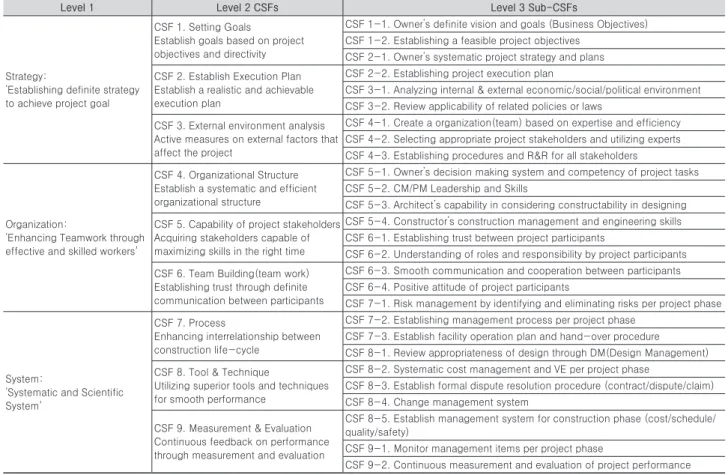
Park et al.은 핵심성공요인을 전략(strategy), 조직 (organization), 시스템(system)의 세 가지 관점으로 1차 구분 하고 총 9개의 CSFs는 측정을 위해 27개의 Sub-CSFs로 제 시하였다(Table 1).
4. 발주자 관점의 사업수행평가서 개발
선행 연구에서 도출된 핵심성공요인들은 프로젝트 수행 과정에서 관리되어야 할 요소들이다. 핵심성공요인에 대 한 체계적인 관리는 프로젝트가 성공하기 위한 필요조건이 다. 이를 위해 프로젝트의 사전평가방식인 PDRI (Project Definition Rating Index)의 구성 형식을 참조하여 각 핵심성
공요인에 대한 정량적인 측정할 수 있는 사업수행평가서를 개발한다.
PDRI는 프로젝트 성과(비용, 공기, 운영 측면)향상을 판단 하기 위해 사전 프로젝트 계획 단계에서 활용하는 도구로서, 본 연구에서는 PDRI 방법론에서 제시하는 측정 및 평가 방법 론을 활용하되, PDRI 요소를 핵심성공요인에 대한 내용으로 변경하여 반영하였다. 핵심성공요인에 대한 사업수행평가서 를 활용하여 사업 초기단계에서는 핵심성공요인들에 대한 목 표(기대)값 측정을 통해 사업성공가능성을 판단하고, 사업종 료 단계에서는 프로젝트 수행결과에 따른 최종 값을 측정하 여 초기의 목표(기대)값과 비교할 수 있도록 하였다. 프로젝 트 관리자는 초기 값과 최종 값에 대한 비교·분석을 통하여 당 프로젝트의 문제점을 분석할 수 있으며, 향후 프로젝트 수 행 시 시사점들을 도출해 낼 수 있다.
사업수행평가서를 개발하여 얻을 수 있는 기대효과는 프로 젝트 계획 수립 단계에서는 상세 체크리스트로 활용이 가능 하고 표준화된 업무 범위 정의를 위한 용어 제공이 가능하다.
또한 리스트 평가 및 관리가 촉진되고 사전 프로젝트 계획 진 도에 대한 모니터링이 가능하다. 발주자 입장에서는 프로젝 트 참여자 간의 요구사항이 충분히 이해하고 이들 간의 관계 를 조정하는 도구로서 활용할 수 있다.
사업수행평가서를 프로젝트 특성을 반영하여 적용하
Table 1. Critical success factors
Level 1 Level 2 CSFs Level 3 Sub-CSFs
Strategy:
‘Establishing definite strategy to achieve project goal
CSF 1. Setting Goals
Establish goals based on project objectives and directivity
CSF 1-1. Owner’s definite vision and goals (Business Objectives) CSF 1-2. Establishing a feasible project objectives
CSF 2-1. Owner’s systematic project strategy and plans CSF 2. Establish Execution Plan
Establish a realistic and achievable execution plan
CSF 2-2. Establishing project execution plan
CSF 3-1. Analyzing internal & external economic/social/political environment CSF 3-2. Review applicability of related policies or laws
CSF 3. External environment analysis Active measures on external factors that affect the project
CSF 4-1. Create a organization(team) based on expertise and efficiency CSF 4-2. Selecting appropriate project stakeholders and utilizing experts CSF 4-3. Establishing procedures and R&R for all stakeholders
Organization:
‘Enhancing Teamwork through effective and skilled workers’
CSF 4. Organizational Structure Establish a systematic and efficient organizational structure
CSF 5-1. Owner’s decision making system and competency of project tasks CSF 5-2. CM/PM Leadership and Skills
CSF 5-3. Architect’s capability in considering constructability in designing CSF 5. Capability of project stakeholders
Acquiring stakeholders capable of maximizing skills in the right time
CSF 5-4. Constructor’s construction management and engineering skills CSF 6-1. Establishing trust between project participants
CSF 6-2. Understanding of roles and responsibility by project participants CSF 6. Team Building(team work)
Establishing trust through definite communication between participants
CSF 6-3. Smooth communication and cooperation between participants CSF 6-4. Positive attitude of project participants
CSF 7-1. Risk management by identifying and eliminating risks per project phase
System:
‘Systematic and Scientific System’
CSF 7. Process
Enhancing interrelationship between construction life-cycle
CSF 7-2. Establishing management process per project phase CSF 7-3. Establish facility operation plan and hand-over procedure CSF 8-1. Review appropriateness of design through DM(Design Management) CSF 8. Tool & Technique
Utilizing superior tools and techniques for smooth performance
CSF 8-2. Systematic cost management and VE per project phase
CSF 8-3. Establish formal dispute resolution procedure (contract/dispute/claim) CSF 8-4. Change management system
CSF 9. Measurement & Evaluation Continuous feedback on performance through measurement and evaluation
CSF 8-5. Establish management system for construction phase (cost/schedule/
quality/safety)
CSF 9-1. Monitor management items per project phase
CSF 9-2. Continuous measurement and evaluation of project performance
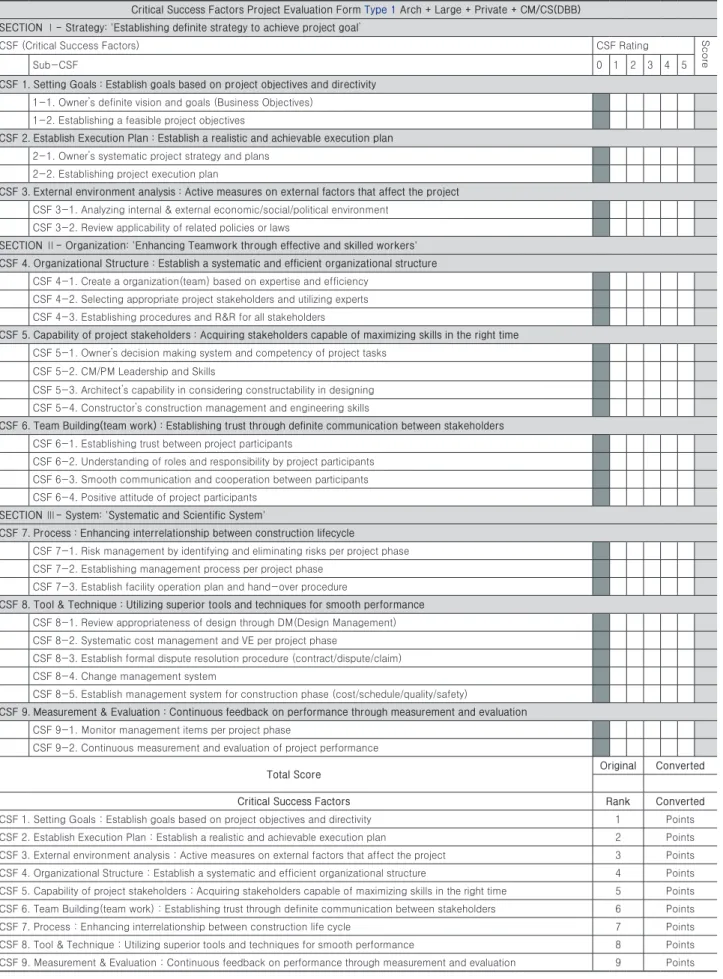
Critical Success Factors Project Evaluation Form Type 1 Arch + Large + Private + CM/CS(DBB) SECTION Ⅰ- Strategy: 'Establishing definite strategy to achieve project goal’
CSF (Critical Success Factors) CSF Rating Score
Sub-CSF 0 1 2 3 4 5
CSF 1. Setting Goals : Establish goals based on project objectives and directivity
1-1. Owner’s definite vision and goals (Business Objectives)1-2. Establishing a feasible project objectives
CSF 2. Establish Execution Plan : Establish a realistic and achievable execution plan
2-1. Owner’s systematic project strategy and plans2-2. Establishing project execution plan
CSF 3. External environment analysis : Active measures on external factors that affect the project
CSF 3-1. Analyzing internal & external economic/social/political environmentCSF 3-2. Review applicability of related policies or laws
SECTION Ⅱ- Organization: 'Enhancing Teamwork through effective and skilled workers' CSF 4. Organizational Structure : Establish a systematic and efficient organizational structure
CSF 4-1. Create a organization(team) based on expertise and efficiency CSF 4-2. Selecting appropriate project stakeholders and utilizing experts CSF 4-3. Establishing procedures and R&R for all stakeholders
CSF 5. Capability of project stakeholders : Acquiring stakeholders capable of maximizing skills in the right time
CSF 5-1. Owner’s decision making system and competency of project tasksCSF 5-2. CM/PM Leadership and Skills
CSF 5-3. Architect’s capability in considering constructability in designing CSF 5-4. Constructor’s construction management and engineering skills
CSF 6. Team Building(team work) : Establishing trust through definite communication between stakeholders
CSF 6-1. Establishing trust between project participantsCSF 6-2. Understanding of roles and responsibility by project participants CSF 6-3. Smooth communication and cooperation between participants CSF 6-4. Positive attitude of project participants
SECTION Ⅲ- System: 'Systematic and Scientific System'
CSF 7. Process : Enhancing interrelationship between construction lifecycle
CSF 7-1. Risk management by identifying and eliminating risks per project phase CSF 7-2. Establishing management process per project phase
CSF 7-3. Establish facility operation plan and hand-over procedure
CSF 8. Tool & Technique : Utilizing superior tools and techniques for smooth performance
CSF 8-1. Review appropriateness of design through DM(Design Management) CSF 8-2. Systematic cost management and VE per project phaseCSF 8-3. Establish formal dispute resolution procedure (contract/dispute/claim) CSF 8-4. Change management system
CSF 8-5. Establish management system for construction phase (cost/schedule/quality/safety)
CSF 9. Measurement & Evaluation : Continuous feedback on performance through measurement and evaluation
CSF 9-1. Monitor management items per project phaseCSF 9-2. Continuous measurement and evaluation of project performance
Total Score Original Converted
Critical Success Factors Rank Converted
CSF 1. Setting Goals : Establish goals based on project objectives and directivity 1 Points
CSF 2. Establish Execution Plan : Establish a realistic and achievable execution plan 2 Points CSF 3. External environment analysis : Active measures on external factors that affect the project 3 Points CSF 4. Organizational Structure : Establish a systematic and efficient organizational structure 4 Points CSF 5. Capability of project stakeholders : Acquiring stakeholders capable of maximizing skills in the right time 5 Points CSF 6. Team Building(team work) : Establishing trust through definite communication between stakeholders 6 Points
CSF 7. Process : Enhancing interrelationship between construction life cycle 7 Points
CSF 8. Tool & Technique : Utilizing superior tools and techniques for smooth performance 8 Points CSF 9. Measurement & Evaluation : Continuous feedback on performance through measurement and evaluation 9 Points
Fig. 3. Project evaluation form
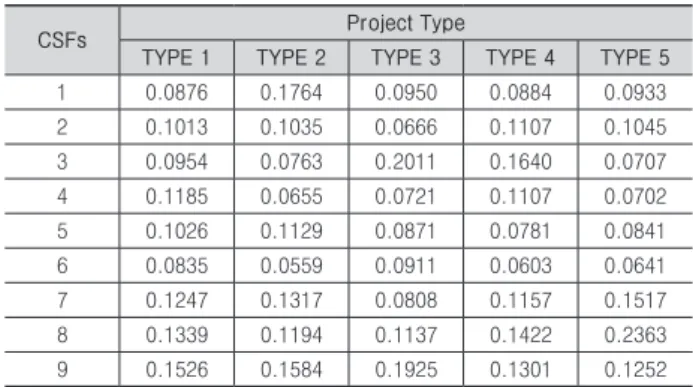
기 위해서 프로젝트의 규모(소, 중, 대), 발주자의 특성(공 공, 민간), 발주방식(설계시공 분리/일괄)에 따라 사업수행 평가서 활용 대상 프로젝트를 5가지의 타입(type)으로 구분 하였다(Table 2). 타입 별 특성을 반영한 측정을 위해 AHP (Analytic Hierarchy Process) 분석을 통해 가중치를 설정 하였다. 현장경험이 있는 64명의 기술자를 대상으로 설문조 사를 실시하였고 일관성지수(Consistency Index)를 계산하 여 답변의 일관성을 확인하였다. 측정된 타입별 핵심성공요 인 평가 가중치는 Table 3과 같다. 사업수행평가서에 반영된 CSF 가중치는 프로젝트 타입과 핵심성공요인 간의 쌍대비교 를 통해 설정된 값에 의해 각 사업수행평가서마다 다른 값을 갖게 된다. Fig. 3은 Type 1 프로젝트의 사업수행평가서이다.
Table 2. Projects subject to project evaluation form
Type Arch/Civil Scale Owner Delivery Method
Type 1 Arch Large Private Design-bid-build Type 2 Arch Small Private Design-bid-buildType 3 Arch Large Public Design-build
Type 4 Arch Medium Private Design-bid-build
Type 5 Arch Large Private Design-build
※ Small: 5~10 billion won, Medium: 10~50 billion won, Large: 50billion +
Table 3. CSFs evaluation weight based on project type
CSFs Project Type
TYPE 1 TYPE 2 TYPE 3 TYPE 4 TYPE 5
1 0.0876 0.1764 0.0950 0.0884 0.0933 2 0.1013 0.1035 0.0666 0.1107 0.1045 3 0.0954 0.0763 0.2011 0.1640 0.0707 4 0.1185 0.0655 0.0721 0.1107 0.0702 5 0.1026 0.1129 0.0871 0.0781 0.0841 6 0.0835 0.0559 0.0911 0.0603 0.0641 7 0.1247 0.1317 0.0808 0.1157 0.1517 8 0.1339 0.1194 0.1137 0.1422 0.2363 9 0.1526 0.1584 0.1925 0.1301 0.1252
사업수행평가서는 엑셀(Excel)형식으로 작성되어 사용성 이 편리하다. 평가서 최상단은 5가지의 타입 중 어떠한 타 입의 사업수행평가서인지를 표시한다. ‘SECTION’은 CSFs 의 대분류인 전략, 조직, 시스템을 나타내며, 27개의 ‘Sub- CSFs’는 실질적인 핵심성공요인 세부관리 항목이다. 평가자 는 오른쪽의 셀을 클릭하여 1점~5점까지의 척도로 체크리 스트와 같은 형식으로 점수(score)를 부여하는데 프로젝트 타입에 따라 각 CSF의 가중치가 다르다. ‘Total Score’는 프 로젝트의 전반적 점수를 말하며 각 항목별 가중치가 적용된 100점 환산점수를 제공한다. 그 하단은 핵심성공요소별 점 수 및 순위로 9개 핵심성공요인의 순위(rank) 및 백분율 점수 (percentage)를 제공한다. 측정된 결과에 따라 점수가 낮은 핵심성공요인은 중점관리 대상으로 선정하면 된다. Table 4 는 사업수행평가서의 각 항목을 설명한 것이다.
Table 4. Project evaluation form categories
Type
ㆍSummary of 5 different typesSection
ㆍComposed of strategy, organization, and systemCSF
ㆍComposed of 9 CSFsSub-CSF
ㆍTotal of 27 sub-CSFs ㆍDetailed factors to manage CSFEvaluation
ㆍChecklist characteristic to manage CSFsㆍ5-point scale to evaluate CSFs
Converted
Score
ㆍOverall project score
ㆍProvides both original and converted score (out of 100)
CSF Score
ㆍProvides ranking of the 9 CSFs and their percentile5. Solution Map & Tool 제안
본 연구에서는 프로젝트 관리자로서의 발주자를 위해서 건 설프로젝트를 효과적으로 관리할 수 있는 9개의 성공핵심요 인을 선정하였고 정량적으로 평가할 수 있는 사업수행평가서 를 개발하였다. 도출된 성공핵심요인의 평가를 통해 프로젝 트의 현황 파악은 할 수 있지만 이를 실무에 적용하기 위해서 는 실제 발생하는 문제를 해결할 수 있는 솔루션 툴을 제공해 야한다. 발주자의 프로젝트가 성공할 수 있는 지식적 기반을 제공하는 맵과 솔루션 툴이 있어야 한다. 본 논문에서는 솔루 션 맵에 의한 툴의 개발 프레임워크(Framework)도 제안하 고자 한다. 제공하는 솔루션 맵과 툴의 프레임워크는 실제 프 로젝트가 수행될수록 수행된 결과가 반영된 솔루션을 개발을 통해 최종 모델을 개발하는 기반이 될 수 있다.
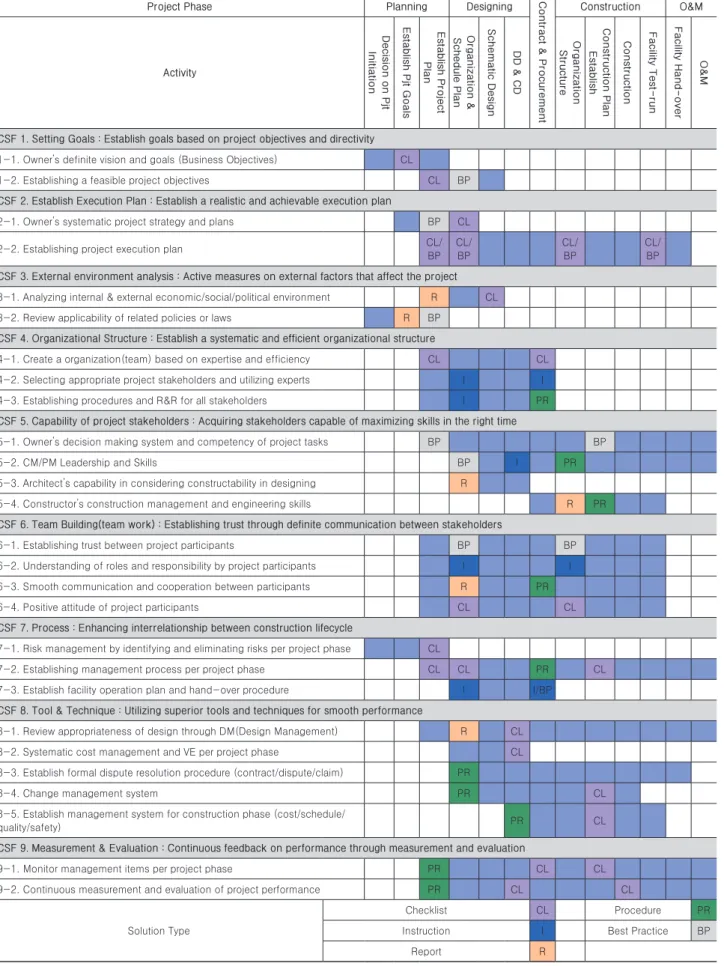
솔루션 맵은 Fig. 4와 같다. 프로젝트의 단계별로 기획단계 에서부터 유지관리단계까지 5단계로 구분해 놓았으며, 각 단 계별 건설사업관리 항목을 표기하여 프로젝트 평가 시 필요 한 솔루션 툴을 구체적으로 확인 할 수 있도록 하였다. 사업 수행평가서의 결과와 각 핵심성공요인별 필요성에 따라 분류 한 솔루션 툴의 형태는 체크리스트, 지침서, 보고서, 절차서, 그리고 베스트프랙티스(Best Practice)로 총 5가지이며, 각 단계별로 활용이 가능한 형태를 솔루션 맵에 배치하여 표시 하였다.
체크리스트는 프로젝트 수행과정에서 프로젝트 관리자가 반드시 확인해야 할 사항을 말한다. 지침서는 업무수행 시 참 고할 수 있는 지침으로 기업별 보유하고 있는 업무매뉴얼을 의미한다. 보고서는 개별기업 또는 관련 기관에서 발행한 기 술보고서를 말하고 베스트프랙티스는 각 기업이 수행했던 유 사프로젝트의 우수사례를 벤치마킹하는 것이다. 마지막으로 절차서는 구체적인 업무수행프로세스를 말한다.
솔루션 맵은 솔루션 툴의 최적 활용을 위해 프로젝트 단계 별로 관리항목을 표현하고, 각 핵심성공요인별로 활용될 수 있는 솔루션 툴이 제시된 일종의 핵심성공요인 관리 도구이 다. 프로젝트 관리자는 사업초기에 측정한 사업수행평가 결 과를 통해 사전에 솔루션 맵을 활용하여 프로젝트 수행과정
Project Phase Planning Designing Contract & Procurement
Construction O&M
Activity
Decision on Pjt Initiation Establish Pjt Goals Establish Project Plan Organization & Schedule Plan Schematic Design DD & CD Organization Structure Construction Plan Establish Construction Facility Test-run Facility Hand-over O&M
CSF 1. Setting Goals : Establish goals based on project objectives and directivity
1-1. Owner’s definite vision and goals (Business Objectives) CL1-2. Establishing a feasible project objectives CL BP
CSF 2. Establish Execution Plan : Establish a realistic and achievable execution plan
2-1. Owner’s systematic project strategy and plans BP CL
2-2. Establishing project execution plan CL/
BP CL/
BP
CL/
BP
CL/
BP
CSF 3. External environment analysis : Active measures on external factors that affect the project
3-1. Analyzing internal & external economic/social/political environment R CL
3-2. Review applicability of related policies or laws R BP
CSF 4. Organizational Structure : Establish a systematic and efficient organizational structure
4-1. Create a organization(team) based on expertise and efficiency CL CL
4-2. Selecting appropriate project stakeholders and utilizing experts I I
4-3. Establishing procedures and R&R for all stakeholders I PR
CSF 5. Capability of project stakeholders : Acquiring stakeholders capable of maximizing skills in the right time
5-1. Owner’s decision making system and competency of project tasks BP BP
5-2. CM/PM Leadership and Skills BP I PR
5-3. Architect’s capability in considering constructability in designing R
5-4. Constructor’s construction management and engineering skills R PR
CSF 6. Team Building(team work) : Establishing trust through definite communication between stakeholders
6-1. Establishing trust between project participants BP BP
6-2. Understanding of roles and responsibility by project participants I I
6-3. Smooth communication and cooperation between participants R PR
6-4. Positive attitude of project participants CL CL
CSF 7. Process : Enhancing interrelationship between construction lifecycle
7-1. Risk management by identifying and eliminating risks per project phase CL
7-2. Establishing management process per project phase CL CL PR CL
7-3. Establish facility operation plan and hand-over procedure I I/BP
CSF 8. Tool & Technique : Utilizing superior tools and techniques for smooth performance
8-1. Review appropriateness of design through DM(Design Management) R CL
8-2. Systematic cost management and VE per project phase CL
8-3. Establish formal dispute resolution procedure (contract/dispute/claim) PR
8-4. Change management system PR CL
8-5. Establish management system for construction phase (cost/schedule/
quality/safety) PR CL
CSF 9. Measurement & Evaluation : Continuous feedback on performance through measurement and evaluation
9-1. Monitor management items per project phase PR CL CL
9-2. Continuous measurement and evaluation of project performance PR CL CL
Solution Type
Checklist CL Procedure PR
Instruction I Best Practice BP
Report R
Fig. 4. Solution map
에서 단계별로 중점 관리해야 할 핵심성공요인에 대해 중요 성을 인지하고, 이에 대한 적절한 준비를 할 수 있다. 또한 프 로젝트 수행과정에서는 솔루션 맵에 제시되어 있는 솔루션 툴을 수집하고 학습함으로써, 개별 프로젝트의 핵심성공요인 에 대한 체계적인 관리가 가능하다.
전략, 조직, 시스템 관점에서 제시된 핵심성공요인은 적용 단계와 특성이 각기 다르기 때문에 최적 관리 방안 또한 다를 수밖에 없다. 솔루션 맵과 툴은 프로젝트 수행과정에서 프로 젝트관리자가 활용할 수 있는 핵심성공요인 최적 관리를 위 한 맞춤형 솔루션을 제시한다. 다시 말해 솔루션 툴은 프로 젝트 수행과정에서 어떻게 하면 핵심성공요인을 효과적으로 관리할 수 있는지에 대한 일종의 가이드라인(guideline)이 될 것이다.
6. 결론
본 연구는 프로젝트 관리자로서 발주자가 성공적인 건설 프로젝트를 수행하기 위해 활용할 수 있는 사업수행평가서를 개발하고 평가결과에 따라 활용해야 할 솔루션 툴을 제공하 는 프레임워크를 제공하였다. 그 결과는 다음과 같다.
첫째, 프로젝트 성공의 핵심이 되는 핵심성공요인을 도출 하였다. 핵심성공요인은 국내외 문헌조사, 현장방문을 통한 전문가들과의 집단면담(Focus Group Interview, FGI) 내용, 그리고 현업에서 프로젝트를 수행하고 있는 전문가들의 의견 이 기초자료가 되어 작성되었다.
둘째, 프로젝트의 성공여부를 확인할 수 있는 방법론 (PDRI)을 활용하여 사업수행평가서를 개발하였다. PDRI는 공기, 공사비와의 상관관계분석을 통해 이미 미국에서 검증 된 평가방식이다. 본 연구에서는 이를 활용하여 사전 프로젝 트 계획단계에서 과업범위설정의 수준을 측정 및 평가하고, 계량화함으로써 과업범위관리에 유용한 도구인 사업수행평 가서를 개발하였다.
셋째, 프로젝트 수행에서 활용할 수 있는 실무적인 솔루션 맵을 제시하였다. 솔루션 맵은 발주자가 프로젝트 관리자로 서 기획, 설계, 계약 및 구매, 시공, 유지단계별로 핵심성공요 인에서 제시하는 항목들을 전체적으로 관리할 수 있도록 지 원한다.
본 눈문에서는 건설프로젝트의 특성에 맞춰 프로젝트관리 자가 프로젝트관리 항목을 쉽게 확인할 수 있는 평가서를 개 발했는데 이를 활용하면 건설프로젝트 참여주체의 책임과 권 한에 대한 명확한 이해도 가능하다. 또한 개발된 사업수행평 가서는 발주자를 지원하는 건설사업관리자가 활용하면 성공 적인 프로젝트 수행을 위한 정확한 판단과 해결책을 제시하 는 도구로 활용될 것이다.
향후 연구에서는 중점적 관리가 요구되는 핵심성공요인에
대한 실질적 해결방안을 제시하는 솔루션 툴이 실무적으로 생성되어야 한다. 이를 위해서는 각 개별기업이 사내 문서나 지식관리(Knowledge Management) 시스템 등의 검토가 필 요하며 실무진의 현장조사를 통한 연구 진행이 추가로 요구 된다. 솔루션 툴이 도출된 뒤에는 프로젝트 단계별로 솔루션 툴의 활용을 위한 다양한 제공형태가 제시되어야 한다. 이것 은 현장에서의 사용 및 피드백을 통하여 수정 및 보완이 수행 되어야 완성도가 높아진다. 그렇게 제작된 결과물은 향후 프 로젝트 관리자로서 발주자가 실무 수행하는데 있어 필수적인 도구가 될 것이다.
References
Ashley, D.B., Lurie, C.S. and Jaselskis, E.J. (1987).
“Determinants of construction project success.”
Project Management Journal, 12(2), pp. 69-79.
Baker, B. N., Murphy, D. C., and Fisher, D. (1988).
Factor affecting success. In: Cleland, D. L. & King, W. R. (Eds), Project Management Handbook, pp.
902-909. New York: Van Nostrand Reinhold.
Construction Industry Institute (1997). “Benchmarking and Metrics Report for 1996.” Construction Industry Institute, Austin, TX, pp. 145-147.
De Wit, A. (1988). Measurement of project success.
International Journal of Project Management, 6(3), pp. 164-170.
Han, S.H., Yusof, A.M., Ismail, S., and Aun N.C. (2012).
“Reviewing the Notions of Construction Project Success.” International Journal of Business and Management, 7(1), pp. 90-101.
Iyer, K., amd Jha, K. (2006). “Critical factors affecting schedule performance: Evidence from Indian construction projects.” Journal of Construction Engineering and Management, 132(8), pp. 871-881.
Jeon, S.J., and Kim, Y.S. (2003). “A Study on the Analysis of Critical Success Factors for Turn-key Construction Projects.” Journal of Architectural Institute of Korea: Structure, 19(6), pp. 141-149.
Ko, C.H., and Cheng, M.Y. (2007). “Dynamic Prediction of Project Success Using Artificial Intelligence.”
Journal of Construction Engineering and Management, ASCE, 133(4), pp 316-324.
Lee, C.J, et. al., (2007). “The Deduction of the Success Factor in Construction Projects by Design Build Methods.” Korean Journal of Construction
Engineering and Management, KICEM, 8(5), pp.
182-190.
Park, C.S., Kim, J.W. (2003). “A Study on the Success Factors Impacting on the Small Construction Projects.” Korean Journal of Construction Engineering and Management, KICEM, 4(3), pp. 67- 75.
Park, J.W., et. al., (2011). “A Study of Deriving Critical Success Factors in Construction Projects.” Korean Society of Civil Engineers Journal of Civil Engineers, pp. 381-384.
Pryke, S., and Smyth, H. (2006). The management of complex projects: a relationship approach. UK:
Blackwell Publishing.
Rockart, J. F. (1982). “The changing role of the information system executive: a critical success factor perspective.” MIT Sloan Management Review, 23(3), pp. 3-13.
Sanvido et al. (1992). “Critical Success Factors for Construction Projects.” Journal of Construction Engineering and Management, 118(1), pp. 94-111.
요약 :
건설프로젝트의 성공은 프로젝트 관리자로서의 발주자의 참여가 중요하다. 그 이유는 일반적으로 프로젝트의 성공을 공기단 축, 비용절감 등으로 측정하지만, 기존 성공을 측정하는 방법으로는 발주자의 역할을 고려하지 않고 있기 때문이다. 따라서 본 연 구는 프로젝트 관리자로서 발주자를 위한 사업수행평가서를 개발하기 위해 통해 총 9개의 프로젝트 CSF와 27개의 sub-CSF를 도 출하였다. 도출된 CSFs의 중요도를 평가하기 위해 AHP 기법을 활용하였으며, 기존 존재하던 PDRI 방법을 활용한 사업수행평가 서를 개발하였다. 사업수행평가서를 활용하면 각 CSFs에 대한 초기 목표값을 설정하고 프로젝트 완료 후 평가 결과의 비교를 통 해 프로젝트를 효과적으로 관리하고 평가할 수 있다. 평가결과를 실무적으로 활용하기 위한 솔루션 맵을 제시하고 활용 가능한 솔 루션 툴을 제안한다. 추후 연구에는 실질적인 검증을 위해 다양한 프로젝트 사례를 추가할 뿐만 아니라 평가를 통해 현장에 적용 가능한 솔루션 툴을 지속적으로 개발해야한다.
키워드 :