Fuzzy Classifier
Jaewon Song
†, Taeki An
††, Daeho Lee
†††퍼지 분류기를 이용한 비전 기반 열차 위치 및 움직임 추정
송재원†, 안태기††, 이대호†††
Abstract We propose a vision-based method that estimates train position and movement for railway monitoring in which we use a fuzzy classifier to determine train states. The proposed method employs frame difference and background subtraction for estimating train motion and presence, respectively. These features are used as the linguistic variables of the fuzzy classifier. Experimental results show that the proposed method can correctly estimate train position and movement. Therefore the method can be used for railway monitoring systems which estimate crowd density or protect safety.
Key Words : Frame difference, Background subtraction, Fuzzy classifier, Image processing, Computer vision
요 약 본 논문에서는 열차 선로 모니터링을 위한 열차의 위치 및 이동을 추정하는 비전 기반 기법을 제안한다
.
퍼 지 분류기를 이용하여 열차의 상태를 판별하며,
프레임 차와 배경 감산을 각각 열차의 움직임과 존재를 판결하기 위 해서 사용하고,
퍼지 분류기의 언어 변수로 사용된다.
실험 결과에서 제안하는 기법은 열차의 위치와 움직임을 정확 히 추정하는 것을 볼 수 있다.
그러므로 제안하는 기법은 군중 밀도를 추정하거나 안전 감시를 수행하는 열차 모니터 링 시스템에 활용될 수 있을 것이다.
주제어 : 프레임 차
,
배경 감산,
퍼지 분류기,
영상 처리,
컴퓨터 비전I. INTRODUCTION
CCTVs (closed circuit televisions) have been installed at many train stations to monitor safety on the tracks and platform. However, most CCTVs are watched by employees, and not used for automated monitoring. It is very inefficient to keep watch and monitor accidents and crowdedness manually.
Therefore, this monitoring should be fully automatic.
A number of vision-based monitoring systems have
been proposed to protect safety [3][5][6][8][9][11] or estimate crowd density [1][2][4]. Because both trains and fallen persons are observed on the tracks, train position estimation is quite important for safety systems. In crowdedness monitoring, the determination of train status is also important because train movements must not be regarded as persons’
movements. This paper is aimed at developing automatic train state (position and movement) determining for railway monitoring systems. To
†Director of Research, Vitzrosys Co., Ltd
††Senior Research Engineer, Korea Railroad Research Institute
†††Associate Professor, Humanitas College, Kyung Hee Univ. (Corresponding author) 논문접수 : 2012년 2월 6일, 1차 수정을 거쳐, 심사완료 : 2012년 2월 17일
This study was supported by a grant (07 Urban Transit Standardization A01) from "the 2nd phase of R&D on the urban transit standardization" funded by Ministry of Land, Transport and Maritime Affairs of Korean government.)
estimate the train state, train detection was used in Ref.
[5], and Park and Lee [6] used edge information to determine a train’s presence. However, it is very difficult to distinguish between person and train evidences owing to the perspective of the CCTV. To deal with this difficulty, we used frame difference and background subtraction in local regions. These methods are widely used for object detection [7][12][13];
however the detection performance is sensitive to their binary evidences and thus these evidences are so fuzzy.
In the proposed method, motion of the train is estimated in the train region by frame difference, and the train’s presence is estimated in the rail region by background subtraction. The train state is determined by a fuzzy classifier using these features.
II. FEATURE EXTRACTION
To determine the train state, two regions are used as shown in Fig. 1. If the train is coming towards (or going away from) the camera, motion may be observed in the train region (
), and if the train is present on the tracks, background subtraction reveals a large difference in the rail region (
). In other words, the motion of the train can be obtained
by the frame difference, and background subtraction can be utilized to determine the train’s presence in
.
[Fig. 1] Train region and rail region.
The frame difference and the background subtraction are calculated by
(1)
(2)
where
and
denote the frame difference and the background subtraction at time , respectively,
and
the input image at times and , respectively,
the background image at time , and
and
the thresholds for
and
, respectively. In (2), the background is updated by
(3)
where denotes the update gain.
Since
and
should be observed in the train region and the rail region, respectively, we use the ratios of the regions,
∈
(4)
∈
(5)
where
and
denote the number of pixels in
and
, respectively.
III. FUZZY CLASSIFIER
In the train station, we classify the train’s position
and movement condition into four states: OFF, IN, ON
and OUT [5]. OFF is the state when the train is not at
the station, IN is the state when the train is
approaching to the station, ON is the state when the
train is stopped, and OUT is the state when the train
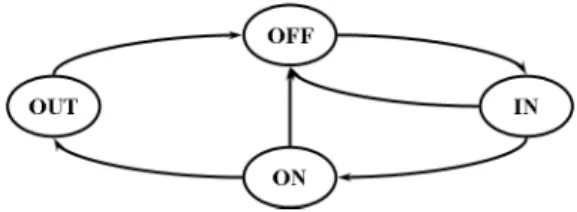
is leaving the station. Transitions between these states
are shown in the state diagram in Fig. 2. In this figure,
the transition to OFF is possible from anywhere. This
transition is used for modifying false states since OFF
is characterized by a clear distinction from other states.
[Fig. 2] Train state diagram.
When the train is not in the station, both
and
are small since motion cannot be observed. When the train is stopped,
is small since motion cannot be observed, and
is large since the rail region is hidden by the train. When the train is coming (or going),
is large since motion may be observed, and
is large since the rail region is hidden by the train. With this knowledge, we use four following fuzzy rules for determining the train states:
R1 : IF
is small AND
is small, THEN the train state is class 1 (OFF).
R2 : IF
is small AND
is large, THEN the train state is class 2 (ON).
R3 : IF
is large AND
is large, THEN the train state is class 3 (IN or OUT).
R4 : OTHERWISE, THEN the train state is class 4 (N/A, Not applicable).
The membership functions of the input linguistic variables and their associated linguistic terms are defined as shown in Fig. 3. In these linguistic terms, medium is defined for N/A. Therefore, the cases of R4 consist of the six remaining conditions created by combinations of small, medium and large values for the linguistic variables.
[Fig. 3] Membership functions for the linguistic terms.
We use a fuzzy classifier based on the TS (Takagi-Sugeno) fuzzy system [10] and the maximum aggregation method. So the train state is classified by
∧
∧
, (6)
, (7)
where denotes the output of each class,
the consequent constant for class in rule , and
and
the membership values of
and
, respectively.
In every frame, the train state is classified by (7), and the state is then changed so that the current state satisfies the state diagram (Fig. 2).
IV. EXPERIMENTAL RESULTS
The proposed method has been tested on five underground station image sequences to evaluate its performance. Three image sequences were acquired from a camera turned toward the head of a train with a 200 ms duration, whereas the others turning toward the tail of a train in Korea. The image resolution is 320×240 (8 bit grayscale).
The method was tested on a Pentium PC (Core
™2 Duo, 3.0GHz). Results of one sequence are shown in Fig. 4, where the red region shows
, the blue region shows
, and each is shown on the top. The train state is correctly classified, as shown in the feature signature image. At frame 4145,
is medium because some moving persons are observed, and the state is determined to N/A.
Figure 5 shows several examples of feature
signature images and results of the state transition
associated with various image sequences. In all of the
test image sequences, false status transition did not
occur in this test. While, several false estimation
[Fig. 4] Train state determination results.
results were observed by the train detection method [5]
owing to split movements. The average processing time of a single frame is about 12.5 ms, so this method can be used at determining the train states for railway monitoring systems.
[Fig. 5] Various feature signature images and results of the state transition.