Effects of Planting Dates and Mulch Types on the Growth, Yield and Chemical Properties of Waxy Corn Crosses Sonjajang×KNU-7 and Asan×KNU-7
Souliya Souvandouane, Manuel Esguerra, Kyu Hong Heo, Cyren M. Rico, and Sang Chul Lee
†Division of Applied Plant Biosciences, College of Agriculture and Life Sciences, Kyungpook National University, Daegu, 702-701, Korea
91
†
Corresponding author: +82-53-950-5713
(E-mail) [email protected] < Received April 13, 2009 >
ABSTRACT The growth, yield and chemical properties of waxy corn Sonjajang×KNU-7 and Asan×KNU-7 planted in different dates and mulch types in a converted paddy field was investigated. Experiment was carried out in a ran- domized complete block design in a split split-plot arrange- ment with four replications. Planting dates (D) [May 16 (D1, early), June 1 (D2, middle), June 6 (D3, late)] repre- sented main plots, plastic mulch (M) [(BM, black mulch;
TM, transparent mulch)] for subplots while waxy corn crosses [Sonjajang×KNU-7 (‘Sonja’) and Asan×KNU-7 (‘Asan’)]
for sub-subplots. Results showed that D had a significant effect on growth characters except emergence, ear quality except ear diameter, and yield whereas M showed significant effect on growth characters only. Superior growth and ear quality performance were recorded in D1 and BM. In terms of crosses, ‘Sonja’ had better growth performance than
‘Asan’ regardless of D and M, but performed better at D1 and BM. Highest yield was obtained in D1 for BM (2,131 kg 10a
-1) and TM (1,655 kg 10a
-1) but no significant difference in the yield across V was recorded. In terms of starch and sugar contents, a decreasing trend was observed from D1 to D3 regardless of M and V.
Keywords : black plastic mulch, converted paddy field, corn, transparent plastic mulch, variety
Corn remains one of the most important and highest yielding crops in the world. In Asia, corn production increa- sed from 87 million tons in 1980 to 167 million tons in 1999 whereas planting area increased from 37.6 million ha to 44.5 million ha in the same period (Park, 2001). In Korea, corn is a profitable crop that gives higher net profit than rice and soybeans. Green corn registered a per area net income of four times higher than rice and nine times higher than soybean.
Due to higher net income coupled with increased demands
and land use change, corn is now being extensively culti- vated in converted paddy fields. Thus, in 2002 over 1,905 ha of paddy fields have been converted for growing upland crops which had increased to about 7,000 ha in 2004 (Kim et al., 2004). Soil in converted paddy fields that are used to produce upland crops have unique physical and chemical properties engendered by their transitional status (Kleinhenz, 1996; Takahashi and Toriyama, 2004). It can affect corn cultivation by waterlogging problems which reduces the uptake of oxygen and certain nutrients from the soil (Arm- strong, 1978).
Kwabiah (2004) showed that growing conditions can be manipulated by planting at an early time and using plastic mulch. Phipps (1994) reported that plastic mulching could be effective in improving the yield, quality and reliability of the crop in marginal climatic area for growth of maize.
Manipulating early season soil temperature by plastic mul- ching has improved the yield and quality of sweet corn (Felcyzynski, 1994), grain (Hanras, 1979) and forage maize (Van der werf, 1993; Nakui et al., 1995; Keane, 2003).
Yield increase of 2 to 4 tons dry matter ha
-1and a propor- tional increase in dry matter content of 0.03-0.06 have been reported from experiment with plastic mulches in a number of Northern European countries (Madsen, 1992) and Northern Japan (Nakui et al., 1995). Thus, this experiment was conducted to investigate the effects of D and M on the growth, yield and chemical properties of waxy corn Sonja- jang×KNU-7 and Asan×KNU-7 in a converted paddy field.
MATERIALS AND METHODS
Site description and cultural management
The experiment was conducted at Kyungpook National
University (KNU) Agricultural Research Station in Gunwi
Table 1. Metrological data in Gunwi.
Meteorological parameters May June July August September Mean
Maximum temperature (ºC) 25.9 28.8 28.9 31.7 26.4 28.3
Minimum temperature (ºC) 9.7 15.6 19.8 22.2 17.6 17.0
Average temperature (ºC) 17.5 21.9 23.8 26.2 21.4 22.2
Precipitation (mm) 90.0 163.5 172.5 278.0 403.5 221.5
Sunshine (h) 222.1 156.0 101.4 143.1 82.7 141.1
Source: Korea Metrological Administration, 2007
in the summer season of May to September 2007. The field was a converted paddy field and was used for corn production in the previous planting season. Soil analysis showed a soil pH (1:5) of 5.7, and organic matter, P
2O
5, contents of 2 g/kg, 371 mg/kg, respectively. Soil K
+, Ca
++and Mg
++were 0.2, 3.8 and 1.4 cmol/kg, respectively.
Table 1 presents the meteorological data.
The field was plowed once and harrowed twice two weeks before planting. Fertilizer application rate was 150 kg N, 130 Kg P
2O
5and 130 Kg K
2O per ha. Half of the nitrogen requirement was applied as basal dressing before planting and the rest as top dressing during 7 to 8
thleaf stage. P
2O
5and K
2O were applied as basal dressing before planting. Plastic mulch sheets of 1.35 m wide were laid on soil 7 days before planting to allow time for soil warming, The edges of plastic mulches were pressed into the soil making the space between the rows reduced to 0.52 m wide.
Planting was done on May 16, June 1 and June 6, 2007.
Corn seeds were manually sown to a depth of 50 mm at a planting space of 60 cm between rows and 25 cm be- tween hills giving a plant population of 66,666 plants ha
-1. Two seeds were sown per hill and thinned to one plant at 5 to 6
thleaf stage. Empty or ungerminated holes were replaced.
Plant growth and yield measurements
The data were collected from two central rows. Emergence rate was determined before thinning out the extra plants by direct counting of germinated seedling of each replication divided by the number of seeds sown. Growth parameters namely plant height (from the base of the plant to the node of flag leaf), number of leaves, and shoot dry weights were
collected ten days after tasselling. Dry shoot weight was determined by cutting the plant at ground level then chopped, oven dried at 65ºC and weighed after 3 days. The ear of waxy corn was harvested 30 days after silking (Kim et al., 1999). Marketable ears with shelling percentage more than 80% were harvested and recorded as number of ears per plant. All harvested ears were used in measuring bare ear length, ear diameter, 100-grain weight, and fresh ear weight.
Ear characters and fresh ear yield were measured immediately after harvest. Grain weight was determined by adjusting grain moisture to 15%. Grains were manually removed from the cobs, weighed and subsamples of approximately 0.25 kg per plot were weighed fresh, oven- dried to constant weight at 65ºC to determine the water content.
Starch and sugar analyses
Starch and sugar were extracted according to the methods
of Jorge et al., (1976) with some modifications. Fresh ear
from each treatment were stored in deep freezer (-70C)
immediately after harvesting. Frozen kernels (2 g) taken
from the central portion of the ear were ground with 30 ml
of boiling 80% (v/v) ethanol and homogenized by centri-
fuging at 13,000 rpm for 6 min at 20°C. The process was
repeated twice and the supernatant was collected each
time. The supernatant was evaporated at 85°C until most
of the alcohol was removed then diluted to 50 ml solution
with distilled water. The remaining pellets after third centri-
fugation was resuspended in 30 ml 95% (v/v) DMSO,
heated at 60°C for 20 min with stirring and diluted to a
final volume of 100 ml using distilled water. The starch
and total sugar was determined by enzymatic bio-analysis
and spectrophotometer determination using commercial test
kit (BOEHRINGE MANNHEIM).
Table 2. ANOVA of growth parameters of waxy corn affected by the number of cultural practices.
Sources of variation df Plant Height Number of
Leaves Shoot weight Emergence (%) Days to Tasseling
Date (D) 2 ** ** * ** **
Mulch (M) 1 ** ** ** * **
DxM 2 ** ** ns ns **
Variety (V) 1 ** ** ** ns **
DxV 2 ** * ** ns ns
MxV 1 * * * * ns
DxMxV 2 * ns ns ns ns
Total
*,** Significant at P<0.05 and P<0.01, respectively.
Table 3. ANOVA of ears characters of waxy corn affected by the number of cultural practices.
Sources of variation df No. ears/plant Ear Length Ear diameter Ear Weight
Date (D) 2 ** ** ns **
Mulch (M) 1 ns ns ns ns
DxM 2 ns ns ** ns
Variety (V) 1 * ns ** *
DxV 2 ns ** ns ns
MxV 1 ns ** ns *
DxMxV 2 ns ns ns ns
Total
*,** Significant at P<0.05 and P<0.01, respectively.
Statistical analysis
The experiment was carried out in a randomized complete block design in a split split-plot arrangement with four repli- cations. Planting dates (D) [May 16 (D1, early), June 1 (D2, middle), June 6 (D3, late)] represented main plots, plastic mulch (M) (BM, black mulch; TM, transparent mulch) for subplots while waxy corn crosses [Sonjajang×KNU-7 (‘Sonja’) and Asan×KNU-7 (‘Asan’)] for sub-subplots. Data were analyzed using the GLM procedure of SAS (SAS Institute, Inc., Cary, NC, USA).
RESULTS
Treatment effects on measured parameters
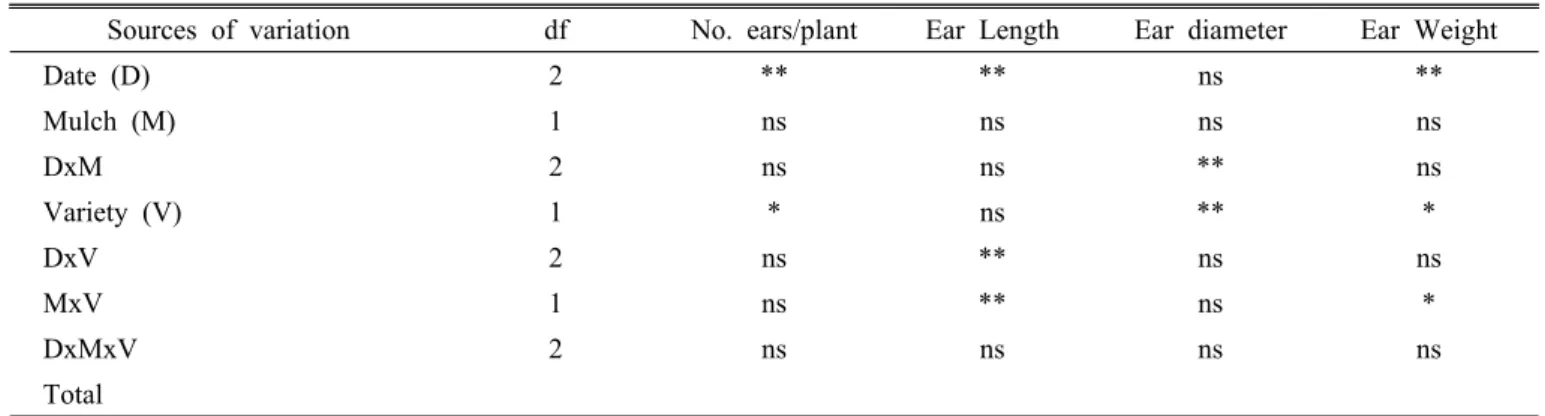
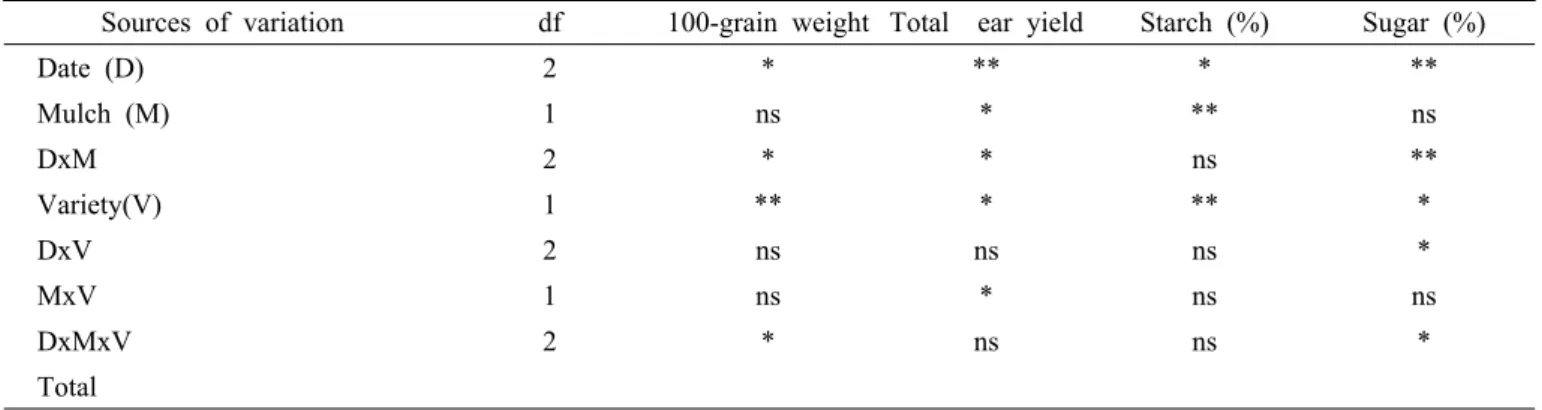
All treatments showed significant effects on the growth parameters except for the effect of V on emergence rate (Table 2). The interaction of D and M was significant in
all growth parameters except for shoot weight and emergence rate. For ear quality parameters, only D and V had significant effect on all parameters except for ear diameter and ear length, respectively (Table 3). M did not show significant effect on any of the ear quality parameters while D×M had significant effect only in ear diameter. In case of yield and chemical composition parameters, D and V had significant effect on all parameters while M had significant effect only on the total yield and starch composition (Table 4). The D×M did not significantly affect the starch content.
Effects on growth characters
All treatments showed significant effects on the growth parameters except for effect of V on emergence rate (Table 2). In agreement with this, result revealed that growth para- meters had significant differences between D (Table 5).
Growth parameters in D1 in both BM and TM showed
Table 4. ANOVA of grain weight, yield and chemical components of waxy corn affected by the number of cultural practices.
Sources of variation df 100-grain weight Total ear yield Starch (%) Sugar (%)
Date (D) 2 * ** * **
Mulch (M) 1 ns * ** ns
DxM 2 * * ns **
Variety(V) 1 ** * ** *
DxV 2 ns ns ns *
MxV 1 ns * ns ns
DxMxV 2 * ns ns *
Total
*,** Significant at P<0.05 and P<0.01, respectively.
Table 5. Differences in plant height (PH), number of leaves (NL), shoot weight (SW), emergence rate (E) and date to tasselling (DT) of two new waxy corn cultivars across varieties and mulching type in three planting dates in Gunwi, Kyungbuk, Korea.
Black mulch Transparent mulch
PH (cm)
NL (no.)
SW (g)
E (%)
DT (days)
PH (cm)
NL (no.)
SW (g)
E (%)
DT (days) 16 May PDT
Sunja 202
§a
†19a 1017a 60a 66a 194a
**15a
**808a
**57a
ns61a
**Asan 181b 14b 317b 73a 59b 144b
**12b
**252b
ns48a
ns50b
**Mean 192x
‡16x 667x 67y 63x 169x 14x 530x 53y 56y
1 June PDT
Sunja 188a 16a 792a 48a 62a 178a
ns14a
ns657a
ns34a
**62a
nsAsan 183a 13b 292b 48a 51b 165a
**11b
*350b
ns33a
**51b
nsMean 185y 15y 542y 48z 56y 172x 13x 513x 34z 57x
6 June PDT
Sunja 167a 14a 517a 90a 62a 159a
ns13a
ns458a
ns95a
ns56a
**Asan 149b 11b 417a 95a 51b 148a
ns11b
ns333a
ns93a
ns45b
**Mean 158z 12z 467y 93x 57y 154y 11y 396y 94x 51z
ns
Between mulching types, not significantly different at P<0.05.
*
,
**Between mulching types, significant at P<0.05 and P<0.01, respectively.
†
Within varieties, same letters are not significantly different at P<0.05 level by DMRT.
‡
Between planting dates, same letters are not significantly different at P<0.05 level by DMRT.
§
All values are mean of 15 samples and 4 replications.
higher values compared to D2 and D3. Plant height, numbers of leaves, shoot weight, and days to tasselling (192 cm, 16, 667 g, and 63 days, respectively) in D1 under BM had higher values than in D3 (158 cm, 12, 467 g, and 57 days, respec- tively). The same trend was observed in TM although values in D1 and D2 had similar values that were higher than those in D3.
In the case of emergence rate, D3 obtained higher value (93%) compared to those of D2 and D3 (67 and 48%, respectively). TM exhibited the same trend. This result is consistent with the highly significant effect of D on emer-
gence rate.
Analysis between M showed lower values in most para-
meters under TM in D1 indicating that both V performed
better when planted under BM. Plant height, number of leaves,
shoot weight, and days to tasselling of ‘Sonja’ planted in
TM decreased significantly compared to those in BM by 4,
21, 21, and 8%, respectively, whereas emergence rate did
not. In the case of ‘Asan’ planted under TM, plant height,
number of leaves, and days to tasselling decreased signi-
ficantly compared to that in BM by 20, 14 and 15%, respec-
tively, whereas shoot weight and emergence rate did not.
Table 6. Differences in number of ears (NE), ear length (EL), ear diameter (ED) and ear weight (EW) of two new waxy corn cultivars across varieties and mulching type in three planting dates in Gunwi, Kyungbuk, Korea.
Planting date treatment and cultivar
Black Transparent
NE (no.)
EL (cm)
ED (mm)
EW (g)
NE (no.)
EL (cm)
ED (mm)
EW (g) 16 May PDT
Sunja 3
§a
†17a 38b 121b 2a
ns18a
ns38a
ns122a
nsAsan 2b 18b 43a 146a 2a
ns17b
ns41a
ns123a
**Mean 2x
‡18x 40x 134x 2x 18x 40x 122x
1 June PDT
Sunja 2a 18a 36a 122a 1a
ns18a
ns39a
ns119a
nsAsan 1a 17a 40a 138a 1a
ns16b
ns41a
ns118a
**Mean 1y 18x 39x 130x 1y 17x 40x 118x
6 June PDT
Sunja 1a 16a 39a 90a 2a
ns16a
ns39a
ns101a
nsAsan 1a 17a 41a 98a 1b
ns16a
ns38a
ns98a
nsMean 1y 17y 38x 94y 1y 16y 40x 100x
Between mulching types, not significantly different at P<0.05.
*,**
Between mulching types, significant at P<0.05 and P<0.01, respectively.
†
Within varieties, same letters are not significantly different at P<0.05 level by DMRT.
‡
Between planting dates, same letters are not significantly different at P<0.05 level by DMRT.
§
All values are mean of 15 samples and 4 replications.
Analysis between V within D in both M showed that growth parameters in ‘Sonja’ had higher values than those of ‘Asan’. These results showed better performance of ‘Sonja’
compared to ‘Asan’ regardless of D and M. Results further showed that ‘Sonja’ performed better when planted at early under BM.
Effects on ear quality
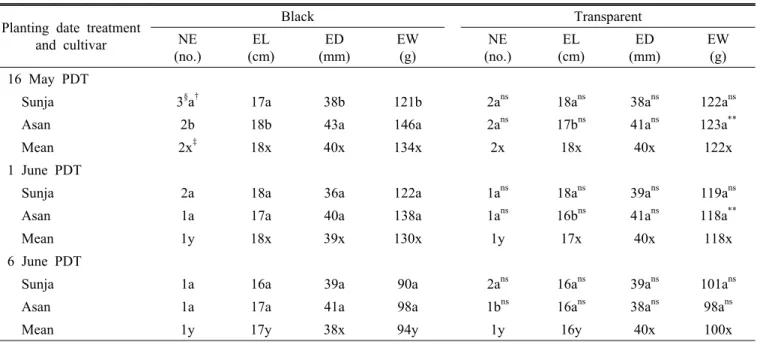
ANOVA showed that D had significant effect on all para- meters except for ear diameter (Table 6). The same was observed for V except for ear length while M did not show significant effect on any of the ear quality parameters. Analy- sis of ear characters across D in BM showed that number of ears was higher (2 pcs.) in D1 than D2 and D3 (1 pc.).
Ear length and weight obtained similar values in D1 and D2 (18, 18 cm and 134, 130 g, respectively) which were higher than those of D3 (17 cm and 94 g, respectively).
There was no difference in ear diameter D1, D2 and D3 (40, 39, and 38 mm, respectively). In the case of TM, same trend was observed in all parameters except for ear weight, which obtained similar values across D (122, 118 and 100
g respectively).
Analysis across V within D showed that ‘Asan’ obtained higher values than ‘Sonja’ in all parameters except for the number of ears in D1. However, there were no significant differences between V in D2 and D3. In TM, there were no significant differences between V in all D except for ear length D1 and D2 wherein ‘Sonja’ obtained higher value than ‘Asan’, and number of ears in D3 wherein ‘Sonja’
also obtained higher value than ‘Asan’.
Analysis between M also showed no significant differences in the parameters except for ear weight in ‘Asan’ in D2 and D3. These results showed that M did not affect the ear quality. Result further showed that D did not significantly affect the ear quality.
Effect on yield and chemical composition
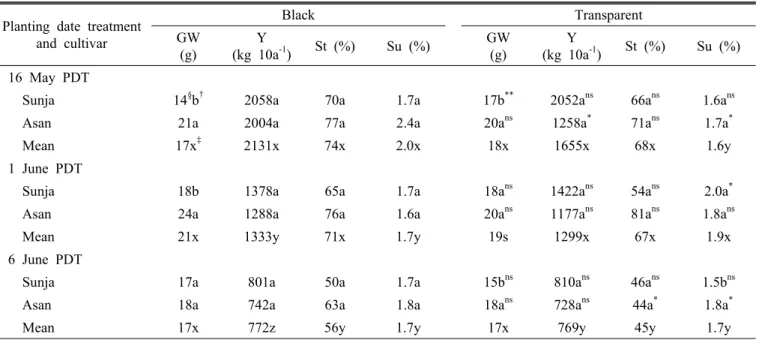
The 1000-grain weight across D had no significant differ-
ence in both BM and TM (Table 7). The total yield across
D for those planted under BM was higher in D1 (2,131 kg
10a
-1) compared to those of D2 (1,333 kg 10a
-1) and D3
(772 kg 10a
-1). Under TM, D1 and D2 obtained similar
Table 7. Differences in 1000-grain weight (GW), total yield (Y), starch content (St) and sugar content (Su) of two new waxy corn cultivars across varieties and mulching type in three planting dates in Gunwi, Kyungbuk, Korea.
Planting date treatment and cultivar
Black Transparent
GW (g)
Y
(kg 10a
-1) St (%) Su (%) GW (g)
Y
(kg 10a
-1) St (%) Su (%) 16 May PDT
Sunja 14
§b
†2058a 70a 1.7a 17b
**2052a
ns66a
ns1.6a
nsAsan 21a 2004a 77a 2.4a 20a
ns1258a
*71a
ns1.7a
*Mean 17x
‡2131x 74x 2.0x 18x 1655x 68x 1.6y
1 June PDT
Sunja 18b 1378a 65a 1.7a 18a
ns1422a
ns54a
ns2.0a
*Asan 24a 1288a 76a 1.6a 20a
ns1177a
ns81a
ns1.8a
nsMean 21x 1333y 71x 1.7y 19s 1299x 67x 1.9x
6 June PDT
Sunja 17a 801a 50a 1.7a 15b
ns810a
ns46a
ns1.5b
nsAsan 18a 742a 63a 1.8a 18a
ns728a
ns44a
*1.8a
*Mean 17x 772z 56y 1.7y 17x 769y 45y 1.7y
ns
Between mulching types, not significantly different at P<0.05.
*,**
Between mulching types, significant at P<0.05 and P<0.01, respectively.
†
Within varieties, same letters are not significantly different P<0.05 level by DMRT.
‡
Between planting dates, same letters are not significantly different P<0.05 level by DMRT.
§