Research on a Solution for Efficient ECG Data Transmission in IoT Environment
Cho Gyoun Yon † ⋅Lee Seo Joon †† ⋅Lee Tae Ro †††
ABSTRACT
Consistently collecting a variety of vital signs is crucial in u-Healthcare. In order to do so, IoT is being considered as a top solution nowadays as an efficient network environment between the sensor and the server. This paper proposes a transmission method and compression algorithm which are appropriate for IoT environment. Results were compared to widely used compression methods, and were compared to other prior researches. The results showed that the compression ratio of our proposed algorithm was 11.7.
Keywords : u-Healthcare, IoT, Vital Information Transmission Method, Compression Solution
사물 인터넷 환경에서의 효율적인 ECG 데이터 전송 방안에 관한 연구
조 균 연 † ⋅이 서 준 †† ⋅이 태 노 †††
요 약
u-Healthcare에서는 다양한 생체 정보를 지속적으로 수집하는 것이 필요하다. 이를 위해 센서와 서버 간의 효율적인 네트워크 환경으로써 IoT가 고려된다. 본 논문에서는 이러한 IoT 환경에 적합한 전송 방식 및 압축 알고리즘을 제안하였다. 결과는 기존의 압축 알고리즘 및 선행 연구들과 비교하였다. 결과에서 본 논문에서 제안하는 알고리즘의 압축효율이 11.7이 됨을 알 수 있었다.
키워드 : 유헬스, IoT, 생체정보 전송 방식, 압축 솔루션
1. Introduction
6)Advancement in the development of ICT(Information Communication Technology) and Convergence Technology has enabled u-Healthcare related machines to freely communicate via wired or wireless network. Along with this kind of technology tiny sized devices that are able to sense health related data of humans rapidly developed to actualize the realm of u-Health(Ubiquitous Healthcare)[1].
u-Health makes possible all kinds of health monitoring services for individuals to efficiently manage their health status.
†비 회 원 : 고려대학교 보건과학연구소 연구교수
††비 회 원 : 고려대학교 보건과학과 석사과정, BK21Plus
†††종신회원 : 고려대학교 보건정책관리학부 교수 Manuscript Received : September 12, 2014 Accepted : October 16, 2014
* Corresponding Author : Lee Tae Ro([email protected])
In order to do so, basically the technology of IoT (Internet of Things) is used to intellectually monitor the status of any users from normal individuals to elderly and chronic patients. This concept automatically does practically any process needed for health or medical providing service. For example, in times when the season is rapidly shifting, or in times when the weather is particularly cold, cases of people who suffer from sudden paralysis or muscle stiffness in the hands or feet occur [2], or maybe even a heart attack. According to the WHO’s(World Health Organization) estimation, cardiovascular disease are the causes of death of nearby seventeen million people each year around the globe[3]. The critical point is that when the time of feedback is delayed the symptom could progress to much severe conditions[4].
The speed of response time by medical experts is highly
likely to decide the life of the patient in emergency[5] so
in order for appropriate feedback to take place, the
medical expert in distance must be informed of the patient’s vital signs such as ECG(Electrocardiogram).
Therefore, there is a need for an efficient ECG monitoring system in real-time cloud network situations for medical experts to swiftly act to patients. Among many efforts of advanced emergency system[6-8], first, our research team chose to apply cloud network to our solution, because ECG data brings about the need for large amounts of mass data for storing information of interest[9]. Second, we applied our proposed ECIoT(ECG Compression for IoT) compression algorithm to maximize the transmission efficiency of the ECG IoT environment.
Also, the compressed data is envisioned to increase the amount of ECG data to be stored in already vast data storage system of cloud servers. This technique is useful for minimizing data storage and transmission requirements for telemedicine applications[10-17] where multiple channels with high bandwidth data are digitized[18, 19], such as our proposed ECG monitoring system.
This paper presents ECIoT which is an optimized compression algorithm for ECG data, and the overall system architecture of the real-time ECG monitoring system in IoT environment. Results showed that the ECIoT was more competitive than widely used compression algorithms and other related researches.
2. Related Research
2.1 ECG Applied Service in IoT
In this section, the general concept of ECG applied service in IoT environment is introduced. The overall service architecture of ECG applied healthcare system is shown in Fig. 1.
Fig. 1. The Service Architecture of ECG Applied Healthcare System
Wearable ECG sensors are widely being developed to comfortably fit to the user without intrusion, and senses ECG signal. The ECG sensor sends the data to ECG IoT device (usually nowadays, a smart phone or smart device) usually through OTG(On-The-Go), Wi-Fi, Bluetooth or Dedicated RF(Radio Frequency). The ECG data is computed in the ECG IoT device and then sent to the
mobile network through mobile networks such as Wi-Fi or cellular network, towards the ECG IoT server. The data server is where numerous servers will exist to aggregate and store data. The healthcare center server will be placed in medical institutions to directly communicate with medial specialist when needed. The three ECG IoT server, data server and healthcare center server, interacts with each other within the internet.
2.2 Related Researches in ECG Data Processing
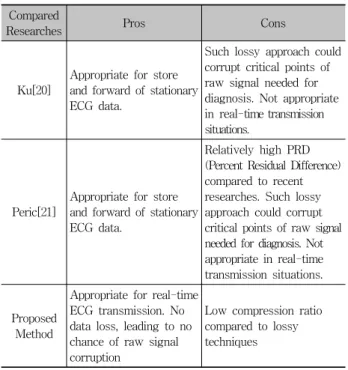
An in-depth comparison of notes, pros and cons between the methods are shown in Table 1 and Table 2.
Compared
Researches Notes
Ku[20] Wavelet based ECG data compression system with linear quality control scheme.
Peric[21] Differential pulse code modulation quantizer adaptation method for efficient ECG signal compression.
Proposed Method
Proposes an algorithm based on LZW coding method combined with applied differential calculus.
Table 1. Notes of Related Researches
Compared
Researches Pros Cons
Ku[20]
Appropriate for store and forward of stationary ECG data.
Such lossy approach could corrupt critical points of raw signal needed for diagnosis. Not appropriate in real-time transmission situations.
Peric[21]
Appropriate for store and forward of stationary ECG data.
Relatively high PRD (Percent Residual Difference) compared to recent researches. Such lossy approach could corrupt critical points of raw signal needed for diagnosis. Not appropriate in real-time transmission situations.
Proposed Method
Appropriate for real-time ECG transmission. No data loss, leading to no chance of raw signal corruption
Low compression ratio compared to lossy techniques
Table 2. Pros and Cons Comparison Between Related Researches
All in all, related researches do not support real-time
transmission, whereas our proposed method supports
real-time transmission. Second, related researches heavily
relied on lossy approaches. The problem of such approach
is that omitting signals without approval of clear clinical
evidence could be quite dangerous. On the other hand,
our proposed algorithm is lossless, that is, there is no
difference between source and destination.
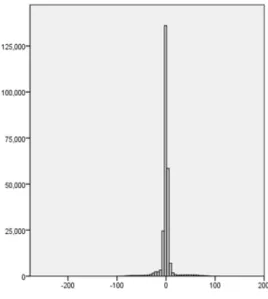
Fig. 2. Distribution Curve of European ST-T Data e0104 Channel 1 After Delta Computation 2.3 Digital Data Compression
Digital data signals are signals that can be thought of as an array or matrix. Transforms can be used for analysis, and are often used in compression applications [22-24]. Approaching medical data in such way is widely being recognized because of its great potential to improve the treatment quality and efficiency of hospitals and increase the services for patients[25]. The most representative methods that are applied in digital data compression applications are Huffman coding and Lempel-Ziv Welch (LZW) coding.
Huffman coding algorithm is a probability coding method which decides the code size by the probabilities of individual data symbols[26, 27]. LZW is a dictionary coding variant of Lempel-Ziv compression[28, 29]. The proposed algorithm ECIoT will be compared and evaluated in the results section.
3. Evaluation
3.1 Method to Evaluation
In this paper, we analyzed the ECG data called the European ST-T data provided by Physionet[30]. All analysis process was implemented using C language and was simulated.
Statistical analysis was conducted using SPSS 21.0.
We looked at the distribution curve of the variable delta and found the following characteristics of the data as shown in Fig. 2. After computing the delta between previous and proceeding samples, the differential value did not exceed the threshold of -128 to 127. Also, 97.74% of the values had a threshold of -50 to 50(Fig. 2).
Note, 15 data were randomly collected from European ST-T database from time sequence 500 second to 1,500
second, a total of 250,000 samples which was obtained by a sampling rate of 250 per second.
The main ideas of ECIoT algorithm are separating channels and LZW compression for the delta.
Original ECG data is not classified the data into channels which could not have the consistency of data.
ECIoT separates the channels according to the channels of ECG data thereby increasing consistency. This led to an increase in redundancy of the data and enhanced compression efficiency.
Also, since each ECG data have a waveform, when they change to be expressed as differential, its redundancy is even more increased and the compression efficiency is more enhanced. In original ECG channels, samples have to use 4 bytes each, but it is changed to delta form, it only needs 1 byte.
To confirm this idea, we investigated similar distribution curve in the 15 samples of data collected and implemented the same analysis. This investigation led to the conclusion that most of the delta variable would no longer have to be saved in large bits, and should be saved to 8 bits. If any data over or below this threshold is found, save it to 16 bits data, with a header attached to it containing the information that this data is over the threshold. This is one of the critical points found in this paper, which points to the fact that not all of the data have to be saved largely and cause inefficiency in compression.
3.2 System Architecture of ECG IoT Device
The system architecture of ECG IoT device of the proposed ECG data transmission system for IoT environment is shown in Fig. 3.
As mentioned, when the ECG data is sensed by any sort of ECG sensing device, it is sent to the ECG IoT device (refer to the overall figure in Fig. 1). The ECG IoT device is consisted of ECIoT and NIM(Network Interface Module). As a sub, ECIoT is consisted of CSM (Channel Separation Module) and DCM(Data Control Module). Explanation will be given about the role of each module.
Fig. 3. System Architecture of the ECG IoT Device
Fig. 4. Function of CSM
Fig. 6. Function of Computing Delta.
1) CSM
CSM is the first step of the ECIoT algorithm. CSM separates the ECG data stream into n channels. The number n is decided according to the number of ECG leads attached to the user (e.g. 12 ECG leads, 3 ECG leads etc). The time sync information is excluded because it is easy to reconstruct time sequence by incrementing.
The overall function of CSM is shown in Fig. 4.
2) DCM
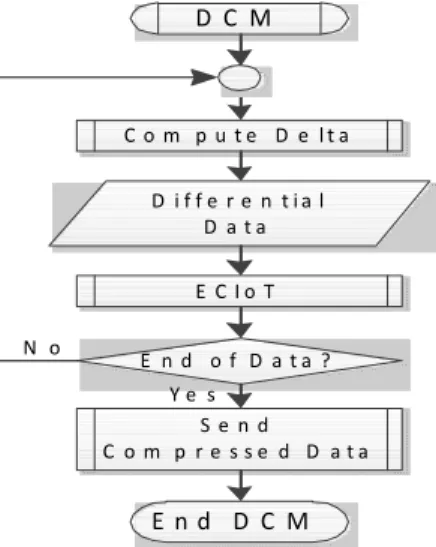
DCM receives the separated data from CSM. Then it computes the differential in each channel of ECG data.
Lastly, it compresses the data with ECIoT algorithm. The overall function of DCM is shown in Fig. 5.
D C M
C o m p u t e D e l t a
D i f f e r e n t i a l D a t a
E n d o f D a t a ? E C I o T N o
S e n d C o m p r e s s e d D a t a
E n d D C M
Y e s
Fig. 5. Flow of DCM Procedure
a) Compute Delta
DCM computes the delta of the ECG and reduces most of the bytes into 8 bit. If the delta exceeds the threshold -128 to 127, it is written to 16bits(Fig. 6). Delta is computed using the following equation (1).
bn = an - an-1 (b1 = a1, n≧2) (1)
The differential transition function executes the following process: First, read the 32 bit ECG information and save it to cur. Save the previous information to old. Second, subtract old from cur and save the value to diff_temp.
Third, if -128<diff_temp<127, save diff_temp to 8 bits diff. If diff_temp exceeds 8 bits, save it to 16 bits by saving it over two 8 bits twice. Fourth, hand diff over to ECIoT compression function.
b) ECIoT Compression Function
ECIoT compression function is coded by modifying the code word of original LZW algorithm to be optimally applied for IoT environment. The size of code word was set to 8192.
3) NIM
When the two steps computing process is finished by the ECIoT algorithm, NIM receives the data and packetizes it in order to make it appropriate for network interface. Examples of network interfaces are Wi-Fi and cellular network. NIM also supports error correction methods like FEC(Forward Error Correction), in case of network failures.
4. Results
4.1 Comparison to Widely Used Compression Algorithms
Huffman compression algorithm and LZW compression
algorithm were selected as ECIoT’s comparisons because
they are the most widely known lossless data compression
algorithms. 15 data samples from Physionet were used to
compare the mean of compression ratio between the three
methods. The name of the database is European ST-T
database[30]. CR(Compression ratio) is calculated by
Compression Methods
Compression Ratio
Types of Databases Used
Real-time Transmission
Ku[20] 6.79±2.95 (PRD 2.99±0.08)
MIT-BIH ST Change Database.
Real-time Transmission
Peric[21]
8.28 (PRD 7.21, lower PRD not
available.)
Obtained real
ECG signal. Impossible Proposed
Method
11.70±1.12 (PRD 0)
European ST-T
Database Possible Table 4. Results Comparison Between Related Research dividing the uncompressed size by the compressed size as in equation (2).
CR = Uncompressed size / Compressed Size (2)
Huffman LZW ECIoT p-value
European
ST-T Database 1.75±0.07 2.41±0.14 11.70±1.12 p<0.0001 Table 3. Mean Compression Ratio Comparison
Between Huffman, LZW, and ECIoT
The average compression ratio of Huffman was 1.75, the average compression ratio of LZW was 2.41, and the average compression ratio of ECIoT was 11.7. ANOVA (Analysis of Covariance) was used for comparison and the fact that the three of the compression ratio were different from each other were statistically significant under 95% significance level.
A point to notice here is the large difference in performance between LZW and ECIoT. This is because first, after channel separation and compute delta, the needed bytes were decreased from 12 to 2. Original data need a total of 12 bytes; 4 bytes for time sync, 4 bytes for channel 1, and 4 bytes for channel 2. On the other hand, the data computed through ECIoT need only 2 bytes time sync bytes are not transmitted and is generated automatically by the receiver’s side, 1 byte for channel 1, and 1 byte for channel 2.
Second, the LZW algorithm per se provides approximately 2 times of better compression outcome.
Therefore, multiplying the first outcome and second outcome (6 × 2 = 12), approximately 12 times of better compression ratio can be calculated, which corresponds to ECIoT’s outcome (CR = 11.70).
4.2 Comparison to Related Researches
We tried to compare our algorithm with other researches under the condition that other researches’
compression ratio is computed by the lowest percent residual difference value shown in the researches’
literature. This was for a fair comparison, because our
algorithm is lossless, meaning that technically our algorithm’s PRD value is 0%. PRD value can be computed by the following equation (3).
(3)
5. Conclusion
IoT environment is highly expected to dominate u-Healthcare related applications. In this paper, an efficient ECG monitoring system in real-time IoT environment was proposed to increase the transmission efficiency of ECG data without loss of data during network transmission.
Compression of ECG data in healthcare fields is important because of its vast amount of data size. If the data size is too large, it will take longer time to transmit, making it prone to transmission errors. If ECG data is not sent to the medical expert at the right time, it may cost his or her life. Unlike prior researches who did not consider the characteristics of the target medical data[31], we thoroughly analyzed the characteristic of ECG and applied the most efficient lossless algorithm possible to it.
Experimental results showed that the proposed ECIoT’s compression ratio was 11.7. This was approximately 6.7 times better than Huffman (CR=1.75), and 4.9 times better than LZW (CR=2.41).
References
[1] Cho, G.Y., “Research on a Method for Efficient u-Healthacer Data Transmission in M2M Environment”, in Journal of Digital Convergence, pp.251-257, 2014.
[2] Finsterer, J., C. Stöllberger, and R. Höftberger, “Left ventricular hypertrabeculation/noncompaction in hereditary inclusion body myopathy”, in International Journal of Cardiology, pp.67-69, 2011.
[3] WHO, Global Status Report on Noncommunicable Diseases, 2010.
[4] Dabby, R., et al., “Myotonia in DNM2-related centronuclear myopathy”, in Journal of Neural Transmission, pp.549-553.
2014.
[5] Wilde, E.T., “Do emergency medical system response times matter for health outcomes?”, in Health Econ, pp.790-806, 2013.
[6] Li, S.H., et al., “Developing an active emergency medical service system based on WiMAX technology”, in J Med Syst, pp.3177-3193. 2012.
[7] El-Masri, S. and B. Saddik, “An emergency system to
improve ambulance dispatching, ambulance diversion and
clinical handover communication-a proposed model”, in J
Med Syst, pp.3917-3923, 2012.
[8] Lee Cc Fau - Hsu, C.-W., et al., “An enhanced mobile- healthcare emergency system based on extended chaotic maps”, in Journal of Medical Systems, 2013.
[9] Trabuco, M.H., M.V. Chaffim Costa, and F.A. de Oliveira Nascimento, “S-EMG signal compression based on domain transformation and spectral shape dynamic bit allocation”, in Biomedical Engineering Online, 2014.
[10] Chen, M., et al., “A 2G-RFID-BASED E-HEALTHCARE SYSTEM”, in Ieee Wireless Communications, pp.37-43, 2010.
[11] Sneha, S. and U. Varshney, “A framework for enabling patient monitoring via mobile ad hoc network”, in Decision Support Systems, pp.218-234, 2013.
[12] Park, S., W. Kim, and I. Ihm, “Mobile collaborative medical display system”, in Computer Methods and Programs in Biomedicine, pp.248-260, 2008.
[13] Lee, S.J., et al., “The Design of Maternity Monitoring System Using USN in Maternity Hospital”, in The Journal of Digital Policy & Management, pp.347-354, 2013.
[14] Lee, S.J. and T.R. Lee, “Design of Remote Infusion Pump Monitoring System Using Wireless Network and RFID Technology”, in The Journal of Digital Policy &
Management, pp.159-167, 2013.
[15] Tu, Y.-J., W. Zhou, and S. Piramuthu, “Identifying RFID- embedded objects in pervasive healthcare applications”, in Decision Support Systems, pp.586-593, 2009.
[16] de Carvalho Junior, H.H., et al., “A heart disease recognition embedded system with fuzzy cluster algorithm”, in Computer Methods and Programs in Biomedicine, pp.447-454, 2013.
[17] Nilsen, W., et al., “Advancing the Science of mHealth”, in Journal of Health Communication, pp.5-10, 2012.
[18] Berger, P.D.A., et al., “Compression of EMG signals with wavelet transform and artificial neural networks”, in Physiological Measurement, pp.457-465, 2006.
[19] Lee, S.J., et al., “Geometric detection algorithm design for ECG data analysis using wavelet”, in International Journal of Bio-Science and Bio-Technology, pp.11-23, 2013.
[20] Ku, C.-T., et al., “Wavelet-Based ECG Data Compression System With Linear Quality Control Scheme”, in Ieee Transactions on Biomedical Engineering, pp.1399-1409, 2010.
[21] Peric, Z., et al., “DPCM quantizer adaptation method for efficient ECG signal compression”, in Journal of Communications Technology and Electronics, pp.1241-1250, 2013.
[22] Weeks, M., “Digital Signal Processing Using Matlab and Wavelets”, Infinity Science Press, 2007.
[23] Puthooran, E., R.S. Anand, and S. Mukherjee, “Lossless Compression of Medical Images Using a Dual Level DPCM with Context Adaptive Switching Neural Network Predictor”, in International Journal of Computational Intelligence Systems, pp.1082-1093, 2013.
[24] Galiano, V., et al., “Fast 3D wavelet transform on multicore and many-core computing platforms”, in Journal of Supercomputing, pp.848-865, 2013.
[25] Mao, Y., et al. “Medical data mining for early deterioration warning in general hospital wards”, in IEEE International Conference on Data Mining, 2011.
[26] Salomon, D., “A Consice Introduction to Data Compression”, Springer, 2008.
[27] Blelloch, G., “Introduction to Data Compression”, 2001.
[28] Ziv, J. and A. Lempel, “UNIVERSAL ALGORITHM FOR SEQUENTIAL DATA COMPRESSION”, in Ieee Transactions on Information Theory, pp.337-343, 1977.
[29] Ziv, J. and A. Lempel, “COMPRESSION OF INDIVIDUAL SEQUENCES VIA VARIABLE-RATE CODING”, Ieee Transactions on Information Theory, pp.530-536, 1978.
[30] Goldberger, A.L., et al., “PhysioBank, PhysioToolkit, and PhysioNet: Components of a New Research Resource for Complex Physiologic Signals. Circulation”, pp.215-220, 2000.
[31] Mukhopadhyay, S.K., S. Mitra, and M. Mitra, “ECG signal compression using ASCII character encoding and transmission via SMS”, in Biomedical Signal Processing and Control, pp.354-363, 2013.
조 균 연
e-mail : [email protected]
1993년 경희대학교 전자계산공학과(공학사) 1998년 경희대학교 전자계산공학과(공학박사) 2000년∼2013년 ㈜팬택 중앙연구소
SW개발팀장
2013년∼현 재 고려대학교 보건과학대학, BK21Plus 프로그램 연구교수 관심분야 : Healthcare Information System, u-Healthcare, Healthcare
Management, Mobile Communication, Mobile Network, Internet of Things
이 서 준
e-mail : [email protected]
2013년 고려대학교 보건행정학과(보건학사) 2013년∼현 재 고려대학교 보건과학과
보건행정학전공 석사과정, BK21 Plus
관심분야 : Bio-informatics, u-Health, e-Health, m-Health, Digital Signal Processing, Digital Image Processing and Telemedicine
이 태 노