1. INTRODUCTION
In the era of the 4th Industrial Revolution, vari- ous service systems that ICT and contents service converge have been studied. In order to provide contents customized to users, there is usually a method of predicting and providing an item that a user is expected to use by using a recom- mendation system. Such a recommendation system operates based on collaborative filtering, content- based filtering, and hybrid filtering. In the collabo- rative filtering, has a cold start problem that can
not be recommended because a new user does not have any evaluation information. In the content- based filtering, it is possible to analyze even the initial user because the information of the content is compared with the information of users. But in this case, the recommendation satisfaction is low because it does not reflect the user's history and preferences like the collaboration filtering. There- fore, there is hybrid filtering that uses both techni- ques[1].
In the age of globalization, people of various eth- nics are being entering into Korea. As dietary hab-
An Intelligent Recommendation Service System for Offering Halal Food (IRSH) Based on Dynamic Profiles
Hyun-ho Lee†, Won-jin Lee††, Jae-dong Lee†††
ABSTRACT
As the growth of developing Islamic countries, Muslims are into the world. The most important thing for Muslims to purchase food, ingredient, cosmetics and other products are whether they were certified as 'Halal'. With the increasing number of Muslim tourists and residents in Korea, Halal restaurants and markets are on the rise. However, the service that provides information on Halal restaurants and markets in Korea is very limited. Especially, the application of recommendation system technology is effective to provide Halal restaurant information to users efficiently. The profiling of Halal restaurant information should be preceded by design of recommendation system, and design of recommendation algorithm is most important part in designing recommendation system. In this paper, an Intelligent Recommendation Service system for offering Halal food (IRSH) based on dynamic profiles was proposed. The proposed system recommend a customized Halal restaurant, and proposed recommendation algorithm uses hybrid filtering which is combined by content-based filtering, collaborative filtering and location-based filtering.
The proposed algorithm combines several filtering techniques in order to improve the accuracy of recommendation by complementing the various problems of each filtering. The experiment of performance evaluation for comparing with existed restaurant recommendation system was proceeded, and result that proposed IRSH increase recommendation accuracy using Halal contents was deducted.
Key words: Recommendation System, Profile, Context Information, Halal
※ Corresponding Author : Jae-dong Lee, Address: (16890) 152, Jukjeon-ro, Suji-gu, Yongin-si, Gyeonggi-do, TEL : +82-31-8005-2384, FAX : +82-31-8021-7422, E-mail : [email protected]
Receipt date : Oct. 10, 2018, Revision date : Jan. 4, 2019 Approval date : Jan. 21, 2019
†Department of Computer Engineering, Dankook Uni- versity (E-mail : [email protected])
†††Research Institute of Information and Culture Technology, Dankook University
(E-mail : [email protected])
†††Department of Software, Dankook University
※ This work was supported by the Ministry of Educa- tion of the Republic of Korea and the National Research Foundation of Korea (NRF-2015S1A5B8A02074504)
its of international citizens have diversified, vari- ous types of restaurants such as vegetarian res- taurants, Halal restaurants, and organic restau- rants have appeared. However, users are not able to collect diverse restaurant information in real time because they can be recognized through just internet surfing or offline information in order to find such a characteristic restaurant. Especially, the domestic Arab population with a sensitive food culture such as Halal is rapidly increasing. There- fore, it is necessary to study the intelligent recom- mendation service system that can provide cus- tomized information of characteristic restaurants.
Halal is Arabic, which means “allowed”, and it is a law in Islamic countries that applies to medi- cines, cosmetics, and food[2]. Halal consumption has increased due to the increase in the number of global Muslim population and their purchasing power, protection trade in Islamic countries and marketing of global companies[3,4]. With the in- creasing number of Muslims in Korea, Halal res- taurants and markets are on the rise. However, the service that provides the information of Halal cer- tified restaurants in Korea is insufficient.
The service that provides the information of Halal certified restaurants in Korea is insufficient.
Currently, Korea Travel Corporation, the only na- tional agency, provides Halal certified restaurant information through online and offline booklets[5].
However, this is also the last update in 2014, and the reliability of information is very poor. It is not easy for Muslims who are staying or traveling in Korea to go to restaurants abroad through booklets.
As the domestic Halal market expands, the need for customized services that provide Halal content information is increasing, and research on this is insufficient. Therefore, in this paper, an Intelligent Recommendation Service system for offering Halal food(IRSH) based on dynamic profiles and pro- posed IRSH based on dynamic profiles can provide customized Halal restaurant information to user.
2. RELATED WORK
2.1 Recommendation System
A recommendation system is a type of in- formation filtering(IF) technology that recom- mends information that a particular user may be interested in. There are three recommendation al- gorithms typically: content-based recommendation system, collaborative filtering-based recommen- dation system, and hybrid-filtering-based recom- mendation system.
The content-based recommendation system an- alyzes and classifies the items by recommending the contents of items to be recommended, and rec- ommends the items of the category that the user prefers (or has purchased). The collaborative fil- tering-based recommendation system identifies customers with similar patterns of preference and interest based on customer preferences and interest expressions. It is used to provide services in the form of recommending related products according to taste or lifestyle.
The content-based recommendation system has the disadvantage that it improperly recommends the results when inaccurate profiling occurs, and it is difficult to operate the items that are difficult to automatically grasp contents such as images and documents. The collaborative filtering has a cold start problem that can’t be recommended be- cause a new user does not have any evaluation information. If the number of items increases or the number of users increases, the problem of sparse- ness, scalability, and the like arise[6].
In order to overcome the drawbacks of the above two recommendation techniques, a hybrid-filter- ing-based recommendation that uses content- based filtering and collaborative filtering is used.
It is largely linear, sequential, and mixed depending on how content-based filtering and collaborative filtering are arranged[7].
2.2 Recommendation System for Providing Res- taurant Information
The study of systems and algorithms for res- taurant recommendation has been active in the past. Most restaurant recommendation systems use collaborative filtering and recommendation method based on user's preference information. As a representative example, there is a method of rec- ommending mutual recommendation among users by identifying users with similar preference in- formation, or recommending a restaurant similar to a user's preferred restaurant. At this time, the nec- essary profiles include the user's history infor- mation (rating information, restaurant visit history information, etc.) and information on restau- rants[8]. The information of a restaurant mainly includes a restaurant name, a restaurant location, a restaurant characteristic (family restaurant, fast food, Korean food, Japanese food, Chinese food, etc.), and a main menu.
In the past, restaurant recommendation system and algorithms were studied and researched. The comparison of some existed researches shown in Table 1. X. Ramirez-Garcia[9] proposed restaurant recommendation using post-filtering. The post- filtering algorithm is based on collaborative filter- ing and it is used to reflect context-aware in- formation. Y. Fu[10] and X.Y. Miao[11] proposed restaurant recommendation algorithm that was upgraded by improvement of profile structure.
Multiple information fusion[10] is an idea that us- ing various profile attributes and mix them effi- ciently, and preference queries[11] is kind of feed- back process. It collects user’s preference in re- al-time and reflect to recommendation algorithm.
A. Gupta[12] proposed a location-based restaurant recommendation. It only analyzes real time chang-
ing of user’s location except user preference, and provide nearest or hottest restaurant. According to Table 1, those research did not consider cold start problem and accuracy in restaurant recommen- dation system.
3. THE PROPOSED INTELLIGENT RECOM- MENDATION SERVICE SYSTEM FOR OF- FERING HALAL FOOD
3.1 The Structure of IRSH
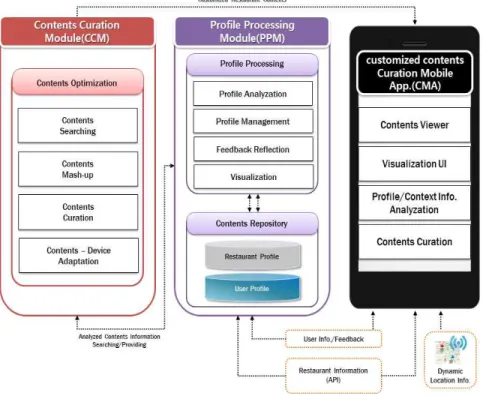
The proposed Intelligent Recommendation Service System for offering Halal food(IRSH) based on dy- namic profile, consists of a Profile Processing Module (PPM), a Contents Curation Module (CCM), and a customized contents Curation Mobile Application(CMA) as shown in Fig. 1.
The PPM stores, analyzes and processes the user profile, restaurant content profile and user feedback, and delivers the processed data to the CCM. The CCM can invoke the information re- quired for recommendation in the profile process- ing module, and performs profile mash-up, recom- mendation operation, and device optimization. Fin- ally, the recommendation result is transmitted to the CMA, and the recommendation information is provided to the user. The user can use the service through the application, and transmits the current location information and feedback information to the PPM.
3.2 The Profile Structure for IRSH
Profile should be designed to be suitable for recommendation. In this paper, the profile includes of user and restaurant information. The profile
Table 1. The comparison of existed researches about restaurant recommendation
existed research main method evaluation
X. Ramirez-Garcia [9] post-filtering user satisfaction
Y. Fu [10] multiple information fusion recommendation accuracy
X.Y. Miao [11] preference queries user satisfaction
A. Gupta [12] location-based user satisfaction
structure for IRSH consists of four tables and is designed as shown in Fig. 2.
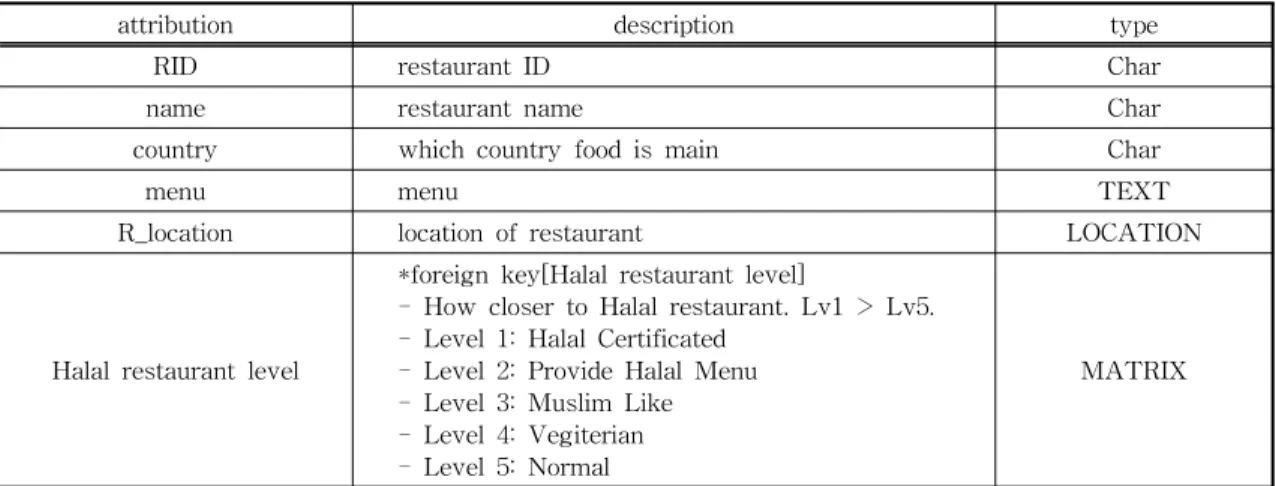
A restaurant profile consists of six attribute val- ues, each of which is a Restaurant ID(RID), restau- rant name, country, menu, location and restaurant level. Restaurant level have been added as proper- ties for restaurant-specific profile design. Restaur- ant level include: (1) a Halal certified restaurant, (2) a restaurant that offers a Halal menu but not
a Halal certified restaurant, (3) a restaurant that a Muslim like, (4) a vegetarian restaurant, Attribute value. The restaurant data provided by the Korea Tourism Organization are used to distinguish the Halal restaurants that are designated as domestic restaurants. The degree of these Halal restaurants is used for content-based filtering in the recom- mendation algorithm, it can solve the cold start problem.
The user profile consists of the user's basic in- formation (ID, password, name, age, nationality, etc.) and the user's preference for restaurants to pre-grasp the user's preferences for content-based filtering. Restaurants selected by the user are stor- ed in five levels from Level 1 to Level 5 by specify- ing the five attributes in order of preference, and these levels are depends on restaurant level in Restaurant Table. In addition, for location-based filtering, there is dynamic data that is collected in real time from smart device that user uses current location information, and there is visit history in- Fig. 1. The Structure of IRSH for Providing Restaura.
Fig. 2. The Profile Structure for IRSH.
formation recorded through rating after using res- taurant and smart phone settlement history. Basic user and restaurant preference information are used for content-based filtering, and user history information is used for collaborative filtering. This structure can solve the initial user problem, which is a problem of collaborative filtering, using basic information and content-based filtering using res- taurant preference degree information.
3.3 The Recommendation Algorithm for IRSH The proposed recommendation algorithm for IRSH is a hybrid filtering method that combines three types of filtering techniques: collaborative filtering, location-based filtering, and content-
based filtering to solve the cold start problem and the initial user problem in collaborative filtering.
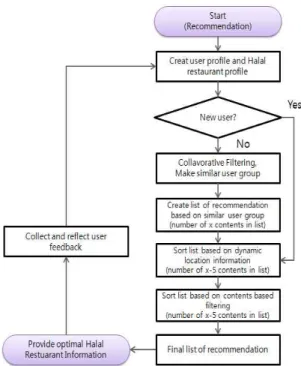
The algorithm is processed as shown in Fig. 3.
First, create a profile designed in Section 3.2 and confirm that the user is the initial user. If it is not the initial user, the similar user is grouped based on the user's history data(restaurant utilization history, rating information) to create the user group.
Similar users will expect similar preferences, recommend restaurants that are not in use within the group among users, and generate the topx rec- ommendation lists in order of restaurants with the highest recommendations, and cosine similarity was used to compute similar users. Cosine sim- Table 2. Description of restaurant table and restaurant level
attribution description type
RID restaurant ID Char
name restaurant name Char
country which country food is main Char
menu menu TEXT
R_location location of restaurant LOCATION
Halal restaurant level
*foreign key[Halal restaurant level]
- How closer to Halal restaurant. Lv1 > Lv5.
- Level 1: Halal Certificated - Level 2: Provide Halal Menu - Level 3: Muslim Like - Level 4: Vegiterian - Level 5: Normal
MATRIX
Table 3. Description of user table and user history
attribution description type
UID user ID Char
PW user password for login service Char
User history *foreign key[user history]
- rating : user rated satisfaction
- count of visiting MATRIX
name user name Char
gender user gender BOOLEAN
age user age INT
device location user device location LOCATION
user selected Halal
restaurant level user selected Halal restaurant level. Halal restaurant
level is explained in table 2. MATRIX
ilarity is the most commonly used method for de- termining similar users in collaborative filtering. It is assumed that the user's preference information is viewed as one point in the n - dimension and one line is drawn at the point and origin. Then, the angle of the line between the two points and the origin to determine the similarity of the two users' preference points was calculated. The final result is expressed as a value between -1 and 1.
If the result is closer to 1, and are similar, and if the result is closer to –1, and are not similar. The similar user using the cosine sim- ilarity is calculated as follows equation (1).
cos ∥∥∥∥
∙
∥∥
∙ ∥∥
(1) Each and represents the user i and the user j, respectively. And ∙ is calculated as follows equation (2).
∙ (2)
‖ ‖ and ‖ ‖ are calculated as follows
equation (3).
∥∥ ∙ (3)
Each and represents kth attributes of useri and j. The formula (2) calculates for deduct- ing relationship between user and contents profiles.
And the formula (3) performs a squaring operation on each attribute value of user to further emphasize the meaningful attribute and make the meaningless attribute more rate. Finally, the formula (1) calcu- lates similarity between two users using result from formula (2) and (3).
When users are grouped after similar users are identified, they are sorted in the order of the high- est probability when recommending mutual res- taurants among the users in the group who have not yet visited or visited.
Location-based filtering was proceeded after collaborative filtering create the recommendation list, and the recommendation list is rearranged based on the user's location. In the case of the ini- tial user, since there is no user's history data, the recommendation list generation process through collaboration filtering is omitted and deletes the lower 5 contents to create a new recommendation list in the order of the restaurants nearest to the user based on the user's location and the restau- rant location information. At this time, the Eucli- dean distance calculation method is used to calcu- late the distance between the user's location and the restaurant location. The Euclidean distance calculation is a formula used to calculate distances between coordinates, such as latitude and longi- tude, and is used to calculate the distance between two points. The formula for the Euclidean distance calculation is as follows equation (4).
(4)
represents the position of the user, and
represents the position of the restaurant. The two values are coordinate values. dist (,) is the distance between user i and restaurant j.
Fig. 3. The Processing Diagram of Recommendation Algorithm for IRSH.
After the recommendation list is sorted based on location information, the user profile and the res- taurant profile are rearranged in a similar order us- ing content-based filtering. At this time, it is judg- ed by comparing the information of restaurants se- lected by the user. In the recommendation list, users sort the restaurants that match the attribute selected by Level 1, and sort them from Level 2 to Level 5 sequentially.
4. EXPERIMENT
In this paper, two experiments were conducted to evaluate and verify the proposed algorithm. The experiment environment was described in Table 4.
In the first experiment, when the recommen- dation list is generated by the recommendation al- gorithm, the top x contents are listed. In this case, an experiment is performed to list the top few con- tents in the first recommendation list. If x is high,
too many restaurants will be added to the primary referral list, and content-based filtering and loca- tion-based filtering will reorder the second and third lists, because it can be seen. For the experi- ment, information of Halal restaurant provided by Korea Travel and Tourism Corporation and 200 restaurants of Korean restaurant data provided by Korean public data portal are used. Because the user information can’t secure real data, 300 arbi- trary users and arbitrary attribute values are used.
Table 5 shows detail of the experimental data.
In the user information, <uid> is a unique ID identifying the user, <sex> is user’s sex, <age>
is user’s age, <dev_loc_x> and <dev_loc_y> are xy coordinate values of the user device location,
<res_lev> is the two preferred type of restaurant that is selected by user. <rating> is the rating those are rated by user, stored as “[restaurant ID : rating(1~5)],…”. <cov> is the number of restau- Fig. 4. The Processing Diagram of three filtering method.
Table 4. The experiment environment
element performance
OS Windows 7 Enterprise K Service Pack 1
CPU Intel(R) Core(TM) i5-3470 CPU
@ 3.20GHz
MEMORY 8.00GB
HDD 128GB SSD
TOOLS/APP R-3.5.1, R studio, Microsoft excel 2013
Table 5. Experiment Data Overview
table type form
uid Char uid0001,…
sex Bool 1 or 2
age Integer 45,22,…
dev_loc_x Integer 6416,34,…
dev_loc_y Integer 2344,8,…
res_lev Char [lv1:2],[lv2:4]
rating Integer [rest1:3],…
cov char [rest1:4],…
rant visits, stored as “[restaurant ID: number of visits],…”.
In the restaurant information, <resID> is a unique ID identifying the restaurant, <res_halal_
lev> is the type number of restaurant, <res_loc_x>
and <res_loc_y> are xy coordinate values of the restaurant location.
The experiment was conducted using the data analysis tool R, and the recommendation accuracy was derived from the MAE evaluation[13,14,15].
MAE refers to Mean Absolute Error; this gives less weight to outliers, as it is not sensitive to out- liers, and the formula for the MAE is as follows equation (5).
(5)
That formula describes the process whereby the
is the actual rating, is the predicted rating, n is the number of items. Using the calculated MAE, the frequency of errors is calculated as a percentage, and the accuracy of the recom- mendation is calculated.
The first experiment was proceeded for calcu- lating the optimum setting value of x. The number of recommendation items x to be included in the first recommendation list. The x value was in- creased from 14 to 50 by 4 and look at 10 recom- mendation results to compare the accuracy of the recommendation and find the optimal x value.
Table 6 shows accuracy of the 10 recom- mendation result using x value 14 to 50.
From the results of each experiment, it can be seen that the recommendation accuracy is the highest (93%) when the x value is 22. If the value of x becomes too large, the algorithm used to up- date the list is strongly affected by each update of the list, so that the recommendation result is most dependent on the algorithm used in the last list update. In other words, if x becomes too large, range of recommendation is greater and more like- ly it is that the wrong recommendation is included, and it causes low accuracy of recommendation.
Conversely, if the value of x is too small, it depends heavily on the algorithm that generates the recom- mendation list first. It means, range of recom- mendation is smaller, even if the algorithm pro- ceeded in sequence, the influence of the first step is largely unilaterally influenced, because the num- ber of recommendations is small, it is difficult for calibration through after second step in algorithm effectively. Therefore, it is necessary to derive the optimal x value so that each algorithm that updates the recommendation list is appropriately applied.
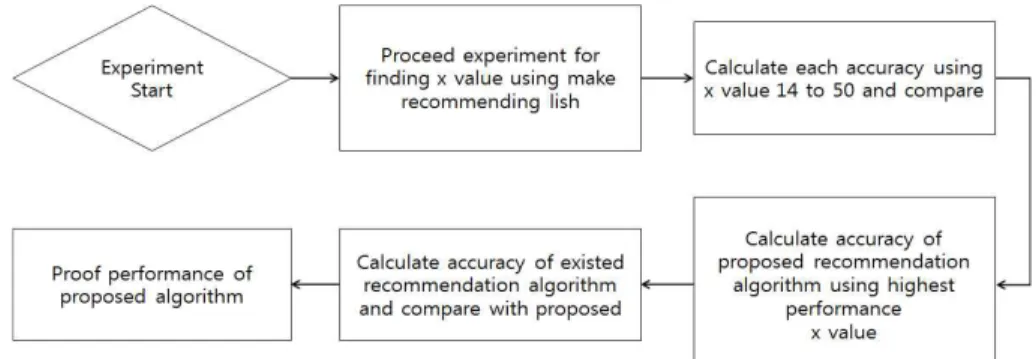
The second experiment was proceeded for com- paring accuracy of recommendation from proposed recommendation algorithm and existed recom- mendation algorithm, and the process of experi- ment is shown in Fig. 5. Existed recommendation algorithm [9,10,11] and [12] are explained in section 2.2 and Table 1.
The recommendation accuracy derived from the proposed algorithm using the x values obtained from the first experiment was compared with the recommendation accuracy of the algorithm used in existed restaurant recommendation system. The experimental results are shown in the Table 7.
According to the recommendation results, the recommendation accuracy using the proposed al- gorithm is higher than the recommendation accu- racy using the existing algorithms. The existing algorithm extracts similar users based on user his- Table 6. Accuracy of the 10 recommendation result us-
ing x value 14 to 50
x value accuracy
14 0.781133(78%)
18 0.859138(86%)
22 0.928713(93%)
26 0.911657(91%)
30 0.906818(90%)
34 0.811753(81%)
38 0.837168(83%)
42 0.716838(72%)
46 0.697641(70%)
50 0.538746(54%)
tory and recommends user base. This method does not take into consideration the user's own prefer- ences because recommendations are made between users having similar preferences or tendencies.
Also, it is not possible to recommend restaurants near the user. However, the proposed algorithm first generates a recommendation list by compar- ing users similar to the user, updates the recom- mendation list using the content-based filtering based on the user's own preference, and updates the recommendation list based on the recom- mendation list. Therefore, the recommendation of the proposed algorithm showed higher accuracy than the existing algorithm.
5. CONCLUSION
In this paper, an Intelligent Recommendation Service system for offering Halal food(IRSH) based on dynamic profiles was proposed. And a profile of users and restaurants optimized for recommend- ing restaurants was designed and proposed. The
proposed profile added attribute values with char- acteristics that can represent the degree of restau- rants in user and restaurant profiles used in exist- ing restaurant recommendation. The user profiles optimized for user grouping and restaurants opti- mized for restaurant recommendation. The pro- posed recommendation algorithm is a hybrid rec- ommendation algorithm using collaborative filter- ing, content-based filtering, and location-based filtering. Grouping is based on users' history in- formation and feedback information using collabo- rative filtering, and lists mutually recommended results in the group. Next, we rearrange the rec- ommendation list by using content-based filtering.
Finally, we use the location-based filtering to re- arrange the list in the nearest order and finally rec- ommend the customized restaurant to the user. ch is combined by content-based filtering, collabo- rative filtering and location-based filtering. The proposed algorithm combines several filtering techniques in order to improve the accuracy of rec- ommendation by complementing the various prob- lems of each filtering such as cold start problem.
This paper is expected to contribute to the research and development of systems and applications that can provide information on Halal restaurants in ac- cordance with the expansion of the domestic Halal market. In future researches, it is expected that a system that can provide various Halal contents in- formation in addition to Halal restaurants.
Fig. 5. The process of second experiment.
Table 7. The accuracy of recommendation using pro- posed algorithm and existed algorithm Recommendation algorithm Accuracy proposed algorithm in IRSH 0.928713(93%) post-filtering[9] 0.881579(88%) multiple information fusion[10] 0.905150(88%) preference queries[11] 0.901387(90%) location-based[12] 0.850255(90%)
REFERENCE
[ 1 ] B. Lika, K. Kolomvatos, and S. Hadjiefthymi- ades, “Facing the Cold Start Problem in Recommender Systems,” Expert Systems with Applications, Vol. 41, Issue 4, pp. 2065- 2073, 2014.
[ 2 ] W.S. Hong, “The Halal Food Market and Halal Certification,” Food Science and Industry, Vol. 48, No. 2, pp. 2-11, 2015.
[ 3 ] A.R. Han and K.W. Lee, “A Study on the Halal Food Market and Halal Certification for Korean Firm’s Access to Halal Market,”Food Science and Industry, Vol. 49, No. 1, pp. 87-93 2016.
[ 4 ] B.S. Kim, J.Y. Lee, H.J. Lee, and S.K. Kim,
“Halal, the Global New Food Market,” Sam- jong Klnveld P eat Marwick Goerdeler Economic Research Institute Issue Monitor, Vol. 6, pp. 1-24, 2015.
[ 5 ] Korea Restaurant Information Data in Korea Public Data Portal, https://www.data.go.kr (accessed May., 20, 2018).
[ 6 ] M.J. Pazzani, “A Framework for Collaborative, Content-based and Demographic Filtering,”
Artificial Intelligence Review, Vol. 13, Issue 5-6, pp. 393-408, 1999.
[ 7 ] L.M. de Campos, J.M. Fernandex-Luna, J.F.
Huete, and M.A. Rueda-Marales, “Combining Content-based and Collaborative Recommen- dations: A Hybrid Approach Based on Bayesian Networks,” International Journal of Approximate Reasoning, Vol. 51, Issue 7, pp.
785-799, 2010.
[ 8 ] H.J. Yun and B.M. Chang, “Design and Imple- mentation of Restaurant Recommendation System Based on Location-Awareness,”Jour-
nal of Korea Multimedia Society, Vol. 14, No.
1, pp. 112-120, 2011.
[ 9 ] X. Ramirez-Garcia and M. Garcia-Valdez,
“Post-Filtering for a Restaurant Context- aware Recommender System,” Studies in Computational Intelligence, Vol. 547, pp. 695- 707, 2014.
[10] Y. Fu, B. Liu, Y. Ge, Z. Yao, and H. Xiong,
“User Preference Learning with Multiple Information Fusion for Restaurant Recom- mendation,”Proceeding of 2014 International Conference on Data Mining Society for Industrial and Applied Mathematics, pp.
470-478, 2014.
[11] X.Y. Miao, Y.J. Gao, G. Chen, H. Cui, C. Guo, W. Pan, et al., “Si2p: A Restaurant Recom- mendation System Using Preference Queries over Incomplete Information,” Proceedings of the Very Large Data Bases Endowment, Vol.
9, Issue 13, pp. 1509-1512, 2016.
[12] A. Gupta and K. Singh, “Location Based Personalized Restaurant Recommendation System for Mobile Environments,”P roceed- ing of International Conference on Advances in Computing, Communications and Infor- matics, pp. 507-511, 2013.
[13] R.D. Peng,R Programming for Data Science, Leanpub Publishers, 1321 Blanshard Street, Suite 301 Victoria, British Columbia, Canada, 2015.
[14] W.N. Venables, D.M. Smith, and the R Core Team, An Introduction to R, Copyright c R Core Team, Available at http://www.r‐proj- ect.org/, 1999.
[15] Description of MAE, https://en.wikipedia.org/
wiki/Mean_absolute_error (accessed May., 20, 2018).
Hyunho Lee
2011 B.S, Law Course in Tianjin Nankai University
2014 B.S, Computer Engineering Department in Hoseo University Present : Doctoral Candidate, Computer Science in Dankook University
Interested Fields : Recommendation Platform, Custo- mized System, Mobile & Service Platform
Wonjin Lee
2002 B.S, Computer Science in Kyungil University
2004 M.S, Computer Engineer- ing in Kyungpook National University
2009 Ph.D., Telecommunications Engineering in Kumoh National Institute of Technology
Present : An Assistant Professor of Institute of Infor- mation and Culture Technology at Dankook University nterested Fields : Convergence Contents Recommender, Computer Security
Jaedong Lee
1985 B.S, Computer Science in Inha University
1991 M.S, Computer and Infor- mation Science in Cleveland State University(USA) 1996 Ph.D., Computer Science in Kent State University (USA) 2017 Associate Vice President of International Affairs in Dankook University
2019 Senior Director of Mobile Institute in Dankook University
Present : A Full Professor at Department of Software, Dankook University
nterested Fields : Distributed System, Mobile & Ser- vice Platform, Convergence & Customized System