Journal of Internet Computing and Services(JICS) 2016. Aug.: 17(4): 173-180 173
Relationship between SOA Adoption and Performance of IT Organizations
Naghmeh Niknejad
1Imran Ghani
2Ab Razak Che Hussin
1Seung Ryul Jeong
3*1ABSTRACT
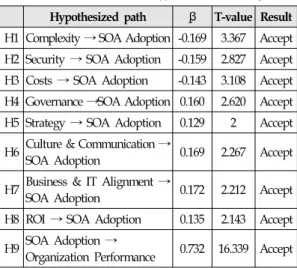
SOA has been adopted by enormous number of organizations world-wide. This study has investigated significant factors which affect SOA adoption in positive and negative manner. Unlike the previous similar studies, where they focused on qualitative analysis for SOA adoption, this study conducted a quantitative analysis to investigate the relationship between the adoption of SOA and the performance of IT organizations. In order to conduct the research, an online questionnaire was created and distributed among SOA experts through the social networking platform of professionals, LinkedIn. Total one hundred and four (104) respondents from thirty (30) different countries participated in this study. The results of this study indicate that there are both positive and negative influences upon SOA adoption. The positive influences includes: governance, strategy, culture and communication, business and IT alignment and ROI;
whereas complexity, security concerns, and costs have negatively affected SOA adoption.
☞ keyword : Service-Oriented Architecture, SOA adoption, TOE Framework, Significant Factors, Effective Factors
1. INTRODUCTION
Service-Oriented Architecture (SOA) is a popular architectural design commonly used to increase organizational agility, promote application adaptability and system interoperability, as well as it provides the reuse of legacy possessions. Successive innovation, competitive emprise and agility are transforming into a significant component of strategic thinking in a large number of current organizations.
Therefore, the growth of information systems has seen an increase in many organizations seeking to re-evaluate their techniques as well as re-examine information technology functions in forming their business strategies.
Though SOA has been used for a decade, however, only a few research studies have been performed on critical success factors that must be concentrated on during such implementations. The results from these few studies show that there are a number of resemblances to success factors found in attaining strategic alignment [1]. Indeed, as has been experienced by other technologies, certain organizations accept
1
Faculty of Computing, Universiti Teknologi Malaysia (UTM), 81310, Skudai, Johor Malaysia
2
School of Information Technology, Monash University Malaysia, 47500, Sunway Campus, Malaysia.
3
Graduate School of Business IT, Kookmin Univ., Korea
*