https://doi.org/10.6111/JKCGCT.2018.28.1.044
Improved high-performance La 0.7 Sr 0.3 M x Fe 1−x O 3 (M = Cu, Cr, Ni) perovskite catalysts for ortho-para hydrogen spin conversion
Jeong-Gil Choi
†, Euiji Choi*, Soon-Cheol Kweon** and In-Hwan Oh**
Department of Chemical Engineering and Advances Materials, Hannam University, Taejon 34430, Korea
*Applied Chemistry, Department of Materials Science and Engineering, Kyushu University, Fukuoka, 819-0395, Japan
**Green City Technology Institute, Korea Institute of Science and Technology, Seoul 02792, Korea (Received December 4, 2017)
(Revised December 23, 2017) (Accepted December 28, 2017)
Abstract The improved high-performance Fe-based perovskite-type oxides (La
0.7Sr
0.3M
xFe
1−xO
3, M = Cu, Cr, Ni) were synthesized by a citrate method and characterized by SEM, EDS, XRD and NMR spectroscopy analyses. The characterization analyses revealed that the stoichiometric amounts of lattice oxygen were existed in all of perovskite samples except for a nickel-doped perovskite. Fe-based perovskites exhibited a surprising result for ortho-para H
2spin conversion reaction, indicating two orders of magnitude higher conversions and conversion rates than commercial Fe
2O
3. It was considered that this conversion difference might be attributed to the presence of oxygen vacancies in Fe-based perovskites prepared in this study.
Key words La
0.7Sr
0.3M
xFe
1−xO
3(M = Cu, Cr, Ni) perovskites, Commercial Fe
2O
3catalyst, Ortho-para hydrogen spin conversion, Particle size, Structure sensitivity
1. Introduction
Recently, there is a growing interest in the use of hydrogen since hydrogen has become one of the pri- mary sustainable energy resources to minimize air pollu- tion, green-house gas production, and global energy crisis, especially through transportation and power gen- eration. For instance, in the sector of green transporta- tion using fuel cell vehicle, the compressed hydrogen storage has been on the verge of utilizing commercially available hydrogen storage technologies. Up to a maxi- mum of 700 bar (~10,000 psi), the modest amount of hydrogen can be stored for urban transportation in short period of time. However, for the compressed hydrogen storage there are the main disadvantages which are related to the low volumetric energy density and safety concern. Zhang et al. reported that liquid hydrogen stor- age could be one of the possible solutions for overcom- ing these difficulties [1].
At this point, one might have to significantly con- sider the phase conversion process of ortho-hydrogen to para-hydrogen via metallic catalysts in order to fill liq- uid hydrogen into cryogenic fuel storage vessel as well as to maintain liquid hydrogen in liquid phase for the
longer time [2, 3]. Until now, the iron (III) oxide (Fe
2O
3) has been widely used as a commercial catalyst for the ortho-para hydrogen spin conversion process. If some crystalline materials with comparatively higher conver- sion rate are successfully developed in the near future, it is expected that these could be used for future high compact liquid hydrogen storage in the application of unmanned aerial vehicle. For this purpose, as one of the strong candidates Fe-based perovskite-type oxides (La
0.7Sr
0.3M
xFe
1−xO
3) were suggested to be investigated.
Here, we report that Fe-based perovskite catalysts show reaction rates for ortho-para hydrogen conversion higher than commercial Fe
2O
3catalyst. The Fe-based perovskite oxides have drawn particular interests because they can be easily prepared with catalytic properties which are superior to those of existing catalysts, by substituting a small fraction of dodecahedral A- and octahedral B-site atoms with other cations [4]. Previous investigation has been concentrated upon general chemi- cal reactions such as oxidation, reduction, and reform- ing, etc. [5-7]. Inspite of extensive research work, no former studies have been reported for ortho-para hydro- gen spin conversion over Fe-based perovskite catalysts.
Based on the above-mentioned background, we have synthesized a series of Fe-based perovskites (La
0.7Sr
0.3M
xFe
1−xO
3) with three different transition met- als (M = Cu, Cr, Ni) using a citrate method. As the
†
Corresponding author
†
E-mail: [email protected]
characterizing tools, the SEM, EDS, XRD, and NMR spectroscopy techniques were employed to obtain the information concerning the surface morphology, elemen- tal analysis, the crystallite size, and hydrogen spin con- version, respectively. Finally, the ortho-para hydrogen spin conversion reaction has been carried out so as to figure out the availability of Fe-based perovskites pre- pared in this study as catalysts, and compare these mate- rials with a commercial Fe
2O
3catalyst.
2. Experimental 2.1. Catalyst Synthesis
A series of Fe-based perovskites (La
0.7Sr
0.3M
xFe
1−xO
3) were prepared using the partial substitution of Fe with three different transition metals (M = Cu, Cr, Ni) by a citrate method [8-10]. The precursor was a solution of lanthanum, strontium, copper, chromium, nickel, and iron nitrates in stoichiometric proportion. The precur- sors used were citric acid anhydrous (99.5 %, Hayashi), lanthanum (III) nitrate hexahydrate (98 %, Samchun), strontium nitrate (98 %, Kanto), nickel (II) nitrate hexa- hydrate (98 % Samchun), copper (II) nitrate trihydrate (99 %, Hayashi), chromium (II) nitrate nonahydrate (98 % Kanto) and iron (III) nitrate nonahydrate (98.5 %, Samchun). The citric acid solution was prepared using a citric acid precursor and distilled water. An appropriate amount of lanthanum, strontium, iron, and other metal (M) nitrate precursors were mixed with distilled and deionized water, and stirred thoroughly. The initially prepared citric acid solution was added with the metal- nitrate precursor’s solution. The precursor mixed solu- tion was dried at 393 K for 16 h, and calcined at 1173 K for 6 h to obtain the final form of perovskites.
2.2. Catalyst Characterization
The specific surface areas were determined by the Brunauer-Emmett-Teller (BET) method with nitrogen at 77 K. A gas mixture containing 30 % nitrogen in He was used for standard single point BET surface area measurements.
The SEM images and EDS analyses of the samples were obtained using FE-SEM (HITACHI-S4200). A computer controlled Bruker D8 Advance rotating anode X-ray diffractometer was used for bulk characterization of the Fe-based perovskite oxides. The crystallite phase and size were determined using the CuK
αirradiation with two theta value of 20 to 60 degree with a scan rate
of 2 degree per minute. The crystallite dimensions were obtained using the Scherrer equation, D
p= 0.9 λ/(B cosθ), where D
pis the crystal thickness, λ is the wave length of the X-radiation, B is the peak width corrected for instrumental broadening, and θ is the Bragg angle of the diffraction peak.
2.3. Catalytic Activity
The ortho-para hydrogen spin conversion was per- formed at 300 K using the prepared perovskite samples.
Before the measurement of conversion, the powder sam- ple was made into a pellet (diameter: 10 mm, thickness:
1 mm) using a pelletizer (Carver Lab. Press). About 0.15 g of each perovskite sample was used for measur- ing the reactivity. An inlet flow rate of normal hydro- gen gas (99.99 %, DEO) was maintained at 40 ml/min by a mass flow controller (Bronkhost). The normal hydrogen gas was passed through the sample bed in the up-flow mode. The converted ortho-para hydrogen mix- ture was collected in a NMR glass sample tube. Before capturing the spin-converted hydrogen gas the NMR glass tube was evacuated with a vacuum pump (ULVAC-DA- 60S). The total time to capture the converted gas was fixed for 3 minutes for each sample. The ortho-para hydrogen spin conversions were measured using an NMR spectrometer (BRUKER 400 MHz Ultra Shield).
The software used to collect the spectra is Bruker Top- sin 3.1. A solution of 1 % CHCl
3/Acetone-d
6was used as standard for the gas phase NMR analysis. A blank run was performed without putting any sample in the reactor by flowing the hydrogen gas.
3. Results and Discussion
3.1. Physicochemical Properties of the Catalysts
The prepared Fe-based perovskite oxides show low surface areas ranging from 1.71 to 3.76 m
2/g (Table 1).
These low surface areas are in good agreement with the
literature [11, 12]. However, compared to the original
material of LaFeO
3perovskite (S
g= 0.9 m
2/g) these
materials have the higher surface areas, suggesting that
Sr, Cu, Cr, and Ni might behave like a structural pro-
moter. In fact, the atomic diameters of Sr, Cu, Cr, and
Ni (= 0.4, 0.25, 0.28, and 0.27 nm, respectively) are sig-
nificantly larger than that of oxygen (= 0.1 nm). It is
generally known that surface areas for perovskite oxides
are around two orders of magnitude lower than those of
typical oxides such as Al
2O
3and CuO. The primary rea- son for the production of low surface areas is assumed to be the high preparation temperature (> 1,000 K) used during the calcination. For our Fe-based perovskite oxides, the final synthesis temperature and time for cal- cination was 1173 K and 6 h, respectively.
Table 1 also gives some of the structural features of the Fe-based perovskite oxides. For all of these materi- als the crystallites were much smaller than the particles.
Recall that the particle sizes were based on the surface area, therefore they reflect average surface character as
compared to the crystallite sizes reflecting average bulk character. Deviations between the crystallite and parti- cle sizes for these catalysts suggested that the particles were polycrystalline.
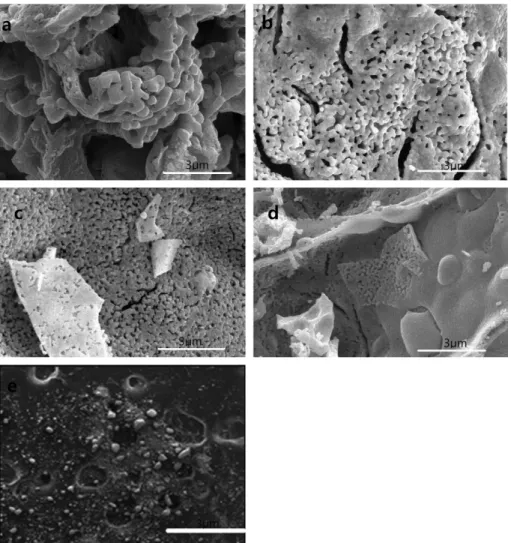
As shown in Fig. 1, the SEM images of the prepared La
0.7Sr
0.3M
xFe
1−xO
3(M = Cu, Cr, Ni) perovskites were obtained, and compared with the commercially avail- able Fe
2O
3sample (Ionex®-Type O-P catalyst, Molecu- lar Products, Inc.). The analyses of the images revealed that the surface morphology of the Fe-based per- ovskites was changed with the addition of other transi- Table 1
Sorption properties of Fe-based perovskite oxides
†S
g(m
2/g) D
p(nm) D
c(nm) Δ=(D
p− D
c/D
p) × 100 (%) Crystalline phase
La
0.7Sr
0.3FeO
33.41 294 30.3 90 Polycrystalline
La
0.7Sr
0.3Cu
0.3Fe
0.7O
31.71 545 44.6 92 Polycrystalline
La
0.7Sr
0.3Cr
0.3Fe
0.7O
33.76 248 40.5 84 Polycrystalline
La
0.7Sr
0.3Ni
0.3Fe
0.7O
33.34 279 37.3 86 Polycrystalline
†
S
g, D
pand D
cindicate the surface area, particle size, and crystallite size of the corresponding perovskite oxides, respectively.
Fig. 1. SEM images of the synthesized catalysts: (a) La
0.7Sr
0.3FeO
3, (b) La
0.7Sr
0.3Cu
0.3Fe
0.7O
3, (c) La
0.7Sr
0.3Cr
0.3Fe
0.7O
3, (d) La
0.7Sr
0.3Ni
0.3Fe
0.7O
3,
and (e) Commercial Fe
2O
3catalyst.
tion metals in the perovskite phase. From Fig. 1(a, b), it can be seen that by the addition of copper in the Fe- based perovskite phase (shown in Fig. 1(a)), the surface morphology is uniformly distributed with the metal cop- per. Similar features were obtained for the chromium- impregnated sample. However, in the case of nickel- substituted sample a comparatively less porous and less crystalline phase was obtained.
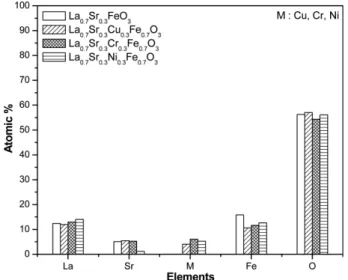
The EDS patterns of all the prepared samples were obtained and the analysis of the elements present in each sample is shown in Fig. 2. The compositional anal- yses revealed that all of the Fe-based perovskites con- tained similar amounts of five different elements (La, Sr, M, Fe, O) within the experimental error range. It appeared that the stoichiometric amounts of lattice oxy- gen were existed in all the perovskite samples except for a nickel-doped perovskite (Table 2). The strontium element in this nickel-impregnated (La
0.7Sr
0.3Ni
0.3Fe
0.7O
3) sample was present in a relatively small amount, indi- cating the presence of non-stoichiometric large amount of lattice oxygen with the Sr/O ratio of 0.02. These
results exhibit that the preparation of Fe-based per- ovskites is influenced by further addition of transition metals in the B site of perovskite structure. Fig. 3 shows the XRD patterns for the formation of the perovskite phases at 2 θ = 32.15 and 46.18 degree, which is in good agreement with the literature [13]. We can see that the crystallite size is increased by the addition of transition metals. The smallest crystallite size of 37.3 nm at 32.15 degree was obtained for nickel-impregnated sample. In the meantime, the largest crystallite size of 44.6 nm was observed in copper-doped perovskite sample.
3.2. Activity of Fe-Based Perovskite Oxides
NMR analysis technique was utilized to investigate the reactivity of Fe-based perovskites for the non-disso- ciative ortho-para H
2spin conversion (ortho → para hydrogen). In particular, the effect of other transition metals (M = Cu, Ni, Cr) impregnated in La
0.7Sr
0.3M
xFe
1−xO
3perovskites on the reaction has also been scrutinized.
Fig. 2. EDS analyses of the metal (M: Cu, Ni, and Cr) impreg- nated La
0.7Sr
0.3M
0.3Fe
0.7O
3samples.
Table 2
Molar ratios of metal to oxygen in Fe-based perovskite oxides analyzed by EDS
La/O Sr/O Fe/O M/O
aLa
0.7Sr
0.3FeO
30.22(0.23)
b0.09(0.10) 0.28(0.33) -
La
0.7Sr
0.3Cu
0.3Fe
0.7O
30.21(0.23) 0.10(0.10) 0.19(0.33) 0.07(0.10) La
0.7Sr
0.3Cr
0.3Fe
0.7O
30.24(0.23) 0.10(0.10) 0.21(0.33) 0.11(0.10) La
0.7Sr
0.3Ni
0.3Fe
0.7O
30.25(0.23) 0.02(0.10) 0.23(0.33) 0.09(0.10)
a
Metals (Cu, Cr, and Ni) corresponding to three Fe-based perovskite samples of La
0.7Sr
0.3Cu
0.3Fe
0.7O
3, La
0.7Sr
0.3Cr
0.3Fe
0.7O
3, and La
0.7Sr
0.3Ni
0.3Fe
0.7O
3.
b
Values in parenthesis indicating stoichiometric molar ratios of metal to oxygen.
Fig. 3. X-ray diffraction patterns of (a) La
0.7Sr
0.3FeO
3, (b) La
0.7Sr
0.3Cu
0.3Fe
0.7O
3, (c) La
0.7Sr
0.3Cr
0.3Fe
0.7O
3, and (d)
La
0.7Sr
0.3Ni
0.3Fe
0.7O
3.
The ortho-para hydrogen spin conversion and the con- version rate expressed on a per gram basis are shown in Fig. 4. The peak of ortho hydrogen present in the nor- mal hydrogen is located at 5.069 ppm, which is consis- tent with the previous studies [14-16]. It can be seen that the ortho hydrogen was effectively converted to para hydrogen in presence of commercial Fe
2O
3and Fe- based perovskites.
Amongst different perovskite oxides, copper-doped perovskite in the B site exhibited the highest conversion (88 %) while nickel-impregnated perovskite showed the lowest conversion (12 %). A plausible explanation for the difference in conversion is that the reaction rate is directly correlated with the particle size (Table 1). It is generally known that the ortho-para hydrogen spin con- version is not a chemical reaction but a magneto-cata- lytic reaction [17], which is accelerated by a magnetic susceptibility leading to paramagnetism (Pr
2O
3, Nd
2O
3, Sm
2O
3), antiferromagnetism (Cr
2O
3, CoO) or ferromag- netism (Fe
2O
3, EuO) [17, 18]. However, for hydrogen spin conversion process the hydrogen should adsorb on the surface of the materials as the first step. Therefore, it is also important to consider the bulk and surface prop- erties of catalysts such as particle size and material composition. For example, as shown in Fig. 3, the high- est conversion rate of La
0.7Sr
0.3Cu
0.3Fe
0.7O
3perovskite might be ascribed to the production of the largest parti- cle size (545 nm).
The ortho-para hydrogen conversion for the per- ovskite oxides prepared in the current study is linearly related to the particle size. The conversion difference could be interpreted in terms of differing bonding geom-
etries at particle surfaces. Recall that the Fe-based per- ovskite oxides are polycrystalline particles. The presence of polycrystalline particles indicates that the cracks, kinks, and grain boundaries were generated at surfaces during the formation of perovskites, which can be favor- ably used for catalytic reactions [19].
Based on the presence of the linear relationship between the particle size and reaction rate, we con- cluded that the ortho-para hydrogen spin conversion reaction over Fe-based perovskite oxides was structure- sensitive. It is noted that the concept of structure sensi- tivity could be described in two aspects: the bulk and surface viewpoints. One bulk aspect is associated with the relationship between the reaction rate and the parti- cle size [20, 21]. In this case, the reaction rate should be linearly related to the particle size. The other surface aspect has been suggested by Choi et al. [22, 23] who used Mo nitrides and carbides for pyridine hydrodenitro- genation. They found that the activity changed with variation of surface properties over these materials.
Based on these findings, they proposed that for materi- als like transition metal nitrides and carbides, the sur- face structure and stoichiometry should be taken into account for the application of structure sensitivity con- cept. This aspect would be the next topic of investiga- tion for ortho-para hydrogen spin conversion over Fe- based perovskite catalysts. Therefore, it might be appro- priate for our system of Fe-based perovskites to be con- sidered as a structure-sensitive reaction.
Since no previous investigation has, thus far, been reported for ortho-para hydrogen spin conversion over Fe-based perovskite catalysts, we propose for the first time that the structure sensitivity can be applied for our system. Nonetheless, in order to better understand the hydrogen spin conversion difference between various Fe-based perovskites further works on magnetic and electronic properties are definitely needed.
3.3. Comparison Between Commercial Fe
2O
3and Fe- Based Perovskite Oxides
Due to very limited information, it is interesting to compare the conversion rates on these perovskite oxides with those on commercial Fe
2O
3catalysts. The Fe-based perovskites synthesized in this study showed as much as two orders of magnitude higher conversions and conver- sion rates than commercial Fe
2O
3sample (rhombohe- dral structure). These perovskites reached a maximum conversion of 88 % while the commercial Fe
2O
3cata- lyst showed a conversion of 3 %. Even though these Fig. 4. Ortho-para conversion and the conversion rate of the
prepared catalysts: (a) Commercial Fe
2O
3catalyst (b) La
0.7Sr
0.3Ni
0.3Fe
0.7O
3, (c) La
0.7Sr
0.3Cr
0.3Fe
0.7O
3, (d) La
0.7Sr
0.3FeO
3,
and (e) La
0.7Sr
0.3Cu
0.3Fe
0.7O
3.
materials have different crystal structures, the primary reason for the conversion difference is the fact that these perovskites contain Sr as a promoter in the A site, and transition metals M (Cu, Cr, and Ni) in the B site of basic perovskite structure. It was considered that this divalent Sr was partially substituted for the trivalent La by 30 mol%, causing the charge imbalance in the A site to take place. This charge imbalance might have given rise to the production of oxygen vacancies, which resulted in the increase of the ortho-para hydrogen spin conver- sion. Likewise, it was expected that the similar elec- tronic behavior might have happened in the B site.
The incorporations of Sr
2+into the A sites and M
λ+into the B sites alter the physical and chemical proper- ties of the perovskite oxide, such as the nonstoichiometry of lattice oxygen and the density of oxygen vacancies [11, 12]. For example, in our perovskite oxides the number of oxygen vacancies can be controlled by dop- ing the different transition metals (such as Sr, Cr, Ni, and Cu) into ABO
3structure. The presence of oxygen vacancies is one of the key criteria to obtain the good catalytic performance. Kim et al. reported that the con- version for NO oxidation increased by a maximum of 86 % using La
0.9Sr
0.1CoO
3catalyst compared to LaCoO
3catalyst [11]. They explained that the increase of con- version was ascribed to the presence of charge imbal- ance generated by the partial substitution of a La
3+ion with a Sr
2+ion (10 mole%). The oxidation states of ele- ments in our perovskite oxides are shown in Table 3.
Depending on the oxidation states of elements, the value of δ was determined and located between 0.15 and 0.8 in La
0.7Sr
0.3M
xFe
1−xO
3−δ, indicating the existence of oxy- gen vacancies.
All in all, this new class of Fe-based perovskite oxides with the high catalytic performance and the advantageous reconfiguration of electronic structure would open up new opportunities for catalytic applica- tions, especially in ortho-para hydrogen spin conversion reaction.
4. Conclusions
We have investigated a series of Fe-based perovskite- type oxides (La
0.7Sr
0.3M
xFe
1−xO
3) which were doped by different transition metals (M = Cu, Cr, Ni). The stoi- chiometric amounts of lattice oxygen were existed in all the perovskite samples except for a nickel-doped per- ovskite, and the largest crystallite size of 44.6 nm was obtained for La
0.7Sr
0.3Cu
0.3Fe
0.7O
3perovskite phase. It was proved that Fe-based perovskites were active for ortho-para hydrogen spin conversion. The conversions of these materials was as much as 30 times higher than that of Fe
2O
3sample, which is due to the presence of oxygen vacancies in Fe-based perovskites prepared in the current study. There is a linear relationship between the hydrogen conversion and the particle size of these perovskite oxides.
Table 3
Oxidation states of elements in Fe-based perovskite oxides
Sample Oxidation states of elements
La
0.7Sr
0.3FeO
3La
2.1+Sr
0.6+- Fe
3+O
5.7−δ = 0.15
aLa
0.7Sr
0.3FeO
3La
2.1+Sr
0.6+- Fe
2+O
4.7−δ = 0.65
La
0.7Sr
0.3Cu
0.3Fe
0.7O
3La
2.1+Sr
0.6+Cu
0.6+Fe
2.1+O
5.4−δ = 0.30 (For Cu
2+and Fe
3+)
La
0.7Sr
0.3Cu
0.3Fe
0.7O
3La
2.1+Sr
0.6+Cu
0.6+Fe
1.4+O
4.7−δ = 0.65 (For Cu
2+and Fe
2+)
La
0.7Sr
0.3Cu
0.3Fe
0.7O
3La
2.1+Sr
0.6+Cu
0.3+Fe
2.1+O
5.1−δ = 0.45 (For Cu
1+and Fe
3+)
La
0.7Sr
0.3Cu
0.3Fe
0.7O
3La
2.1+Sr
0.6+Cu
0.3+Fe
1.4+O
4.4−δ = 0.80 (For Cu
1+and Fe
2+)
La
0.7Sr
0.3Cr
0.3Fe
0.7O
3La
2.1+Sr
0.6+Cr
0.9+Fe
2.1+O
5.7−δ = 0.15 (For Cr
3+and Fe
3+)
La
0.7Sr
0.3Cr
0.3Fe
0.7O
3La
2.1+Sr
0.6+Cr
0.9+Fe
1.4+O
5.0−δ = 0.50 (For Cr
3+and Fe
2+)
La
0.7Sr
0.3Ni
0.3Fe
0.7O
3La
2.1+Sr
0.6+Ni
0.6+Fe
2.1+O
5.4−δ = 0.30 (For Ni
2+and Fe
3+)
La
0.7Sr
0.3Ni
0.3Fe
0.7O
3La
2.1+Sr
0.6+Ni
0.6+Fe
1.4+O
4.7−δ = 0.65 (For Ni
2+and Fe
2+)
a