국내 식물자원 및 약용식물 추출물이 벼 유묘 생장에 미치는 영향*
1)
지기수**․김용훈***․박지성***․김건우****
Effects of Methanolic Extracts from Some Native Plant Resources and Medicinal Plants on Early Seedling
Growth of Rice(Oryza sativa L.)
Ji, Gi-Su․Kim Yong-Hun․Park, Jee-Sung․Kim, Kun-Woo
This study was conducted to identify plant growth promoting effects of native plant resources and medicinal plants. 65 kinds of plant extracts from 64 species were evaluated based on two rice(Oryza sativa) seedling bioassays for gibberellins and gibberellin-like substances. 12 extracts of Artemisia princeps stem and leaf, Cirsium japonicum var. maackii whole plant, Rhododendron mucronulatum branch and leaf, Phragmites communis stem, Coix lacryma-jobi var. mayuen whole plant, Lespedeza bicolor branch and leaf, Hydrangea serrata f. acuminata whole plant, Phlomis umbrosa whole plant, Glycyrrhiza uralensis Rhizome, G. uralensis stem and leaf, Angelica gigas root, and Cnidium officinale rhizome showed growth promotion of rice seedlings. Our results suggested that the parts of these plants could be the potential sources as farm-made liquid fertilizers for plant growth promotion.
Key words : medicinal plants, plant growth promotion, plant resources, rice seedling bioassays
* 본 연구는 농촌진흥청 아젠다과제(과제번호 : PJ008951)의 지원에 의해 수행되었습니다.
** 안동대학교 생약자원학과 *** (주)한국식물환경연구소
**** Corresponding author, 안동대학교 생약자원학과([email protected])
Ⅰ. 서 론
현존하는 약 300,000여 종의 식물들이 생합성하는 물질은 20,000여 종으로서 이들로부터 매년 약 1,500여 종의 물질이 추출․분리되고 있으며, 그 중 300여종은 인간에게 유용한 물질 로서 개발 가능한 생리활성을 지닌 것으로 평가되고 있다(Allan and Fowler, 1985). 식물은 종별로 다양한 allelochemical을 생산하여 자연 생태계에서 타 동․식물 및 미생물에 대해 상 호적인 화학적 제어를 통해 자신의 생존영역을 방어하는 메커니즘을 가지고 있으며, alkaloids, flavonoids, terpenoids, phenolic compounds, quinones 및 volatile oil 등의 이차대사산 물이 allelopathic agent로 인정되고 있다(Rice, 1984). 이들은 현재까지 항산화, 항암(Jang et al., 2011), 항생제(Kim et al., 2005) 등 의약을 개발하기 위한 소재로 주목받고 있으며, 관련 연구들이 집중되고 있다. 또한 식물에 생리활성을 가지는 식물 기원 물질들을 대상으로 생 장억제물질을 이용한 농약 개발(Lee et al., 2012; Kwon et al., 1997), 식물생리활성 물질로서 식물 호르몬과 식물생장조절물질(Arteca, 1996)에 관련된 연구들이 수행되어져 왔으나, 다 양한 생리활성을 가지는 식물에 함유된 천연 식물 호르몬류와 식물생장조절물질들을 농업 현장에 활용하고자 하는 연구는 아직 미흡한 실정에 있다.
농업현장에서는 작물의 착과증진을 위해 진동수분(Choi et al., 2009), 수정벌 방사(Jung et al., 2012; Choi et al., 2009; Lee et al., 2002; Lee et al., 2001), 생장조정제 4-CPA(4-chloro- phenoxy acetic acid) 처리 (Jung et al., 2012; Choi et al., 2009; Kang et al., 2007; Lee et al., 2004; Lee et al., 2002; Lee et al., 2001; Jang and Park, 2000) 및 gibberellin A3(Jung et al., 2012; Kil et al., 2011; Kang et al., 2007; Choi et al., 2009; Choi et al., 1999) 처리 또는 이들 을 병용 사용하고 있다. 상기 착과안정기술 중에서도 생장조정제 gibberellin A3와 화학합성 오옥신류인 4-CPA가 주로 활용되고 있으므로, gibberellin A3 및 4-CPA를 대체하거나 이들 의 처리효과에는 미치지 못하더라도 경제적 적정수준의 유기농업 기준에 적합한 기술의 개발이 요구된다. 따라서 본 연구에서는 식물자원으로부터 식물 생장촉진 활성을 보유한 식물 종들을 탐색하고 선발하여 착과증진을 위한 농가 자가제조 액비 개발의 소스로 활용 하고자 하였으며, 그 일환으로 64종의 자생식물, 작물, 약용식물로부터 추출물 시료를 조제 하여 gibberellin류 및 gibberellin 유사물질의 생장촉진 활성을 조사․ 검토하기로 하였다.
Ⅱ. 재료 및 방법
1. 실험재료 및 추출본 실험에 사용된 38종 자생식물은 경북 북부지역의 산야지에서 채취하였으며, 국가표준
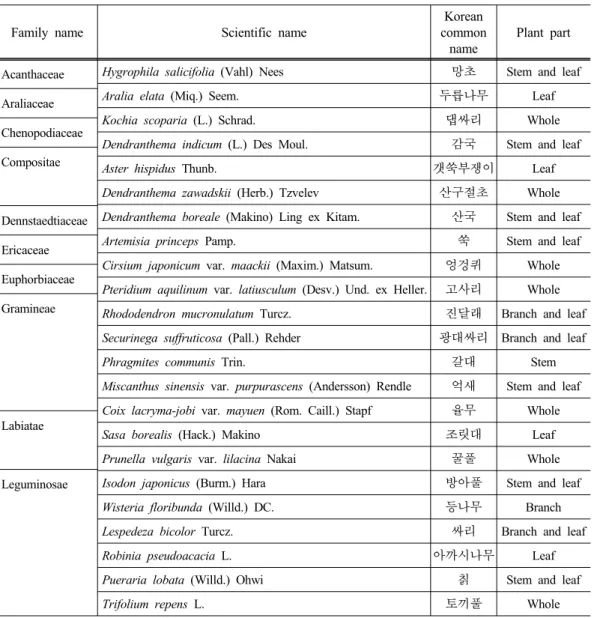
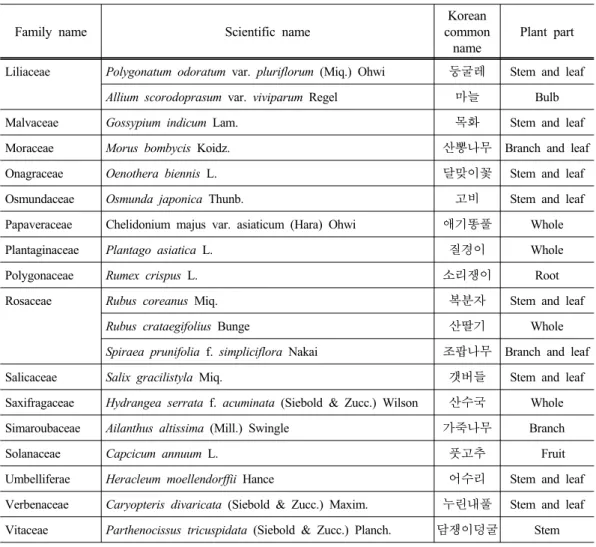
식물목록(Korea National Arboretum and The Plant Toxonomic Society of Korea, 2007)에 따라 식물 종을 분류하였다. 공시 17종 약용식물은 경북농업기술원 봉화약초시험장 전시포에서 채취하였고, 감초, 당귀, 육계, 작약 및 천궁은 한약재 유통업체에서 구입하였다. 자생식물 38종, 작물 4종(Table 1) 및 약초 22종(Table 2)에 대해 식물체를 부위별로 나누어 실온에서 음건하였고, 분쇄된 시료를 80% methanol에 침지하여 5일 동안 12시간 간격으로 교반하면 서 3회 추출하였다. B¨uchner funnel에 Whatman No. 2 여지를 깔고 여과를 통해 식물체 잔사 를 제거하였으며, 추출여액을 40℃ 이하에서 감압농축하였다. 건고시킨 조추출물은 생물검 정시까지 N2 gas를 충진하여 –20℃에 보관하였다.
Table 1. List of native plant resources tested
Family name Scientific name
Korean common
name
Plant part
Acanthaceae Hygrophila salicifolia (Vahl) Nees 망초 Stem and leaf
Aralia elata (Miq.) Seem. 두릅나무 Leaf
Araliaceae
Kochia scoparia (L.) Schrad. 댑싸리 Whole
Chenopodiaceae
Dendranthema indicum (L.) Des Moul. 감국 Stem and leaf
Compositae Aster hispidus Thunb. 갯쑥부쟁이 Leaf
Dendranthema zawadskii (Herb.) Tzvelev 산구절초 Whole
Dendranthema boreale (Makino) Ling ex Kitam. 산국 Stem and leaf Dennstaedtiaceae
Artemisia princeps Pamp. 쑥 Stem and leaf
Ericaceae
Cirsium japonicum var. maackii (Maxim.) Matsum. 엉겅퀴 Whole Euphorbiaceae
Pteridium aquilinum var. latiusculum (Desv.) Und. ex Heller. 고사리 Whole Gramineae Rhododendron mucronulatum Turcz. 진달래 Branch and leaf
Securinega suffruticosa (Pall.) Rehder 광대싸리 Branch and leaf
Phragmites communis Trin. 갈대 Stem
Miscanthus sinensis var. purpurascens (Andersson) Rendle 억새 Stem and leaf Coix lacryma-jobi var. mayuen (Rom. Caill.) Stapf 율무 Whole Labiatae
Sasa borealis (Hack.) Makino 조릿대 Leaf
Prunella vulgaris var. lilacina Nakai 꿀풀 Whole
Leguminosae Isodon japonicus (Burm.) Hara 방아풀 Stem and leaf
Wisteria floribunda (Willd.) DC. 등나무 Branch
Lespedeza bicolor Turcz. 싸리 Branch and leaf
Robinia pseudoacacia L. 아까시나무 Leaf
Pueraria lobata (Willd.) Ohwi 칡 Stem and leaf
Trifolium repens L. 토끼풀 Whole
Family name Scientific name
Korean common
name
Plant part
Liliaceae Polygonatum odoratum var. pluriflorum (Miq.) Ohwi 둥굴레 Stem and leaf
Allium scorodoprasum var. viviparum Regel 마늘 Bulb
Malvaceae Gossypium indicum Lam. 목화 Stem and leaf
Moraceae Morus bombycis Koidz. 산뽕나무 Branch and leaf
Onagraceae Oenothera biennis L. 달맞이꽃 Stem and leaf
Osmundaceae Osmunda japonica Thunb. 고비 Stem and leaf
Papaveraceae Chelidonium majus var. asiaticum (Hara) Ohwi 애기똥풀 Whole
Plantaginaceae Plantago asiatica L. 질경이 Whole
Polygonaceae Rumex crispus L. 소리쟁이 Root
Rosaceae Rubus coreanus Miq. 복분자 Stem and leaf
Rubus crataegifolius Bunge 산딸기 Whole
Spiraea prunifolia f. simpliciflora Nakai 조팝나무 Branch and leaf
Salicaceae Salix gracilistyla Miq. 갯버들 Stem and leaf
Saxifragaceae Hydrangea serrata f. acuminata (Siebold & Zucc.) Wilson 산수국 Whole Simaroubaceae Ailanthus altissima (Mill.) Swingle 가죽나무 Branch
Solanaceae Capcicum annuum L. 풋고추 Fruit
Umbelliferae Heracleum moellendorffii Hance 어수리 Stem and leaf Verbenaceae Caryopteris divaricata (Siebold & Zucc.) Maxim. 누린내풀 Stem and leaf Vitaceae Parthenocissus tricuspidata (Siebold & Zucc.) Planch. 담쟁이덩굴 Stem
Table 2. List of medicinal plants tested
Family name Scientific name
Korean common
name
Plant part
Araliaceae Eleutherococcus sessiliflorus (Rupr. & Maxim.) S.Y.Hu 오갈피나무 Leaf
Araliaceae Panax ginseng C.A.Mey. 인삼 Stem and leaf
Amaranthaceae Achyranthes japonica (Miq.) Nakai 쇠무릎 Root
Convolvulaceae Lithospermum erythrorhizon Siebold & Zucc. 지치 Stem and leaf
Compositae Inula helenium L. 목향 Stem and leaf
Cyperaceae Cyperus rotundus L. 향부자 Leaf
Labiatae Phlomis umbrosa Turcz. 속단 Whole
Labiatae Scutellaria dentata var. alpina Nakai 황금 Stem and leaf
Family name Scientific name
Korean common
name
Plant part
Lauraceae Cinnamomum cassia PRESL 육계 Bark
Leguminosae Glycyrrhiza uralensis Fisch. ex DC. 감초 Rhizome
Stem and leaf
Leguminosae Astragalus membranaceus Bunge 황기 Whole
Najadaceae Liriope platyphylla F.T.Wang & T.Tang 맥문동 Leaf
Paeoniaceae Paeonia lactiflora Pall. 작약 Root
Rhamnaceae Hovenia dulcis Thunb. 헛개나무 Branch and leaf
Saururaceae Houttuynia cordata Thunb. 약모밀 Stem and leaf
Solanaceae Lycium chinense Mill. 구기자나무 Branch and leaf
Umbelliferae Angelica gigas Nakai 당귀 Root
Umbelliferae Aralia cordata var. continentalis (Kitag.) Y.C.Chu 독활 Stem and leaf
Umbelliferae Torilis japonica (Houtt.) DC. 사상자 Whole
Umbelliferae Atactylodes ovata (Thunb.) DC. 삽주 Whole
Umbelliferae Bupleurum falcatum L. 시호 whole
Umbelliferae Cnidium officinale Makino 천궁 Rhizome
2. 생장촉진 활성 검정
자생식물, 약용식물 및 작물에 함유된 식물생장촉진물질의 탐색을 위한 생물검정용 재료 로써 삼광벼 종자를 사용하였다. 벼 종자를 무수 에탄올에 2분간 침지한 후 1% sodium hypochlorite 용액에 30분간 살균하여 흐르는 물에 깨끗이 씻은 후 32℃ growth chamber에서 2일간 최아시켜 시료용액을 처리하였다. Petri dish를 사용한 벼 유묘 생장촉진 활성 검정을 위해 methanol 3ml로 시료를 용해하여 직경 9㎝ petri dish 내의 Whatman No. 2 여지에 균일 하게 흡착시킨 후 fume hood에서 1시간 이상 방치하여 methanol을 완전히 증발시켰다. Petri dish에 7mL의 증류수를 첨가하고 최아시킨 삼광벼 종자를 petri dish 당 10립씩 3반복으로 파종하였으며, 32℃, 3,000 lux 하의 growth chamber에 치상하였다. 파종 5일 후 균일하게 자란 20개의 유묘를 선발하여 초장 및 근장을 조사하였고, 대조구에 대한 생장율을 산출하였다.
벼 제2엽초장 신장 검정법에서는 최아 종자 중 균일한 개체를 선별해서 1% 한천배지에 50ml 비이커당 7립씩 파종한 뒤 32℃, 3,000 lux 하에 2일간 생육시켰다. 초엽과 제1본엽 사 이에 마이크로 피펫으로 50% acetone에 용해된 피검용액을 2㎕ 처리하였으며, 상기의 생육 환경에서 3일간 경과 후 생육이 고른 유묘 10개체의 제2엽초장 및 근장을 조사하여 대조구 에 대한 생장율을 산출하였다.
Ⅲ. 결과 및 고찰
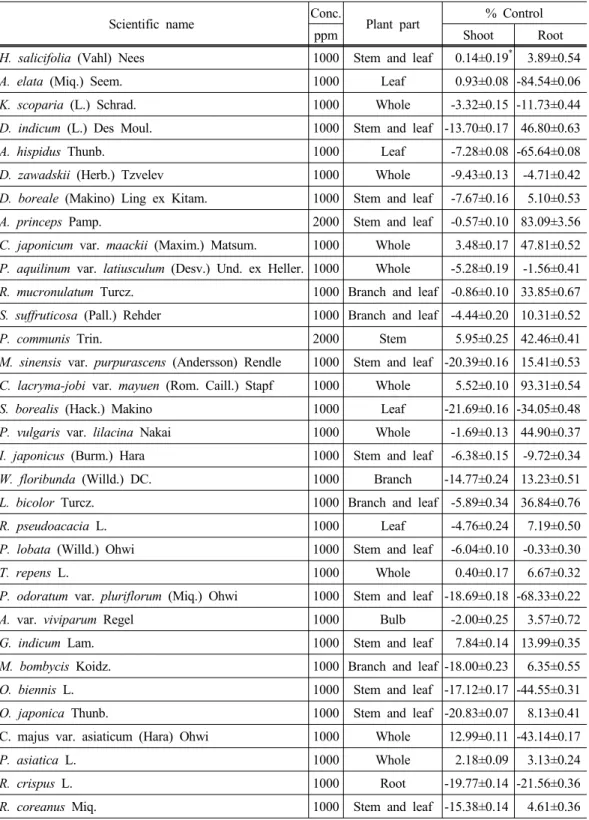
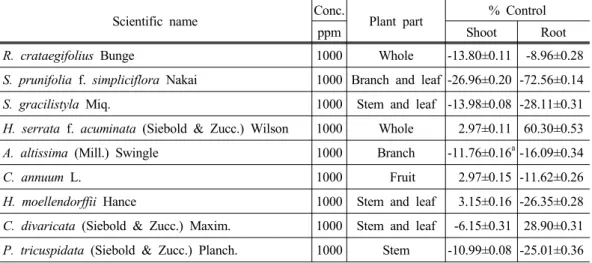
1. 자생식물 및 작물 methanol 추출물의 생장촉진 활성자생식물 38종, 작물 4종의 methanol 추출물을 1,000ppm과 2,000ppm의 농도로 조제하여 대조구에 대한 벼 유묘 생장율을 검정(Lee, 1989)한 결과, 갈대 줄기 2,000ppm(신초 5.95%;
뿌리 42.46%), 목화 경엽 1,000ppm(신초 7.84%; 뿌리 13.99%), 산수국 전초 1,000ppm(신초 2.97%; 뿌리 60.30%), 엉겅퀴 전초 1,000ppm(신초 3.48%; 뿌리 47.81%) 및 율무 전초 1,000ppm(신초 5.52%; 뿌리 93.31%)가 벼 유묘 신초와 뿌리 신장을 모두 촉진한 것으로 나 타났다(Table 3). 또한 벼 유묘 신초 신장에 대한 억제율이 미약하면서 벼 유묘 뿌리의 신장 을 촉진한 식물 종은 감국 경엽 1,000ppm(46.80%), 꿀풀 전초 1,000ppm(44.90%), 누린내풀 경엽 1,000ppm(28.90%), 싸리 가지와 잎 1,000ppm(36.84%), 쑥 경엽 2,000ppm(83.09%) 및 진 달래 가지와 잎 1,000ppm(33.85%)이었다.
Gibberellin류의 활성 검정을 위해 벼 제2엽초장 신장 검정법(Murakami, 1970)을 사용하였 으며, 피검액을 1,000, 2,000, 4,000ppm의 농도로 조제하여 처리하였다. 대조구에 비해 10%
이상 제2엽초장이 신장된 추출물 시료들은 갈대 줄기 2,000ppm(21.23%), 감국 경엽 4,000 ppm(26.45%), 광대싸리 가지와 잎 2,000ppm(26.08%), 누린내풀 경엽 2,000ppm(26.89%), 댑 싸리 전초 2,000ppm(15.95%), 등나무 가지 2,000ppm(15.17%), 복분자 경엽 2,000ppm(13.32%), 산구절초 전초 2,000ppm(20.08%), 산뽕나무 가지와 잎 2,000ppm(14.82%), 소리쟁이 뿌리 2,000ppm(14.70%), 싸리 가지와 잎 2,000ppm(15.57%), 쑥 경엽 2,000ppm(30.21%), 아까시나 무 잎 2,000ppm(21.20%), 진달래 가지와 잎 2,000ppm(40.71%) 및 풋고추 2,000ppm(20.08%) 이었으며, 이들 중 풋고추를 제외한 모든 식물 종에서 뿌리의 신장을 촉진하였다(Table 4).
상기 실험 결과들을 비교․검토한 결과(Table 3, Table 4), 갈대 줄기는 벼 유묘의 생장과 제2엽초장 신장을 모두 촉진하였으며, 감국 경엽, 광대싸리 가지와 잎, 누린내풀 경엽, 등나 무 가지, 싸리 가지와 잎, 쑥 경엽, 아까시나무 잎, 진달래 가지와 잎은 벼 제2엽초장 신장 및 유묘 뿌리의 생장을 함께 촉진하였다. 또한 엉겅퀴 전초 1,000ppm(신초 3.48%; 뿌리 47.81%) 및 율무 전초 1,000ppm(신초 5.52%; 뿌리 93.31%)는 벼 유묘 뿌리의 생장을 크게 촉진하였다. 따라서 이들 식물 종들에는 gibberellin류를 위시한 식물 생장촉진에 관여된 생 리활성 물질들이 함유되어 있는 것으로 추정되었으며, 주변 산야지에서 쉽게 채취할 수 있 는 초종들은 착과촉진을 위한 농가 자가제조 액비(An et al., 2012) 개발 소재로써의 이용가 능성이 있을 것으로 생각된다.
Table 3. Growth of rice seedlings as affected by the methanol extracts of native plant resources
Scientific name Conc.
Plant part % Control
ppm Shoot Root
H. salicifolia (Vahl) Nees 1000 Stem and leaf 0.14±0.19
*3.89±0.54
A. elata (Miq.) Seem. 1000 Leaf 0.93±0.08 -84.54±0.06
K. scoparia (L.) Schrad. 1000 Whole -3.32±0.15 -11.73±0.44
D. indicum (L.) Des Moul. 1000 Stem and leaf -13.70±0.17 46.80±0.63
A. hispidus Thunb. 1000 Leaf -7.28±0.08 -65.64±0.08
D. zawadskii (Herb.) Tzvelev 1000 Whole -9.43±0.13 -4.71±0.42
D. boreale (Makino) Ling ex Kitam. 1000 Stem and leaf -7.67±0.16 5.10±0.53
A. princeps Pamp. 2000 Stem and leaf -0.57±0.10 83.09±3.56
C. japonicum var. maackii (Maxim.) Matsum. 1000 Whole 3.48±0.17 47.81±0.52 P. aquilinum var. latiusculum (Desv.) Und. ex Heller. 1000 Whole -5.28±0.19 -1.56±0.41 R. mucronulatum Turcz. 1000 Branch and leaf -0.86±0.10 33.85±0.67 S. suffruticosa (Pall.) Rehder 1000 Branch and leaf -4.44±0.20 10.31±0.52
P. communis Trin. 2000 Stem 5.95±0.25 42.46±0.41
M. sinensis var. purpurascens (Andersson) Rendle 1000 Stem and leaf -20.39±0.16 15.41±0.53 C. lacryma-jobi var. mayuen (Rom. Caill.) Stapf 1000 Whole 5.52±0.10 93.31±0.54
S. borealis (Hack.) Makino 1000 Leaf -21.69±0.16 -34.05±0.48
P. vulgaris var. lilacina Nakai 1000 Whole -1.69±0.13 44.90±0.37
I. japonicus (Burm.) Hara 1000 Stem and leaf -6.38±0.15 -9.72±0.34
W. floribunda (Willd.) DC. 1000 Branch -14.77±0.24 13.23±0.51
L. bicolor Turcz. 1000 Branch and leaf -5.89±0.34 36.84±0.76
R. pseudoacacia L. 1000 Leaf -4.76±0.24 7.19±0.50
P. lobata (Willd.) Ohwi 1000 Stem and leaf -6.04±0.10 -0.33±0.30
T. repens L. 1000 Whole 0.40±0.17 6.67±0.32
P. odoratum var. pluriflorum (Miq.) Ohwi 1000 Stem and leaf -18.69±0.18 -68.33±0.22
A. var. viviparum Regel 1000 Bulb -2.00±0.25 3.57±0.72
G. indicum Lam. 1000 Stem and leaf 7.84±0.14 13.99±0.35
M. bombycis Koidz. 1000 Branch and leaf -18.00±0.23 6.35±0.55
O. biennis L. 1000 Stem and leaf -17.12±0.17 -44.55±0.31
O. japonica Thunb. 1000 Stem and leaf -20.83±0.07 8.13±0.41
C. majus var. asiaticum (Hara) Ohwi 1000 Whole 12.99±0.11 -43.14±0.17
P. asiatica L. 1000 Whole 2.18±0.09 3.13±0.24
R. crispus L. 1000 Root -19.77±0.14 -21.56±0.36
R. coreanus Miq. 1000 Stem and leaf -15.38±0.14 4.61±0.36
Scientific name Conc.
Plant part % Control
ppm Shoot Root
R. crataegifolius Bunge 1000 Whole -13.80±0.11 -8.96±0.28
S. prunifolia f. simpliciflora Nakai 1000 Branch and leaf -26.96±0.20 -72.56±0.14
S. gracilistyla Miq. 1000 Stem and leaf -13.98±0.08 -28.11±0.31
H. serrata f. acuminata (Siebold & Zucc.) Wilson 1000 Whole 2.97±0.11 60.30±0.53 A. altissima (Mill.) Swingle 1000 Branch -11.76±0.16
a-16.09±0.34
C. annuum L. 1000 Fruit 2.97±0.15 -11.62±0.26
H. moellendorffii Hance 1000 Stem and leaf 3.15±0.16 -26.35±0.28
C. divaricata (Siebold & Zucc.) Maxim. 1000 Stem and leaf -6.15±0.31 28.90±0.31 P. tricuspidata (Siebold & Zucc.) Planch. 1000 Stem -10.99±0.08 -25.01±0.36
* Mean±standard error of 20 seedlings.
Table 4. Effects of the methanol extracts of native plant resources on the second leaf sheath and root growth in rice seedlings
Scientific name
Conc.
Plant part
% Control The 2nd leaf
sheath Root
ppm
H. salicifolia (Vahl) Nees 1000 Stem and leaf -10.46±0.09
*-3.12±0.44
A. elata (Miq.) Seem. 2000 Leaf -8.07±0.12 -8.89±0.36
K. scoparia (L.) Schrad. 2000 Whole 15.95±0.13 5.00±0.40
D. indicum (L.) Des Moul. 4000 Stem and leaf 26.45±0.18 4.81±0.40
A. hispidus Thunb. 1000 Leaf -8.81±0.07 2.38±0.38
D. zawadskii (Herb.) Tzvelev 2000 Whole 20.08±0.22 85.00±5.73
D. boreale (Makino) Ling ex Kitam. 2000 Stem and leaf 5.07±0.17 -4.17±0.60
A. princeps Pamp. 2000 Stem and leaf 30.21±0.11 2.13±0.28
C. japonicum var.maackii (Maxim.) Matsum. 2000 Whole 7.32±0.18 -10.00±.29 P. aquilinum var. latiusculum (Desv.) Und.ex Heller. 1000 Whole -2.23±0.08 -1.56±0.22 R. mucronulatum Turcz. 2000 Branch and leaf 40.71±0.16 19.26±0.33 S. suffruticosa (Pall.) Rehder 2000 Branch and leaf 26.08±0.17 13.28±0.44
P. communis Trin. 2000 Stem 21.23±0.14 -0.19±0.38
M. sinensis var. purpurascens (Andersson) Rendle 2000 Stem and leaf -11.07±0.13 -6.94±0.19 C. lacryma-jobi var. mayuen (Rom.Caill.) Stapf 2000 Whole 5.82±0.24 -8.06±0.70
S. borealis (Hack.) Makino 1000 Leaf -1.06±0.08 -2.97±0.32
P. vulgaris var. lilacina Nakai 2000 Whole 0.94±0.18 -14.81±0.34
Scientific name
Conc.
Plant part
% Control The 2nd leaf
sheath Root
ppm
I. japonicus (Burm.) Hara 2000 Stem and leaf -1.80±0.19 -3.28±0.43
W. floribunda (Willd.) DC. 2000 Branch 15.17±0.14 -3.68±0.35
L. bicolor Turcz. 2000 Branch and leaf 15.57±0.13 5.00±0.34
R. pseudoacacia L. 2000 Leaf 21.20±0.15 -3.52±0.50
P. lobata (Willd.) Ohwi 2000 Stem and leaf -9.57±0.15 -14.44±0.44
T. repens L. 2000 Whole -2.61±0.18 -4.87±0.56
P. odoratum var. pluriflorum (Miq.) Ohwi 1000 Stem and leaf -9.99±0.10 -18.74±1.32 A. scorodoprasum var. viviparum Regel 1000 Bulb -2.23±0.07 7.21±0.40
G. indicum Lam. 1000 Stem and leaf -4.82±0.05 -0.22±0.26
M. bombycis Koidz. 2000 Branch and leaf 14.82±0.16 1.67±0.44
O. biennis L. 1000 Stem and leaf -4.82±0.07 -3.57±0.44
O. japonica Thunb. 1000 Stem and leaf -2.56±0.07 7.85±0.39
C. majus var. asiaticum (Hara) Ohwi 2000 Whole -0.59±0.20 -1.78±0.46
P. asiatica L. 2000 Whole 8.07±0.18 1.02±0.39
R. crispus L. 2000 Root 14.70±0.15 2.73±0.36
R. coreanus Miq. 2000 Stem and leaf 13.32±0.13 -5.83±0.37
R. crataegifolius Bunge 2000 Whole -15.54±0.20 -15.54±0.63
S. prunifolia f. simpliciflora Nakai 1000 Branch and leaf -4.11±0.06 -6.91±0.27
S. gracilistyla Miq. 1000 Stem and leaf -2.00±0.07 -3.35±0.40
H. serrata f. acuminata (Siebold&Zucc.) Wilson 2000 Whole 4.69±0.17 -6.20±0.53 A. altissima (Mill.) Swingle 2000 Branch -22.41±0.25
a-21.13±0.67
C. annuum L. 2000 Fruit 20.08±0.18 -1.67±0.52
H. moellendorffii Hance 2000 Stem and leaf -16.70±0.15 -8.43±0.44 C. divaricata (Siebold&Zucc.) Maxim. 2000 Stem and leaf 26.89±0.16 11.48±0.33 P. tricuspidata (Siebold&Zucc.) Planch. 1000 Stem -2.00±0.10 -8.70±0.40
* Mean±standard error of 10 seedlings.
2. 약용식물 methanol 추출물의 생장촉진 활성
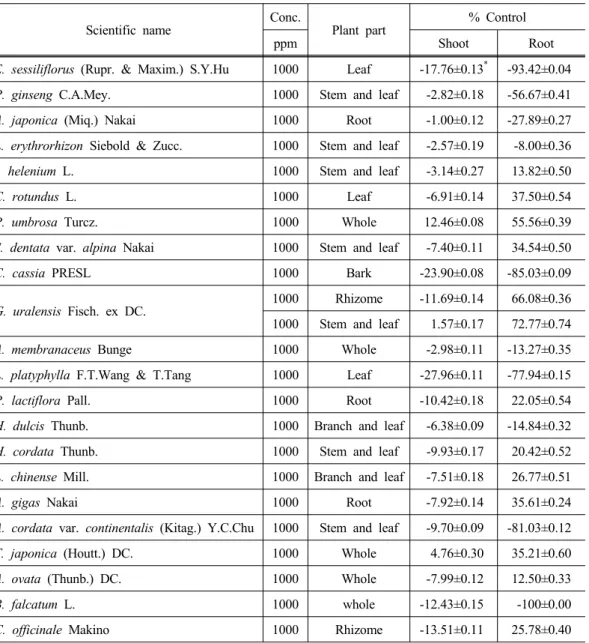
22종 23점의 약용식물과 한약재 methanol 추출물에 대한 벼 유묘 생장율을 검정한 결과 (Table 5), 벼 유묘 신초와 뿌리 생장을 촉진한 식물 종은 감초 경엽 1,000ppm(신초 1.57%;
뿌리 72.77%), 구기자나무 가지와 잎 2,000ppm(신초 6.40%; 뿌리 19.09%), 사상자 전초
1,000ppm(신초 4.76%; 뿌리 35.21%) 및 속단 전초 1,000ppm(신초 12.46%; 뿌리 55.56%)이었 다. 한편 벼 유묘 신초를 약 10% 전후로 억제시키면서 뿌리의 신장을 촉진한 시료는 감초 근경 1,000ppm(66.08%), 당귀 뿌리 1,000ppm(35.61%), 약모밀 경엽 1,000ppm(20.42%), 작약 뿌리 1,000ppm(22.05%), 천궁 근경 1,000ppm(25.78%), 향부자 잎 1,000ppm(37.50%) 및 황금 경엽 1,000ppm(34.54%)이었다. 또한 육계, 맥문동 잎, 독활 경엽은 1,000ppm에서 약 80% 내 외로 벼 유묘 뿌리의 생장을 현저하게 억제하였다.
Table 5. Growth of rice seedlings as affected by the methanol extracts of medicinal plants
Scientific name Conc.
Plant part % Control
ppm Shoot Root
E. sessiliflorus (Rupr. & Maxim.) S.Y.Hu 1000 Leaf -17.76±0.13
*-93.42±0.04
P. ginseng C.A.Mey. 1000 Stem and leaf -2.82±0.18 -56.67±0.41
A. japonica (Miq.) Nakai 1000 Root -1.00±0.12 -27.89±0.27
L. erythrorhizon Siebold & Zucc. 1000 Stem and leaf -2.57±0.19 -8.00±0.36
I. helenium L. 1000 Stem and leaf -3.14±0.27 13.82±0.50
C. rotundus L. 1000 Leaf -6.91±0.14 37.50±0.54
P. umbrosa Turcz. 1000 Whole 12.46±0.08 55.56±0.39
S. dentata var. alpina Nakai 1000 Stem and leaf -7.40±0.11 34.54±0.50
C. cassia PRESL 1000 Bark -23.90±0.08 -85.03±0.09
G. uralensis Fisch. ex DC. 1000 Rhizome -11.69±0.14 66.08±0.36
1000 Stem and leaf 1.57±0.17 72.77±0.74
A. membranaceus Bunge 1000 Whole -2.98±0.11 -13.27±0.35
L. platyphylla F.T.Wang & T.Tang 1000 Leaf -27.96±0.11 -77.94±0.15
P. lactiflora Pall. 1000 Root -10.42±0.18 22.05±0.54
H. dulcis Thunb. 1000 Branch and leaf -6.38±0.09 -14.84±0.32
H. cordata Thunb. 1000 Stem and leaf -9.93±0.17 20.42±0.52
L. chinense Mill. 1000 Branch and leaf -7.51±0.18 26.77±0.51
A. gigas Nakai 1000 Root -7.92±0.14 35.61±0.24
A. cordata var. continentalis (Kitag.) Y.C.Chu 1000 Stem and leaf -9.70±0.09 -81.03±0.12
T. japonica (Houtt.) DC. 1000 Whole 4.76±0.30 35.21±0.60
A. ovata (Thunb.) DC. 1000 Whole -7.99±0.12 12.50±0.33
B. falcatum L. 1000 whole -12.43±0.15 -100±0.00
C. officinale Makino 1000 Rhizome -13.51±0.11 25.78±0.40
* Mean±standard error of 20 seedlings.
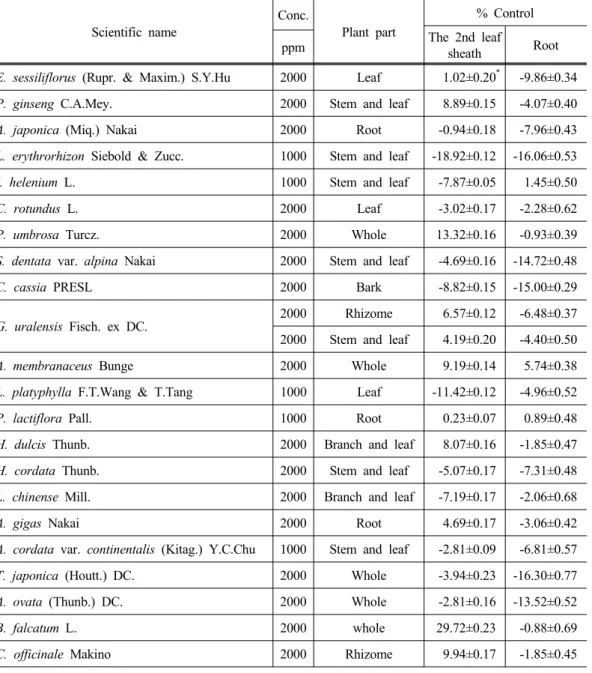
Table 6. Effects of the methanol extracts of medicinal plants on the second leaf sheath and root growth in rice seedlings
Scientific name
Conc.
Plant part
% Control The 2nd leaf
sheath Root
ppm
E. sessiliflorus (Rupr. & Maxim.) S.Y.Hu 2000 Leaf 1.02±0.20
*-9.86±0.34
P. ginseng C.A.Mey. 2000 Stem and leaf 8.89±0.15 -4.07±0.40
A. japonica (Miq.) Nakai 2000 Root -0.94±0.18 -7.96±0.43
L. erythrorhizon Siebold & Zucc. 1000 Stem and leaf -18.92±0.12 -16.06±0.53
I. helenium L. 1000 Stem and leaf -7.87±0.05 1.45±0.50
C. rotundus L. 2000 Leaf -3.02±0.17 -2.28±0.62
P. umbrosa Turcz. 2000 Whole 13.32±0.16 -0.93±0.39
S. dentata var. alpina Nakai 2000 Stem and leaf -4.69±0.16 -14.72±0.48
C. cassia PRESL 2000 Bark -8.82±0.15 -15.00±0.29
G. uralensis Fisch. ex DC. 2000 Rhizome 6.57±0.12 -6.48±0.37
2000 Stem and leaf 4.19±0.20 -4.40±0.50
A. membranaceus Bunge 2000 Whole 9.19±0.14 5.74±0.38
L. platyphylla F.T.Wang & T.Tang 1000 Leaf -11.42±0.12 -4.96±0.52
P. lactiflora Pall. 1000 Root 0.23±0.07 0.89±0.48
H. dulcis Thunb. 2000 Branch and leaf 8.07±0.16 -1.85±0.47
H. cordata Thunb. 2000 Stem and leaf -5.07±0.17 -7.31±0.48
L. chinense Mill. 2000 Branch and leaf -7.19±0.17 -2.06±0.68
A. gigas Nakai 2000 Root 4.69±0.17 -3.06±0.42
A. cordata var. continentalis (Kitag.) Y.C.Chu 1000 Stem and leaf -2.81±0.09 -6.81±0.57
T. japonica (Houtt.) DC. 2000 Whole -3.94±0.23 -16.30±0.77
A. ovata (Thunb.) DC. 2000 Whole -2.81±0.16 -13.52±0.52
B. falcatum L. 2000 whole 29.72±0.23 -0.88±0.69
C. officinale Makino 2000 Rhizome 9.94±0.17 -1.85±0.45
* Mean±standard error of 10 seedlings.
약용식물 및 한약재 추출물에 대한 벼 제2엽초장 신장 검정 결과(Table 6)로부터 뿌리 생 장에 있어서 약 6% 이하의 미약한 억제를 나타내었으나, 제2엽초장이 신장된 시료들은 감 초 근경 2,000ppm(6.57%), 감초 경엽 2,000ppm(4.19%), 당귀 뿌리 2,000ppm(4.69%), 속단 전 초 2,000ppm(13.32%), 시호 전초 2,000ppm(29.72%), 인삼 경엽 2,000ppm(8.89%), 천궁 근경
2,000ppm(9.94%) 헛개나무 가지와 잎 2,000ppm(8.07%) 및 황기 전초 2,000ppm(9.19%)로 확 인되었다. 한편 작약 뿌리의 경우 추출물은 동일 농도에서 신장촉진 활성을 보여주지 않았 으나, 이는 벼 유묘 생장 검정법(Lee, 1989)과 벼 제2엽초장 신장 검정법(Murakami, 1970)에 서 피검약량 및 피검용액에 노출된 기간의 상이함에 기인한 것으로 생각된다. 따라서 벼 유묘 생장 검정법에서 뿌리의 생장을 억제시킨 시호 전초, 인삼 경엽 및 헛개나무 가지와 잎 추출물도 보다 낮은 농도에서 검토할 필요성이 제기되었다.
상기 검정법들을 통해 벼 유묘 생장을 촉진한 감초 근경, 당귀 뿌리, 속단 전초 및 천궁 근경은 공용부위가 아닌 감초 경엽을 비롯한 약용식물 부산물과 함께 농가 자가제조 친환 경농자재(Lee et al., 2006)로써의 활용성이 확인되었다.
Ⅳ. 적 요
국내 식물자원 및 약용식물들의 식물 생장촉진 효과를 조사하기 위하여 64종 65점의 추 출물 시료를 조제하여 벼(Oryza sativa) 유묘 생장에 미치는 영향을 평가하였다. 그 결과, 11 종 12점의 쑥(Artemisia princeps) 경엽, 엉겅퀴(Cirsium japonicum var. maackii) 전초, 진달래 (Rhododendron mucronulatum) 가지와 잎, 갈대(Phragmites communis) 줄기, 율무(Coix lacryma- jobi var. mayuen) 전초, 싸리(Lespedeza bicolor) 가지와 잎, 산수국(Hydrangea serrata f.
acuminata) 전초, 속단(Phlomis umbrosa) 전초, 감초(Glycyrrhiza uralensis) 근경, 감초(G.
uralensis) 경엽, 당귀(Angelica gigas) 뿌리 및 천궁(Cnidium officinale) 근경 추출물은 벼 유묘 생장을 촉진시키는 것으로 나타났다. 본 결과에 따라 상기 식물 종의 부위들은 식물 생장 촉진용 농가 자가제조 액비 개발을 위한 소재로써 활용가능성이 있는 것으로 판명되었다.
[논문접수일 : 2013. 11. 17. 논문수정일 : 2014. 1. 13. 최종논문접수일 : 2014. 1. 20.]
Reference
1. Allan, E. J. and M. W. Fowler. 1985. Biologically active plant secondary metabolites perspectives for the future. Chemistry and Industry. pp. 408-410.
2. An, N. H., Y. S. Jo, J. R. Jo, Y. K. Kim, Y. Lee, H. J. Jee, S. M. Lee, K. L. Park, and B. M. Lee. 2012. The survey of actual using conditions of farm-made liquid fertilizers for cultivating environment-friendly agricultural products. Korean J. Organic. Agri. 20(3): 345-
356.
3. Arteca, R. N. 1996. Plant growth substances : principles and applications. Chapman & Hall, New York, NY. pp. 1-28.
4. Choi, S. T., S. M. Kang, G. H. Ahn, D. S. Park, G. M. Shon, and C. W. Rho. 1999. Effect of GA3 and artificial pollination on fruit set and grwoth of ‘Fuyu’ persimmon (Diospyros kaki). J. Kor. Soc. Hort. Sci. 40(5): 581-584.
5. Choi, Y. H., N. J. Kang, K. S. Park, H. Chun, M. W. Cho, Y. C. Um, and H. Y. You.
2009. Influence of Fruiting Methods on fruit characteristics in cherry tomato. Kor. J. Hort.
Sci. Technol. 27(1): 62-66.
6. Jang, K. H., H. W. Park, and D. J. Lee. 2011. Evaluation of antioxidant, anticancer and tyrosinase inhibition activities in Labiatae herb plants. Korean J. Intl. Agri. 23(1): 81-88.
7. Jang, S. W. and H. Y. Pak. 2000. Effect of plant growth regulators on fruit set and develop- ment in several cultivated Cucurbita spp. J. of Agri. Res. Devel.(Kon-Kuk Univ.) 22: 61-67.
8. Jung, S. J., D. H. Jin, H. J. Lee, and J. S. Oh. 2012. Effects of bumblebee pollination and plant growth regulators on the yield and quality in eggplant (Solanum melongena L). Korean J. Organic. Agri. 20(2): 243-258.
9. Kang, H. J., Y. S. Chae, and J. S. Jang. 2007. Effect of growth regulators on the fruit characters and quality of tomato. J. Agric. Tech. Res. Inst. (Junju Nat. Univ.) 20: 107-116.
10. Kil, M. J., Y. J. Huh, and Y. S. Kwon. 2011. Effect of GA3 treatment on bud formation, fruit set, and enlargement in Ardisia pusilla. Kor. J. Hort. Sci. Technol. 29(6): 555-560.
11. Kim, K. W., J. K. Baek, Y. W. Jang, E. J. Kum, Y. S. Kwon, H. J. Kim, and H. Y. Sohn.
2005. Screening of antibacterial agent against Streptococcus mutans from natural and medi- cinal Plants. J. of Life Sci. 15(5): 715-725.
12. Korea National Arboretum and The Plant Toxonomic Society of Korea. 2007. A Synonymic list of vascular plants in Korea. Korea National Arboretum.
13. Kwon, O. K., S. K. Lim, K. S. Seong, and B. R. Choi. 1997. Screening of pesticidal active compounds from various domestic wild plants. Kor. J. of Environ. Agri. 16(4): 347-355.
14. Lee, E. M., N. H. Song, I. H. Cho, and S. B. Lee. 2002. Enhancement of fruit set by using Bombus ignitus Smith and 4-CPA in protected cultivation of beefsteak-tomato. Kor. J. Hort.
Sci. Technol. 20(2): 85-89.
15. Lee, E. M., N. H. Song, I. H. Cho, and S. B. Lee. 2001. Enhancement of fruit set by using Bombus ignitus Smith and 4-CPA in protected cultivation of eggplant. J. Kor. Soc. Hort.
Sci. 42(5): 509-512.
16. Lee, J. H., J. H. Byeon, J. H. Lee, C. G. Park, C. B. Park, and J. H. Cho. 2012.
Allelopathic effect of Ganghwa mugwort (Artemisia spp.) on seed germination and seedling growth of plants. Korean J. Organic. Agri. 20(4): 589-605.
17. Lee J. M. 1989. Bioassays of plant hormons and plant growth regulating substances: I.
Auxins, gibberellins, and cytokinins. Korean J. Crop Sci. 34: 4-15.
18. Lee, J. S., Y. A. Shin, Y. C. Um, and S. N. Lee. 2004. Effect of plant growth regulators on fruit set and yield of eggplant (Solanum melongena L.). Kor. J. Hort. Sci. Technol.
22(4): 403-406.
19. Lee, M. G., J. M. Hwang, and S. R. Lee. 2006. The usage status on environmental-frendly materials for vegetable cultivated under protected houses in the southern part of Korea.
Korean J. Environ. Agric. 25(1): 93-103.
20. Murakami, Y. 1970. New rice seedling test for gibberellins―microdrop method. JARQ 5(2):
5-9.
21. Rice, E. L. 1984. Allelopathy. 2nd ed. Academic Press, Orlando, Florida. pp. 266-291.