Introduction
Beneficial plant growth promoting (PGP) bacteria that are able to colonize plants effectively can accelerate seedling emergence, promote plant establishment and enhance plant growth (Chanway, 1997; Bent and Chanway, 1998). Beneficial PGP bacteria are believed to elicit plant growth promotion directly or indirectly.
Indirect effects may be by helping plants acquire nutrients, e.g. via nitrogen fixation, phosphate solubili- zation (Wakelin et al., 2004) or iron chelation (Costa and Loper, 1994); by preventing pathogen infections via antifungal or antibacterial agents, by out competing pathogens for nutrients by siderophore production, or by establishing the plant’s systemic resistance (Van Loon et al., 1998; Strobel et al., 2004). On the other hand, these
can directly affect plant growth by producing phytohormones such as auxin or cytokinin (Madhaiyan et al., 2006), or by producing the enzyme 1-aminocy- cloropane-1-carboxylate (ACC) deaminase, which lowers plant ethylene levels (Glick, 1995; Madhaiyan et al., 2007). A particular bacterium may affect plant growth and development using one or more of the above mechanisms and may use different ones at various times during the life cycle of the plant. Many studies have documented the interactions between PGP rhizobacteria and host plants (Glick et al., 2007; Long et al., 2008; Madhaiyan et al., 2007; Poonguzhali et al., 2008). Glick et al. (1998) explained the role of bacterial ACC deaminase and IAA in promoting plant growth. Ethylene and IAA are implicated in virtually all aspects of plant growth and development, ranging from seed germination to shoot growth and leaf abscission (Woodward and Bartel, 2005). Therefore, production of ACC deaminase and IAA is likely an important and efficient way for beneficial PGP to
Comparison of Plant Growth Promoting Methylobacterium spp. and Exogenous Indole-3-Acetic Acid Application on Red Pepper and Tomato
Seedling Development
Hari P. Deka Boruah, Puneet S. Chauhan, Woo-Jong Yim, Gwang-Hyun Han, and Tong-Min Sa*
Department of Agricultural Chemistry, Chungbuk National University, Cheongju, Chungbuk, 361-763, Republic of Korea
A comparative study was performed in gnotobiotic and greenhouse conditions to evaluate the effect of exogenous application of indole-3-acetic acid (IAA) and inoculation of Methylobacterium spp. possessing 1-aminocyclopropane-1-carboxylate deaminase (ACCD) and IAA activity on red pepperand tomato seedling growth and development. Application of 1.0 g mLμ -1 IAA positively influenced root growth while high concentrations (>10.0 g mLμ -1) suppressed root growth of red pepperand tomato undergnotobiotic condition.
On the other hand, inoculation of Methylobacterium strains with ACCD activity and IAA or without IAA enhanced root growth in both plants. Similarly, under greenhouse condition the inoculation of Methylobacterium sp. with ACCD activity and IAA enhanced plant fitness recorded as average nodal length and specific leaf weight (SLW) but the effect is comparable with the application of low concentrations of IAA.
Seedling length was significantly increased by Methylobacterium strains while total biomass was enhanced by Methylobacterium spp. and exogenous applications of < 10.0 µg mL-1IAA. High concentrations of IAA retard biomass accumulation in red pepperand tomato. These results confirm that bacterial strains with plant growth promoting characters such as IAA and ACCD have characteristic effects on different aspects of growth of red pepper and tomato seedlings which is comparable or better than exogenous applications of synthetic IAA.
Key words: Methylobacterium spp., indole-3-acetic acid, 1-aminocyclopropane-1-carboxylate deaminase, plant growth, plant performance
Received : February 3. 2010 Accepted : February 12. 2010
*Corresponding author : Phone: +82432612561 E-mail: [email protected]
manipulate their plant hosts. Among the different IAA producing PGP bacteria, the production of IAA by ubiquitous Methylobacterium spp. is remarkable (Abanda -Nkpwatt et al., 2006; Madhaiyan et al., 2006).
Bacteria belonging to the genus Methylobacterium spp.
are ubiquitous in nature and colonize probably all land plants (Koenig et al., 2002; Holland and Palacco 1992;
Chanprame et al., 1996; Shepelyakovskaya et al., 1999).
In the case of symbiosis with nitrogen-fixing Methylobacterium strains, the benefit for the plant is evident, but this is not the case for looser forms of association, although it has been suggested that plants benefit from the production of plant hormones, such as cytokinins and auxins, by the epiphytic methylotrophs (Ivanova et al., 2000; Omer et al., 2004b; Madhaiyan et al., 2007). Much investigation has been done to predict the role of different PGP traits on plant growth with respect to the effect of bacterial hormones (Glick et al., 2007;
Raaijmakers et al., 2009; Madhaiyan et al., 2007). Thus the aim of the present study was to compare the effect of exogenous application of IAA and inoculation of Methylobacterium spp. with ACCD activity and IAA on seedling growth and development of red pepper (Capsicum annum L.) and tomato (Lycopersicon esculentum L.) under gnotobiotic and greenhouse conditions.
Materials and Methods
Bacterial strains, media and bacterial inocula
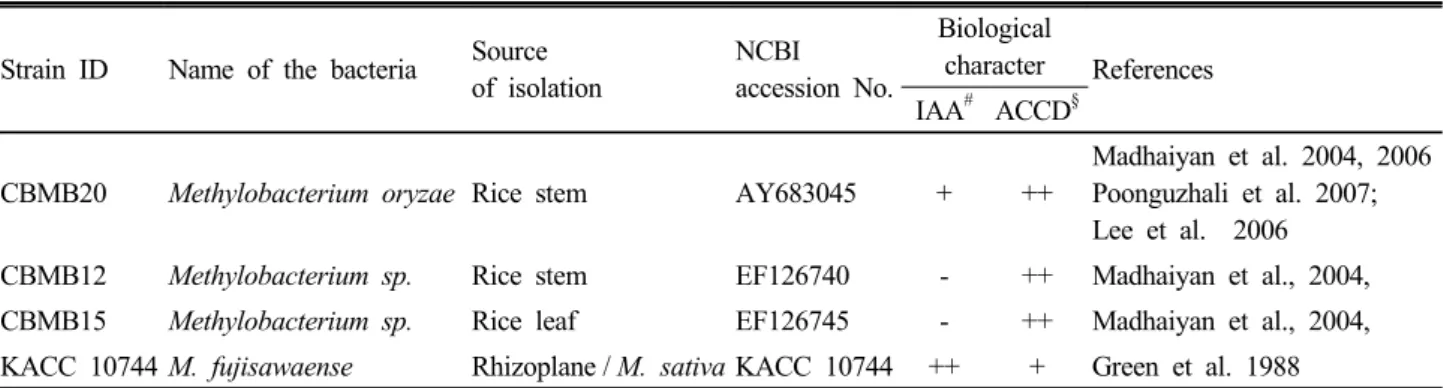
The Methylobacterium spp. used in this study are listed in Table 1. The strains possessed more than one plant growthpromoting characteristic. Stock cultures were stored at -8 0℃in 50% glycerol. All the strains were maintained in ammonium mineral salt (AMS) media. Bacterial inocula for seed bacterization was prepared by growing the strains in AMS broth for 72 h. Cell pellets were collected by centrifugation (10,000 rpm, 10 min, 4 ) and washed℃ twice in distilled water. Bacteria in sterile distilled water suspension (OD600= 0.8) were used for seed inoculation.
Test plants
Tomato (Lycopersicon esculentum Mill) and red pepper (Capsicum annum L.) were used as test plants in gnotobiotic condition. Red pepper was further used in a greenhouse experiment.Preparation of gnotobiotic growth pouch and IAA amendment
Growth pouches (CY9 seed germination pouch, Mega International) were prepared for gnotobiotic assays to check root elongation. This was done by adding 20 mL of distilled water to each growth pouch, wrapping them in aluminum foil in groups of 10 in an upright position to prevent water loss then autoclaving these at 121℃for 15 minutes. Three different doses (1.0 g mLμ -1, 10.0 g mLμ -1 and 20.0 g mLμ -1) indole-3-acetic acid concentrations were maintained in each growth pouch to test the effect of IAA on root growth and overall seedling development.Seed sterilization
Seeds of red pepper and tomato were surface sterilized before treatment with the bacterial suspension. The seeds were first washed with sterile distilled water twice then treated with 70% ethanol for 1 min. This was followed by treatment with 2% sodiumTable 1. Methylobacterium strains used in the study and their characteristics.
Strain ID Name of the bacteria Source of isolation
NCBI accession No.
Biological
character References IAA# ACCD§
CBMB20 Methylobacterium oryzae Rice stem AY683045 + ++
Madhaiyan et al. 2004, 2006 Poonguzhali et al. 2007;
Lee et al. 2006 CBMB12 Methylobacterium sp. Rice stem EF126740 - ++ Madhaiyan et al., 2004, CBMB15 Methylobacterium sp. Rice leaf EF126745 - ++ Madhaiyan et al., 2004, KACC 10744 M. fujisawaense Rhizoplane / M. sativa KACC 10744 ++ + Green et al. 1988 ++ = present; - = absent;
#IAA: + = < 5.0 mg ml-1; ++ = >5 mg ml-1 but <10 mg ml-1
§ACCD activity: + = >50 nmol -keto butyrate mgα -1 protein h-1 but <100 nmol -keto butyrate mgα -1 protein h-1 ++ = >100 nmol -keto butyrate mgα -1 protein h-1.
hypochlorite solution for 30 seconds. Finally, the treated seeds were thoroughly rinsed for more than five times with sterile distilled water.
Seed bacterization
Surface sterilized seeds were immersed in the bacterial cell suspension prepared as mentioned above for 4 h at 60 rpm. After decanting the suspension, the dried seeds were transferred to growth pouches (six seeds per pouch), with six replication per treatment. Two empty pouches were placed at the ends of each rack so that plants at the end of a rack are not subjected to extremes of light or air circulation. The racks were placed in a plastic tray containing sterile distilled water. The pouches were then incubated in a growth chamber at 20℃with 12 h day -night photoperiod for 14 days.Measurement of seedling development
The effect of Methylobacterium spp. and exogenous IAA treatments on root elongation was determined after 14 days in gnotobiotic condition and after 20 days from seed germination in greenhouse condition by measuring the root length from the base of the plants to the root tip.Seedling length was measured from the root tip to the tip of the plant. Total dry matter accumulation was measured after drying the seedlings in an oven at 70℃ until a constant weight was obtained.
Greenhouse experiment
Surface-sterilized red pepper seeds were sown in plastic pots (9 cm x 8 cm x 6 cm) containing approximately 250 g of vermiculite soil from Seoul Bio (peatmoss 13-17%, perlite 5-8%, cocopeat 65-70%, zeolite 3-5%, vermiculite 6-8%), pH 5.5-7.0, NH4-N 200 mg L-1, EC (1:5 water suspension) 0.7 dS m-1±0.3, CEC: 40-60 cmolcKg-1; NO3-N: 130-350 mg L-1, P2O5: 0.14-0.21 mg L-1. The media was moistened and allowed to stabilize. The pots were held in a rack (20 pots per rack) with five replications in each treatment and grown under greenhouse conditions and watered regularly. One seed was sown in each pot with 5 replications in each treatment. The experiment was laid out in a completely randomized design. To maintain the IAA concentration under in situ soil condition at 1.0 gμ mL-1, 10 mL of water with different concentrations of IAA was supplemented at 5 day intervals for 20 days.
The length of seedlings was measured after uprooting.
Total dry biomass of the plants was determined after
drying the plants in an oven at 70℃for 48 h. The specific leaf weight and average nodal length was calculated as performance of the plant species according to Gardiner et al. (1987).
Chlorophyll content
The chlorophyll content of the inoculated and control red pepper plants grown under greenhouse condition were measured as SPAD indices.The chlorophyll content of fully expanded leaves of the plant was measured using a chlorophyll analyser (SPAD-501, Japan, Minolta).
Statistics
Data generated were normalized and mean standard error (SE) was determined. Analysis of variance and testing of means by Duncan’s Multiple Range Test at P<0.05 were calculated using SAS package, Version 9.1 (SAS Institute Inc., Cary, NC, USA).Result
Effect of Methylobacterium spp. and exogenous IAA application on root elongation
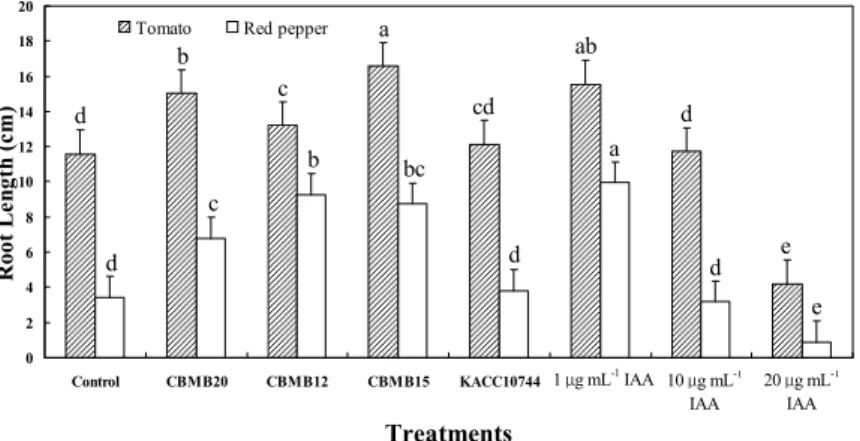
Under gnotobio- tic condition, tomatoes inoculated with Methylobacterium CBMB15, CBMB20 and CBMB12, together with exogenous application of 1.0 µg mL-1 IAA have significantly longer roots compared to control. While KACC10744 and application of 10 µg mL-1 did not significantly increase root length, application of 20 µg mL-1retarded it (Fig. 1).In red pepper, 1.0 µg mL-1IAA significantly promoted root growth. Increased root length was also observed in plants inoculated with CBMB12, CBMB15 and CBMB20. Similar to the observations in tomatoes, KACC10744 and 10 µg mL-1did not promote root length while 20 µg mL-1 IAA significantly suppressed root growth. Although there was evidence of emergence of plumule and radicle at 10 µg mL-1 and 20 µg mL-1 concentrations in red pepper, the radicles are rudimentary and no basal root emergence was observed (Fig. 2).
Effect of Methylobacterium spp. and exogenous
IAA application on seedling length and dry biomass
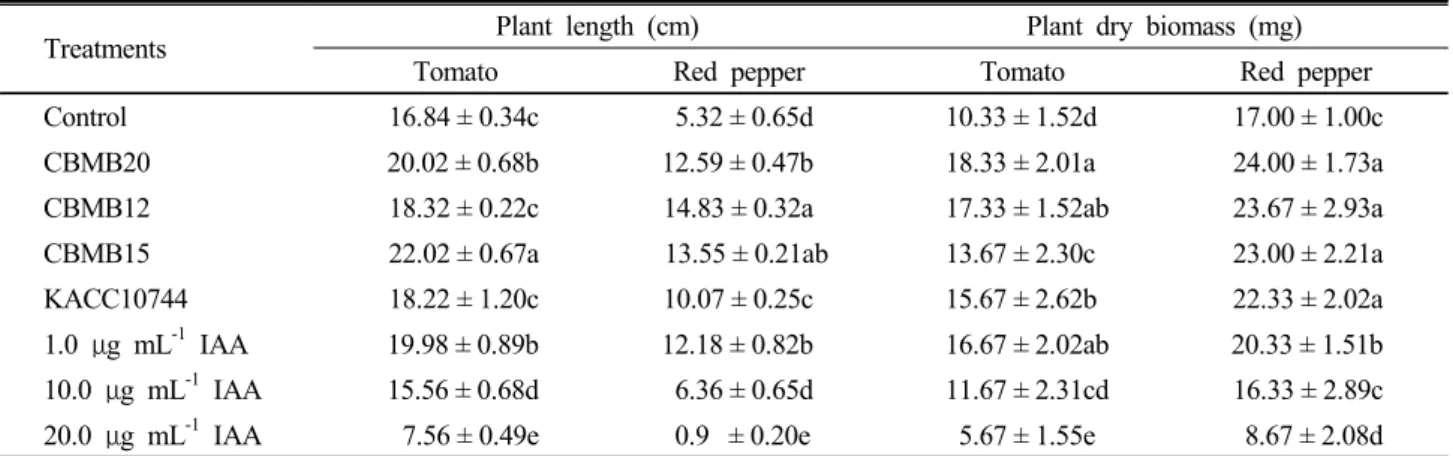
The effect of the different Methylobacterium strains and exogenous application of IAA on seedling length and dry matter accumulation of red pepper and tomato is summarized in Table 2. All the bacterial strains and 1.0 µg mL-1 of applied IAA significantly enhanced seedlinglength of tomato and red pepper compared to uninoculated control. The longest tomato seedlings were those inoculated with CBMB15 (30.8%) while the shortest plants were tomatoes treated with 20 µg mL-1IAA. IAA concentration of 10 µg mL-1 similarly did not enhance seedling growth of tomatoes. In red pepper, inoculation
with CBMB12 (178.8%) gave the longest seedlings. As with tomatoes, growth was also retarded in red pepper when inoculated with 20 µg mL-1IAA.
All Methylobacterium strains significantly increased biomass of tomato and red pepper, though in different degrees. Moreover, 1 µg mL-1 IAA enhanced plant
0 2 4 6 8 10 12 14 16 18 20
Control CBMB20 CBMB12 CBMB15 KACC10744 1 μg / mL IAA 10 μg / mL IAA
20 μg / mL IAA
Treatments
Root Length (cm)
Tomato Red pepper
d
d d
b
c c
b a
bc cd
ab
a d
d e
e
1 g mLμ -1IAA 10 g mLμ -1 IAA
20 g mLμ -1 IAA
Fig. 1. Effect of Methylobacterium spp. and exogenous IAA application on root growth of tomato and red pepper under gnotobiotic condition.
Values are means of five individual observations error bars = standard error means of observed values Identical columns followed by similar letters are not significantly different from each other according to Duncan’s Multiple Range Test (DMRT).
Fig. 2. Effect of Methylobacterium spp. and exogenous IAA application on germination and root length of red pepper under gnotobiotic condition.
A. Control; B. 1.00 g mLμ -1 IAA; C. 10.00 g mLμ -1 IAA; D. 20.00 g mLμ -1 IAA; E. CBMB20; F. CBMB 12; G.
CBMB15 and H. KACC10744
biomass of both test plants while 10 µg mL-1 IAA enhanced tomato biomass in a significantly lesser degree.
Effect of Methylobacterium spp. and exogenous IAA application on growth of red pepper under greenhouse condition
To compare the effect of inoculation of Methylobacterium spp. and exogenous application of IAA on red pepper growth under greenhouse condition, Methylobacterium strains CBMB20 and KACC10744 were selected. The average nodal lengths, specific leaf weight (SLW) (Fig. 3) and percentage of SPAD index (Fig. 4) were considered as effects of Methylobacterium spp. and IAA on the performance of the red pepper seedlings. Plant height and biomass accumulation were considered as the ultimate effect of Methylobacterium spp. and IAA on red pepper growth.
Methylobacterium CBMB20 and Methylobacterium Table 2. Effect of Methylobacterium spp. and exogenous IAA application on growth and biomass accumulation of tomato and red pepper grown in pouch.
Treatments Plant length (cm) Plant dry biomass (mg)
Tomato Red pepper Tomato Red pepper
Control 16.84 ± 0.34c 5.32 ± 0.65d 10.33 ± 1.52d 17.00 ± 1.00c
CBMB20 20.02 ± 0.68b 12.59 ± 0.47b 18.33 ± 2.01a 24.00 ± 1.73a
CBMB12 18.32 ± 0.22c 14.83 ± 0.32a 17.33 ± 1.52ab 23.67 ± 2.93a
CBMB15 22.02 ± 0.67a 13.55 ± 0.21ab 13.67 ± 2.30c 23.00 ± 2.21a
KACC10744 18.22 ± 1.20c 10.07 ± 0.25c 15.67 ± 2.62b 22.33 ± 2.02a
1.0 g mLμ -1 IAA 19.98 ± 0.89b 12.18 ± 0.82b 16.67 ± 2.02ab 20.33 ± 1.51b 10.0 g mLμ -1 IAA 15.56 ± 0.68d 6.36 ± 0.65d 11.67 ± 2.31cd 16.33 ± 2.89c 20.0 g mLμ -1 IAA 7.56 ± 0.49e 0.9 ± 0.20e 5.67 ± 1.55e 8.67 ± 2.08d Values are means of five individual experiments with 5 replications each; ± = standard deviation of observed values. Values in a column followed by similar letters are not significantly different from each other according to Duncan’s Multiple Range Test (DMRT).
Fig. 3. Effect of Methylobacterium strains CBMB20 and KACC10744 and exogenous IAA application on average nodal length and specific leaf weight (SLW) of red pepper grown under greenhouse condition.
Values are means of five individual observationserror bars = standard error means of observed values Columns followed by similar letters are not significantly different from each other according to Duncan’s Multiple Range Test (DMRT).
KACC10744 significantly enhanced nodal length of red pepper seedlings under greenhouse condition. However, IAA treated plants have appreciably higher increment in nodal length compared to untreated control. The highest increment in nodal length was found in red pepper inoculated with CBMB20 (65.7%) and followed by KACC10744 (13.4%). No dose-dependent effect of exogenous application of IAA was observed on the nodal length of red pepper seedlings.
Methylobacterium inoculated seedlings have enhanced SLW; CBMB20 with 95.4% and KACC10744 with 102.7% compared to control. On the other hand, a dose-dependent effect on SLW was observed in seedlings exogenously applied with IAA. Exogenous application of beyond 1.0 µg mL-1 IAA concentration on red pepper showed no significant enhancement on SLW.
Effect of Methylobacterium spp. and exogenous IAA application on SPAD index of red pepper grown under greenhouse condition
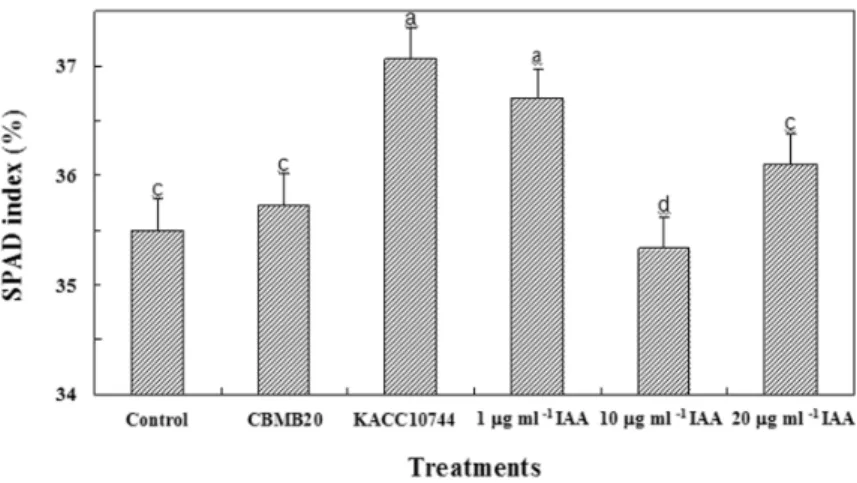
The effect of inoculation of Methylobacterium spp. and exogenous application of IAA on pigment synthesis of red pepper seedlings was determined as percentage of SPAD index (Fig. 4). Red pepper with KACC10744 (37.1%) and 1.0 µg mL-1of IAA (36.7%) showed significantly high SPAD indices compared to untreated control. Chlorophyll content of inoculated red pepper seedlings was 0.7 to 4.6%higher compared to the control.
Effect of Methylobacterium spp. and exogenous IAA application on plant height and total dry biomass grown under greenhouse condition
Similar to the gnotobiotic study, there was a dose-dependent effect of exogenously applied IAA on plant height and biomass accumulation of red pepper seedlings grown under greenhouse condition (Table 3). Among the treatments, red pepper seedlings inoculated with Methylobacterium CBMB20 and KACC10744 significantly enhanced plant height and biomass accumulation compared to the control.The highest increment in height was observed in seedlings inoculated with CBMB20 (43.8%) and lowest in seedlings applied with 20.0 µg mL-1 IAA (10.9%). The highest Fig. 4. Effect of Methylobacterium strains CBMB20 and KACC10744 and exogenous IAA application on SPAD index of red pepper grown under greenhouse condition.
Values are means of five individual observationserror bars = standard error means of observed values Columns followed by similar letters are not significantly different from each other according to Duncan’s Multiple Range Test (DMRT).
Table 3. Effect of Methylobacterium strains CBMB20 and KACC10744 and exogenous IAA application on growth and biomass accumulation of red pepper grown under greenhouse condition at 20 days after sowing.
Treatments Plant height (cm)
Total dry biomass (mg plant-1)
Control 11.54±1.67b 56.43±7.03c
CBMB20 16.59±1.08a 84.53±7.86b
KACC10744 15.80±2.18a 94.87±7.25a 1.0 g mLμ -1 IAA 13.33±0.48b 84.50±2.21b 10.0 g mLμ -1 IAA 13.33±0.57b 82.73±7.51b 20.0 g mLμ -1 IAA 12.79±1.33b 44.23±3.82c Values are means of five individual experiments with 5 replications each; ±= standard deviation of observed values values in a column followed by similar letters are not significantly different from each other according to Duncan’s Multiple Range Test (DMRT).
biomass was with seedlings inoculated with KACC10744 (68.0%) followed by CBMB20, 1.0 µg mL-1IAA and 10.0 µg mL-1 treated seedlings. Retardation of biomass accumulation was observed in seedlings applied with 20.0 µg mL-1IAA (-21.0%).
Discussion
The effect of four Methylobacterium spp. having ACC deaminase activity and with or without IAA production along with exogenous application of synthetic IAA was compared in root growth and plant fitness of red pepper and tomato under gnotobiotic condition. The same was compared only for red pepper under greenhouse condition.
The effect of Methylobacterium spp. is known for plant growth promotion and fitness of their host by modulating ethylene and IAA homeostasis and by producing phytohormones such as cytokinins or auxins, or by degrading hormone precursors, such as ACC by ACC deaminase (Madhaiyan et al., 2007; Ryu et al., 2006; Kim et al., 2009). The relatively widespread production of IAA by plant-associated bacteria suggests that bacterial IAA stimulates root development of host plants (Glick and Pasternak, 2003; Spaepen et al., 2007). In the present investigation, it was observed that IAA-producing isolates stimulated root growth, but only when they released low quantities of IAA (<5.0 µg mL-1). Similar result was observed for greenhouse condition. The present findings were in agreement with the works of Long et al. (2008) and Madhaiyan et al. (2007). Madhaiyan et al. (2007) while working on the interaction of auxins and ACCD regulations of ethylene in M. oryzea-inoculated canola, reported that IAA inhibit the root growth by 52.5%.
Similarly, while establishing the relationship of IAA and ACCD on root growth of Solanum nigrum and Nicotiana attenuate, Long et al. (2008) reported that application of IAA at 1.0 µg mL-1to seed significantly increased the root growth and seeds treated with 10 µg mL-1to 100 µg mL-1 retarded the root elongation.
Plant growth promoting rhizobacteria living in the rhizosphere are generally believed to be beneficial to all plant species they associate with because of their conserved influence of phytohormones on plant growth (Cakmakci et al., 2007). Given that hormonal regulation is conserved among plants, it was anticipated that IAA and ACCD effects on root growth would be similar in tomato and red pepper. However, no similar effect on the root
growth of the tested crops was observed due to high concentration of exogenous IAA application. These suggest the possible explanation for the discrepancy in the bacterial ACC deaminase and IAA as well as the mutual effects on root growth. Some models describe how ACC deaminase counteracts ethylene-repressed auxin- response factors involved in root growth (Madhaiyan et al., 2007; Glick et al., 2007). The presence of ACC deaminase-producing rhizobacteria in the rhizosphere can depress the expression of auxin response genes in the shoots which ultimately affect the plant root growth (Long et al., 2008).
Methylobacterium and low concentration of IAA consistently enhanced plant fitness. This was also supported by appreciably higher SPAD index along with a significant increment in plant height and biomass accumulation in Methylobacterium CBMB20 and KACC10744 inoculated seedlings.
These findings demonstrated that Methylobacterium spp. with low IAA but high ACCD as well as low concentrations of exogenous IAA positively influenced root growth while high concentrations of IAA have inhibiting effects on root growth. The effect of Methylobacterium spp. on plant fitness and high biomass accumulation could be the cumulative effect of ACCD and IAA. The potential of Methylobacterium spp. should be further investigated in their ecological context to maximize their utilization for sustainable agricultural crop production.
Acknowledgments
This research was partially funded through the Korea Institute of Planning and Evaluation for Technology of Food, Agriculture, Forestry and Fisheries (IPET) of the Ministry of Food, Agriculture, Forestry and Fisheries, Republic of Korea.
References
Abanda-Nkpwatt, D., M. Musch, J. Tschiersch, M. Boettner, and W. Schwab. 2006. Molecular interaction between Methylobacterium extroquens and seedlings: growth promotion, methanol consumption and localization of methanol emission site. J. Expt. Botany. 15:4025-4032.
Bent, E., and C.P. Chanway. 1998. The growth-promoting effects of a bacterial endophyte on lodgepole pine are partially inhibited by the presence of other rhizobacteria. Can.
J. of Microbiol. 44: 980 988.–
Cakmakci, R., M. Erat, U. Erdogan, and M.F. Donmez. 2007.
The influence of plant growth-promoting rhizobacteria on growth and enzyme activities in wheat and spinach plants. J.
of Plant Nut. and Soil Sci.-Zeit. Fur Pflanzen. und Bodenkunde 170: 288 295.–
Chanprame, S., J.J. Todd, and J.M. Widholm. 1996. Prevention of pink-pigmented Methylotrophic bacteria (Methylo- bacterium mesophilicum) contamination of plant tissue cultures. Plant Cell Rep. 16: 222 225.–
Chanway, C.P. 1997. Inoculation of tree roots with plant growth promoting soil bacteria: An emerging technology for reforestation. Forest Sci. 43: 99 112.–
Costa, J.M., and J.E. Loper. 1994. Characterization of siderophore production by the biological control agent Enterobacter cloacae. Mol. Plant-Microbe Inter. 7: 440 448.– Glick, B.R. 1995. The enhancement of plant-growth by free-
living bacteria. Can. J. Microbiol. 41: 109 117.–
Glick, B.R., and J.J. Pasternak. 2003. Molecular Biology Princi- ples and application of Recombinant DNA. ASM Press. 3rded.
Glick, B.R., D.M. Penrose, and J.P. Li. 1998. A model for the lowering of plant ethylene concentrations by plant growth-promoting bacteria. J. Theo. Biol. 190: 63 68.– Glick, B.R., B. Todorovic, J. Czarny, Z.Y. Cheng, and J. Duan.
2007. Promotion of plant growth by bacterial ACC deaminase. Crit. Rev. in Plant Sci. 26: 227 242.–
Holland, M.A., and J.C. Polacco. 1992. Urease-null and hydrogenase-null phenotypes of a phylloplane bacterium reveal altered nickel metabolism in soybean mutants. Plant Physiol. 98:942 948.–
Ivanova, E.G., N.V. Doronina, A.O. Shepelyakovskaya, A.G.
Laman, F.A. Brovko, and Y.A. Trotsenko. 2000. Facultative and obligate aerobic methyl obacteria synthesize cytokinins.
Microbiol. 69:646 651.–
Kim, K.A., W.J. Yim, P. Trivedi, M. Madhaiyan, H.P. Deka Boruah, M.R. Islam, G. Lee, and T.M. Sa. 2009. Synergistic effects of inoculating arbuscular mycorrhizal fungi and Methylobacterium oryzae strains on growth and nutrient uptake of red pepper (Capsicum annum L.). Plant Soil, DOI 10.1007/s11104-009-0072-4.
Koenig R.L., R.O. Morris, and J.C. Polacco. 2002. tRNA is the source of low-level trans-zeatin production in Methylobac- terium spp. J. of Bacteriol. 184:1832 1842.–
Long, H.H., D.D. Schmidt, and I.T. Baldwin. 2008. Native bacterial endophytes promote host growth in a species- specific manner; phytohormone manipulations do not result in common growth responses. PL0S One, 3(7)2702.
Madhaiyan, M., S. Poonguzhali, and T.M. Sa. 2007.
Characterization of 1-aminocyclopropane-1-carboxylate (ACC) deaminase containing Methylobacterium oryzae and inter- actions with auxins and ACC regulation of ethylene in canola (Brassica campestris). Planta. 226:867-876.
Madhaiyan, M., S. Poonguzhali, J.H. Ryu, and T.M. Sa, 2006.
Regulation of ethylene levels in canola (Brassica campestris) by 1-aminocyclopropane-1-carboxylate deaminase-containing Methylobacterium fujisawaense. Planta 224, 268 278.– Omer, Z.S., R. Tombolini, A. Broberg, and B. Gerhardson.
2004b. Indole-3-acetic acid production by pink-pigmented facultative methylotrophic bacteria. Plant Growth Regul.
43:93 96.–
Poonguzhali, S., M. Madhaiyan, W.J. Yim, K.A. Kim, and T.M.
Sa. 2008. Colonization pattern of plant root and leaf surfaces visualized by use of green-fluorescent-marked strain of Methylobacterium suomiense and its persistence in rhizosphere. App. Microbial and Cell Physiol. 78:1033-1043.
Raaijmakers, J.M., C.T. Paulitz, C. Steinberg, C. Alabouvette, and Y. Moenne-Loccoz. 2009. The rhizosphere: a playground and battlefield for soil borne pathogens and beneficial microorganisms. Plant Soil DOI: 10.1007/s11104-008- 9568-6.
Ryu, J.H., M. Madhaiyan, S. Poonguzhali, W.J. Yim, P.
Indiragandhi, K.A. Kim, R. Anandham, J.C. Yun, and T.M.
Sa. 2006. Plant growth substances produced by Methylo- bacterium spp. and their effect on the growth of tomato (Lycopersicon esculentum L.) and red pepper (Capsicum annuum L.). J. Microbiol. Biotechnol., 16: 1622-1628.
Shepelyakovskaya, A.O., N.V. Doronina, A.G. Laman, F.A.
Brovko, and Y.A. Trotsenko. 1999. New Data about the ability of aerobic Methylotrophic bacteria to synthesize cytokinins. Dokl. Akad. Nauk, 368:555 557.–
Spaepen, S., J. Vanderleyden, and R. Remans. 2007. Indole- 3-acetic acid in microbial and microorganism-plant signaling.
FEMS Microbiology Reviews 31: 425 448.–
Strobel, G., B. Daisy, U. Castillo, and J. Harper. 2004. Natural products from endophytic microorganisms. J. of Nat.
Products 67: 257 268.–
Van Loon, L.C., P. Bakker, and C.M.J. Pieterse. 1998. Systemic resistance induced by rhizosphere bacteria. Annual Review of Phytopathol. 36: 453 483.–
Wakelin, S.A., R.A. Warren, P.R. Harvey, and M.H. Ryder.
2004. Phosphate solubilization by Penicillium spp. closely associated with wheat roots. Biol. and Fertil. of Soils 40: 36–
43.
Woodward, A.W., and B. Bartel. 2005. Auxin: Regulation, action and interaction. Ann. of Bot. 95: 707 735.–
식물생장촉진 세균
Methylobacterium
spp. 와 IAA 처리가 고추와 토마토 유묘의 생육에 미치는 영향임우종 한광현 사동민
Hari P. Deka Boruah·Puneet S. Chauhan· · · *
충북대학교 농업생명환경대학 농화학과
무균 및 온실조건에서 indole-3-acetic acid (IAA)의 처리와 1-aminocyclopropane-1-carboxylate deaminase (ACCD) 및 IAA 활성을 갖는 Methylobacterium 균주 접종 시 토마토와 고추의 생장을 비교 평가하였다 무균조건에서. 1.0 ㎍ mL-1의 IAA는 고추와 토마토의 뿌리생장을 촉진시키는데 비해 10.0 ㎍mL-1 이상의 높은 농도에서는 뿌리생장이 억제되 었다 그러나 높은. ACCD 활성을 갖고, IAA 활성은 낮거나 가지고 있지 않은 Methylobacterium균주들을 접종하였을 때
에는 고추와 토마토 모두 IAA 처리구 보다 뿌리생장이 증진되는 것을 확인하였다. 마찬가지로 온실조건에서
Methylobacterium 균주들을 접종했을 때 마디길이와 잎의 크기 그리고 단위 면적당 잎의 무게, (SLW)에서 유의성 있는 증진효과를 보였다 전반적인 식물 생장에서 저농도의. IAA 처리 효과는Methylobacterium의 효과와 비슷한 경향을 나타 냈다 유묘의 지상부 길이는. ACCD 활성과 IAA 생산능을 갖는 Methylobacterium 균주 처리구에서 유의성 있는 증가를 확인할 수 있었으며 전체 건물중 또한, Methylobacterium 처리 시 유의성 있는 증진 효과를 확인 할 수 있었다 하지만.
고농도의IAA는 고추와 토마토의 생물량을 억제시켰다 이러한 결과는 접종 균주의. IAA와ACCD가 고추와 토마토 유묘의
생장 증진에 영향을 끼친다는 것을 증명한다.