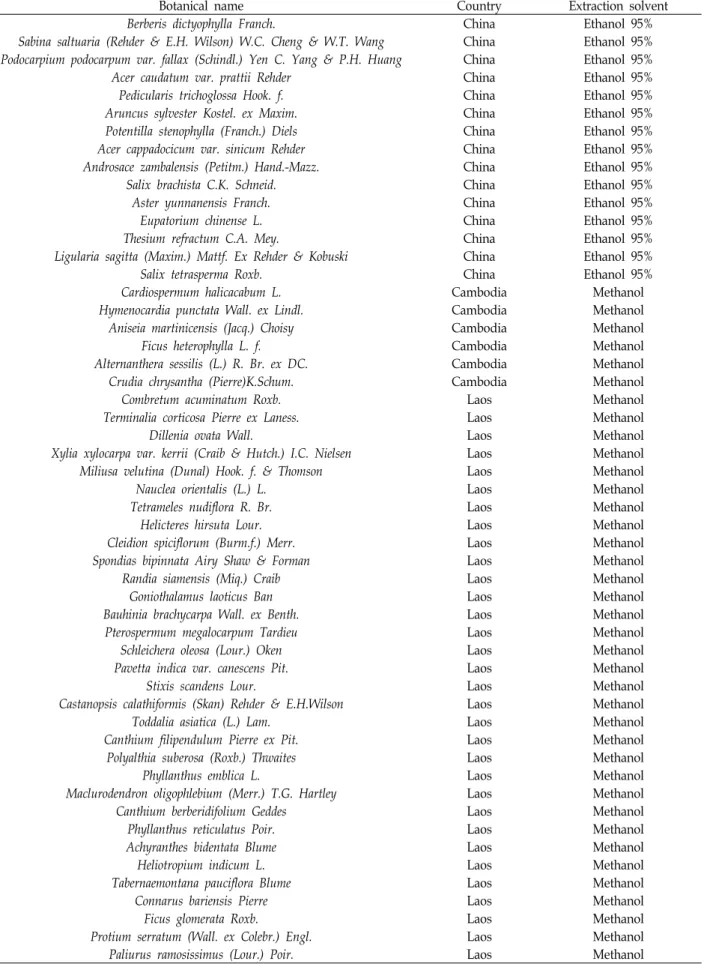
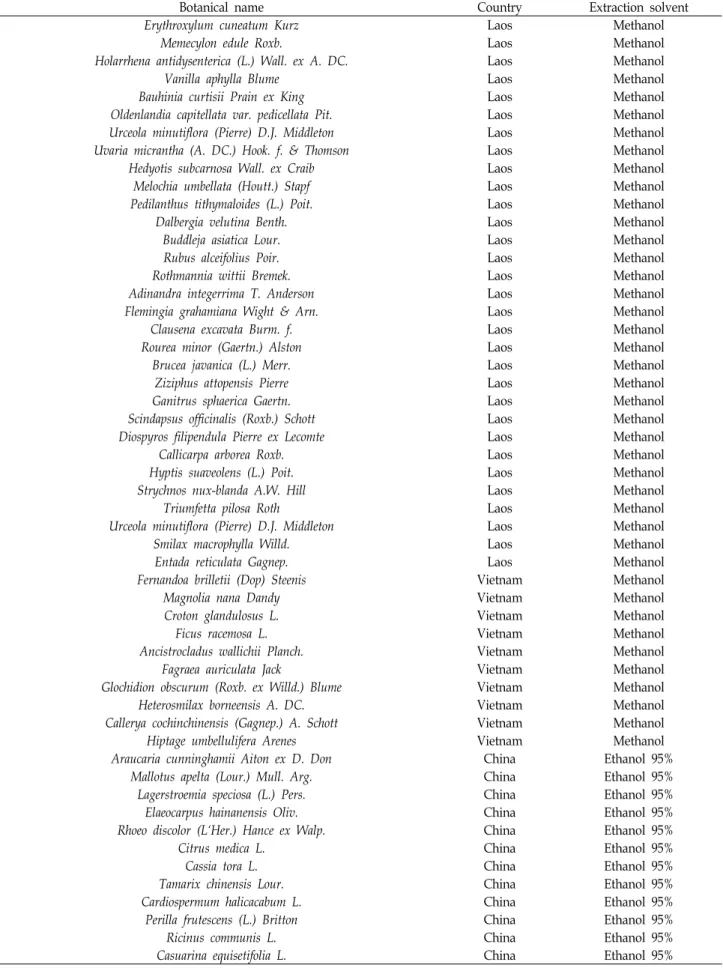
Effects of Foreign Plant Extracts on Cell Growth and Biofilm Formation of Streptococcus Mutans
Kyung Hoon Moon
1, Yun-Chae Lee
2and Jeong Nam Kim
1,2*
1
Department of Microbiology, College of Natural Sciences, Pusan National University, Busan 46241, Korea
2
Department of Integrated Biological Science, College of Natural Sciences, Pusan National University, Busan 46241, Korea Received March 16, 2019 /Revised April 30, 2019 /Accepted April 30, 2019
Chemically synthesized compounds are widely used in oral hygiene products. However, excessively long-term use of these chemicals can cause undesirable side effects such as bacterial tolerance, allergy, and tooth discoloration. To solve these issues, significant effort is put into the search for natural anti- bacterial agents. The aim of this study was to assess the extracts of foreign native plants that inhibit the growth and biofilm formation of Streptococcus mutans. Among the 300 foreign plant extracts used in this study, Chesneya nubigena (D. Don) Ali extract had the highest antimicrobial activity relatively against S. mutans with a clear zone of 9 mm when compared to others. This plant extract also showed anti-biofilm activity and bacteriostatic effect (minimal bactericidal concentration [MBC], 1.5 mg/ml).
In addition, the plant extracts of 19 species decreased the ability of S. mutans to form biofilm at least a 6-fold in proportion to the tested concentrations. Of particular note, C. nubigena (D. Don) Ali extract was found to inhibit biofilm formation at the lowest concentration tested effectively. Therefore, our results reveal that C. nubigena (D. Don) Ali extract is a potential candidate for the development of anti- microbial substitutes, which might be effective for caries control as well, as demonstrated by its in- hibitory effect on the persistence and pathogenesis of S. mutans.
Key words : Antimicrobial substitutes, biofilm formation, foreign plant extracts, growth, Streptococcus mutans
*Corresponding author
*Tel : +82-51-510-2269, Fax : +82-51-514-1778
*E-mail : [email protected]
This is an Open-Access article distributed under the terms of the Creative Commons Attribution Non-Commercial License (http://creativecommons.org/licenses/by-nc/3.0) which permits unrestricted non-commercial use, distribution, and reproduction in any medium, provided the original work is properly cited.
Journal of Life Science 2019 Vol. 29. No. 6. 712~723 DOI : https://doi.org/10.5352/JLS.2019.29.6.712
서 론
치아우식증(dental caries)은 감염성 구강질환으로 치아 표 면에 서식하는 세균의 당 대사를 통해 생성되는 젖산에 의한 치아 부식을 말한다[12, 32]. 대표적인 치아우식증 유발 균주의 하나로써 Streptococcus mutans가 알려져 있다[21]. S. mutans의 병원성 인자로는 젖산(lactic acid)의 생합성, 치아에 형성된 타액 펠리클(salivary pellicles)에 결합 할 수 있는 표면 부착소 의 발현, 자당(sucrose)을 기질로 이용하여 glucosyltransfer- ases (Gtfs)와 glucan binding proteins (GBPs) 매개로 형성되 는 생물막(biofilm)이 있다[19, 26]. 치아우식증 유발 균주에 있어 생물막 형성은 감염성에 중요한 인자이지만, 일반적으로 생물막내에는 유해균의 증식을 억제하는 유익균도 함께 공생 한다. 그러나 당 대사로 인해 생물막 내 pH가 낮아지게 되면, S. mutans와 같은 내산성 균주는 생활사에 이점을 얻을 수 있 다[23]. 이 세균들이 지속적으로 산을 생성하면 S. mutans의
세포 수를 상대적으로 증가시키고 치태 내의 산성화가 유지되 고 결국 치아우식원성 생물막으로 전환된다[1]. 따라서 치아우 식증을 효과적으로 예방하기 위해서는 S. mutans의 성장을 억 제할 뿐만 아니라 생물막 형성의 저해에 관한 연구가 함께 이루어져야 한다.
치아우식증 예방을 위해 S. mutans에 항균효과가 있는 항생 제로 penicillin과 erythromycin 등이 보고가 되어있지만, 이런 항생제의 장기간 사용 시 내성균이 출현하는 위험성을 증가시 킨다[3]. 또한, chlorhexidine, delmopinol과 같은 화합물을 이 용하면 충치균의 생장과 치태 형성을 감소시키는 효과와 함께 알레르기, 치아 변색, 설사와 같은 부작용을 유발할 수 있다는 연구 보고가 있다[11, 24]. 최근에는 이러한 문제점을 해결할 수 있는 항균 대체재를 찾는 연구가 국내뿐만 아니라 국외에 서도 활발히 진행되고 있다. 국내의 경우, 자몽 종자추출물 (Grapefruit seed extract) [36][과 관중(Crassirhizomae Rhizoma) 의 메탄올추출물[7]에서 S. mutans에 대한 항균 활성이 나타나 는 것을 발견하였고, 황련(Coptis chinensis) 추출물은 Gtfs 활성 억제 및 세균의 부착 능력을 저해하는 효과가 보고되었다[16].
또한, 세신(Asarum sieboldii)의 추출물은 S. mutans의 부착능과 비수용성 글루칸 합성에 대한 억제 효과가 입증되었다[35]. 더 욱이 이와 같은 연구결과를 활용한 식물추출물 함유 치약의 임상적인 효능 또한 증명되었다[4, 18].
국외의 연구로는 일본산 녹차(Camellia sinensis)의 추출물
이 S. mutans의 성장을 저해하고[29], 인도 마늘(Allium sat- ivum)과 암라(Emblica Officinalis)의 항균 활성과 세균의 부착 억제 효과에 대한 연구결과가 보고되었다[15]. 그리고 브라질 에 자생하는 마(yam)의 일종인 Dioscorea altissima과 포포나무 과(Annonaceae)의 한 종인 Annona hypoglauca가 S. mutans의 생물막 형성을 저해할 수 있다는 연구결과도 보고되었다[2].
본 연구는 해외 자생식물 유래 추출물 중 치아우식증 원인 균인 S. mutans의 생장을 억제하거나 생물막 형성을 저해하는 효과가 있는 식물추출물을 선별하는데 목적을 두고 있다. 이 러한 식물추출물은 S. mutans 매개 치아우식증의 제어에 효과 적으로 활용될 수 있으며, 더 나아가 구강헬스케어 제품에 이 용될 수 있는 고부가가치 식물추출물의 확보에 기여할 것으로 기대한다.
재료 및 방법
사용 균주 및 배양
본 연구에서는 해외 식물 유래 추출물의 항균 활성의 유무 를 확인하기 위해 두 종류의 그람양성 균주 Streptococcus mu- tans UA159와 Streptococcus sanguinis (ATCC® 10556™), 그리 고 그람음성 균주 Escherichia coli DH10B를 사용하였다. S. mu- tans와 S. sanguinis 균주는 Brain Heart Infusion (BHI, Difco Laboratories, Detroit, MI) 배지를 사용하여 37℃, 5% CO
2조 건에서 배양하였다. E. coil 균주는 Luria Bertani (LB, Difco Laboratories, Detroit, MI) 배지를 사용하여 37℃, 호기성 조건 하에서 배양하였다.
식물 추출물
본 실험에서 사용된 식물추출물은 해외생물소재센터(IBMRC;
http://www.ibmrc.re. kr/)에서 무상으로 분양 받았으며, 중 국, 캄보디아, 라오스, 베트남 등지에서 자생하는 300종의 식 물에서 유기 용매인 에탄올 또는 메탄올을 이용하여 추출물을 획득하였다(Table 1). 식물추출물의 항균 활성을 측정하기 위 해 동결 건조된 식물추출물을 50 mg/ml의 동일한 농도가 되 도록 dimethyl sulfoxide (DMSO)에 용해시켜 사용하였다.
디스크 확산법을 이용한 항균 활성 측정
본 연구에서 선정한 세 균주(S. mutans, S. sanguinis, E. coli) 에 대한 해외 식물 추출물의 항균 활성을 검증하기 위해 디스 크 확산법을 수행하였다[33]. 37℃에서 18시간 동안 전 배양한 후, 액체배지에 본 배양한(O.D.
600=0.3-0.5) 각 세균을 BHI 또 는 LB 고체배지에 150 μl씩 분주하여 도말하였다. 도말 된 배 지 위에 일정 간격으로 디스크를 올린 후, 디스크 위에 50 mg/
ml 농도의 추출물을 20 μl씩 첨가하였다. 준비된 배지는 5%
CO
2또는 호기적 조건하에서 24시간 동안 배양한 후, 디스크 주위에 형성된 억제환의 크기를 측정하여 항균 활성 유무를
확인하였다.
생물막(biofilm) 형성 측정법
식물추출물이 S. mutans의 생물막 형성에 주는 효과를 판별 하기 위해 생물막 형성 측정법을 이용하였다[27]. 37℃, 5%
CO
2조건 하에 18시간 배양한 S. mutans를 BHI 액상 배지에 본 배양한 후(O.D.
600=0.3-0.5), 배양액을 18 mM 포도당과 2 mM 자당이 첨가된 biofilm medium (BM) [22]에 1:100의 비율 이 되도록 접종하고, 24시간 동안 37℃, 5% CO
2incubator에서 배양하였다. 96-well plate에 액체 BM 배지 200 μl를 주입하고 추출물 농도 변화에 따른 영향을 측정하기 위해 추출물의 농 도구배(최종농도 1.25, 2.50 또는 3.75 mg/ml) 별로 각 well에 첨가하였다. 96-well plate에 형성된 생물막을 0.1% crystal violet으로 15분 간 염색하고 증류수로 세척하였다. 다음으로 1:4(v/v) 아세톤-에탄올 용액으로 생물막에 흡착된 crystal vio- let을 용해시켜 ELISA microplate reader (Bio-Rad, Hercules, model 680, CA, USA)를 이용하여 파장 595 nm에서 흡광도를 측정하였다.
최소살균농도 측정
식물추출물의 최소살균농도(minimal bactericidal concen- tration, MBC)는 다음의 방법으로 측정되었다[5]. S. mutans는 37℃, 5% CO
2조건에서 18시간 배양 후, 배양액을 BHI 액체 배지에 희석하여 실험에 사용하였다(O.D.
600=0.3-0.5). 96-well plate에 각각 추출물 0.8, 0.9, 1.0, 1.1, 1.2, 1.3, 1.4, 1.5 mg/ml 농도로 처리된 BHI 배지 200 μl에 1:100의 비율로 균 2 μl를 접종하였다. 96-well plate에서 24시간 배양한 배양액을 BHI 고체 배지에 각각 10 μl를 접종한 후, 24시간 동안 37℃, 5%
CO
2조건에서 배양하였다. S. mutans의 군집이 관찰되지 않는 식물추출물의 최소 농도를 MBC로 정하였다.
통계분석
모든 실험은 동일한 과정으로 3번 이상 반복 실행되었다.
실험 결과의 통계분석은 SPSS (statistical package for social science) 프로그램을 이용하여 analysis of variance (ANOVA) 분석법을 적용하였으며 least significant difference (LSD)로 신뢰수준 95%(p<0.05)에서 통계적 유의성을 검증하였다.
결과 및 고찰
S. mutans의 생육성장을 억제하는 Chesneya nubigena (D. Don) Ali 추출물
치아우식증 원인균인 S. mutans에 대한 중국, 캄보디아, 라
오스, 베트남 등지에서 자생하는 300종의 식물에서 추출한 에
탄올, 메탄올 추출물의 항균력을 검사하기 위해 디스크 확산
실험을 진행하였다. 식물추출물의 항균효과를 비교하기 위한
Table 1. List of plants used in this study
Botanical name Country Extraction solvent
Astragalus bhotanensis Baker China Ethanol 95%
Ribes glaciale Wall. China Ethanol 95%
Aralia chinensis L. China Ethanol 95%
Sedum kamtschaticum Fisch. China Ethanol 95%
Ranunculus tanguticus (Maxim.) Ovcz. China Ethanol 95%
Claoxylon longifolium (Blume) Endl. ex Hassk. China Ethanol 95%
Bauhinia viridescens Desv. China Ethanol 95%
Rumex nepalensis Spreng. China Ethanol 95%
Elsholtzia fruticosa (D. Don) Rehder China Ethanol 95%
Rosa sweginzowii Koehne China Ethanol 95%
Cassiope pectinata Stapf China Ethanol 95%
Litsea populifolia (Hemsl.) Gamble China Ethanol 95%
Potentilla parvifolia Fisch. ex Lehm. China Ethanol 95%
Vaccinium gaultheriifolium (Griff.) Hook. f. ex C.B. Clarke China Ethanol 95%
Astragalus mahoschanicus Hand.-Mazz. China Ethanol 95%
Pedicularis decora Franch. China Ethanol 95%
Sorbus obsoletidentata (Cardot) T.T.Yu China Ethanol 95%
Ranunculus ficariifolius H. Lev. & Vaniot China Ethanol 95%
Vitex quinata (Lour.) F.N. Williams China Ethanol 95%
Myricaria rosea W.W. Sm. China Ethanol 95%
Vaccinium bracteatum Thunb. China Ethanol 95%
Anaphalis bulleyana (Jeffrey) C.C. Chang China Ethanol 95%
Pleurospermum nanum Franch. China Ethanol 95%
Chesneya nubigena (D. Don) Ali China Ethanol 95%
Gentiana purdomii C. Marquand China Ethanol 95%
Scutellaria hypericifolia H. Lev. China Ethanol 95%
Cremanthodium pleurocaule (Franch.) R.D. Good China Ethanol 95%
Pedicularis roylei Maxim. China Ethanol 95%
Bridelia tomentosa Blume China Ethanol 95%
Corydalis adrienii Prain China Ethanol 95%
Thalictrum finetii B. Boivin China Ethanol 95%
Lonicera tangutica Maxim. China Ethanol 95%
Ribes griffithii Hook. F. & Thomson China Ethanol 95%
Berberis jamesiana Forrest & W.W. Sm. China Ethanol 95%
Acer caudatifolium Hayata China Ethanol 95%
Lonicera setifera Franch. China Ethanol 95%
Bauhinia glauca subsp. hupehana (Craib) T.C. Chen China Ethanol 95%
Vitis davidii (Rom. Caill.) Foex China Ethanol 95%
Pertya phylicoides Jeffrey China Ethanol 95%
Astragalus yunnanensis Franch. China Ethanol 95%
Syncalathium souliei (Franch.) Ling China Ethanol 95%
Saussurea neofranchetii Lipsch. China Ethanol 95%
Thalictrum alpinum L. China Ethanol 95%
Anaphalis nepalensis Spreng. China Ethanol 95%
Polygonum coriaceum Sam. China Ethanol 95%
Rhodiola kirilowii (Regel) Maxim. China Ethanol 95%
Taraxacum sikkimense Hand.-Mazz. China Ethanol 95%
Senecio nemorensis L. China Ethanol 95%
Jasminum nudiflorum fo. pulvinatum (W.W. Sm.) P.S. Green China Ethanol 95%
Epilobium sikkimense Hausskn. China Ethanol 95%
Salvia subpalmatinervis E. Peter China Ethanol 95%
Heteropappus crenatifolius (Hand.-Mazz.) Grierson China Ethanol 95%
Salvia przewalskii Maxim. China Ethanol 95%
Table 1. Continued
Botanical name Country Extraction solvent
Berberis dictyophylla Franch. China Ethanol 95%
Sabina saltuaria (Rehder & E.H. Wilson) W.C. Cheng & W.T. Wang China Ethanol 95%
Podocarpium podocarpum var. fallax (Schindl.) Yen C. Yang & P.H. Huang China Ethanol 95%
Acer caudatum var. prattii Rehder China Ethanol 95%
Pedicularis trichoglossa Hook. f. China Ethanol 95%
Aruncus sylvester Kostel. ex Maxim. China Ethanol 95%
Potentilla stenophylla (Franch.) Diels China Ethanol 95%
Acer cappadocicum var. sinicum Rehder China Ethanol 95%
Androsace zambalensis (Petitm.) Hand.-Mazz. China Ethanol 95%
Salix brachista C.K. Schneid. China Ethanol 95%
Aster yunnanensis Franch. China Ethanol 95%
Eupatorium chinense L. China Ethanol 95%
Thesium refractum C.A. Mey. China Ethanol 95%
Ligularia sagitta (Maxim.) Mattf. Ex Rehder & Kobuski China Ethanol 95%
Salix tetrasperma Roxb. China Ethanol 95%
Cardiospermum halicacabum L. Cambodia Methanol
Hymenocardia punctata Wall. ex Lindl. Cambodia Methanol
Aniseia martinicensis (Jacq.) Choisy Cambodia Methanol
Ficus heterophylla L. f. Cambodia Methanol
Alternanthera sessilis (L.) R. Br. ex DC. Cambodia Methanol
Crudia chrysantha (Pierre)K.Schum. Cambodia Methanol
Combretum acuminatum Roxb. Laos Methanol
Terminalia corticosa Pierre ex Laness. Laos Methanol
Dillenia ovata Wall. Laos Methanol
Xylia xylocarpa var. kerrii (Craib & Hutch.) I.C. Nielsen Laos Methanol
Miliusa velutina (Dunal) Hook. f. & Thomson Laos Methanol
Nauclea orientalis (L.) L. Laos Methanol
Tetrameles nudiflora R. Br. Laos Methanol
Helicteres hirsuta Lour. Laos Methanol
Cleidion spiciflorum (Burm.f.) Merr. Laos Methanol
Spondias bipinnata Airy Shaw & Forman Laos Methanol
Randia siamensis (Miq.) Craib Laos Methanol
Goniothalamus laoticus Ban Laos Methanol
Bauhinia brachycarpa Wall. ex Benth. Laos Methanol
Pterospermum megalocarpum Tardieu Laos Methanol
Schleichera oleosa (Lour.) Oken Laos Methanol
Pavetta indica var. canescens Pit. Laos Methanol
Stixis scandens Lour. Laos Methanol
Castanopsis calathiformis (Skan) Rehder & E.H.Wilson Laos Methanol
Toddalia asiatica (L.) Lam. Laos Methanol
Canthium filipendulum Pierre ex Pit. Laos Methanol
Polyalthia suberosa (Roxb.) Thwaites Laos Methanol
Phyllanthus emblica L. Laos Methanol
Maclurodendron oligophlebium (Merr.) T.G. Hartley Laos Methanol
Canthium berberidifolium Geddes Laos Methanol
Phyllanthus reticulatus Poir. Laos Methanol
Achyranthes bidentata Blume Laos Methanol
Heliotropium indicum L. Laos Methanol
Tabernaemontana pauciflora Blume Laos Methanol
Connarus bariensis Pierre Laos Methanol
Ficus glomerata Roxb. Laos Methanol
Protium serratum (Wall. ex Colebr.) Engl. Laos Methanol
Paliurus ramosissimus (Lour.) Poir. Laos Methanol
Table 1. Continued
Botanical name Country Extraction solvent
Canarium subulatum Guill. Laos Methanol
Caesalpinia digyna Rottler Laos Methanol
Harrisonia perforata (Blanco) Merr. Laos Methanol
Microcos tomentosa Sm. Laos Methanol
Elephantopus scaber L. Laos Methanol
Knema mixta de Wilde Laos Methanol
Ancistrocladus tectorius (Lour.) Merr. Laos Methanol
Syzygium zimmermannii (Warb. ex Craib) Merr. & L.M. Perry Laos Methanol
Allophylus cobbe (L.) Raeusch. Laos Methanol
Gardenia sootepensis Hutch. Laos Methanol
Dasymaschalon lomentaceum Finet & Gagnepain Laos Methanol
Scleropyrum wallichianum (Wight & Arn.) Arn. Laos Methanol
Lepisanthes rubiginosa (Roxb.) Leenh. Laos Methanol
Kibatalia macrophylla (Pierre ex Hua) Woodson Laos Methanol
Argyreia brachypoda (Kerr) Ooststr. Laos Methanol
Pterolobium punctatum Hemsl. Laos Methanol
Helicteres isora L. Laos Methanol
Tiliacora triandra Diels Laos Methanol
Murraya koenigii (L.) Spreng. Laos Methanol
Memecylon myrsinoides Blume Laos Methanol
Caesalpinia mimosoides Lam. Laos Methanol
Fagraea fragrans Roxb. ex Carey & Wall. Laos Methanol
Sambucus williamsii Hance Laos Methanol
Ficus hirta var. hirta Vahl Laos Methanol
Diospyros montana Roxb. Laos Methanol
Sindora siamensis Teysm. ex Miq. Laos Methanol
Calycopteris floribunda (Roxb.) Lam. ex Poir. Laos Methanol
Lagerstroemia villosa Wall. ex Kurz Laos Methanol
Antidesma acidum Retz. Laos Methanol
Walsura trichostemon Miq. Laos Methanol
Oxyceros horridus Lour. Laos Methanol
Mesua ferrea L. Laos Methanol
Polyalthia evecta var. baochianensis (Pierre) Fin. & Gagnep. Laos Methanol
Spatholobus roxburghii Benth. Laos Methanol
Cassytha filiformis L. Laos Methanol
Peltophorum dasyrhachis Kurz ex Baker in Hook. f. Laos Methanol
Morinda elliptica (Hook. f.) Ridl. Laos Methanol
Mitragyna hirsuta Havil. Laos Methanol
Dillenia hookeri Pierre Laos Methanol
Vatica harmandiana Pierre Laos Methanol
Castanopsis argyrophylla King ex Hook. f. Laos Methanol
Helicteres angustifolia L. Laos Methanol
Uvaria rufa Blume Laos Methanol
Stereospermum neuranthum Kurz Laos Methanol
Boerhavia chinensis (L.) Rottb. Laos Methanol
Hoya carnosa (L. f.) R. Br. Laos Methanol
Vitex quinata (Lour.) F.N. Williams Laos Methanol
Myriopteron extensum (Wight & Arn.) K. Schum. Laos Methanol
Holarrhena curtisii King & Gamble Laos Methanol
Desmodium longipes Craib Laos Methanol
Eurycoma longifolia Jack Laos Methanol
Drynaria quercifolia (L.) J. Sm. Laos Methanol
Rhodamnia dumetorum (DC.) Merr. & L.M. Perry Laos Methanol
Table 1. Continued
Botanical name Country Extraction solvent
Erythroxylum cuneatum Kurz Laos Methanol
Memecylon edule Roxb. Laos Methanol
Holarrhena antidysenterica (L.) Wall. ex A. DC. Laos Methanol
Vanilla aphylla Blume Laos Methanol
Bauhinia curtisii Prain ex King Laos Methanol
Oldenlandia capitellata var. pedicellata Pit. Laos Methanol
Urceola minutiflora (Pierre) D.J. Middleton Laos Methanol
Uvaria micrantha (A. DC.) Hook. f. & Thomson Laos Methanol
Hedyotis subcarnosa Wall. ex Craib Laos Methanol
Melochia umbellata (Houtt.) Stapf Laos Methanol
Pedilanthus tithymaloides (L.) Poit. Laos Methanol
Dalbergia velutina Benth. Laos Methanol
Buddleja asiatica Lour. Laos Methanol
Rubus alceifolius Poir. Laos Methanol
Rothmannia wittii Bremek. Laos Methanol
Adinandra integerrima T. Anderson Laos Methanol
Flemingia grahamiana Wight & Arn. Laos Methanol
Clausena excavata Burm. f. Laos Methanol
Rourea minor (Gaertn.) Alston Laos Methanol
Brucea javanica (L.) Merr. Laos Methanol
Ziziphus attopensis Pierre Laos Methanol
Ganitrus sphaerica Gaertn. Laos Methanol
Scindapsus officinalis (Roxb.) Schott Laos Methanol
Diospyros filipendula Pierre ex Lecomte Laos Methanol
Callicarpa arborea Roxb. Laos Methanol
Hyptis suaveolens (L.) Poit. Laos Methanol
Strychnos nux-blanda A.W. Hill Laos Methanol
Triumfetta pilosa Roth Laos Methanol
Urceola minutiflora (Pierre) D.J. Middleton Laos Methanol
Smilax macrophylla Willd. Laos Methanol
Entada reticulata Gagnep. Laos Methanol
Fernandoa brilletii (Dop) Steenis Vietnam Methanol
Magnolia nana Dandy Vietnam Methanol
Croton glandulosus L. Vietnam Methanol
Ficus racemosa L. Vietnam Methanol
Ancistrocladus wallichii Planch. Vietnam Methanol
Fagraea auriculata Jack Vietnam Methanol
Glochidion obscurum (Roxb. ex Willd.) Blume Vietnam Methanol
Heterosmilax borneensis A. DC. Vietnam Methanol
Callerya cochinchinensis (Gagnep.) A. Schott Vietnam Methanol
Hiptage umbellulifera Arenes Vietnam Methanol
Araucaria cunninghamii Aiton ex D. Don China Ethanol 95%
Mallotus apelta (Lour.) Mull. Arg. China Ethanol 95%
Lagerstroemia speciosa (L.) Pers. China Ethanol 95%
Elaeocarpus hainanensis Oliv. China Ethanol 95%
Rhoeo discolor (L`Her.) Hance ex Walp. China Ethanol 95%
Citrus medica L. China Ethanol 95%
Cassia tora L. China Ethanol 95%
Tamarix chinensis Lour. China Ethanol 95%
Cardiospermum halicacabum L. China Ethanol 95%
Perilla frutescens (L.) Britton China Ethanol 95%
Ricinus communis L. China Ethanol 95%
Casuarina equisetifolia L. China Ethanol 95%
Table 1. Continued
Botanical name Country Extraction solvent
Melastoma normale D. Don China Ethanol 95%
Microcos paniculata L. China Ethanol 95%
Cratoxylum ligustrinum (Spach) Blume China Ethanol 95%
Prunus fordiana Dunn Vietnam Methanol
Maesa elongata Mez Vietnam Methanol
Diospyros hayatae Lecomte Vietnam Methanol
Eurya japonica var. harmandii Pierre Vietnam Methanol
Maesa membranacea A. DC. Vietnam Methanol
Lithocarpus gigantophyllus (Hickel & A. Camus) A. Camus Vietnam Methanol
Helicia formosana Hemsl. Vietnam Methanol
Elaeagnus delavayi Lecomte Vietnam Methanol
Syzygium chloranthum (Duthie) Merr. & L.M. Perry Vietnam Methanol
Glochidion sphaerogynum (Mull. Arg.) Kurz Vietnam Methanol
Aidia henryi (E. Pritz.) T. Yamaz. Vietnam Methanol
Archidendron pellitum (Gagnep.) I.C. Nielsen Vietnam Methanol
Syzygium fastigiatum (Blume) Merr. & L.M. Perry Vietnam Methanol
Strobilanthes echinata Nees Vietnam Methanol
Rhododendron oxyphyllum Franch. Vietnam Methanol
Vaccinium iteophyllum Hance Vietnam Methanol
Symplocos longifolia H.R.Fletcher Vietnam Methanol
Clianthus scandens (Lour.) Merr. Vietnam Methanol
Carpinus poilanei A. Camus Vietnam Methanol
Aralia foliolosa var. sikkimensis C.B. Clarke Vietnam Methanol
Rubus obcordatus (Franch.) Thuan Vietnam Methanol
Salacia noronhioides Pierre Vietnam Methanol
Rubus involucratus Focke Vietnam Methanol
Psychotria yunnanensis Hutch. Vietnam Methanol
Lindera spicata Kosterm. Vietnam Methanol
Camellia sinensis var. bohea cultivars Vietnam Methanol
Mespilus bengalensis Roxb. Vietnam Methanol
Lithocarpus annamensis (Hickel & A. Camus) Barnett Vietnam Methanol
Glochidion lanceolarium (Roxb.) Voigt Vietnam Methanol
Lithocarpus lepidocarpus (Hayata) Hayata Vietnam Methanol
Symplocos henschelii (Moritzi) Benth. ex C.B. Clarke Vietnam Methanol
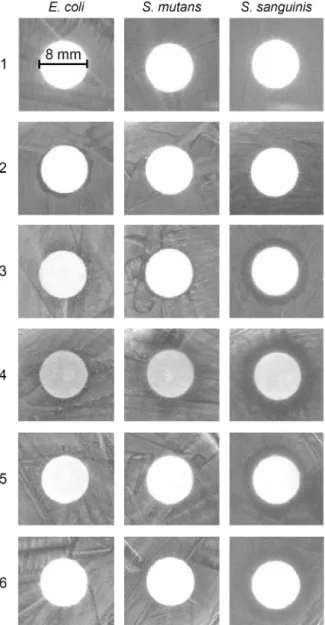
지표미생물로써 구강 토착미생물인 S. sanguinis와 그람음성 균주인 E. coil도 실험에 이용하였다. E. coil의 경우 2종의 식물 추출물에서 생육 억제환이 관찰되었으며, S. sanguinis의 경우 4종의 추출물에서 육안으로 식별이 가능한 생육억제환이 관 찰되었다(Fig. 1). E. coli의 경우 Ribes glaciale Wall. 추출물에서 직경 9 mm, Chesneya nubigena (D. Don) Ali 추출물에서 직경 10 mm 정도의 미세한 억제환을 관찰할 수 있었고, S. sangui- nis에서는 C. nubigena (D. Don) Ali 추출물에서 직경 10 mm, Salvia przewalskii Maxim. 추출물에서 직경 13 mm, Perilla fru- tescens (L.) Britton 추출물에서 직경 12 mm, Murraya koenigii (L.) Spreng. 추출물에서 직경 13 mm의 억제환을 확인할 수 있었다. 그러나 총 300종의 식물추출물 중 C. nubigena (D.
Don) Ali 추출물만이 S. mutans에 생육 저해 효과를 나타냈다 (직경 9 mm)(Fig. 1). C. nubigena (D. Don) Ali 추출물의 최소성 장억제농도(minimal inhibitory concentration, MIC)를 측정
하려 시도했지만, 추출물의 본래 탁도 때문에 시야 또는 분광 계를 이용한 MIC 측정이 불가능하였다. 다음으로 추출물의 최소살균농도(minimal bactericidal concentration, MBC)를 측정한 결과, 1.5 mg/ml 농도에서 S. mutans의 군집을 관찰할 수 없었다(Fig. 2).
C. nubigena (D. Don) Ali은 분류학적으로 중국 자생식물로 서 콩과 식물에 속하지만 이 추출물의 생리활성 및 효능에 관한 연구는 미비한 것으로 보인다[37]. 본 실험에서 사용된 C. nubigena (D. Don) Ali는 디스크 확산 실험과 최소살균농도 측정 실험 결과를 통해 추출물 내 S. mutans의 생육을 저해할 수 있는 낮은 농도의 항균 활성 소재가 함유되어 있는 것으로 판단된다. 그리고 사용된 다른 두 종의 균주에 항균 활성을 나타내는 결과로 보아 다양한 그람양성균 또는 그람음성균의 생육을 저해할 수 있을 것으로 예측된다.
S. przewalskii Maxim은 중국에서 의학 치료용으로 쓰이는
Fig. 1. Evaluation of antimicrobial activity of plant extracts. 1, DMSO as a negative control; 2, ethanol extract of R.
glaciale Wall.; 3, ethanol extract of C. nubigena (D. Don) Ali; 4, ethanol extract S. przewalskii Maxim.; 5, ethanol extract of P. frutescens (L.) Britton; 6, methanol extract of M. koenigii (L.) Spreng.
식물로 지역 주민들이 심혈관 질환 치료를 위해 사용한 것으 로 알려져 있다[20]. 앞선 연구에서 S. przewalskii Maxim의 페놀산 추출물이 사구체 신염 치료에 이용될 수 있다는 가능 성을 확인하였다[6]. S. przewalskii Maxim로부터 유래한 es- sential oils의 항균 효과를 확인하기 위해 최소성장억제농도 (minimal inhibitory concentration, MIC)를 측정한 결과, E.
coli나 Pseudomonas aeruginosa와 같은 그람음성균보다 Staphylococcus aureus와 S. epidermidis가 높은 감수성을 나 타내었다(MIC, 2.5 mg/ml) [30]. 또한, S. przewalskii의 essen- tial oil은 효모인 Candida albicans에 항진균성 활성이 있는 것
을 확인하였다(MIC, 5.0 mg/ml). 본 실험에서는 S. przewalskii Maxim을 에탄올 추출하여 사용한 반면에, 이 연구에서는 미세 번식을 통해 얻은 in vitro의 S. przewalskii 식물과 분양 받은 종자로부터 번식시켜 얻은 in vivo의 S. przewalskii 식물의 es- sential oils을 이용하여 MIC를 측정하였다. In vitro 식물과 in vivo 식물의 essential oil 활성을 비교해본 결과, in vitro 식 물로부터 얻은 추출물이 S. aureus와 S. epidermidis에 더 강한 항균 활성을 가지는 것으로 관찰되었으며, essential oil 성분 검사 결과로 in vivo보다 in vitro에서의 oxygenated mono- terpenes 비율이 2배 더 많은 것을 확인하였다. 탄화수소 화합 물보다 산소 함유 화합물이 일반적으로 높은 항균 활성과 항 진균 활성을 가진다고 알려져 있고[17], Oxygenated mono- terpenes의 주성분 중 하나인 borneol은 뛰어난 항균 활성을 나타내는 것으로 보고 되었다[9].
P. frutescens (L.) Britton은 들깨종에 속하는 꿀풀과(Lamia- ceae) 식물로 중국에서는 자소(紫蘇)라고 불리는데 자소는 우 리나라에서 흔히 말하는 들깨의 아종이다. 선행 연구에서 구 강 내 병원성 세균에 대한 들깨의 항균 활성을 확인하기 위해 MIC를 측정한 결과, 들깨 추출물이 실험에 사용된 S. mutans GS5, S. mutans OMZ175, S. mutans ATCC25175, S. mutans ATCC273524 모두에 항균 활성을 가지는 것으로 확인되었고 (MIC, 0.1, 0.1, 0.2, 0.05 mg/ml), 들깨에서 유래된 polyphenol 중 luteolin에서 항균 활성을 관찰하였다[34]. S. mutans GS5 strain에 관한 들깨의 ethanol 추출물과 ethyl acetate 추출물의 MIC 값을 비교해보면 ethanol 추출의 항균 활성(MIC, 1.6 mg/ml)보다 ethyl acetate 추출물의 항균 활성(MIC, 0.1 mg/
ml)이 높은 것으로 보고되었다. 또한, 들깨로부터 얻은 poly- phenol 중에서 luteolin 성분이 S. mutans GS5 strain에 강한 항균 활성이 있는 것을 확인하였다(MIC, 0.1 mg/ml). Luteolin 은 이 실험에서 사용한 다른 식물의 polyphenol인 quercetin 물질과 같이 hydroxyl group 구조를 가지는 반면, apigenin 성분은 hydroxyl group 구조를 가지지 않는다. 이 구조를 가 지는 polyphenol 성분은 여러 Streptococci에 항균 활성을 나 타내는 것으로 알려져 있다. 본 실험에 사용한 들깨의 아종 P. frutescens (L.) Britton을 ethanol 추출이 아닌 ethyl acetate 추출하여 실험을 수행할 필요가 있다고 판단된다. 그리고 이 추출물이 S. sanguinis에 대한 항균 활성이 있는 것으로 보아 luteolin과 같이 hydroxyl group 구조를 가지는 polyphenol과 유사한 성분을 함유하고 있을 것으로 추측된다.
추출물의 농도에 비례적으로 S. mutans의 생물막 형성을 저해
생물막 형성 분석법을 이용하여 총 300종의 해외 자생식물 추출물이 S. mutans의 생물막 형성능력에 어떠한 영향을 주는 지 확인하였다. 19종의 추출물에서 추출물의 농도가 1.25 mg/
ml에서 2.50, 3.75 mg/ml로 증가할수록 생물막 형성은 비례적
Fig. 2. Minimum bactericidal concentration (MBC) of ethanol extract of C. nubigena (D. Don) Ali against S. mutans. 1, 0.8 mg/ml;
2, 0.9 mg/ml; 3, 1.0 mg/ml; 4, 1.1 mg/ml; 5, 1.2 mg/ml; 6, 1.3 mg/ml; 7, 1.4 mg/ml; 8, 1.5 mg/ml.
Fig. 3. Effect of the plant extracts on biofilm formation. The black, gray or white boxes indicate that S. mutans cells were treated with 1.25, 2.50 or 3.75 mg/ml concentrations of each plant extract, respectively. All assays were performed in triplicate.
*, p<0.05 compared to the cells treated with 1.25 mg/ml concentration of plant extract, **, p<0.05 compared to the cells treated with 3.75 mg/ml concentration of plant extract. BM, biofilm media; Sm, S. mutans; DMSO, dimethyl sulfoxide.
으로 감소하였다(Fig. 3). 즉 추출물 농도에 의존하여 S. mutans 의 생물막 생성이 억제되는 것을 확인할 수 있었다.
본 실험에서 사용한 Citrus medica L.와 같은 감귤속에 속하 는 3종류의 citrus에서 추출된 essential oils의 생물막 형성에 대한 효과는 다른 연구팀에 의해 수행되었다[33]. Citrus hys- trix (Kaffir lime) essential oils은 24시간 배양했을 때, 0.25%
chlorhexidine과 비슷한 수준으로 S. mutans 생물막을 저해하 는 것으로 나타났다. C. monstrousa (pompia)와 C. paradise (grapefruit) essential oils은 P. aeruginosa의 생물막을 약 50%
저해하였고, C. albicans은 생물막을 70%까지 저해하였다.
Aspergillus fumigatus는 grapefruit essential oil에 의해서만 생
물막이 저해되었는데, 농도에 따라 생물막의 20, 50, 70%를
Fig. 4. Anti-biofilm effect of the plant extracts. The black, gray or white boxes indicate that S. mutans cells were treated with 1.25, 2.50 or 3.75 mg/ml concentrations of each plant extracts, respectively. All assays were performed in triplicate. *, p<0.05 compared to the control (BM + Sm + DMSO). BM, biofilm media; Sm, S. mutans; DMSO, dimethyl sulfoxide.
저해하였다(concentration, 10, 50, 100 mg/l, respectively). 앞 선 연구에서 사용한 C. hystrix은 일반적으로 태국에서 향신료 로 쓰이는 물질이다. 잎과 껍질 부위를 essential oils로 추출하 여 S. mutans의 생물막 저해 효과에 확인한 결과, 추출물의 농도에 따라 저해 효과가 증가하는 것으로 관찰했다. 본 실험 에서는 C. medica L. 잎, 줄기 부위를 에탄올 추출하여 사용하 였으며, C. hystri와 비슷하게 추출물의 농도에 따라 S. mutans 의 생물막 형성을 저해하지만 항균 활성을 나타내지 않았다.
그 밖에 Helicteres hirsuta Lour. 잎과 줄기 추출물의 항암 활성[28], Nauclea orientalis (L.) L.의 항말라리아 치료제 성분 [14], Scindapsus officinalis (Roxb.) Schott의 소염제로서의 효과 [8] 등의 여러 연구가 있지만, S. mutans에 관한 항균 활성에 관한 연구는 미비한 것으로 보인다. 생물막은 항균 활성 물질 로부터 균을 보호하는 역할을 하는 것으로 알려져 있으며, S.
mutans에게는 중요한 병원성 인자 중 하나이다[31]. 본 연구에 서 19종 식물추출물의 S. mutans에 대한 생물막 저해 효과는 추출물의 농도 증가와 비례관계를 이루는 것으로 관찰되었다.
추출물의 S. mutans에 대한 항균력과 생물막 형성 저해의 연관성
추출물의 농도와 비례적으로 효과가 나타나는 결과와 다르 게 최저 측정 농도인 1.25 mg/ml에서부터 생물막 형성을 저해 하는 식물추출물을 비교해 보았다(Fig. 4). 먼저 S. mutans에 항균 활성이 관찰되는 C. nubigena (D. Don) Ali 추출물의 생물 막 형성에 대한 효과를 보면, 실험에 사용한 최저 농도에서부
터 생물막 생성을 억제하는 효과를 확인할 수 있었다. 또한, S. mutans에 대한 항균 활성을 나타내지 않았던 S. przewalskii Maxim.과 P. frutescens (L.) Britton. 추출물들도 최저 농도에서 부터 생물막 형성을 저해하였다. 즉, 이 결과를 통해 우리는 추출물의 종류에 따라 항균작용, 생물막 형성 저해 또는 두가 지 효과를 모두 나타내는 기능적인 차이가 있을 것으로 예측 할 수 있다. 이와 유사하게 xylitol은 설탕의 천연 대체재로 충치 예방에 효과가 있는 것으로 널리 알려져 있다[25]. 그러나 앞서 확인된 생물막 저해 추출물과 유사하게 디스크 확산 실 험에서 생육 억제능이 관찰되지 않았다[10]. 이러한 추물물의 기능적 차이는 항균 활성과 생물막 저해 작용에 관련된 대사 작용 및 분자 기작이 서로 다르고 추출물에 의해 영향을 받는 목표 유전자가 서로 다르다는 것으로 해석될 수 있다. 그러므 로 전사체분석 기법(RNA-seq)을 활용한 후속 연구를 진행하 여 특정 천연추출물의 항균기작 분석 및 중요 목표유전자를 확보하고 항균 대체재로써 천연추출물의 기능적 가치를 판단 할 필요가 있다.
감사의 글
본 연구는 부산대학교 기본연구지원사업(2년)의 지원으로 수행되었음.
References