• 검색 결과가 없습니다.

Synthesis of Boron Nitride Nanotubes via inductively Coupled thermal Plasma process Catalyzed by Solid-state ammonium Chloride

N/A
N/A
Protected

Academic year: 2021

Share "Synthesis of Boron Nitride Nanotubes via inductively Coupled thermal Plasma process Catalyzed by Solid-state ammonium Chloride"

Copied!
6
0
0

로드 중.... (전체 텍스트 보기)

전체 글

(1)

ISSN 1225-7591(Print) / ISSN 2287-8173(Online)

Synthesis of Boron Nitride Nanotubes via inductively Coupled thermal Plasma process Catalyzed by Solid-state ammonium Chloride

Mi Se Chang

a

, Young Gyun Nam, Sangsun Yang, Kyung Tae Kim, Ji Hun Yu, Yong-Jin Kim and Jae Won Jeong

a

*

a

Metal Powder Department, Korea Institute of Materials Science, 797 Changwondae-ro, Seongsan-gu, Changwon 51508, Korea

(Received April 9, 2018; Revised April 15, 2018; Accepted April 24, 2018)

···

Abstract Boron nitride nanotubes (BNNTs) are receiving great attention because of their unusual material properties, such as high thermal conductivity, mechanical strength, and electrical resistance. However, high-throughput and high- efficiency synthesis of BNNTs has been hindered due to the high boiling point of boron (~ 4000

o

C) and weak interaction between boron and nitrogen. Although, hydrogen-catalyzed plasma synthesis has shown potential for scalable synthesis of BNNTs, the direct use of H

2

gas as a precursor material is not strongly recommended, as it is extremely flammable. In the present study, BNNTs have been synthesized using radio-frequency inductively coupled thermal plasma (RF-ITP) catalyzed by solid-state ammonium chloride (NH

4

Cl), a safe catalyst materials for BNNT synthesis.

Similar to BNNTs synthesized from h-BN (hexagonal boron nitride) + H

2

, successful fabrication of BNNTs synthesized from h-BN+NH

4

Cl is confirmed by their sheet-like properties, FE-SEM images, and XRD analysis. In addition, improved dispersion properties in aqueous solution are found in BNNTs synthesized from h-BN +NH

4

Cl.

Keywords: boron nitride nanotube, thermal plasma, BNNT, plasma synthesis, nanotube

···

1. Introduction

Boron nitride nanotube (BNNT), a structural analogue of hexagonal boron nitride (h-BN), is receiving great concerns among material researchers, because of its unusual material properties such as high thermal conduc- tivity [1], high Young’s modulus (up to 1.3 TPa) [2], and high electrical resistance [3], which have never been demonstrated with classical bulky materials, and it is believed to shape the future of mechanical and func- tional applications.

BNNTs are structurally similar with carbon nanotubes (CNTs), so many researches have tried to apply synthe- sis methods which was successful with CNTs. To date, various methods have been introduced to synthesize highly crystalline BNNTs such as chemical vapor deposi- tion (CVD) [4, 5], ball milling [6], arc discharge [7], and laser ablation [8]. However, these methods are limited to synthesizing BNNTs in only gram-level amounts. BNNT

synthesis mcethods developed so far are mostly based on seeded-growth mechanism, where boron containing solid- phase source are reacted with gas-phase nitrogen which results in successive formation of B-N bonds with hexag- onal alternating one-by-one arrangement of boron and nitrogen atoms. In contrast to CNTs, the high-throughput and high-efficiency synthesis of BNNTs was difficult, primarily due to [1] lack of vapor-phase boron precur- sors, and [2] highly strong bond of nitrogen molecules which hindered fast and efficient reaction between boron and nitrogen atoms. Further study needs to be employed for scalable synthesis of BNNTs along with cost-con- trolling methods.

The plasma process system provides a new pathway to the synthesis of scalable and size controllable BNNTs [9]. Extremely high temperature of thermal plasma (exceeding 10000 K) ensures vaporization of boron [10], and strong electric field generated in the plasma torch breaks N-N bond, and makes reactive nitrogen species

*Corresponding Author: , TEL: +82-55-280-3611, FAX: +82-55-55-280-3289, E-mail: [email protected]

(2)

Synthesis of Boron Nitride Nanotubes via inductively Coupled thermal Plasma process Catalyzed .... 121

facilitating B-N reaction. In plasma synthesis of BNNTs, firstly boron nanoparticles are formed via nucleation from highly concentrated boron vapors just after passing high-temperature plasma region. Boron nanoparticles formed during the plasma process act as the seed mate- rial for the growth of BNNTs. Because the growth of BNNT starts with the formation of boron seed and ends by the solidification of the boron, the growth of BNNTs is restricted only to temperature range of 2000~4000

o

C.

Boron seed resides in this region very shortly, less than several tens of ms, so there is no plenty of reaction time.

Furthermore, most of dissociated nitrogen atoms tend to recombine into N

2

just after passing the high-tempera- ture region of plasma, thus the frequency of active reac- tion between B and N is far below than expected and the growth of BNNTs is disturbed.

Here, hydrogen plays a big role in impeding the recom- bination by forming N-H bonds and thus consequently aiding the growth of BNNT as a vital N-source. Kim et al proved the theory through their thermal plasma synthe- sis of BNNTs with the precursor h-BN and H

2

gas [9].

BNNTs made from such precursors showed high yield of nanotubes compared to BNNTs fabricated from h-BN alone. However, direct use of H

2

gas as a precursor mate- rial is not strongly recommended as it is extremely flam- mable, having a wide explosive/flammability range (4% - 74% in air), meaning that even a small leak can cause a hazardous fire [11]. Therefore, use of other precursors is recommended for safety reasons, especially when synthe- sizing materials with high temperature processes.

Although many methods for synthesizing BNNTs are being developed, further study in BNNT based applica- tions/devices has not yet been explored extensively due to its difficulty in dispersing in aqueous solution [12].

BNNT solubility region lies at a low hydrogen bonding range, implying its hydrophobicity, thus lacking interac- tion with solvents with hydroxyl groups [13]. In order to fabricate BNNT composites or to apply to devices, it is crucial to be able to prepare BNNT in uniform and sta- ble dispersions [14].

Here, we present plasma synthesis of BNNTs in the help of catalytic solid-sate ammonium compounds with- out using explosive hydrogen. We have chosen NH

4

Cl as an ammonium compound, because NH

4

Cl does not leave any solid state byproduct during thermal decomposition,

and NH

4

Cl itself is well dissolvable in pure water. In this work, BNNTs were synthesized via RF-ITP with precur- sors h-BN, h-BN+H

2

, and h-BN+NH

4

Cl. Sheet-like BNNTs were collected from the collector filter only from the two combinations of precursors, h-BN+H

2

and h- BN+ NH

4

Cl, implying successful fabrication of nano- tubes. Also meaning that the hydrogen from NH

4

Cl has substituted the role of H

2

gas (impeding the recombina- tion of N

2

) and contributing to the synthesis of BNNTs.

As-synthesized BNNTs were dispersed in distilled water to test for dispersion ability in aqueous solution.

3. Experimental

BNNTs were synthesized via TEKNA PL-35LS with precursors h-BN, H

2

gas and NH

4

Cl. Precursors h-BN and NH

4

Cl were injected from the powder feeder to the plasma torch at feeding rate 4 g/min with 5 slpm of Ar carrier gas. BNNTs were first synthesized from h-BN only. Ar gas was first purged and filled into the system followed by 70 slpm N

2

of sheath gas. The second sam- ple of BNNTs was synthesized from precursors h-BN and H

2

gas with 5 slpm of Ar carrier gas. The sheath gas was programmed to 65 slpm N

2

, 15 slpm H

2

and 5 slpm of Ar carrier gas. The third sample of BNNTs was also syn- thesized at the same conditions with a precursor ratio of 1:1 for h-BN and NH

4

Cl but this time without H

2

gas.

The two types of powders were manually mixed and were put into the hopper to be injected from the powder feeder. The as-synthesized BNNTs were easily collected from the collector filter as the BNNTs were fabricated into sheet-like form. The aqueous dispersion test of BNNTs was performed by bath sonication for 15 min- utes.

The structural morphology of BNNTs were examined by Field Emission Scanning Electron Microscopy (Tes- can, MIRA3 LM) and X-Ray Diffraction (Rigaku, D/

Max-2500VL/PC). Distilled water was used to investi- gate the dispersion ability of BNNTs in aqueous solu- tion. Vacuum filtration was performed with PTFE filter with sub-20 nm pores.

4. Results and Discussion

The RF-ITP system (TEKNA PL-35LS) is arranged

(3)

into four major parts: the plasma torch, reactor chamber, cyclone chamber, and collector chamber as shown in Fig- ure 1 [15]. Precursor materials are injected into the injec- tion probe and into the thermal plasma created in the plasma torch induced by the induction coil. Figure 2 Fig. 1. Schematic illustration of RF-ITP system employed in this work.

Fig. 2. Mechanism scheme of BNNT synthesis with precursors (a) h-BN+H

2

(b) h-BN+NH

4

Cl via thermal plasma.

Fig. 3. Photographs of as-synthesized BNNTs from precursors h-BN+ NH

4

Cl via thermal plasma. (a) As-synthesized BNNTs

collected on metal filter, and (b) free-standing as-synthesized BNNT sheets peeled off from collector filter. Photographs of

BNNTs synthesized from (c) h-BN (d) h-BN+H

2

(e) h-BN+NH

4

Cl.

(4)

Synthesis of Boron Nitride Nanotubes via inductively Coupled thermal Plasma process Catalyzed .... 123

shows the mechanism scheme of BNNT synthesis via thermal plasma. As shown in figure 2(a), hydrogen from H

2

gas plays a role in impeding the recombination of N

2

molecule and forming highly reactive N-H molecules, which contribute to the synthesis of BNNTs. Figure 2(b) also shows a similar scheme, however, this time reactive N-H molecules come directly from dissociation of NH

4

Cl and contribute to the synthesis of BNNTs. Meaning, when NH

4

Cl is used along with h-BN as a precursor material, H

2

gas is no longer needed, solving the safety issues of using H

2

gas in extreme temperature synthesis such as thermal plasma. Figure 3 shows photographs of BNNTs synthesized from precursors h-BN+ NH

4

Cl. Fig- ure 3(a) shows how the sheet-like BNNTs were peeled off from the collector filter. As the sheets are peeled off, the sheets roll up and are easily peeled off from the sur- face of the filter. Figure 3(b) shows the peeled off and free-standing bundle of sheets of BNNTs. While the BNNTs exhibit grayish color when bundled up, it appears to be whiter when only one layer of BNNTs is peeled off.

Figure 3 also shows photographs of as-synthesized BNNTs, each synthesized from three different combina- tions of precursors. Figure 3(c) shows BNNTs synthe- sized from h-BN only while figure 3(d) and 3(e) shows BNNTs synthesized from h-BN+H

2

and h-BN+NH

4

Cl respectively. A difference can be seen between BNNTs synthesized from only h-BN and when synthesized from H

2

or NH

4

Cl as figure 3(c) does not show any sheet-like properties, and were solely collected in a powder form.

However, figure 3d show that BNNTs can fully be grown in our thermal plasma system with the precursor h-BN and H

2

gas as reported by Kim et al. [9]. Figure 3(e) also shows that BNNTs can fully be grown from the aid of only NH

4

Cl. The sheet-like and rolling properties seen in figure 3(b) and 3(c) implies the successful synthesis of nanotubes [16]. The synthesis of BNNTs was possible without H

2

gas as NH

4

Cl played a role in providing hydrogen radicals to form N-H bonds (impeding the recombination of N

2

molecule) and thus taking over the role of H

2

gas and contributing to the growth of nano- tubes. FE-SEM images shown in figure 4(a) and 4(b) confirms the unsuccessful growth of BNNTs from only h-BN as no nanotubes are found in the images. Figure 4(c) and 4(d) show successful growth of BNNTs from h- BN+H

2

and same goes with figure 4(e) and 4(f). Figure

4(e) and 4(f) however show a slightly larger portion of nanoparticles distributed between the nanotubes com- pared to Figure 4(c) and 4(d). While nanotubes in figure 4(c) and 4(d) are entangled with each other, nanotubes in figure 4(e) and 4(f) are more widely distributed, which can improve its dispersion properties when dispersed in aqueous solutions.

In order to first distinguish the nanoparticles apart from the nanotubes, the as-synthesized BNNTs were character- ized by XRD analysis as shown in Figure 4(g). BNNTs Fig. 4. (a-f) FE-SEM images of BNNTs synthesized from (a, b) h-BN (c, d) h-BN+H

2

(e, f) h-BN+NH

4

Cl. (g) XRD analysis result of BNNTs synthesized from h-BN+H

2

and h-BN+

NH

4

Cl.

(5)

synthesized from h-BN and H

2

gas only shown in figure 4(g) exhibit h-BN peaks at 2 θ = 26, 50

o

implying hexag- onal structures of BNNTs [17]. BNNTs synthesized from h-BN+NH

4

Cl also exhibit h-BN peaks at 2 θ = 26, 50

o

. In addition, peaks at 2 θ = 43, 75

o

are also seen, indicating the presence of BH

12

N

3

O

3

[18] (ammonium borate). The presence of above peaks of nanoparticles implies that the nanoparticles distributed between the nanotubes in Fig- ure 4(e)-4(f) are synthesized through the thermal plasma process along with the synthesis of BNNTs. BH

12

N

3

O

3

[19] possess high solubility in aqueous solution, which may contribute to the dispersion of BNNTs as the distri- bution of nanoparticles impede the nanotubes from entan- gling with each other.

The dispersion ability of the BNNTs samples were tested in distilled water as shown in figure 5. BNNTs synthesized from h-BN+H

2

show poor dispersibility in distilled water as shown in figure 5(a). The sheet-like BNNT break into smaller pieces and remain in the solu- tion in a colloidal-like form. BNNTs synthesized from NH

4

Cl show improved dispersibility in aqueous solution as shown in figure 5(b). Differences can be seen from the two samples as the dispersed BNNTs exhibit opaque properties in figure 5(b) compared to figure 5(a). It is typical to show such opacity in solutions with well-dis- persed nanotubes [20], implying that BH

12

N

3

O

3

nanoparti- cles played a big role in contributing to the dispersibility

properties by impeding the entanglement of BNNTs in the fabrication process. The proposed principle of disper- sity enhancement in the help of reaction by product is schematically represented in figure 5(b).

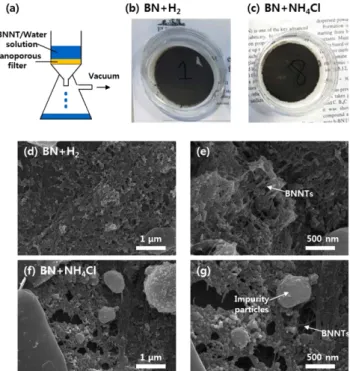
The dispersed BNNTs can be easily retrieved from the solution by vacuum filtration. Figure 6(a) schematically shows vacuum filtration process employed in this work.

BNNT/water solution was poured onto PTFE filter hav- ing sub-20 nm pores, and solvents are extracted out via vacuum pumping. Figure 6(b) and 6(c) show optical images of filters poured with solutions dispersed with H

2

- catalyzed-synthesized and NH

4

Cl-catalyzed-synthesized BNNTs, respectively. Dark color of collected BNNTs is originated from increased volumetric density of boron nanoparticles due to compaction of BNNTs during filtra- tion process. Figure 6(d, e) and Figure 6(f, g) shows SEM images captured from surfaces of filters decorated with H

2

-catalyzed-synthesized and NH

4

Cl-catalyzed-syn- thesized BNNTs, respectively. Compacted PNNT fibrils can be clearly seen in the images, and it is difficult to Fig. 5. Dispersion test of BNNTs in distilled water synthesized

from (a) h-BN+H

2

(b) h-BN+NH

4

Cl, and their schematic representation of dispersion principles.

Fig. 6. Vacuum filtration process of BNNT solution. (a) A schematic of vacuum filtration process. (b, c) Optical images of filters poured with solutions dispersed with H

2

-catalyzed- synthesized (b) and NH

4

Cl-catalyzed-synthesized BNNTs (c).

(d-g) SEM images captured from surfaces of filters

decorated with H

2

-catalyzed-synthesized (d, e) and NH

4

Cl-

catalyzed-synthesized BNNTs (f, g).

(6)

Synthesis of Boron Nitride Nanotubes via inductively Coupled thermal Plasma process Catalyzed .... 125

find out the difference in areal density of BNNTs between two samples.

5. Conclusion

BNNTs were synthesized from three different combina- tions of precursors via thermal plasma. Because of the safety reasons of using H

2

gas in high temperature syn- thesis, the use of different precursor other than H

2

gas was investigated. h-BN was used as the base precursor with H

2

and NH

4

Cl as the independent variable. BNNTs synthesized from NH

4

Cl (without H

2

gas) showed suc- cessful fabrication of nanotubes with sheet-like and roll- ing properties. In addition, BNNTs synthesized from NH

4

Cl showed improved dispersibility in aqueous solu- tion compared to nanotubes synthesized from h-BN+H

2

gas. The BNNTs successfully retrieved from the solution by vacuum filtration.

Acknowledgements

This study was supported financially by Fundamental Research Program of the Korea Institute of Materials Sci- ence (KIMS).

References

[1] C. W. Chang, A. M. Fennimore, A. Afanasiev, D. Okawa, T. Ikuno, H. Garcia, Deyu Li, A. Majumdar, and A. Zettl : Phys. Rev. Lett., 97 (2006) 085901.

[2] N. G. Chopra and A Zettl : Solid State Commun., 105 (1998) 297 .

[3] C. H. Lee, M. Xie, V. Kayastha, J. Wang and Y. K. Yap : Chem. Mater., 22 (2010) 1782.

[4] O. R. Lourie, C. R. Jones, B. M. Bartlett, P. C. Gibbons, R. S. Ruoff and W. E. Buhro : Chem. Mater., 12 (2000) 1808.

[5] M.J Kim, S. Chatterjee, S. M. Kim, E. A. Stach, M. G.

Bradley, M. J. Pender, L. G. Sneddon and B. Maruyama : Nano Lett., 8 (2008) 3298.

[6] L. Lu Hua, C. Ying and M. G. Alexey. Nanotechnology.

21 (2010) 105601.

[7] A. Loiseau, F. Willaime, N. Demoncy, G. Hug and H.

Pascard : Phys. Rev. Lett., 76 (1996) 4737.

[8] D. P. Yu, X. S. Sun, C. S. Lee, I. Bello, S. T. Lee, H. D.

Gu, K. M. Leung, G. W. Zhou, Z. F. Dong, and Z. Zhang : Appl. Phys. Lett., 72 (1998) 1966.

[9] K. S. Kim, C. T. Kingston, A. Hrdina, M. B. Jakubinek, J.

Guan, M. Plunkett, and B.Simard : ACS Nano. 8 (2014) 6211.

[10] K. Keun Su, K. Myung Jong, P. Cheol, C. F. Catharine, C.

Sang-Hyon and T. K. Christopher : Semicond. Sci. Tech- nol., 32 (2017) 013003.

[11] Fact Sheet: Hydrogen Safety [Internet]. Office of Envi- ronment, Health & Safety. 2013.

[12] C. Lee, S. Bhandari, B. Tiwari, N. Yapici, D. Zhang, Y.

Yap. Molecules. 21 (2016) 922.

[13] A. L. Tiano, C. Park, J. W. Lee, H. H. Luong, L. J. Gib- bons, S.-H. Chu, et al., editors. Boron nitride nanotube:

synthesis and applications. SPIE Smart Structures and Materials + Nondestructive Evaluation and Health Moni- toring; 2014: SPIE.

[14] G. Ciofani, G. G. Genchi, I. Liakos, A. Athanassiou, D.

Dinucci, F. Chiellini V.Mattoli : J. Colloid Interface Sci., 374 (2012) 308.

[15] B Todorović-Marković, Z Marković, I Mohai, Z Nikolić, Z Farkas, J Szépvölgyi, E Kovats, P Scheier and S Feil : J. Phys. D. 39 (2006) 320.

[16] C. Zhi, Y. Bando, C. Tang and D. Golberg : Mater. Sci.

Eng. R Rep., 70 (2010) 92.

[17] T. H. Ferreira, D. C. F. Soares, L. M. C. Moreira, P. R. O.

da Silva, R. G. dos Santos and E.M.B. de Sousa : Mater.

Sci. Eng., C. 33 (2013) 4616.

[18] J. Hannauer, U. B. Demirci, C. Geantet, J. M. Herrmann, and P.Miele : Phys. Chem. Chem. Phys., 13 (2011) 3809.

[19] Boron Specialties. Available from: http://www.boron.

com/ammonia_borane.html.

[20] J. Yu, Y. Chen and B.M.Cheng : Solid State Commun.,

149 (2009) 763.

수치

Fig. 3. Photographs of as-synthesized BNNTs from precursors h-BN+ NH 4 Cl via thermal plasma
Figure 3 also shows photographs of as-synthesized BNNTs, each synthesized from three different  combina-tions of precursors
Fig. 6. Vacuum filtration process of BNNT solution. (a) A schematic of vacuum filtration process

참조

관련 문서