http://dx.doi.org/10.14577/kirua.2016.18.4.53
A Study on User Satisfaction of Village Bathhouses in Rural Areas
- Focusing on Pilot Project of Common Facilities for Rural Seniors - Hyun-Hak Do1, Kyeonghwa Byun2, Seung-Geun Kim3, Jae-Hyung Seo4
1Professor, School of Architecture, Yeungnam University
2Assistant Professor, University Industry Cooperation Foundation, Catholic Kwandong University
3Professor, Department of Architecture, Gangdong University
4Representative Architect, SUN Architects and Planners
Abstract
The purpose of this study is to evaluate user satisfaction with village bathhouses, selected from a two-year pilot project of common facilities for seniors in rural areas from 2014 to 2015. A survey was conducted using a questionnaire to evaluate user satisfaction, and 96 questionnaires were collected from 10 village bathhouses. User satisfaction was evaluated in five categories with a five-point scale: location and spatial composition; emotions and intimacy; safety;
hygiene and equipment; and maintenance and management. The results are as follows. First, scores on hygiene and equipment stood at four points or higher, indicating higher user satisfaction. However, scores on the other four categories were below four points. But when overall user satisfaction was evaluated on a five-point scale, the average score stood at 4.13out of five points and 89.5 out of 100 points. These findings suggest that users were generally satisfied with the bathhouses. Second, a comparison of bathing patterns from before and after bathhouse construction in villages revealed that 42.7% of residents had previously gone to neighboring villages to bathe. Local bathhouse construction led to an increase in overall bathing frequency, exerting a beneficial effect on hygiene. Third, general user satisfaction correlated more closely with items related to location and spatial composition than items of other categories, indicating that the architectural elements of the bathhouses have a major impact. Finally, access to a bathhouse at all times showed strong correlation with satisfaction levels, suggesting a need for the establishment of more bathhouses throughout rural areas.
Keywords: rural area, common facility for seniors, pilot project, village bathhouse
1. Introduction
1.1. Background and Purpose of Study
Seniors residing in rural areas face the need to repair their old and decrepit homes, and therefore live in inadequate housing where they do not utilize heating in winter due to high costs. Poor housing environments in rural areas are causing rural villages to transform into depopulated villages or marginal villages, bringing about imbalances in regional development.
The growing number of seniors and elderly single-person households in rural areas means an overall increase in a vulnerable social class with an inadequate standard of living. This phenomenon is connected with growing isolation from social relationships and higher rates of depression, suicide, and solitary undiscovered deaths. In 2015, the rural population aged 65 and older numbered 1.83 million, or 20.9% of the rural population as a whole. Single-person households aged 65 and older
numbered 444,000 (13.3%). Suicide rates are higher in rural areas than urban areas.
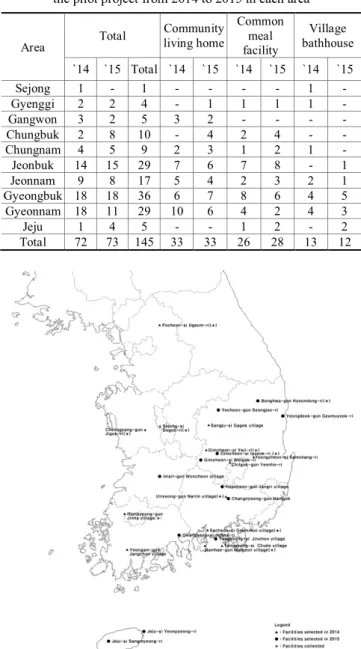
In addition to these problems of an aging society, poverty, and lonely deaths, disadvantaged rural areas are a blind spot for medical welfare. With the intent of promoting basic housing and security in old age for rural seniors, in addition to expanding health, medical and welfare benefits, Korea’s Ministry of Agriculture, Food and Rural Affairs announced the “Common Facilities for Seniors in Rural Areas Pilot Project” in January 2014 as an alternative welfare model to address the issue of the aging rural population. The pilot project intends to provide a basic residential environment for seniors who are struggling with aging, poverty and lonely death and have difficulty in accessing medical services. Over a period of two years from 2014 to 2015, public facilities for rural seniors in the form of community living homes, common facilities for meals, and public bathhouses have been established as demonstration projects on a national scale (Table 1).
The pilot project of constructing common facilities for seniors in rural areas is a measure aimed at overcoming and resolving problems of the aging rural population. With the exception of community living homes, the common facilities for meals and village bathhouses established in Corresponding Author: Kyeonghwa Byun, Assistant Prof., Catholic
Kwandong University, 24 Beomil-ro 579beon-gil, Gangneung-si, Gangwon-do, Korea
Tel: 82-33-649-7423 Fax: 82-33-647-3436 e-mail: [email protected]
this pilot program can become a means of providing welfare benefits to all rural residents and pave the way for creating new, smaller-scale models of welfare.
From an architectural standpoint, guidelines for design standards for these three types of public facilities were provided in order to expand safe and convenient public facilities for seniors. Mandatory design guidelines for universal access were implemented to ensure the construction of senior-friendly buildings. In addition, the evaluation of facilities following usage has allowed for the diffusion and dissemination of design standards for public facilities for senior citizens.
The pilot project entailed public participation through the positive encouragement of the utilization of unused village meeting halls, senior centers, welfare centers, closed schools, storage facilities, vacant homes, and other buildings. Thus, the project carried out the purpose of making maximum use of unused village facilities.
Table1. The number of common facilities for seniors built under the pilot project from 2014 to 2015 in each area
Area Total Community
living home
Common meal facility
Village bathhouse
`14 `15 Total `14 `15 `14 `15 `14 `15
Sejong 1 - 1 - - - - 1 -
Gyenggi 2 2 4 - 1 1 1 1 -
Gangwon 3 2 5 3 2 - - - -
Chungbuk 2 8 10 - 4 2 4 - -
Chungnam 4 5 9 2 3 1 2 1 -
Jeonbuk 14 15 29 7 6 7 8 - 1
Jeonnam 9 8 17 5 4 2 3 2 1
Gyeongbuk 18 18 36 6 7 8 6 4 5
Gyeonnam 18 11 29 10 6 4 2 4 3
Jeju 1 4 5 - - 1 2 - 2
Total 72 73 145 33 33 26 28 13 12
Fig. 1. Area distribution of bathhouses in pilot project
Among the common facilities for seniors constructed in rural areas in the two-year pilot project from 2014 to 2015, village bathhouses are the focus of this study. The purpose of this study is to evaluate user satisfaction with the bathhouses. A survey was conducted using a questionnaire to evaluate user satisfaction.
The word “bathhouse” in the context of the pilot project translates literally to “small bathhouse.” They are public facilities for all village residents, but their size is small due to a low number of users, as they are constructed in villages in rural areas. Therefore, the small bathhouses of the pilot project are referred to as
“village bathhouses” in this study.
1.2 Research subjects and methods
The subjects of this study were selected from 28 village bathhouses constructed as part of the pilot project of common facilities for the elderly in rural areas from 2014 to 2015. Through a field survey, a questionnaire-based survey was conducted at bathhouses currently in operation. Facilities with completed construction but an operation period of less than one month were excluded from the research.
A questionnaire was distributed to bathhouse users and included questions regarding user information, user satisfaction, and changes before and after using the bathhouses. User satisfaction was comprised of five categories: location and spatial composition; emotions and intimacy; safety; hygiene and equipment; and maintenance and management. These categories were evaluated on a five-point scale, while overall user satisfaction was assessed on both a five-point scale and a 100-point scale.
Leaders of villages, presidents of senior councils, operations directors, and other village leaders distributed and collected questionnaires in person. Research was conducted during the period from March 26, 2016 to July 30, 2016.A total of 96 questionnaires were collected from 10 village bathhouses1)(Table 3).
To prevent results from a single village from exerting a disproportionate effect on overall results, 10 or fewer questionnaires were accepted from each village.
Table 2. Question composition of satisfaction evaluation
Contents No. of
Question s
Type
User Information
Outline 7 Multiple
Choice
Usage feature 8
Evaluation in satisfaction
Location & spatial composition 11
5-point scale Emotions & intimacy 7
Safety 1
Hygiene &equipment 8 Maintenance &management 7
Overall satisfaction 1
1 100-point scale Bathhouse usage before and
after local construction 5 Multiple choice
Total 50
Table 3. Number of bathhouses subjected in the research Area No. of questionnaire No. of bathhouses
Sejong City 10 1
Gyenggi 11 1
Chuungnam 10 1
Jeonam 7 1
Gyeongbuk 33 3
Gyeongnam 25 3
Total 96 10
2. Establishment background of village bathhouses Bathing is an extremely individual and private behavior that entails the exposure of one’s uncovered body. The public bathhouse is a public space where this type of private behavior occurs in the company of total strangers who use bath water together. Thus, in rural areas, it is a place where residents can meet each other and develop community.
Development of public bathhouses began in earnest during the Japanese colonial period, when many Japanese people migrated to Korea. The Japanese had established frequent bathing habits based on climatic and topographical conditions. As Japanese immigrants to Korea experienced inconveniences in bathing, they decided to construct public bathhouses, but were unable to begin due to fierce opposition from the Korean population. At the time, Koreans considered undressing and bathing in the company of others in a public place to be extremely low-class behavior. Amid such opposition, the first public bathhouse was constructed in 1924 in Pyongyang. The first public bathhouse was constructed in Seoul in 1925, and following Korean independence, the number of public bathhouses increased due to the growing population and advancing ideas about hygiene.2)
At this time, the city government began to establish public bathhouses as welfare facilities. The function of bathhouses also began to expand from simply washing one’s body to enjoying a place of relaxation.
As interest in quality of life has risen in recent years, there has also been increased interest in bathing for the purposes of health enhancement and recovery from fatigue, with bathing now being considered a means of rest, recuperation, and treatment. There is research on correlations between bathing and health, correlations between bathing and centenarianism, the effect of bathing on specific diseases and recovery from fatigue, the correlation of bathing with symptoms in young children, and the psychological effects of bathing. An examination of such research indicates that in contemporary society, the purpose of bathing is expanding beyond essential hygiene to encompass mental and physical health.
As a public space, bathhouses are becoming community areas where family members and neighbors can engage in activity together, fathers and sons and mothers and daughters can scrub each other’s backs, and neighborhood residents can greet each other and share
conversation.
One survey3)on urban and rural seniors’ bathing habits indicated that 33.8% of rural seniors bathe daily, compared with 30.6% of urban seniors. However, the largest proportion of urban seniors, 36.1%, bathes every other day. This suggests that rural seniors who bathe every day (full-body baths and showers included) do so because they engage in farm labor. Furthermore, the public bathhouse is the preferred bathing location among rural seniors (61.4%), while bathing at home is preferred by the majority of urban seniors (63.9%). This is because urban homes tend to have better-equipped bathrooms than rural homes, but rural seniors’ desire to save on heating costs may also be an important factor. Seniors residing in “eup” and “myeon”-designated rural areas report economic hardship (34.7%) as second only to health problems (51.5%) among the difficulties they face;
thus, a poor housing environment may also be seen as a factor causing them to prefer bathhouses.
Bathing is significant behavior in hygiene and fatigue recovery for rural seniors, but few studies have been conducted. In Japan, small bathhouses in villages have been used as tourism resources based on hot springs.
Those bathhouses play the role not only of sanitary facilities, but also as a regenerative asset for villages.
However, bathhouses in this study play a sanitary role and are facilities for all ages, as well as being aimed at seniors in Korea as a form of welfare.
The small bathhouses included in this pilot project were preceded by the first small public bathhouse in Anseong-myeon area of Muju county in Jeollabuk-do, Korea. A small public bathhouse for people who had gone out neighboring villages for bathing was designed by Jung Ki-Young4) inside the building of the Anseong-myeon office. After this Muju project, construction of small bathhouses began in other rural areas throughout Korea. Such bathhouses feature a single bathing space, with men and women utilizing the bathhouse on different days.
As rural seniors continue to face economic difficulties, uncomfortable and poor housing situations, and inadequate access to public bathing facilities, village bathhouses hold great significance as a potential solution.
3. Evaluation of user satisfaction 3.1 User information
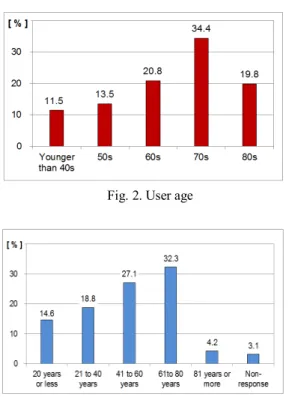
This study included 48 men and 48 women for a total of 96 users with a 50-50 gender split. In terms of age, those in their 70s formed the highest proportion of users at 35.4%, followed by those in their 60s, 80s, and 50s.
Those in their 40s or younger represented 11.4% of users.
Although the bathhouses were built with the purpose of supporting seniors, village residents of various ages made use of them, as they were located within their villages. The oldest user was 96 years old, and average
user age was 67.6 years old.
In terms of period of residence, users who had lived in their current villages for 61 to 80 years accounted for the highest proportion of users with 38.2%, followed by users who had lived there for 41 to 60 years.
Approximately 70% of users had resided in their current villages for 41 years or more. The shortest period of residence recorded was one year, while the longest was 92 years. The average period of residence was 53.3 years.
Responses of how users came to reside in their current villages revealed that 50% were born in their current villages,24%came to their current villages after marrying men who resided there,19.8% moved to their current villages, and 5.28% left urban areas to become farmers in the villages.
Users took between 1 minute and 60 minutes to reach a bathhouse, spending an average of 14.7 minutes in transit time. A total of 49% of users resided within 5 minutes of a bathhouse.65.6% of users walked to the bathhouse, while26% used vehicles. The proportion of users who rode vehicles to the bathhouse was higher than anticipated, as some bathhouses were located in townships rather than villages.
Questions regarding who accompanied users to the bathhouse revealed that users who came alone comprised the largest segment at 63.4%, followed by those who came with other village residents at 25.7%. Only a small proportion of users visited the bathhouse with family members. However, as most bathhouses designate usage according to gender based on day of the week, date, or morning versus afternoon times, these results appear to be an effect of gender segregation and unrelated to family life.
Fig. 2. User age
Fig. 3. Period of residence
Fig. 4. Residence background
a. Time b. Transportation Fig. 5. The time and transportation to reach a bathhouse
Fig. 6. Companion at bathhouse
3.2 Location and spatial composition of bathhouses The 11questionsregarding location and spatial composition of the bathhouses utilized a five-point scale of assessment. The average score on all items combined stood at 3.78 points. The average score for bathhouse location was high, at 4.05 points. However, users were relatively less satisfied with the distance between their homes and the bathhouse, likely because bathhouses were largely located in villages with a township office.
The overall evaluation forth interior spaces stood at an average of 3.84 points. Users showed the lowest level of satisfaction with the rest area, followed by the finishing materials used for the interior. This was because vinyl sheeting, which becomes slippery when wet, was used as flooring in the changing rooms. Brightly colored, boldly patterned wallpaper, which may irritate some users, was also a feature of some bathhouses.
Among users who responded that the distance from home to bathhouse was too far, the average reported transit time was 53.7 minutes. Users who were satisfied
or highly satisfied with the distance reported average transit time of 11.2 minutes. Analysis of the correlation between transit time and satisfaction with distance revealed a correlation coefficient of -0.405, indicating that increased transit time correlated with decreased satisfaction. Thus, there was high satisfaction for bathhouse location in the center of villages or townships, but decreasing satisfaction with increased transit time.
3.3 Evaluation of emotions and intimacy
Seven questions concerning users' emotions and intimacy were evaluated on a five-point scale, with an average score of 3.91 points.
With a score of 4 points indicating satisfaction, questionnaire items were divided into two groupings.
Items which scored 4 points or higher included “I’ve become closer with other residents since the bathhouse was built,” “I enjoy talking with others while we bathe,”
“I like going to bathe because I find out what’s happening in the village,” and “It’s easy to use bathhouse facilities and equipment.” These items, representing intimacy with others and communal attitudes, all received an average score of 4 points or higher.
On the other hand, the items “I frequently ask others to go and bathe together,” “Even if I don’t want to, I go to the bathhouse if someone else asks me,” and “My children frequently suggest I go to the bathhouse”
received relatively low scores.
In terms of emotions and intimacy, users were satisfied by their improved intimacy with others and enhanced community life through the construction of village bathhouses, but there was little impact in the area of their personal lives. This is likely because bathing is a highly individual behavior.
Fig. 7. Evaluation of location and spatial composition
3.4 Evaluation of safety
The category of safety consisted of one item scored on a five-point scale, with an average score of 3.97 points.
Approximately 80% of users were satisfied with bathhouse safety, but 5.2% of users responded that the bathhouses were not safe.
A total of 132 responses were collected for the multiple-choice question as to why users felt the bathhouses were safe. “No changes in floor elevation”
had the largest proportion of responses at 36.4%, followed by “installation of handrails and other added equipment” (32.6%) and “easy-to-use handles on windows and doors” (28%). The remaining 3% of responses were “the floors are not slippery.”
An analysis of the free description question as to why users felt the bathhouses were unsafe can be summarized into four specific cases (Fig. 9).
First, users described how the steps leading up into the bath were slippery (Case 1). As a result of problems in the early stages of use, the steps were covered with synthetic carpet.
Second, users described how there were too many steps to climb when entering the bath (Case 1) or too high a step or elevation difference (Case 2).
Third, users described how seats in the rest area were narrow and had no backs (Case 3).
<Case 1><Case 2>
<Case 3><Case 4>
Fig.9. Cases of safety vulnerabilities
Fig. 8. Evaluation of emotions and intimacy
Fourth, users described how the doors leading into the bathhouse were heavy and posed a risk of fingers or toes being caught (Case 4).
3.5 Evaluation of hygiene and equipment
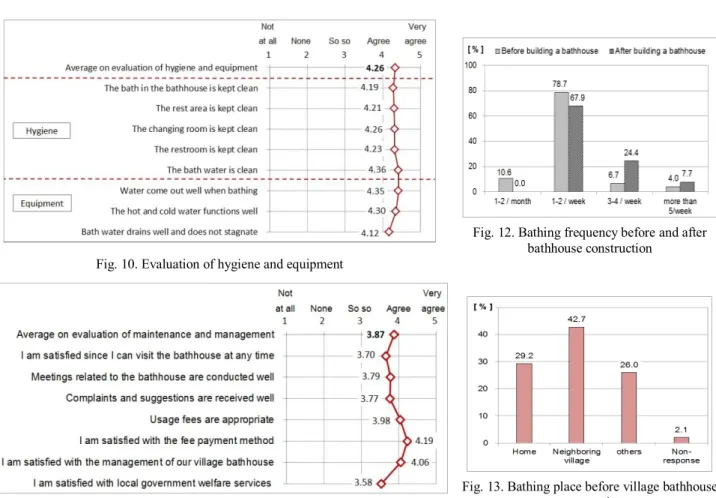
Eight questions were evaluated with five for hygiene and three for equipment on a five-point scale. The average score was 4.26 points, indicating that users were largely satisfied regarding these categories.
Users expressed satisfaction in response to all questions concerning the cleanliness of the major spaces of the bathhouses– the bath, rest area, changing room, and restroom – as well as water quality. Users also expressed satisfaction regarding water supply and drainage and the supply of cold and hot water.
As the bathhouses assessed in this study had been constructed in 2014 and 2015 as part of the pilot project and had operated for less than two years, problems in terms of hygiene and equipment had not yet occurred.
3.6 Evaluation of maintenance and management Seven questions regarding bathhouse maintenance and management were assessed on a five-point scale. The average score was 3.87 points, indicating that users were somewhat less satisfied with the maintenance and management aspect.
Out of the items with an average score of 4 points or lower, the item “I am satisfied since I can visit the
bathhouse at any time” scored relatively low because most bathhouses were open only two days per week.
Furthermore, the item “I am satisfied with local government welfare services connected to bathhouse”
had relatively low scores because many bathhouse users were residents of small villages with no bathhouses of their own. Thus, they had fewer opportunities to participate in related meetings or gathering in townships where bathhouses were located. Scores on items related to fee payment and management indicated general user satisfaction.
4. Before-after comparison of bathing patterns An examination of bathing patterns prior to bathhouse construction indicated that42.7% of respondents had gone to a village with a bathhouse, while29.2% had bathed at home and 26.03%had bathed elsewhere.
Both before and after bathhouse construction, the majority of respondents fell into the category “one to two baths per week.” Following bathhouse construction, this category decreased by 16%. On the other hand, the categories “three to four baths per week” and “five or more baths per week” increased by 27%. The category
“one to two baths per month” declined to 0%. While the category “one to two baths per week” decreased following bathhouse construction, the elimination of the
“one to two baths per month” category and the increase
Fig. 12. Bathing frequency before and after bathhouse construction
Fig. 10. Evaluation of hygiene and equipment
Fig. 13. Bathing place before village bathhouse construction
Fig. 11. Evaluation of maintenance and management
in respondents who bathed three, four, or five times a week indicates an overall increase in bathing frequency.
After converting the “one to two baths per month”
category into a weekly average, the average number of baths per week before and after bathhouse construction increased by 0.58, rising from 1.41 baths per week to 1.99 baths per week.
42.7% of users had bathed in neighboring villages before the village bathhouse construction. Bathhouse construction thus improved village welfare, which is a significant and positive effect of the construction of bathhouses in villages.
5. Overall evaluation
5.1 Comparison of satisfaction across categories Overall user satisfaction with the bathhouses was measured with a single question on a five-point scale, with an average score of 4.13 points. Measurement on a 100-point scale yielded an average score of 89.5 points.
These results indicated that users were generally satisfied with the bathhouses.
Among five categories evaluated on a five-point scale, only the hygiene and equipment category scored above 4 points, indicating satisfaction. The other four categories all scored below 4 points, indicating lower satisfaction levels.
The differences in scores below 4 points were slight, but the categories scored in the following order from highest satisfaction to lowest satisfaction: safety;
emotions and intimacy; maintenance and management;
and location and spatial composition.
Table 4.Evaluation on public bathhouse
Categories Average
Location and spatial composition 3.78
Emotions and intimacy 3.91
Safety 3.97
Hygiene and equipment 4.26
Maintenance and management 3.87 Average on evaluation of satisfaction 3.96
Overall satisfaction 4.13
5.2 Factors affecting satisfaction
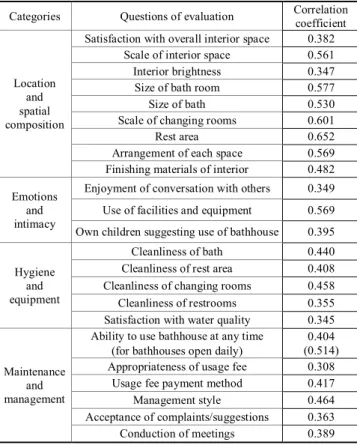
On a 100-point scale, evaluation questions that correlated with user satisfaction scores by a correlation coefficient of 0.3 or greater are listed in Table 5.
Of the categories that correlated with overall user satisfaction, nine were related to location and spatial composition, three were related to emotions and intimacy, five were related to hygiene and facilities, and six were related to maintenance and management. No category showed a correlation coefficient greater than 0.7, and satisfaction in all categories positively correlated with overall user satisfaction with the bathhouses.
In terms of location and spatial composition, scores
for individual categories regarding interior space showed greater correlation with overall satisfaction than the overall interior space category. In particular, scores for the rest area and scale of changing rooms showed high correlation with overall satisfaction.
Satisfaction in the category of emotions and intimacy correlated with increased satisfaction with use of facilities and equipment, which appeared to arise from an increased psychological sense of security. The enjoyment of conversation with others and instances of one’s children suggesting bathhouse use also correlated with increased satisfaction.
Scores for the category of hygiene and equipment only showed a correlation with scores regarding hygiene.
Scores for cleanliness and water quality exerted an impact on overall satisfaction.
In terms of maintenance and management, users’
increased satisfaction with the appropriateness of usage fees, the fee payment method, acceptance of complaints and suggestions, and the conduction of meetings correlated with increased overall satisfaction.
One interesting result from the maintenance and management category was that the ability to use the bathhouse at any time highly correlated with overall satisfaction. Although the majority of bathhouses evaluated in this study were open only two times per week, this category showed high correlation. For users at the two bathhouses open daily, this correlation increased further. This outcome suggests the need for construction of bathhouse facilities in rural areas where constant bathhouse access is difficult.
Table 5.Number of facilities examined in the research Categories Questions of evaluation Correlation
coefficient
Location and spatial composition
Satisfaction with overall interior space 0.382 Scale of interior space 0.561 Interior brightness 0.347 Size of bath room 0.577
Size of bath 0.530
Scale of changing rooms 0.601
Rest area 0.652
Arrangement of each space 0.569 Finishing materials of interior 0.482
Emotions and intimacy
Enjoyment of conversation with others 0.349 Use of facilities and equipment 0.569 Own children suggesting use of bathhouse 0.395
Hygiene and equipment
Cleanliness of bath 0.440 Cleanliness of rest area 0.408 Cleanliness of changing rooms 0.458 Cleanliness of restrooms 0.355 Satisfaction with water quality 0.345
Maintenance and management
Ability to use bathhouse at any time (for bathhouses open daily)
0.404 (0.514) Appropriateness of usage fee 0.308
Usage fee payment method 0.417
Management style 0.464
Acceptance of complaints/suggestions 0.363 Conduction of meetings 0.389
6. Conclusion and suggestions
This study examines a two-year pilot project of common facilities for rural seniors from 2014 to 2015, focusing on village bathhouses. A survey was conducted using a questionnaire to evaluate user satisfaction. 96 questionnaires were collected from 10 village bathhouses selected in the pilot project. User satisfaction was evaluated based on five categories: location and spatial composition; emotions and intimacy; safety; hygiene and equipment; and maintenance and management.
The average score for hygiene and equipment stood at 4 points or higher, indicating user satisfaction. However, average scores for the other four categories were all lower than 4 points. The average score for overall user satisfaction on a five-point scale was 4.13 points, and the average on a 100-point scale was 89.5 points. These results demonstrate that users were generally satisfied with the bathhouses.
Questionnaire items related to location and spatial composition displayed higher correlation with user satisfaction than did items in the other four categories assessed.
Contrary to anticipated results, user perception of bathhouse fees as reasonable showed lower correlation with satisfaction than did the ability to access the bathhouse at any time. This outcome suggests that there is a need for the construction of more bathhouse facilities in rural areas where there is inadequate bathhouse access.
42.7% of current bathhouse users had gone to bathhouses in neighboring villages to bathe before village bathhouse construction took place. Bathhouse construction thus improved village welfare. Average bathing frequency increased, benefitting overall hygiene.
Responses to questions on emotions and Intimacy indicate that bathing is not an individualized behavior.
Rather, bathhouse users find satisfaction in the opportunity to converse with others, and thus bathhouses exert a positive impact by strengthening rural village communities.
Public bathhouses for seniors in rural areas in this project exerted a significant effect and positive influence.
Residents demonstrated high satisfaction and overall heightened satisfaction as the average number of baths increased. In addition, welfare services are being concretely realized at the level where residents’ true circumstances are most evident.
Bathhouses are facilities with significant upfront costs, as well as operating expenses that continue following completion. A single bathing space, used by men and women at different times or days, is often utilized because many village bathhouses in rural areas are built at the minimum size. Therefore, ongoing study on the space planning of bathhouses, taking small size and gender difference into account, is necessary in order to revitalize village bathhouses in rural areas.
Notes
1) One bathhouse per one village was selected.
2) Reference 1) 3) Reference 2)
4) A Korean architect was born in 1945 and died in 2011. He emphasized societal responsibility of architects and participated in public projects. This small-size bathhouse was constructed as one of Muju project (1996-2006).
References
1) Back, S. (2005), A Design of Public Bath as Playground for Social Equality, Hanyang University, Master Thesis, p.28.
2) Cho, M. Y. (2008), The study of desiring and status of life the age in urban and agricultural village, Sogang University, Master Thesis, pp.45-47.
3) Nam, Y.(2015) A Policy of Senior Community Center in Rural Area-Focused on Pilot Project of Senior Community Center, Journal of Korea Institute of Rural Architecture, 17(1), 121-128
Received : 2016. October 10 Revised : 2016. November 11 Accepted : 2016. November 11