연료 전지 구성요소에 사용되는 탄소 재료에 관한 고찰
장민혁
1
, 강유진1
, 조형근1
, 박초이2
, 심희수1
, 박주일3*
1한밭대학교 화학생명공학과 학사과정, 2한밭대학교 화학생명공학과 석사과정, 3한밭대학교 화학생명공학과 조교수
Review of Carbon Materials Used in Fuel cell Components
Min-Hyeok Jang
1
, Yu-Jin Kang1
, Hyung-Kun Jo1
, Cho-I Park1
, Hye-Soo Sim1
, Joo-Il Park3*
1Undergraduated Stutdent, Department of Chemical & Biological Engineering, Hanbat University
2Graduated Stutdent, Department of Chemical & Biological Engineering, Hanbat University
3Asistant Professor, Department of Chemical & Biological Engineering, Hanbat University
요 약 화석 연료 사용으로 인한 각종 환경오염의 정도가 심화됨에 따라 많은 국가에서 대체 에너지 개발을 위한 투자를 계속해서 진행하고 있다. 대체 에너지 중 하나인 PEMFC는 양극판, 전해질, 가스 확산 층, 전극 네 가지의 주요 구성 요소로 이루어져 있다. 이 중 양극판, 가스 확산 층, 전극은 보편적으로 카본 블랙, 탄소 섬유 등의 탄소 재료를 사용하여 제조한다. 탄소 재료들은 공정비용이 비싸거나 부식 등의 단점이 존재하는데 이를 개선하기 위해 많은 분야에서 연구가 진행되고 있다. 본 논문은 이 세 가지 구성요소들의 단점을 개선하기 위하여 시행된 여러 연구결과들을 취합하여 과거부 터 현재까지의 PEMFC에 어떤 문제점이 있었고 어떻게 개선되어 왔는지를 파악하여 PEMFC 연구 흐름을 파악한다.
주제어 : 탄소 재료, 연료 전지, 양극판, 가스 확산 층, 촉매 층
Abstract As the degree of environmental pollution caused by the use of fossil fuels intensifies, many countries continue to invest in the development of alternative energy. PEMFC, one of the alternative energies, consists of four main components: bipolor plate, electrolyte, gas diffusion layer, and electrode. Among them, bipolor plate, the gas diffusion layer, and electrode are generally manufactured using carbon materials such as carbon black and carbon fiber. These carbon materials are expensive in manufacturing process or have disadvantages such as corrosion, and research is being conducted in many fields to improve this. This paper collects several research results conducted to improve the shortcomings of these three components and examines the trends of PEMFC by grasping what problems have been and how they have improved.
Key words : Carbon material, Fuel cell, BP(Bipolar Plate), GL(Gas Diffusion Layer), CL(Catalyst Layer)
*Corresponding Author : Joo-Il Park([email protected]) Received December 29, 2020
Accepted February 20, 2021 Revised January 25, 2021
Published February 28, 2021
1. 배경
19세기 산업혁명부터 현재까지 주 에너지원인 화석연 료는 한정된 매장량, 지구온난화의 심화 및 대기오염 물 질 발생 등의 문제점으로 인해 전 세계적 기후 변화와 환
경규제 대응이 시급하다. 현재 범 국가 차원의 전략적 대 응책으로 자연 친화적이며 공급이 지속적이고, 에너지 안 보 측면에서도 기대가치가 높은 수소를 대체 에너지원으 로 활용하는 방안에 큰 관심을 기울이고 있는 실정이다.
한국의 경우, 2019년 수소경제를 3대 전략 투자 중 하나
로 선정하여 많은 투자가 이루어지고 있으며 수소차 및 연료전지 세계시장 점유율 1위 달성을 목표로 설정하는 등 전방위적인 수소경제 활성화 전략 추진에 집중하고 있다[1].
이로 인해 수소를 활용하는 연료전지가 각광받고 있다.
전해질, 작동 온도 등에 따라 고분자 전해질 (PEMFC), 직접메탄올 (DMFC), 고체산화물 (SOFC), 인산염 (PAFC), 용융염 (MCFC) 연료전지 등으로 분류가 가능하다. 이 중 수소의 소모가 가장 클 것으로 예상되는 것으로 수송 분야에서 응용 가능한 연료전지는 PEMFC이다[2,3].
PEMFC는 셀이 층층이 쌓인 스택에서 전기가 생산되 며, 이 셀 스택은 양극판, 가스 확산 층, 촉매 층 및 전해 질의 네 가지 구성요소로 이루어져 있다. 이중 양극판, 가 스 확산 층 및 촉매 층은 우수한 전기 전도도와 우수한 기계적 특성 등을 요구 하고 있다. 이 요구조건 대부분을 충족하는 물질이 탄소이기 때문에 보편적으로 탄소 재료 를 사용하여 전해질을 제외한 구성요소들을 제조한다. 본 고에서는 PEMFC의 구성요소에 주로 사용 또는 연구되 어 지고 있는 탄소재료에 대하여 소개하고자 한다.
2. 연료전지에 사용되는 탄소
2.1 Carbon black (CB)
무산소 및 희박 산소하의 불활성 환경에서 탄소 함유 물질을 가열했을 때 생성되는 물질이 카본 블랙이다. 일 반적으로 직경 50nm 미만인 구형에 가까운 흑연 입자로 구성되어 있으며 이는 약 250nm의 응집체로 합쳐질 수 있다[4]. 각 입자는 파라 결정형 평면 구조를 가지고 있으 며 0.35~0.38의 면간 간격을 가진 여러 개의 난층 구조 로 이루어져 있다[5]. 형태와 입자 크기 분포는 재료와 열 분해 과정에 따라 차이를 가지게 되며 이는 표면적을 직 접 결정할 수 있다는 큰 장점을 가지고 있다. 카본 블랙 은 탄소 전구체에 인산이나 염화아연을 첨가 시키는 화 학적 활성화 방법 및 고온 및 고압 하에서 증기/이산화탄 소로 활성화하는 방법이 있다[6].
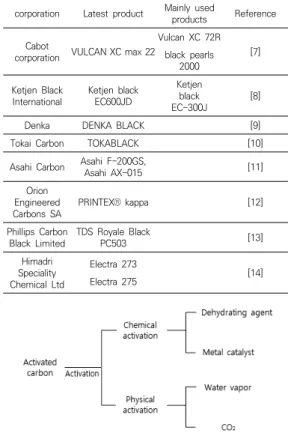
카본 블랙은 보편적으로 양극판, 촉매 지지체, 가스 확 산 층에 널리 사용되고 있으며 연료전지용으로 상용화된 제품 역시 많다. 상용화된 제품들은 Table 1에 기재하였 다. 카본 블랙은 비 표면적이 높기 때문에 이를 담체로 하여 함침법, 콜로이드법, 이온 교환법 등의 방법을 사용 하여 백금을 함침시켜 사용한다[15]. 카본 블랙의 낮은 분산성을 극복하기 위해 탄소 표면에 카르복실릭, 페놀
릭, 카르보닐 그룹 등을 화학적 활성화 처리에 사용하였 다. 그러나 이는 표면 처리 과정에서 발생하는 환경 문제 로 인해 2017년도부터 현재 까지는 저 농도의 환경 친화 적인 유기산을 사용하고 있다. 카본 블랙은 탄소 부식에 취약하므로 계속해서 대체재를 연구하고 있다[16].
2.2 Activated Carbon (AC)
활성탄은 다공성이며 표면적이 높아 흡착성이 우수하 여 화학반응이 빠르게 일어난다. 물리적 형상에 따라 분 말상, 파쇄상, 조립상, 섬유상, 천상, 액체상 및 페인트상 등이 존재하며 기초 원료에 따라 식물질, 석탄질, 석유질 및 폐기물질 등으로 분류가 가능하다. 활성화 방법은 물 리적 활성화 방법과 화학적 활성화 방법이 있다. 입자 크 기는 20~30㎛ 정도로 상대적으로 크지만 활성화 과정을 통해 미세 다공성 및 BET 표면적을 증가시킨 후 사용이 가능하다[17]. 각각의 활성화 공정은 원료나 형상에 따라 성능이 다르게 나타난다[18]. 현재 촉매 지지체 혹은 전 해질로 적용시키기 위한 연구가 진행되고 있다.
corporation Latest product Mainly used
products Reference Cabot
corporation VULCAN XC max 22
Vulcan XC 72R black pearls
2000 [7]
Ketjen Black
International Ketjen black EC600JD
Ketjen black
EC-300J [8]
Denka DENKA BLACK [9]
Tokai Carbon TOKABLACK [10]
Asahi Carbon Asahi F-200GS, Asahi AX-015 [11]
Orion Engineered
Carbons SA PRINTEX® kappa [12]
Phillips Carbon
Black Limited TDS Royale Black
PC503 [13]
Himadri Speciality Chemical Ltd
Electra 273
Electra 275 [14]
Table 1. Commercialized of carbon black
Fig. 1. Activation method of Activated Carbon
Author Main materials Study summary ref WANG Carbon steel - The investigation on the electrochemical performance and interfacial contact resistance after
surface modification to carbon steel [23]
Dweiri PP/Graphite, G/CB,
PP/G/CB, PP/G/PA
1)- Manufacturing bipolar plate using various composites
- The best eletrical conductivity on the PP/C/CB compisite. [24]
Hwang CF/Epoxy - Bipolar plate using CF/Epoxy composite
- Meet the criteria on the electrical conductivity and gas permeability [25]
Show Stainless steel, CNT/PTFE
2)- Forming the CNT/PTFE layer on the bipolar plate (carbon steel)
- Upgrade the fuel cell performance through the reduction of corrosion on the bipolar plate and
of contact resistance on the MEA [26]
Larijani 316L
Stainless steel - The characteristics according to carbon coating on the bipolar plate
- The improvement of the electrical and anti-corrosive performance [27]
Kim CF/C,
Phenolic resin - Manufacturing the hybrid bipolar plate combining CF/C and phenol resin
- Meet the target of DOE (electrical resistance and bending strength) [28]
Kim CF/Phenolic resin - Manufacturung the commecially available bipolar plate using CF/Phenol resin - Meet the target of DOE (2 times on the gas permeability and bending strength) by
flame-treating for 5 second (CF/Phenol resin) [29]
Kim CF/Phenolic resin - Bipolar plate (CF/Phenol resin) for the improvement of high temperature performance
- Remarkable increase of tensile and flexural strength [30]
Lim PEEK
3), CB, CF - Using the CB/CF and conducting nano-particle for the improvement of performance on the
PEEK bipolar plate [31]
Lee MWCNT,
CF/PE/PP - Development of CF/PP/PE bipolar plate filling with MWCNT
- Meet the target of DOE in the case of bipolar plate containing 5 wt% of MWCNT [32]
Lee CF,
MWCNT - Bipolar plate of CF containing MWCNT: Meet the target of DOE (flextural strength) [33]
Chanda Low carbon steel,
Ni/Ni-Cr-P - Bipolar plate coated with Ni/Ni-Cr-P on low carbon steel
- Higher anti-corrosive and hydrophobic character comparing with conventional one [34]
Alo C/CB,
PP/Epoxy - Bipolar plate using C/CB and PP/Epoxy: Meet the target of DOE (flectural strength)
- The increase of electrical conductivity in the proportion of filler contents [35]
Witpathom
wong PBA,
C/Graphene/CNT - Bipolar plate using the PBA filled with C/G/CNT [36]
Lee C/Silicon - Bipolar plate using gasket-integrated C/Silicone to reduce stack assembly cost [37]
Lee CF/Cyanate Ester - Bipolar plate using CF and cyanate ester for HT-PEMFC
- Remakable electrical and thermal chracteristics [38]
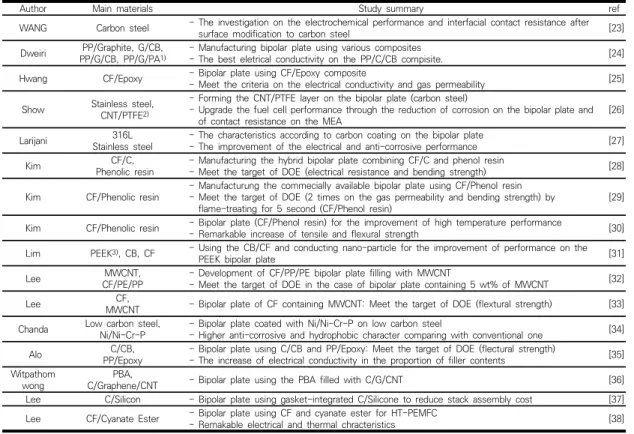
Table 2. Study of Bipolar Plate
2.3 Carbon nanotube (CNT)
1991년 Ijima [19]는 탄소 나노 튜브의 구조를 확인 하였다. 이 물질은 양쪽 끝이 닫혀있는 실린더 형태로 말 려진 그래핀 층으로 구성되어 있다. 이로 인해 분자 구조 내에 다른 원소의 원자를 포획할 수 있다. 이는 탄소 나 노 튜브가 수소 저장 능력을 가질 수 있게 하여, 연료 전 지 성능 향상에 기여할 수 있으며, 뛰어난 기계적, 전기적 특성 및 열 전도성은 연료 전지 응용에 매우 유리하게 만 든다.
탄소 나노 튜브의 최초 제법은 전기 방전법이다. 이후 대면적 합성에 유리한 화학 증착법이 사용되고 있으며, 최근 탄소 나노 튜브가 대량으로 합성 될 수 있는 방법으 로 기상성장법 외, 레이저 증착법, 플라즈마법, 열분해법 등의 다양한 제법이 있다[20,21].
1) Poly Aniline
2) Poly Tetra Fluoro Ethylene 3) Poly Ether Ether Ketone
2.4 Carbon fiber (CF)
대부분 탄소 섬유 유형의 필라멘트 직경은 5~15
정도로 매우 높은 인장 강도와 압축 강도를 가지고 있으 며, 부식과 피로에 대한 저항력이 높다. 이에 더하여, 화 학적 안정성, 불연성, 산화에 의한 열화 저항성, 다공성 및 전도성 이 우수한 특성을 가지고 있다. 탄소 섬유는 현재 양극판과 가스 확산 층으로 사용되고 있다.
탄소 섬유의 대표적인 제조방법은 PAN계와 Pitch계 제조법 두 가지로 분류된다. PAN계는 Acrylonitrile monomer를 사용하며 Pitch계는 석유 혹은 석탄 피치 를 사용하여 제조한다. PAN계는 고강도 섬유와 고탄성 섬유를 선택적으로 제조할 수 있는 특징을 가지며 Pitch 계의 경우, 석유 피치는 일반적인 탄소 섬유 뿐만 아니라 고강도 고탄성 섬유를 제조할 수 있지만 석탄 피치의 경 우엔 제조할 수 없다는 특징을 가지고 있다. 각 공정은
중합, 방사, 불연화, 탄소화, 사이징 등의 공정을 거쳐 탄 소 섬유가 제조된다[22].
Author Main materials Study summary ref
Chen CF, PTFE - Newly modified GDL with insertion of WML [39]
Tseng CF, PTFE - Relation of water management/cell performance with GDL/porous layer character
- The thick MPL show the high electron resistance in the proportion of the contents of PTFE [40]
Hung CF, PTFE - Thin GDL (50μm) [41]
Lee TGP-H-090 - The effect of MPL on the water behavior in the PEMFC [42]
Chen Carbon paler, PTFE - The effect of thermal conductivity on GDL according to the contents of PTFE [43]
Delikaya Porous carbon
nanofiber mats - The integrated investigation on GDL and gas diffusion electrode in the HT-PEMFC [44]
Zhang CF - The mechanical behavior of carbon species in the PEMFC [45]
Chuang TGP-H-060,
Freudenberg H23C8
- The effect of GDL on the PEMFC performance at the high electrical density
- The material from Toray presents better perfromance in the dry condition (but, the material from
Freudenberg in the wet condition) [46]
Park CB, CNT, CNF - GDL using CNF show the improved gas permeability and electrical conductivity [47]
Eom CF, PTFE, - The investigation on performance of PEMFC using stainless steel bipolar plate according to PTFE
contents in the GDL [48]
Hou CF, TiO2 - The investigation of cell performance with coating the TiO
2on the GDL [49]
Zhang CF - The investigation on the performance according to the aging in the GDL [50]
Jeon - - The effect on the thick of GDL by simulation of liquid transportation in the GDL [51]
Kim CF - The effect on the case of generating the crack in the GDL [52]
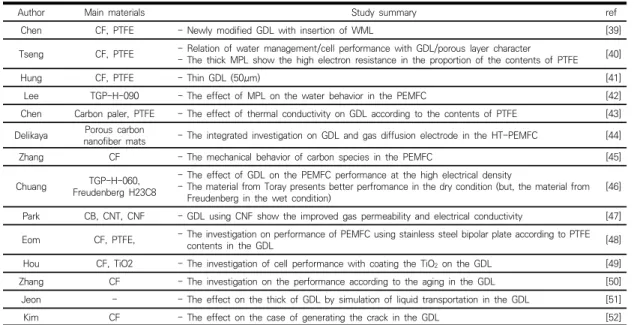
Table 3. Study of Gas Diffusion Layer
Author Main materials Study summary ref
Yuan CNF, Ni(OH)2
Mg(OH)2 - CNF synthesis with mixture of Ni(OH)2-Mg(OH)2 [54]
Ambrosio Orderd mesoporous
carbon - OMC as a catalyst support
- Mesoporous carbon improve the electrical conductivity and homogeneous dispersion of Pt [55]
Rego CF, PTFE - Caalyst support using carbon material containing 5 wt% of PTFE [56]
Yun Porous carbon
containing nitrogen - Catalyst support using the porous carbon containing nitrogen species
- Better dispersion of Pt [57]
Wu PtNi/Graphene,
Pt/CB - Comparison of Pt/CB and PtNi/G
- PtNi/G improve oxygen reduction and durability [58]
Suzuki CB, TEC10E50E - Combination of carbon black and TEC10E50E catalyst support [59]
Wang Porous carbon
nanofibers - Catalyst support using porous carbon nano fiber: Improved perfromance and stability [60]
Shahgaldi - - Review on the catalyst support using carbon black based materials
- Focuc on graphene doped nano-structured material [61]
Marinoiu graphene - Pt/graphene [62]
Labbe CNT, CB, Carbon
aerogel, SnO2 - Coating SnO
2nano particle on the CNT and CB [63]
Esfahani MWCNT,
NbO - Using multi-wall carbon nanotube and niobium oxide: higher electrical performance and stability,
comparing to Pt/C [64]
Table 4. Study of Catalyst Layer
3. 탄소 재료가 사용되는 PEMFC 구성요소
3.1 양극판 (Bipolar plate, BP)
PEMFC에서 양극판은 전지 내부의 연료 및 산화제의 분배, 셀과 셀 간의 분리, 생성된 전류 수집, 각 셀에서의 생성된 물 배출, 가스의 가습 및 전지 냉각 등의 역할을 하는 중요한 구성요소이다. 여러 가지 기능을 모두 수행 해야 하기 때문에 재료에 대한 요구 조건이 굉장히 많다.
전기 및 열 전도성이 우수해야하며, 내식 성 및 기계적 안정성이 좋아야한다. 뿐만 아니라, 경제성도 있어야 하 므로, 흑연재료가 가장 대표적이라 할 수 있겠다. 이로 인 해 전통적으로 탄소 양극판은 고분자 수지가 함침 된 흑 연 시트를 가공하여 만들어 졌지만 경제성을 문제로 금 속 혹은 탄소 복합 재료를 사용한 양극판을 제조하고 있 다. Table 2는 고분자 함침 흑연 양극판의 단점을 보완 하기 위한 연구 내용이다.
3.2 가스 확산 층 (Gas diffusion layer, GDL)
PEMFC는 촉매를 백금 및 백금 합금을 사용하기 때문 에 비용이 비싸다. 따라서 이를 최대의 효율로 사용하기 위해서는 연료 가스와 접촉을 최대화 시켜야 한다. PEMFC 내에서 연료가스와 촉매층의 접촉을 최대화 시키는 역할 을 하는 것이 바로 가스 확산 층이다. 가스 확산 층은 보 편적으로 미세 다공성 층(MPL)과 탄소 섬유 기판으로 구 성되어 있다. 가스 확산 층에서 사용 되어지는 탄소재를 Table 3에 정리하였다.3.3 촉매 지지체 (Catalyst support)
촉매 층(Catalyst layer, CL)은 전해질의 양쪽에 위치 하며 PEMFC 내에서 전류를 생성한다. 촉매 층은 주 촉 매로 분산된 형태의 백금/백금 합금 및 분산된 금속들을 지지하는 촉매 지지층으로 구성되어있다. 촉매 지지체의 요구 조건으로는 높은 표면적, 높은 다공성 및 우수한 전 기 전도성이 필요하며 주로 탄소 재료를 사용한다. 주로 카본 블랙을 사용하나, 밀도가 높아 소량의 Pt가 증착되 어 물질 전달을 제한할 뿐만 아니라 음극에서 탄소의 산 화로 인한 이산화탄소의 생성 및 Pt입자의 응집으로 전 지 성능이 감소하는 단점이 존재하므로 이를 대체하기 위한 연구가 진행되고 있다[53]. 촉매 지지체의 종류와 지지체에 분산된 촉매 분산도에 따라 PEMFC의 성능이 어떻게 변화하는지에 대한 연구 논문을 Table 4에 정리 하였다.
4. 결론
양극판의 경우, 기존 고분자 수지를 함침한 흑연판의 공정의 경제성을 개선하고자 카본 블랙, 탄소 섬유, 탄소 나노 튜브 등을 사용하여 양극판을 제조하여 단점을 보 완하였다. 대부분의 연구는 구성요소의 일부 통합 및 변 경으로 성능을 향상 시켰고, 첨가제의 함량과 종류를 변 화시켜 열적 및 기계적 특성을 개선 시켜 공정비용이 완 화된 성능 개선을 목표로 하고 있다.
가스 확산 층은 PEMFC 내에서 이 연료가스와 촉매 층의 접촉을 최대화시키는 역할을 한다. 보편적으로 탄소 종이 또는 탄소 섬유를 소수성 보강을 통해 사용한다.
촉매 층은 전해질의 양쪽 옆에 위치하는 구성 요소로 서 PEMFC 내에서 역할을 하는 주요한 구성 요소이다.
촉매 층의 경우 Pt 및 Pt 합금 을 사용하였을 때 성능 연
구가 주를 이루었으며 지지체에 대한 연구는 상대적으로 부족하였다. 지지체에 관한 연구로는 지지체 재료의 변 화, 다공성에 따른 촉매의 분산도, 여러 조건에 따른 ORR의 변화 등이 진행되고 있다.
REFERENCES
[1] S. K. Heo. (2019). How to activate the hydrogen energy industry . Sejong : KIET
[2] H. Chang & P. Thapa. (2016). A Study of Monitoring and Operation for PEM Water Electrolysis and PEM Fuel Cell Through the Convergence of IoT in Smart Energy Campus Microgrid. Journal of the Korea Convergence Society , 7(6) , 13-21.
DOI : 10.15207/JKCS.2016.7.6..013
[3] K. Y. Chung & S. Kim. (2012). Optimization of Fuel Processing Unit of Fuel Cell System using Six-sigma Technique. Journal of Digital Convergence , 10(2) , 225-229.
DOI : 10.14400/JDPM.2012.10.2..225
[4] J. Bayer, & S. Ergun. (1967). An X-ray Study of carbon blacks produced from coals. Carbon, 5(2) , 107-111.
DOI : 10.1016/0008-6223(67)90064-4
[5] A. L. Dicks. (2006). The role of carbon in fuel cells.
Journal of Power Sources , 156(2) , 128-141. DOI : 10.1016/j.jpowsour.2006.02.054
[6] I. Mochida, I. Ito, Y. Korai, H. Fujitsu & K. Takeshita.
(1981). Catalytic graphitization of fibrous and particulate carbons. Carbon , 19(6) , 457-465. DOI : 10.1016/0008-6223(81)90029-4
[7] Carbot corporation.
https://www.cabotcorp.com/solutions/products-plus/s pecialty-carbon-blacks.
[8] Lion Specialty Chemicals. Co., LTD.
https://www.lion-specialty-chem.co.jp/en/product/ca rbon/carbon01.htm
[9] Denka Korea Co., Ltd.
http://www.denka.co.kr/?page_id=725 [10] Tokai Carbon Co., LTD.
https://www.tokaicarbon.co.jp/en/products/carbon_b /
[11] ASAHI CARBON Co., LTD.
https://www.asahicarbon.co.jp/global_site/product/te chnology/index.html
[12] Orion ENGINEERED CARBONS.
https://www.orioncarbons.com/specialty_carbon_blac ks
[13] Phillips Carbon Black Limited.
https://www.pcblltd.com/specialty-black/
[14] Himadri. https://www.himadri.com/products
[15] C. S. Oh. [2004]. Carbon material for electrode catalyst of polymer electrolyte fuel cell. Seoul : RESEAT
[16] H. J. kim, H. N. Lim, H. M. Oh, J. E. Ahn, H. S. Chei
& H. N. Lee. (2011). Application of Fuel cell Catalysts and Low Pollution of Surface Treatment by Conductive Carbon Powder. Applied Chemistry, 15(2) , 141-144.
[17] J. I. Lee. (2007). Review of Activated Carbon . Junrado : Jeollanam-do Institute of Health and Enviroment [18] M. Kwiatkowski & E. Broniek. (2017). An analysis of
the porous structure of activated carbons obtained from hazelnut shells by various physical and chemical methods of activation. Clloids and Surfaces A:
Physicochemical and Engineering Aspects , 529 , 443-453. DOI : 10.1016/j.colsurfa.2017.06.028 [19] S. Ijima. (1991). Helical microtubules of graphitic
carbon. Nature , 354 , 56-58.
DOI : 10.1038/354056a0
[20] CNT Materials & Properties. (2019). Seoul : Korea University Nanoelectronics Laboratory.
[21] K. B. Kim, J P. Lee, M. J. Kim & Y. S. Min. (2019).
Characteristics of Excimer Laser-Annealed Polycrystalline Silicon on Polymer layers. Journal of Convergence for Information Technology , 9(3) , 75-81.
DOI : 10.22156.CS4SMB.2019.9.3.075
[22] M. K. Seo & S. J. Park. (2010). Manufactruing Method of Carbon Fibers and Their Application Fields.
Polymer Science and Technology , 21(2), 130-140.
[23] J. WANG, J. SUN, R. TIAN & J. XU. (2006). Plain carbon steel bipolar plates for PEMFC. Rare Metals , 25(6) , 235-239.
DOI : 10.1016/S1001-0521(07)60080-1
[24] R. Dweiri & J. Sahari. (2007) Electrical properties of carbon-based polypropylene composites for bipolar plates in polymer electrolyte membrane fuel cell (PEMFC). Journal of Power Sources , 171(2) , 424-432.
DOI :10.1016/j.jpowsour.2007.05.106
[25] I. U. Hwang et al. (2008). Bipolar plate made of carbon fiber epoxy composite for polymer electrolyte membrane fuel cells. Journal of Power Sources , 184(1) , 90-94. DOI : 10.1016/j.jpowsour.2008.05.088 [26] Y. Show & K. Takahashi. (2009). Stainless steel bipolar
plate coated with carbon nanotube (CNT)/polytetrafluoroethylene(PTFE) composite film for proton exchange membrane fuel cell (PEMFC).
Journal of Power Sources , 190(2), 322-325.
DOI : 10.1016/j.jpowsour.2009.01.027
[27] M. M. Larijani, M. Yari, A. Afshar, M. Jafarian & M.
Eshghabadi. (2011). A comparison of carbon coated and uncoated 316L stainless steel for using as bipolar plates in PEMFCs. Journal of Alloys and Compounds , 509(27) , 7400-7404.
DOI : 10.1016/j.jallcom.2011.04.044
[28] K. H. Kim, J. W. Lim, M. K. Kim & D. G. Lee. (2013).
Development of carbon fabric/graphite hybrid bipolar plate for PEMFC. Composite Structures , 98 , 103-110.
DOI : 10.1016/j.compstruct.2012.10.043
[29] M. K. Kim, J. W. Lim, K. H. Kim & D. G. Lee. (2013).
Bipolar plates made of carbon fabric/phenolic composite reinforced with carbon black for PEMFC.
Composite Structures , 96 , 569-575.
DOI : 10.1016/j.compstruct.2012.09.017
[30] M. K. Kim, J. W. Lim & D. G. Lee. (2015). Surface modification of carbon fiber phenolic bipolar plate for the HT-PEMFC with nano-carbon black and carbon felts. Composite Structures , 119 , 630-637. DOI : 10.1016/j.compstruct.2014.09.010
[31] J. W. Lim, M. K. Kim, Y. H. Yu & D. G. Lee. (2014).
Development of carbon/PEEK composite bipolar plates with nano-conductive particles for High-Temperature PEM fuel cells (HT-PEMFCs).
Composite Structures , 118 , 519-527.
DOI : 10.1016/j.compstruct.2014.08.011
[32] H. E. Lee, S. H. Han, S. A. Song & S. S. Kim. (2015) Novel fabrication process for carbon fiber composite bipolar plates using sol gel and the double percolation effect for PEMFC. Composite Structures , 134 , 44-51.
DOI : 10.1016/j.compstruct.2015.08.037
[33] H. E. Lee, Y. S. Chung & S. S. Kim. (2017). Feasibility study on carbon - felt - reinforced thermoplastic composite materials for PEMFC bipolar plates.
Composite Structures , 180 , 378-385.
DOI : 10.1016/j.compstruct.2017.08.037
[34] U. K. Chanda, A. Behera, S. Roy & S. Pati. (2018).
Evaluation of Ni-Cr-P coatings electrodeposited on low carbon steel bipolar plates for polymer electrolyte membrane fuel cell. International Journal of Hydrogen Energy , 43(52) , 23430-23440.
DOI : 10.1016/j.ijhydene.2018.10.218
[35] O. A. Alo, I. O. Otunniyi, H. Pienaar & E. R. Sadiku.
(2020). Electrical and mechanical properties of polypropylene/epoxy blend-graphite/carbon black composite for proton exchange membrane fuel cell bipolar plate. materialstoday : PROCEEDINGS . DOI : 10.1016/j.matpr.2020.03.642
[36] S. Witpathomwong, M. Okhawilai, C. Jubsilp, P.
Karagiannidis & S. Rimdusit. (2020). Highly filled graphite/graphene/carbon nanotube in polybenzoxazine composites for bipolar plate in PEMFC. International Journal of Hydrogen Energy , 45(55) , 30898-30910.
DOI : 10.1016/j.ijhydene.2020.08.006
[37] D. Y. Lee, J. W. Lim, S. H. Nam, I. B. Choi & D. G. Lee.
(2015). Gasket - integrated carbon/ silicone elastomer composite bipolar plate for high-temperature PEMFC.
Composite Structures , 128 , 284-290.
DOI : 10.1016/j.compstruct.2015.03.063
[38] D. Y. Lee & D. G. Lee. (2016). Carbon composite
bipolar plate for high-temperature proton exchange
membrane fuel cells (HT-PEMFCs). Journal of Power Sources , 327 , 119-126.
DOI : 10.1016/j.jpowsour.2016.07.045
[39] J. Chen, T. Matsuura & M. Hori. (2004). Novel gas diffusion layer with water management function for PEMFC. Journal of Power Sources , 131(1-2) , 155-161.
DOI : 10.1016/j.jpowsour.2004.01.007
[40] C. J. Tseng & S. K. Lo. (2010). Effects of microstructure characteristics of gas diffusion layer and microporous layer on the performance of PEMFC.
Energy Conversion and Management , 51(4) , 677-684.
DOI : 10.1016/j.enconman.2009.11.011
[41] C. H. Hung, C. H. Chiu, S. P. Wang, I. L. Chiang & H.
Yang. (2012) Ultra thin gas diffusion layer development for PEMFC. International Journal of Hydrogen Energy , 37(17) , 12805-12812.
DOI : doi.org/10.1016/j.ijhydene.2012.05.110 [42] J. Lee, J. Hinebaugh & A. Bazylak. (2013). Synchrotron
X-ray radiographic investigations of liquid water transport behavior in a PEMFC with MPL-coated GDLs. Journal of Power Sources , 227 , 123-130.
DOI : 10.1016/j.jpowsour.2012.11.006
[43] T. Chen, S. Liu, J. Zhang & M. Tang. (2019). Study on the characteristics of GDL with different PTFE content and its effect on the performance of PEMFC.
International Journal of Heat and Mass Transfer , 128 , 1168-1174.
DOI : 10.1016/j.ijheatmasstransfer.2018.09.0 97 [44] Ö. Delikaya, N. Bevilacqua, L. Eifert, U.Kunz, R. Zeis &
C. Roth. (2020). Porous electrospun carbon nanofibers network as an integrated electrode@gas diffusion layer for high temperature polymer electrolyte membrane fuel cells. Electrochimica Acta , 345 , 136192.
DOI : 10.1016/j.electacta.2020.136192
[45] Z. Zhang, P. He, Y. J. Dai, P. H. Jin & W. Q. Tao.
(2020). Study of the mechanical behavior of paper-type GDL in PEMFC based on microstructure morphology. International Journal of Hydrogen Energy , 45(53) , 29379-29394.
DOI : 10.1016/j.ijhydene.2020.07.240
[46] P. A. Chuang, M. A. Rahman, F. Mojica, D. S. Hussey, D. L. Jacobson & J. M. LaManna. (2020). The interactive effect of heat and mass transport on water condensation in the gas diffusion layer of a proton exchange membrane fuel cell. Journal of Power Sources , 480 , 229121.
DOI : 10.1016/j.jpowsour.2020.229121
[47] G. G. Park et al. (2006). Adoption of nano-materials for the micro-layer in gas diffusion layers of PEMFCs.
Journal of Power Souerces , 163(1) , 113-118.
DOI : 10.1016/j.jpowsour.2005.11.103
[48] K. S. Eom et al. (2013). Optimization of GDLs for high-performance PEMFC employing stainless steel bipolar plates. International Journal of Hydrogen Energy , 38(14) , 6249-6260.
DOI : 10.1016/j.ijhydene.2012.12.061
[49] S. Hou et al. (2020). Enhanced low-humidity performance in a proton exchange membrane fuel cell by developing a novel hydrophilic gas diffusion layer. International Journal of Hydrogen Energy , 45(1) , 937-944.DOI : 10.1016/j.ijhydene.2019.10.160 [50] X. Zhang, Y. Yang, X. Zhang & H. Liu. (2020).
Identification of performance degradations in catalyst layer and gas diffusion layer in proton exchange membrane fuel cells. Journal of Power Sources , 449 , 227580.
DOI : 10.1016/j.jpowsour.2019.227580
[51] D. H. Jeon. (2020). Effect of gas diffusion layer thickness on liquid water transport characteristics in polymer electrolyte membrane fuel cells. Journal of power Sources , 475 , 228578.
DOI : 10.1016/j.jpowsour.2020.228578
[52] G. H. Kim, D. S. Kim, J. Y. Kim, H. Kim & T. H. Park.
(2020). Impact of cracked gas diffusion layer on performance of polymer electrolyte membrane fuel cells. Journal of Industrial and Engineering Chemistry , 91 , 311-316.
DOI : 10.1016/j.jiec.2020.08.014
[53] S. Shahgaldi & J. Hamelin. (2015). Improved carbon nanostructures as a novel catalyst support in the cathode side of PEMFC: a critical review. Carbon , 94, 705-728.
DOI : 10.1016/j.carbon.2015.07.055
[54] F. Yuan, H. K. Yu & H. J. Ryua. (2004) Preparation and characterization of carbon nanofibers as catalyst support material for PEMFC. Electrochimica Acta , 50(2-3) , 685-691.
DOI : 10.1016/j.electacta.2004.01.106
[55] E. P. Ambrosio, C. Francia, M. Manzoli, N. Penazzi &
P. Spinelli. (2008). Platinum catalyst supported on mesoporous carbon for PEMFC. International Journal of Hydrogen Energy , 33(12) , 3142-1345.
DOI : 10.1016/j.ijhydene.2008.03.045
[56] R. Rego, M. C. Oliveira, F. Alcaide & G. Álvarez.
(2012). Development of a carbon paper-supported Pd catalyst for PEMFC application. Internatinoal Journal of Hydrogen Energy , 37(8) , 7192-7199.
DOI : 10.1016/j.ijhydene.2011.12.074
[57] Y. S. Yun, D. Y. Kim, H. H. Park, Y. S. Tak & H. J. Jin.
(2012). 3D hierarchical porous carbons containing numerous nitrogen atoms as catalyst supports for PEMFCs. Synthetic Metals , 162(24) , 2337-2341.
DOI : 10.1016/j.synthmet.2012.11.005
[58] H. Wu, D. Wexler & H. Liu. (2012). Pt–Ni/C catalysts using different carbon supports for the cathode of the proton exchange membrane fuel cell (PEMFC).
Materials Chemistry and Physics , 136(2-3) , 845-849.
DOI :10.1016/j.matchemphys.2012.08.007
[59] T. Suzuki, S. Tsushima & S. Hirai. (2013). Fabrication
and performance evaluation of structurally-controlled
PEMFC catalyst layers by blending platinum-supported and stand-alone carbon black. Journal of Power Sources , 233 , 269-276.
DOI : 10.1016/j.jpowsour.2013.01.092
[60] Y. Wang, J. Jin, S. Yang, G. Li & J. Qiao. (2015). Highly active and stable platinum catalyst supported on porous carbon nanofibers for improved performance of PEMFC. Electrochimica Acta , 177 , 181-189.
DOI : 10.1016/j.electacta.2015.01.134
[61] S. Shahgaldi & J. Hamelin. (2015). Improved carbon nanostructures as a novel catalyst support in the cathode side of PEMFC: a critical review. Carbon , 94 , 705-728. DOI : 10.1016/j.carbon.2015.07.055 [62] A. Marinoiu et al. (2015). Graphene-based Materials
Used as the Catalyst Support for PEMFC Applications.
materialstoday : PROCEEDINGS , 2(6) , 3797-3805.
DOI : 10.1016/j.matpr.2015.08.013
[63] F. Labbé et al. (2018). Tin dioxide coated carbon materials as an alternative catalyst support for PEMFCs: Impacts of the intrinsic carbon properties and the synthesis parameters on the coating characteristics, Microporous and Mesoporous Materials , 271 , 1-15.
DOI : 10.1016/j.micromeso.2018.05.019
[64] R. A. MoghadamEsfahani, S. K. Vankova, E. B. Easton, I. I. Ebralidze & S. Specchia. (2020). A hybrid Pt/NbO/CNTs catalyst with high activity and durability for oxygen reduction reaction in PEMFC.
Renewable Energy , 154 , 913-924.
DOI : 10.1016/j.renene.2020.03.029
장 민 혁(Min-Hyeok Jang) [학생회원]
· 2021년 2월 : 한밭대학교 화학생명공 학과 공학사 (졸업예정)
· 관심분야 : 화공, 환경
· E-Mail : [email protected]
강 유 진(Yu-Jin Kang) [학생회원]
· 2021년 2월 : 한밭대학교 화학생명공 학과 공학사 (졸업예정)
· 관심분야 : 화공, 촉매
· E-Mail : [email protected]
조 형 근(Hyung-Kun Jo) [학생회원]
· 2021년 2월 : 한밭대학교 화학생명공 학과 공학사 (졸업예정)
· 관심분야 : 화공, 촉매
· E-Mail : [email protected]
박 초 이(Cho-i Park) [학생회원]
· 2020년 2월 : 한밭대학교 화학생명 공학과 석사
· 관심분야 : 화공, 환경, 촉매
· E-Mail : [email protected]
심 희 수(Hee-Soo Sim) [학생회원]
· 2021년 2월 : 한밭대학교 화학생명 공학과 공학사 (졸업예정)
· 관심분야 : 화공, 환경
· E-Mail : [email protected]
박 주 일(Joo-Il Park) [정회원]