• 검색 결과가 없습니다.

New Design of Li[Ni<sub>0.8</sub>Co<sub>0.15</sub>Al<sub>0.05</sub>]O<sub>2</sub> Nano-bush Structure as Cathode Material through Electrospinning

N/A
N/A
Protected

Academic year: 2021

Share "New Design of Li[Ni<sub>0.8</sub>Co<sub>0.15</sub>Al<sub>0.05</sub>]O<sub>2</sub> Nano-bush Structure as Cathode Material through Electrospinning"

Copied!
6
0
0

로드 중.... (전체 텍스트 보기)

전체 글

(1)

Vol. 24, No. 1, 2021, 1-6

https://doi.org/10.5229/JKES.2021.24.1.1

− 1 −

pISSN 1229-1935 eISSN 2288-9000

New Design of Li[Ni 0.8 Co 0.15 Al 0.05 ]O 2 Nano-bush Structure as Cathode Material through Electrospinning

Yun-Chae Nam, Seon-Jin Lee, Hae-In Kim, and Jong-Tae Son*

Department of Nano-Polymer Science & Engineering Korea National University of Transportation, 50, Daehak-ro, Daesowon-myeon, Chungju-si, Chungcheongbuk-do, Republic of Korea (Received September 1, 2020 : Revised February 3, 2021 : Accepted February 6, 2021)

Abstract : In this study, new morphology of NCA cathode material for lithium ion batteries was obtained through the electrospinning method. The prepared NCA nanofibers formed a nano-bush structure, and the primary particles were formed on the surface of the nanofibers.

The embossing primary particles increased the surface area thus increasing the reactivity of lith- ium ions. The nano-bush structure could shorten the Li

+

diffusion path and improve the Li

+

diffusion coefficient. Scanning electron microscopy (SEM) revealed that the synthesized mate- rial consisted of nanofibers. The surface area of the nanofibers increased by primary particles was measured using atomic force microscopy (AFM). X-ray diffraction (XRD) analysis was carried out to determine the structure of the NCA nanofibers.

Keywords : Li-ion batteries, Cathode material, Electrospinning, Li[Ni

0.8

Co

0.15

Al

0.05

]O

2

1. Introduction

Lithium-ion batteries (LIBs) are promising and widely used as electrochemical power sources for home appliances, electric vehicles (EVs), hybrid electric vehicles (HEVs), and energy storage devices.

1)

Cathode materials significantly influence the electrochemical performance of LIBs, and a lot of effort has been in the development of high-performance cathode materials.

2,3)

Nickel-rich layered metal oxides have attracted considerable attention owing to their ease of manufacture, low cost, non-toxicity, and high energy density.

4,5)

Among Ni-rich layered cathode materials, the Li[Ni

0.8

Co

0.15

Al

0.05

]O

2

(NCA) is promising because of its superior structural stability and high capacity.

2-5)

In particular, many synthetic methods, such as spray drying,

6)

cation exchange,

7)

spray pyrolysis,

8)

sol-gel,

9)

solution combustion,

10)

and co-precipitation

11-13)

have been used to prepare NCA. However, there are only a few reports on the synthesis of NCA nano fiber.

14)

We synthesized NCA nanofibers with novel nano-bush structures using the electrospinning method and simplified sintering process and analyzed the properties of the new nano-bush structure. The nano-bush structure, which is firmly connected to each other, is expected to improve the cycle life by preventing the fibers from cracking during cycle progress.

SEM confirmed that the nanofibers formed a nano-bush structure. In addition, the embossed primary particles were found to be the result of AFM and the surface area increased. The nano- bu sh stru ct ure im prov ed t he Li

+

d iff u sio n coefficient by shortening the Li

+

diffusion path, while the embossed primary particles increased the surface area to increase the reactivity of lithium ions.

2. Experimental

2.1. Preparation of the electrospinning solution The electrospinning solution was prepared using LiNO

3

(Aldrich), Ni(NO

3

)

2

·6H

2

O (Aldrich, 98%), Co(NO

3

)

2

·6H

2

O (Aldrich, 98%), Al(NO

3

)

3

·9H

2

O (Aldrich, 99%), Polyvinylpyrrolidone (PVP)

*E-mail: [email protected]

(2)

the collector was set at 15 cm, and the applied voltage was 10-18 kV. The nanofibers were deposited on the collector, which was dried at 100

o

C for 24 h. The dried fibers were calcined at 750

o

C for 10 h in an O

2

atmosphere at a heating rate of 3

o

C/min.

2.3. Characterization

XRD of the cathodes were obtained using a Siemens D-5000 diffractometer in the 2 θ range from 10

o

to 70

o

with Cu Kα radiation ( λ = 1.54068 Å). The morphology of the obtained fibers was observed using SEM (JSM–7610F) and AFM (Bruker, multimode-n3-am).

For electrochemical testing, the cathode was fabricated by blending 80% active material, 10%

super P carbon black, and 10% binder (10 wt%

Polyvinylidenefluoride in 90 wt% N-methyl-2- pyrrolidone). The mixed slurry was cast uniformly on a thin Al foil and dried in vacuum for 12 h at 120

o

C. After drying, the film was pressed using a

was used as both the counter and reference electrodes. The cell was assembled in an argon- filled glove box. The initial charge-discharge and cycle capability were evaluated at a voltage that ranged from 3.0 to 4.3 V. The frequencies were changed from 0.001 Hz to 0.1 MHz, at an alternating-current signal amplitude of 10 mV.

Nyquist plots ( Z’ vs. –Z”) were prepared and analyzed using Z-plot and Z-view packages.

3. Results and Discussion

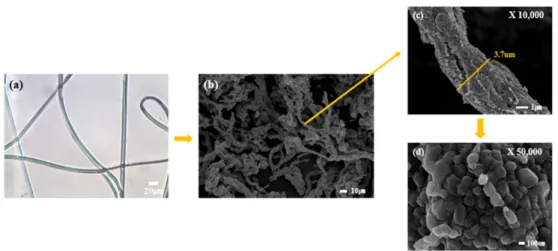
The optical microscope image of the precursor of NCA (a) and the SEM image of the NCA cathode material (b) – (d) are shown in Fig. 1.

The precursor had a smooth fiber shape, and after calcination, it contained nano-sized primary particles and retained its fiber shape. These p r i m a r y p a r t i c l e s w e r e f o r m e d b y t h e carbonization of PVP during the high-temperature heat-treatment process.

15)

Fig. 1. (a) Optical microscope image of the precursor and (b)-(d) SEM images of the NCA nano-bush structure cathode

materials.

(3)

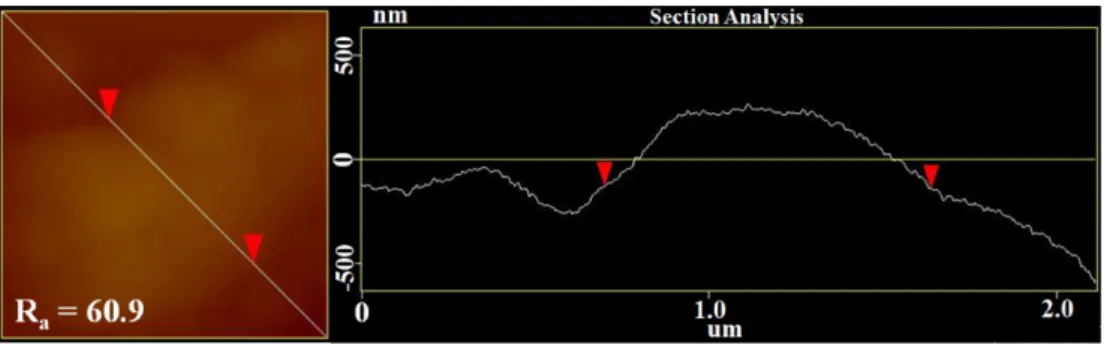
The AFM data demonstrate the roughness of the nanofibers. Fig. 2 shows the atomic force microscopy (AFM) image of the LiNi

0.8

Co

0.15

Al

0.05

nanofiber after calcination at 750

o

C. Section Analysis was performed to confirm the fiber surface morphology and roughness. The roughness (R

a

) value of the nanofiber was 60.9 nm. Primary particles were observed to be generated after calcination, and the surface area was found to increase.

Fig. 3 shows the XRD patterns of NCA after calcination at 750

o

C. All the major diffraction peaks were indexed as a layered oxide lattice based on a hexagonal α-NaFeO

2

–type structure w i t h t h e s p a c e g r o u p R - 3 m . T h e l a t t i c e parameters of the layered oxides were calculated to be a = 2.8654 Å and c = 14.1867 Å. The ratio I(003)/I(104) was calculated to be 1.23, indicating that the crystallinity was lower than that of conventional materials.

11-13)

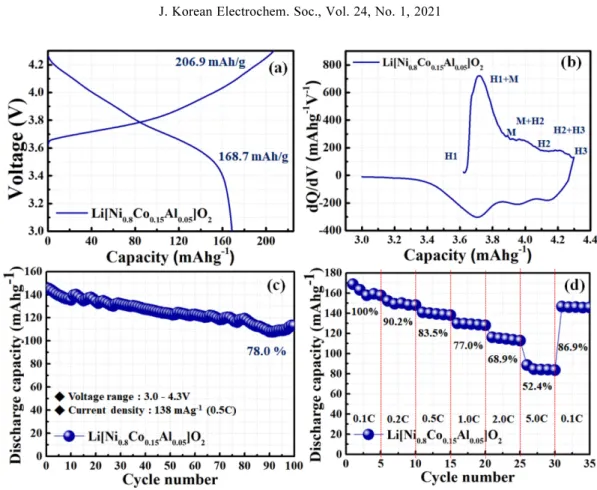
The electrochemical properties were analyzed using Fig. 4 (a, b) shows the initial charge- discharge curves and dQ/dV of NCA electrodes at a current density of 0.1 C, between 3.0 and 4.3 V. The initial discharge capacities of NCA

were 168.7 mAhg

-1

. In the case of conventional NCA, the discharge capacity is approximately 190 mAh/g at 0.1C,

11-13)

indicating that the capacity is higher than in this study. Fig. 4 (c) shows the initial discharge capacity of the NCA electrode. By the 100

th

cycle, NCA had decreased from 145.2 to 113.2 mAhg

−1

. (Capacity retention = 78.0%). Compared to conventional NCA,

11-13)

the Fig. 2. AFM image of NCA nano-bush structure cathode materials.

Fig. 3. XRD pattern of NCA nano-bush structure cathode materials.

Table 1. Lattice parameters of the NCA nano-bush structure cathode materials

Sample a (Å) c (Å) V (Å

3

) I

(003)

/I

(104)

R-factor

Li[Ni

0.8

Co

0.15

Al

0.05

]O

2

2.865 (±0.002) 14.187 (±0.009) 100.87 (±0.016) 1.23 1.02

Table 2. Resistance of the electrolyte solution (R

s

), surface film (R

SEI

) and charge-transfer resistance (R

ct

) of NCA nano- bush structure cathode material by Nyquist circles

Sample R

s

( Ω ) R

f

( Ω ) R

ct

( Ω ) Li diffusion coefficients (D

Li

) Before cycle 2.2 229.2 (±0.4) 2,326.7 (±9.1) 1.3 × 10

-15

cm

2

/s

After 1 cycle 3.1 73.0 (±0.1) 639.6 (±0.9) 6.4 × 10

-14

cm

2

/s

(4)

reduced capacity retention at 0.1C is presumed to be an increase in cation mixing. Fig. 4 (d) shows rate performance of NCA nano-bush structure cathode materials. The result can be found that the discharge specific capacity of NCA nano-bush structure can still remain ~112.8 mAh g

−1

at 5 C.

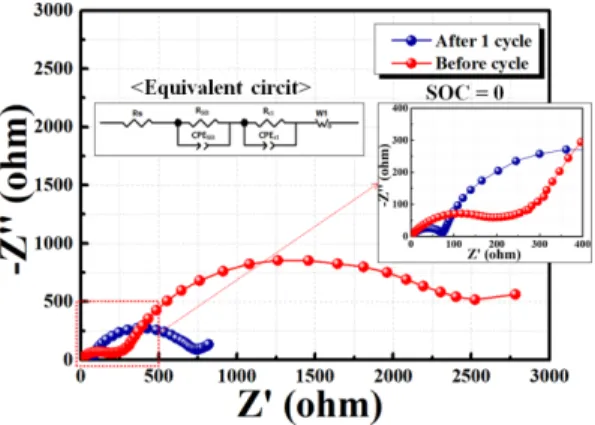
Fig. 5 shows the AC impedance spectra of the NCA. The electrode data show the electrolyte solution resistance (R

s

), solid electrolyte interphase (SEI) resistance (R

SEI

), and charge transfer resistance (R

ct

). Table 2 shows that The R

s

, R

SEI

, and R

ct

of the NCA electrode were measured to be 2.2, 229.2, and 2326.7 Ω , respectively. After the cycle, the R

s

, R

SEI

and R

ct

of the NCA electrode were measured to be 3.1, 73.0 and 639.6 Ω , respectively as shown Table 2. The nano-bush NCA showed significantly reduced

impedance after cycle. This phenomenon shows a large resistance due to the stress of the cathode electrode due to high pressure roll pressing, and then stabilizes after one cycle and the resistance decreases.

EIS can be used to calculate the lithium diffusion coefficient (D

Li

) using the following equations.

Z

re

= R

ct

+ R

s

+ σ ω

-0.5

(1)

D

Li

= 0.5 (2)

where R

ct

is the charge-transfer resistance, ω the angular frequency in the low-frequency region, D the diffusion coefficient, R the gas constant, T the absolute temperature, F the Faraday’s constant, A the area of the electrode surface, and C the

RT AF

2

σ

W

C ---

⎝ ⎠

⎜ ⎟

⎛ ⎞

2

Fig. 4. (a) Initial charge-discharge curves and (b) differential capacity plots versus voltage of NCA nano-bush structure

cathode materials in the voltage range of 3.0–4.3 V at 0.1 C. (c) Discharge capacities versus cycle number of NCA nano-

bush structure cathode materials cycled in the voltage range of 3.0–4.6 V at 1 C. (d) Rate performance of NCA nano-

bush structure cathode materials.

(5)

molar concentration of lithium ions (moles/

cm

−3

).

16,17)

The plot of Z

re

versus the reciprocal square root of the lower angular frequencies is illustrated in Fig. 6. D

Li

of the NCA nano-bush was 6.4 × 10

−14

cm

2

/s and higher than that of traditional NCA particles.

18)

However, further studies are needed on the improved discharge capacity and cycle stability of nano-bush NCA.

4. Conclusions

Novel Li[Ni

0.8

Co

0.15

Al

0.05

]O

2

nano-bush cathode materials were successfully synthesized through an electrospinning method. SEM confirmed that the

nanofiber cathode material was composed of a nano-bush structure. After calcination at 750

o

C, the embossed primary particles were formed on the surface of the nanofiber. The surface area was increased by the primary particles by AFM, and the surface roughness was measured to be 60.86 nm. The cation mixing is lower than that of conventional materials because it is synthesized at low temperatures. The initial charge and discharge capacities were 138.13 mAh/g, and the discharge capacity of the NCA electrode was reduced from 145.2 mAh/g to 113.2 mAh/g by the 100

th

cycle at 0.5 C. The nano-bush structure shortens the Li

+

diffusion path and improves the Li

+

diffusion coefficient. In addition, the formation of primary particles increased the surface area of the nanofibers to increase the reactivity of lithium ions. However, further studies are needed on the improved discharge capacity and cycle stability of nano-bush NCA.

Acknowledgments

This study was supported by financial resources granted by the Ministry of SMEs and Startups, Republic of Korea(S2928638) and the National Research Foundation of Korea (NRF) funded by the Korea government (MSIT, No. 2019R1F1A1057220) and by the Technology Innovation Program (or Industrial Strategic Technology Development Program-Material Parts Technology Development Project) (20003747, Development of high-performance cathode material manufacturing technology through valuable metal upcycling from waste battery and waste cathode material) funded by the Ministry of Trade, Industry & Energy (MOTIE, Korea) and the Korea Agency for Infrastructure Technology.

References

1. Y. Tang, Y. Zhang, W. Li, B. Ma, and X. Chen, Chem.

Soc. Rev. 44, 5926 (2015).

2. S. Xia, J.-J. Liu,., F. Li, F. Cheng, X. Li, C. Sun, and H.

Guo, Ceram Int 44(8), 9294 (2018).

3. L. Qiu, W. Xiang, W. Tian, C-L. Xu, Y-C., Li, Z. G. Wu, and X. D. Guo, Nano Energy, 63, 103818 (2019).

4. W. Liu, P. Oh, X. Liu, M. Lee, W. Cho, S. Chae, Y. Kim, and J. Cho, Chem. Int. Ed. 54, 4440 (2015).

5. P. He, H. Yu, D. Lia, and H. Zhou, J. Mater. Chem. 22, Fig. 5. Impedance plot of NCA nano-bush structure

positive electrode before cell test and after 1 cycles at state of charge = 0.

Fig. 6. Lithium diffusion coefficients of NCA nano-bush

structure positive electrode before cell test and after 1

cycles at state of charge = 0.

(6)

11. H. Ouyang, X. Li, Z. Wang, H. Guo, W. Peng and Z. He, Funct. Mater. Lett., 11 1850083 (2018).

12. M. Liang, D. Song, H. Zhang, X. Shi, Q. Wang, and L.

17. Stoyanova, R., Solid State Ionics, 128(1-4), 1-10. (2000).

18. R. Chen, H. Zhang, J. Xie, Y. Lin, J. Yu, and. L. Chen,

Chem. Electro. Chem, 5(21), 3176-3182, (2018).

수치

Fig. 1. (a) Optical microscope image of the precursor and (b)-(d) SEM images of the NCA nano-bush structure cathode materials.
Fig. 3 shows the XRD patterns of NCA after calcination at 750 o C. All the major diffraction peaks were indexed as a layered oxide lattice based on a hexagonal α-NaFeO 2 –type structure w i t h   t h e   s p a c e   g r o u p   R - 3 m
Fig. 5 shows the AC impedance spectra of the NCA. The electrode data show the electrolyte solution resistance (R s ), solid electrolyte interphase (SEI) resistance (R SEI ), and charge transfer resistance (R ct )
Fig. 6. Lithium diffusion coefficients of NCA nano-bush structure positive electrode before cell test and after 1 cycles at state of charge = 0.

참조

관련 문서

Among the sub-factors of autonomy support coaching behavior, strategy recognition had the most direct influence on the grit of athletes, followed by

For job characteristics sub-factors, while the average of functional diversity was high in graduate school graduates, the average of task importance, job

Second, as a result of the IPA analysis of the sub-factors of audience perception, the factors of entry route were located in the first quadrant, the

Among the five sub-content categories, only in the communication domain 'listening and speaking', the social relations domain 'living together' and the

This study was conducted to recognize the importance of self - management of dance major students and to understand the relationship between the sub -

For the gender, while training and direction, democratic direction, positive regard, and autocratic direction of leadership type sub-factors were perceived as high in

Fourth, for the sub-factors of personality traits according to weight lifters’ education, while there was a high difference in neuroticism and agreeableness

For the sub-factors of selection attributes and customer value according to screen golf course handicap, convenience, professionality, facilities, price,