1. 서 론
플랑크톤은 대부분 물리적, 화학적 교란과 생 태계 변화에 민감하게 반응하기 때문에 수질과 수생태계 건강의 좋은 지표인자이다(Ternjej and
Tomec, 2005). 식물플랑크톤은 수중 생태계에서 일차 생산자이며, 식물플랑크톤 천이 상태를 통해 호수 환경 변화를 파악할 수 있으므로 중요하다.
그러나 식물플랑크톤의 동정은 별 특징 없는 외 형과 다양한 크기와 종 때문에 숙련된 전문가에
PCR-DGGE 방법을 이용한 북한강 수계 호수의 플랑크톤 군집 분석
김 윤 정* / 김 민 경** / 이 상 돈***+
Plankton community analysis in the lake of North-Han river system using PCR-DGGE method
Yoon-Jung Kim* / Min-Kyung Kim** / Sang-Don Lee***+
요약 : 식물플랑크톤의 동정은 숙련된 전문가에게도 어려운 과제이다. 별 특징없는 외형과 다양한 크기와 종은 형태학적으로 구분하기에 어려움이 있다. 본 연구에서는 미생물 군집의 다양성을 분석하는데 효과적인 fingerprinting 기법인 PCR-DGGE 방법을 사용하여 이런 형태학적 동정의 제한점을 보완하고자 하는데 목적이 있다. 5곳의 호수 샘플로부터 2008년 8월 총 46개의 band를 찾을 수 있었고, 2008년 11월 총 26개 band를 찾 을 수 있었다. 이 fingerprint 결과는 각각 다른 샘플링 장소를 비교하는데 용이하였다. 본 연구에서 PCR-DGGE 방법은 북한강 호수들의 플랑크톤 군집의 다양성을 파악하는데 사용되었고, 이 DGGE 기법이 플랑크톤의 동정 기법으로써의 가능성을 검토해보았다.
핵심용어 : 북한강, PCR-DGGE, 진핵생물, 플랑크톤
Abstract : Taxonomic identification of phytoplankton has been a difficult task, even for the experienced taxonomist.
Many non-descript, yet abundant, phytoplanktons do exist without distinguishing features which cause difficulties in morphological identification. Using PCR(polymerase chain reaction)-DGGE(denaturing gradient gel electrophoresis)method, which is known to be a powerfulfingerprinting technique to analyze diversity and dynamics of microbial populations, this study aimed to find the way to overcome the limitation of morphological identification. As a result, a total of 46 bands from samples in five lakes were detected in September and 27 bands in November. Fingerprinting results showed convenient and comparative analyses among each sampling site. In this study, PCR-DGGE method was used to figure out diversity and dynamics of plankton community in the lakes of North-Han River system. Also, the possibility of DGGE technique as an identification tool for phytoplankton was estimated.
Keywords : North-Han river, PCR-DGGE, eukaryote, plankton
+ Corresponding author : [email protected]
* 환경정책평가연구원 연구원, 이화여자대학교 에코과학부 석사
** 이화여자대학교 환경공학과 박사과정, 이화여자대학교 환경공학 석사
*** 이화여자대학교 환경공학과 교수, 환경생태학 박사
게도 매우 어려운 과제이다(Yan et al., 2007).
이러한 형태에 따른 동정의 한계를 극복하기 위 해, 최근에는 분자생물학적 기법을 응용하여 플랑 크톤을 포함하는 미생물의 군집과 기능을 분석하 려는 시도들이 폭넓게 진행되고 있다(Nubel et al., 1997; Hannen et al., 1998; Diez et al., 2001; Barth, 2003; 고소라, 2004; Savin et al., 2004; Yan et al., 2007; Green et al., 2008).
이러한 분자유전학적 기법 중 PCR-DGGE (Polymerase Chain Reaction-Denaturing Gradient Gel Electrophoresis)는 군집의 시공간적 변화에 따른 변동을 분석하는데 가장 많이 사용되는 방법 중 하나이다(Yan et al., 2007). DGGE (Denaturing Gradient Gel Electrophoresis)는 DNA분자의 안 정성이 염기서열에 따라 다르고, 불과 1개의 염기 차이가 안정성의 변화로 전기영동의 이동도에 반 영되는 것을 이용한 변이 검출법이다(Myers et al., 1987). DGGE의 장점은 많은 군집간의 빠른 비교가 가능한 동시에, 자른 band로부터 특정한 계통 정보도 얻을 수 있다는 데 있다(Muyzer et al., 1997).
1993년 Muyzer et al.이 환경 분석에서 최초 로 DGGE를 사용한 이후, 수많은 미생물 생태학 연구에 DGGE가 사용되어 왔다(Muyzer G., 1999). 담수호에서의 식물플랑크톤 군집다양성 연구(Yan et al., 2007), 해양플랑크톤 군집 연구 (Hannen et al., 1998; Savin et al., 2004;
Green et al., 2008) 뿐만 아니라, 우리나라에서 도 PCR-DGGE를 이용한 대청호에서 세균 군집 연구(고소라 외, 2004)와 부영양 연못의 식물플랑 크톤 군집 연구 등이 지속적으로 수행되고 있다 (고소라 외, 2006). 그러나 지금까지 대부분의 연 구가 16S ribosomal RNA(rRNA) gene에 초점이 맞추어져 있고, 상대적으로 진핵생물 군집에 대한 연구는 많지 않았다(Yan et al., 2007).
본 연구에서는 수도권의 상수원으로써 중요한 역할을 담당하고 있는 북한강 수계의 파로호, 춘 천호, 의암호, 소양호, 청평호를 대상으로 플랑크 톤을 채집하여 진핵생물의 PCR-DGGE 분석을 실
시하였다. 본 연구를 통해 다른 호수의 환경에서 플랑크톤 군집이 어떤 양상을 띠고 있는지 살펴보 고, 플랑크톤 동정과 군집변화 측정수단으로써 PCR-DGGE 법의 응용가능성을 검토해 보았다.
2. 재료 및 방법
샘플링 및 DNA 추출
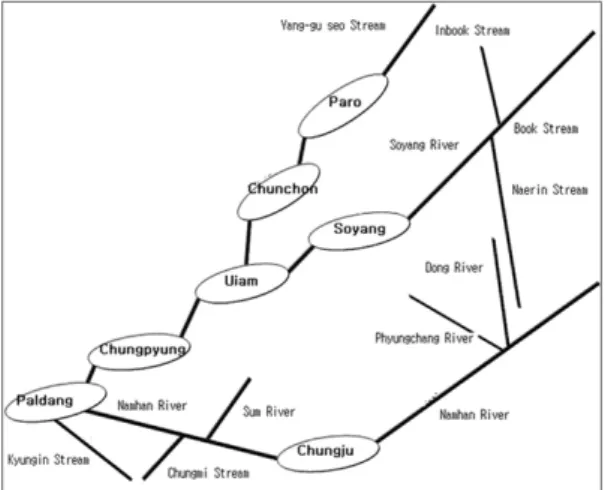
조사 지역은 파로호, 춘천호, 소양호, 의암호, 청평호의 북한강 수계의 5개 호수이다(Fig. 1).
2008년 9월과 2008년 11월 각 5개의 호수에서 세 지점씩 채수하였다. 시료는 수층 별로 채수된 물을 혼합하여 1ℓ를 취하였다. 시료 1ℓ 중 500㎖
는 감압 플라스크를 이용하여 0.22㎛ pore size filter(Millipore system, Bedfold, USA)로 여과 하였다. 여과지에 걸러진 세포들은 3차 증류수와 핀셋을 이용하여 조심스럽게 긁어내어 1.5㎖ 튜브 에 담은 후 원심분리기로 spin-down하여 농축하 였다. 농축된 세포는 DNeasy plant mini kit(Qiagen, Hilden, Germany)를 이용하여 채수 후 24시간 이내 DNA를 추출하여 -20℃에서 보 관하였다.
플랑크톤 중 진핵생물의 종 다양성을 확인하기 위하여, 프라이머는 18S rDNA를 증폭할 수 있는 F1427GC와 R1616을 사용하였다(Table 1). PCR 조성은 3㎕의 주형 DNA와 2㎕의 10X buffer(iNtRON), 1.6㎕의 dNTPs(iNtRON), 1㎕
의 Mg2+(iNtRON), 1㎕의 각각의 primer, 0.2㎕
의 i-star Taq polymerase(iNtRON)를 넣고 dH2O로 총 반응량을 20㎕로 맞추었다. 반응조건 은 94℃에서 denaturing 5분, 94℃부터 시작하여 10번의 touchdown cycle을 진행하였다. 즉 94℃
에서 30초간 denaturing시키고 annealing 온도는 69℃에서 시작하여 60℃에 도달할 때까지 매 cycle마다 1℃ 감소하도록 설정하고, extention을 위하여 72℃에서 1분간 반응시켰다. 그 후 94℃
에서 30초, 59℃에서 30초, 72℃에서 1분씩 18cycle 수행한 후 최종 extention을 위해 72℃
에서 10분간 처리하였다(Yan et al,. 2007). 이 때 이용된 PCR 기계는 PTC-100 (Peltier Thermal Cycler)이며, negative control도 함께 수행하였 다. PCR 증폭산물의 존재와 분자량을 확인하기 위 하여 1.5% agarose gel에서 전기영동하여 DNA band를 확인하였다.
Fig. 1. A schematic view of 5 lakes linked in Han River system
Primer Sequence(5' to 3') Nucleotide position
F1427GCa
CGCCCGCCGCGCCCCGCGCCC GGCCCGCCGCCCCCGCCCCTC TGTGATGCCCTTAGATGTTC TGGG
1427-1453
R1616b GCGGTGTGTACAAAGGGCAG
GG 1616-1637
Table 1. Eukaryotic oligonucleotide sequence and 18S rDNA target site of primers used in this study(Hannen et al., 1998)
a Forward primer with GC clamp attached 5' end b Reverse primer
PCR-DGGE 분석
PCR 산물은 BioRad Dcode System (Bio-Rad Laboratories, Hercules, USA)으로 DGGE를
수행하였다. Denaturing gradient gel은 9%
polyaclamide (37.5:1=acrylamide:bisacrylamide) 에 urea와 formamide denaturing제를 30% ~ 65%까지 농도구배가 연속적으로 형성되도록 첨 가하여 gradient former로 제작하였다. 이와 같이 제작된 gel을 1X TAE buffer (40mM tris, 20mM acetic acid, 1mM EDTA)가 든 60℃의 항온수조 안에 담그고 PCR 증폭산물 20㎕을 loading dye 20㎕과 함께 well에 loading하여 6 0℃, 120V로 15시간 30분 동안 전기영동하였다.
전기영동이 끝난 gel은 EtBr (ethidium bromide)를 포함하는 1X TAE buffer에서 15분간 staining한 후 다시 1X TAE buffer에서 40분간 destaining 하여 UV로 band를 확인하였다.
18S rRNA gene의 염기서열 및 이미지 분석
Denaturing gradient gel 에서 각기 다른 위치 에 존재하는 DNA를 회수하기 위해 band를 잘라 낸 뒤 3차 증류수 100㎕를 첨가하여 voltexing후 15분정도 방치 하였다. 그 후 원심분리(8000rpm, 1분)하여 취한 상등액을 가지고 F1427 (5'-TCTGTGATGCCCTTAGATGTTCTGGG-3') 과 R1616 프라이머를 이용하여 위와 같은 조건의 PCR을 실시하였다. PCR product는 Zymoclean Gel DNA Recovery kit (ZYMO RESEARCH)을 이용하여 gel purification 하였고, Automatic DNA sequencing machine (ABI 3730, PE Applied Biosystems, U.S.A)으로 염기서열을 분 석하였다. sequencing 결과에서 얻어진 염기서열 을 이용하여 NCBI(http://www.ncbi.nlm.nih.gov) 의 GenBank database에서 Blast search를 하여 sequence를 비교, 각각의 종을 확인하였다. Blast search 결과 출력되는 Max score 200이상의 결 과 중에서 최고점의 결과 중 일치율이 97% 이상 으로 검색되는 것만 결과로 출력하였다. 이들 중 속과 종명이 동일한 결과와 해양에서 발견되는 것 으로 보고되는 것은 목록에서 제외하였다.
Denaturing gradient gel상 band의 위치와 강도
는 E-box(Viber Lourmat, France)로 스캔한 사 진을 분석하였다. 군집의 유사성을 분석하기 위해 사진상 각 조사지점의 밴드위치와 개수를 평행 비 교하여 이진수 엑셀파일로 만든 후, XLstat2008 (Addinsoft, U.S.A) 을 이용하여 Dice 유사도를 계산하고, unweighted pair group average를 사 용하여 dendrogram으로 표현하였다.
3. 결 과 DGGE profile 분석
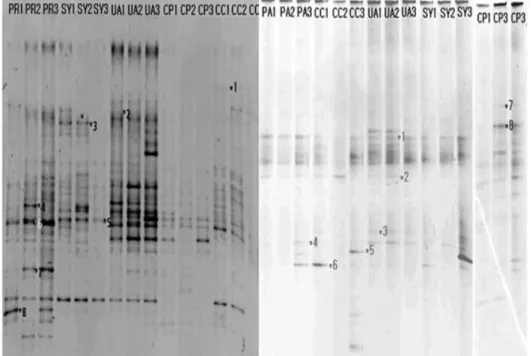
증폭된 PCR 산물을 이용하여 북한강 수계의 진핵생물 군집구조를 살펴본 결과는 Fig. 2와 같 다. 시료로부터 추출한 genomic DNA에서 18S rDNA의 증폭을 통해 획득한 250-300bp사이의
PCR산물을 DGGE에 적용한 결과 gel 상에서 다 양한 위치의 band들을 확인 할 수 있었다. DGGE 에서 분리된 밴드는 각각 다른 개체군을 의미한다 는 점을 고려하면 매우 다양한 개체군이 존재하고 있음을 알 수 있다(Muyzer et al., 1993). 2008 년 9월에는 총 46종의 밴드가 발견되었으며 한 조사지점에만 존재하는 밴드들은 6개로 전체 밴 드의 약 13%를 차지했다. 그러나 낮은 분포를 보 이는 군집의 경우 증폭산물이 적어 검출되지 않을 수 있음을 고려해야 한다(고소라, 2004).
2008년 11월, 한강수계의 7개의 호수에서 채 취한 sample들로부터 DGGE 실험수행 결과, 9월 과는 조금 다른 양상의 band들의 형태를 볼 수 있었다(Fig. 2).
Fig. 2. A Comparison of DGGE profile generated from 5 lakes of North-Han River system in September(left) and November 2008(right). TheDGGE bands were excised and sequenced.
Numbered bands were identified with 97% similarity over maximum score 200 through BLAST search in NCBI website (http://www.ncbi.nlm.nih.gov).(PR1, Paro site1; PR2, Paro site2 PR3, Paro site3; SY1, Soyang site1; SY2, Soyang site2; SY3, Soyang site3; UA1, Uiam site1; UA2, Uiam site 2; UA3, Uiam site 3; CP1, Chungpyung site1; CP2, Chungpyung site2; CP3, Chungpyung site3;
CC1, Chunchon site1; CC2, Chunchon site2; CC3, Chunchon site3) DGGE profile from paldang and chungju in November are not shown.
18S rRNA gene의 sequencing 분석
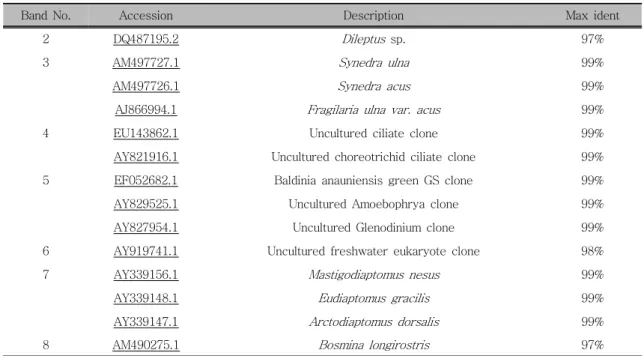
DGGE profile에서 얻은 각 band에 대하여, 어떤 진핵생물에서 유래했는지 알기 위해 DNA를 추출 후 염기서열을 결정하였다. 2008년 9월 호수 샘플에서 3번은 Synedra속 혹은 Fragilaria속과 일치하는 결과를 보였으며 5번은 와편모조류로 나타났다. 2번은 원생동물 Deleptus sp. 4번은 섬모충, 6번은 담수 진핵생물, 7번은 갑각류인 Mastigodiaptomus, Eudiaptomus, Arctodiaptomus 가 같은 정도의 상동성을 보였으며 8번은 지각류인 Bosmina longirostris로 나타났다(Appendix Table 1). 1번 band의 경우 200점 이상의 점수로 95%이상 규조류와 일치하는 검색결과가 다량 검색되었으나 similarity 97% 이상의 결과가 없어 동정목록에서는 제외되었다.
2008년 11월 호수 샘플에서 식물 플랑크톤으로 나타난 band는 1번, 3번, 4번, 7번, 9번, 10번 band였다(Appendix Table 2). 1번의 경우 Fragilaria 속과 Synedra 속이 같은 확률을 나타내었으며, 3번은 Eukaryotic picoplankton, 4번은 은편모조류인 Teleaulax amphioxeia로 동정되었다. 7번의 경우 같은 점수와 확률을 갖는 결과가 너무 많아 같은 속과 종이 포함되는 중복결과를 제외하고, 속은 같지만 종은 다른 결과를 모두 포함하였다. 7번은 형태학적 동정시 확인한 Cyclotella 속과 Stephanodiscus 속 둘
중의 하나로 예상되나 염기서열만으로는
둥근모양의 규조류라는 것 외에는 알 수 없었다.
9번의 경우 Aulacoseira 속으로 동정되었으나 종은 알 수 없었다. 10번은 편모조류인 Cryptomonas 속이었다. 동물플랑크톤은 2번, 5번, 6번, 11번이었는데 2번은 섬모충 Strombidium sp., 5번은 갑각류인 Eudiaptomus gracilis, Arctodiaptomus dorsalis가 같은 확률을 나타내었으며, 6번은 요각류인 Apocyclops royi로 동정되었다. 11번은 요각류인 Cyclops sp.로 동정되었다(Appendix Table 3).
북한강 수계에 대한 호수별 군집 양상
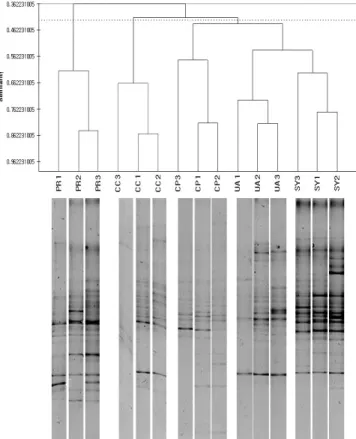
사진 상의 밴드의 수와 위치에 대한 정보를 이 용 조사지점 별 서식지의 특성이 얼마나 다른가를 살펴보기 위하여 군집분석을 실시하였다. 예상대 로 같은 호수의 지점들, 서로 옆에 위치한 호수들 은 대체로 유사한 군집 양상을 보이고 있었다. 그 러나 파로호와 춘천호의 경우 플랑크톤 군집에 있 어 독립적인 형태를 띠고 있는 것으로 나타났다.
파로호의 중층 방류수를 받는 춘천호는 파로호와 독립적인 특성을 보이는 반면 소양호의 중층 방류 수를 받는 의암호는 소양호와 어느 정도 군집유사 성을 보였다(Fig. 3).
북한강 수계에 대한 시기별 조사결과 비교
북한강 수계 5개 호수에 대한 2008년 9월과 11월의 조사지점별 PCR-DGGE band의 개수를 비교해 보았다. 먼저 9월과 11월의 PCR-DGGE band의 숫자는 많은 차이를 보였다(Fig. 4). 9월 의 PCR-DGGE profile의 경우 46개, 11월의 PCR-DGGE profile에서는 총 27종의 밴드가 발 견되었다. 이와 같은 band 숫자의 감소는 빛의 세기와 수온의 저하에 따른 플랑크톤의 전체적인 감소에 따른 것으로 보인다. 11월 sample의 PCR-DGGE band sequencing 결과 식물플랑크 톤은 대부분 규조류로 나타났다(Appendix Table 2). 온대지방의 호수의 경우 수온이 낮아지는 가 을에는 규조류가 우점하는데, 이는 성층의 파괴에 따른 혼합층의 깊이가 점차 증가함에 따른 영양염 류 공급 및 수중의 빛 투과도 감소와 같은 물리·
화학적 변화에 규조류가 잘 적응하기 때문이다(김 범철 등 1999). 북한강 5개 호수의 2004년부터 2006년까지 식물플랑크톤을 살펴본 자료에 의하 면 규조류는 5개 호수 모두에서 적게는 50% 많 게는 80%이상의 점유율을 가지고 있으며, 대부분 의 호수에서 9월을 기점으로 규조류의 현존량이 급격히 증가했다가 빛이 감소하는 11월 사이 급 격히 감소하는 것을 볼 수 있다(한강물환경연구소
Fig. 3. Cluster analysis on plankton community of 5 lakes of North-Han River system in September 2008 (PR1, Paro site1; PR2, Paro site2; PR3, Paro site3; SY1, Soyang site1; SY2, Soyang site2; SY3, Soyang site3; UA1, Uiam site1; UA2, Uiam site 2; UA3, Uiam site 3; CP1, Chungpyung site1; CP2, Chungpyung site2; CP3, Chungpyung site3; CC1, Chunchon site1; CC2, Chunchon site2; CC3, Chunchon site3)
0 5 10 15 20 25 30
Site 1
Site 2
Site 3
Site 1
Site 2
Site 3
Site 1
S ite 2
S ite 3
Site 1
S ite 2
Site 3
Site 1
S ite 2
Site 3
Paro S oyang Uiam Chungphyung Chunchon
Sampling sites
Number of band
18S rDNA P CR-DGGE bands in September 18S rDNA P CR-DGGE bands in November
Fig. 4. Comparison between number of PCR-DGGE in September and November 2008
2007). 9월과 11월의 PCR-DGGE profile 사진은 이러한 양상을 반영하고 있다고 생각된다.
4. 고 찰
DGGE는 개개의 미생물군의 생리학적 특성을 살피지 않더라도 종합적이거나 특이적인 미생물 군락의 다양성과 역동성을 살펴볼 수 있는 신뢰성 있고 재현성 있는 도구로써 미생물 생태학분야에 서 활발히 사용되어 왔다. 또한 DGGE 기법의 강 력한 장점은 바로 T-RFLP와 같은 다른 fingerprinting 기법으로는 불가능한, 잘려진 band 를 sequencing 하여 군락의 구성원을 밝힐 수 있 다는 것이다. 그러나 그 동안의 연구는 원핵생물 인 16S rRNA gene을 중심으로 한 것으로, 진핵 생물의 다양성을 밝히려 PCR-DGGE 를 이용한 연구는 상대적으로 드물었다.
본 연구의 경우 PCR-DGGE profile의 band를 절단 후, sequencing하여 진핵생물인 플랑크톤 종 동정을 시도하였고, 그 결과를 이용하여 호수 별 유사성을 검토하고 시기별 비교를 해보았다.
PCR-DGGE방법은 공간적으로 떨어진 군집을 한 눈에 파악하게 해주었고 시기별 비교도 쉽게 가능 하게 하였다. 본 연구의 결과는 9월 군집보다 빛 이 감소하는 11월 군집이 더 적게 나타나는 기존 의 연구결과와 같았다(정유경 2007). 그러나 본 연구에서 band sequencing을 통한 종 수준의 동 정은 제한적이었다. 북한강 수계에 대한 9월 DGGE profile의 군집분석을 통해 동일 호수간의 군집 유사성을 확인하였고 파로호와 춘천호의 군 집의 경우 독립적인 양상을 띠고 있는 것을 볼 수 있었다.
향후 종 동정을 위한 PCR-DGGE 실험에 있어 서는 다음과 같은 사항의 보완이 요청된다. 먼저 정밀한 분석을 위해서는 Cloning을 거치거나, 형 태학적 동정 등 다른 기법과의 결합이 필요할 것 으로 보인다. Nubel et al.(1999)은 8곳의 호염성 미생물 매트에서 호기적 광합성 세균의 다양성을 정량화하는데 DGGE를 사용하면서, 다른 서열이
포함될 수 있는 밴드의 진하기를 계측하는 대신 밴드의 풍부함(richness)으로 계산하였고 형태적 동정과 같은 다른 테크닉을 통해 DGGE 결과를 보완한 결과를 낸 바 있다(Nubel et al., 1999).
두 번째로, Primer의 길이를 200bp에서 500bp 정도로 길이를 늘림과 동시에 한국의 담수조류에 맞는 primer를 개발해야 할 필요성이 있다고 생 각된다. 본 연구에서 찾아진 식물플랑크톤의 염기 서열의 경우 데이터베이스의 부족으로 similarity 가 높은 염기서열을 찾기 어려웠다. 그리고 similarity가 높은 검색결과들의 경우 97%가 넘는 상동성에도 불구하고, 속은 일치하지만 수많은 종 이 존재하는 경우가 많았다. 그 원인으로는 미생 물 자체의 특성에 의해 핵산 추출과정에서 발생하 는 실험적 오차의 가능성, PCR증폭 중 mismatch 에 의한 오류가능성(Amann et al., 1995)이 있을 수 있으나, 주요한 원인은 서열차이가 작고 길이 가 짧기 때문인 것으로 생각된다.
본 연구는 지금까지 대부분의 연구가 16S rRNA gene에 초점이 맞추어져 있고, 상대적으로 진핵생물 군집에 대한 연구가 많이 이루어지지 않 은 상황에서, 우리나라 한강 수계의 5개 호수 플 랑크톤의 비교 및 시기별 비교를 PCR-DGGE를 통해 시도해 보았다. PCR-DGGE는 지역 및 시기 별 차이가 있는 샘플의 경우 비교가 용이하였으 나, 다른 보완적인 방법과 병행하면 좀 더 정밀한 결과를 얻을 수 있을 것으로 사료된다.
사 사
본 연구는 LTER(16000-16001-2). 장기생태 및 KEITI (403-112-005) 생태계복원 관리기술, Green-river 연구사업단에 의해 지원되었습니다.
참고문헌
고소라, 안치용, 최애란, 이정숙, 김희식, 윤병대, 오희목. 2004 DGGE를 이용한 대청호수화 발 생시기의 세균군집 분석. 한국미생물학회지
40(3):205-210.
고소라, 안치용, 정승현, 김희식, 오희목. 2006.
부영양 연못에서 초음파 작동에 따른 식물플 랑크톤의 군집 변화. 한국 환경생물학회지 24(3):221-229
김범철, 전만식, 황순진. 1999 소양호 동식물플랑 크톤의 계절 변동. Korean Journal of Limnology. 32(2):127-134.
정유경. 2007. 북한강 수계 상류호수와 하류호수 의 식물플랑크톤 군집 변동 (파로호, 춘천호, 의암호, 청평호). 석사학위논문. 강원대학교 한강물환경연구소. 2007 북한강 수계 호소의 생
태계 구조조사, 한강물환경연구소.
Amann, R., Ludwig W. and Schleiffer K. H.
1995. Phylogenetic identification and in situ detection of individual microbial cells without cultivation. Microbiological Reviews 59:143-169
Barth, H. J. 2003. The influence of cyanobacteria on oil polluted intertidal soils at the Saudi Arabian Gulf shores. Marine Pollution Bulletin 46(10):1245-1252 Diez, B., Pedros-Alio C., Marsh T. L. and
Massana R. 2001.Application of denaturing gradient gel electrophoresis (DGGE) to study the diversity of marine picoeukaryotic assemblages and comparison of DGGE with other moleculartechniques. Applied and Environmental Microbiology 67(7):2942-2951 Green, S. J., Blackford C., Bucki P., Jahnke L.
L. and Prufert-Bebout L. 2008. A salinity and sulfate manipulation of hypersaline microbial mats reveals stasis in the cyanobacterial community structure. ISME Journal. 2(5):457-470
Hannen, E. J, Agterveld M., Herman G. J. and Laanbroek H. J. 1998.Revealing genetic diversity of eukaryotic microorganisms in aquatic environments by Denaturing Gradient
Gel Electrophoresis. Journal of Phycology.
34(2):206-213
Muyzer, G., de Waal E.C., and Uitterlinden A.
G. 1993.Profiling of complex microbial populations by denaturing gradient gel electrophoresis analysis of polymerase chain reaction-amplified genes coding for 16S rRNA fragments. Applied and Environmental Microbiology 59:695-700 Muyzer G., Brinkhoff T., Nubel U., Santegoeds
C., Schafer H. and Wawer C. 1997.
Denaturing gradient gel electrophoresis (DGGE) in microbial ecology. In:
AkkermansADL, van Elsas JD&de Bruijn FJ (Eds) Molecular Microbial Ecology Manual (3.4.4: pp. 1–27) Kluwer Academic Publishers, Dordrecht, The Netherlands Muyzer G. 1999. DGGE/TGGE a method for
identifying genes from natural ecosystems.
Current Opinion in Microbiology 2:317-322 Myers, R. M., Maniatis T. and Lerman L. S.
1987. Methods in Enzymology. 68:183-191 Nubel, U., Garcia-Pichel F. and Muyzer G.
1997. PCR primers to amplify 16S rRNA genes from cyanobacteria. Appled and Environmental Microbiology. 63(8):3327-3332 Nubel, U., Garcia-Pichel F., Kuhl M. and
Muyzer G. 1999 Quantifying microbial diversity morphotypes, 16S rRNA genes, and carotenoids of oxygenic phototrophs in microbial mats. Appled and Environmental Microbiology. 65:422-430
Savin, M. C., Martin J. L., LeGresley M., Giewat M. and Rooney-Varga J. 2004.
Plankton Diversity in the Bay of Fundy as Measured by Morphological and Molecular Methods. Microbial Ecology 48(1):51-65 Ternjej, I. and Tomec M. 2005.Plankton
community and related environmental
factors in the oligotrophic Lake Vrana.
Periodicum Bilogorum 107:321-328
Yan, Q., Yu Y. H., Feng W. S., Deng W. N.
and Song X. H. 2007.Genetic Diversity of Plankton Community as Depicted by PCR-DGGE Fingerprinting and its Relation to Morphological Composition and
Environmental Factors in Lake Donghu.
Microbial Ecology 54(2):290-297
○ 논문접수일 : 2012년 05월 11일
○ 심사의뢰일 : 2012년 05월 24일
○ 심사완료일 : 2012년 08월 30일
Appendix
Band No. Accession Description Max ident
2 DQ487195.2 Dileptus sp. 97%
3 AM497727.1 Synedra ulna 99%
AM497726.1 Synedra acus 99%
AJ866994.1 Fragilaria ulna var. acus 99%
4 EU143862.1 Uncultured ciliate clone 99%
AY821916.1 Uncultured choreotrichid ciliate clone 99%
5 EF052682.1 Baldinia anauniensis green GS clone 99%
AY829525.1 Uncultured Amoebophrya clone 99%
AY827954.1 Uncultured Glenodinium clone 99%
6 AY919741.1 Uncultured freshwater eukaryote clone 98%
7 AY339156.1 Mastigodiaptomus nesus 99%
AY339148.1 Eudiaptomus gracilis 99%
AY339147.1 Arctodiaptomus dorsalis 99%
8 AM490275.1 Bosmina longirostris 97%
Table 1. Identity of the bands obtained from DGGE profile of 5 lakes of North-Han River system in September 2008
Band No. Accession Description Max ident
1 AM497727.1 Synedra ulna 99%
AM497726.1 Synedra acus 99%
AJ866994.1 Fragilaria ulna var. acus 99%
3 AY642714.1 Uncultured eukaryotic picoplankton clone 99%
4 AJ421146.1 Teleaulax amphioxeia 100%
7 DQ514899.1 Cyclostephanos invisitatus 99%
DQ514898.1 Cyclostephanos tholiformis 99%
Table 2. Plankton identified from DGGE profile of 7 lakes (including chungju and paldang lake) of Han River system in November 2008
Band No. Accession Description Max ident
DQ514901.1 Cyclotella bodanica 99%
AY485499.1 Cyclotella cryptica 99%
DQ514859.1 Cyclotella distinguenda 99%
DQ514853.1 Cyclotella menegheniana 99%
AF525672.1 Detonula confervacea 99%
DQ514905.1 Discostella pseudostelligera 99%
DQ514903.1 Discostella stelligera strain 99%
AB353772.1 Peridiniopsis cf. kevei diatom endosymbiont 99%
AB353773.1 Peridiniopsis penardii diatom endosymbiont 99%
DQ396524.1 Skeletonema costatum 99%
AJ535166.1 Skeletonema subsalsum 99%
DQ514895.1 Stephanodiscus agassizensis 99%
DQ514896.1 Stephanodiscus binderanus 99%
DQ093370.1 Stephanodiscus hantzschii 99%
DQ514911.1 Stephanodiscus minutulus 99%
DQ514906.1 Stephanodiscus neoastraea 99%
DQ457009.1 Stephanodiscus niagarae 99%
DQ514909.1 Stephanodiscus reimerii 99%
DQ514910.1 Stephanodiscus yellowstonensis 99%
AF374478.2 Thalassiosira guillardii 99%
AJ810858.1 Thalassiosira tenera 99%
9 AY569584.1 Aulacoseira granulata 98%
AY569583.1 Aulacoseira ambigua 98%
AJ535187.1 Aulacoseira nyannensis 98%
10 EU163587.1 Cryptomonas pyrenoidifera 98%
Table 2. Plankton identified from DGGE profile of 7 lakes (including chungju and paldang lake) of Han River system in November 2008 (continued)
Band No. Accession Description Max ident
2 AY919741.1 Uncultured freshwater eukaryote clone 97%
AY919679.1 Uncultured freshwater eukaryote 97%양식의 맨 아래
AY143564.1 Strombidium sp. 97%
5 AY339156.1 Eudiaptomus gracilis 99%
AY339148.1 Arctodiaptomus dorsalis 99%
6 AY626997.1 Apocyclops royi 99%양식의 맨 아래
11 EF532821.2 Cyclops insignis 99%
DQ107580.1 Thermocyclops sp. 99%
DQ107579.1 Cyclops sp. 99%
Table 3. Zooplankton identified from DGGE profile of 5 lakes of North Han River system in November 2008