* 정회원 ․ 연세대학교 사회환경시스템공학부 석사후연구원 (Yonsei University ․ [email protected])
** 연세대학교 사회환경시스템공학부 석사과정 (Yonsei University ․ [email protected])
*** 한국환경정책·평가연구원 기후융합연구실 연구위원 (Korea Environment Institute ․ [email protected])
**** 정회원 ․ 교신저자 ․ 연세대학교 사회환경시스템공학부 조교수 (Corresponding Author ․ Yonsei University ․ [email protected])
Received September 6, 2017/ revised September 12, 2017/ accepted September 19, 2017
Copyright ⓒ 2017 by the Korean Society of Civil Engineers
This is an Open Access article distributed under the terms of the Creative Commons Attribution Non-Commercial License (http://creativecommons.org/licenses/by-nc/3.0)
DOI: https://doi.org/10.12652/Ksce.2017.37.6.0965
www.kscejournal.or.kr
기후 및 사회· 경제 변화를 고려한 한강 유역의 물이용 취약성 평가
박혜선*ㆍ김혜진**ㆍ채여라***ㆍ김연주****
Park, Hyesun*, Kim, Heey Jin**, Chae, Yeora***, Kim, Yeonjoo****
Assessment of Water Use Vulnerability Considering Climate and Socioeconomic Changes in Han River Watershed
ABSTRACT
Assessment of vulnerability of water use to climate change include a variety of climate change scenarios. However, in most future vulnerability studies, only the climate change scenarios are used and not the future scenarios of social and economic indicators.
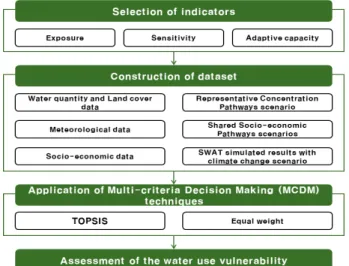
Therefore, in this study, we applied the Representative Concentration Pathway (RCP) climate change scenario and Shared Socioeconomic reference Pathway (SSP) developed by IPCC to reflect the future. We selected indicators for estimating the vulnerability of water use, and indices were integrated with a multi-criteria decision making approach – Technique for Order of Preference by Similarity to Ideal Solution (TOPSIS). The indicator data utilized national statistics and reports, social and economic scenarios, and simulated results from the Soil and Water Assessment Tool (SWAT) model which reflects climate change scenario. Finally, we derived the rankings of water use vulnerability for the short-term future (2020) and mid-term future (2050) within the Han River watershed.
Generally, considering climate change alone and considering climate change plus social and economic changes showed a similar spatial distribution. In the future scenarios, the watershed rankings were similar, but showed differences with SSP scenario in some watersheds.
Therefore, considering social and economic changes is expected to contribute to more effective responses to climate change.
Key words : Water use vulnerability, Climate change, Socioeconomic change, TOPSIS 초 록
수자원 분야에서 기후변화 취약성 평가 연구는 미래를 반영하는 기후변화 시나리오를 다양한 방법으로 적용하고 있다. 하지만 대부분의 미래 취약성 평가 연구에서 미래 사회 및 경제 변화는 반영되지 않고 있다. 이에 본 연구에서는 통합적인 미래 시대상을 반영하기 위하여 Intergovernmental Panel on Climate Change (IPCC) 에서 개발한 Reprensentative Concentration Pathway (RCP) 기후 변화 시나리오 와 함께 공동 사회·경제 경로 시나리오(Shared Socioeconomic reference Pathway, SSP)를 적용하고자 하였다. 취약성 평가는 현재 상황 뿐 아니라 미래 시나리오를 반영하기에 적절한 지표를 선정하고 다기준 의사결정기법인 TOPSIS (Technique for Order Performance by Similarity to Ideal Solution) 를 활용하여 각 지표를 통합하는 방법으로 진행하였다. 지표 자료는 국가 통계 및 보고서, 기후변화 시나리오가 반 영된 SWAT (Soil and Water Assessment Tool) 모형의 모의 결과, 사회·경제 시나리오를 활용하였으며, 최종적으로 주요 수계인 한강 유역 의 단기 미래(2020)와 중기 미래(2050)에 대한 중권역별 물이용 취약성 순위를 도출하였다. 전반적으로 기후변화만 적용한 결과와 사회·경제 변 화를 함께 적용한 결과는 유사한 공간분포를 보였으나, SSP 시나리오에 따라 일부 유역에서 차이를 보였다. 미래 시나리오 적용 시 유역의 순위 변동성이 유사하게 나타났으나 일부에서는 SSP 시나리오 적용 유무에 따른 차이를 확인할 수 있었다. 본 연구에서 기후변화 취약성 분석 시 사 회·경제 시나리오 활용가능성을 확인하였고, 이에 사회·경제 변화를 고려하는 것이 보다 효과적인 기후변화 대응에 도움이 될 것으로 판단된다.
검색어 : 물이용 취약성, 기후변화, 사회경제변화, TOPSIS
Water Engineering
수공학